 Скачать презентацию DPS 202 FUNDAMENTALS OF SUPPLY CHAIN MANAGEMENT September-December
84b805abaf79e8f4a0e008e0a3251f96.ppt
- Количество слайдов: 83



DPS 202 FUNDAMENTALS OF SUPPLY CHAIN MANAGEMENT September-December 2012 By Thomas Ombati Department of Management Science School of Business University of Nairobi
COURSE OBJECTIVES This is an introductory course into the field of Procurement and Supply Chain Management. The objectives of this course are to provide students with knowledge in the key areas in supply chain management and to provide a solid understanding of the basic terms, concepts, objects and relationships involved in managing supply chains. 15 March 2018 2
COURSE CONTENT 1. Introduction Defining supply chain Why SCM; Value Addition in SCs; Components of SC; Advantages of Using SCM Approach 2. Supply chain relationship with other functions Operations; Marketing; Procurement; Accounting/Finance 15 March 2018 3
CONTENT – Cont. . . 3. Supply chain management storage and warehousing. 4. Transportation Role in SC; Modes of Transportation, Their Advantages an Limitations; Trade offs in Transporter Selection; Empty Backhaul Management 5. Materials handling Importance; Principles and Devices 15 March 2018 4
CONTENT – Cont. . . 6. Inventory Management Methods of Managing; In Transit Inventory; Distributor Managed Inventory 7. Purchasing Management Objectives of Purchasing; Changing Nature of Purchasing; Methods of Purchasing; Supplier selection and Evaluation; Green Purchasing 15 March 2018 5
CONTENT – Cont. . . 8. Location Decisions Locating Warehouses; Supplier Location 9. Information flows in Supply Chains. Assessment Assignments & Class Projects 15%, CATs 15% and 70% for the Final Exam 15 March 2018 6
INTRODUCTION You get into a popular supermarket in Nairobi to pick a certain item. "It's out of stock !, " a supermarket employee tells you. "We'll get a shipment tomorrow. Actually, several people have been looking for it. . . must be a popular item, " s/he adds. Why was this product out-of -stock? Especially if there was high demand for it, as the store employee indicated. 15 March 2018 7
COMPONENTS OF A SUPPLY CHAIN This example highlights a problem that occurs in supply chain management - the focus of this course (DPS 202). So, if that item had been in the s/mkt, how would it have gotten there? - it would have transported the item producer's supply chain. Then you would have been able to enjoy it, instead of going home with some other brand that you really didn't want. 15 March 2018 8
COMPONENTS – Cont. . . A typical supply chain consists of five main components: Suppliers. Source of raw materials, component parts, semi-manufactured products, and other items that occur early in the supply chain - unfinished or non-consumable products. 15 March 2018 9
COMPONENTS – Cont. . . Manufacturers. Makers of products. Many consider them to be the heart of the supply chain. Actually, both suppliers and manufacturers are producers of products. Suppliers produce components or subassemblies, while manufacturers perform the task of final assembly or product integration. 15 March 2018 10
COMPONENTS – Cont. . . Distributors. Responsible for the packaging, storing, and handling of materials at receiving docks, warehouses, and retail outlets. Retailers. These are the manufacturer's customers - the stores that buy the actual products. Consumers. This is you - the person who goes into a s/Mkt and buys the product. 15 March 2018 11
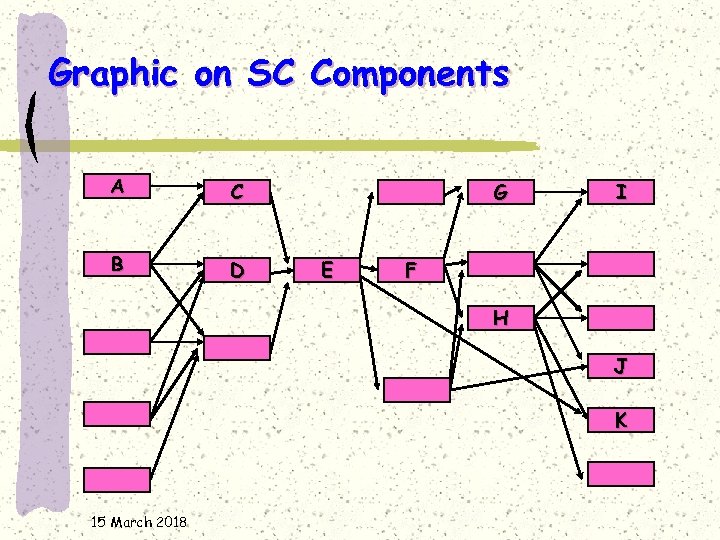
Graphic on SC Components A C B D G E I F H J K 15 March 2018
COMPONENTS – Cont. . . In the centre, E, is “the operation”. The operation could be a manufacturing company, a retailer or a public sector institution such as a university or hospital. It is an organization that is being considered at any given point in time. It is therefore a standpoint. Rather like being in a river, upstream and downstream are relative concepts depending upon your position in the river. 15 March 2018 13
COMPONENTS – Cont. . . Lets assume that the operation is a motorcar manufacturer. From the manufacturer’s standpoint the suppliers that it has direct dealings with are known as “first-tier” suppliers, shown in the diagram as C and D. These suppliers could be manufacturers or distributors of major assemblies, chassis, transmission systems etc. These suppliers in turn need to purchase many inputs in order to make their products. 15 March 2018 14
COMPONENTS – Cont. . . Their suppliers are known as “second-tier” suppliers, shown in the diagram as A and B. These goes on & on ‘upstream’ to the raw material (initial) supplier. On the downstream side, the manufacturer sells its cars to first-tier customers (dealers) like F. These dealers sell the cars to small dealers, G and H, (secondtier customers) who in turn sell to final customers, I, J and K (third-tier customers). 15 March 2018 15
COMPONENTS – Cont. . . The diagram is a simplification of reality. In reality the chain resembles a web or network with many different tributaries. For instance C and D would be supplying other car manufacturers. All the members of a SC rely upon the demand from the final consumer. In some SCs the bargaining power lies downstream – eg fast moving consumer goods (FMCG) retailers, in other SCs, the power lies upstream – eg petroleum products. 15 March 2018 16
COMPONENTS – Cont. . . Identifying where this power lies is very important. Without this power, it would be very difficult to influence the other members of SC either up or downstream. SCs vary in length. Some are very short (Dell). A farmer who sells her produce directly to consumers by the road side is an example of a short “no-tier” SC. FMCGs are likely to involve many tiers. 15 March 2018 17
Other players in SC There are many other players in the supply chain who also play valuable and important roles in getting products to the end consumer. For example, consider the facilitating roles outside parties, such as the following, play in important areas of the supply chain: 15 March 2018 18
Other players – Cont. . . Logistics providers. Perform individual tasks such as transporting products from one place to another, or operating strategically placed warehousing or distribution operations. Contract manufacturers. As firms specialize and focus on core competencies, the use of contract manufacturers has become a well accepted practice. 15 March 2018 19
Other players – Cont. . . Information-based service providers. Refers to firms which have either software or other information technologies which assist with the activities of supply chain planning. They may include IT firms, which provide and manage systems for individual firms and for overall supply chains. 15 March 2018 20
Other players – Cont. . . Financial institutions. Includes banks and other financial institutions, which provide supply chain services such as freight payment and billing, inventory financing, and inter-firm transaction management. Services may be for individual firms or combinations of firms in the supply chain. 15 March 2018 21
Definitions SC consists of the series of activities and organizations that items move through on their journey from initial suppliers to final customers (Donald Waters, 2003) SC is a network of organizations that are involved, through up and downstream linkages, in the different process and activities that produce value in the form of products and services to the consumer (Lysons & Farrington, 2006) 15 March 2018 22
Definitions – Cont. . . Supply Chain Management (SCM) – Is the mgt of up and downstream r/ships with suppliers and customers to deliver superior customer value at less cost to the supply chain as a whole. SCM – is a network of connected and interdependent organizations mutually and co-operatively working together to control, manage and improve the flow of items and information from suppliers to 15 end 2018 March users. 23
IMPORTANCE OF SCM Supply chains are sometimes referred to as value chains. The concept reflects that value is added and services progress through supply chain. Supply chain components and demand components must be considered if supply chain is to be complete. 15 March 2018 24
IMPORTANCE– Cont. . . IMPORTANCE Demand component of the chain starts at a point where organizations output starts or is delivered to its immediate customers and ends with the final customer in the chain. Supply chain management is considered to a large extent with efficiency of supply chain and supply chain responsiveness. 15 March 2018 25
IMPORTANCE– Cont. . . IMPORTANCE SC efficiency focuses on minimizing the costs of the supply chain. SC responsiveness ensures customers’ requirements are met. Some of the dimensions of SC responsiveness include: Offering timeliness; Reliability; Flexibility; After sale service; Giving the right quantities; Offering credit facilities 15 March 2018 26
IMPORTANCE– Cont. . . IMPORTANCE SCM is concerned with efficient integration of suppliers, factories, and warehouses so that merchandise is produced and distributed in right quantities, locations and time. This ensures: The total systems cost is minimized Satisfies customer requirements 15 March 2018 27
IMPORTANCE – Cont. . . Acts as a link in business strategies Ensures focus and scope Advices an organization whether to make (manufacture)or purchase Enables to monitor suppliers Ensures performance of suppliers is improved 15 March 2018 28
RELATIONSHIP BETWEEN SCM & OTHER FUNCTIONS Marketing Supply chain mgt is an important area of business practice and scholarship that overlap with the discipline of marketing and marketing mgt. The success of org depend on their ability to satisfy customers. Since market orientation is supposed to be truly related to organization success, the SC strategy helps to facilitate mkt orientation. 15 March 2018 29
RELATIONSHIP – Cont. . . Effective SCM is an important element in meeting customer needs. Market orientation affects mgt of firm’s relationships and SCs. The marketing and sales force is well positioned to implement, facilitate and coordinate SC activities. Objective of marketing is creating exchanges and output for its 15 March 2018 30
RELATIONSHIP – Cont. . . customer satisfaction. SC function is also concerned with SC responsiveness which focuses on customer satisfaction. Marketing concept consists of these pillars. Customer focus Coordinating the marketing function Profitability of an organization 15 March 2018 31
RELATIONSHIP – Cont. . . Finance Many company executives have the traditional vision of supply chain and do not always realize opportunities that the different actions of supply chain could bring to an organization. Efficient and responsive supply chains lead to maximum productivity of any organization. 15 March 2018 32
RELATIONSHIP – Cont. . . Supply chain activities have a cost relationship with financial performance of an org. They affect profit and loss statements, balance sheets and cost of capital. Single opportunities exist for a competent SCM which includes reduction of expenses, generation of better returns in investments and improvements of profit margins. 15 March 2018 33
RELATIONSHIP – Cont. . . Controlling of SCM will lead to improved profit margins. Improved collaborations between finance and other business and supply chain function is necessary to improve performance of an organization. 15 March 2018 34
RELATIONSHIP – Cont. . . Procurement Supply chain management has a direct relationship with procurement. Supply chain management is an overall term that encompasses various activities procurement being one of them. Procurement is a subset of SCM. 15 March 2018 35
RELATIONSHIP – Cont. . . An org should follow proper steps in a contract within the procurement cycle in order to improve understanding of its own supply chain and to establish the right environment for good supply chain mgt. 15 March 2018 36
RELATIONSHIP – Cont. . . Operations Management SCM uses the cross functional approach including managing movement of raw materials into an org, certain aspects of internal processing of materials into finishing goods and movement of finished goods out of the organization. Firms strive on competencies and become more flexible, reduce their ownership of raw materials and distribution channels. 15 March 2018 37
RELATIONSHIP – Cont. . . Operations mgt focuses on the quality dimensions which include timeliness, flexibility, accessibility and delivery of the right quantity at the required time. This quality dimensions require knowledge of operations mgt. if they are well coordinated, they will result into a positive outcome in the SCM. 15 March 2018 38
RELATIONSHIP – Cont. . . These functions are increasingly being outsourced. Operations mgt is critical in this respect. The effect is to increase number of firms involved in satisfying customer demands, while reducing mgt control of the daily logistics operations. Less control and more supply chain partners lead to the creation of SCM relationships. 15 March 2018 39
RELATIONSHIP – Cont. . . In summary; The purpose of SCM is to improve trust and collaboration among supply chain partners thus improving inventory visibility and reliability in the inventory movement. 15 March 2018 40
Supply Chain Activities There are several main activities that cut across the components of the supply chain, as well as link them together. They include: Warehousing, Purchasing , Order processing, Demand planning, Inventory management, Transportation, and Customer service. 15 March 2018 41
WAREHOUSING A warehouse is a hub in logistics network where goods are temporarily stored or re -routed to different channel in the network. In this respect warehouse are used for supply, handling/transshipment and distribution. Supply warehouses Usually part of the production operation and are used to store raw materials, 15 March 2018 42
Warehousing – Cont. . . auxiliary supplies and other resources needed for production as well as finished products and finished goods used during this particular season. Transshipment warehouses Goods are housed for short periods between their transfers from one means of transportation to another. They are frequently operated by logistics providers and retail companies. 15 March 2018 43
Warehousing – Cont. . . Distribution warehouses Classified into central, regional and local distribution w/h depending on the area they serve. Central distribution w/h are generally referred to as central w/h while decentralized regional or local distribution w/h are called supply or delivery warehouses. In delivery w/h, goods from production are stored before being delivered to customers. goto 51 15 March 2018 44
Further Classification of Warehouses Classification can also be done on the basis of either the ownership, structure or service rendered. On the basis of ownership Private warehouses Public government warehouses Bonded warehouses Co-operative warehouses 15 March 2018 45
Private Warehouses owned and managed by manufacturers or traders to store exclusively their own stock of goods. Generally they are constructed by farmers near their fields, by wholesalers and retailers near their business centres and by manufacturers near their factories. Their design and the facilities provided therein are according to the nature of products to be stored. 15 March 2018 46
Public Warehouses They store goods for the general public. Any one can store their goods in the warehouse on payment of rent. An individual, partnership or company may own these warehouses. To start such a warehouse, a license from the govt is required. The govt also regulates the functions and operations of these warehouses. Mostly these warehouses are used by manufacturers, wholesalers, exporters, importers, govt agencies. 15 March 2018 47
Government Warehouses owned, managed and controlled by central govt or public corporations or local authorities. Both govt and private enterprises may use these warehouses to store their goods. 15 March 2018 48
Bonded Warehouses owned, managed and controlled by govt as well as private agencies. Private warehouses have to obtain licence from the govt. Bonded warehouses are used to store imported goods for which import duty is yet to be paid. 15 March 2018 49
Bonded Warehouses Incase of imported goods the importers are not allowed to take away the goods from the ports till such duty is paid. These warehouses are generally owned by dock or custom authorities and are found near the ports. 15 March 2018 50
On the Basis of Structure Warehouses are built in different ways to meet the special requirement for storage. Different warehouses are constructed for specific goods. While selecting the types of warehouse, one has to take into consideration the nature of goods. Classical warehouse - A big hall of singles storey building divided into various big and small rooms to store 15 March 2018 of general nature. 51 goods
Cont. . . Silo - Vertical structure room equipped with mechanical devices. The loading and unloading functions are affected through mechanical devices in the shape of big tanks or bunkers. Bins - They are small cylindrical cabins of different sizes meant to store varieties of products. These are manually operated and provide bulk storage facility. 15 March 2018 52
Cont. . . Elevators - Big vertical premise and are of craned types. Used for lifting and de-lifting of products from elevators, goods are directly discharged from wagons. Portable warehouses - A type of temporary warehouse which can be removed or set in a short time. These warehouses have enough capacity to withstand rain and winds e. g coca cola depos. 15 March 2018 53
On the basis of service rendered Specific commodity warehouses - Meant to store specific goods e. g. cotton, petroleum products and wool. They are specifically constructed to accommodate the above articles. Cold storage - They are meant to store agricultural products of perishable nature e. g. fruits, vegetable, eggs and butter. 15 March 2018 54
Cont. . . Bank warehouses - Maintained by banks to keep goods as securities. The goods received by banks against credits or loans are kept in these warehouses. General merchandise warehouses - Goods which don’t require any special storage facility are stored in these warehouses. 15 March 2018 55
Characteristics of Warehouses Mechanical appliances should be there for loading and unloading of goods. There should be adequate space Cold storage facilities for preservation of perishable items Proper arrangement to protect goods from sun light, rain 15 March 2018 56
Cont. . . Sufficient parking space to facilitates easy and quick loading Security to avoid theft of goods. The building should be fitted with latest fire fighting equipments Convenience i. e. accessibility 15 March 2018 57
Functions of Warehouses Storage of goods Protection of goods Risk bearing Financing Processing Grading and branding 15 March 2018 58
Inventory Management Inventory is all the goods and materials held in an organization for sale or use. Inventory refers to materials in a supply chain or in a segment chain expressed in quantities, locations or values. Inventory and its mgt are related to both materials mgt and physical distribution mgt. 15 March 2018 59
Inventory Management - Cont. . . Inventory Management entails unified management of all those internal activities associated with the acquisition, storage, issue, use and internal distribution of inventories used in production. It is the activity of determining the range and quantities of materials to be stocked in an organization and the regulation of receipts and issues of these stocks. 15 March 2018 60
Reasons for Keeping Inventory It enables the org to reduce the risk due to supply failure or uncertainty. Protections against contingencies e. g. strikes transport, breakdown due to floods, crop failure and other similar factors is required. Due to these safety and buffer stocks are kept to take care of such occurrences. 15 March 2018 61
Reasons - Cont. . . Enables org to meet unexpected demands for customization of products. Ensure rapid replenishment of items in constant demand e. g. office stationery. Hedge against anticipation shortage and price increases especially in times of high inflation more as deliberate policy of speculation. Take advantage of lots of purchase. 15 March 2018 62
Aims of Inventory Management Provide both internal and external customers with the required service levels in terms of quality and order rate fill. Ascertain present and future requirements for all types of inventory to avoid overstocking while avoiding bottlenecks needs in production. 15 March 2018 63
Aims – Cont. . . Provide upstream and downstream inventory visibility in the supply chain. Keeps costs to a minimum level by varying reducing, economical and analysis of costs incurred in obtaining and carrying inventories. 15 March 2018 64
Inventory Classification Manufacturing enterprises Raw materials Components and sub-assemblies Consumables Finished goods Chain usage Supply Primary inventories i. e. raw materials, WIP and unfinished goods. Support inventories –MROs maintenance repair and operating items. 15 March 2018 65
Scope of Inventory Management Demand mgt and Forecasting Managing items with difficult supply and demand patterns Reviewing safety stock levels Implementing lean inventory policies Ensuring safety and scarcity of supplies Appropriate disposal of scrap, surplus and obsolete items Developing cost effective and procedures relating to ordering, procurement and budgeting of supplies. 15 March 2018 66
MODEL - COSTS - NB DIAGRAM ASSUMPTIONS MODEL 15 March 2018 67

15 March 2018 68

15 March 2018 69

15 March 2018 70

15 March 2018 71
Warehousing – Cont. . . Warehousing refers to activities involved in storing goods on a large scale in a systematic and orderly manner and making them available conveniently when needed. It means holding preserving goods in large quantities from time of production until their use or sale. 15 March 2018 72
Need for warehousing Seasonal production-agricultural commodities are harvested during certain seasons but their consumption or use takes place through out the year. Therefore there is need for proper storage or warehousing for these commodities from where they can be supplied as and when required. 15 March 2018 73
Need for Warehousing – Cont. . . Seasonal demand- certain goods are demanded seasonally like sweaters or umbrellas. Their production takes place throughout the year to meet the seasonal demand. Therefore there is need to store these goods in a warehouse to make them available at the time of need. 15 March 2018 74
Need for Warehousing – Cont. . . Large scale production-in case of manufactured goods, production takes place to meet the existing as well as future demand of the products. Manufacturers also produce huge quantities to enjoy benefits of largescale production which is more economical. Therefore the finished products which are produced on a large scale needs to be stored properly until they are sold. 15 March 2018 75
Need for Warehousing – Cont. . . Quick supply- both industrial as well as agricultural goods are produced at some specific places but consumed throughout the country. Therefore its essential to stock these goods near the place of consumption, so that without making any delay this goods are made available to consumers at the time of their need. 15 March 2018 76
Need for Warehousing – Cont. . . Continuous production- continuous production of goods in factories require adequate supply of raw materials so there is a need to keep sufficient quantity of stock of raw materials in the warehouse to ensure continuous production. 15 March 2018 77
Need for Warehousing – Cont. . . Price stabilization- to maintain a reasonable level of the price of goods in the market there is need to keep sufficient stock in the warehouse. Scarcity in supply of goods may increase their price in the market. Again, excess production and supply may also lead to a fall in prices of the product. By maintaining a balance of supply of goods, warehousing leads to price stabilization. 15 March 2018 78
Flows in a SC Three items flow along the supply chain, connecting the five components. These items are: Product/material – flow of physical goods from suppliers through the distribution centres to stores; Information – flow of demand data from the endcustomer back to suppliers, and supply data from suppliers to retailer, so that material flow can be accurately planned and controlled. Financial resources 15 March 2018 79
Some Quotes to Remember Conscience is the Inner Voice that Warns us Somebody May be Looking H. Mencken US Critic (1880 – 1956) 15 March 2018 80

Some Quotes to Remember Don’t Look Forward to the Day You Stop Sitting (Working) Because When it Comes, You’ll Know You're Dead Tennessee Williams US Playwright (1958) 15 March 2018 81

Some Quotes to Remember Have You Met the Devil Lately? If Not, Then You May be Walking in the Same Direction Pastor Oscar Muriu Nairobi Chapel 2003 15 March 2018 82
Some Quotes to Remember The Things That Destroy us Are: Pleasure Without Work, Knowledge Without Character, Business Without Morality, Science Without Humanity and Worship Without Sacrifice Mahatma Ghandhi 15 March 2018 83
Скачать презентацию DPS 202 FUNDAMENTALS OF SUPPLY CHAIN MANAGEMENT September-December
84b805abaf79e8f4a0e008e0a3251f96.ppt