


 Скачать презентацию Download the talk www chemstuff co uk
f75e1642ff0bf85e01bc8dbbf7926ab1.ppt
- Количество слайдов: 144
 Download the talk www. chemstuff. co. uk
 Chemistry What the Hell is it!
 What is Chemistry • If it moves, it's biology. • If it doesn't work, it's physics. • If it stinks, it's chemistry. • If it’s all three it’s a student If it doesn’t work, its physics
 Chemistry Seriously Now!!
 Chemistry • Persian ( کیﻤیﺎ Kimia)
 Chemistry • Greek χημεία (Khemeia) – Alchemy
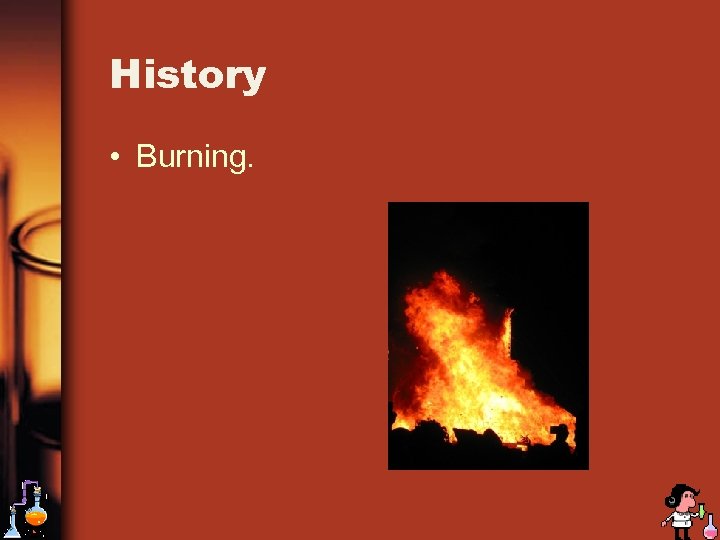 History • Burning.
 History • Metallurgy – Purifcation – Alloys
 Alchemy • Common Perception – Liars – Concocting potions
 Alchemy • Scholars
 Alchemy • attempted to explore the nature of chemical substances and processes.
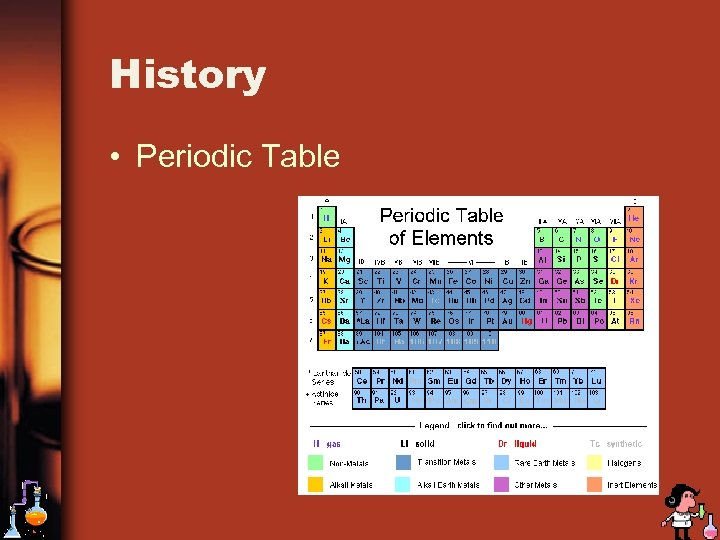 History • Periodic Table
 Chemistry • noun (pl. chemistries) – 1 the branch of science concerned with the properties and interactions of the substances of which matter is composed. – 2 the chemical properties of a substance or body. – 3 attraction or interaction between two people.
 Chemistry • Interactions of atoms and electrons.
 Nobel Prize Chemistry Winners
 Nobel Prize Winners • 1901 Jacobus Henricus van 't Hoff – Netherlands – for his discovery of the laws of chemical dynamics – osmotic pressure in solutions
 Nobel Prize Winners • 1902 Hermann Emil Fischer – Germany – Work on sugar and purine syntheses
 Nobel Prize Winners • 1903 Svante August Arrhenius – Sweden – Electrolytic theory of dissociation
 Nobel Prize Winners • 1904 Sir William Ramsay – United Kingdom – Discovery of the inert gaseous elements in air
 Nobel Prize Winners • 1905 Johann Friedrich Wilhelm Adolf von Baeyer – Germany – work on organic dyes and hydroaromatic compounds
 Nobel Prize Winners • 1906 Henri Moissan – France – Investigation and isolation of the element fluorine, and for the electric furnace named after him
 Nobel Prize Winners • 1907 Eduard Buchner – Germany – for his biochemical research – Discovery of cell-free fermentation
 Nobel Prize Winners • 1908 Ernest Rutherford – New Zealand United Kingdom – For investigations into the disintegration of the elements, – And the chemistry of radioactive substances
 Nobel Prize Winners • 1909 Wilhelm Ostwald – Germany – Work on catalysis – And for his investigations into chemical equilibria and rates of reaction
 Nobel Prize Winners • 1910 Otto Wallach – Germany – for his work in the field of alicyclic compounds
 Nobel Prize Winners • 1911 Maria Skłodowska-Curie – Poland France – Discovery of radium and polonium
 Nobel Prize Winners • 1912 Victor Grignard – France – for his the discovery of the Grignard reagent • Paul Sabatier – France – for his method of hydrogenating organic compounds
 Nobel Prize Winners • 1913 Alfred Werner – Switzerland – for his work on the linkage of atoms in molecules
 Nobel Prize Winners • 1914 Theodore William Richards – United States – Determinations of the atomic weight of a large number of elements
 Nobel Prize Winners • 1915 Richard Martin Willstätter – Germany – for his research on plant pigments
 Nobel Prize Winners • 1916 no award
 Nobel Prize Winners • 1917 no award
 Nobel Prize Winners • 1918 Fritz Haber – Germany – for his synthesis of ammonia
 Nobel Prize Winners • 1919 no award
 Nobel Prize Winners • 1920 Walther Hermann Nernst – Germany – for his work in thermochemistry
 Nobel Prize Winners • 1921 Frederick Soddy – United Kingdom – for his work on the chemistry of radioactive substances – Investigations into isotopes
 Nobel Prize Winners • 1922 Francis William Aston – United Kingdom – For the discovery of isotopes in a large number of non-radioactive elements, and for his whole-number rule
 Nobel Prize Winners • 1923 Fritz Pregl – Austria – for his invention of the method of microanalysis of organic substances
 Nobel Prize Winners • 1925 Richard Adolf Zsigmondy – Germany – for his demonstration of the heterogeneous nature of colloid solutions and the methods used
 Nobel Prize Winners • 1926 Theodor Svedberg – Sweden – for his work on disperse systems
 Nobel Prize Winners • 1927 Heinrich Otto Wieland – Germany – for his investigations of the bile acids and related substances
 Nobel Prize Winners • 1928 Adolf Otto Reinhold Windaus – Germany – for his research into sterols and their connection with vitamins
 Nobel Prize Winners • 1929 Arthur Harden Hans Karl August and Simon von Euler-Chelpin – United Kingdom Sweden – for their investigations on the fermentation of sugar and fermentative enzymes
 Nobel Prize Winners • 1930 Hans Fischer – Germany – for his research into haemin and chlorophyll
 Nobel Prize Winners • 1931 Carl Bosch and Friedrich Bergius – Germany and France – for their synthesis of new radioactive elements
 Nobel Prize Winners • 1936 Petrus (Peter) Josephus Wilhelmus Debye – Netherlands – for his work on molecular structure through investigations on dipole moments and the diffraction of X-rays and electrons in gases
 Nobel Prize Winners • 1937 Walter Norman Haworth – United Kingdom – for his work on carbohydrates and vitamin C"Paul Karrer. Switzerland"for his work on carotenoids, flavins and vitamins A and B 2
 Nobel Prize Winners • 1938 Richard Kuhn – Germany – for his work on carotenoids and vitamins
 Nobel Prize Winners • 1939 Adolf Friedrich Johann Butenandt – Germany – for his work on sex hormones • and Leopold Ružička – Switzerland – for his work on polymethylenes and higher terpenes
 Nobel Prize Winners • 1940 no award
 Nobel Prize Winners • 1941 no award
 Nobel Prize Winners • 1942 no award
 Nobel Prize Winners • 1943 George de Hevesy – Hungary – for his work on the use of isotopes as tracers to study chemical processes
 Nobel Prize Winners • 1944 Otto Hahn – Germany – for his discovery of the fission of heavy nuclei
 Nobel Prize Winners • 1945 Artturi Ilmari Virtanen – Finland – for his research and inventions in agricultural and nutrition chemistry, especially for his fodder preservation method
 Nobel Prize Winners • 1946 James Batcheller Sumner – United States – for his discovery that enzymes can be crystallized • John Howard Northrop • Wendell Meredith Stanley – United States – for their preparation of enzymes and virus proteins in a pure form
 Nobel Prize Winners • 1947 Sir Robert Robinson – United Kingdom – for his investigations on plant products, especially the alkaloids
 Nobel Prize Winners • 1948 Arne Wilhelm Kaurin Tiselius • Sweden • for his research on electrophoresis and adsorption analysis
 Nobel Prize Winners • 1949 William Francis Giauque – United States – for his contributions in the field of chemical thermodynamics
 Nobel Prize Winners • 1950 Otto Paul Hermann Diels and Kurt Alder – West Germany – for their discovery and development of the diene synthesis. Diels-Alder reaction.
 Nobel Prize Winners • 1951 Edwin Mattison Mc. Millan and Glenn Theodore Seaborg – United States – the discovery in the chemistry of transuranium elements
 Nobel Prize Winners • 1952 Archer John Porter Martin and Richard Laurence Millington Synge – United Kingdom – for their invention of partition chromatography
 Nobel Prize Winners • 1953 Hermann Staudinger – West Germany – for his discoveries in the field of macromolecular chemistry
 Nobel Prize Winners • 1954 Linus Carl Pauling – United States – for his research into the nature of the chemical bond
 Nobel Prize Winners • 1955 Vincent du Vigneaud – United States – for his work on sulphur compounds, especially the first synthesis of a polypeptide hormone
 Nobel Prize Winners • 1956 Sir Cyril Norman Hinshelwood and Никола й Никола евич Семёнов – United Kingdom and Soviet Union – for their research into the mechanism of chemical reactions
 Nobel Prize Winners • 1957 Sir Alexander Todd – United Kingdom – for his work on nucleotides and nucleotide co-enzymes
 Nobel Prize Winners • 1958 Frederick Sanger – United Kingdom – for his work on the structure of proteins, especially insulin
 Nobel Prize Winners • 1959 Jaroslav Heyrovský – Czechoslovakia – for his discovery and development of the polarographic methods of analysis
 Nobel Prize Winners • 1960 Willard Frank Libby – United States – for his method to use carbon-14 for age determination
 Nobel Prize Winners • 1961 Melvin Calvin – United States – for his research on carbon dioxide assimilation in plants
 Nobel Prize Winners • 1962 Max Ferdinand Perutz and John Cowdery Kendrew – United Kingdom – for their studies of the structures of globular proteins
 Nobel Prize Winners • 1963 Karl Ziegler and Giulio Natta. West – Germany and Italy – for their discoveries relating to high polymers
 Nobel Prize Winners • 1964 Dorothy Crowfoot Hodgkin – United Kingdom – for her determinations by X-ray techniques of the structures of important biochemical substances
 Nobel Prize Winners • 1965 Robert Burns Woodward – United States – for his achievements in organic synthesis
 Nobel Prize Winners • 1966 Robert Sanderson Mulliken – United States – for his work concerning chemical bonds and the electronic structure of molecules
 Nobel Prize Winners • 1967 Manfred Eigen and Ronald G. W. Norrish and George Porter – United Kingdom and West Germany – for their studies of extremely fast chemical reactions, effected by disturbing the equilibrium by means of very short pulses of energy
 Nobel Prize Winners • 1968 Lars Onsager – Norway United States – for the discovery of the reciprocal relations bearing his name
 Nobel Prize Winners • 1969 Derek H. R. Barton and Odd Hassel – United Kingdom and Norway – for their contributions to the development of the concept of conformation
 Nobel Prize Winners • 1970 Luis F. Leloir – Argentina – for his discovery of sugar nucleotides and their role in the biosynthesis of carbohydrates
 Nobel Prize Winners • 1971 Gerhard Herzberg – Canada – for his contributions to electronic structure and the geometry of molecules, particularly free radicals
 Nobel Prize Winners • 1972 Christian B. Anfinsen – United States – for his work on ribonuclease, especially concerning the connection between the amino acid sequence and the biologically active conformation • Stanford Moore and William H. Stein – United States – for their contribution to the understanding of the connection between chemical structure and catalytic activity of the active centre of the ribonuclease molecule
 Nobel Prize Winners • 1973 Ernst Otto Fischer and Geoffrey Wilkinson – West Germany United Kingdom – for their pioneering work, performed independently, on the chemistry of the organometallic, so called sandwich compounds
 Nobel Prize Winners • 1974 Paul J. Flory – United States – for his fundamental work, both theoretical and experimental, in the physical chemistry of macromolecules
 Nobel Prize Winners • 1975 John Warcup Cornforth – Australia United Kingdom – for his work on the stereochemistry of enzyme -catalyzed reactions • Vladimir Prelog – Switzerland – for his research into the stereochemistry of organic molecules and reactions
 Nobel Prize Winners • 1976 William Nunn Lipscomb, Jr. • United States • for his studies on the structure of boranes illuminating problems of chemical bonding
 Nobel Prize Winners • 1977 Ilya Prigogine – Belgium – for his contributions to non-equilibrium thermodynamics, particularly theory of dissipative structures
 Nobel Prize Winners • 1978 Peter D. Mitchell – United Kingdom – for his contribution to the understanding of biological energy transfer through the formulation of the chemiosmotic theory
 Nobel Prize Winners • 1979 Herbert C. Brown and Georg Wittig – United States and West Germany – for their development of the use of boron- and phosphorus-containing compounds, respectively, into reagents in organic synthesis
 Nobel Prize Winners • 1980 Paul Berg – United States – for his fundamental studies of the biochemistry of nucleic acids, with particular regard to recombinant-DNA • Walter Gilbert and Frederick Sanger – United States and. United Kingdom – for their contributions concerning the determination of base sequences in nucleic acids
 Nobel Prize Winners • 1981 福井謙一 and Roald Hoffmann – Japan and United States – for their theories concerning the course of chemical reactions
 Nobel Prize Winners • 1982 Aaron Klug – South Africa United Kingdom – for his development of crystallographic electron microscopy and his structural elucidation of biologically important nucleic acid-protein complexes
 Nobel Prize Winners • 1983 Henry Taube – United States – for his work on the mechanisms of electron transfer reactions
 Nobel Prize Winners • 1984 Robert Bruce Merrifield – United States – for his development of methodology for chemical synthesis on a solid matrix
 Nobel Prize Winners • 1985 Herbert A. Hauptman and Jerome Karle – United States – for their achievements in developing direct methods for the determination of crystal structures
 Nobel Prize Winners • 1986 Dudley R. Herschbach and 李 遠哲 and John C. Polanyi – United States, Taiwan - United States and Canada – for their contributions concerning the dynamics of chemical elementary processes
 Nobel Prize Winners • 1987 Donald J. Cram, Jean-Marie Lehn and Charles J. Pedersen – United States and France – for their development and use of molecules with structure-specific interactions of high selectivity
 Nobel Prize Winners • 1988 Johann Deisenhofer, Robert Huber and Hartmut Michel – West Germany – for their determination of the threedimensional structure of a photosynthetic reaction centre
 Nobel Prize Winners • 1989 Sidney Altman and Thomas R. Cech – Canada United States and United States – for their discovery of catalytic properties of RNA
 Nobel Prize Winners • 1990 Elias James Corey – United States – for his development of theory and methodology of organic synthesis
 Nobel Prize Winners • 1991 Richard R. Ernst – Switzerland – for his contributions to the development of high resolution nuclear magnetic resonance (NMR) spectroscopy
 Nobel Prize Winners • 1992 Rudolph A. Marcus – United States – for his contributions to theory of electron transfer reactions in chemical systems
 Nobel Prize Winners • 1993 Kary B. Mullis – United States – for his invention of the polymerase chain reaction (PCR) method • Michael Smith – Canada – for his fundamental contributions to the establishment of oligonucleotide-based, sitedirected mutagenesis and its development for protein studies
 Nobel Prize Winners • 1994 George A. Olah – Hungary United States – for his contribution to carbocation chemistry
 Nobel Prize Winners • 1995 Paul J. Crutzen, Mario J. Molina, F. Sherwood Rowland – Netherlands, Mexico and United States – for their work in atmospheric chemistry, in particular ozone depletion
 Nobel Prize Winners • 1996 Robert Curl, Sir Harold Kroto and Richard Smalley • United Kingdom, United States"for their discovery of fullerenes
 Nobel Prize Winners • 1997 Paul D. Boyer and John E. Walker – United States and United Kingdom – for their elucidation of the enzymatic mechanism underlying the synthesis of adenosine triphosphate • Jens C. Skou – Denmark – for his discovery of an ion-transporting enzyme, Na+/K+-ATPase
 Nobel Prize Winners • 1998 Walter Kohn – United States – for his development of the density functional theory • John A. Pople – United Kingdom – for his development of computational methods in quantum chemistry
 Nobel Prize Winners • 1999 ﺃﺤﻤﺪ ﺯﻭﻳﻞ – Egypt United States – for his studies of the transition states of chemical reactions using femtosecond spectroscopy
 Nobel Prize Winners • 2000 Alan J. Heeger, Alan G Mac. Diarmid, 白川英樹 – United States, New Zealand, Japan – for their discovery and development of conductive polymers
 Nobel Prize Winners • 2001 William S. Knowles and 野依良治 – United States, Japan – for their work on chirally catalysed hydrogenation reactions • K. Barry Sharpless – United States – for his work on chirally catalysed oxidation reactions" see Sharpless asymmetric dihydroxylation
 Nobel Prize Winners • 2002 John B. Fenn and 田中耕一 – United States and Japan – for their development of soft desorption ionisation methods for mass spectrometric analyses of biological macromolecules • Kurt Wüthrich – Switzerland – for his development of nuclear magnetic resonance spectroscopy for determining the three-dimensional structure of biological macromolecules in solution
 Nobel Prize Winners • 2003 Peter Agre – United States – for the discovery of water channels • Roderick Mac. Kinnon – United States – for structural and mechanistic studies of ion channels
 Nobel Prize Winners • 2004 Aaron Ciechanover, Avram Hershko and Irwin Rose – Israel and United States – for the discovery of ubiquitin-mediated protein degradation
 Nobel Prize Winners • 2005 Robert Grubbs, Richard Schrock and Yves Chauvin – United States and France"for the development of the metathesis method in organic synthesis
 Nobel Prize Winners • 2006 Roger D. Kornberg – United States – for his studies of the molecular basis of eukaryotic transcription
 Nobel Prize Winners • 2007 Gerhard Ertl – Germany – for his studies of chemical processes on solid surfaces"
 Subdisceplines The Area’s of specific Interest
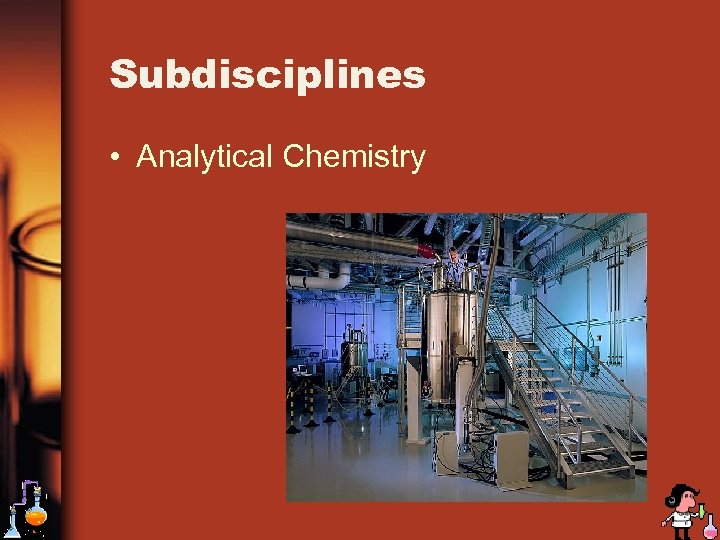 Subdisciplines • Analytical Chemistry
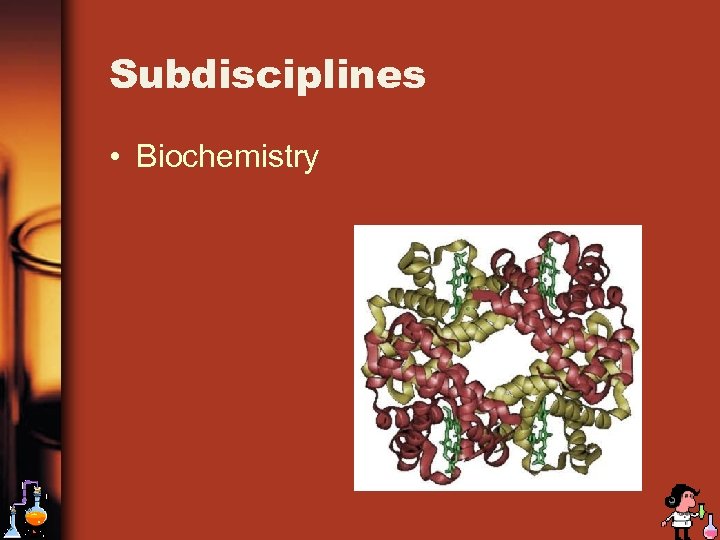 Subdisciplines • Biochemistry
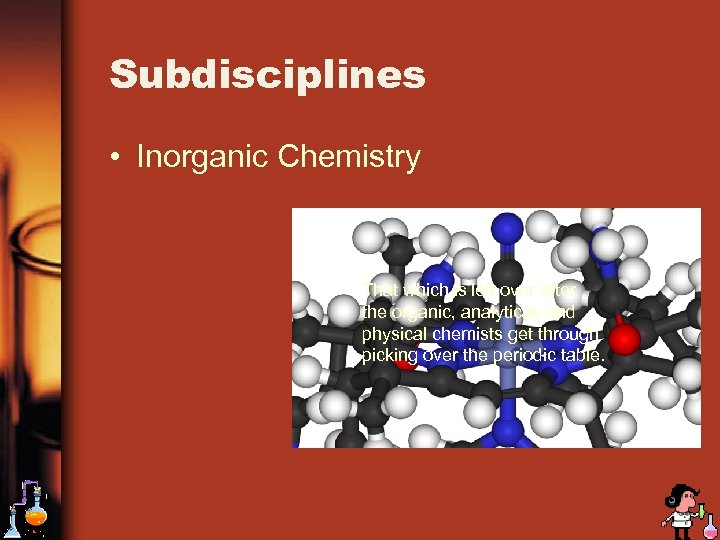 Subdisciplines • Inorganic Chemistry That which is left over after the organic, analytical, and physical chemists get through picking over the periodic table.
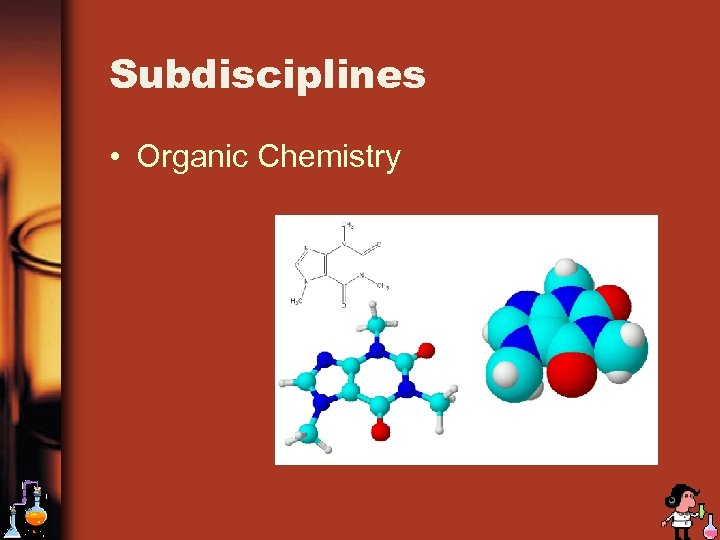 Subdisciplines • Organic Chemistry
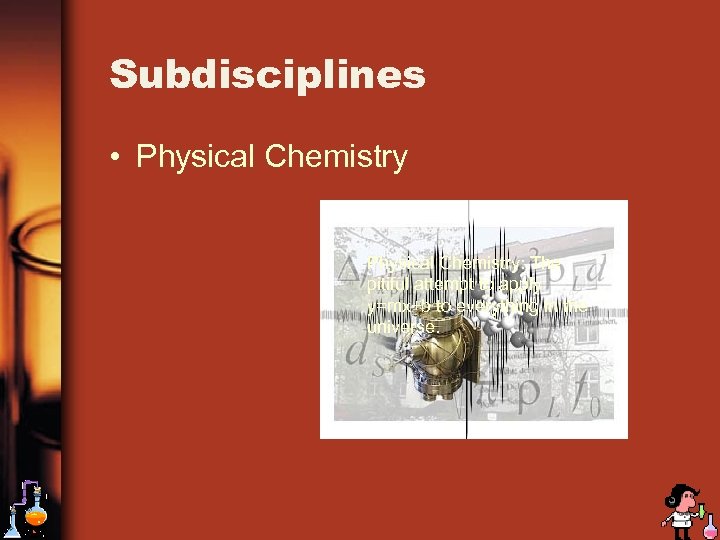 Subdisciplines • Physical Chemistry: The pitiful attempt to apply y=mx+b to everything in the universe.
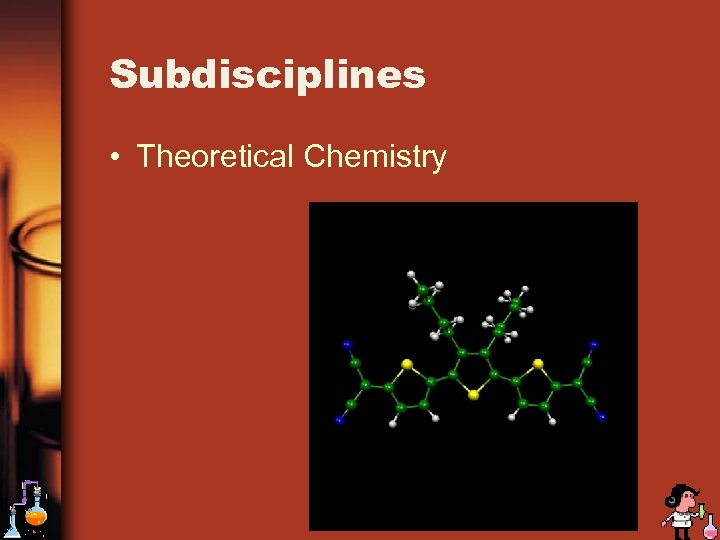 Subdisciplines • Theoretical Chemistry
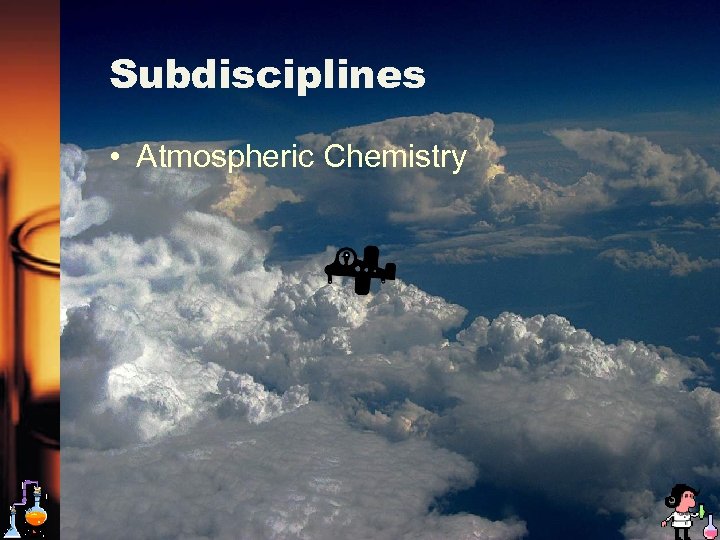 Subdisciplines • Atmospheric Chemistry
 Employment Opportunities What can we get paid to do!!
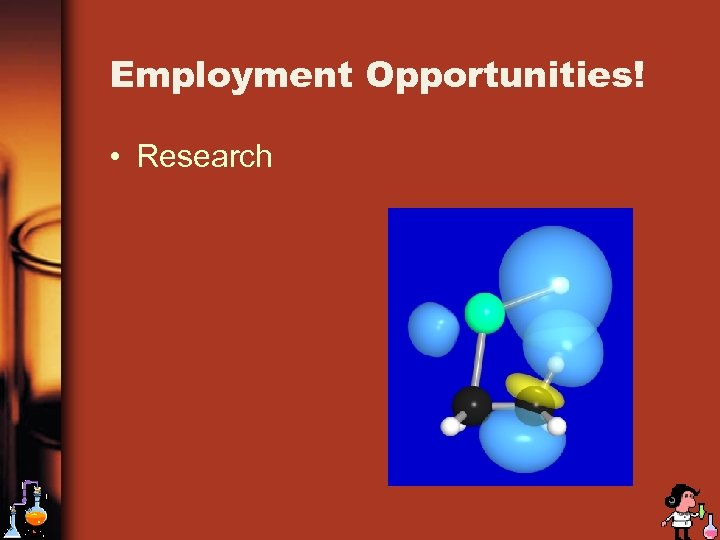 Employment Opportunities! • Research
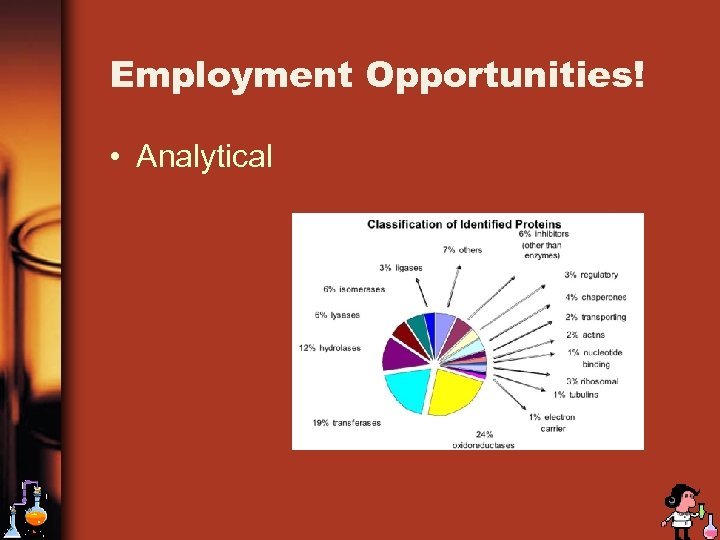 Employment Opportunities! • Analytical
 Employment Opportunities! • Education
 Employment Opportunities! • Industry –
 Employment Opportunities! • Pretty much anything! – Police – Quality Control – Technician – Water management
 The Future! • Materials
 The Future! • Power – Batteries
 The Future! • Solvents
 The Future! • Theatre – Smoke fluids – Flame simulation – Fluorescent Compounds for safety.
 What makes you a chemist Well…
 You Might Be a Chemist if: • You carry your lab safety goggles around with you at all times, just in case. . .
 You Might Be a Chemist if: • You start disagreeing with scientific points in films and correct them at every possible moment
 You Might be a Chemist if: • you no longer ask for Tylenol, you ask for acetaminophenol.
 You Might be a Chemist if: • you start referring to the smell of nail polish remover as an acetone smell.
 You Might be a Chemist if: • you don't drink water, you drink H 2 O.
 You Might be a Chemist if: • you become very agitated when people refer to air as Oxygen, and proceed to list all of the components of air
 You Might be a Chemist if: • you think a mole is a unit of amount, rather than a small furry animal in your lawn
 Thank You For Listening – Bibliography – www. en. wikipedia. org/wiki/Chemistry New Scientist Issues from 2004 – 8 th Feb 2007 Analytical Chemistry – Higson Physical Chemistry – Atikins & de. Paula Inorganic Chemistry – Shriver & Atkins Organic Chemistry – Claydon, Greaves, Warren and Wothers http: //www. workjoke. com/projoke 25. htm