 Скачать презентацию Down syndrome By Vadym Kopko Genetic Disease Project
New Microsoft PowerPoint Presentation.pptx
- Количество слайдов: 4



Down syndrome By Vadym Kopko Genetic Disease Project
What is it? Down syndrome (DS) or Down's syndrome, also known as trisomy 21, is a genetic disorder caused by the presence of all or part of a third copy of chromosome 21. Trisomy 21 is the most common chromosome abnormality in humans. It is typically associated with a delay in cognitive ability (mental retardation, or MR) and physical growth, and a particular set of facial characteristics. The average IQ of young adults with Down syndrome is around 50, whereas young adults without the condition typically have an IQ of 100. (MR has historically been defined as an IQ below 70. ) A large proportion of individuals with Down syndrome have a severe degree of intellectual disability. Down syndrome is named after John Langdon Down, the British physician who described the syndrome in 1866. The condition was clinically described earlier by Jean Etienne Dominique Esquirol in 1838 and Edouard Seguin in 1844. Down syndrome was identified as a chromosome 21 trisomy by Dr. Jérôme Lejeune in 1959. Down syndrome can be identified in a baby at birth or before birth by prenatal screening. Pregnancies with this diagnosis are often terminated. The CDC estimates that about one of every 691 babies born in the United States each year is born with Down syndrome. Many children with Down syndrome are educated in regular school classes while others require specialised educational facilities. Some children graduate from high school, and, in the US, there are increasing opportunities for participating in post-secondary education. Education and proper care has been shown to improve quality of life significantly. Many adults with Down Syndrome are able to work at paid employment in the community, while others require a more sheltered work environment. Answer
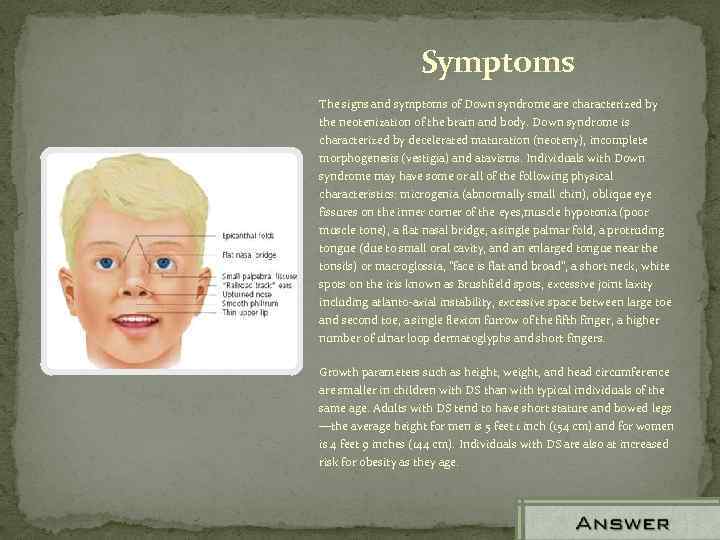
Symptoms The signs and symptoms of Down syndrome are characterized by the neotenization of the brain and body. Down syndrome is characterized by decelerated maturation (neoteny), incomplete morphogenesis (vestigia) and atavisms. Individuals with Down syndrome may have some or all of the following physical characteristics: microgenia (abnormally small chin), oblique eye fissures on the inner corner of the eyes, muscle hypotonia (poor muscle tone), a flat nasal bridge, a single palmar fold, a protruding tongue (due to small oral cavity, and an enlarged tongue near the tonsils) or macroglossia, "face is flat and broad", a short neck, white spots on the iris known as Brushfield spots, excessive joint laxity including atlanto-axial instability, excessive space between large toe and second toe, a single flexion furrow of the fifth finger, a higher number of ulnar loop dermatoglyphs and short fingers. Growth parameters such as height, weight, and head circumference are smaller in children with DS than with typical individuals of the same age. Adults with DS tend to have short stature and bowed legs —the average height for men is 5 feet 1 inch (154 cm) and for women is 4 feet 9 inches (144 cm). Individuals with DS are also at increased risk for obesity as they age.
Inheritance patterns Most cases of Down's syndrome are sporadic but there is a small risk of recurrence in further pregnancies. The incidence of Down's syndrome is related to maternal age. The older the mother the higher the risk of an affected child, though the majority of children with Down's syndrome are born to younger mothers. However, in a minority of cases (three to four per cent) a mother or father may have a balanced translocation of chromosome 21. In these cases the condition is inheritable. Genetic counselling should be sought in all cases. An ante-natal screening test, the 'triple test', is sometimes used. It involves taking a small sample of blood from the mother, but it is not a definitive test; it is a screening process, the aim of which is to calculate whether the likelihood of having a Down's syndrome fetus is sufficiently high to warrant the performance of an amniocentesis. This screening test has a rather high false positive rate, and it is only the amniocentesis which provides a definitive answer.
Скачать презентацию Down syndrome By Vadym Kopko Genetic Disease Project
New Microsoft PowerPoint Presentation.pptx