 Скачать презентацию DOWN HOUSE Natasha Larionova 11 -B DOWN
Down House,Larionova.pptx
- Количество слайдов: 15



DOWN HOUSE Natasha Larionova, 11 -B
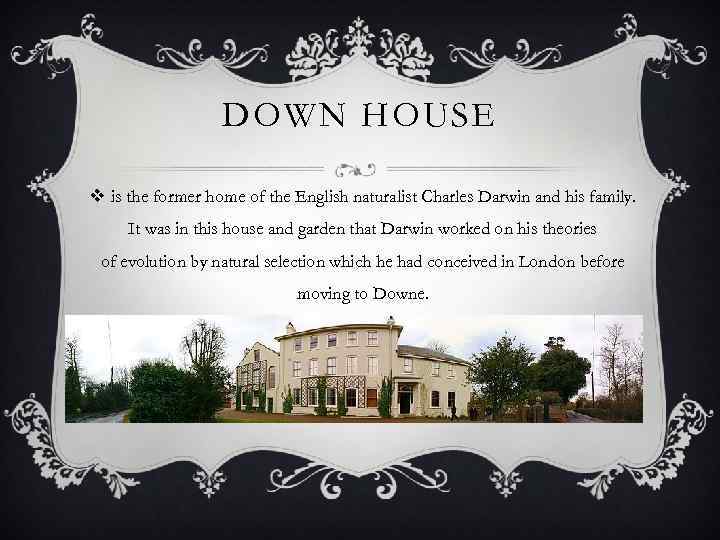
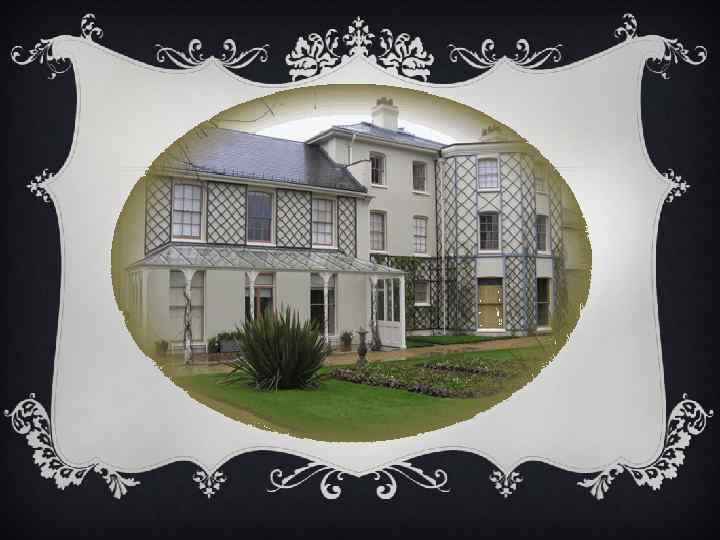
DOWN HOUSE v is the former home of the English naturalist Charles Darwin and his family. It was in this house and garden that Darwin worked on his theories of evolution by natural selection which he had conceived in London before moving to Downe.
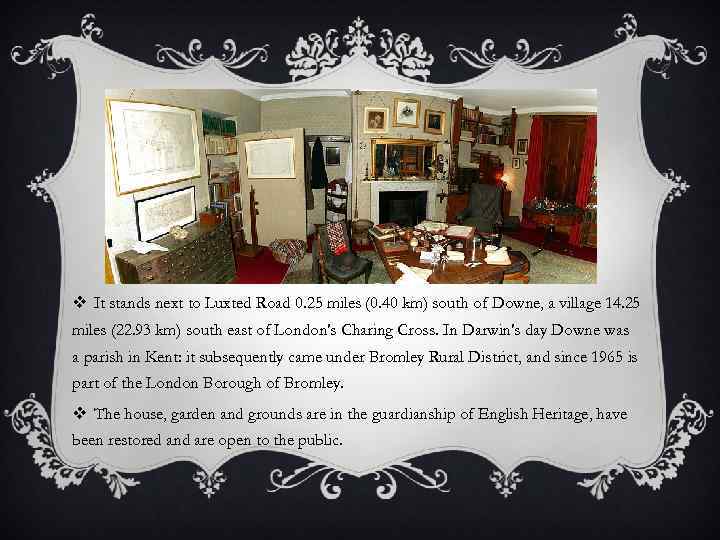
v It stands next to Luxted Road 0. 25 miles (0. 40 km) south of Downe, a village 14. 25 miles (22. 93 km) south east of London's Charing Cross. In Darwin's day Downe was a parish in Kent: it subsequently came under Bromley Rural District, and since 1965 is part of the London Borough of Bromley. v The house, garden and grounds are in the guardianship of English Heritage, have been restored and are open to the public.
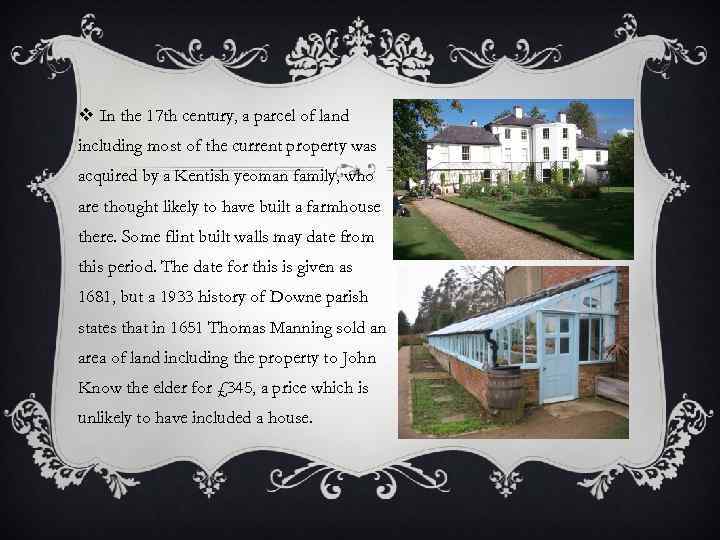
v In the 17 th century, a parcel of land including most of the current property was acquired by a Kentish yeoman family, who are thought likely to have built a farmhouse there. Some flint built walls may date from this period. The date for this is given as 1681, but a 1933 history of Downe parish states that in 1651 Thomas Manning sold an area of land including the property to John Know the elder for £ 345, a price which is unlikely to have included a house.
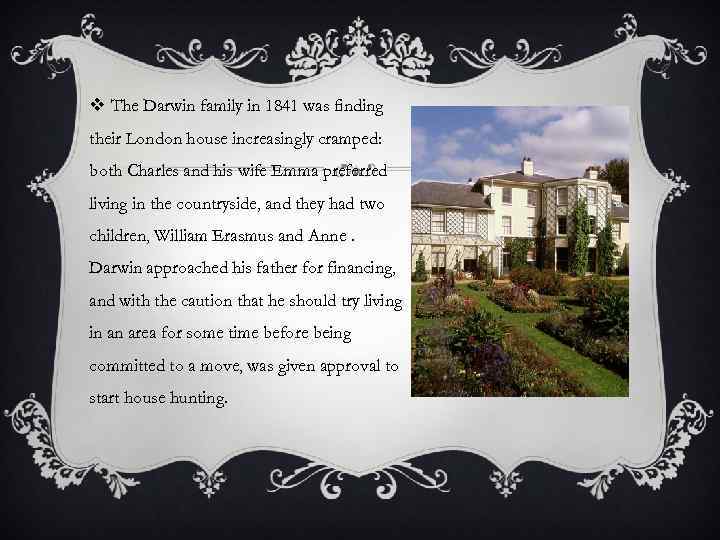
v The Darwin family in 1841 was finding their London house increasingly cramped: both Charles and his wife Emma preferred living in the countryside, and they had two children, William Erasmus and Anne. Darwin approached his father for financing, and with the caution that he should try living in an area for some time before being committed to a move, was given approval to start house hunting.
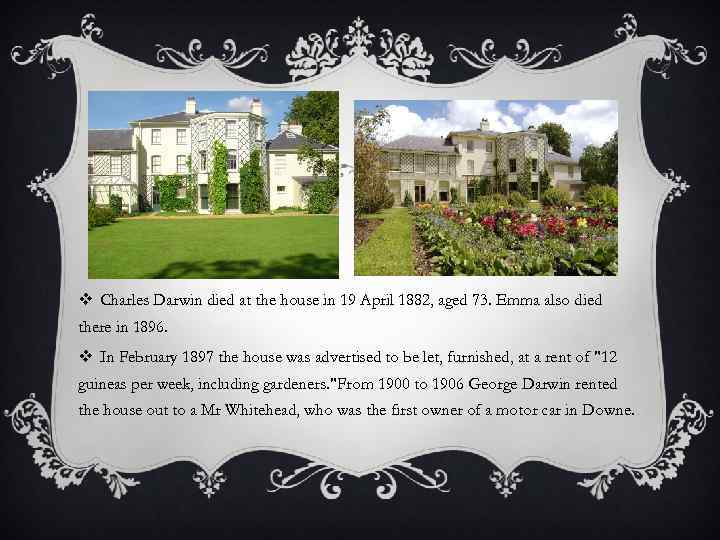
v Charles Darwin died at the house in 19 April 1882, aged 73. Emma also died there in 1896. v In February 1897 the house was advertised to be let, furnished, at a rent of "12 guineas per week, including gardeners. "From 1900 to 1906 George Darwin rented the house out to a Mr Whitehead, who was the first owner of a motor car in Downe.
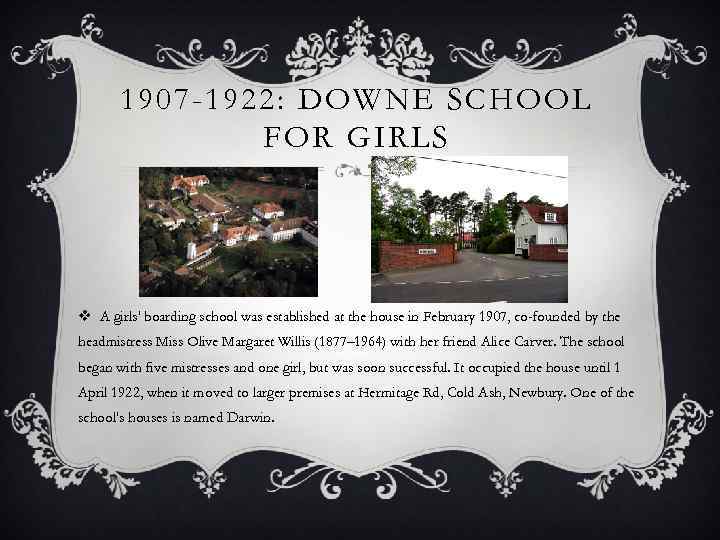
1907 -1922: DOWNE SCHOOL FOR GIRLS v A girls' boarding school was established at the house in February 1907, co-founded by the headmistress Miss Olive Margaret Willis (1877– 1964) with her friend Alice Carver. The school began with five mistresses and one girl, but was soon successful. It occupied the house until 1 April 1922, when it moved to larger premises at Hermitage Rd, Cold Ash, Newbury. One of the school's houses is named Darwin.
1927 -1996: DARWIN MUSEUM v From 1924 another girls' school was run in the house by a Miss Rain, but this was unsuccessful and closed in 1927. Following an appeal at that year's Annual Meeting of the British Association for the Advancement of Science by its president Sir Arthur Keith, the surgeon Sir George Buckston Browne (1850– 1945) bought Down from the Darwin heirs for £ 4, 250 in 1927.
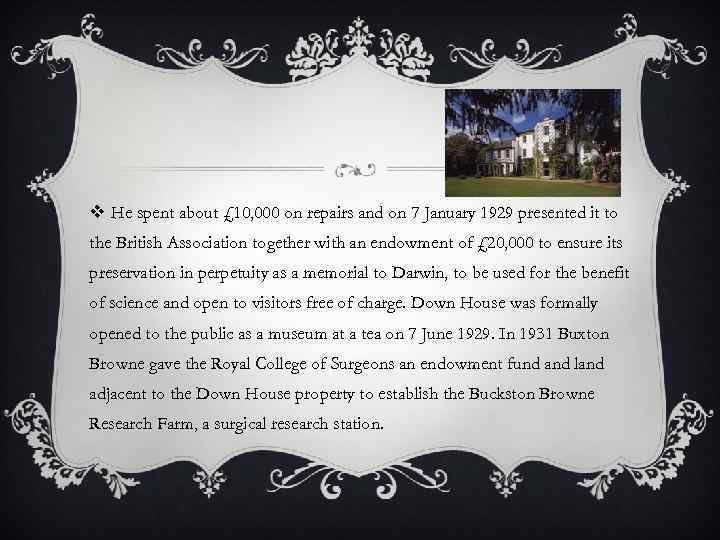
v He spent about £ 10, 000 on repairs and on 7 January 1929 presented it to the British Association together with an endowment of £ 20, 000 to ensure its preservation in perpetuity as a memorial to Darwin, to be used for the benefit of science and open to visitors free of charge. Down House was formally opened to the public as a museum at a tea on 7 June 1929. In 1931 Buxton Browne gave the Royal College of Surgeons an endowment fund and land adjacent to the Down House property to establish the Buckston Browne Research Farm, a surgical research station.
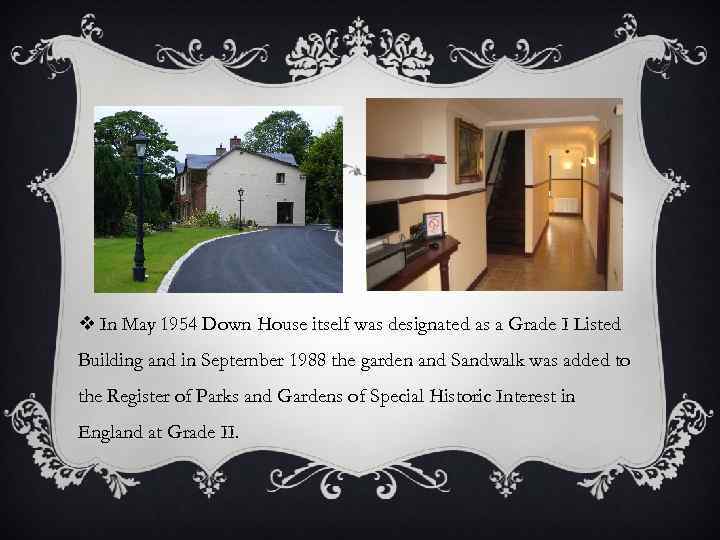
v In May 1954 Down House itself was designated as a Grade I Listed Building and in September 1988 the garden and Sandwalk was added to the Register of Parks and Gardens of Special Historic Interest in England at Grade II.
1996 TO PRESENT: RESTORED HOUSE AND GARDEN v Down House was acquired in 1996 by English Heritage, with a grant from the Welcome Trust. It was restored with funds raised by the Natural History Museum from many trusts, and from a grant from the Heritage Lottery Fund, and reopened to the public in April 1998. v Down House and the surrounding area has been nominated by the UK government's Department for Culture, Media and Sport (DCMS) to become a World Heritage Site. It originally went through public consultation in 2006 and a decision had been expected in the last three days of June 2007. However, ICOMOS warned the DCMS that the House might not meet the criteria for scientific sites on the register, and so in May 2007 the DCMS announced that it was withdrawing the bid with the intention of resubmitting it later. The bid was resubmitted in January 2009, with a decision expected in the summer of 2010.
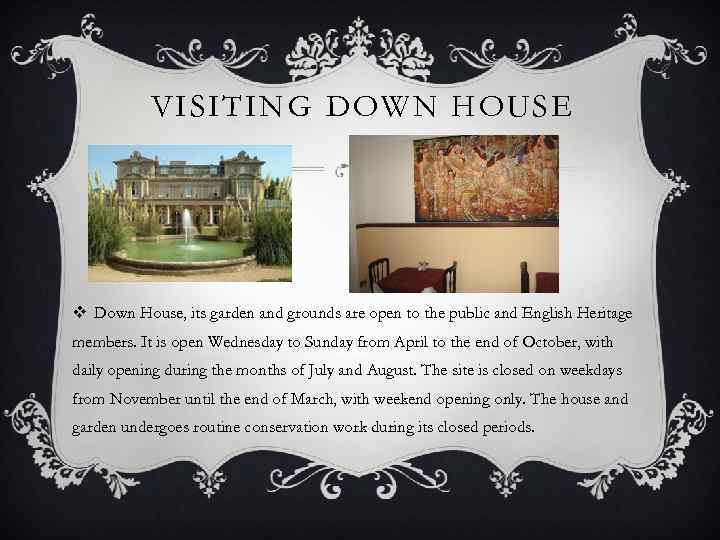
VISITING DOWN HOUSE v Down House, its garden and grounds are open to the public and English Heritage members. It is open Wednesday to Sunday from April to the end of October, with daily opening during the months of July and August. The site is closed on weekdays from November until the end of March, with weekend opening only. The house and garden undergoes routine conservation work during its closed periods.
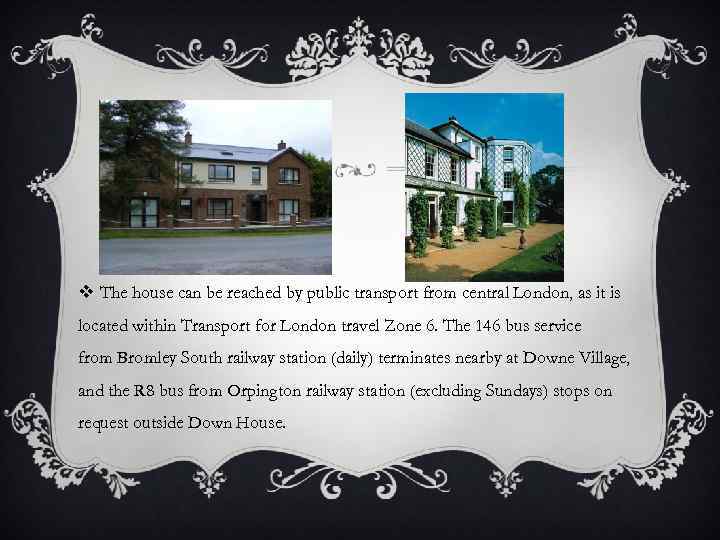
v The house can be reached by public transport from central London, as it is located within Transport for London travel Zone 6. The 146 bus service from Bromley South railway station (daily) terminates nearby at Downe Village, and the R 8 bus from Orpington railway station (excluding Sundays) stops on request outside Down House.
v. You should definitely visit this place if you will be in London! It is my advice!
Скачать презентацию DOWN HOUSE Natasha Larionova 11 -B DOWN
Down House,Larionova.pptx