


 Скачать презентацию DOTS IS NOT ENOUGH POVERTY IS STILL AN
81a5763775dfc3aec041fcc9550a7027.ppt
- Количество слайдов: 1
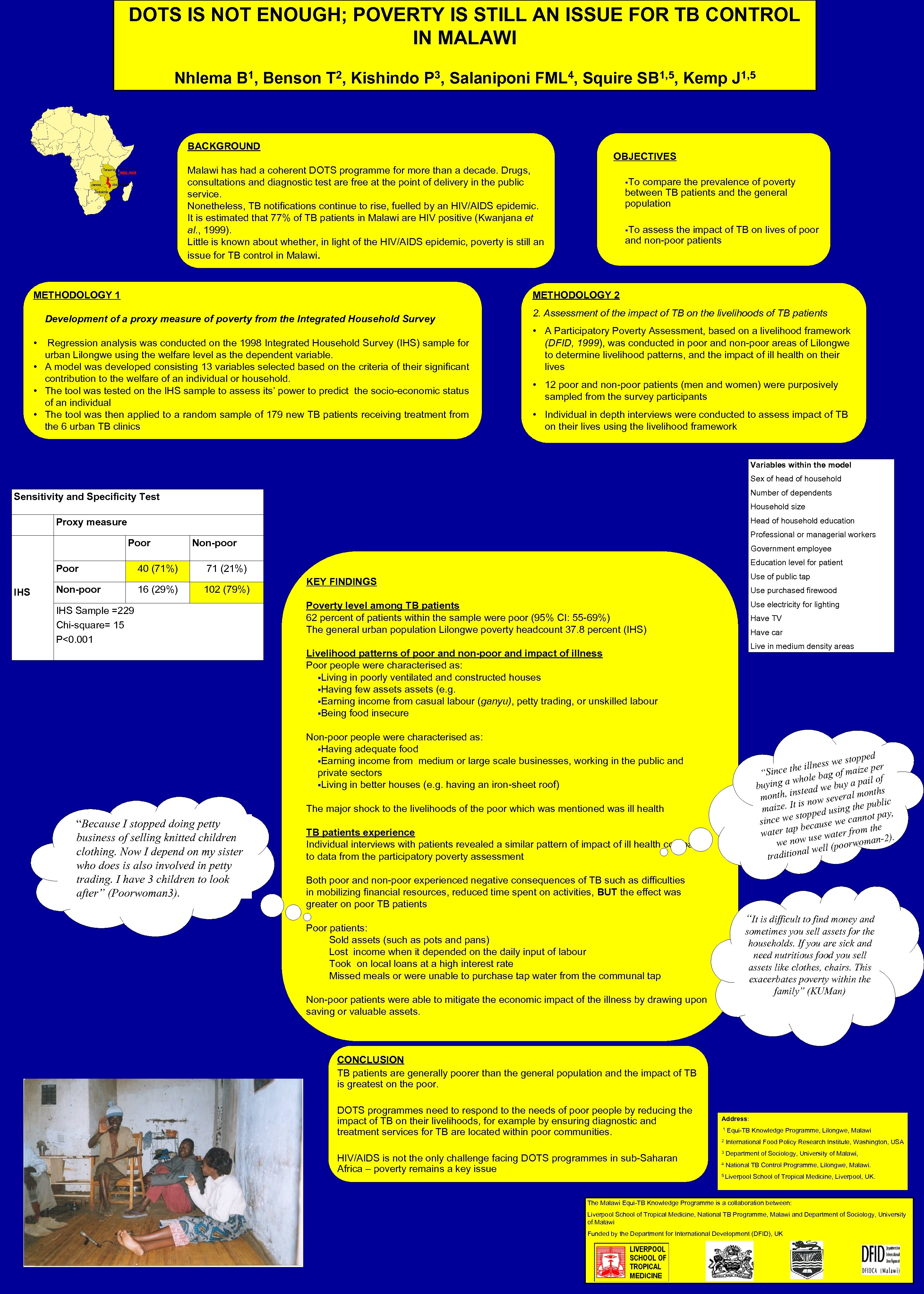 DOTS IS NOT ENOUGH; POVERTY IS STILL AN ISSUE FOR TB CONTROL IN MALAWI Nhlema 1, B Benson 2, T Kishindo 3, P Salaniponi 4, FML BACKGROUND Squire 1, 5, SB Kemp 1, 5 J OBJECTIVES Malawi has had a coherent DOTS programme for more than a decade. Drugs, consultations and diagnostic test are free at the point of delivery in the public service. Nonetheless, TB notifications continue to rise, fuelled by an HIV/AIDS epidemic. It is estimated that 77% of TB patients in Malawi are HIV positive (Kwanjana et al. , 1999). Little is known about whether, in light of the HIV/AIDS epidemic, poverty is still an issue for TB control in Malawi. §To compare the prevalence of poverty between TB patients and the general population §To assess the impact of TB on lives of poor and non-poor patients METHODOLOGY 2 METHODOLOGY 1 Development of a proxy measure of poverty from the Integrated Household Survey • Regression analysis was conducted on the 1998 Integrated Household Survey (IHS) sample for urban Lilongwe using the welfare level as the dependent variable. • A model was developed consisting 13 variables selected based on the criteria of their significant contribution to the welfare of an individual or household. • The tool was tested on the IHS sample to assess its’ power to predict the socio-economic status of an individual • The tool was then applied to a random sample of 179 new TB patients receiving treatment from the 6 urban TB clinics 2. Assessment of the impact of TB on the livelihoods of TB patients • A Participatory Poverty Assessment, based on a livelihood framework (DFID, 1999), was conducted in poor and non-poor areas of Lilongwe to determine livelihood patterns, and the impact of ill health on their lives • 12 poor and non-poor patients (men and women) were purposively sampled from the survey participants • Individual in depth interviews were conducted to assess impact of TB on their lives using the livelihood framework Variables within the model Sex of head of household Number of dependents Sensitivity and Specificity Test Household size Head of household education Proxy measure Poor IHS Non-poor 40 (71%) 16 (29%) Professional or managerial workers Non-poor Government employee Education level for patient 71 (21%) 102 (79%) IHS Sample =229 Chi-square= 15 P<0. 001 Use of public tap KEY FINDINGS Use purchased firewood Poverty level among TB patients 62 percent of patients within the sample were poor (95% CI: 55 -69%) The general urban population Lilongwe poverty headcount 37. 8 percent (IHS) Use electricity for lighting Have TV Have car Live in medium density areas Livelihood patterns of poor and non-poor and impact of illness Poor people were characterised as: §Living in poorly ventilated and constructed houses §Having few assets (e. g. §Earning income from casual labour (ganyu), petty trading, or unskilled labour §Being food insecure Non-poor people were characterised as: §Having adequate food §Earning income from medium or large scale businesses, working in the public and private sectors §Living in better houses (e. g. having an iron-sheet roof) stopped lness we ce the il aize per “Sin ag of m whole b a pail of buying e buy a nstead w eral months month, i now sev public It is maize. sing the topped u cannot pay, nce we s ause we si tap bec r om the water fr now use man-2). we poorwo al well ( tradition The major shock to the livelihoods of the poor which was mentioned was ill health “Because I stopped doing petty business of selling knitted children clothing. Now I depend on my sister who does is also involved in petty trading. I have 3 children to look after” (Poorwoman 3). TB patients experience Individual interviews with patients revealed a similar pattern of impact of ill health compared to data from the participatory poverty assessment Both poor and non-poor experienced negative consequences of TB such as difficulties in mobilizing financial resources, reduced time spent on activities, BUT the effect was greater on poor TB patients “It is difficult to find money and Poor patients: Sold assets (such as pots and pans) Lost income when it depended on the daily input of labour Took on local loans at a high interest rate Missed meals or were unable to purchase tap water from the communal tap sometimes you sell assets for the households. If you are sick and need nutritious food you sell assets like clothes, chairs. This exacerbates poverty within the family” (KUMan) Non-poor patients were able to mitigate the economic impact of the illness by drawing upon saving or valuable assets. CONCLUSION TB patients are generally poorer than the general population and the impact of TB is greatest on the poor. DOTS programmes need to respond to the needs of poor people by reducing the impact of TB on their livelihoods, for example by ensuring diagnostic and treatment services for TB are located within poor communities. Address: Equi-TB Knowledge Programme, Lilongwe, Malawi 2 HIV/AIDS is not the only challenge facing DOTS programmes in sub-Saharan Africa – poverty remains a key issue 1 International Food Policy Research Institute, Washington, USA 3 Department of Sociology, University of Malawi, 4 National TB Control Programme, Lilongwe, Malawi. 5 Liverpool School of Tropical Medicine, Liverpool, UK. The Malawi Equi-TB Knowledge Programme is a collaboration between: Liverpool School of Tropical Medicine, National TB Programme, Malawi and Department of Sociology, University of Malawi Funded by the Department for International Development (DFID), UK