


 Скачать презентацию Donor Coordination Meeting Draft Guide to the Monitoring
e261352f4f89f200ac3e1b8fbd59545a.ppt
- Количество слайдов: 25
 Donor Coordination Meeting Draft Guide to the Monitoring Framework of the Global Partnership March 2013 28 March 2013
 INTRODUCTION The Busan Partnership for Effective Development Cooperation (30 Nov-01 Dec. 2011), n sets out shared principles, common goals and differential commitments for improving the effectiveness of international development cooperation. n calls for the establishment of a “new, inclusive and representative Global Partnership for Effective Development Co-operation (hereafter “Global Partnership”) n invites the UNDP/OECD joint support team to provide day to day support to the Global Partnership. General Division for Policy Coordination, Foreign Aid and Central Public Administration Reform at the State Chancellery 2
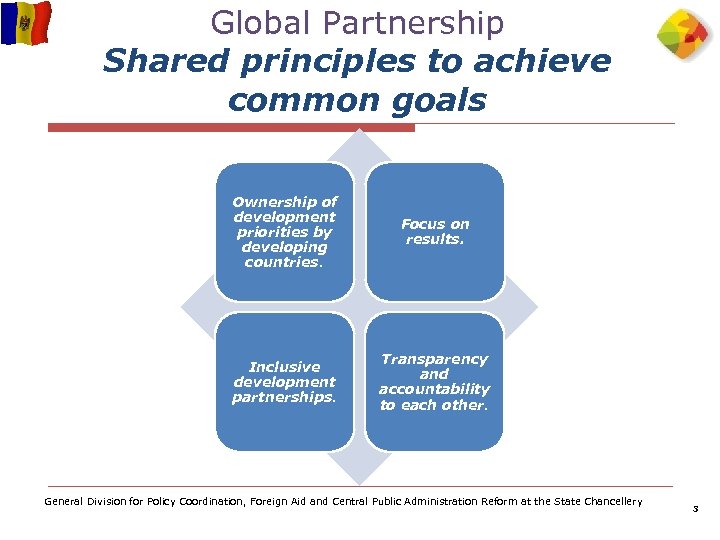 Global Partnership Shared principles to achieve common goals Ownership of development priorities by developing countries. Focus on results. Inclusive development partnerships. Transparency and accountability to each other. General Division for Policy Coordination, Foreign Aid and Central Public Administration Reform at the State Chancellery 3
 Global Partnership Core Functions o Maintain and strengthen political momentum for more effective momentum development co-operation; o Ensure accountability for implementing accountability Busan commitments; o Facilitate knowledge exchange and sharing of lessons learned; and o Support implementation of Busan commitments at the country level, including monitoring General Division for Policy Coordination, Foreign Aid and Central Public Administration Reform at the State Chancellery 4
 PURPOSE OF GLOBAL MONITORING o Support accountability for the implementation of the Busan commitments and actions by providing a snapshot of progress at the international level; o Stimulate multi-stakeholder dialogue at both country and international levels on how to improve the effectiveness of development co-operation; and o Promote agreements on specific actions that are needed to enhance successful implementation of the Busan Partnership agreement and support accountability at country level. General Division for Policy Coordination, Foreign Aid and Central Public Administration Reform at the State Chancellery 5
 Global Partnership Progress Reports o produced to inform high-level political dialogue within the Global Partnership during ministerial-level meetings o every 18 -24 months o first stock-taking of progress will be undertaken by mid-2013 for the mid-2013 preparation of the first GP ministerial-level meeting scheduled for the last quarter of 2013 General Division for Policy Coordination, Foreign Aid and Central Public Administration Reform at the State Chancellery 6
 What is new? Indicators and Targets o INDICATORS n Paris Declaration – 12 indicators; n Global Partnership – 10 indicators. o TARGETS n A global target is available for each global indicator. This does not prevent stakeholders from agreeing different targets at the country level. For indicators where data is available, 2010 will be used as the baseline year. For others, a baseline will be determined depending on data availability. General Division for Policy Coordination, Foreign Aid and Central Public Administration Reform at the State Chancellery 7
 Reporting and data collection A web-based “help desk” will be established within the knowledge platform for the Global Partnership to provide access to expertise, technical information and good practices. This web solution will build on the UNDP Team-works web platform and will offer a password-protected ‘intranet’ for Global Partnership stakeholders o o Scope of reporting n Official Development Assistance (ODA) + a broader range of official development co-operation funds could be monitored in addition. n Analysis is focused on areas of relevant interest to the Global Partnership. n Global progress reports will not include standard country chapters – partner-countries are to decide on the form of narrative reports to assess progress. n The UNDP/OECD joint support team will use country-level reports to complement the evidence generated through the global indicators. Data collection n By incorporating GP indicators in partner country monitoring tools/frameworks (e. g. AIMS) we’ll avoid the creation of parallel monitoring tools, e. g. ad hoc arrangements/questionnaires. General Division for Policy Coordination, Foreign Aid and Central Public Administration Reform at the State Chancellery 8
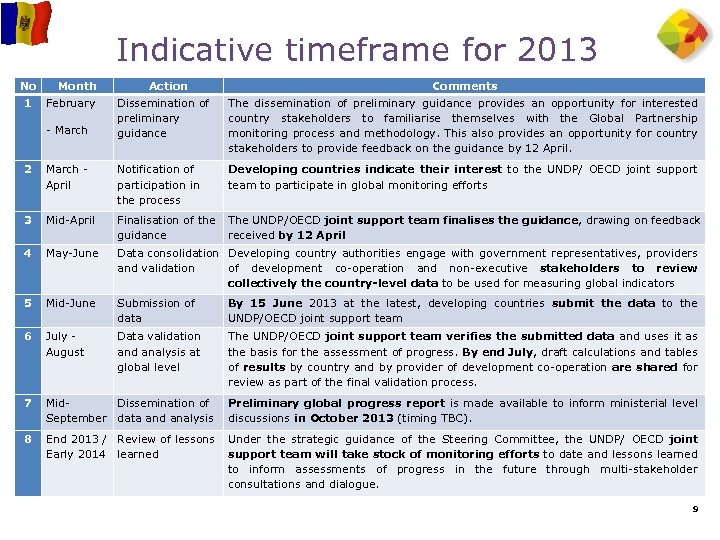 Indicative timeframe for 2013 No 1 Month February - March Action Comments Dissemination of preliminary guidance The dissemination of preliminary guidance provides an opportunity for interested country stakeholders to familiarise themselves with the Global Partnership monitoring process and methodology. This also provides an opportunity for country stakeholders to provide feedback on the guidance by 12 April. Developing countries indicate their interest to the UNDP/ OECD joint support team to participate in global monitoring efforts 2 March April Notification of participation in the process 3 Mid-April Finalisation of the The UNDP/OECD joint support team finalises the guidance, drawing on feedback guidance received by 12 April 4 May-June Data consolidation Developing country authorities engage with government representatives, providers and validation of development co-operation and non-executive stakeholders to review collectively the country-level data to be used for measuring global indicators 5 Mid-June Submission of data By 15 June 2013 at the latest, developing countries submit the data to the UNDP/OECD joint support team 6 July - August Data validation and analysis at global level The UNDP/OECD joint support team verifies the submitted data and uses it as the basis for the assessment of progress. By end July, draft calculations and tables of results by country and by provider of development co-operation are shared for review as part of the final validation process. 7 Mid. Dissemination of September data and analysis 8 End 2013 / Review of lessons Under the strategic guidance of the Steering Committee, the UNDP/ OECD joint Early 2014 learned support team will take stock of monitoring efforts to date and lessons learned to inform assessments of progress in the future through multi-stakeholder consultations and dialogue. Preliminary global progress report is made available to inform ministerial level discussions in October 2013 (timing TBC). 9
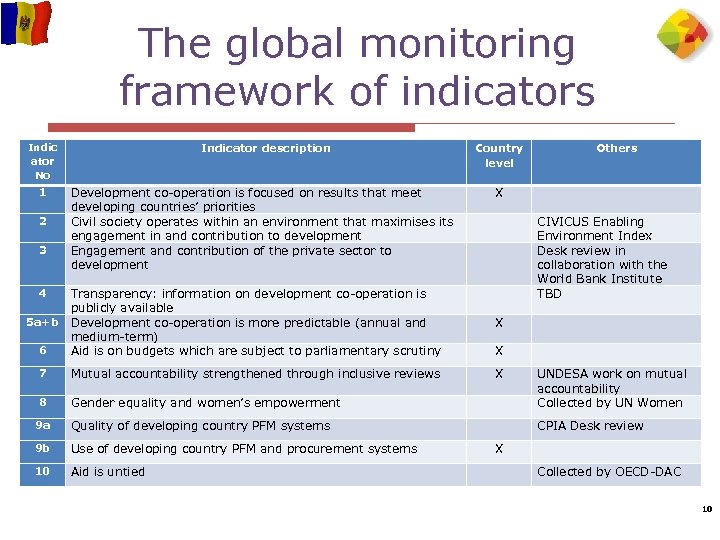 The global monitoring framework of indicators Indic ator No Indicator description Country level 1 Development co-operation is focused on results that meet developing countries’ priorities Civil society operates within an environment that maximises its engagement in and contribution to development Engagement and contribution of the private sector to development X CIVICUS Enabling Environment Index Desk review in collaboration with the World Bank Institute TBD X X 2 3 Transparency: information on development co-operation is publicly available 5 a+b Development co-operation is more predictable (annual and medium-term) 6 Aid is on budgets which are subject to parliamentary scrutiny 4 Others 7 Mutual accountability strengthened through inclusive reviews X 8 Gender equality and women’s empowerment UNDESA work on mutual accountability Collected by UN Women 9 a Quality of developing country PFM systems CPIA Desk review 9 b Use of developing country PFM and procurement systems X 10 Aid is untied Collected by OECD-DAC 10
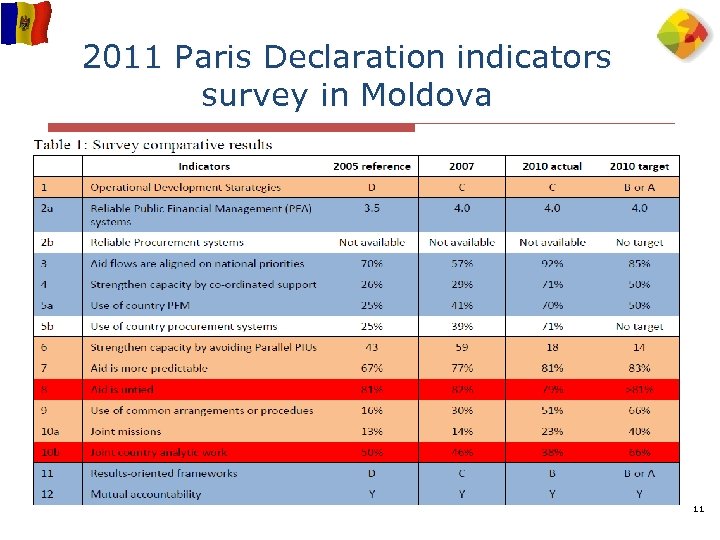 2011 Paris Declaration indicators survey in Moldova 11
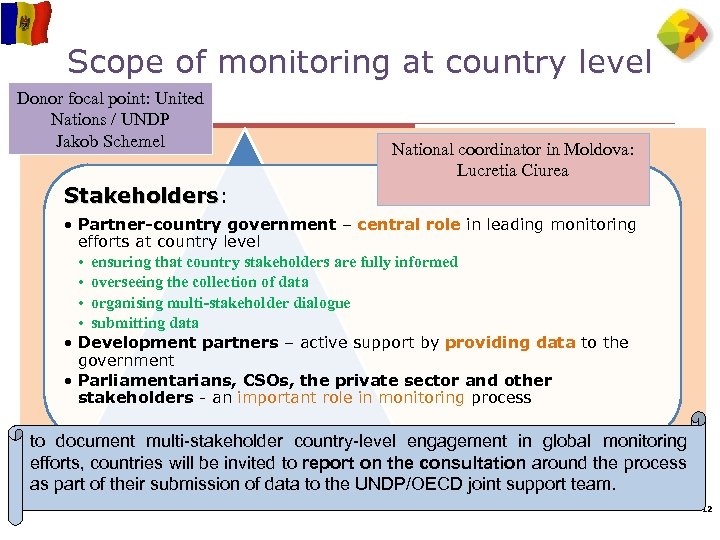 Scope of monitoring at country level Donor focal point: United Nations / UNDP Jakob Schemel National coordinator in Moldova: Lucretia Ciurea Stakeholders: Stakeholders • Partner-country government – central role in leading monitoring efforts at country level • ensuring that country stakeholders are fully informed • overseeing the collection of data • organising multi-stakeholder dialogue • submitting data • Development partners – active support by providing data to the government • Parliamentarians, CSOs, the private sector and other stakeholders - an important role in monitoring process to document multi-stakeholder country-level engagement in global monitoring efforts, countries will be invited to report on the consultation around the process as part of their submission of data to the UNDP/OECD joint support team. General Division for Policy Coordination, Foreign Aid and Central Public Administration Reform at the State Chancellery 12
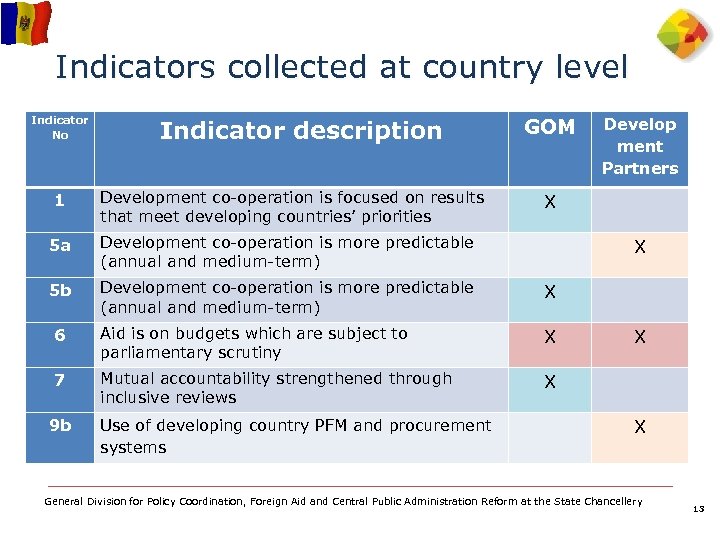 Indicators collected at country level Indicator No Indicator description GOM Development co-operation is focused on results that meet developing countries’ priorities X 5 a Development co-operation is more predictable (annual and medium-term) 5 b Development co-operation is more predictable (annual and medium-term) X 6 Aid is on budgets which are subject to parliamentary scrutiny X 7 Mutual accountability strengthened through inclusive reviews X Use of developing country PFM and procurement systems Develop ment Partners 1 9 b X X X General Division for Policy Coordination, Foreign Aid and Central Public Administration Reform at the State Chancellery 13
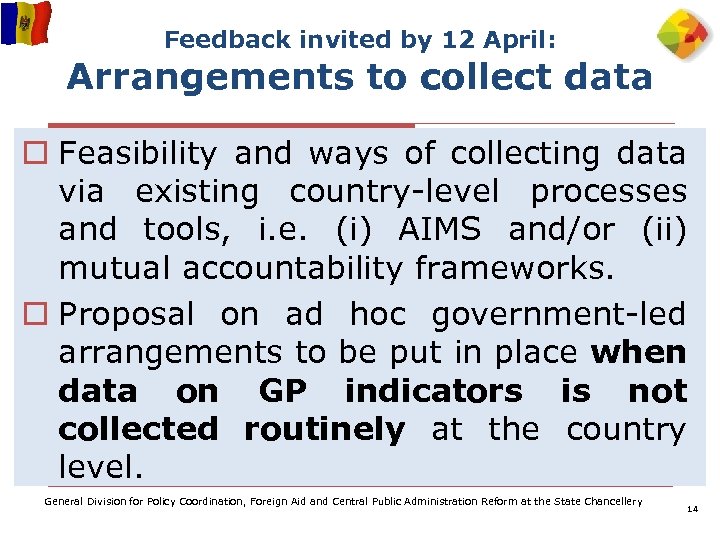 Feedback invited by 12 April: Arrangements to collect data o Feasibility and ways of collecting data via existing country-level processes and tools, i. e. (i) AIMS and/or (ii) mutual accountability frameworks. o Proposal on ad hoc government-led arrangements to be put in place when data on GP indicators is not collected routinely at the country level. General Division for Policy Coordination, Foreign Aid and Central Public Administration Reform at the State Chancellery 14
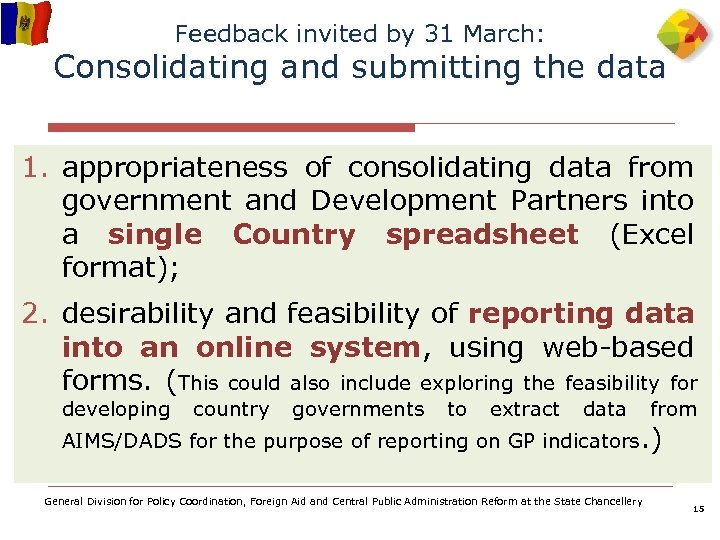 Feedback invited by 31 March: Consolidating and submitting the data 1. appropriateness of consolidating data from government and Development Partners into a single Country spreadsheet (Excel format); 2. desirability and feasibility of reporting data into an online system, using web-based forms. (This could also include exploring the feasibility for developing country governments to extract data from AIMS/DADS for the purpose of reporting on GP indicators. ) General Division for Policy Coordination, Foreign Aid and Central Public Administration Reform at the State Chancellery 15
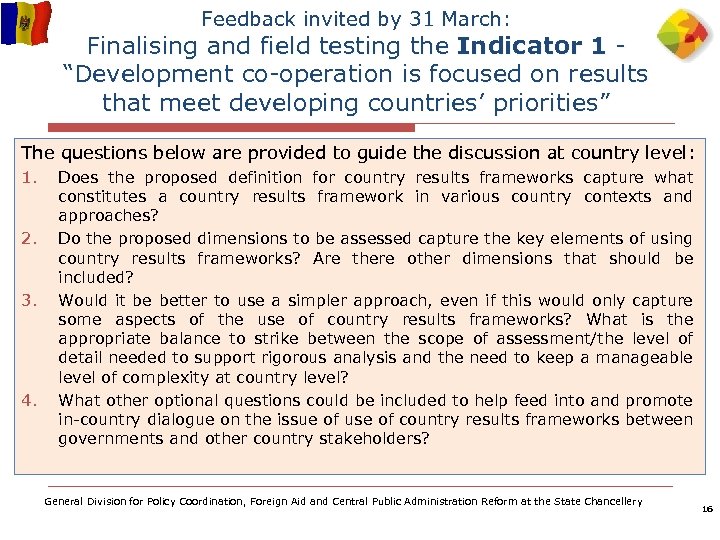 Feedback invited by 31 March: 31 March Finalising and field testing the Indicator 1 “Development co-operation is focused on results that meet developing countries’ priorities” The questions below are provided to guide the discussion at country level: 1. 2. 3. 4. Does the proposed definition for country results frameworks capture what constitutes a country results framework in various country contexts and approaches? Do the proposed dimensions to be assessed capture the key elements of using country results frameworks? Are there other dimensions that should be included? Would it be better to use a simpler approach, even if this would only capture some aspects of the use of country results frameworks? What is the appropriate balance to strike between the scope of assessment/the level of detail needed to support rigorous analysis and the need to keep a manageable level of complexity at country level? What other optional questions could be included to help feed into and promote in-country dialogue on the issue of use of country results frameworks between governments and other country stakeholders? General Division for Policy Coordination, Foreign Aid and Central Public Administration Reform at the State Chancellery 16
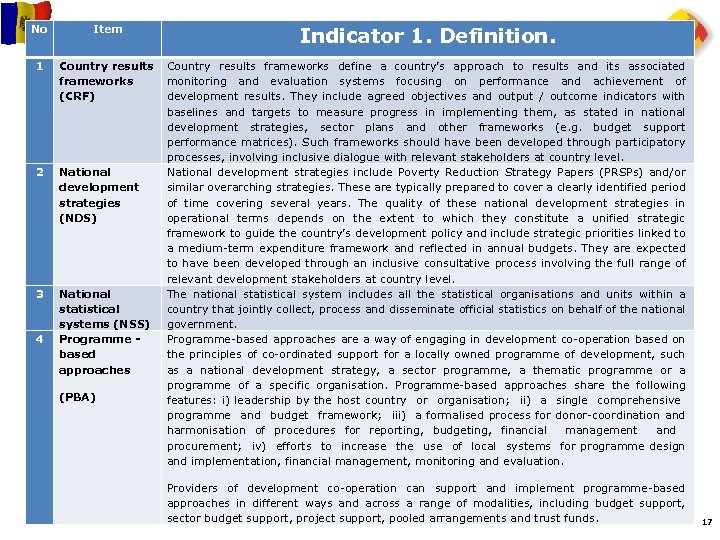 No 1 Item Indicator 1. Definition. Country results frameworks define a country’s approach to results and its associated frameworks monitoring and evaluation systems focusing on performance and achievement of (CRF) development results. They include agreed objectives and output / outcome indicators with baselines and targets to measure progress in implementing them, as stated in national development strategies, sector plans and other frameworks (e. g. budget support performance matrices). Such frameworks should have been developed through participatory processes, involving inclusive dialogue with relevant stakeholders at country level. National development strategies include Poverty Reduction Strategy Papers (PRSPs) and/or development similar overarching strategies. These are typically prepared to cover a clearly identified period strategies of time covering several years. The quality of these national development strategies in (NDS) operational terms depends on the extent to which they constitute a unified strategic framework to guide the country’s development policy and include strategic priorities linked to a medium-term expenditure framework and reflected in annual budgets. They are expected to have been developed through an inclusive consultative process involving the full range of relevant development stakeholders at country level. National The national statistical system includes all the statistical organisations and units within a statistical country that jointly collect, process and disseminate official statistics on behalf of the national systems (NSS) government. Programme-based approaches are a way of engaging in development co-operation based the principles of co-ordinated support for a locally owned programme of development, such approaches as a national development strategy, a sector programme, a thematic programme or a programme of a specific organisation. Programme-based approaches share the following (PBA) features: i) leadership by the host country or organisation; ii) a single comprehensive programme and budget framework; iii) a formalised process for donor-coordination and harmonisation of procedures for reporting, budgeting, financial management and procurement; iv) efforts to increase the use of local systems for programme design and implementation, financial management, monitoring and evaluation. 2 3 4 Providers of development co-operation can support and implement programme-based approaches in different ways and across a range of modalities, including budget support, sector budget support, project support, pooled arrangements and trust funds. 17
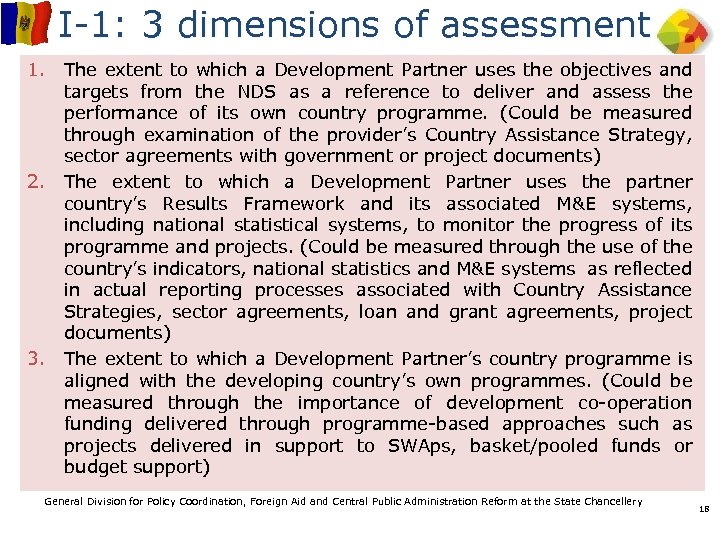 I-1: 3 dimensions of assessment 1. 2. 3. The extent to which a Development Partner uses the objectives and targets from the NDS as a reference to deliver and assess the performance of its own country programme. (Could be measured through examination of the provider’s Country Assistance Strategy, sector agreements with government or project documents) The extent to which a Development Partner uses the partner country’s Results Framework and its associated M&E systems, including national statistical systems, to monitor the progress of its programme and projects. (Could be measured through the use of the country’s indicators, national statistics and M&E systems as reflected in actual reporting processes associated with Country Assistance Strategies, sector agreements, loan and grant agreements, project documents) The extent to which a Development Partner’s country programme is aligned with the developing country’s own programmes. (Could be measured through the importance of development co-operation funding delivered through programme-based approaches such as projects delivered in support to SWAps, basket/pooled funds or budget support) General Division for Policy Coordination, Foreign Aid and Central Public Administration Reform at the State Chancellery 18
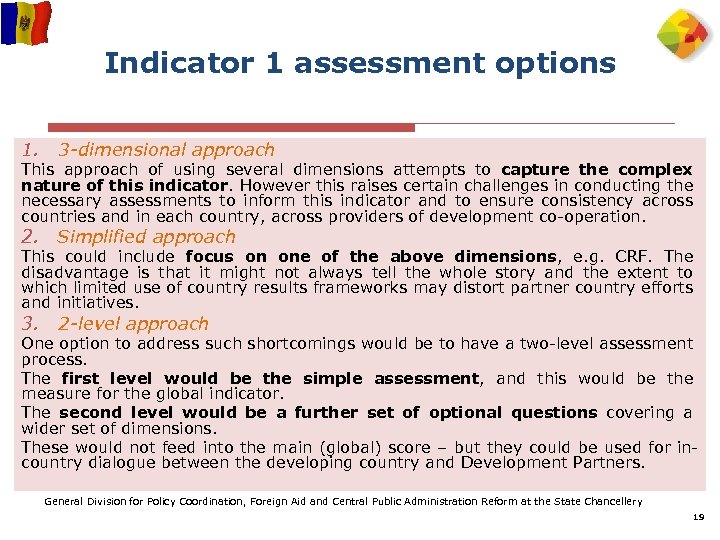 Indicator 1 assessment options 1. 3 -dimensional approach This approach of using several dimensions attempts to capture the complex nature of this indicator. However this raises certain challenges in conducting the necessary assessments to inform this indicator and to ensure consistency across countries and in each country, across providers of development co-operation. 2. Simplified approach This could include focus on one of the above dimensions, e. g. CRF. The disadvantage is that it might not always tell the whole story and the extent to which limited use of country results frameworks may distort partner country efforts and initiatives. 3. 2 -level approach One option to address such shortcomings would be to have a two-level assessment process. The first level would be the simple assessment, and this would be the measure for the global indicator. The second level would be a further set of optional questions covering a wider set of dimensions. These would not feed into the main (global) score – but they could be used for incountry dialogue between the developing country and Development Partners. General Division for Policy Coordination, Foreign Aid and Central Public Administration Reform at the State Chancellery 19
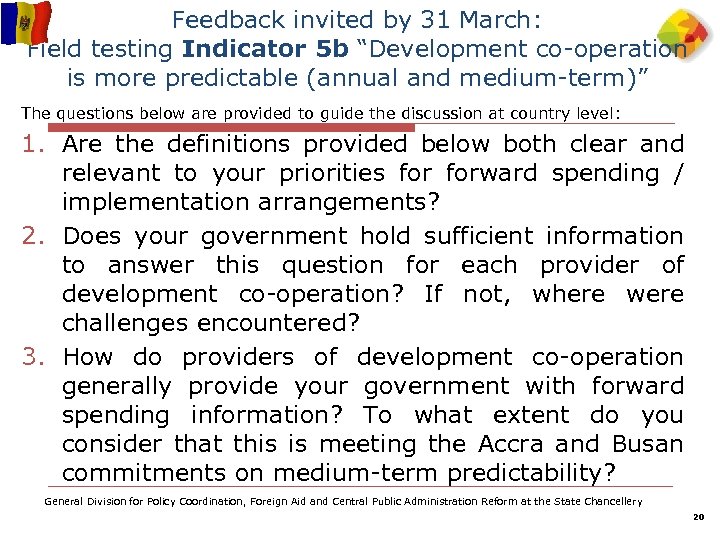 Feedback invited by 31 March: Feedback invited by 31 March Field testing Indicator 5 b “Development co-operation is more predictable (annual and medium-term)” The questions below are provided to guide the discussion at country level: 1. Are the definitions provided below both clear and relevant to your priorities forward spending / implementation arrangements? 2. Does your government hold sufficient information to answer this question for each provider of development co-operation? If not, where were challenges encountered? 3. How do providers of development co-operation generally provide your government with forward spending information? To what extent do you consider that this is meeting the Accra and Busan commitments on medium-term predictability? General Division for Policy Coordination, Foreign Aid and Central Public Administration Reform at the State Chancellery 20
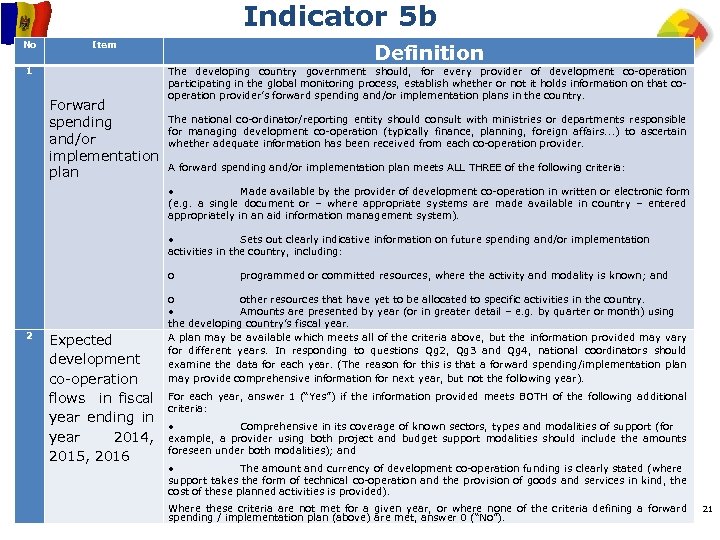 Indicator 5 b No Item 1 Forward spending and/or implementation plan 2 Expected development co-operation flows in fiscal year ending in year 2014, 2015, 2016 Definition The developing country government should, for every provider of development co-operation participating in the global monitoring process, establish whether or not it holds information on that co- operation provider’s forward spending and/or implementation plans in the country. The national co-ordinator/reporting entity should consult with ministries or departments responsible for managing development co-operation (typically finance, planning, foreign affairs. . . ) to ascertain whether adequate information has been received from each co-operation provider. A forward spending and/or implementation plan meets ALL THREE of the following criteria: • Made available by the provider of development co-operation in written or electronic form (e. g. a single document or – where appropriate systems are made available in country – entered appropriately in an aid information management system). • Sets out clearly indicative information on future spending and/or implementation activities in the country, including: o programmed or committed resources, where the activity and modality is known; and o other resources that have yet to be allocated to specific activities in the country. • Amounts are presented by year (or in greater detail – e. g. by quarter or month) using the developing country’s fiscal year. A plan may be available which meets all of the criteria above, but the information provided may vary for different years. In responding to questions Qg 2, Qg 3 and Qg 4, national coordinators should examine the data for each year. (The reason for this is that a forward spending/implementation plan may provide comprehensive information for next year, but not the following year). For each year, answer 1 (“Yes”) if the information provided meets BOTH of the following additional criteria: • Comprehensive in its coverage of known sectors, types and modalities of support (for example, a provider using both project and budget support modalities should include the amounts foreseen under both modalities); and • The amount and currency of development co-operation funding is clearly stated (where support takes the form of technical co-operation and the provision of goods and services in kind, the cost of these planned activities is provided). Where these criteria are not met for a given year, or where none of the criteria defining a forward spending / implementation plan (above) are met, answer 0 (“No”). 21
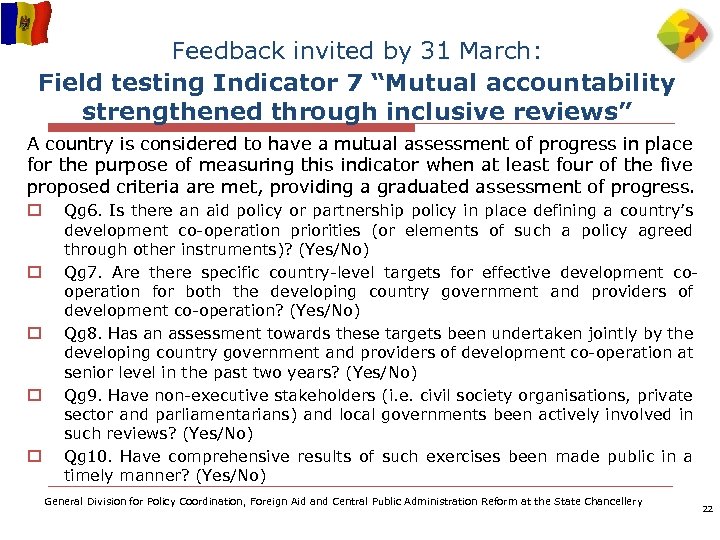 Feedback invited by 31 March: Feedback invited by 31 March Field testing Indicator 7 “Mutual accountability strengthened through inclusive reviews” A country is considered to have a mutual assessment of progress in place for the purpose of measuring this indicator when at least four of the five proposed criteria are met, providing a graduated assessment of progress. o o o Qg 6. Is there an aid policy or partnership policy in place defining a country’s development co-operation priorities (or elements of such a policy agreed through other instruments)? (Yes/No) Qg 7. Are there specific country-level targets for effective development cooperation for both the developing country government and providers of development co-operation? (Yes/No) Qg 8. Has an assessment towards these targets been undertaken jointly by the developing country government and providers of development co-operation at senior level in the past two years? (Yes/No) Qg 9. Have non-executive stakeholders (i. e. civil society organisations, private sector and parliamentarians) and local governments been actively involved in such reviews? (Yes/No) Qg 10. Have comprehensive results of such exercises been made public in a timely manner? (Yes/No) General Division for Policy Coordination, Foreign Aid and Central Public Administration Reform at the State Chancellery 22
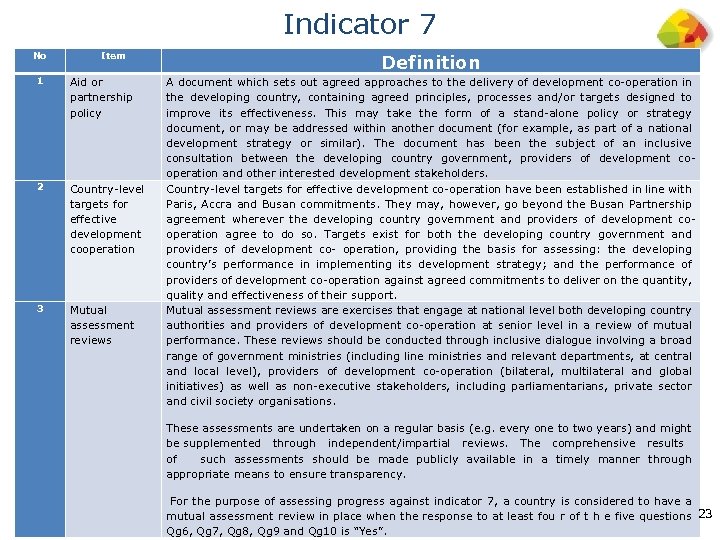 Indicator 7 No Item 1 Aid or partnership policy 2 Country-level targets for effective development cooperation 3 Mutual assessment reviews Definition A document which sets out agreed approaches to the delivery of development co-operation in the developing country, containing agreed principles, processes and/or targets designed to improve its effectiveness. This may take the form of a stand-alone policy or strategy document, or may be addressed within another document (for example, as part of a national development strategy or similar). The document has been the subject of an inclusive consultation between the developing country government, providers of development cooperation and other interested development stakeholders. Country-level targets for effective development co-operation have been established in line with Paris, Accra and Busan commitments. They may, however, go beyond the Busan Partnership agreement wherever the developing country government and providers of development cooperation agree to do so. Targets exist for both the developing country government and providers of development co- operation, providing the basis for assessing: the developing country’s performance in implementing its development strategy; and the performance of providers of development co-operation against agreed commitments to deliver on the quantity, quality and effectiveness of their support. Mutual assessment reviews are exercises that engage at national level both developing country authorities and providers of development co-operation at senior level in a review of mutual performance. These reviews should be conducted through inclusive dialogue involving a broad range of government ministries (including line ministries and relevant departments, at central and local level), providers of development co-operation (bilateral, multilateral and global initiatives) as well as non-executive stakeholders, including parliamentarians, private sector and civil society organisations. These assessments are undertaken on a regular basis (e. g. every one to two years) and might be supplemented through independent/impartial reviews. The comprehensive results of such assessments should be made publicly available in a timely manner through appropriate means to ensure transparency. For the purpose of assessing progress against indicator 7, a country is considered to have a mutual assessment review in place when the response to at least fou r of t h e five questions 23 Qg 6, Qg 7, Qg 8, Qg 9 and Qg 10 is “Yes”.
 For more information and feedback More information at: o http: //www. aideffectiveness. org/busanhlf 4/ab out/global-partnership. html o http: //www. ncu. moldova. md/ Provide feedback to o Lucretia Ciurea at Lucretia. Ciurea@gov. md or o Jakob Schemel at jakob. schemel@one. un. org General Division for Policy Coordination, Foreign Aid and Central Public Administration Reform at the State Chancellery 24
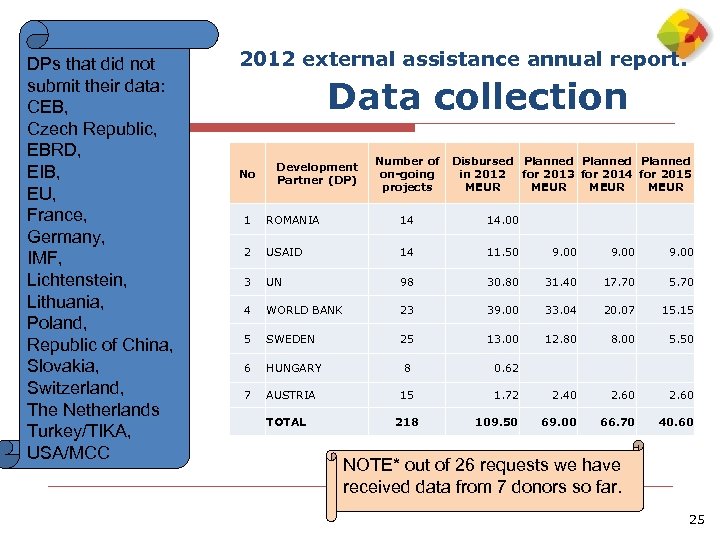 DPs that did not submit their data: CEB, Czech Republic, EBRD, EIB, EU, France, Germany, IMF, Lichtenstein, Lithuania, Poland, Republic of China, Slovakia, Switzerland, The Netherlands Turkey/TIKA, USA/MCC 2012 external assistance annual report. Data collection No Development Partner (DP) Number of Disbursed Planned on-going in 2012 for 2013 for 2014 for 2015 projects MEUR 1 ROMANIA 14 14. 00 2 USAID 14 11. 50 9. 00 3 UN 98 30. 80 31. 40 17. 70 5. 70 4 WORLD BANK 23 39. 00 33. 04 20. 07 15. 15 5 SWEDEN 25 13. 00 12. 80 6 HUNGARY 8 0. 62 7 AUSTRIA 15 1. 72 TOTAL 218 109. 50 8. 00 2. 40 69. 00 2. 60 66. 70 5. 50 2. 60 40. 60 NOTE* out of 26 requests we have received data from 7 donors so far. 25