


 Скачать презентацию Domotic Centre for Research and Technology Hellas Hellenic
5ac9bc356b9bc24f760acbdcc00ee23c.ppt
- Количество слайдов: 12
 Domotic Centre for Research and Technology Hellas Hellenic Institute of Transport Web: www. hit. certh. gr Kostas Kalogirou – Taxiarchis Tsaprounis Email: kalogir@certh. gr, Taxiarchis. Tsaprounis@certh. gr
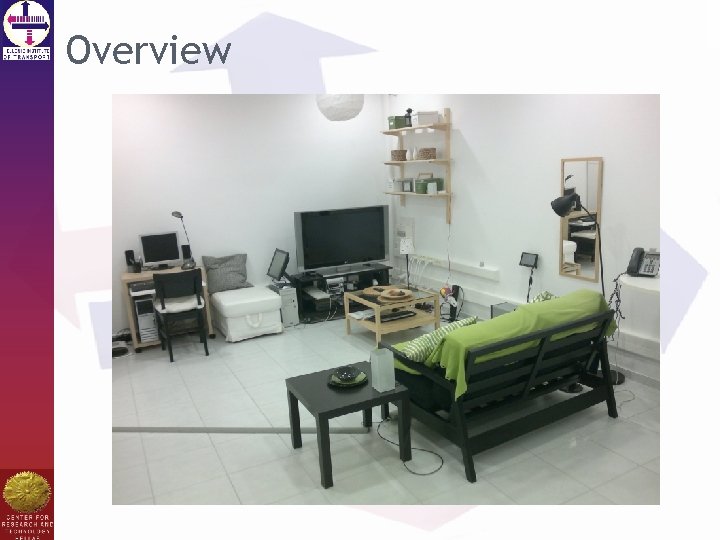 Overview
 Objectives • To control the environment at home, in order to provide the necessary comfort, security and safety • To offer remote access to home appliances • To monitor home status anytime, anywhere • To increase confidence and self-esteem of the elderly or people with physical disabilities inside the house • To reduce in-house physical mobility for people with physical disabilities • To provide to elderly people’s caregivers (i. e. neighbors, family relatives) the opportunity to monitor their home environment
 Actuators • Door ▫ Open ▫ Close ▫ Lock • Devices ▫ Switch on ▫ Switch off • Light ▫ Increase brightness ▫ Decrease brightness
 Sensors • • • IP Cameras Humidity monitoring Temperature monitoring CO detection Motion detection Energy consumption Device status monitoring Door status monitoring Light detection
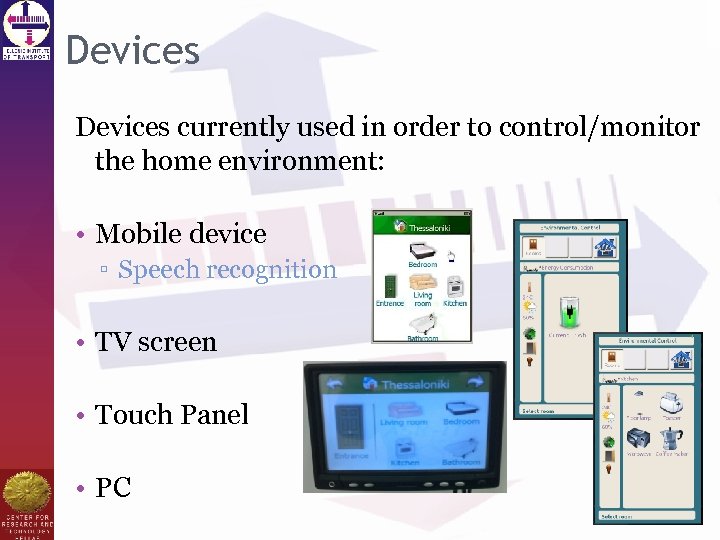 Devices currently used in order to control/monitor the home environment: • Mobile device ▫ Speech recognition • TV screen • Touch Panel • PC
 Technologies The domotic server communicates with the sensors and actuators with the use of the following: • Wired Technologies ▫ HS 485, HS 485 D • Wireless Technologies ▫ ▫ ▫ FS 20 H 300 EM FHT HMS KS 300
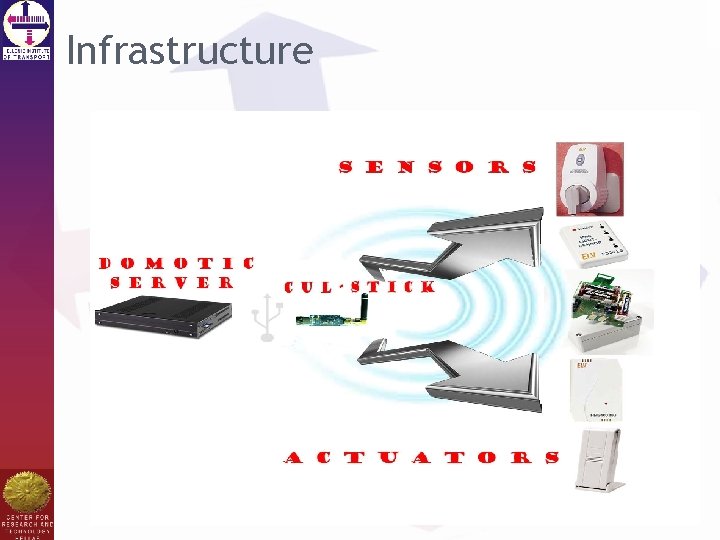 Infrastructure
 How it works (1/2) • A specific Bus-Adapter, the so-called CUL-Stick, provides a bridge to all communication protocols in the frequency band of 868 MHz. The CUL-Stick is connected by USB to the Domotic server. • The assignment of domotic devices to the Domotic server is realized by the so-called Learning process. • To provide web-services for every device of the domotic network, the Domotic server has to “know” each device and its functionalities. • During the installation process, a new device is assigned to the Domotic server by the installer. This is done by creating a virtual representation of the device, existing as software structure inside the Domotic server.
 How it works (2/2) • All web services will affect the virtual representation of the device, and the Domotic server will forward status change automatically to the “real” device (placeholder mechanism). Vice-versa, status changes of the real device will be mapped to the virtual device. • During the installation process, a technician switches a domotic device to a “learning mode” and uses a web interface (next slide), provided by the Domotic server, to assign the device. • The Domotic server creates an abstraction instance for the device type. Accordingly, the Domotic server creates a unique address and sends it with a command to the device, which is in the learning mode. • After the learning process, the device is “known” by the Domotic server, and it can be controlled by web-services.
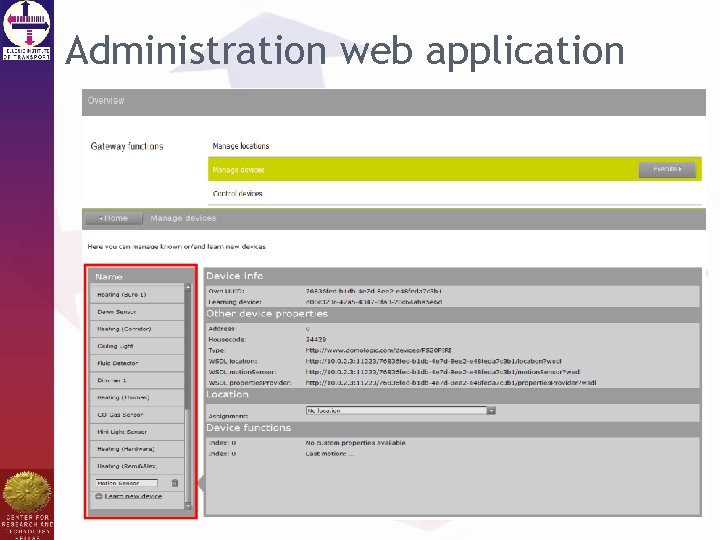 Administration web application
 Thank you!