


 Скачать презентацию Dominic Counsell Scottish Natural Heritage
a984ad0d3879f7f39c0794243919e891.ppt
- Количество слайдов: 32
 Dominic Counsell Scottish Natural Heritage
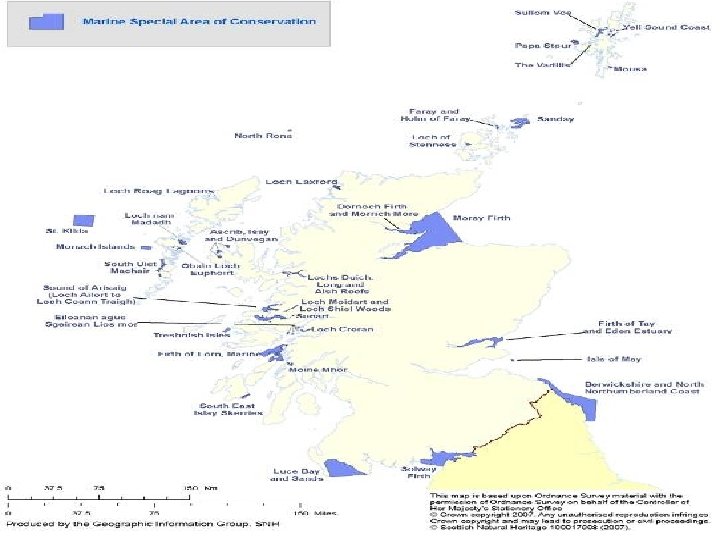
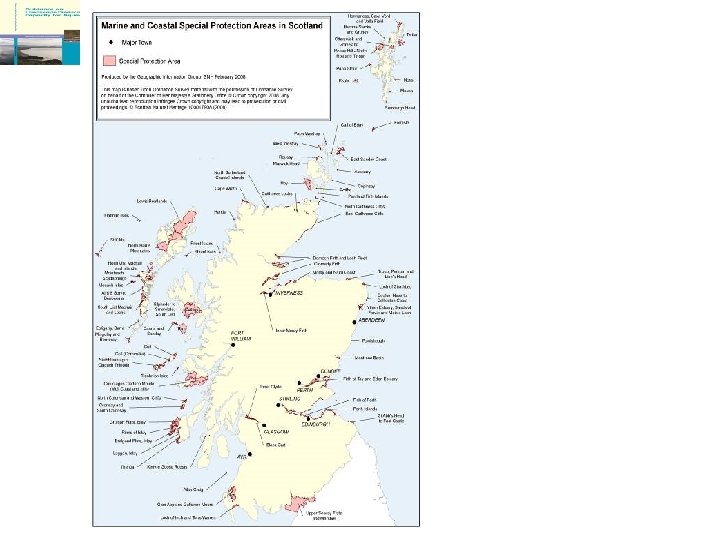
 • Natura 2000 • Landscape capacity for aquaculture
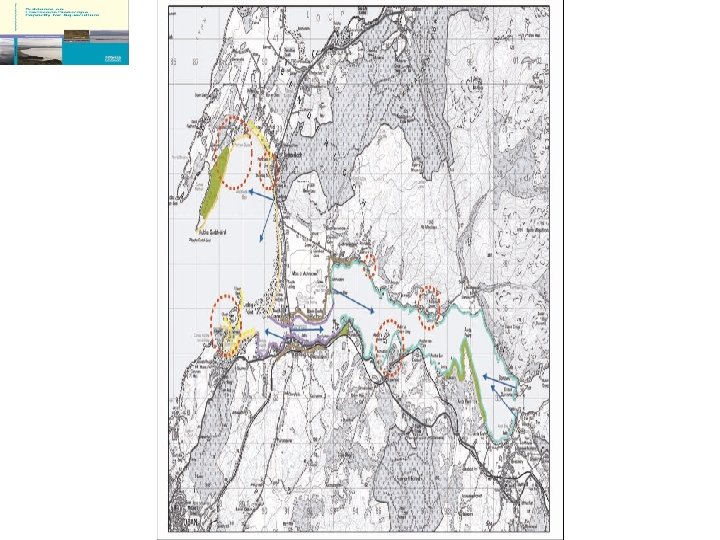
 Conservation Objectives, Loch Creran marine SAC: To avoid deterioration of the qualifying habitat (Reefs) thus ensuring that the integrity of the site is maintained …. To ensure for the qualifying habitat the following are maintained in the long term: • Extent of the habitat on site • Distribution of the habitat within site • Structure and function of the habitat • Processes supporting the habitat • Distribution of typical species of the habitat • Viability of typical species as components of the habitat • No significant disturbance of typical species of the habitat
 HD Article 6. 2 Member States shall take appropriate steps to avoid, in the special areas of conservation, the deterioration of natural habitats and the habitats of species as well as disturbance of the species for which the areas have been designated, in so far as such disturbance could be significant in relation to the objectives of this Directive.
 HD Article 6. 3 Any plan or project not directly connected with or necessary to the management of the site but likely to have a significant effect thereon, either individually or in combination with other plans or projects, shall be subject to appropriate assessment of its implications for the site in view of the site's conservation objectives. In the light of the conclusions of the assessment of the implications for the site and subject to the provisions of paragraph 4, the competent national authorities shall agree to the plan or project only after having ascertained that it will not adversely affect the integrity of the site concerned and, if appropriate, after having obtained the opinion of the general public.
 Plans or projects For Natura sites three basic tests: • • • is proposal connected with nature conservation management? is it likely to have a significant effect? can it be ascertained that the proposal will not adversely affect the integrity of the site?
 Is it likely to have a significant effect? • test is alone or in combination • plans and projects outwith sites need to be considered: consider connectivity • what may be significant for one site may not be for another
 Judging significant effect • made by the competent authority (but SNH often consulted) • coarse filter - 1 st stage of process • must be made in relation to the qualifying interests • all decisions must be based on sound reasons which must be recorded
 Waddenzee “…any plan or project not directly connected with or necessary to the management of the site is to be subject to an appropriate assessment of its implications for the site in view of the site’s conservation objectives if it cannot be excluded, on the basis of objective information, that it will have a significant effect on that site, either individually or in combination with other plans or projects. ”
 If likely significant effect • undertake an appropriate assessment • “in view of that sites conservation objectives” i. e. the reasons for which the site was classified • “…shall agree to a project only after having ascertained that it will not adversely affect the integrity of the European site. ”
 SG Interim guidance assessing development plans… “As a guide, any element of a plan which has the potential to affect the interests of the site should initially be considered significant and an appropriate assessment undertaken. ”
 Waddenzee The competent national authorities, taking account of the appropriate assessment … in the light of the site’s conservation objectives, are to authorise such an activity only if they have made certain that it will not adversely affect the integrity of that site. That is the case where no reasonable scientific doubt remains as to the absence of such effects.
 Integrity • will always be a matter for scientific judgement • will depend on a number of factors which vary from case to case • judgement should be reasoned, and recorded
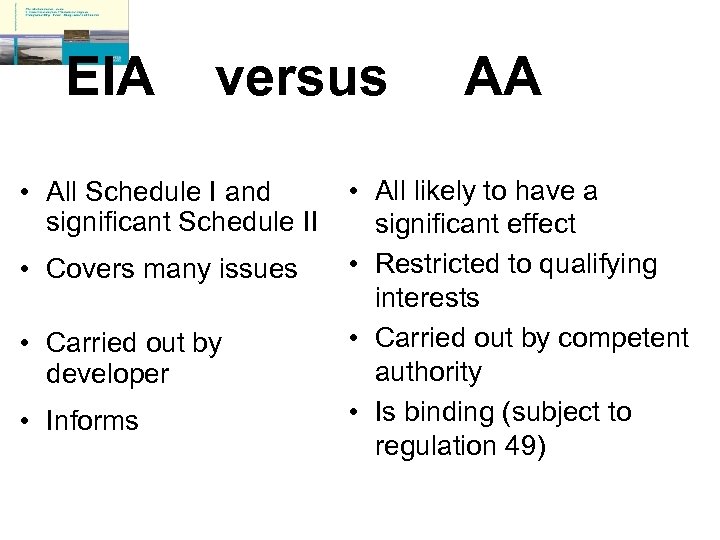 EIA versus • All Schedule I and significant Schedule II • Covers many issues • Carried out by developer • Informs AA • All likely to have a significant effect • Restricted to qualifying interests • Carried out by competent authority • Is binding (subject to regulation 49)
 Landscape/ Seascape carrying capacity for aquaculture


 Importance and value of Scotland’s landscapes • Distinct and diverse range of landscapes • Held in high regard as part of natural and cultural heritage • Important resource, contributing to social and economic well-being of Scotland • Surroundings to people’s daily lives • Provide the special places whose character and scenic quality is the main attraction for outdoor recreation and tourism.
 SNH’s Aim for Scotland’s Landscape • To safeguard and enhance the distinct identity, the diverse character and the special qualities of Scotland’s landscapes as a whole, so as to ensure tomorrow’s landscapes contribute positively to people’s environment and are at least as attractive and valued as they are today
 Advising on landscape change Change can: • Modify landscape, but be accommodated within the existing character • Transform a landscape’s character and create a different character type – gradually or suddenly To a great extent most change should fit with and enhance existing landscape character, particularly where present character is highly valued
 Landscape capacity • The ability of a landscape to accommodate different amounts of change or development of a specific type.
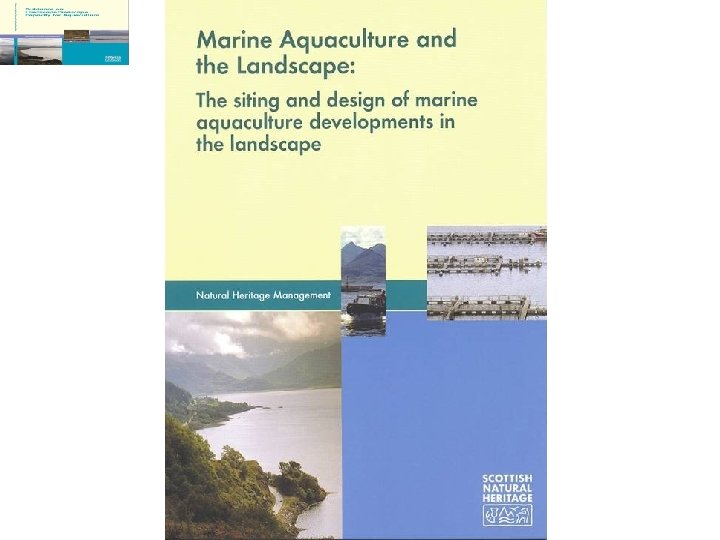
 Landscape capacity studies To assess the character and visual qualities of coastal areas to determine where aquaculture development may be best accommodated. 1. Identify the character areas, to ensure coherent assessment and presentation 2. Survey and analysis 3. Identify opportunities and constraints 4. Assess the sensitivity of character areas 5. Conclusions
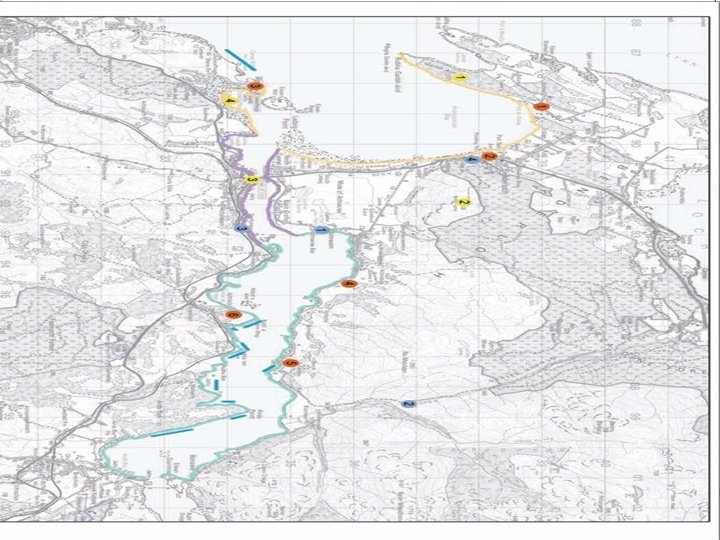
 Opportunities – may relate to: • physical character of the shoreline, such as a simple, linear coastline against which development may be located • scale and expansiveness of the seascape • the ‘ambience’ of the coast, for example where a coastline is busy and developed, or • the character of the hinterland
 Constraints Where aquaculture may have an impact on: • significant/ defining characteristics of landscape • features valued because of their historic, cultural or aesthetic qualities • aspects of the experience or appreciation of a place • areas of visual sensitivity
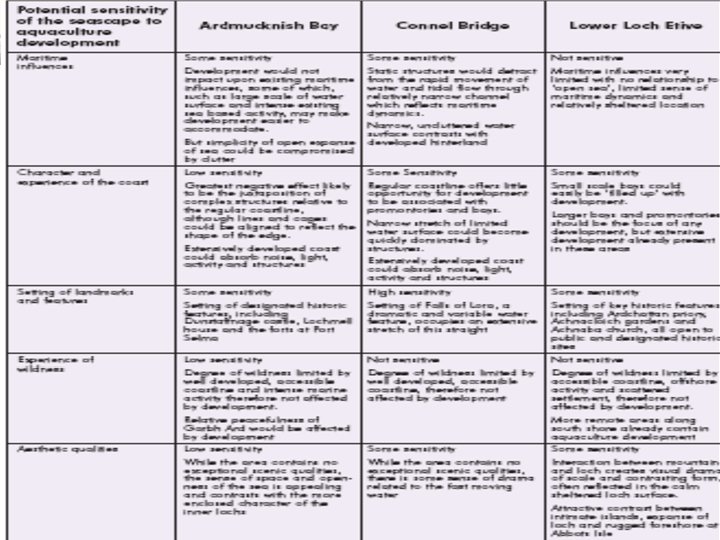
 Sensitivity • Maritime influences • Character and experience of the coastal edge • Setting of landmarks and features • Experience of wildness • Aesthetic qualities • Key viewpoints
 Conclusions • Areas where there is low/ some/ high potential for the landscape to accommodate aquaculture development • Areas where existing aquaculture development already reaches capacity in landscape terms and there is no further capacity for development • etc