 Скачать презентацию Domestic Rainwater Systems Domestic rainwater systems Objectives
c8cfa4a32c4b8b11f0d144dd45c853cd.ppt
- Количество слайдов: 36



Domestic Rainwater Systems
Domestic rainwater systems Objectives By the end of this session you will be able to: • specify the location of running outlets on a rainwater system; • explain problems linked with changes of direction on gutters; • give details on the types of gutters and their profiles; • describe rainwater fittings and materials.
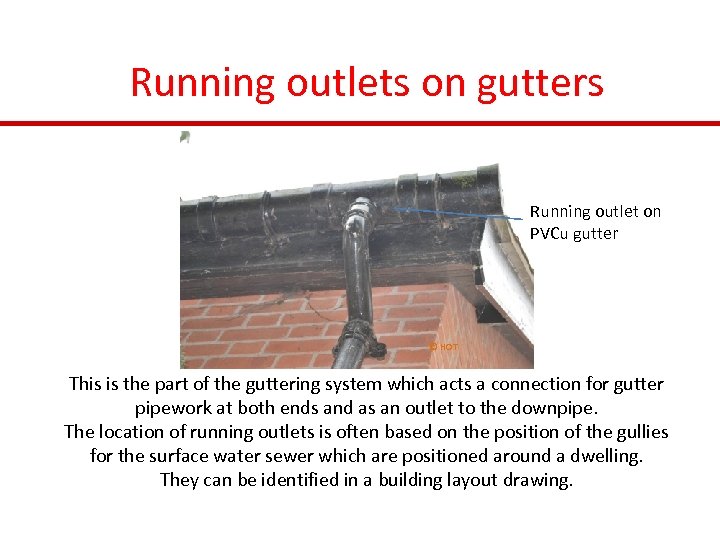
Running outlets on gutters Running outlet on PVCu gutter © HOT This is the part of the guttering system which acts a connection for gutter pipework at both ends and as an outlet to the downpipe. The location of running outlets is often based on the position of the gullies for the surface water sewer which are positioned around a dwelling. They can be identified in a building layout drawing.
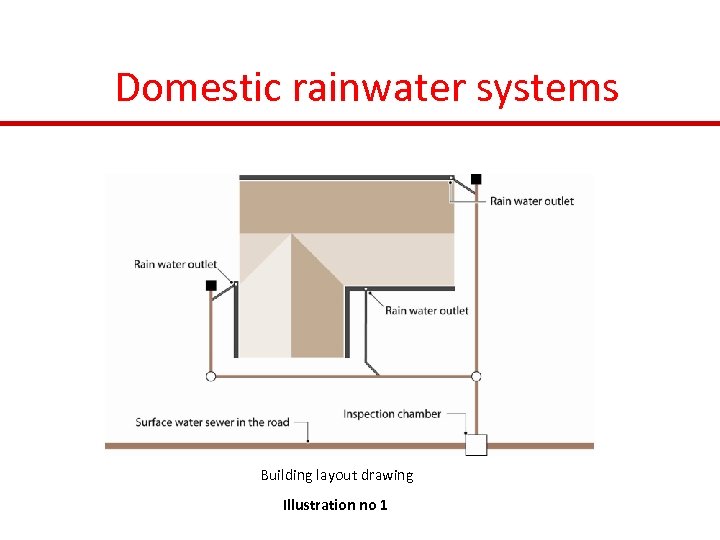
Domestic rainwater systems Building layout drawing Illustration no 1
Running outlet positions The guttering system will be more effective with more outlets located on the guttering system as this will allow for a better balanced flow from the roof. By placing an outlet centrally rather than at the ends of a roof, it means that the outlet could accommodate a greater area of roof water run off. The illustrations that follow show that the specific location of outlets can increase the effectiveness of a guttering system. By dividing the expected flow rate of the roof by the flow rate of the outlet you can work out how many outlets you will need, so always check the manufacturer’s literature as flow rates for outlets vary.
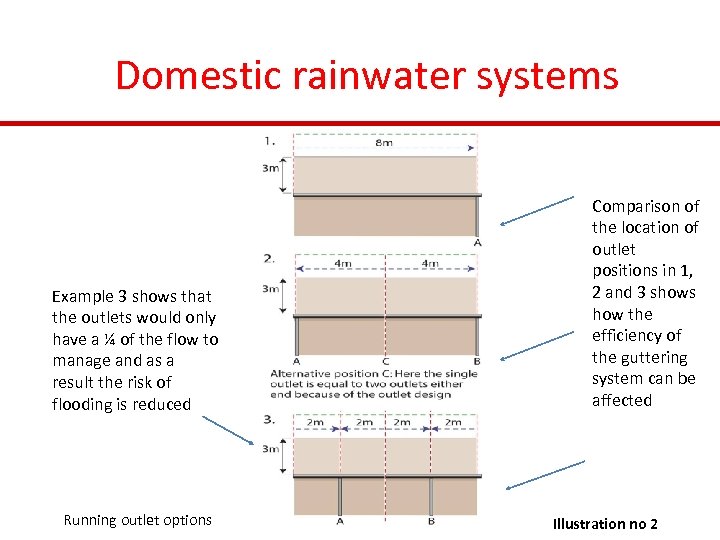
Domestic rainwater systems Example 3 shows that the outlets would only have a ¼ of the flow to manage and as a result the risk of flooding is reduced Running outlet options Comparison of the location of outlet positions in 1, 2 and 3 shows how the efficiency of the guttering system can be affected Illustration no 2
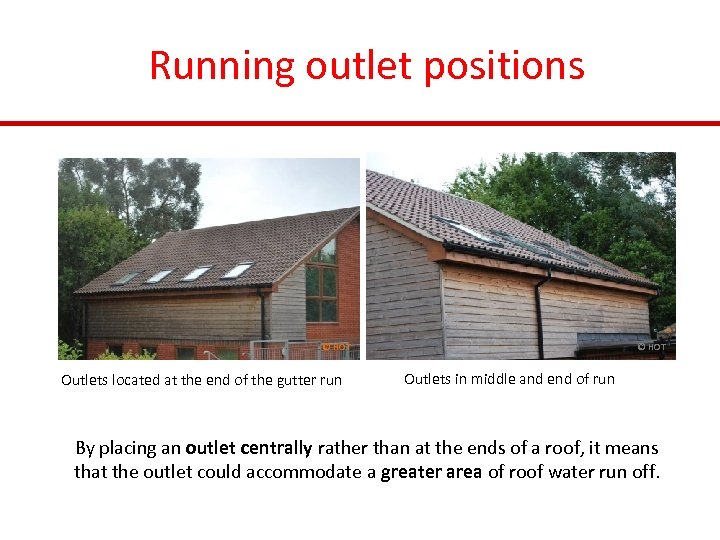
Running outlet positions © HOT Outlets located at the end of the gutter run © HOT Outlets in middle and end of run By placing an outlet centrally rather than at the ends of a roof, it means that the outlet could accommodate a greater area of roof water run off.
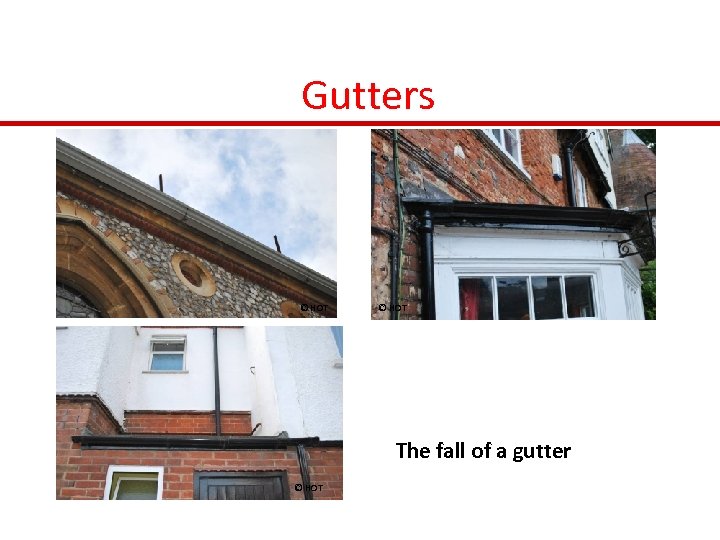
Gutters The fall of a gutter Gutters should be laid so that they fall between 1 and 3 mm/m. This is interpreted as a fall of 1: 600 (25 mm for every 15 m). Although gutters are designed to discharge water when installed level, a fall will greatly increase the flow capacity. Another reason for the fall of 1: 600 is that it will ensure that the gutter will not fall too low at the end run. Brackets should be installed at a maximum of 1 m intervals to ensure the gutter can accurately contain a fall and that it does not sag when filled with water.
Gutters © HOT The fall of a gutter © HOT
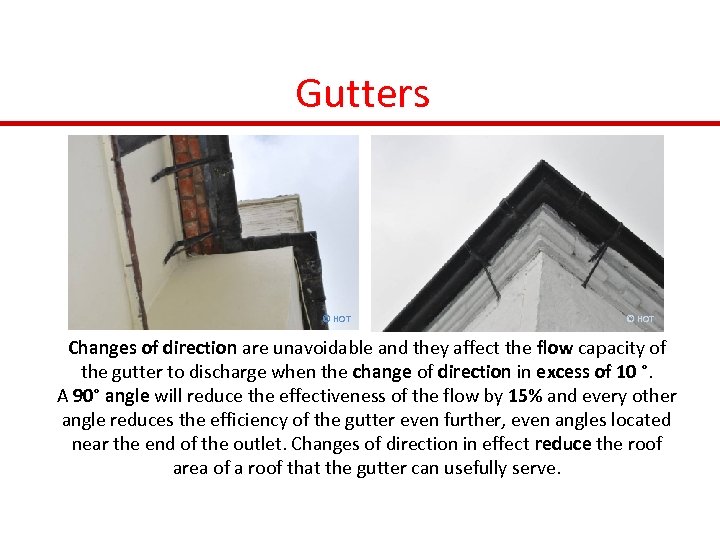
Gutters © HOT Changes of direction are unavoidable and they affect the flow capacity of the gutter to discharge when the change of direction in excess of 10 °. A 90° angle will reduce the effectiveness of the flow by 15% and every other angle reduces the efficiency of the gutter even further, even angles located near the end of the outlet. Changes of direction in effect reduce the roof area of a roof that the gutter can usefully serve.
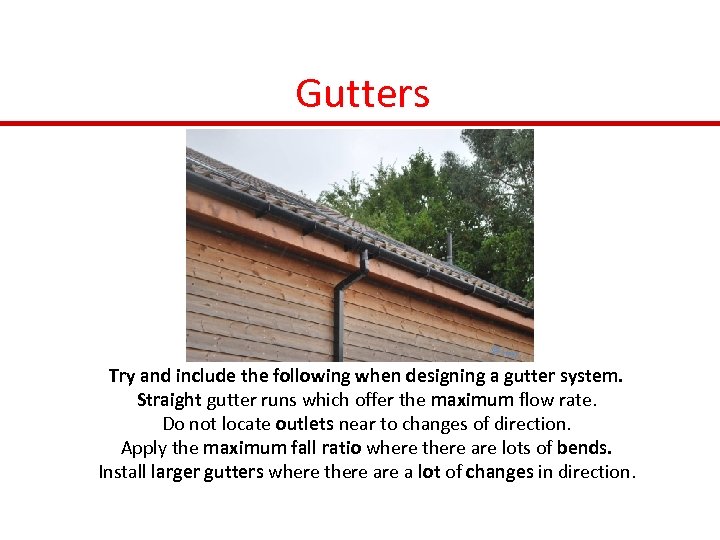
Gutters © HO T Try and include the following when designing a gutter system. Straight gutter runs which offer the maximum flow rate. Do not locate outlets near to changes of direction. Apply the maximum fall ratio where there are lots of bends. Install larger gutters where there a lot of changes in direction.
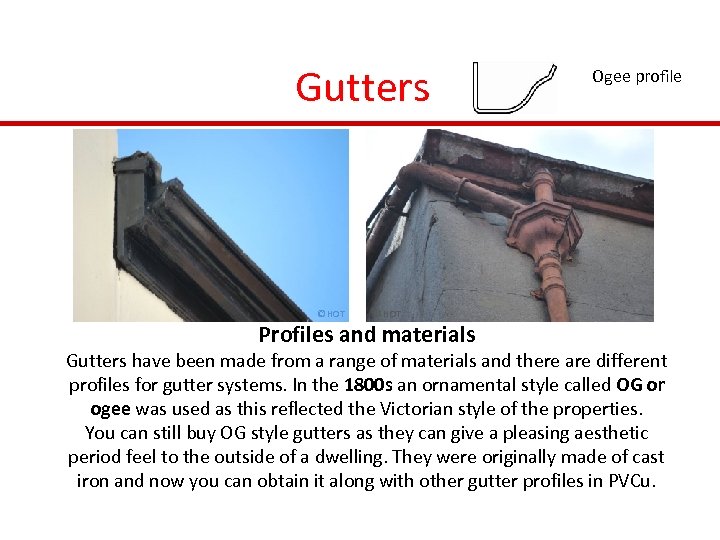
Gutters © HOT Ogee profile © HOT Profiles and materials Gutters have been made from a range of materials and there are different profiles for gutter systems. In the 1800 s an ornamental style called OG or ogee was used as this reflected the Victorian style of the properties. You can still buy OG style gutters as they can give a pleasing aesthetic period feel to the outside of a dwelling. They were originally made of cast iron and now you can obtain it along with other gutter profiles in PVCu.
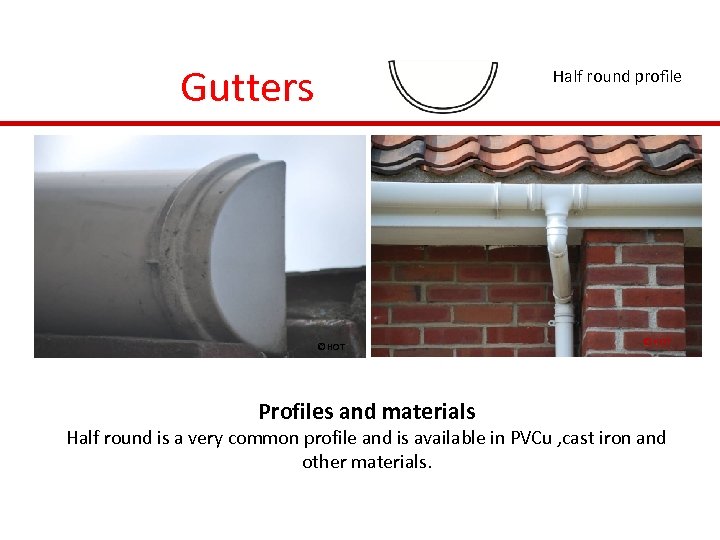
Gutters Half round profile © HOT Profiles and materials © HOT Half round is a very common profile and is available in PVCu , cast iron and other materials.
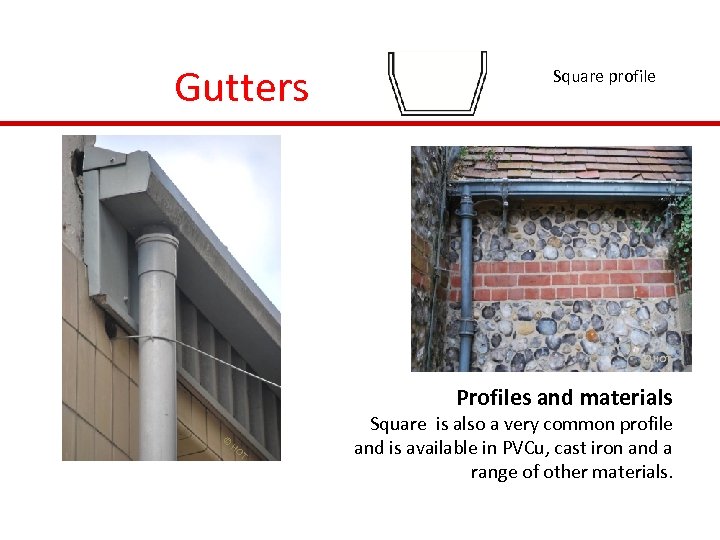
Gutters Square profile © HOT Profiles and materials © HO T Square is also a very common profile and is available in PVCu, cast iron and a range of other materials.
Gutters The British Standard for PVCu eaves guttering and fittings is BS EN 607: 2004. BS EN 122001: 2000 covers rainwater piping systems for above ground external use. Most of the guttering system used on domestic dwellings are made from unplasticised polyvinyl chloride (PVCu).
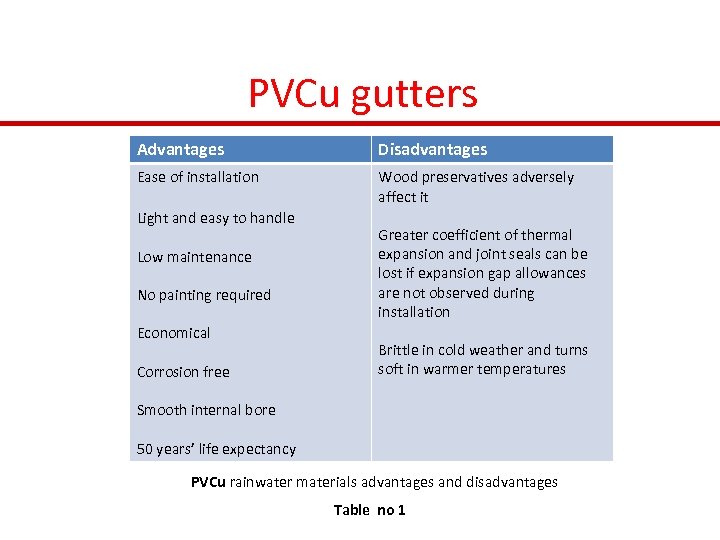
PVCu gutters Advantages Disadvantages Ease of installation Wood preservatives adversely affect it Light and easy to handle Low maintenance No painting required Economical Corrosion free Greater coefficient of thermal expansion and joint seals can be lost if expansion gap allowances are not observed during installation Brittle in cold weather and turns soft in warmer temperatures Smooth internal bore 50 years’ life expectancy PVCu rainwater materials advantages and disadvantages Table no 1
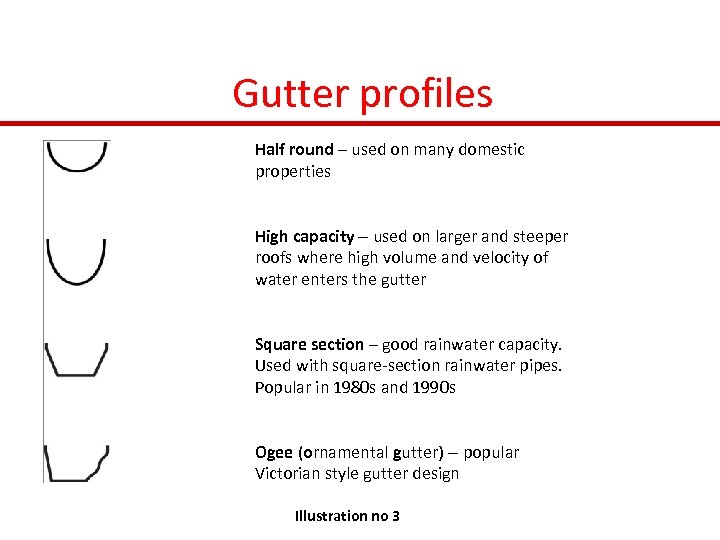
Gutter profiles Half round – used on many domestic properties High capacity – used on larger and steeper roofs where high volume and velocity of water enters the gutter Square section – good rainwater capacity. Used with square-section rainwater pipes. Popular in 1980 s and 1990 s Ogee (ornamental gutter) – popular Victorian style gutter design Illustration no 3
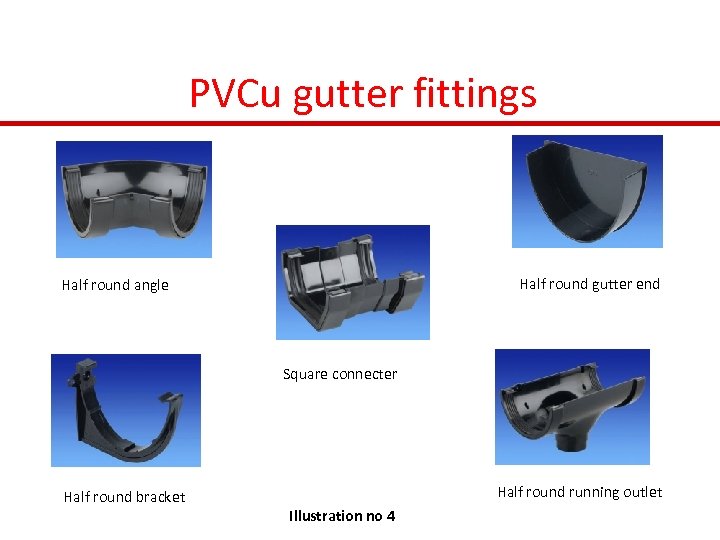
PVCu gutter fittings Half round gutter end Half round angle Square connecter Half round bracket Half round running outlet Illustration no 4
Thermal expansion All materials expand when subjected to heat and PVCu expands more than most. It has coefficient of linear expansion 0. 06 mm/m/°C which means that for every degree Celsius of heat rise, 1 m of PVCu expands by 0. 06 mm. This can cause joint failure on gutter connections if the manufacturer’s tolerances are not adhered to during installation. If 1 m of gutter was exposed to a 15°C rise the gutter length would expand by 0. 9 m (1 × 0. 06 × 15 = 0. 9 mm). If this temperature rise was applied to a 12 m length of gutter the length would expand by 10. 8 mm (12 × 0. 06 × 15 = 10. 8 mm).
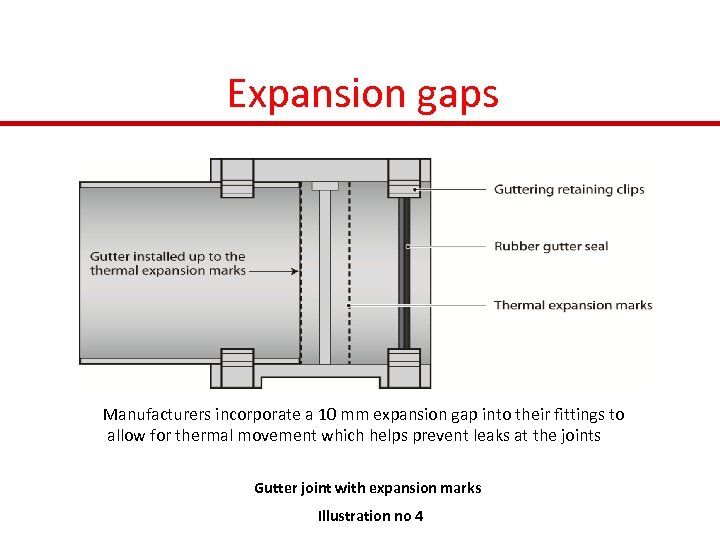
Expansion gaps Manufacturers incorporate a 10 mm expansion gap into their fittings to allow for thermal movement which helps prevent leaks at the joints Gutter joint with expansion marks Illustration no 4
Cast iron guttering Cast iron is strong and durable but requires regular painting to help prevent corrosion. Before PVCu entered the market, cast iron was likely to be the most popular materials for gutter and rainwater pipework. Local authorities, the National Trust and English Heritage still specify cast iron rainwater pipework.
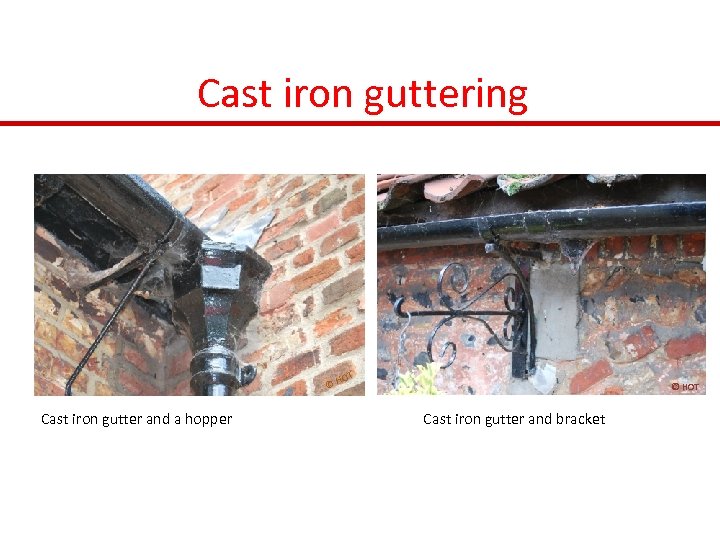
Cast iron guttering OT ©H Cast iron gutter and a hopper © HOT Cast iron gutter and bracket
Cast iron guttering The gutter profiles are as follows: • • Half round – which is similar to the PVCu shape Ogee section – there are several variations of this profile Deep half round – usually found on larger buildings Cast aluminium – replicates the profiles of cast iron and has certain advantages
Cast iron gutter jointing Cast iron guttering comes in a plain and a socket section. The plain end is like a spigot which fits into the socket and a jointing material is inserted in between before a zinc bolt finally secures them together via a purpose-made hole in the gutter sections. The jointing material can be linseed oil putty, a special silicone sealant, which is usually used on new installations, or a rubber grommet which is specified by certain manufacturers.

Cast iron gutter jointing The traditional, paint and putty joint process comprises of the following: • black bitumen paint is applied to the inside of the socket and outside of the spigot; • linseed oil putty is placed in. the socket and the plain gutter is then fitted; • a zinc bolt is located through a purpose-made hole and the tightened (do not over tighten or the gutter may crack); • excess putty is cleaned off with a non-abrasive item and, when clean, finally painted.
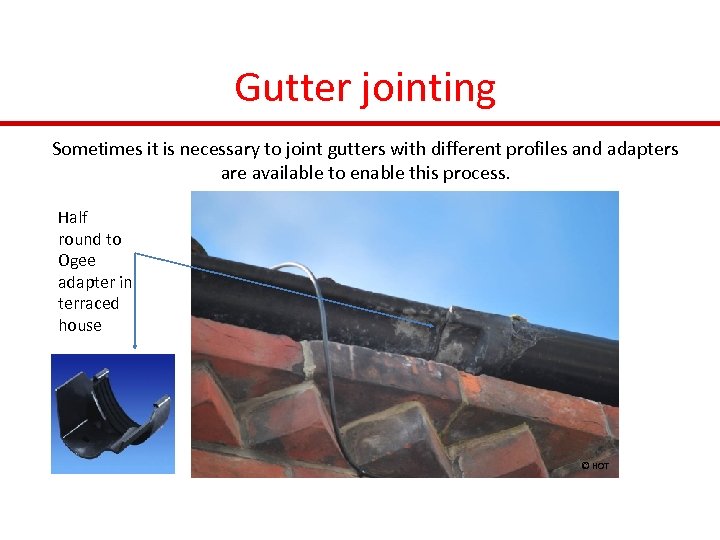
Gutter jointing Sometimes it is necessary to joint gutters with different profiles and adapters are available to enable this process. Half round to Ogee adapter in terraced house © HOT
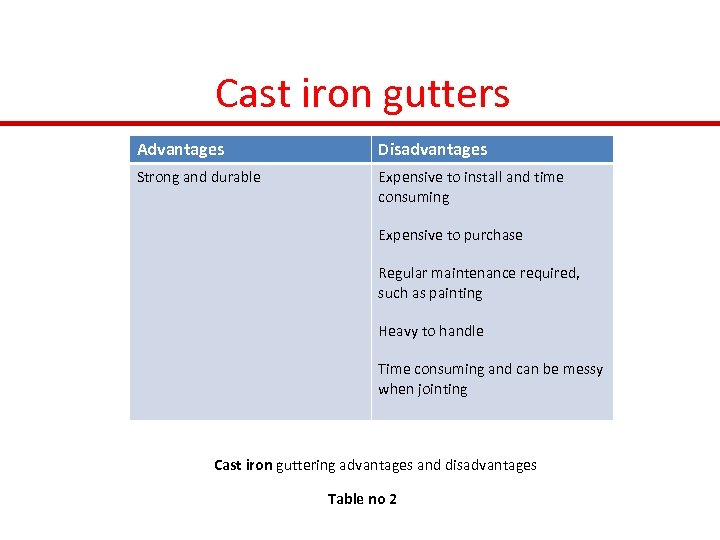
Cast iron gutters Advantages Disadvantages Strong and durable Expensive to install and time consuming Expensive to purchase Regular maintenance required, such as painting Heavy to handle Time consuming and can be messy when jointing Cast iron guttering advantages and disadvantages Table no 2
Extruded aluminium guttering The guttering system is manufactured on site by a specialist company and is made from coloured aluminium sheet which is formed by a special machine transported in the back of a van. The forming machine can produce a variety of profiles. When the aluminium is being processed strengtheners are fitted as it leaves the former to give it extra rigidity. Continuous lengths of up to 30 m can be manufactured without the need for an expansion joint. It is supported every 400 mm with internal brackets which add to its mechanical strength and resistance to impact form ladders, etc.
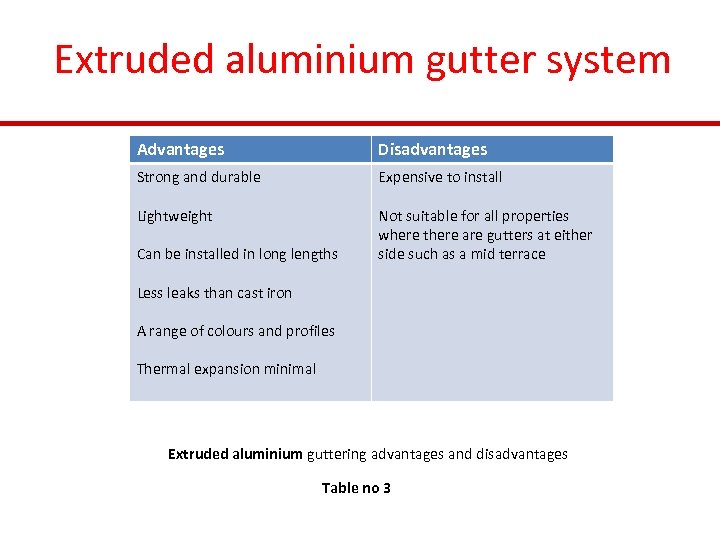
Extruded aluminium gutter system Advantages Disadvantages Strong and durable Expensive to install Lightweight Not suitable for all properties where there are gutters at either side such as a mid terrace Can be installed in long lengths Less leaks than cast iron A range of colours and profiles Thermal expansion minimal Extruded aluminium guttering advantages and disadvantages Table no 3
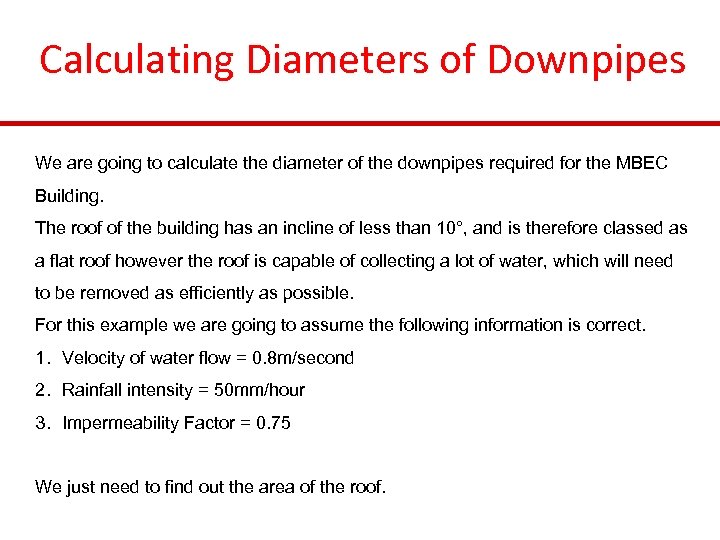
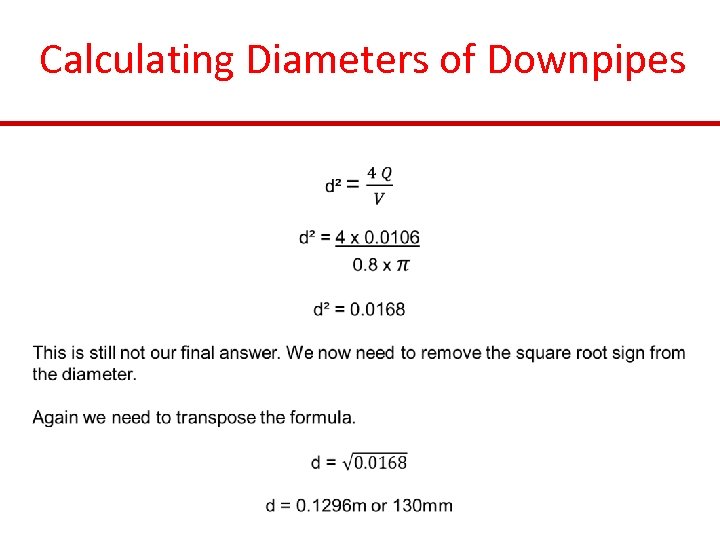
Calculating Diameters of Downpipes We are going to calculate the diameter of the downpipes required for the MBEC Building. The roof of the building has an incline of less than 10°, and is therefore classed as a flat roof however the roof is capable of collecting a lot of water, which will need to be removed as efficiently as possible. For this example we are going to assume the following information is correct. 1. Velocity of water flow = 0. 8 m/second 2. Rainfall intensity = 50 mm/hour 3. Impermeability Factor = 0. 75 We just need to find out the area of the roof.
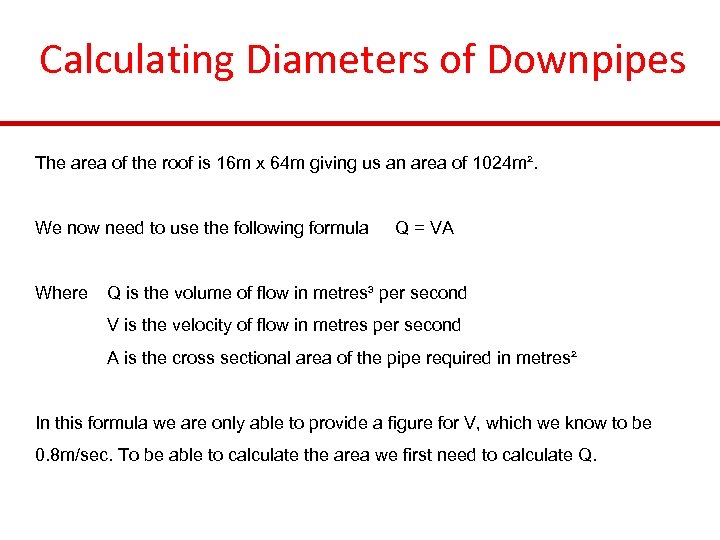
Calculating Diameters of Downpipes The area of the roof is 16 m x 64 m giving us an area of 1024 m². We now need to use the following formula Where Q = VA Q is the volume of flow in metres³ per second V is the velocity of flow in metres per second A is the cross sectional area of the pipe required in metres² In this formula we are only able to provide a figure for V, which we know to be 0. 8 m/sec. To be able to calculate the area we first need to calculate Q.
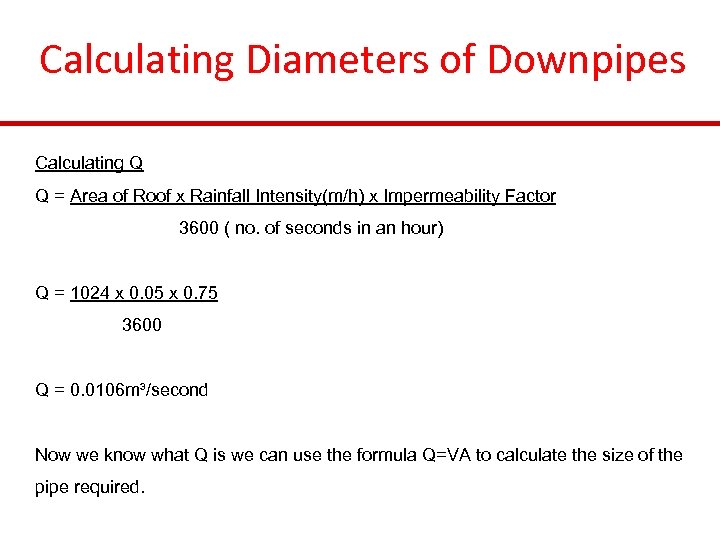
Calculating Diameters of Downpipes Calculating Q Q = Area of Roof x Rainfall Intensity(m/h) x Impermeability Factor 3600 ( no. of seconds in an hour) Q = 1024 x 0. 05 x 0. 75 3600 Q = 0. 0106 m³/second Now we know what Q is we can use the formula Q=VA to calculate the size of the pipe required.
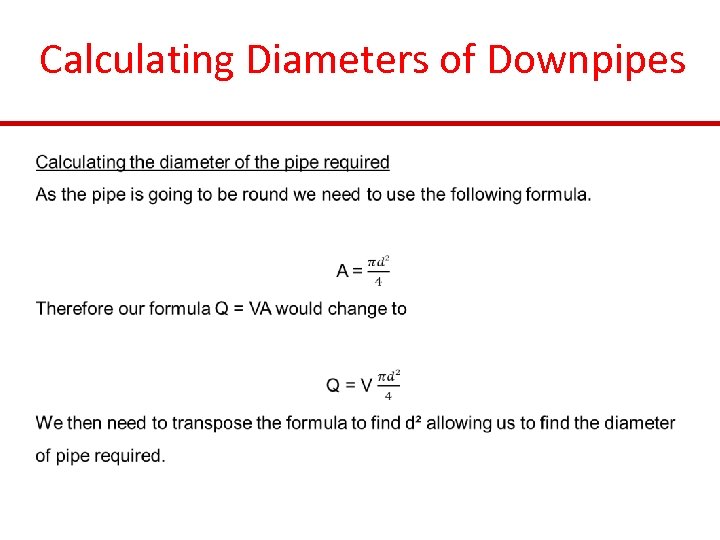
Calculating Diameters of Downpipes
Calculating Diameters of Downpipes
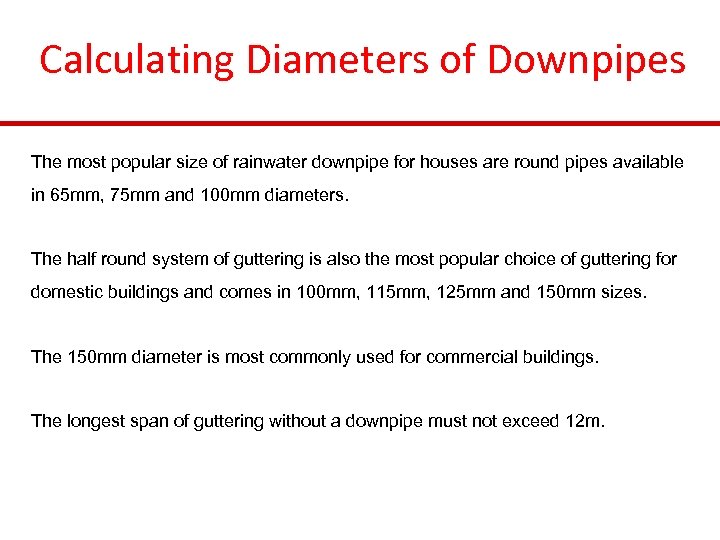
Calculating Diameters of Downpipes The most popular size of rainwater downpipe for houses are round pipes available in 65 mm, 75 mm and 100 mm diameters. The half round system of guttering is also the most popular choice of guttering for domestic buildings and comes in 100 mm, 115 mm, 125 mm and 150 mm sizes. The 150 mm diameter is most commonly used for commercial buildings. The longest span of guttering without a downpipe must not exceed 12 m.
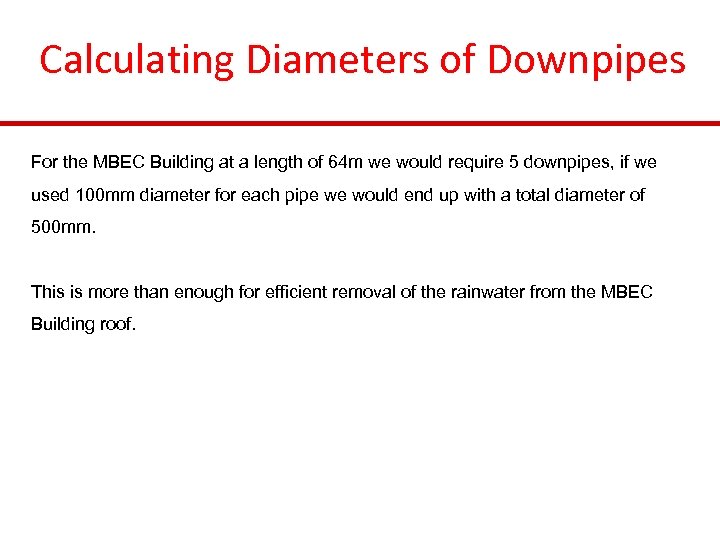
Calculating Diameters of Downpipes For the MBEC Building at a length of 64 m we would require 5 downpipes, if we used 100 mm diameter for each pipe we would end up with a total diameter of 500 mm. This is more than enough for efficient removal of the rainwater from the MBEC Building roof.
Скачать презентацию Domestic Rainwater Systems Domestic rainwater systems Objectives
c8cfa4a32c4b8b11f0d144dd45c853cd.ppt