


 Скачать презентацию Domain Name System DNS Session-1 Fundamentals Wale Adedokun
5868699e2b9f9a429e6c20d5e0df342a.ppt
- Количество слайдов: 30
 Domain Name System (DNS) Session-1: Fundamentals Wale Adedokun and Dewole Ajao ng. NOG 07
 Computers use IP addresses. Why do we need names? Names are easier for people to remember Computers may be moved between networks, in which case their IP address will change.
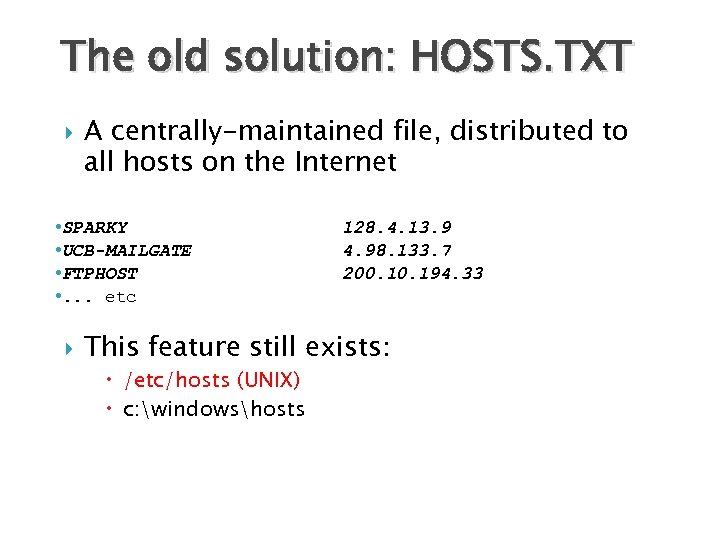 The old solution: HOSTS. TXT A centrally-maintained file, distributed to all hosts on the Internet • SPARKY • UCB-MAILGATE • FTPHOST • . . . etc 128. 4. 13. 9 4. 98. 133. 7 200. 194. 33 This feature still exists: /etc/hosts (UNIX) c: windowshosts
 hosts. txt does not scale ✗Huge file (traffic and load) ✗Name collisions (name uniqueness) ✗Consistency ✗Always out of date ✗Single point of Administration ✗Did not scale well
 The Domain Name System was born DNS is a distributed database for holding name to IP address (and other) information Distributed: ◦ Shares the Administration ◦ Shares the Load Robustness and performance achieved through ◦ replication ◦ and caching Employs a client-server architecture A critical piece of the Internet's infrastructure
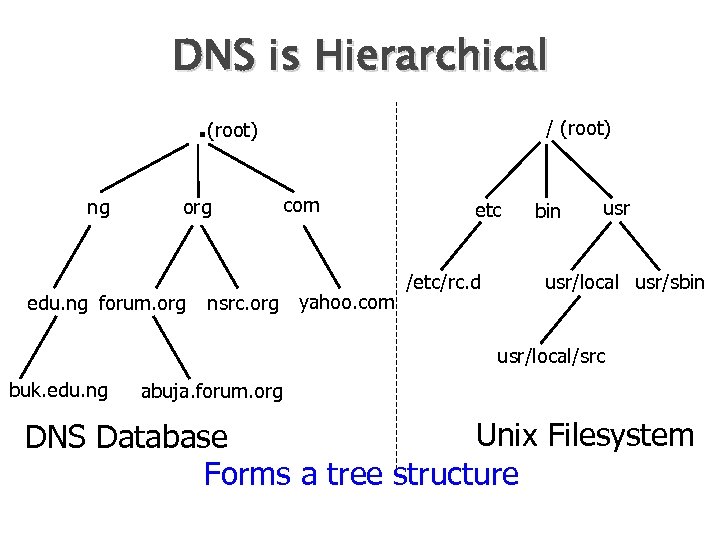 DNS is Hierarchical. (root) ng org edu. ng forum. org / (root) com nsrc. org yahoo. com etc /etc/rc. d bin usr/local usr/sbin usr/local/src buk. edu. ng abuja. forum. org Unix Filesystem DNS Database Forms a tree structure
 DNS is Hierarchical (contd. ) Globally unique names Administered in zones (parts of the tree) You can give away ("delegate") control of part of the tree underneath you Example: ◦ forum. org on one set of nameservers ◦ blogs. forum. org on a different set ◦ wale. blogs. forum. org on another set
 Domain Names are (almost) unlimited Max 255 characters total length Max 63 characters in each part ◦ RFC 1034, RFC 1035 If a domain name is being used as a host name, you should abide by some restrictions ◦ RFC 952 (old!) ◦ a-z 0 -9 and minus (-) only ◦ No underscores ( _ )
 Using the DNS A Domain Name (like www. blogs. forum. org) is the KEY to look up information The result is one or more RESOURCE RECORDS (RRs) There are different RRs for different types of information You can ask for the specific type you want, or ask for "any" RRs associated with the domain name
 Commonly seen Resource Records (RRs) A (address): map hostname to IP address PTR (pointer): map IP address to hostname MX (mail exchanger): where to deliver mail for user@domain CNAME (canonical name): map alternative hostname to real hostname TXT (text): any descriptive text NS (name server), SOA (start of authority): used for delegation and management of the DNS itself
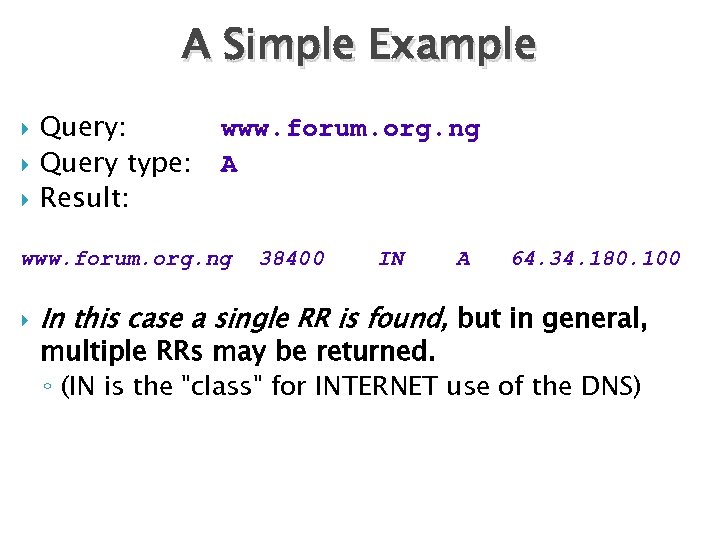 A Simple Example Query: Query type: Result: www. forum. org. ng A www. forum. org. ng 38400 IN A 64. 34. 180. 100 In this case a single RR is found, but in general, multiple RRs may be returned. ◦ (IN is the "class" for INTERNET use of the DNS)
 Possible results from a Query Positive ◦ one or more RRs found Negative ◦ definitely no RRs match the query Server fail ◦ cannot find the answer Refused ◦ not allowed to query the server
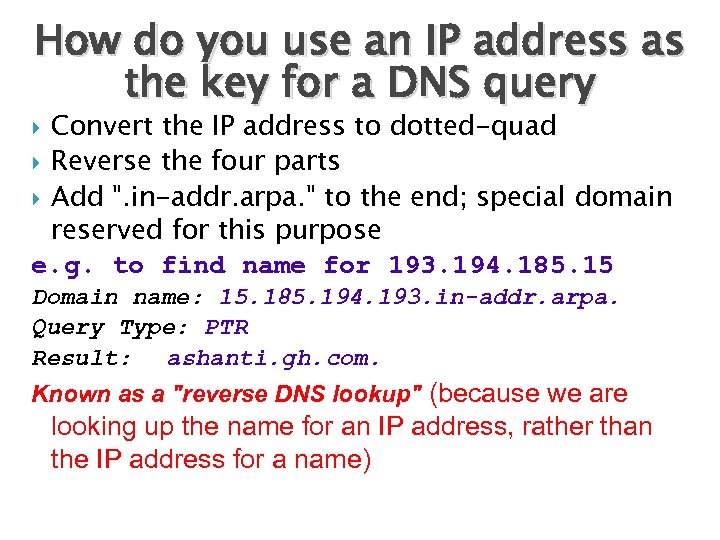 How do you use an IP address as the key for a DNS query Convert the IP address to dotted-quad Reverse the four parts Add ". in-addr. arpa. " to the end; special domain reserved for this purpose e. g. to find name for 193. 194. 185. 15 Domain name: 15. 185. 194. 193. in-addr. arpa. Query Type: PTR Result: ashanti. gh. com. Known as a "reverse DNS lookup" (because we are looking up the name for an IP address, rather than the IP address for a name)
 Any Questions? ?
 DNS is a Client-Server application (Of course - it runs across a network) Requests and responses are normally sent in UDP packets, port 53 Occasionally uses TCP, port 53 ◦ for very large requests (larger than 512 -bytes) e. g. zone transfer from master to slave or an IPv 6 AAAA (quad A) record.
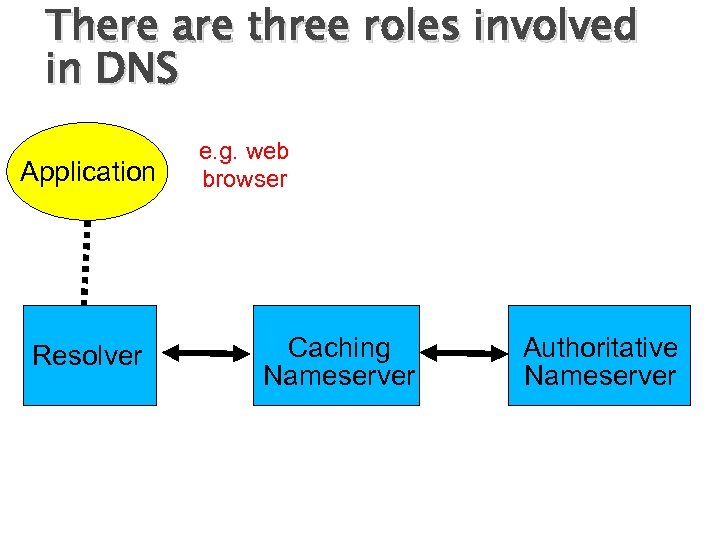 There are three roles involved in DNS Application Resolver e. g. web browser Caching Nameserver Authoritative Nameserver
 Three roles in DNS RESOLVER ◦ Takes request from application, formats it into UDP packet, sends to cache CACHING NAMESERVER ◦ Returns the answer if already known ◦ Otherwise searches for an authoritative server which has the information ◦ Caches the result for future queries ◦ Also known as RECURSIVE nameserver AUTHORITATIVE NAMESERVER ◦ Contains the actual information put into the DNS by the domain owner
 Three roles in DNS The SAME protocol is used for resolver <-> cache and cache <-> auth NS communication It is possible to configure a single name server as both caching and authoritative But it still performs only one role for each incoming query Common but NOT RECOMMENDED to configure in this way (we will see why later).
 ROLE 1: THE RESOLVER A piece of software which formats a DNS request into a UDP packet, sends it to a cache, and decodes the answer Usually a shared library (e. g. libresolv. so under Unix) because so many applications need it EVERY host needs a resolver - e. g. every Windows workstation has one
 How does the resolver find a caching nameserver? It has to be explicitly configured (statically, or via DHCP etc) Must be configured with the IP ADDRESS of a cache (why not name? ) Good idea to configure more than one cache, in case the first one fails
 How do you choose which cache(s) to configure? Must have PERMISSION to use it ◦ e. g. cache at your ISP, or your own Prefer a nearby cache ◦ Minimises round-trip time and packet loss ◦ Can reduce traffic on your external link, since often the cache can answer without contacting other servers Prefer a reliable cache ◦ Perhaps your own?
 Resolver can be configured with default domain(s) If "foo. bar" fails, then retry query as "foo. bar. mydomain. com" Can save typing but adds confusion May generate extra unnecessary traffic Usually best avoided
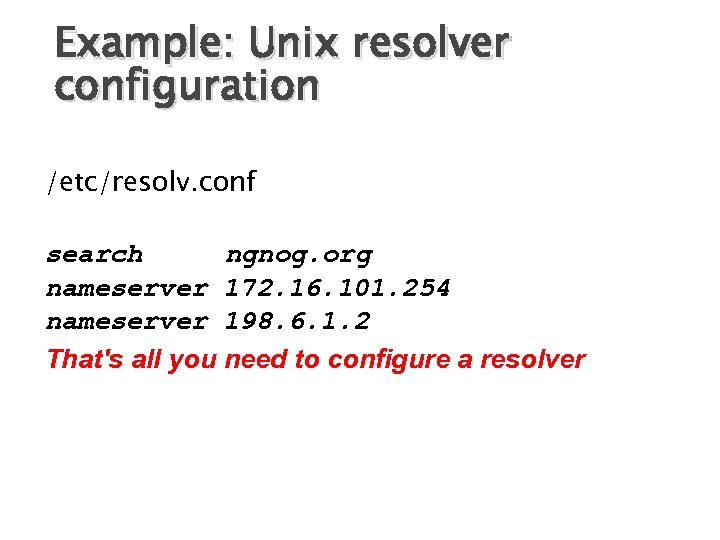 Example: Unix resolver configuration /etc/resolv. conf search ngnog. org nameserver 172. 16. 101. 254 nameserver 198. 6. 1. 2 That's all you need to configure a resolver
 Testing DNS Just put "www. yahoo. com" in a web browser? Why is this not a good test?
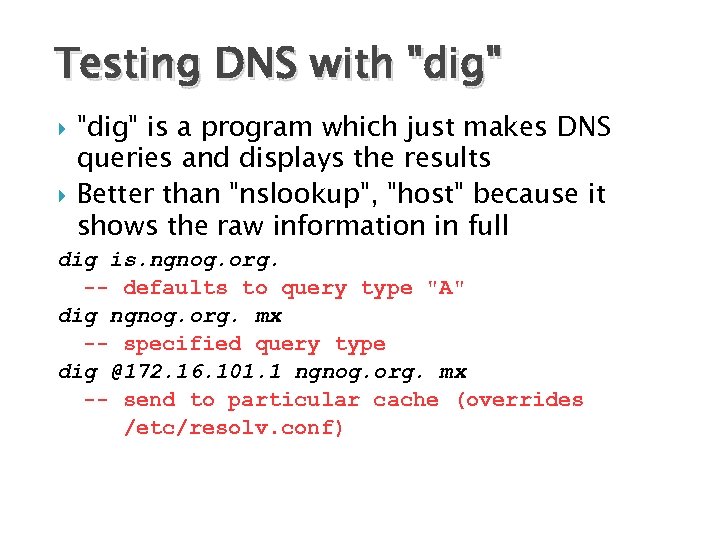 Testing DNS with "dig" is a program which just makes DNS queries and displays the results Better than "nslookup", "host" because it shows the raw information in full dig is. ngnog. org. -- defaults to query type "A" dig ngnog. org. mx -- specified query type dig @172. 16. 101. 1 ngnog. org. mx -- send to particular cache (overrides /etc/resolv. conf)
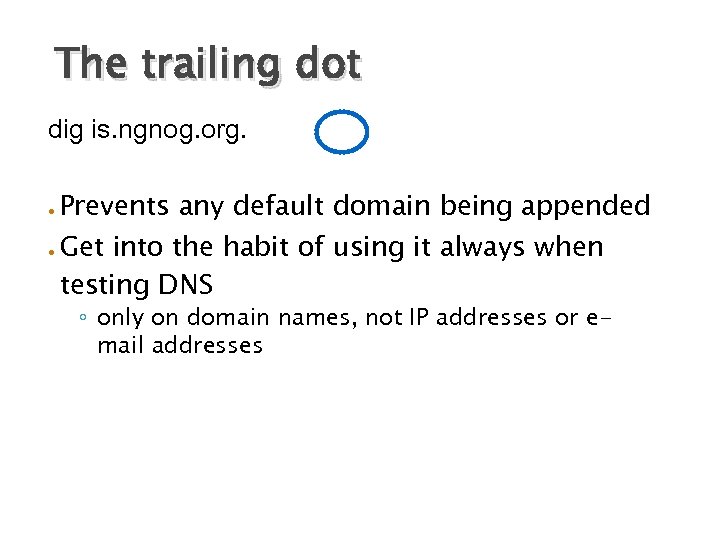 The trailing dot dig is. ngnog. org. ● ● Prevents any default domain being appended Get into the habit of using it always when testing DNS ◦ only on domain names, not IP addresses or email addresses
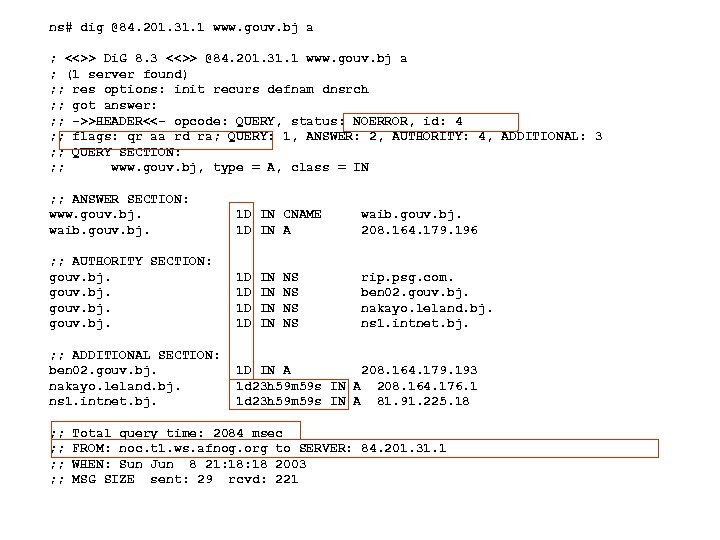 ns# dig @84. 201. 31. 1 www. gouv. bj a ; <<>> Di. G 8. 3 <<>> @84. 201. 31. 1 www. gouv. bj a ; (1 server found) ; ; res options: init recurs defnam dnsrch ; ; got answer: ; ; ->>HEADER<<- opcode: QUERY, status: NOERROR, id: 4 ; ; flags: qr aa rd ra; QUERY: 1, ANSWER: 2, AUTHORITY: 4, ADDITIONAL: 3 ; ; QUERY SECTION: ; ; www. gouv. bj, type = A, class = IN ; ; ANSWER SECTION: www. gouv. bj. waib. gouv. bj. 1 D IN CNAME 1 D IN A waib. gouv. bj. 208. 164. 179. 196 ; ; AUTHORITY SECTION: gouv. bj. 1 D 1 D rip. psg. com. ben 02. gouv. bj. nakayo. leland. bj. ns 1. intnet. bj. ; ; ADDITIONAL SECTION: ben 02. gouv. bj. nakayo. leland. bj. ns 1. intnet. bj. 1 D IN A 208. 164. 179. 193 1 d 23 h 59 m 59 s IN A 208. 164. 176. 1 1 d 23 h 59 m 59 s IN A 81. 91. 225. 18 ; ; ; ; IN IN NS NS Total query time: 2084 msec FROM: noc. t 1. ws. afnog. org to SERVER: 84. 201. 31. 1 WHEN: Sun Jun 8 21: 18 2003 MSG SIZE sent: 29 rcvd: 221
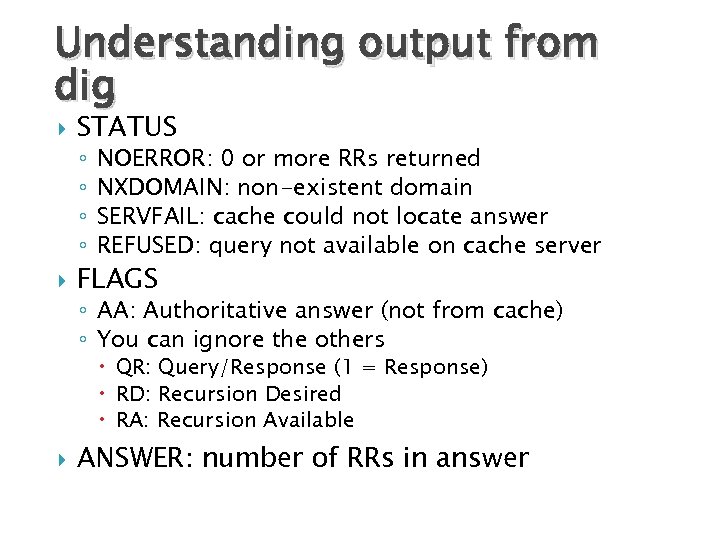 Understanding output from dig STATUS ◦ ◦ NOERROR: 0 or more RRs returned NXDOMAIN: non-existent domain SERVFAIL: cache could not locate answer REFUSED: query not available on cache server FLAGS ◦ AA: Authoritative answer (not from cache) ◦ You can ignore the others QR: Query/Response (1 = Response) RD: Recursion Desired RA: Recursion Available ANSWER: number of RRs in answer
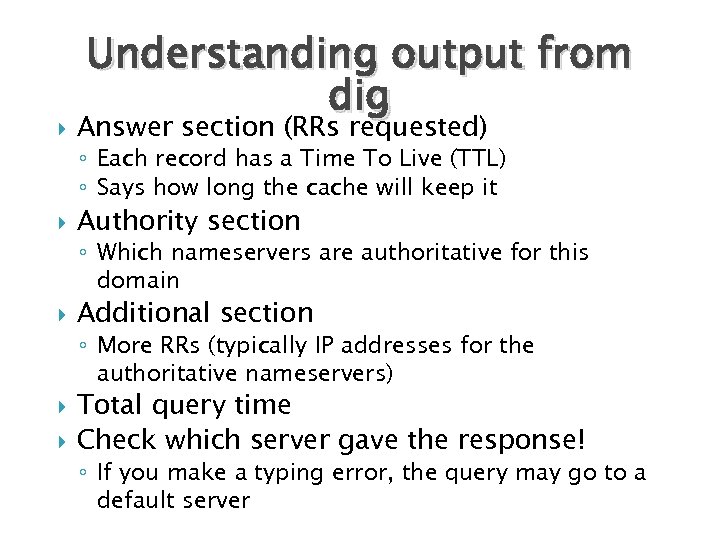 Understanding output from dig Answer section (RRs requested) ◦ Each record has a Time To Live (TTL) ◦ Says how long the cache will keep it Authority section ◦ Which nameservers are authoritative for this domain Additional section ◦ More RRs (typically IP addresses for the authoritative nameservers) Total query time Check which server gave the response! ◦ If you make a typing error, the query may go to a default server
 Practical Exercise Configure Unix resolver Issue DNS queries using 'dig' Use tcpdump to show queries being sent to cache