 Скачать презентацию Doing Business in the Information Age John Corker
d8dfe012b44f99b75dd3c48888c60639.ppt
- Количество слайдов: 35



Doing Business in the Information Age John Corker GENL 0230
What is e-commerce? Includes: ► Online business to business transactions ► Online business to consumer transactions ► Digital delivery of products and services ► Online merchandising ► Automated telephone transactions eg phone banking ► EFTPOS and other automated transfer systems
Contracts ►Law of contracts ►Issues for e-commerce
Contracts - the basics ► Offer ► Acceptance ► Intention to enter legal relations ► Consideration ► Legal capacity ► Genuine consent
Offer ► Clear statement of terms ► Person who makes it is prepared to be bound ► Not just an “invitation to treat”
Acceptance ► Unqualified agreement to terms of offer ► Express or inferred by conduct ► Can’t be forced on unwilling person
Time of creation of contract ► Contract formed at time and place the acceptance is communicated to offeror
Termination or revocation of offer ► Can be revoked prior to acceptance ► Revocation must be communicated to offeror
Certainty ► Essential parts of contract must be clear and complete ► Courts may imply a meaning ► Uncertain term can be “severed”
Consideration ► Valuable consideration ► Passing between parties to contract ► Can’t be unlawful or immoral
Intention ► Express ► Inferred from the circumstances ► Must be genuine consent - not obtained under duress
Capacity ► Age ► Intellectual capacity
Terms and conditions ► Express ► Implied
Formalities ► Oral or written ► Writing required under statute land eg for sale of
Practical concerns for e-commerce deals ► Identity and capacity of seller or buyer ► Authenticity of offer and acceptance (digital signatures) ► When and where contract formed ► Governing law ► Terms and conditions (click through)
Practical Concerns for e-commerce deals(2) ► Agreement on electronic payment system ► Security of information exchanges ► Consequences on breach ► Storing electronic data to prevent alteration
Electronic Transactions Act ► Federal law with mirror State laws (NSW, VIC, WA) ► To remove obstacles to electronic transactions, communications, signatures and record keeping ► 1 July 2001 applies to all federal laws unless exempted
Electronic Transactions Act(2) ► Validates electronic transactions ► Given in writing met electronically now § Govt can specify technology requirements § Business requirement valid only with consent ► Signatures-parties free to agree on method ► Production and retention of documents § Method must ensure integrity and accessibility ► Time and place of dispatch and receipt of communications
Electronic Transactions(3) § Time of dispatch is when it enters the first information system outside control of sender § Time of receipt is when it enters an information system designated by the addressee for receiving it. § Place of dispatch and receipt taken to be respective places of business
Electronic Transactions (4) ► Record keeping OK electronically if law says: § Information to be recorded in writing § A written document to be kept § An electronic communication to be kept ► Records must be kept identifying origin, destination, time of sending and receipt of electronic communication
Making a contract ► What terms do you want to include? ► What risks are you trying to avoid? ► How will disputes about contract be dealt with? ► What is the governing law? ► Who will sign it?
Setting up a business entity ► ► Sole trader Partnership Company Trust
Sole trader ► All profits ► All losses ► All liabilities ► Own name or choose business name ► Register business name
Partnership ►Carrying on a business ►In common ►With a view to profit ►Established by written agreement, oral agreement or conduct
Partnership ► Partnership Act 1892 (NSW) ► Corporations Law: Not more than 20 partners (except doctors, solicitors and accountants)
Partnership ► Profit ► Joint sharing and several liability ► Fiduciary duties to partners
Companies ► Corporations ► Artificial Act legal entity ► Liability of members can be limited
Companies ► Constitution ► Directors ► Limits duties on raising money from the public
Companies ► The “corporate veil” ► Lifting the veil: fraud, agency, paying more dividends than profit, incurring debts when company insolvent
Companies Form a company by: ► Registering name ► Lodge application with ASIC ► Registered office ► Names of directors and members
Which structure? ► Where are you getting your money from? ► What is your risk/liability? ► Who will be in control? ► What are the ongoing costs?
What is a domain name ► Human friendly form of an Internet address ► Actual address is an Internet Protocol (IP) number ► System globally administered by ICANN ► Generic top level domains (g. TLDs) §. com, . org, . net, . edu, . gov, . biz ► Country code top level domains (cc. TLDs)
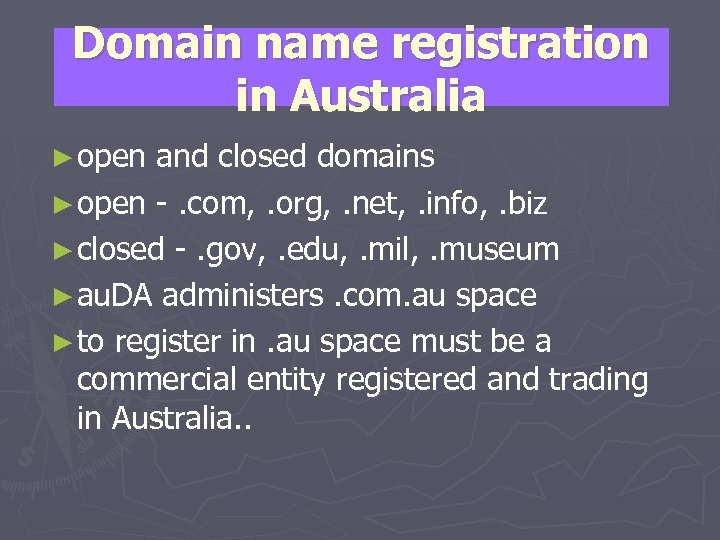
Domain name registration in Australia ► open and closed domains ► open -. com, . org, . net, . info, . biz ► closed -. gov, . edu, . mil, . museum ► au. DA administers. com. au space ► to register in. au space must be a commercial entity registered and trading in Australia. .
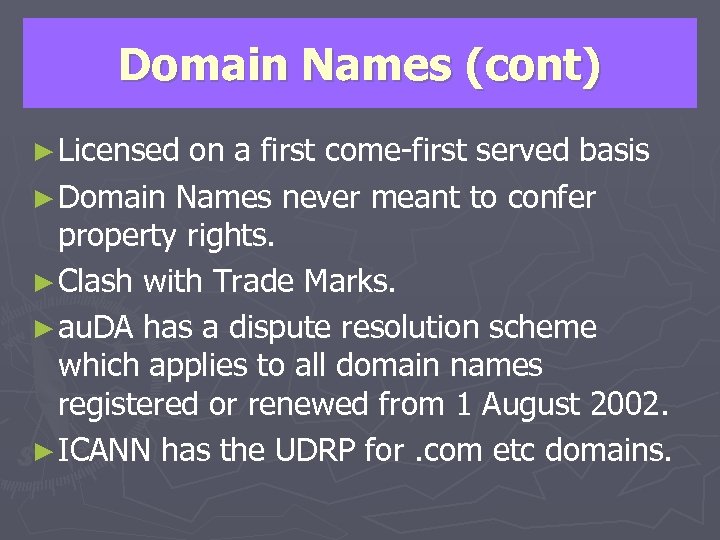
Domain Names (cont) ► Licensed on a first come-first served basis ► Domain Names never meant to confer property rights. ► Clash with Trade Marks. ► au. DA has a dispute resolution scheme which applies to all domain names registered or renewed from 1 August 2002. ► ICANN has the UDRP for. com etc domains.
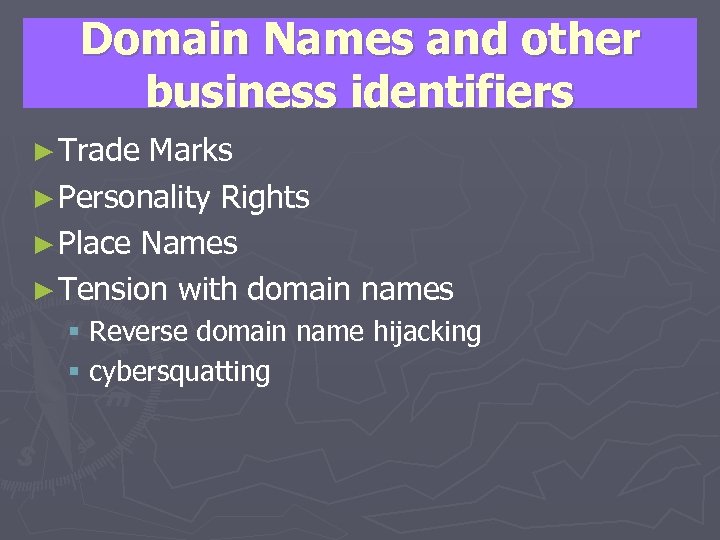
Domain Names and other business identifiers ► Trade Marks ► Personality Rights ► Place Names ► Tension with domain names § Reverse domain name hijacking § cybersquatting
Скачать презентацию Doing Business in the Information Age John Corker
d8dfe012b44f99b75dd3c48888c60639.ppt