 Скачать презентацию DOING BUSINESS IN LATVIA Law office Skrastiņš un
ee9d327ee6195b44f19ccb8bf529d37f.ppt
- Количество слайдов: 43



DOING BUSINESS IN LATVIA Law office “Skrastiņš un Dzenis” Tallinn, 2007
BULLETPOINTS I Forms of presence in Latvia II Contractual relationship III Real estate issues IV Taxation issues V Litigation and arbitration
IMPORTANT FACTS n n n n Latvia - one of the fastest growing economies in the world; Growth of GDP in the first quarter of 2007 was 10, 7 % - the fastest growing economy in the EU (The closest rivals - Slovakia and Lithuania with 8, 9 % and 6, 7% respectively); Adverse implication - relatively high inflation (over 8%) Estonian FDI – around 10%; 15% - one of the lowest corporate income tax rates in the EU; the foreign investor may be the sole founder and owner of a company in Latvia; the foreign investor may freely repatriate after tax profits and investment capital.
I FORMS OF PRESENCE IN LATVIA
INCORPORATION n Latvian Commercial Code (LCC) provides for 5 forms of incorporation: n n n LLC (Sabiedrība ar ierobežotu atbildību, SIA, Estonian equivalent for OÜ) JSC (Akciju sabiedrība, AS, ) General partnership (Pilnsabiedrība, PS) Limited partnership (Komandītsabiedrība, KS) Individual merchant (Individuālais komersants, IK)
OTHER FORMS OF PRESENCE n Branch of a foreign merchant (Ārvalstu komersanta filiāle) n n No legal personality, regarded a part or the foreign merchant, May commence economic activities; Considered to be an independent Latvian tax payer. Representative office (Ārvalstu komersanta pārstāvniecība) n n Does not have a right to conduct commercial activities; For purposes of marketing research, market studies, attracting clients, information exchange etc.
LLC/SIA n n Overwhelming majority of Latvian businesses are launched as limited liability companies (e. g. in the year 2006 – 13 173 new LLCs were registered); Latvian legal entity status is acquired upon registration with the Latvian Enterprise Register; Minimum share capital – 2000 LVL (approx. 2850 EUR), may be paid by monetary contribution or in kind; LLC may issue only registered shares and the minimum nominal value of one share is 1 LVL.
LLC/SIA(II) Management institutions: n n Shareholders meeting and Management Board (MB), minimum - 1 MB member, no requirement of Latvian, EU or EEA residence; Supervisory board - optional; MB elected and dismissed by shareholders’ meeting or supervisory board if such is formed; Share ownership is recorded in the internal shareholders register kept by the MB;
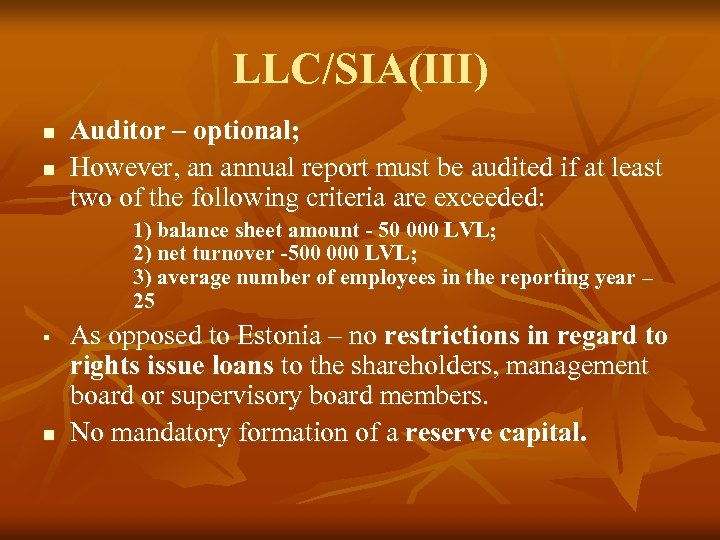
LLC/SIA(III) n n Auditor – optional; However, an annual report must be audited if at least two of the following criteria are exceeded: 1) balance sheet amount - 50 000 LVL; 2) net turnover -500 000 LVL; 3) average number of employees in the reporting year – 25 § n As opposed to Estonia – no restrictions in regard to rights issue loans to the shareholders, management board or supervisory board members. No mandatory formation of a reserve capital.
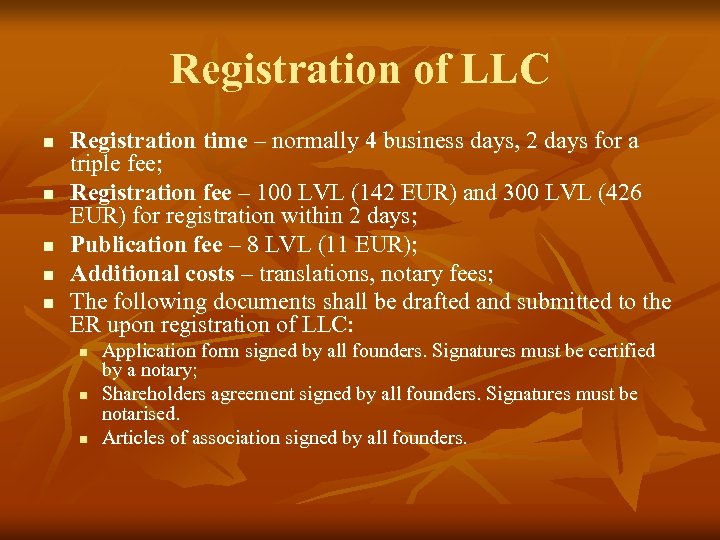
Registration of LLC n n n Registration time – normally 4 business days, 2 days for a triple fee; Registration fee – 100 LVL (142 EUR) and 300 LVL (426 EUR) for registration within 2 days; Publication fee – 8 LVL (11 EUR); Additional costs – translations, notary fees; The following documents shall be drafted and submitted to the ER upon registration of LLC: n n n Application form signed by all founders. Signatures must be certified by a notary; Shareholders agreement signed by all founders. Signatures must be notarised. Articles of association signed by all founders.
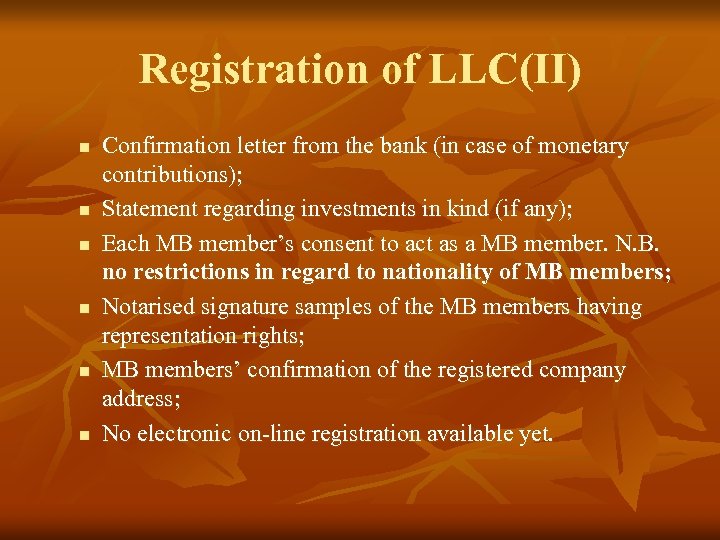
Registration of LLC(II) n n n Confirmation letter from the bank (in case of monetary contributions); Statement regarding investments in kind (if any); Each MB member’s consent to act as a MB member. N. B. no restrictions in regard to nationality of MB members; Notarised signature samples of the MB members having representation rights; MB members’ confirmation of the registered company address; No electronic on-line registration available yet.
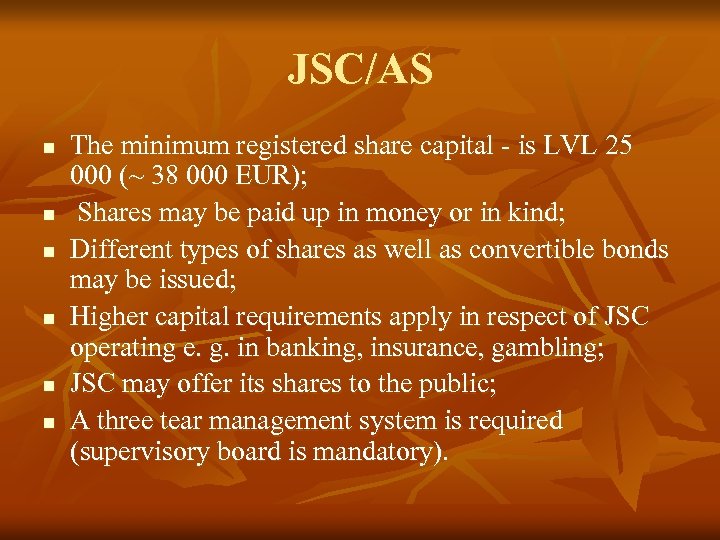
JSC/AS n n n The minimum registered share capital - is LVL 25 000 (~ 38 000 EUR); Shares may be paid up in money or in kind; Different types of shares as well as convertible bonds may be issued; Higher capital requirements apply in respect of JSC operating e. g. in banking, insurance, gambling; JSC may offer its shares to the public; A three tear management system is required (supervisory board is mandatory).
SUBSIDIARY VS BRANCH n Subsidiary n n Latvian legal entity; 10% withholding tax on remittance of dividends (may be avoided or reduced in case of payments to EU resident companies or residents of tax treaties countries); Arm’s length principle applicable to transactions between related companies; Share capital is required. n Branch n n n No legal personality, no share capital required; For tax purposes treated as a separate Latvian taxpayer - the same tax and reporting requirements as local subsidiaries; The list of deductible expenses is shorter if compared with that for subsidiaries (any fees paid to head office are taxable); application of several tax provisions is not clear; no withholding tax (branch tax) upon remittance of taxed branch profits to the head office; May be useful if start-up losses are expected and the losses can be set off for tax purposes against profits arising in the country of residence of the head office.
Activities of private individuals n Options for pursuing economic activities in Latvia for private individuals besides those provided for in the LCC: n n registration as a self employed person in the State Revenue Service. E. g. An Estonian resident, natural person, gives Estonian language classes in Latvia – registration in SRS is required but no registration in the ER is necessary. Not so popular - registration with a respective municipality and SRS. (Activities restricted to a territory of a particular municipality)
Acquisition of shares n n A rather popular transaction in the real estate development sector in order to avoid a stamp duty of 2% from the transaction value; No special institution like Central Register of Securities where LLC or JSC shares and ownership thereof is registered except for JSC stock traded on the stock exchange; The official document conferring the ownership rights to the shares - an internal shareholders register kept by the MB; In addition, data on shareholders is recorded in the Commercial register kept by ER and publicly available;
Acquisition of shares (II) n n n Alienation of shares – a rather simple transaction, notarial form not mandatory; In case of LLC the other shareholders have rights of first refusal; Obligation to notify ER about changes in shareholding - on the MB of the company; It is advised to perform LDD prior to a transaction to identify the risks and use an escrow account provided that funds are released upon registration of relevant changes in the internal shareholders register and the ER; N. B. In case the principal field of activity is altered after ownership change, losses of the previous periods may not be carried forward
Acquisition assets n Alienation of assets – in case it amounts to alienation of an undertaking as defined in LCC (an organisational economic unit including both tangible and intangible assets belonging to a merchant, as well as other economic benefits), special regulation applies: n n Liabilities and obligations are transferred along with assets, claims and other rights to the acquirer of the undertaking; An agreement in contrary shall be void as to third parties.
II CONTRACTUAL RELATIONSHIP WITH LATVIAN COMPANIES
General n n Contractual relationship - regulated by a Civil Code (1937), unlike in Estonia, many forms of modern agreements (e. g. leasing, franchising) are left outside its scope, thus, not explicitly regulated; Planned – to adopt an additional part to the LCC regulating transactions between merchants and providing for regulation i. a. for the modern agreements; Latvia is a member to the CISG with reservation in regard to form of an agreement; Freedom of contract form – however, the most common form is written. Notarial form is required only in limited special cases e. g. upon submitting a corroboration request to a land register the signatures of the contracting parties shall be notarised.
Rights of representation As opposed to Estonia, in case of LLCs MB members represent a company jointly unless provided for otherwise in the AOA. Two principal types of commercial power of attorney: n n n ordinary commercial power of attorney (rights to conduct actions necessary for everyday business excluding procedural powers and rights to alienate immovable property, take loans etc. Mentioned shall be conferred by an explicit indication. Not subject to registration in ER); procuration – shall be provided for in the AOA, registered with the ER, broad powers, cannot be restricted towards third parties. Similar to Estonian procuration. The authorised person has also procedural powers, but rights to encumber, alienate etc. immovable property – only if such powers specially granted and registered with the ER).
Rights of representation(II) n n n Representation rights may be verified by requesting a relevant ER notice or by checking the electronic ER database; Powers of authorised representatives shall be checked by asking to present the relevant document, checking it with a notary and/or ER in; N. B. data contained in the mentioned electronic database is of informative character only and does not have a legal force.
CONTRACT LANGUAGE § § The Official language act provides for several occasions when agreements entered into by a Latvian company shall be available in Latvian language (e. g. when the document needs to be submitted for a review to tax or other authorities); Often international agreements are bilingual - to avoid ambiguity, it is advised that a clause stating the text in which language prevails is included.
APPLICABLE LAW n Applicable law and choice of forum: Rome convention of 1980 and Latvian Civil Code, Brussels I Regulation and Latvian Civil Procedure Law - in most cases parties have a freedom of choice in regard to applicable law and forum of a dispute resolution. However, several exceptions apply e. g. in case of consumer and employment agreements or in disputes related to e. g. immovable property.

III REAL ESTATE ISSUES
PURCHASING REAL ESTATE n n n Restrictions for residents of third countries; EU residents - a transitional period for land in rural areas, no restrictions in city area land. Transitional period (till May 1, 2011) - EU citizens may not purchase land in rural areas, except for self employed individuals residing in Latvia for at least 3 years and pursuing agricultural activities in Latvia for the same period. Companies – no restrictions in regard to Latvian companies where more then 50% of the capital is held by Latvian citizens, citizens of the countries with agreements on facilitation and protection of investments (Estonia is amongst them) or both jointly. No restrictions in regard to purchasing buildings. Buying shares of a limited liability company instead of property itself is a popular scheme of real estate acquisition in Latvia in order to escape payment of a stamp duty of 2% from the value of transaction for reregistration of the title to real estate. (Moreover, so far sales of shares by a private individual has been tax exempt). n Adverse implications – LDD often required, which makes a transaction more complicated, lengthy and expensive

PURCHASING REAL ESTATE (II) n n n Purchase agreement - written form required, notarial form is not mandatory; Advisable to check the legal history of the property, as illegality of any transaction in the past may affect rights of the last owner even if he/she has acquired property in good faith (increasing number of litigations); advisable to use an escrow account for transactions; make sure that the pre-emption rights and rights of first refusal are observed; check the status of the land - it is of importance for developers as converting agricultural land can be lengthy and cumbersome procedure.
PURCHASING REAL ESTATE (III) n Joint ownership n n Rights of first refusal by municipality n n May exercise 20 days from the receiving the purchase agreement, not applicable to industrial objects, in case undivided shares are sold nor to apartment properties. Pre-emption rights of building/land owner n n co-owners have rights of first refusal, term – 2 month from receiving the purchase offer. In case building and the land are owned by different persons and one of them plan selling, the owner of the respective land plot or a building standing on a land plot has pre-emption rights. Stamp duty n As from April 16, 2007 new increased rates of stamp duty for registration of title to immovable are established varying from 0, 5% upon alienation of the property to relatives up to 6% in case if endowment to a natural person from the value of the property. Rates are differentiated according to a number of properties owned by the particular person i. e. in case the title is registered in regard to a third immovable property, increased rate of stamp duty applies.

Government plan for fighting inflation, implications thereof n n personal income tax - alienation of privately owned real estate is regarded a taxable transaction (except- if owned by a particular individual at least for 60 month and at least for 12 of them it is a registered place of residence of the particular individual. (Instead of former 12 month ownership). New provision - if the value of the immovable property forms at least 50% of the total value of assets, income from alienation of shares is regarded as income from alienation of real estate and is subject to tax at the same rate as income from alienation of real estate. Transitional period till July 1, 2010 in regard to properties owned by the seller as at the moment the personal income tax act enter into force. In the mentioned case the requirement of 12 month ownership applies. N. B. – several unclarities with the practical application of the mentioned provisions, no Cabinet Regulation on application issued yet
IV TAXATION
TAXATION IN GENERAL n 10 different taxes in Latvia: 1) personal income tax; 2) corporate income tax; 3) real estate tax; 4) value added tax; 5) excise duty; 6) customs duty; 7) natural resources tax; 8) lotteries and gambling tax; 9) mandatory social payments; 10) cars and motocycles tax.
TAXATION IN GENERAL (II) n n 15 % - one of the lowest corporate income tax rates in EU, (beneficial for investors willing to withdraw profits); Corporate income tax is payable from the calculated gross profit notwithstanding if the profit is distributed or not; Taxable entities - resident companies (except partnerships), non-resident entities as well as permanent establishments (as defined in the OECD Model, including branches of foreign merchants) of non-residents generating income in Latvia. In regard to non-residents the taxable basis - income generated in Latvia.
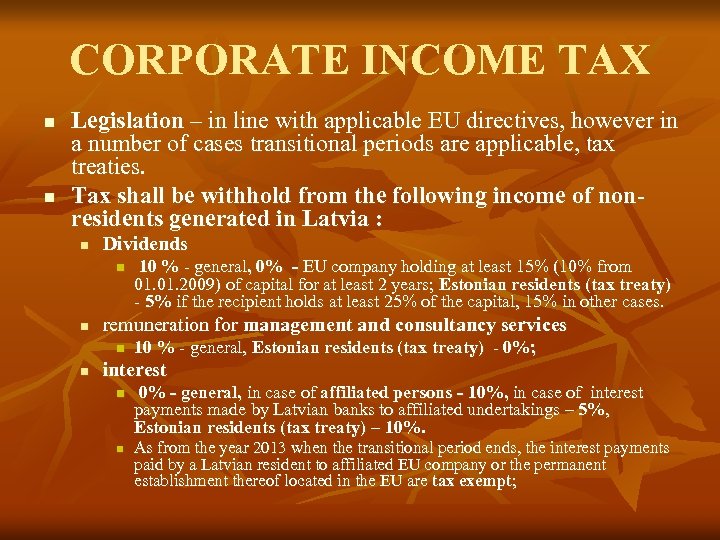
CORPORATE INCOME TAX n n Legislation – in line with applicable EU directives, however in a number of cases transitional periods are applicable, tax treaties. Tax shall be withhold from the following income of nonresidents generated in Latvia : n Dividends n n remuneration for management and consultancy services n n 10 % - general, 0% - EU company holding at least 15% (10% from 01. 2009) of capital for at least 2 years; Estonian residents (tax treaty) - 5% if the recipient holds at least 25% of the capital, 15% in other cases. 10 % - general, Estonian residents (tax treaty) - 0%; interest n n 0% - general, in case of affiliated persons - 10%, in case of interest payments made by Latvian banks to affiliated undertakings – 5%, Estonian residents (tax treaty) – 10%. As from the year 2013 when the transitional period ends, the interest payments paid by a Latvian resident to affiliated EU company or the permanent establishment thereof located in the EU are tax exempt;
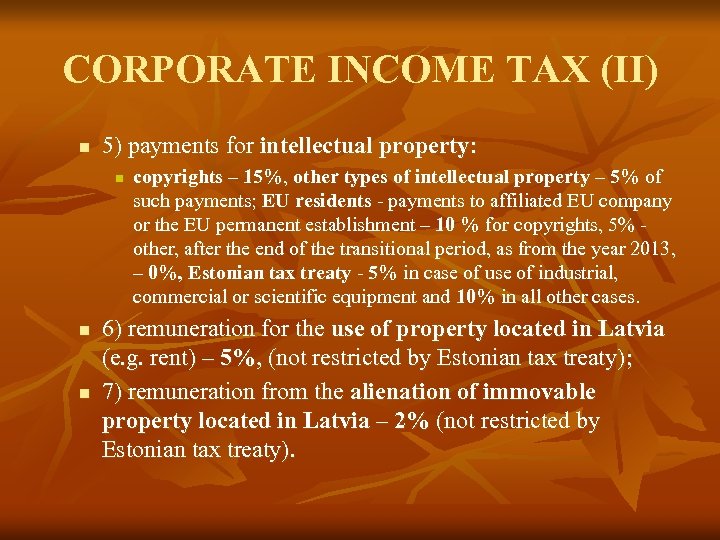
CORPORATE INCOME TAX (II) n 5) payments for intellectual property: n n n copyrights – 15%, other types of intellectual property – 5% of such payments; EU residents - payments to affiliated EU company or the EU permanent establishment – 10 % for copyrights, 5% other, after the end of the transitional period, as from the year 2013, – 0%, Estonian tax treaty - 5% in case of use of industrial, commercial or scientific equipment and 10% in all other cases. 6) remuneration for the use of property located in Latvia (e. g. rent) – 5%, (not restricted by Estonian tax treaty); 7) remuneration from the alienation of immovable property located in Latvia – 2% (not restricted by Estonian tax treaty).
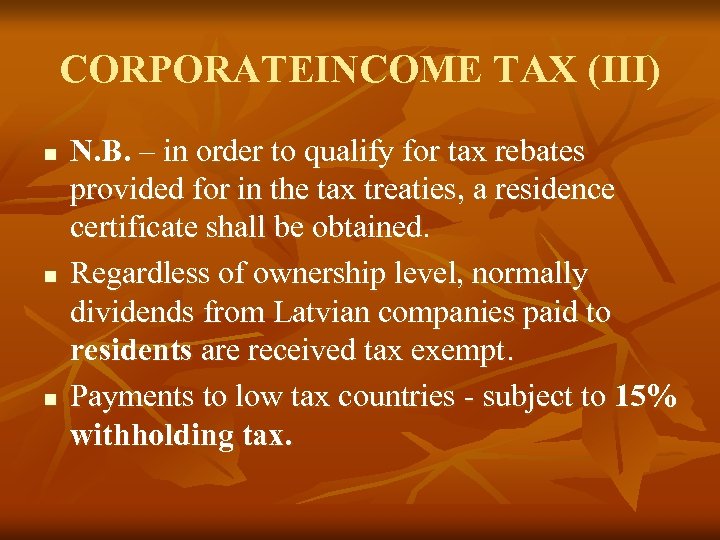
CORPORATEINCOME TAX (III) n n n N. B. – in order to qualify for tax rebates provided for in the tax treaties, a residence certificate shall be obtained. Regardless of ownership level, normally dividends from Latvian companies paid to residents are received tax exempt. Payments to low tax countries - subject to 15% withholding tax.
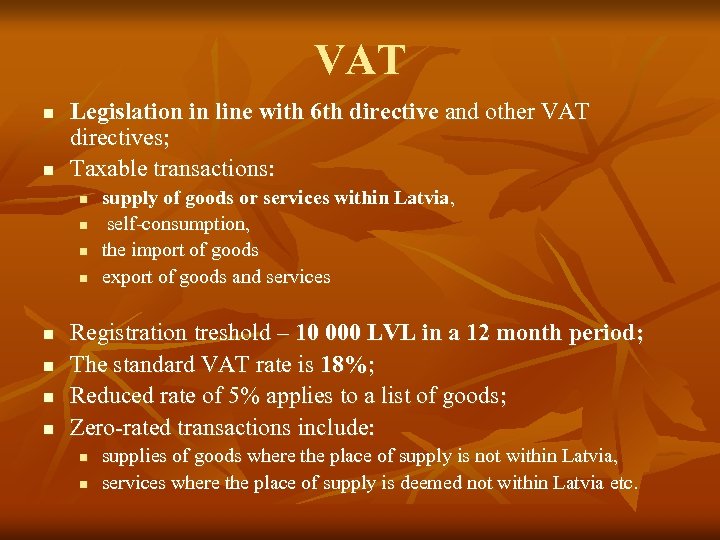
VAT n n Legislation in line with 6 th directive and other VAT directives; Taxable transactions: n n n n supply of goods or services within Latvia, self-consumption, the import of goods export of goods and services Registration treshold – 10 000 LVL in a 12 month period; The standard VAT rate is 18%; Reduced rate of 5% applies to a list of goods; Zero-rated transactions include: n n supplies of goods where the place of supply is not within Latvia, services where the place of supply is deemed not within Latvia etc.
VAT (II) n n n VAT declarations are filed on a monthly basis by the 15 th day of the following month. Input VAT cannot be claimed in respect of exempt transactions and input VAT can only be claimed in respect of transactions that are directly related to the income production of the individual or entity. N. B. Procedure of the input VAT reclaim - more lengthy and complicated as in Estonia, almost always first time involves tax audit, thus, according planning is required!
PERSONAL INCOME TAX AND SOCIAL CONTRIBUTIONS n n Personal income tax rate – 25%; Non-taxable income – 50 LVL per month plus 35 LVL per each dependant; Minimum monthly wage – 120 LVL; Social contributions rate – 33%, divided between the employer and employee, Employer shall cover 24% and 9% is withheld from the employee’s payroll.
V LITIGATION AND ARBITRATION
LITIGATION n n n Three level state court system Separate Administrative court system Average time period for review of a civil case in all three instances – 2, 5 years The first court session being appointed approximately within three month after filing a claim Amount of applicable stamp duty depends on the value of claim e. g. If a claim amount is 10 000 LVL, the stamp duty is 330 LVL (fixed amount of 250 LVL plus 1, 6% from the amount exceeding 5000 LVL)
ARBITRATION n n Traditional advantages: speed, confidentiality, lower total costs, flexibility Large number of private courts - according to the Enterprise register data as on 06. 2007. there are 135 registered permanent courts of arbitration in Latvia. Different specialisation, reputation and competence. Quality of argumentation awards not always consistent, may vary from court to court as well as depending on the particular composition of arbitrators
ARBITRATION (II) n n Competence – all civil disputes except several cases (e. g. if the award is likely to infringe the rights of a person not party to the arbitration agreement, one of the parties is a State or municipal institution, dispute involves amendments to the Civil Records Registry, labour disputes as well as disputes regarding the rights and duties of insolvent persons). Costs - Arbitration costs vary depending on the particular court, however in average costs normally slightly exceed litigation costs in the first instance, however, in terms of procedural economy the advantage of arbitration may be considerable.
ARBITRATION (III) n Enforcement procedure for awards by Latvian arbitration courts: n n n award submitted to the relevant state court for issuing a writ, other parties are given 10 days to submit explanations, a writ is issued/refused to issue, the party turns to a bailiff for enforcement assistance/challenge the refusal. N. B. lately there is an increasing number of cases when courts refuse to issue a writ, basing a refusal on different grounds e. g. protection of consumer rights. Thus, lately parties to arbitration are facing problems with enforcement of delivered arbitration awards. Enforcement of foreign awards: Latvia - a party to the New York Convention on the Recognition and Enforcement of Foreign Arbitral Awards (currently 142 contracting parties).
Thank you! In case of any further questions contact Law office Skrastiņš un Dzenis, www. skdz. lv
Скачать презентацию DOING BUSINESS IN LATVIA Law office Skrastiņš un
ee9d327ee6195b44f19ccb8bf529d37f.ppt