 Скачать презентацию DOING BUSINESS IN EUROPE ADDRESSING TODAY S AND TOMORROW S
cb9f5836f65ef989d97f92c758b299b0.ppt
- Количество слайдов: 29



DOING BUSINESS IN EUROPE ADDRESSING TODAY’S AND TOMORROW’S MOST PRESSING ISSUES DRAFT FOR REVIEW MERCER
CONTENTS • THE GLOBAL MACRO-ECONOMIC SCENE AND EUROPE • GLOBAL & EUROPEAN LABOUR/TALENT-RELATED TRENDS • RISKS AND OPPORTUNITIES FOR EMPLOYERS IN EUROPE MERCER 20 March 2018 1

THE GLOBAL MACRO-ECONOMIC SCENE AND EUROPE 20 March 2018 2
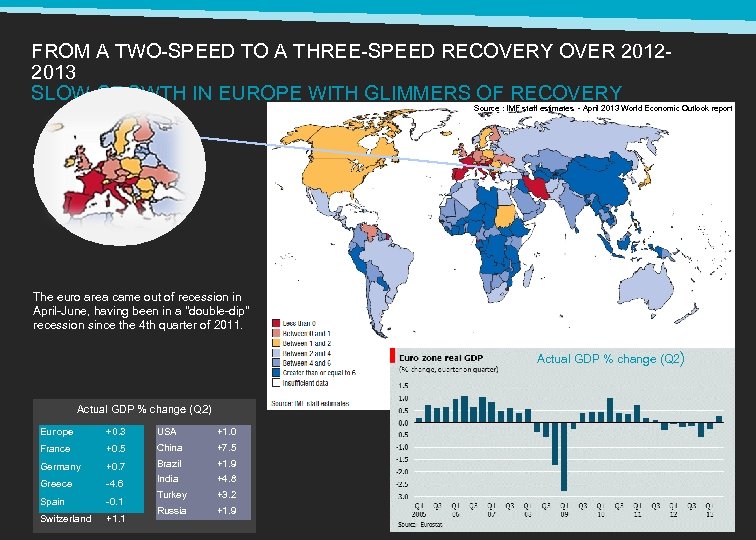
FROM A TWO-SPEED TO A THREE-SPEED RECOVERY OVER 20122013 SLOW GROWTH IN EUROPE WITH GLIMMERS OF RECOVERY Source : IMF staff estimates - April 2013 World Economic Outlook report The euro area came out of recession in April-June, having been in a "double-dip" recession since the 4 th quarter of 2011. Actual GDP % change (Q 2) Europe +0. 3 USA +1. 0 France +0. 5 China +7. 5 Germany +0. 7 Brazil +1. 9 Greece -4. 6 India +4. 8 Spain -0. 1 Turkey +3. 2 MERCER Switzerland +1. 1 Russia +1. 9 3
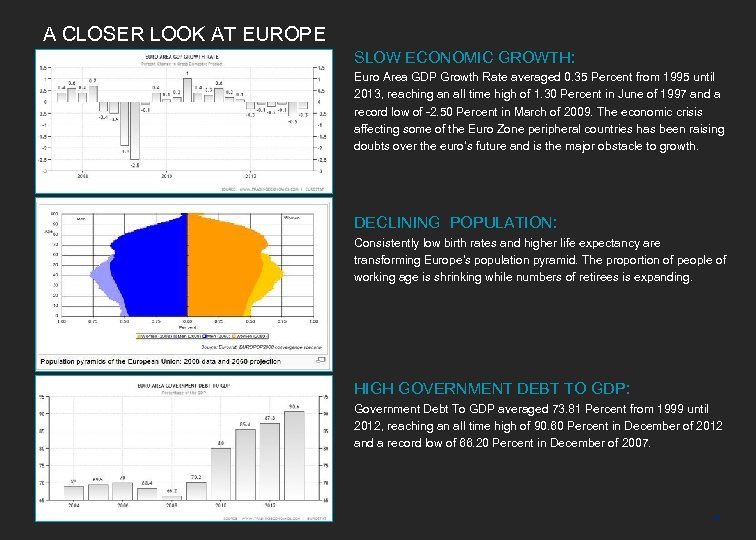
A CLOSER LOOK AT EUROPE SLOW ECONOMIC GROWTH: Euro Area GDP Growth Rate averaged 0. 35 Percent from 1995 until 2013, reaching an all time high of 1. 30 Percent in June of 1997 and a record low of -2. 50 Percent in March of 2009. The economic crisis affecting some of the Euro Zone peripheral countries has been raising doubts over the euro’s future and is the major obstacle to growth. DECLINING POPULATION: Consistently low birth rates and higher life expectancy are transforming Europe's population pyramid. The proportion of people of working age is shrinking while numbers of retirees is expanding. HIGH GOVERNMENT DEBT TO GDP: Government Debt To GDP averaged 73. 81 Percent from 1999 until 2012, reaching an all time high of 90. 60 Percent in December of 2012 and a record low of 66. 20 Percent in December of 2007. MERCER 4
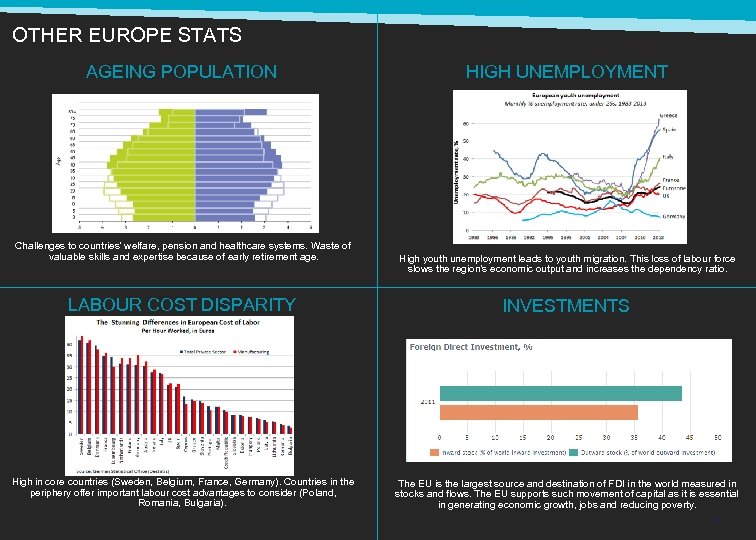
OTHER EUROPE STATS AGEING POPULATION HIGH UNEMPLOYMENT Likely to stabilize above 12% in 2014 Challenges to countries' welfare, pension and healthcare systems. Waste of valuable skills and expertise because of early retirement age. High youth unemployment leads to youth migration. This loss of labour force slows the region’s economic output and increases the dependency ratio. LABOUR COST DISPARITY INVESTMENTS High in core countries (Sweden, Belgium, France, Germany). Countries in the periphery offer important labour cost advantages to consider (Poland, Romania, Bulgaria). The EU is the largest source and destination of FDI in the world measured in stocks and flows. The EU supports such movement of capital as it is essential in generating economic growth, jobs and reducing poverty. MERCER 5
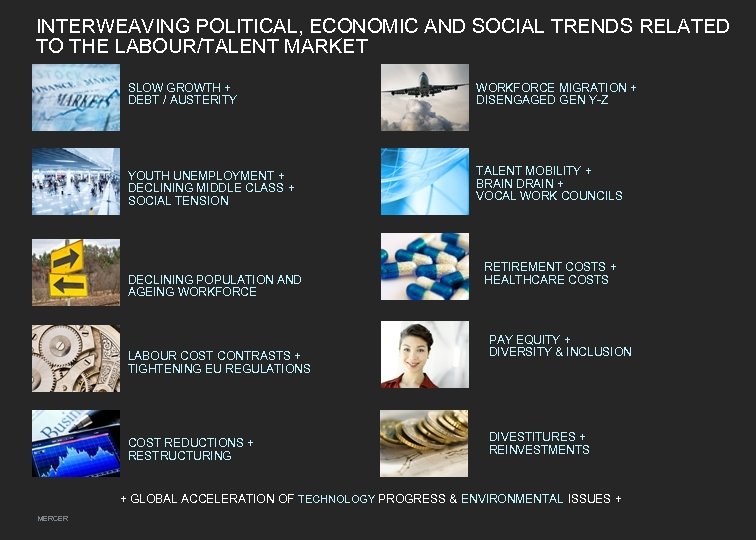
INTERWEAVING POLITICAL, ECONOMIC AND SOCIAL TRENDS RELATED TO THE LABOUR/TALENT MARKET SLOW GROWTH + DEBT / AUSTERITY WORKFORCE MIGRATION + DISENGAGED GEN Y-Z YOUTH UNEMPLOYMENT + DECLINING MIDDLE CLASS + SOCIAL TENSION TALENT MOBILITY + BRAIN DRAIN + VOCAL WORK COUNCILS DECLINING POPULATION AND AGEING WORKFORCE LABOUR COST CONTRASTS + TIGHTENING EU REGULATIONS COST REDUCTIONS + RESTRUCTURING RETIREMENT COSTS + HEALTHCARE COSTS PAY EQUITY + DIVERSITY & INCLUSION DIVESTITURES + REINVESTMENTS + GLOBAL ACCELERATION OF TECHNOLOGY PROGRESS & ENVIRONMENTAL ISSUES + MERCER
GLOBAL & EUROPEAN LABOUR / TALENT-RELATED TRENDS MERCER 20 March 2018 7
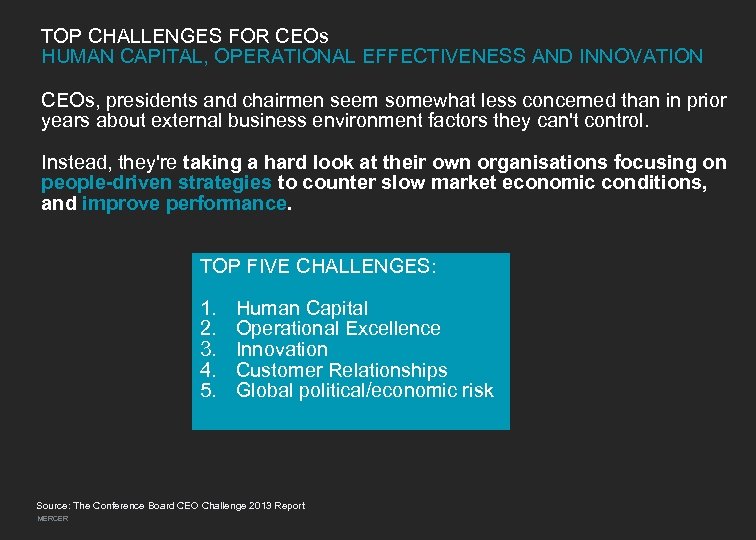
TOP CHALLENGES FOR CEOs HUMAN CAPITAL, OPERATIONAL EFFECTIVENESS AND INNOVATION CEOs, presidents and chairmen seem somewhat less concerned than in prior years about external business environment factors they can't control. Instead, they're taking a hard look at their own organisations focusing on people-driven strategies to counter slow market economic conditions, and improve performance. TOP FIVE CHALLENGES: 1. 2. 3. 4. 5. Human Capital Operational Excellence Innovation Customer Relationships Global political/economic risk Source: The Conference Board CEO Challenge 2013 Report MERCER
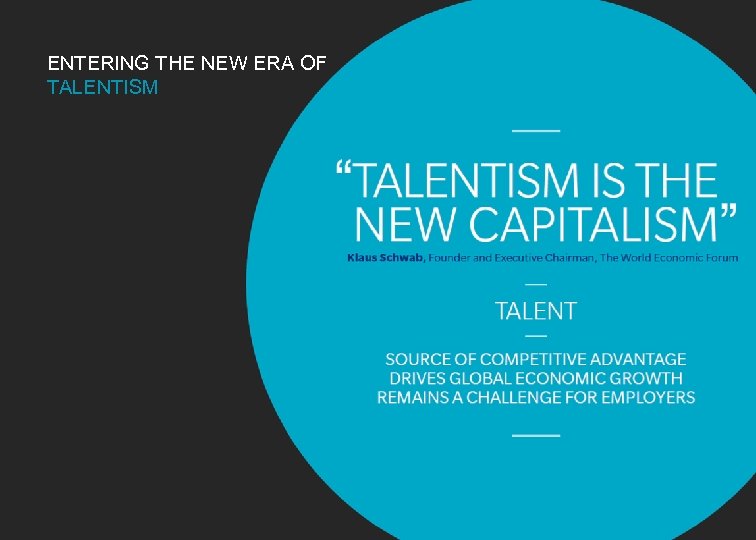
ENTERING THE NEW ERA OF TALENTISM MERCER 20 March 2018 9
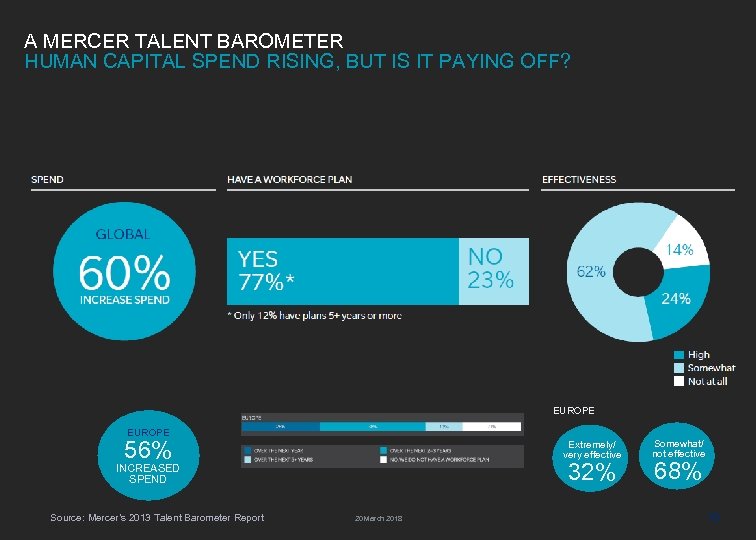
A MERCER TALENT BAROMETER HUMAN CAPITAL SPEND RISING, BUT IS IT PAYING OFF? EUROPE 56% Extremely/ very effective 32% INCREASED SPEND Source: Mercer’s 2013 Talent Barometer Report MERCER 20 March 2018 Somewhat/ not effective 68% 10
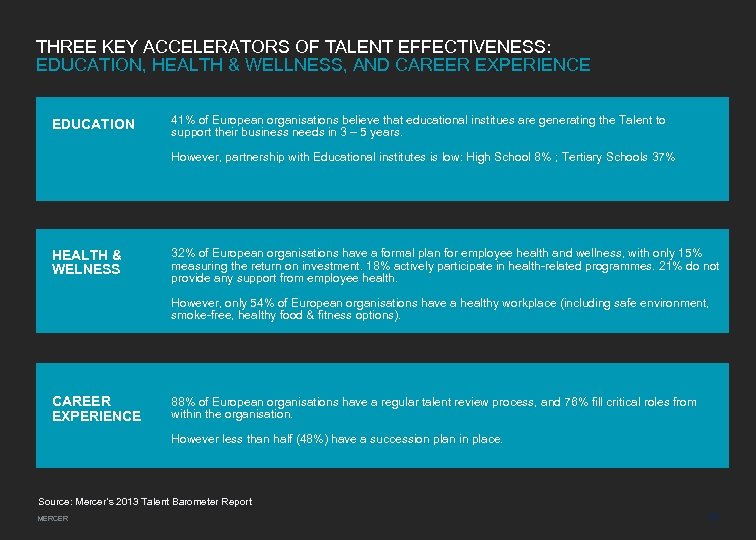
THREE KEY ACCELERATORS OF TALENT EFFECTIVENESS: EDUCATION, HEALTH & WELLNESS, AND CAREER EXPERIENCE EDUCATION 41% of European organisations believe that educational institues are generating the Talent to support their business needs in 3 – 5 years. However, partnership with Educational institutes is low: High School 8% ; Tertiary Schools 37% HEALTH & WELNESS 32% of European organisations have a formal plan for employee health and wellness, with only 15% measuring the return on investment. 18% actively participate in health-related programmes. 21% do not provide any support from employee health. However, only 54% of European organisations have a healthy workplace (including safe environment, smoke-free, healthy food & fitness options). CAREER EXPERIENCE 88% of European organisations have a regular talent review process, and 76% fill critical roles from within the organisation. However less than half (48%) have a succession plan in place. Source: Mercer’s 2013 Talent Barometer Report MERCER 11
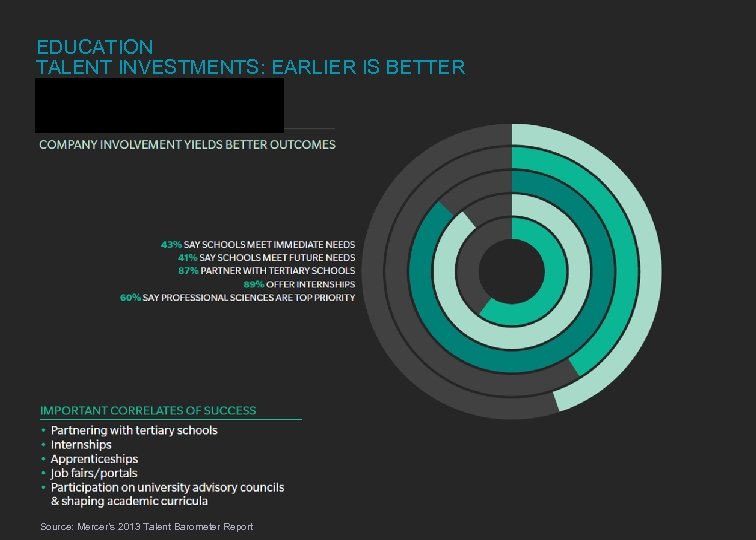
EDUCATION TALENT INVESTMENTS: EARLIER IS BETTER MERCER Source: Mercer’s 2013 Talent Barometer Report 20 March 2018 12
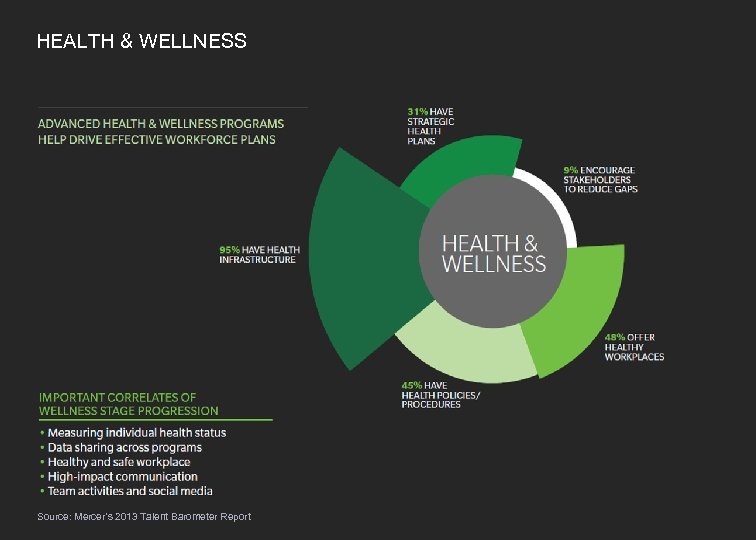
HEALTH & WELLNESS Source: Mercer’s 2013 Talent Barometer Report MERCER 20 March 2018 13
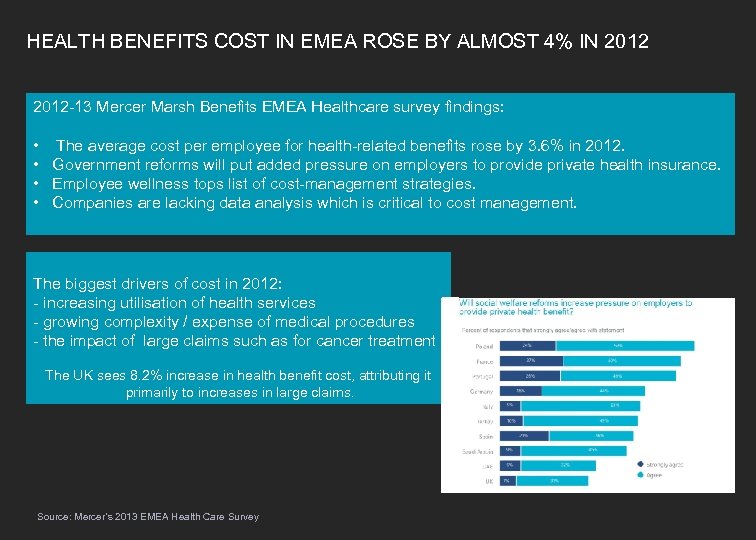
HEALTH BENEFITS COST IN EMEA ROSE BY ALMOST 4% IN 2012 -13 Mercer Marsh Benefits EMEA Healthcare survey findings: • The average cost per employee for health-related benefits rose by 3. 6% in 2012. • Government reforms will put added pressure on employers to provide private health insurance. • Employee wellness tops list of cost-management strategies. • Companies are lacking data analysis which is critical to cost management. The biggest drivers of cost in 2012: - increasing utilisation of health services - growing complexity / expense of medical procedures - the impact of large claims such as for cancer treatment The UK sees 8. 2% increase in health benefit cost, attributing it primarily to increases in large claims. Source: Mercer’s 2013 EMEA Health Care Survey MERCER 20 March 2018 14
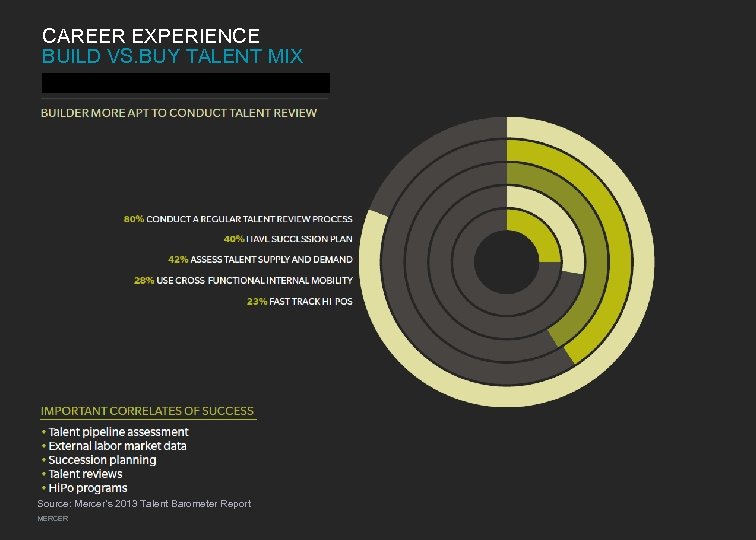
CAREER EXPERIENCE BUILD VS. BUY TALENT MIX Source: Mercer’s 2013 Talent Barometer Report MERCER 3/20/2018 15
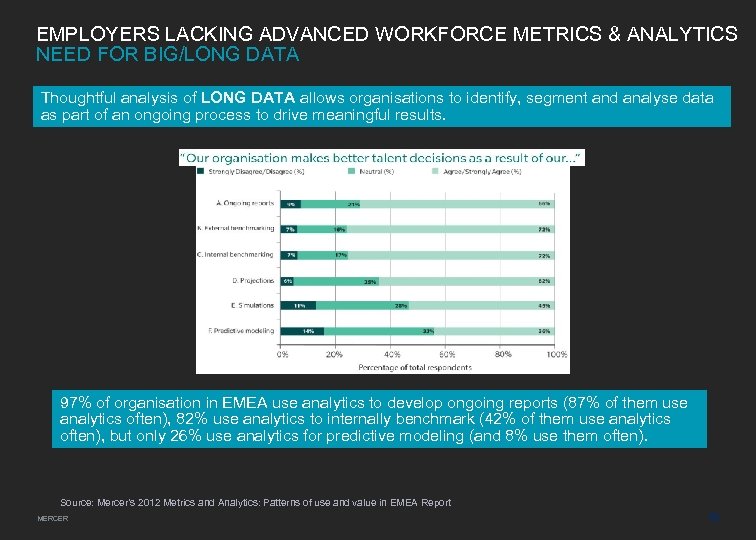
EMPLOYERS LACKING ADVANCED WORKFORCE METRICS & ANALYTICS NEED FOR BIG/LONG DATA Thoughtful analysis of LONG DATA allows organisations to identify, segment and analyse data as part of an ongoing process to drive meaningful results. 97% of organisation in EMEA use analytics to develop ongoing reports (87% of them use analytics often), 82% use analytics to internally benchmark (42% of them use analytics often), but only 26% use analytics for predictive modeling (and 8% use them often). Source: Mercer’s 2012 Metrics and Analytics: Patterns of use and value in EMEA Report MERCER 16
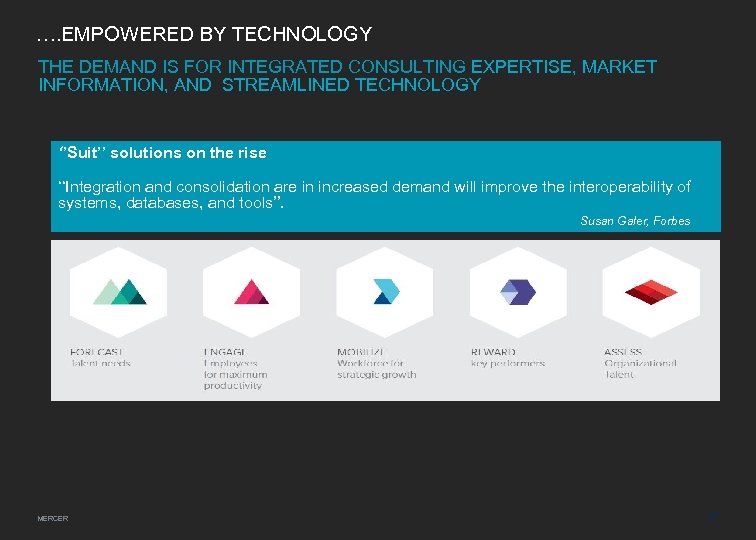
…. EMPOWERED BY TECHNOLOGY THE DEMAND IS FOR INTEGRATED CONSULTING EXPERTISE, MARKET INFORMATION, AND STREAMLINED TECHNOLOGY ‘’Suit’’ solutions on the rise ‘‘Integration and consolidation are in increased demand will improve the interoperability of systems, databases, and tools’’. Susan Galer, Forbes MERCER 17
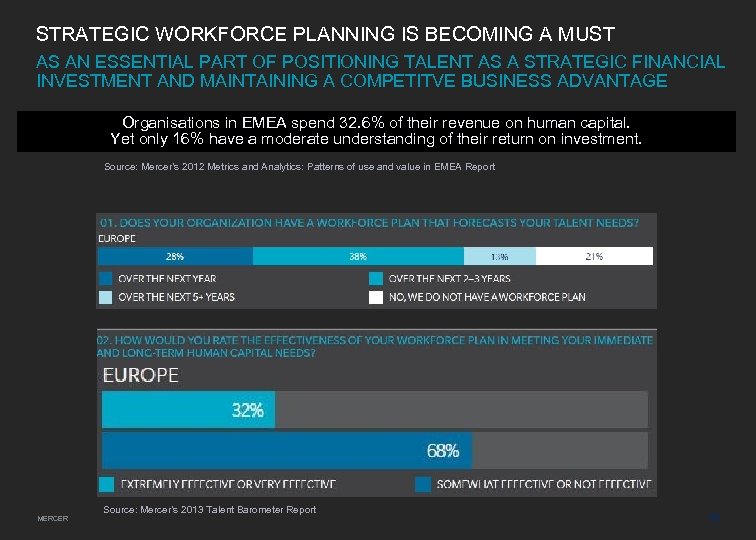
STRATEGIC WORKFORCE PLANNING IS BECOMING A MUST AS AN ESSENTIAL PART OF POSITIONING TALENT AS A STRATEGIC FINANCIAL INVESTMENT AND MAINTAINING A COMPETITVE BUSINESS ADVANTAGE Organisations in EMEA spend 32. 6% of their revenue on human capital. Yet only 16% have a moderate understanding of their return on investment. Source: Mercer’s 2012 Metrics and Analytics: Patterns of use and value in EMEA Report MERCER Source: Mercer’s 2013 Talent Barometer Report 18
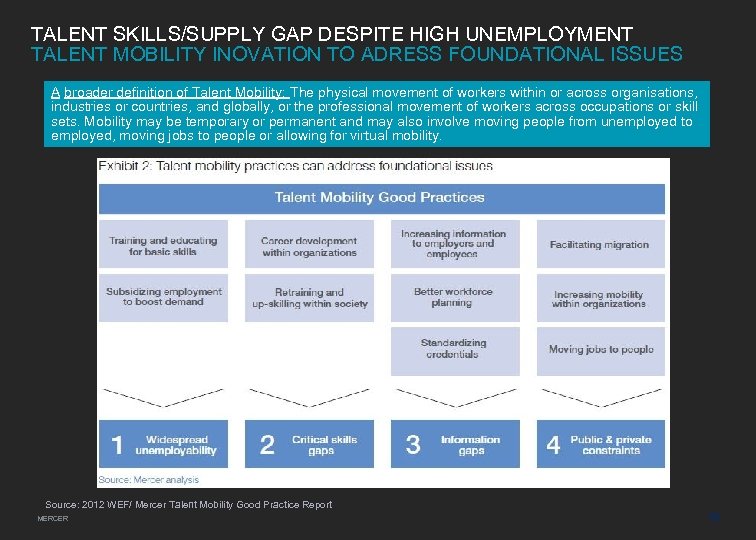
TALENT SKILLS/SUPPLY GAP DESPITE HIGH UNEMPLOYMENT TALENT MOBILITY INOVATION TO ADRESS FOUNDATIONAL ISSUES A broader definition of Talent Mobility: The physical movement of workers within or across organisations, industries or countries, and globally, or the professional movement of workers across occupations or skill sets. Mobility may be temporary or permanent and may also involve moving people from unemployed to employed, moving jobs to people or allowing for virtual mobility. Source: 2012 WEF/ Mercer Talent Mobility Good Practice Report MERCER 19
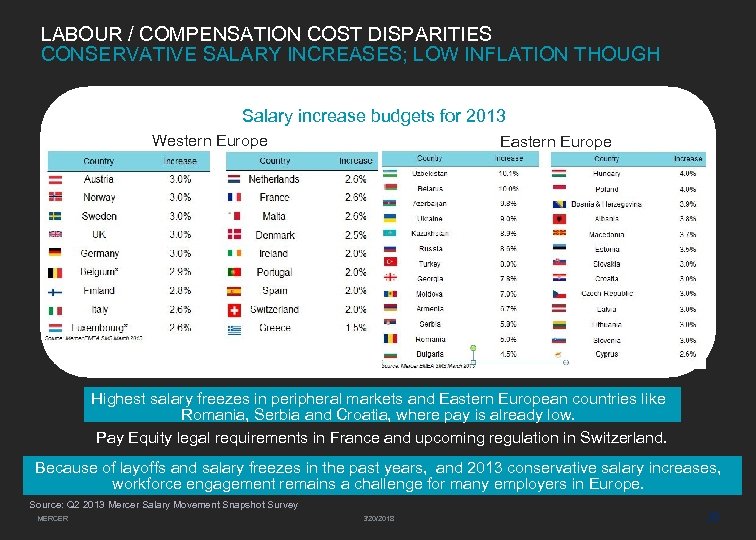
LABOUR / COMPENSATION COST DISPARITIES CONSERVATIVE SALARY INCREASES; LOW INFLATION THOUGH Salary increase budgets for 2013 Western Europe Eastern Europe Highest salary freezes in peripheral markets and Eastern European countries like Romania, Serbia and Croatia, where pay is already low. Pay Equity legal requirements in France and upcoming regulation in Switzerland. Because of layoffs and salary freezes in the past years, and 2013 conservative salary increases, workforce engagement remains a challenge for many employers in Europe. Source: Q 2 2013 Mercer Salary Movement Snapshot Survey MERCER 3/20/2018 20
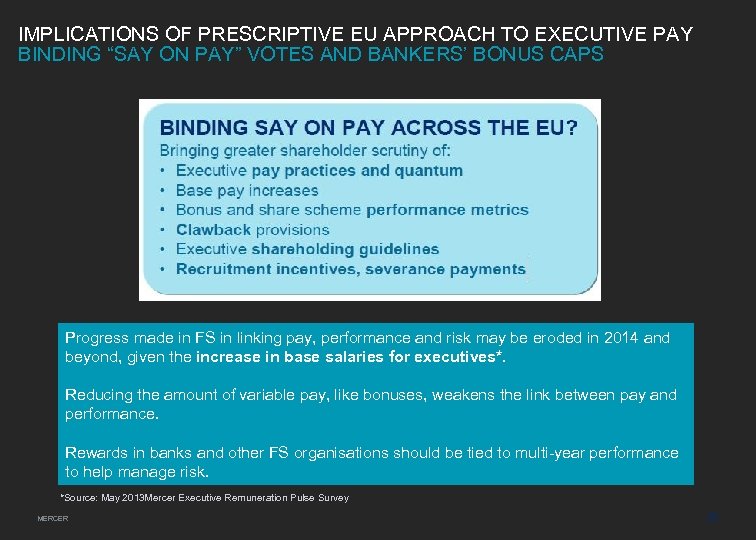
IMPLICATIONS OF PRESCRIPTIVE EU APPROACH TO EXECUTIVE PAY BINDING “SAY ON PAY” VOTES AND BANKERS’ BONUS CAPS Progress made in FS in linking pay, performance and risk may be eroded in 2014 and beyond, given the increase in base salaries for executives*. Reducing the amount of variable pay, like bonuses, weakens the link between pay and performance. Rewards in banks and other FS organisations should be tied to multi-year performance to help manage risk. *Source: May 2013 Mercer Executive Remuneration Pulse Survey MERCER 21
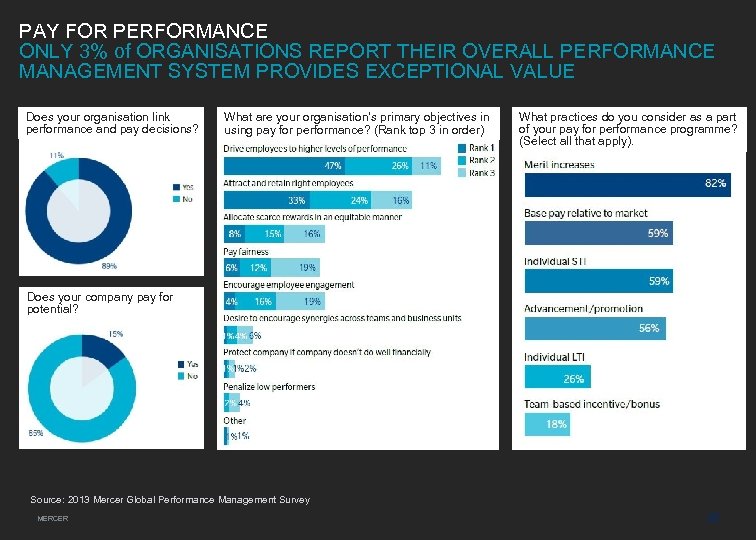
PAY FOR PERFORMANCE ONLY 3% of ORGANISATIONS REPORT THEIR OVERALL PERFORMANCE MANAGEMENT SYSTEM PROVIDES EXCEPTIONAL VALUE Does your organisation link performance and pay decisions? What are your organisation’s primary objectives in using pay for performance? (Rank top 3 in order) What practices do you consider as a part of your pay for performance programme? (Select all that apply). Does your company pay for potential? Source: 2013 Mercer Global Performance Management Survey MERCER 22
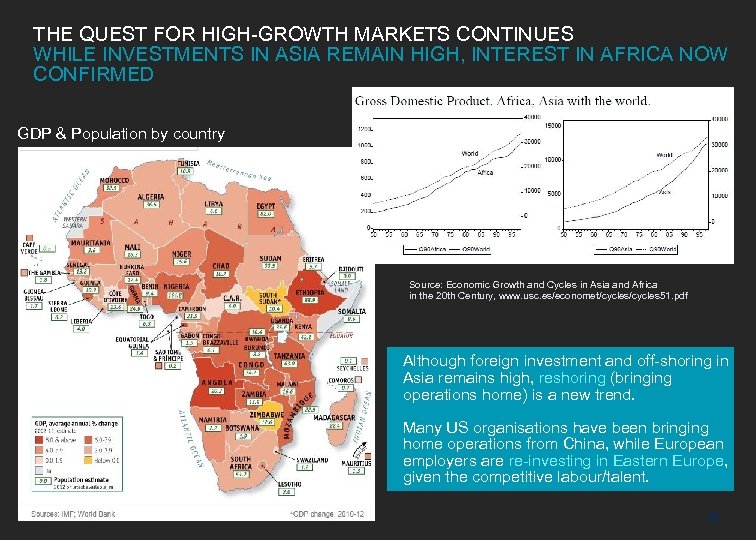
THE QUEST FOR HIGH-GROWTH MARKETS CONTINUES WHILE INVESTMENTS IN ASIA REMAIN HIGH, INTEREST IN AFRICA NOW CONFIRMED GDP & Population by country Source: Economic Growth and Cycles in Asia and Africa in the 20 th Century, www. usc. es/economet/cycles 51. pdf Although foreign investment and off-shoring in Asia remains high, reshoring (bringing operations home) is a new trend. Many US organisations have been bringing home operations from China, while European employers are re-investing in Eastern Europe, given the competitive labour/talent. Source: 2013 Mercer Global Performance Management Survey MERCER 23
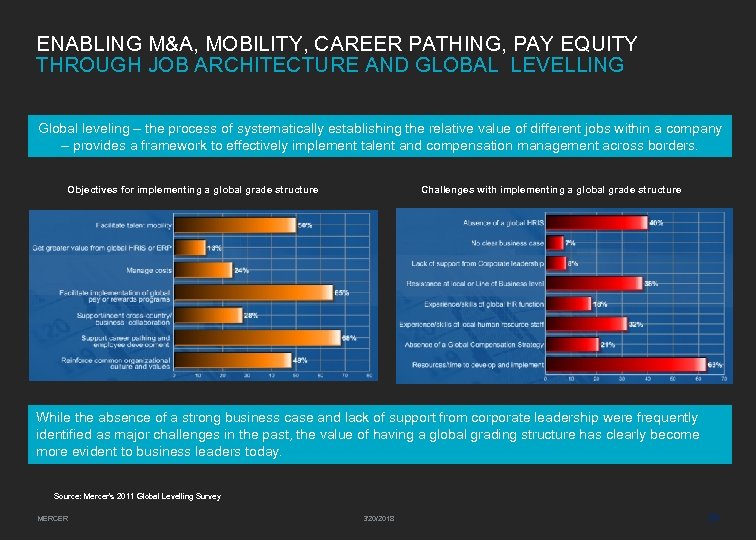
ENABLING M&A, MOBILITY, CAREER PATHING, PAY EQUITY THROUGH JOB ARCHITECTURE AND GLOBAL LEVELLING Global leveling – the process of systematically establishing the relative value of different jobs within a company – provides a framework to effectively implement talent and compensation management across borders. Objectives for implementing a global grade structure Challenges with implementing a global grade structure While the absence of a strong business case and lack of support from corporate leadership were frequently identified as major challenges in the past, the value of having a global grading structure has clearly become more evident to business leaders today. Source: Mercer’s 2011 Global Levelling Survey MERCER 3/20/2018 24
RISKS & OPPORTUNITIES FOR EMPLOYERS IN EUROPE 20 March 2018 25
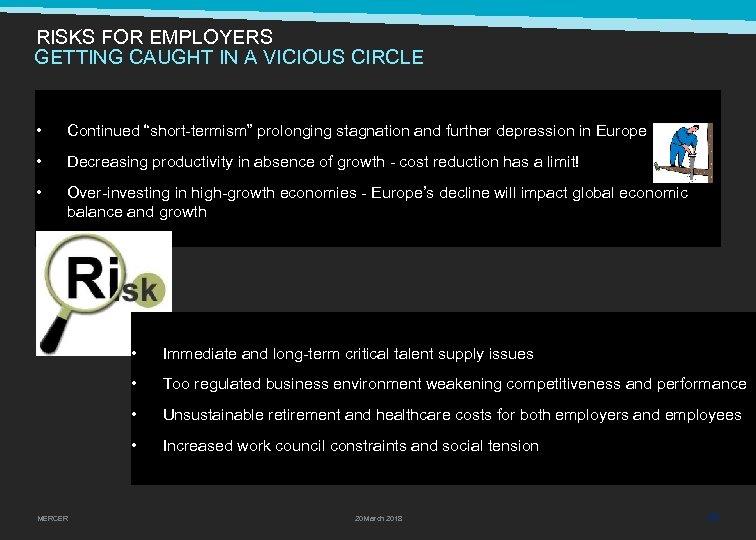
RISKS FOR EMPLOYERS GETTING CAUGHT IN A VICIOUS CIRCLE • Continued “short-termism” prolonging stagnation and further depression in Europe • Decreasing productivity in absence of growth - cost reduction has a limit! • Over-investing in high-growth economies - Europe’s decline will impact global economic balance and growth • • Too regulated business environment weakening competitiveness and performance • Unsustainable retirement and healthcare costs for both employers and employees • MERCER Immediate and long-term critical talent supply issues Increased work council constraints and social tension 20 March 2018 26
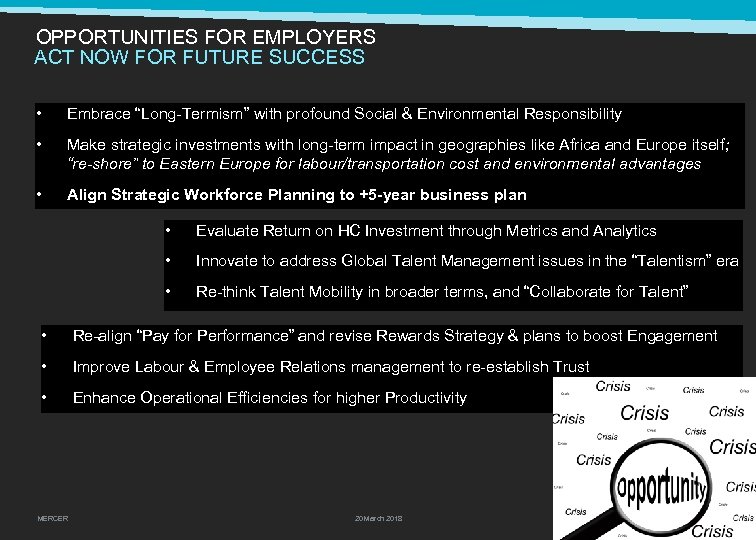
OPPORTUNITIES FOR EMPLOYERS ACT NOW FOR FUTURE SUCCESS • Embrace “Long-Termism” with profound Social & Environmental Responsibility • Make strategic investments with long-term impact in geographies like Africa and Europe itself; “re-shore” to Eastern Europe for labour/transportation cost and environmental advantages • Align Strategic Workforce Planning to +5 -year business plan • Evaluate Return on HC Investment through Metrics and Analytics • Innovate to address Global Talent Management issues in the “Talentism” era • Re-think Talent Mobility in broader terms, and “Collaborate for Talent” • Re-align “Pay for Performance” and revise Rewards Strategy & plans to boost Engagement • Improve Labour & Employee Relations management to re-establish Trust • Enhance Operational Efficiencies for higher Productivity MERCER 20 March 2018 27

MERCER
Скачать презентацию DOING BUSINESS IN EUROPE ADDRESSING TODAY S AND TOMORROW S
cb9f5836f65ef989d97f92c758b299b0.ppt