


 Скачать презентацию DOI SYSTEM AND ITS APPLICATIONS Co-operation and promotion
49b1b20a9820fb8491c3c0586d7cc752.ppt
- Количество слайдов: 34
 DOI SYSTEM AND ITS APPLICATIONS Co-operation and promotion of Information Resources in Science and Technology Beijing Oct 23 2006 Norman Paskin International DOI Foundation
 Outline 1. Naming (identifying) resources on the internet • • • 2. The problem Handles DOIs Meaning of resources on the internet • 3. Mapping meanings through metadata DOI System • Current position of the DOI system
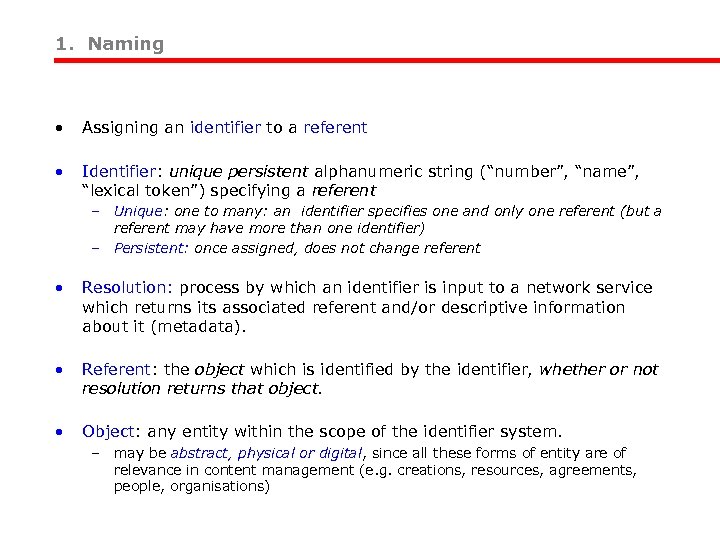 1. Naming • Assigning an identifier to a referent • Identifier: unique persistent alphanumeric string (“number”, “name”, “lexical token”) specifying a referent – Unique: one to many: an identifier specifies one and only one referent (but a referent may have more than one identifier) – Persistent: once assigned, does not change referent • Resolution: process by which an identifier is input to a network service which returns its associated referent and/or descriptive information about it (metadata). • Referent: the object which is identified by the identifier, whether or not resolution returns that object. • Object: any entity within the scope of the identifier system. – may be abstract, physical or digital, since all these forms of entity are of relevance in content management (e. g. creations, resources, agreements, people, organisations)
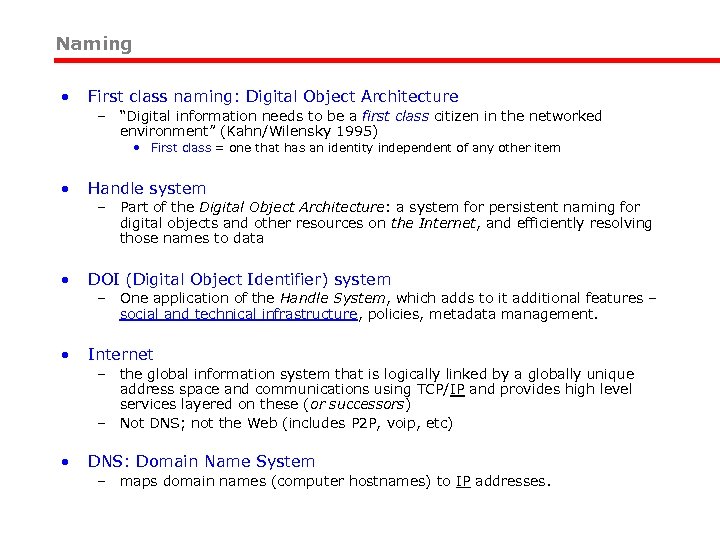 Naming • First class naming: Digital Object Architecture – “Digital information needs to be a first class citizen in the networked environment” (Kahn/Wilensky 1995) • First class = one that has an identity independent of any other item • Handle system – Part of the Digital Object Architecture: a system for persistent naming for digital objects and other resources on the Internet, and efficiently resolving those names to data • DOI (Digital Object Identifier) system – One application of the Handle System, which adds to it additional features – social and technical infrastructure, policies, metadata management. • Internet – the global information system that is logically linked by a globally unique address space and communications using TCP/IP and provides high level services layered on these (or successors) – Not DNS; not the Web (includes P 2 P, voip, etc) • DNS: Domain Name System – maps domain names (computer hostnames) to IP addresses.
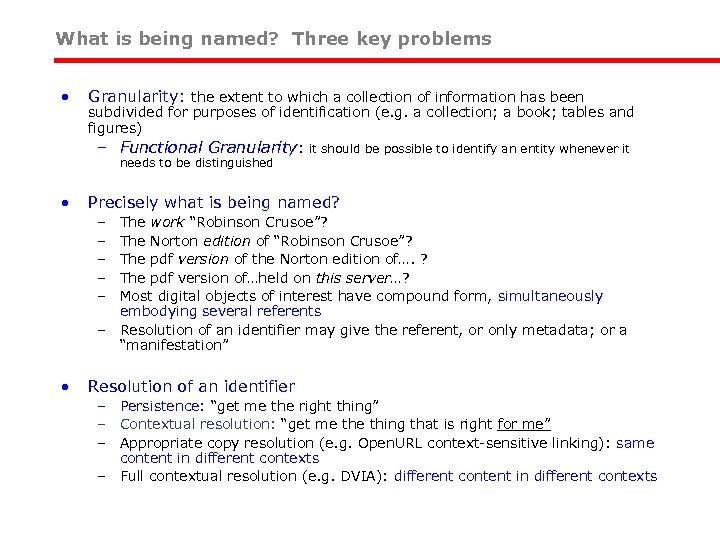 What is being named? Three key problems • Granularity: the extent to which a collection of information has been subdivided for purposes of identification (e. g. a collection; a book; tables and figures) – Functional Granularity: it should be possible to identify an entity whenever it needs to be distinguished • Precisely what is being named? – – – The work “Robinson Crusoe”? The Norton edition of “Robinson Crusoe”? The pdf version of the Norton edition of…. ? The pdf version of…held on this server…? Most digital objects of interest have compound form, simultaneously embodying several referents – Resolution of an identifier may give the referent, or only metadata; or a “manifestation” • Resolution of an identifier – Persistence: “get me the right thing” – Contextual resolution: “get me thing that is right for me” – Appropriate copy resolution (e. g. Open. URL context-sensitive linking): same content in different contexts – Full contextual resolution (e. g. DVIA): different content in different contexts
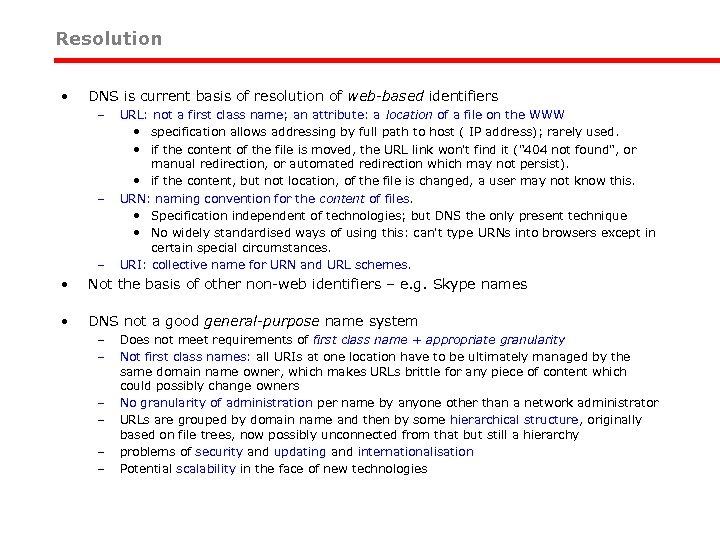 Resolution • DNS is current basis of resolution of web-based identifiers – – – URL: not a first class name; an attribute: a location of a file on the WWW • specification allows addressing by full path to host ( IP address); rarely used. • if the content of the file is moved, the URL link won't find it ("404 not found", or manual redirection, or automated redirection which may not persist). • if the content, but not location, of the file is changed, a user may not know this. URN: naming convention for the content of files. • Specification independent of technologies; but DNS the only present technique • No widely standardised ways of using this: can't type URNs into browsers except in certain special circumstances. URI: collective name for URN and URL schemes. • Not the basis of other non-web identifiers – e. g. Skype names • DNS not a good general-purpose name system – – – Does not meet requirements of first class name + appropriate granularity Not first class names: all URIs at one location have to be ultimately managed by the same domain name owner, which makes URLs brittle for any piece of content which could possibly change owners No granularity of administration per name by anyone other than a network administrator URLs are grouped by domain name and then by some hierarchical structure, originally based on file trees, now possibly unconnected from that but still a hierarchy problems of security and updating and internationalisation Potential scalability in the face of new technologies
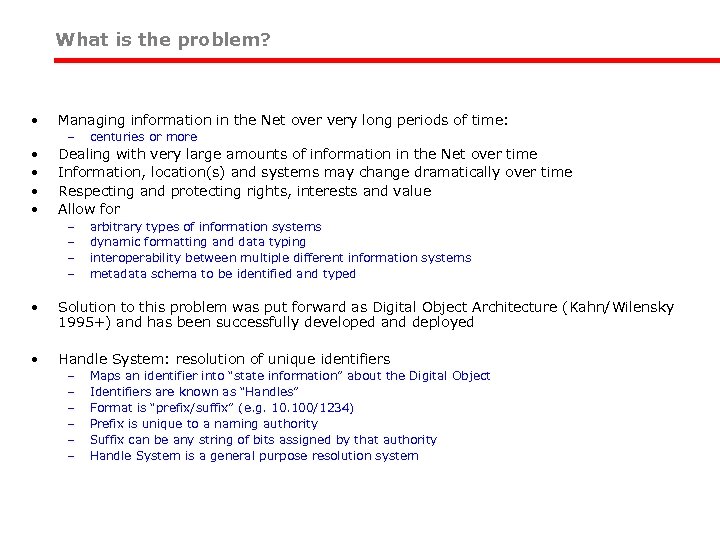 What is the problem? • Managing information in the Net over very long periods of time: – • • centuries or more Dealing with very large amounts of information in the Net over time Information, location(s) and systems may change dramatically over time Respecting and protecting rights, interests and value Allow for – – arbitrary types of information systems dynamic formatting and data typing interoperability between multiple different information systems metadata schema to be identified and typed • Solution to this problem was put forward as Digital Object Architecture (Kahn/Wilensky 1995+) and has been successfully developed and deployed • Handle System: resolution of unique identifiers – – – Maps an identifier into “state information” about the Digital Object Identifiers are known as “Handles” Format is “prefix/suffix” (e. g. 100/1234) Prefix is unique to a naming authority Suffix can be any string of bits assigned by that authority Handle System is a general purpose resolution system
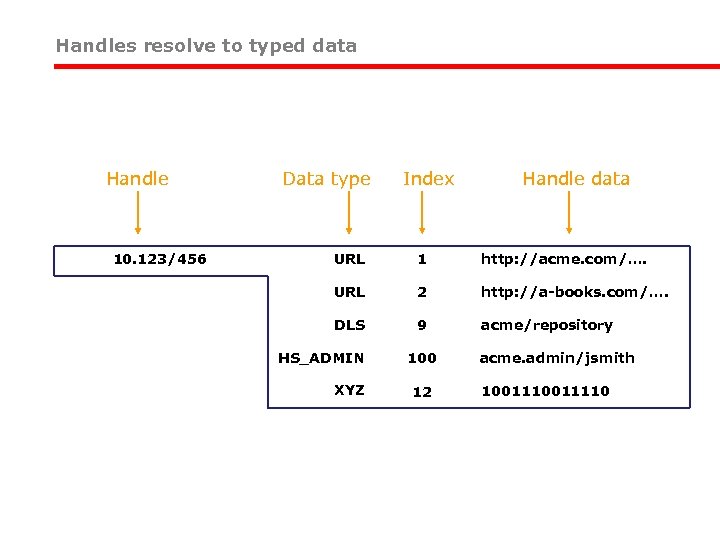 Handles resolve to typed data Handle 10. 123/456 Data type Index Handle data URL 1 http: //acme. com/…. URL 2 http: //a-books. com/…. DLS 9 acme/repository HS_ADMIN XYZ 100 12 acme. admin/jsmith 10011110
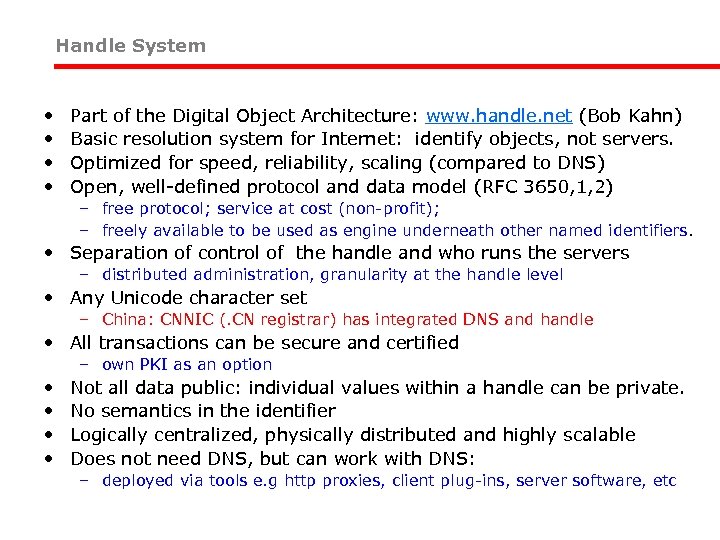 Handle System • • Part of the Digital Object Architecture: www. handle. net (Bob Kahn) Basic resolution system for Internet: identify objects, not servers. Optimized for speed, reliability, scaling (compared to DNS) Open, well-defined protocol and data model (RFC 3650, 1, 2) – free protocol; service at cost (non-profit); – freely available to be used as engine underneath other named identifiers. • Separation of control of the handle and who runs the servers – distributed administration, granularity at the handle level • Any Unicode character set – China: CNNIC (. CN registrar) has integrated DNS and handle • All transactions can be secure and certified – own PKI as an option • • Not all data public: individual values within a handle can be private. No semantics in the identifier Logically centralized, physically distributed and highly scalable Does not need DNS, but can work with DNS: – deployed via tools e. g http proxies, client plug-ins, server software, etc
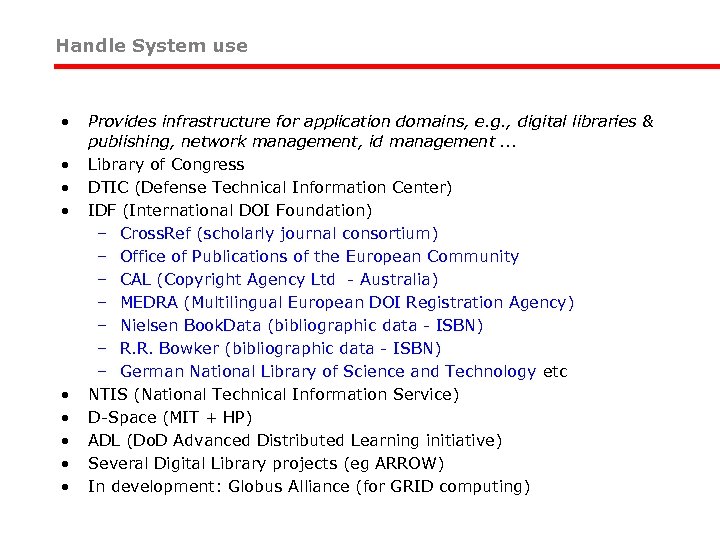 Handle System use • • • Provides infrastructure for application domains, e. g. , digital libraries & publishing, network management, id management. . . Library of Congress DTIC (Defense Technical Information Center) IDF (International DOI Foundation) – Cross. Ref (scholarly journal consortium) – Office of Publications of the European Community – CAL (Copyright Agency Ltd - Australia) – MEDRA (Multilingual European DOI Registration Agency) – Nielsen Book. Data (bibliographic data - ISBN) – R. R. Bowker (bibliographic data - ISBN) – German National Library of Science and Technology etc NTIS (National Technical Information Service) D-Space (MIT + HP) ADL (Do. D Advanced Distributed Learning initiative) Several Digital Library projects (eg ARROW) In development: Globus Alliance (for GRID computing)
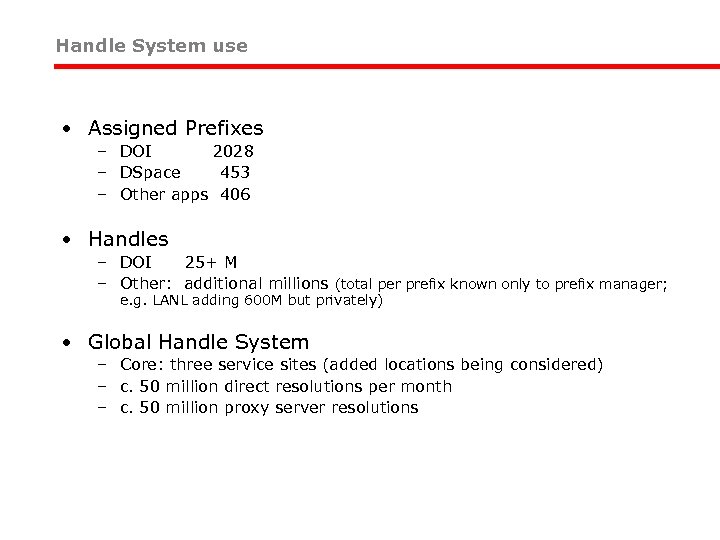 Handle System use • Assigned Prefixes – DOI 2028 – DSpace 453 – Other apps 406 • Handles – DOI 25+ M – Other: additional millions (total per prefix known only to prefix manager; e. g. LANL adding 600 M but privately) • Global Handle System – Core: three service sites (added locations being considered) – c. 50 million direct resolutions per month – c. 50 million proxy server resolutions
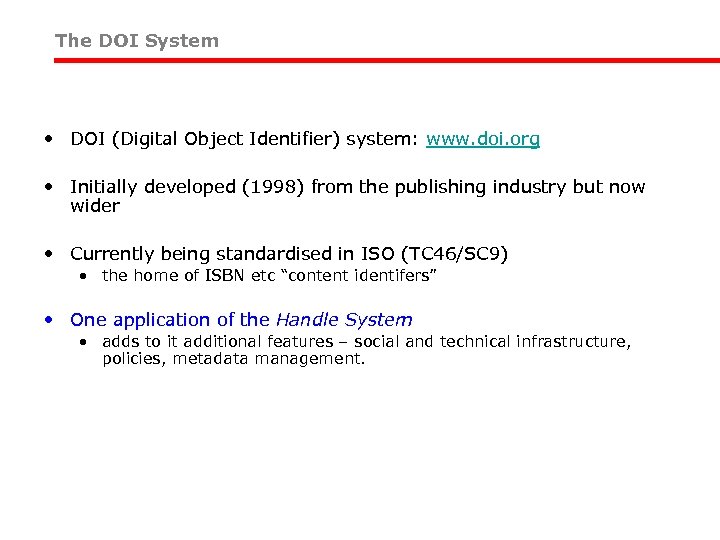 The DOI System • DOI (Digital Object Identifier) system: www. doi. org • Initially developed (1998) from the publishing industry but now wider • Currently being standardised in ISO (TC 46/SC 9) • the home of ISBN etc “content identifers” • One application of the Handle System • adds to it additional features – social and technical infrastructure, policies, metadata management.
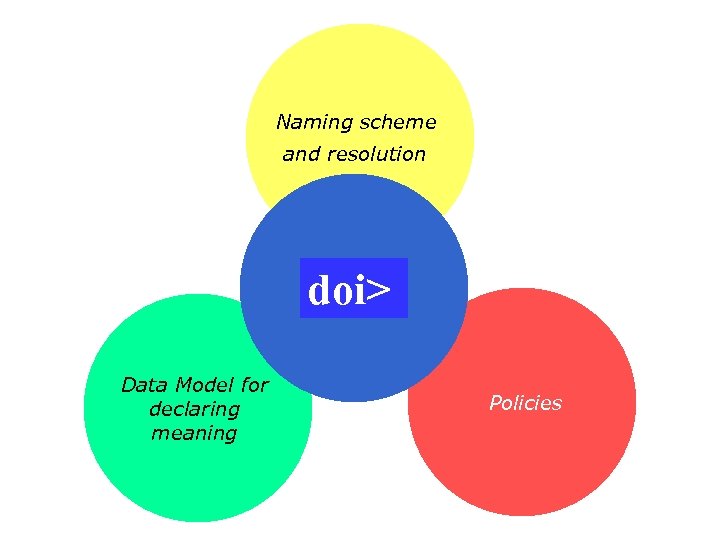 Naming scheme and resolution doi> Data Model for declaring meaning Policies
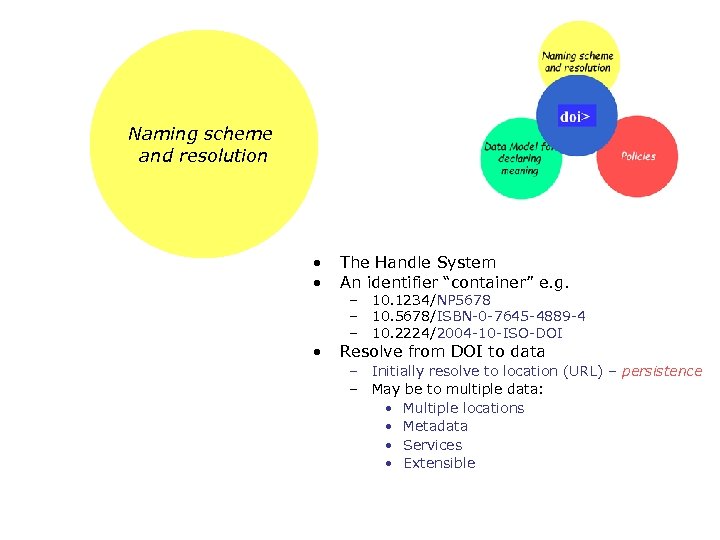 Naming scheme and resolution • • The Handle System An identifier “container” e. g. • Resolve from DOI to data – 10. 1234/NP 5678 – 10. 5678/ISBN-0 -7645 -4889 -4 – 10. 2224/2004 -10 -ISO-DOI – Initially resolve to location (URL) – persistence – May be to multiple data: • Multiple locations • Metadata • Services • Extensible
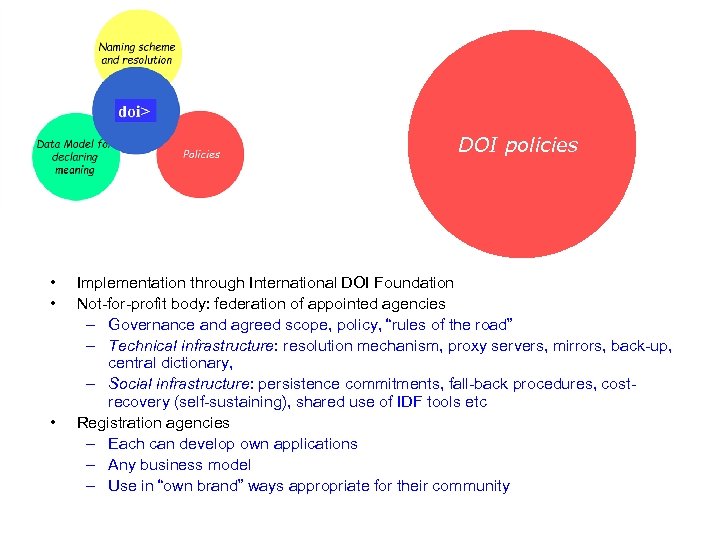 DOI policies • • • Implementation through International DOI Foundation Not-for-profit body: federation of appointed agencies – Governance and agreed scope, policy, “rules of the road” – Technical infrastructure: resolution mechanism, proxy servers, mirrors, back-up, central dictionary, – Social infrastructure: persistence commitments, fall-back procedures, costrecovery (self-sustaining), shared use of IDF tools etc Registration agencies – Each can develop own applications – Any business model – Use in “own brand” ways appropriate for their community
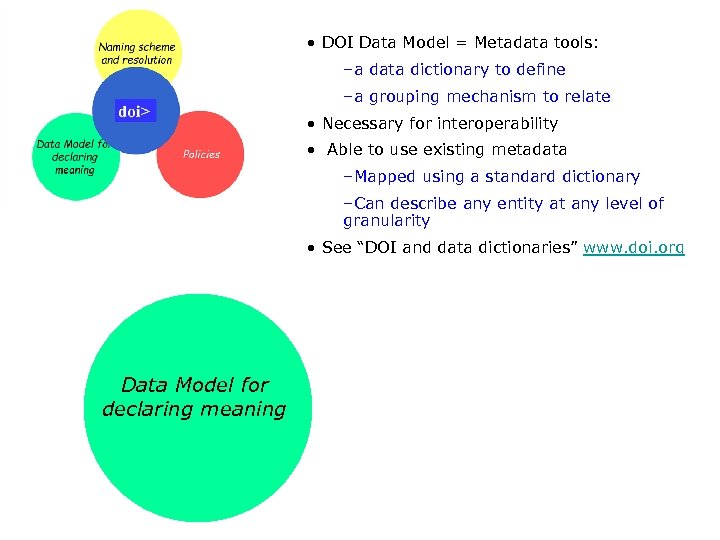 • DOI Data Model = Metadata tools: –a data dictionary to define –a grouping mechanism to relate • Necessary for interoperability • Able to use existing metadata –Mapped using a standard dictionary –Can describe any entity at any level of granularity • See “DOI and data dictionaries” www. doi. org Data Model for declaring meaning
 2. Meaning • Assigning metadata to a referent, to enable semantic interoperability – “say what the referent is” – Resolution of an identifier may give the referent, or only metadata; or a “manifestation” • Semantic: – Do two identifiers from different schemes actually denote the same referent? – If A says “owner” and B says “owner”, are they referring to the same thing? – If A says “released” and B says “disseminated”, do they mean different things? • Interoperability: the ability for identifiers to be used in services outside the direct control of the issuing assigner – Identifiers assigned in one context may be encountered, and may be reused, in another place or time - without consulting the assigner. You can’t assume that your assumptions made on assignment will be known to someone else. • Persistence = interoperability with the future
 Tools to ensure meaning • Basis: “Interoperability of Data in E-Commerce Systems” (indecs) : http: //www. indecs. org 1998 -2000 • Focus: generic intellectual property and how to make data about it interoperable • Who: EC + groups from the content, author, creator, library, publisher and rights communities • What: Pioneered a model of event-based metadata as a solution for integrating management of rights. • Led to: a structured ontology (data dictionary); tools for mapping terms precisley; inference tools etc: – contextual ontology architecture
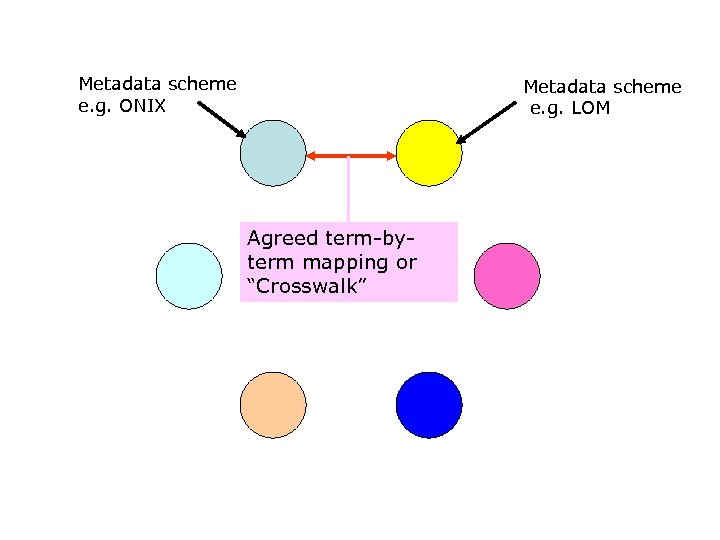 Metadata scheme e. g. ONIX Metadata scheme e. g. LOM Agreed term-byterm mapping or “Crosswalk”
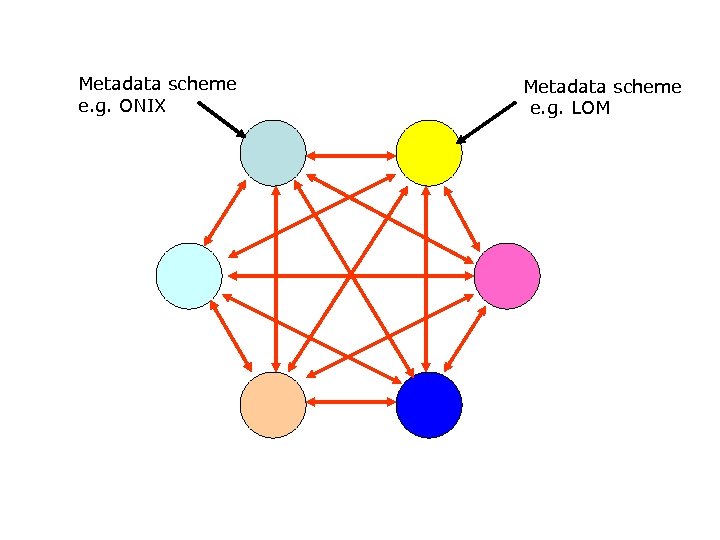 Metadata scheme e. g. ONIX Metadata scheme e. g. LOM
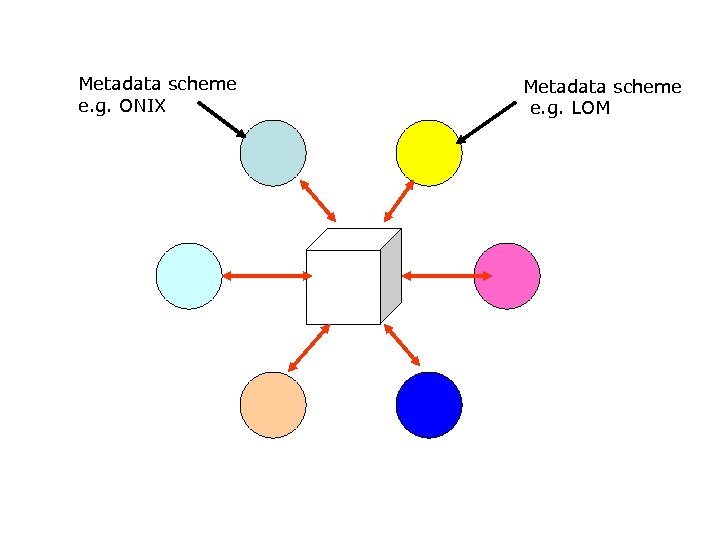 Metadata scheme e. g. ONIX Metadata scheme e. g. LOM
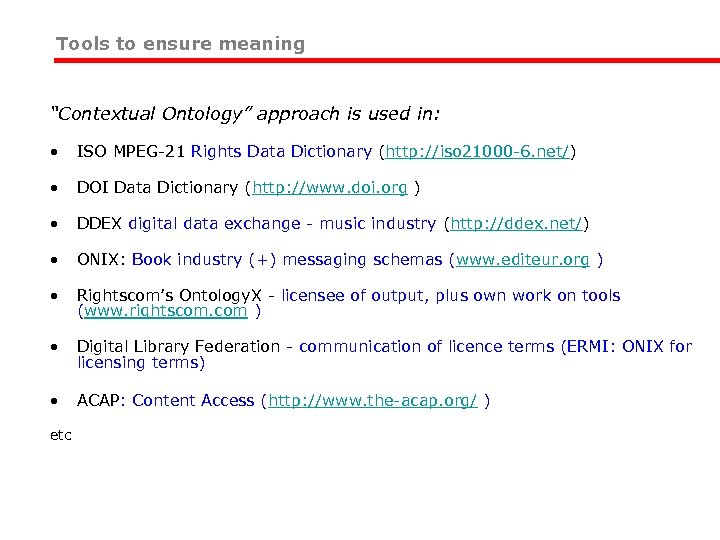 Tools to ensure meaning “Contextual Ontology” approach is used in: • ISO MPEG-21 Rights Data Dictionary (http: //iso 21000 -6. net/) • DOI Data Dictionary (http: //www. doi. org ) • DDEX digital data exchange - music industry (http: //ddex. net/) • ONIX: Book industry (+) messaging schemas (www. editeur. org ) • Rightscom’s Ontology. X - licensee of output, plus own work on tools (www. rightscom. com ) • Digital Library Federation - communication of licence terms (ERMI: ONIX for licensing terms) • ACAP: Content Access (http: //www. the-acap. org/ ) etc
 3. DOI System in application DOI System solves the problems of: • Naming: prerequisite for management of digital information entities • Meaning: prerequisite for enabling digital information entities to interact And also: • Building a practical system to do this
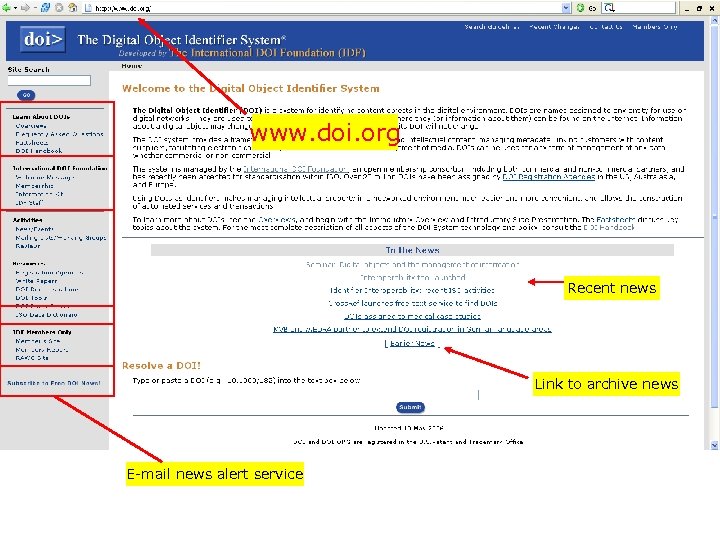 www. doi. org Recent news Link to archive news E-mail news alert service
 Two consistent aims since 1998 doi>
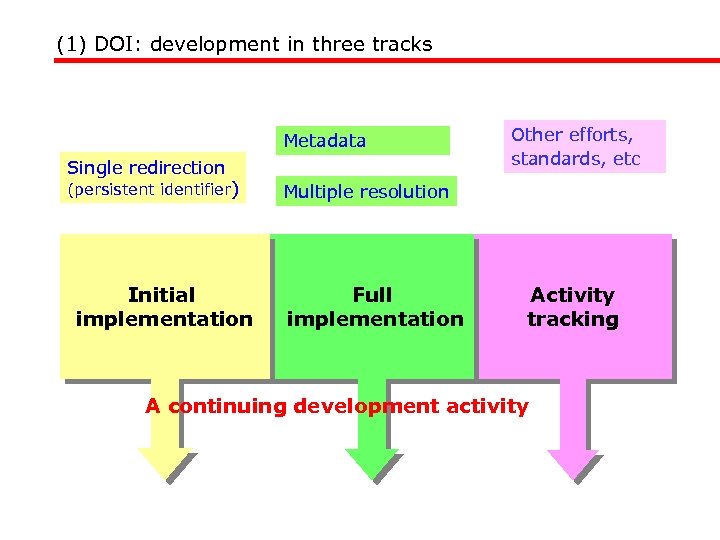 (1) DOI: development in three tracks Metadata Single redirection (persistent identifier) Initial implementation Other efforts, standards, etc Multiple resolution Full implementation Activity tracking A continuing development activity
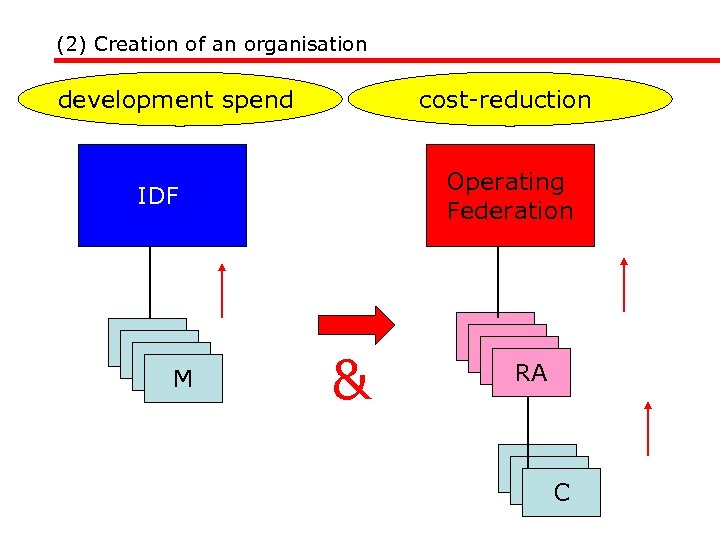 (2) Creation of an organisation development spend cost-reduction Operating Federation IDF M & RA C
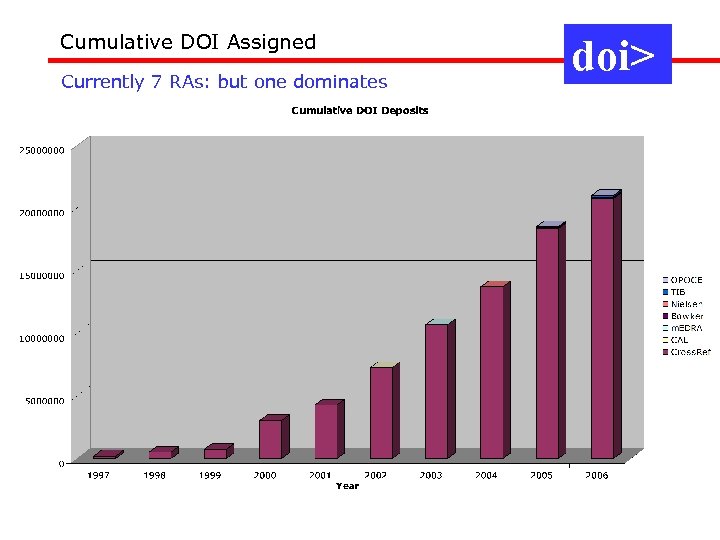 Cumulative DOI Assigned Currently 7 RAs: but one dominates doi>
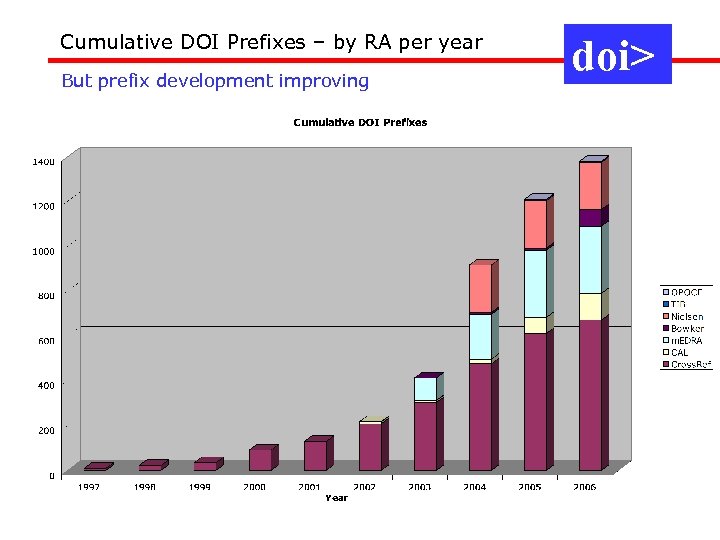 Cumulative DOI Prefixes – by RA per year But prefix development improving doi>
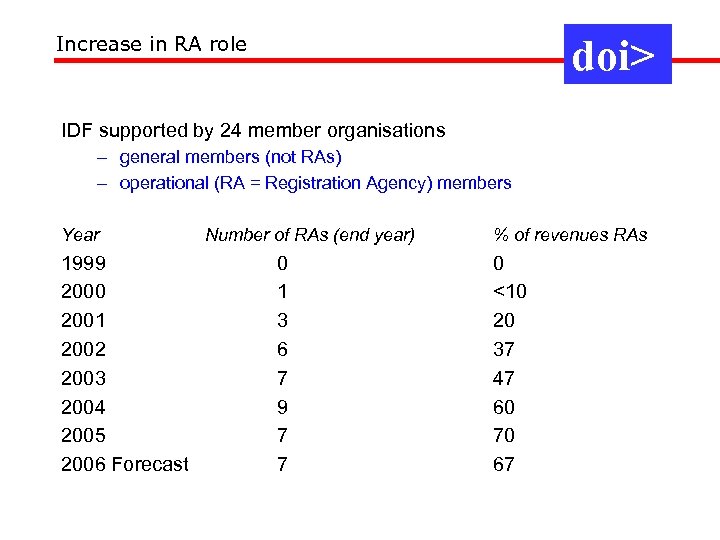 Increase in RA role doi> IDF supported by 24 member organisations – general members (not RAs) – operational (RA = Registration Agency) members Year 1999 2000 2001 2002 2003 2004 2005 2006 Forecast Number of RAs (end year) 0 1 3 6 7 9 7 7 % of revenues RAs 0 <10 20 37 47 60 70 67
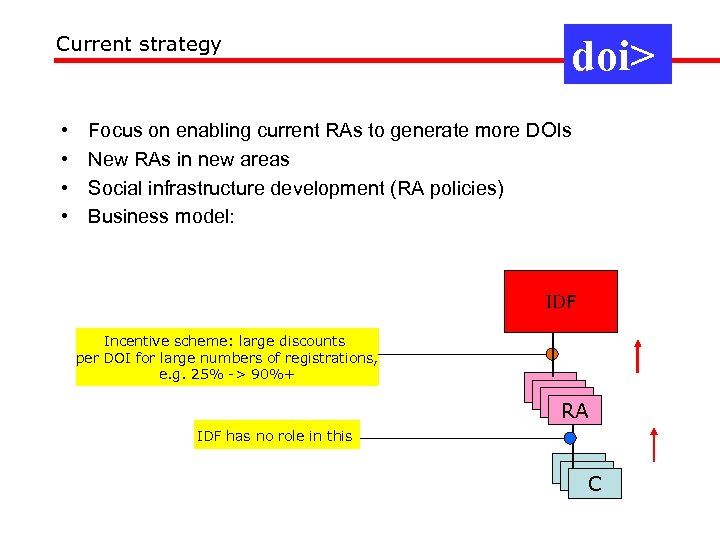 Current strategy • • doi> Focus on enabling current RAs to generate more DOIs New RAs in new areas Social infrastructure development (RA policies) Business model: IDF Incentive scheme: large discounts per DOI for large numbers of registrations, e. g. 25% -> 90%+ RA IDF has no role in this C
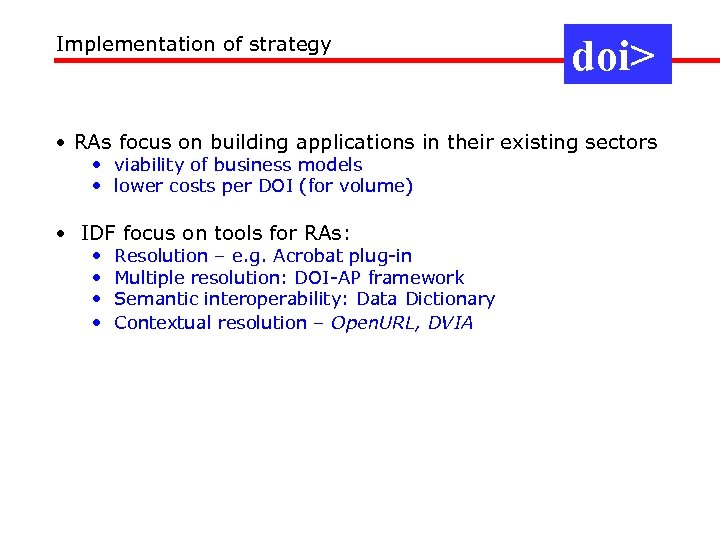 Implementation of strategy doi> • RAs focus on building applications in their existing sectors • viability of business models • lower costs per DOI (for volume) • IDF focus on tools for RAs: • Resolution – e. g. Acrobat plug-in • Multiple resolution: DOI-AP framework • Semantic interoperability: Data Dictionary • Contextual resolution – Open. URL, DVIA
 ISO standardisation doi> • DOI system as an ISO standard • Within ISO TC 46 SC 9 ISO/TC 46 = "Information and documentation". Subcommittee 9 = "Presentation, identification and description of documents": ISBN, ISSN, ISMN, ISRC, ISAN, V-ISAN, ISWC, ISTC • Aim is to codify system by reference to components IDF becomes ISO appointed authority for DOI standard ISO standard is basis of operating procedures (Handbook) Sept 06: Working Group reviews Nov 06: Committee Draft Likely completion 2007 or 2008
 DOI SYSTEM AND ITS APPLICATIONS Co-operation and promotion of Information Resources in Science and Technology Beijing Oct 23 2006 Norman Paskin n. paskin@doi. org International DOI Foundation