


 Скачать презентацию DOI implementations doi DOI update on progress
204514e21bb7ac4c5a93ef3ce074bf90.ppt
- Количество слайдов: 14
 DOI implementations doi> • DOI update on progress Norman Paskin • DOIs and journal publishing Ed Pentz, Cross. Ref • DOIs and book publishing David Sidman, CDI • [DOIs and non-English language publishing] see Enpia Systems stand 1. 1 L 1105 • DOIs and learning objects John Purcell, LON • DOIs and rights management Norman Paskin • Summary, Q&A
 DOI Update 2001 “DOI commercial implementations” doi>
 Features and benefits of DOI • Persistent identification doi> – – Not just a location Permanent, trackable, name Stays the same if ownership, location, control changes No need to update customers if location changes – – – Standard e. g. ISBN, ISSN, ISMN, SICI, ISRC Non-standard / public e. g. PII Private e. g. workflow, internal production Assigned by the publisher or on his behalf • Can incorporate existing identifiers • Can integrate with existing internal and external systems – Sales, royalty, stock, analysis, etc – Web sites, etc.
 Features and benefits of DOI doi> • Automated link from DOI to any (and multiple) data – e. g. Multiple locations; purchase options; additional info; access control • See DOI-EB for a demonstration – controlled globally by the publisher. – can be used globally by an intermediary, customer, etc. – No other system can do this • Build your own custom features: entirely extensible architecture • Generic applicability; any form of intellectual property, any granularity (text, music, audio. . ) – ensure interoperability • Uses existing standards; ensures long term use
 Business benefits doi> • Promotes use of material in a legal, controllable, manner • Proven, implemented, real system in use now • Proven defence against new entrants – The best defence: better features, better services, by legitimate routes - • Demonstrated unique additional features – Multiple resolution; See DOI-EB work • Low risk, low cost, standard solution – – Not a proprietary system; available at low cost controlled by neutral, not-for-profit Foundation with single aim. Built on open standards; allows use of existing standards Comprehensive effort reduces risk of "dead-end": Asia as well as EU, US; multimedia e. g. text, music, software
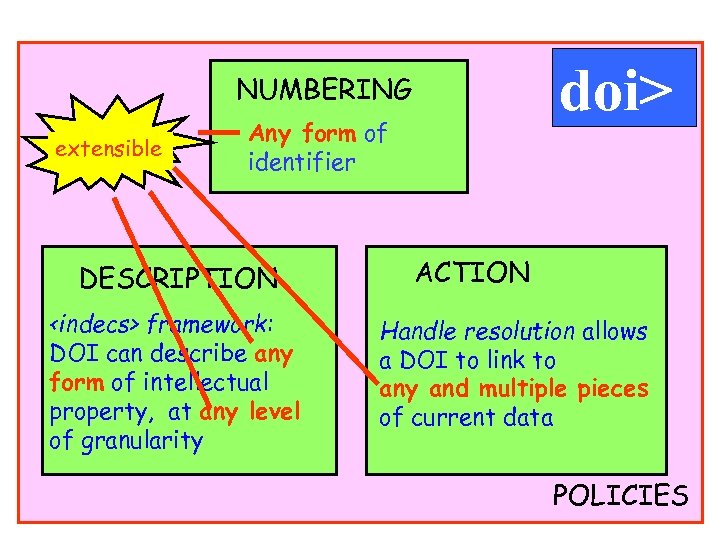 doi> NUMBERING extensible Any form of identifier DESCRIPTION
 What more is needed now? doi> • Coordinated work to support efficient operation: – – Governance Refine operational rules Development of standards for application building Development of additional features, tools • Promotion and publicity to ensure deployment and avoid fragmentation • Work with other activities to prevent conflicts and promote efficiency – Standards bodies, consortia, etc (w 3 C, IETF, OEBF, MPEG, ISO, SIIA, XML, Xr. ML, etc. )
 What is needed now? doi> Membership support to provide finance for the work • Membership grew consistently to 2001; – renewed effort now necessary to complete work • membership supports development as operating federation gradually takes over • basis of business model • proven model in other sectors (Visa, ISBN, EAN/UPC); community invests now to get benefit for all • Business model demonstrated as sustainable: – “Deployment” paper – financial model for scenario building (RA Working Group)
 Why support IDF? • Ensure the DOI is widely implemented doi> – Underpinning of consistent rules, infrastructure, and wide uptake • Ensure content community sets standards – Technology standards are not enough (Napster) – Strong lead by publishing industry - text as the lead carrier, but supports audio, video, etc – No other existing forum is doing this: W 3 C, OEBF, MPEG 21 etc. all looking at parts • Common community platform: – DOI results from extensive work by AAP, IPA, STM (1995+) • IDF has strong lead, recognised position, and support. – Build on what has been achieved • Promote collaboration • – Content and technology communities are represented – interoperate with others; reduce costs, prevent mistakes Facilitate building of specific added-value services.
 Benefits of supporting IDF doi> • Cost-effective access to digital commerce expertise: – Membership cost is equivalent to 2 -3 days per month of one consultant (even at highest membership level) – Detailed monthly briefings • Preferential access to business opportunities: – IDF makes connections between members and potential applications: explore at low risk possible business opportunities – Early access to results of prototypes, plans – Shared ownership of IDF output (data dictionaries, future developments) • Share cost of development of prototypes: – Costs can be shared by participants rather than by one company • Influence the course of the IDF: – participate in working groups, annual meeting, prototypes, board – share in use of resulting technologies • The benefits of standards: reduced risk, increased speed.
 How to support IDF doi> • International DOI Foundation – Not-for-profit communal effort; paid membership support – Members own and control DOI effort • Open to all interested parties • Governance by board elected from members • Membership fees: – $30, 000 per annum – $10, 000 for small /not-for-profit members – [$5000 per annum for non-member affiliates] • Membership support will enable us to put self-funding operating federation in place • www. doi. org
 Registration Agencies doi> • Provide a simple one-stop DOI solution for a community • An additional business opportunity for some members • Build on the features and acceptance of the system – build on existing services or offer new services – management of content, management of metadata, etc. • RAs may build as little or as much as they wish on this – simple assignment, through to a wide range of services • RAs determine their own fate: – IDF provides federal structure for infrastructure, predictable costs and governance model – open market structure for applications • Business opportunity is a shared risk: – DOI service supported by multiple RAs and multiple applications – Shared costs of the infrastructure – common infrastructure encourages common added-value tools
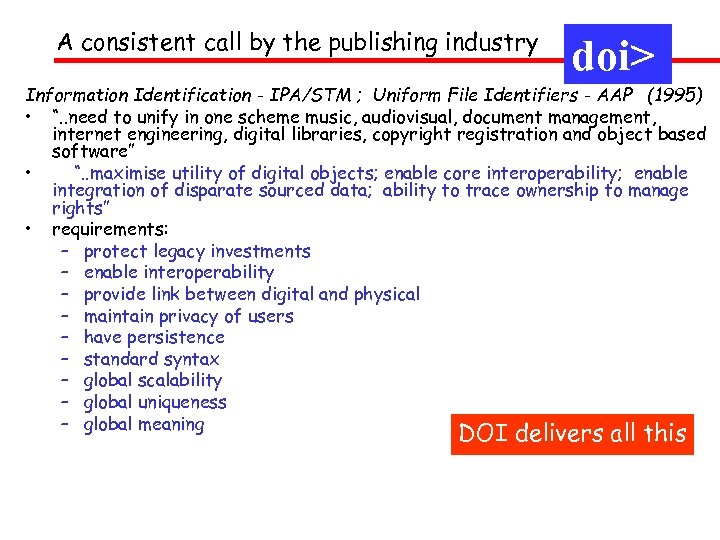 A consistent call by the publishing industry doi> Information Identification - IPA/STM ; Uniform File Identifiers - AAP (1995) • “. . need to unify in one scheme music, audiovisual, document management, internet engineering, digital libraries, copyright registration and object based software” • “. . maximise utility of digital objects; enable core interoperability; enable integration of disparate sourced data; ability to trace ownership to manage rights” • requirements: – protect legacy investments – enable interoperability – provide link between digital and physical – maintain privacy of users – have persistence – standard syntax – global scalability – global uniqueness – global meaning DOI delivers all this
 Further information Norman Paskin n. paskin@doi. org The International DOI Foundation http: //www. doi. org doi>