


 Скачать презентацию DOI implementations doi DOI update on progress
8fbb9c1e8b2983f17e61bdb928bc4f75.ppt
- Количество слайдов: 25
 DOI implementations doi> • DOI update on progress Norman Paskin • DOIs and journal publishing Ed Pentz, Cross. Ref • DOIs and book publishing David Sidman, CDI • [DOIs and non-English language publishing] see Enpia Systems stand 1. 1 L 1105 • DOIs and learning objects John Purcell, LON • DOIs and rights management Norman Paskin • Summary, Q&A
 Rights management through Digital Objects Norman Paskin The International DOI Foundation doi>
 Applying DOI to Rights Management • • doi> Last year we were investigating "DOI-R" Sub rights activity: ONIX DOIs can be used for more than just sub-rights The original aim of DOI: rights management • "Digital objects provide a means of organizing and identifying content for purposes of storage, access or distribution… …metadata may include restrictions on access to digital objects, notices of ownership, and licensing agreements…" (www. xiwt. org/documents/Manag. Access. html)
 Rights management through Digital Objects Trading intellectual property (rights management) requires representations – – Just like trading physical property Structured representations: digital objects Structured representations for Rights transactions need consistent interoperable pieces of "metadata" Using representations in rights transactions needs a consistent dictionary of defined terms and their relationships – Now being built (indecs 2)
 Representations are what is traded doi> • Physical property: – representations e. g. deeds, mortgages, are traded (not the physical bricks etc. ) • Intellectual property: – representations e. g. licences, files, are traded (not the abstract Work etc. ) See: De Soto: The Mystery Of Capital (book) Kahn: "Representing Value as Digital Objects" D-Lib magazine, May 01 (www. dlib. org/dlib/may 01)
 Representations must be structured doi> • Representation = not just an inventory but a structured entity, such as a deed • "to facilitate the comparison and combination of assets (standard descriptions)" • "crafted so as to facilitate the easy measurement of an asset's attributes"
 Rights management: trading intellectual property • "Digital Rights Management" simply means that these representations are digital – DRM = digital management of rights = digital management of physical, digital, abstract entities • but structured – "to facilitate the comparison and combination of assets (standard descriptions)" – "crafted so as to facilitate the easy measurement of an asset's attributes" • i. e. "information objects" or "digital objects" • Having identity, structure, metadata: • Some structured accessible data of the asset's attributes
 Trading intellectual property doi> Trading intellectual property (rights management) requires representations • We need to have representations, providing structured data about the assets: digital objects • What does this structured data need to be?
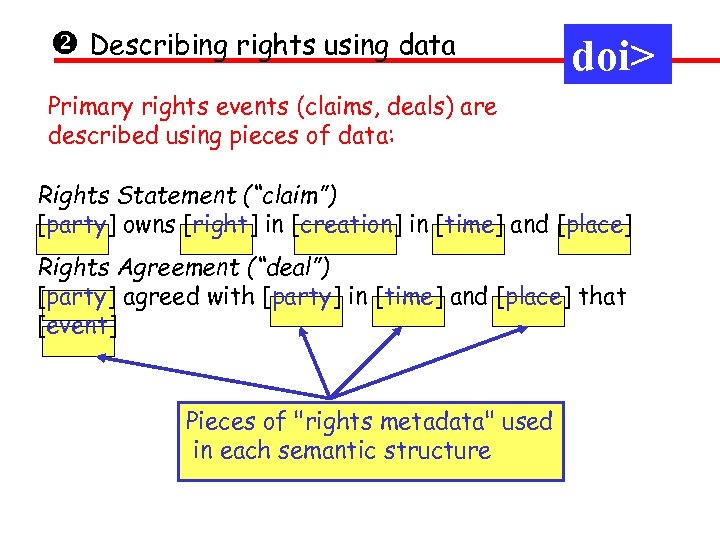 Describing rights using data doi> Primary rights events (claims, deals) are described using pieces of data: Rights Statement (“claim”) [party] owns [right] in [creation] in [time] and [place] Rights Agreement (“deal”) [party] agreed with [party] in [time] and [place] that [event] Pieces of "rights metadata" used in each semantic structure
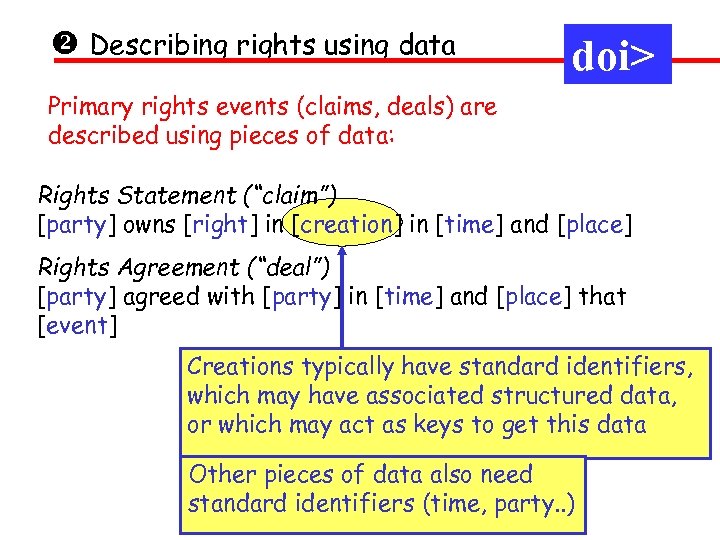 Describing rights using data doi> Primary rights events (claims, deals) are described using pieces of data: Rights Statement (“claim”) [party] owns [right] in [creation] in [time] and [place] Rights Agreement (“deal”) [party] agreed with [party] in [time] and [place] that [event] Creations typically have standard identifiers, which may have associated structured data, or which may act as keys to get this data Other pieces of data also need standard identifiers (time, party. . )
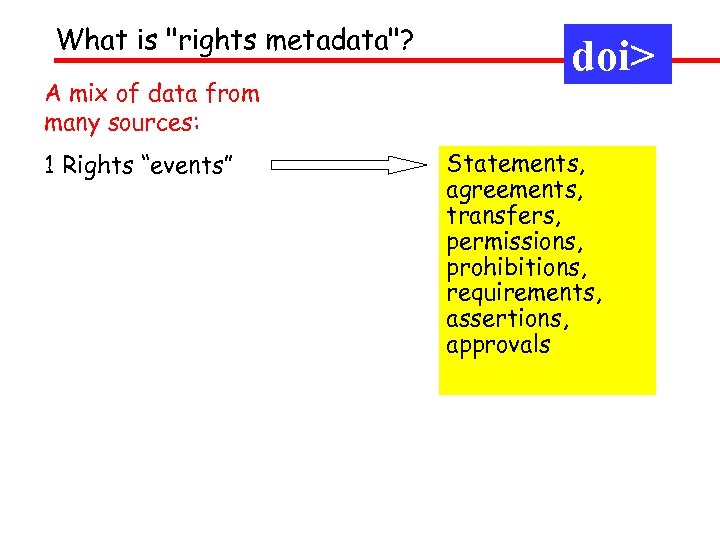 What is "rights metadata"? A mix of data from many sources: 1 Rights “events” doi> Statements, agreements, transfers, permissions, prohibitions, requirements, assertions, approvals
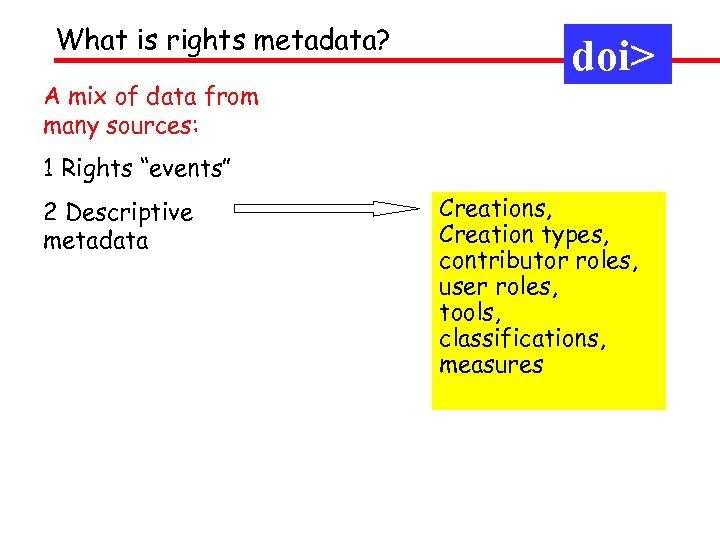 What is rights metadata? A mix of data from many sources: doi> 1 Rights “events” 2 Descriptive metadata Creations, Creation types, contributor roles, user roles, tools, classifications, measures
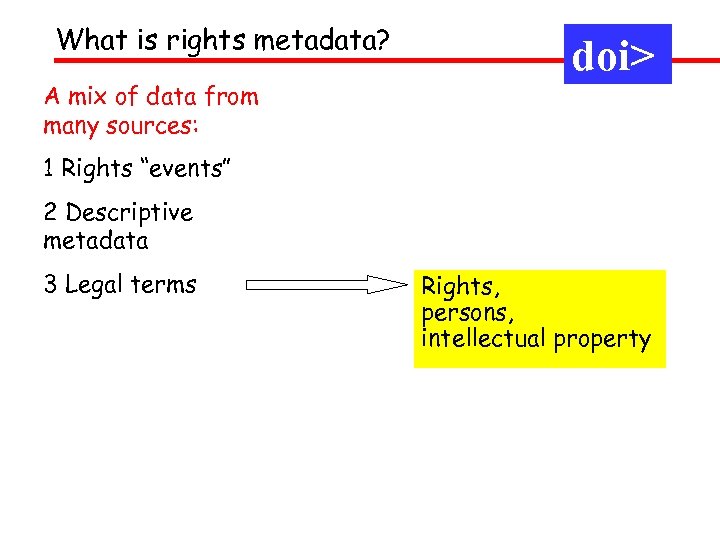 What is rights metadata? A mix of data from many sources: doi> 1 Rights “events” 2 Descriptive metadata 3 Legal terms Rights, persons, intellectual property
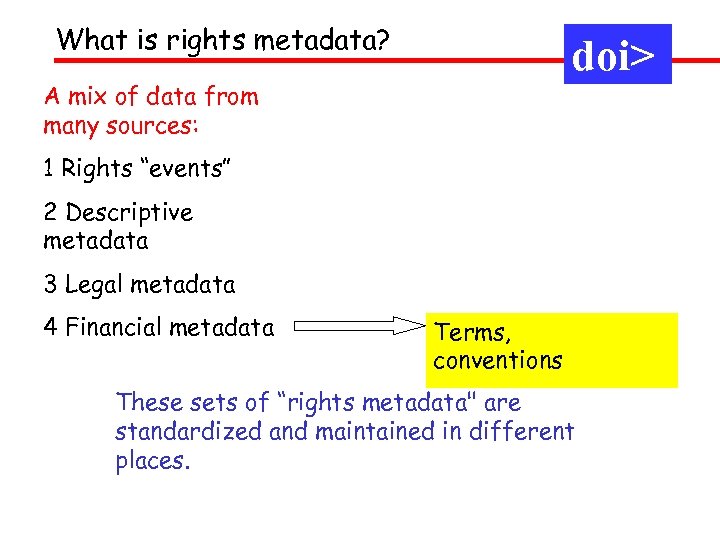 What is rights metadata? doi> A mix of data from many sources: 1 Rights “events” 2 Descriptive metadata 3 Legal metadata 4 Financial metadata Terms, conventions These sets of “rights metadata" are standardized and maintained in different places.
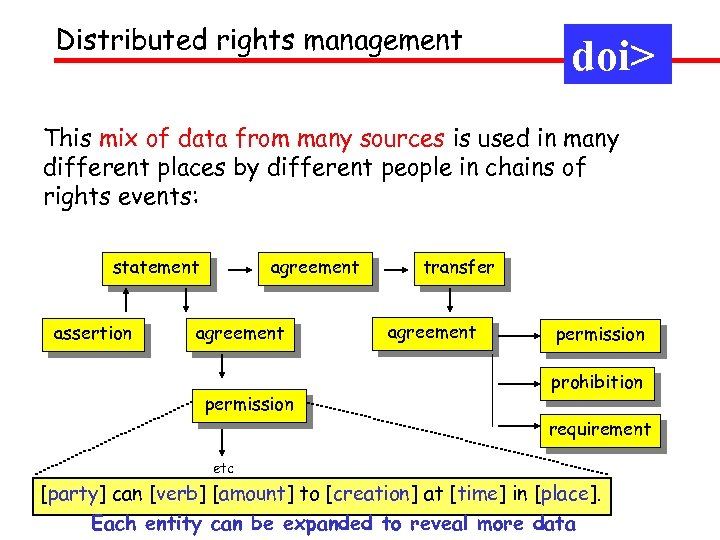 Distributed rights management doi> This mix of data from many sources is used in many different places by different people in chains of rights events: statement assertion agreement permission transfer agreement permission prohibition requirement etc [party] can [verb] [amount] to [creation] at [time] in [place]. Each entity can be expanded to reveal more data
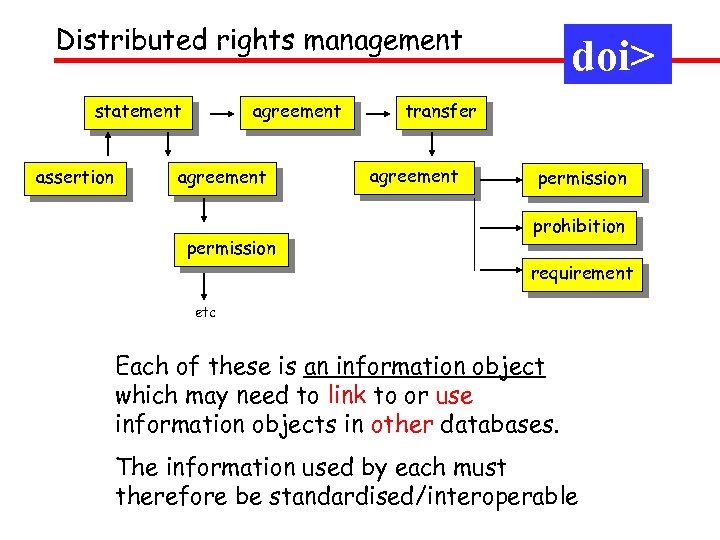 Distributed rights management statement assertion agreement permission doi> transfer agreement permission prohibition requirement etc Each of these is an information object which may need to link to or use information objects in other databases. The information used by each must therefore be standardised/interoperable
 Using representations doi> Is there a way of getting to this "interoperation of data from many sources"? Yes: work already done which shows how
 indecs (www. indecs. org) doi> • Interoperability of Data in E-Commerce Systems • Multiple partner work 1998 -2000 (EC, standards bodies, commerce, and non-commercial) - a broad cross-section of international bodies representing all aspects of the content industries' value chain from creators to users. • Produced principles for structured metadata and basis for a data dictionary for interoperability • Used by DOI, ONIX, Muze, etc • Applicable to other structured approaches e. g. SMPTE (and creates means of interoperability with them) • Now being extended to rights transactions
 indecs 2 structure doi> • Initial proposal by International DOI Foundation (IDF) and EDIt. EUR. • Feasibility study funded by IDF, spring-summer 2001. Project managed by Rights. Com Ltd. • An example of how IDF is "thinking smarter" • A consortium from technology, rights owners and rights managers. • Status: Consortium finalized. See press release. Project under way with delivery in December.
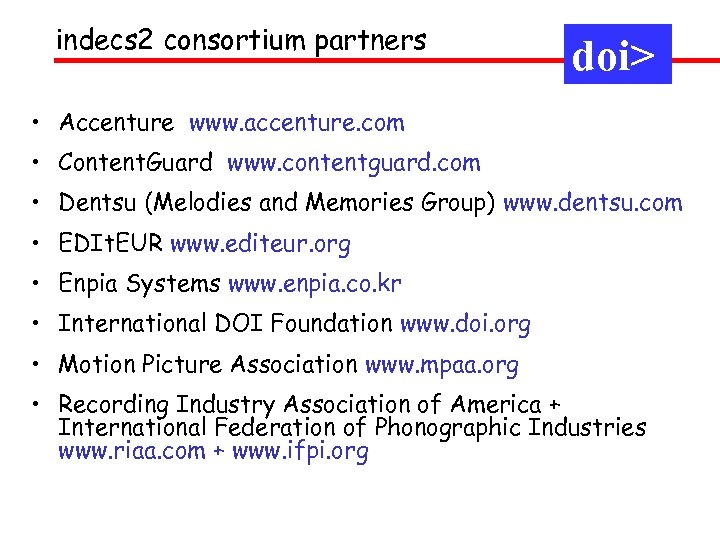 indecs 2 consortium partners doi> • Accenture www. accenture. com • Content. Guard www. contentguard. com • Dentsu (Melodies and Memories Group) www. dentsu. com • EDIt. EUR www. editeur. org • Enpia Systems www. enpia. co. kr • International DOI Foundation www. doi. org • Motion Picture Association www. mpaa. org • Recording Industry Association of America + International Federation of Phonographic Industries www. riaa. com + www. ifpi. org
 indecs 2 objective doi> To produce a Rights Data Dictionary as a candidate for the common “semantic layer” standard for digital rights management. • Using ISO/MPEG process • DOI data dictionary will be used as input • DOI developments will use output • Significantly extends DOI outreach, and possibly scope
 indecs 2 work doi> • Not starting from zero: will use existing indecs work, DOI descriptive work, DOI data dictionary etc. (will provide some central elements of the dictionary, e. g. contributor, creation and derivation types) and add to these. • Will deliver: • A database containing a dictionary of defined terms and their semantic relationships • A “proof of concept” demonstrator. • Input to MPEG 21 and other standards forums
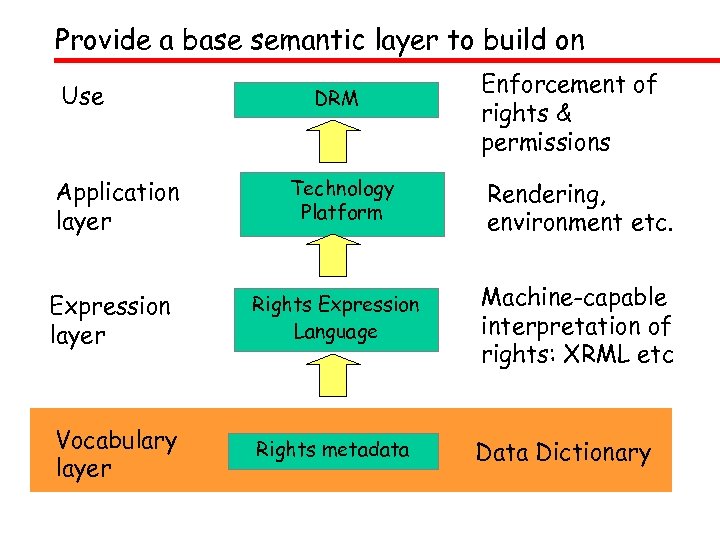 Provide a base semantic layer to build on Use Application layer DRM Technology Platform Enforcement of rights & permissions Rendering, environment etc. Expression layer Rights Expression Language Machine-capable interpretation of rights: XRML etc Vocabulary layer Rights metadata Dictionary
 Rights management through Digital Objects Norman Paskin n. paskin@doi. org The International DOI Foundation www. doi. org doi>