 Скачать презентацию Does UMB export Complying with the U S
40ceb0d2d96a915774541146b4439be0.ppt
- Количество слайдов: 68



Does UMB export? Complying with the U. S. Export and Sanction Regulations Awareness Education Updated February 2017 University of Maryland Baltimore http: //www. umaryland. edu/ord/export‐compliance/ 1
Why does the government control exports? The U. S. government controls certain technologies that it considers to be strategically important for: – – – – National Security Reasons Nuclear Non‐Proliferation Reasons Missile Technology Controls Anti‐Terrorism Chemical & Biological Controls Regional Stability Crime Control Measures Anti‐boycott Reasons 2
U. S. Export Control Regulations • Are designed to advance national security, foreign policy and economic interests of the United States • Govern the export of strategic technologies, equipment, hardware, software or providing technical assistance to Foreign Persons. 3
Who is a Foreign Person? 1. Any person who is NOT a: – U. S. citizen – U. S. Permanent Resident (Green Card holder) – Person who has been granted political asylum by the U. S. 2. Any foreign corporation, entity, partnership or group that is not incorporated or organized to do business in the U. S. 3. Any foreign government 4. Individuals (including U. S. citizens) who represent a foreign government or foreign entity 4
Export includes • Things, information, services • Either within the U. S. or abroad 5
Export examples • Transmission of material goods – Items shipped out of the U. S. – Items hand‐carried (laptop, memory devices) out of the U. S. – Use of controlled materials by a foreign person • Use or application of controlled technology on behalf of, or for the benefit of, any foreign person or entity • Dissemination of research data and information to a foreign person Email Website Face‐to‐face Visual inspection that reveals controlled technical data – Conference – – 6
Export without crossing borders Deemed Export “In its simplest terms, a “Deemed Export” can be defined as (1) the release (2) of technology or source code (3) having both military and civilian applications (4) to a foreign national (5) within the United States. Thus, even though the release in question takes place within the confines of the United States, the transaction is “deemed” to be an export and therefore subject to certain United States Government export control regulations. The logic is that knowledge transferred to an individual within the United States can readily be transported abroad should the recipient wish to do so. ” ‐‐The Deemed Export Rule in an Era of Globalization, December 20, 2007, report to the U. S. Secretary of Commerce 7
Controlled Technology and Transactions • U. S. Export Control Regulations define controlled technologies, items, information, services • The regulations include exceptions, exclusions, general licenses and authorizations • Legal and technical analyses determine whether a technology/transaction is controlled • If a technology/transaction is controlled under the regulations, further legal analyses determine whether (a) a controlled technology/transaction falls under an exception, exclusion, general license, or authorization, or (b) a specific license or authorization is needed for compliance with export regulations 8
How do we know what is controlled? 9
Details What we need to know to determine control and licensing requirements: • Who will receive services, information, technology or technical data (individuals and entities)? • What is the destination country? • Who will benefit from services provided? • What is the end use of the item? • What information, technology or technical data is involved? Is it controlled? 10
Analysis of the details • Legal analysis of the regulations determines whether an exemption, exclusion or authorization is available for the transaction • Scientific/technical analysis of the regulations determines whether the item under review meets the detailed specifications for control 11
Investigator Roles • Identify export red flags in your programs (science, services, trainings, collaborations) • Work with administrators in processing foreign national employees and visitors/volunteers – provide description of research or other activities; complete the deemed export control form • Never accept publication restrictions, even “off the record” 12
The following slides describe • The three key sets of U. S. export regulations • Exclusions from the export regulations (and how the exclusions can be negated) • Red flags • UMB review procedures 13
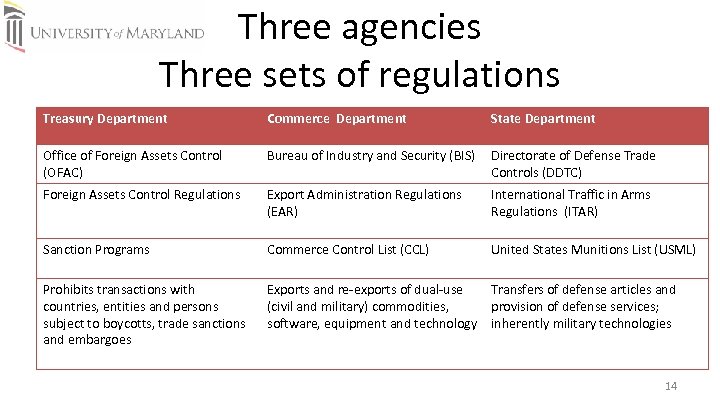
Three agencies Three sets of regulations Treasury Department Commerce Department State Department Office of Foreign Assets Control (OFAC) Bureau of Industry and Security (BIS) Directorate of Defense Trade Controls (DDTC) Foreign Assets Control Regulations Export Administration Regulations (EAR) International Traffic in Arms Regulations (ITAR) Sanction Programs Commerce Control List (CCL) United States Munitions List (USML) Prohibits transactions with countries, entities and persons subject to boycotts, trade sanctions and embargoes Exports and re‐exports of dual‐use Transfers of defense articles and (civil and military) commodities, provision of defense services; software, equipment and technology inherently military technologies 14
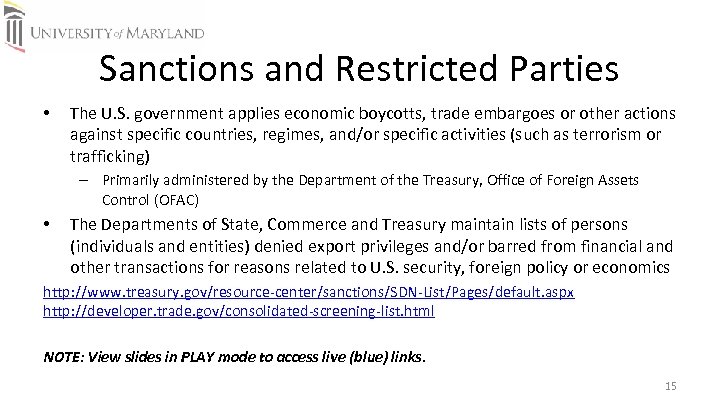
Sanctions and Restricted Parties • The U. S. government applies economic boycotts, trade embargoes or other actions against specific countries, regimes, and/or specific activities (such as terrorism or trafficking) – Primarily administered by the Department of the Treasury, Office of Foreign Assets Control (OFAC) • The Departments of State, Commerce and Treasury maintain lists of persons (individuals and entities) denied export privileges and/or barred from financial and other transactions for reasons related to U. S. security, foreign policy or economics http: //www. treasury. gov/resource‐center/sanctions/SDN‐List/Pages/default. aspx http: //developer. trade. gov/consolidated‐screening‐list. html NOTE: View slides in PLAY mode to access live (blue) links. 15
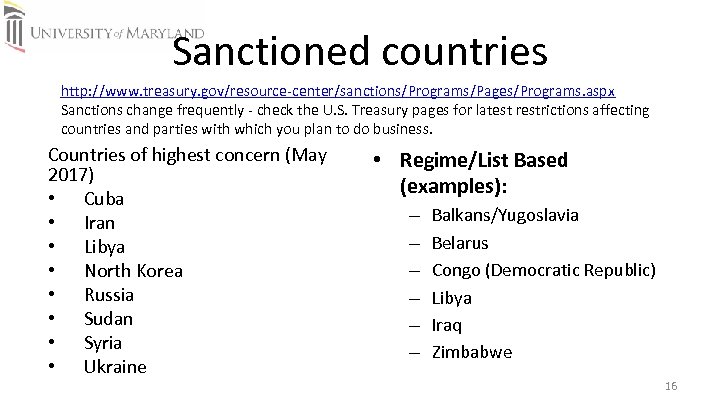
Sanctioned countries http: //www. treasury. gov/resource‐center/sanctions/Programs/Pages/Programs. aspx Sanctions change frequently ‐ check the U. S. Treasury pages for latest restrictions affecting countries and parties with which you plan to do business. Countries of highest concern (May 2017) • Cuba • Iran • Libya • North Korea • Russia • Sudan • Syria • Ukraine • Regime/List Based (examples): – – – Balkans/Yugoslavia Belarus Congo (Democratic Republic) Libya Iraq Zimbabwe 16
Categories of Sanctions • • • Comprehensive Sanctions: Generally prohibit all imports and exports of materials, financial transactions of any kind, and/or providing services of any kind. Transactions will require a specific license or exemption from OFAC before any transaction can take place. Limited Sanctions: Block specific practices. Most research and business activities may be conducted without an OFAC special license, so long as specific criteria are met as outlined in the regulations for a General License. Regime or List-Based Sanctions: Blocks specific property of targeted foreign governments, regimes, supporters and persons that are not necessarily country‐ specific, but which may be owned, controlled by, or acting for or on behalf of, targeted countries or entities as a front organization. 17
ITAR • Department of State: Arms Export Control Act – International Traffic in Arms Regulations (ITAR) – Covers commodities and technologies with a predominantly military use or space application – U. S. Munitions List ‐ 22 CFR Part 121 – Examples: some vaccines, which are considered medical countermeasures; submarine technology; some electronic equipment https: //www. pmddtc. state. gov/regulations_laws/itar. html 18
EAR • Department of Commerce: Export Administration Act – – – Export Administration Regulations (EAR) Covers commercial technologies Covers “dual use” technologies (i. e. , civil + military applications) Commerce Control List ‐ 15 CFR Part 774 Examples: computers, software, sensors, lasers, toxins, pathogens, night vision goggles or cameras http: //www. bis. doc. gov/index. php/regulations/export‐administration‐ regulations‐ear 19
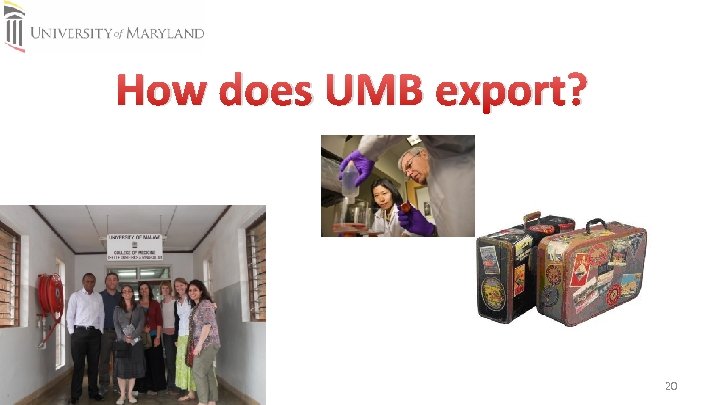
How does UMB export? 20
How does UMB export? • Global collaborations, international sponsors, foreign subrecipients, foreign consultants, international travel • Deemed export: Foreign persons on campus (visiting scientists, employees on work visas, students) • Most UMB export concerns relate to country sanctions • Export laws apply regardless of funding source 21
University policy on export controls UMB and its personnel must comply with applicable laws and regulations governing Export Controls and Sanctions. UMB Personnel must comply with the provisions of any license, conditions of any other government approval, policy or UMB‐directed certification, technology control plan, or procedure if an export, activity, or transaction is subject to Export Controls and Sanctions. http: //www. umaryland. edu/policies‐and‐ procedures/library/research/policies/iv‐ 9900 a. php 22
UMB is a “Fundamental Research” university UMB (and many other U. S. institutions) rely on the fundamental research exclusion for international collaborations on campus http: //www. umaryland. edu/ord/export‐compliance/fundamental‐research/ 23
Fundamental Research Exclusion • Fundamental research is: basic and applied research in science and engineering at accredited institutions of higher learning in the U. S. where the resulting information is ordinarily published and shared broadly in the scientific community – Applies to research performed on campus here in the U. S. if there are no restrictions on publication or dissemination of the research results • Research data and information resulting from fundamental research is excluded from (not subject to) EAR or ITAR 24
Fundamental Research Exclusion • Does not cover: – – – – Exports of hardware, software and technology Encryption software Dealing with prohibited parties or entities Transactions involving embargoed‐sanctioned countries Research where there is no intention to publish the results Research conducted outside of the United States Project work that is not research (services, training) 25
UMB and Export Compliance • By policy, UMB does not accept research with restrictions on publication • Thus, most research at UMB is not subject to EAR or ITAR • But, UMB must still comply with OFAC sanctions and watch for other “red flags” 26
Protecting the Fundamental Research Exclusion (FRE) • Research must be intended for publication. – Terms that require approval or consent to publish negate the FRE and are in conflict with University policy. – A “side” agreement that agrees to publication restrictions negates the FRE (examples: correspondence between PI and sponsor; confidentiality agreement with publication restriction) 27
Protecting the Fundamental Research Exclusion (FRE) • Participation restrictions – Terms that restrict participation of foreign nationals in the project may negate the FRE and they limit your ability to assign students, fellows, staff and investigators to the project without sponsor approval • Accepting export‐controlled material or information from a sponsor or collaborator – Agreement terms should require the provider to identify export‐ controlled information/material and allow UMB and its investigator to decline receipt and/or modify UMB’s research to remain fundamental 28
DURC The fundamental research exclusion may be lost if research is identified as Dual Use Research of Concern (DURC) http: //www. umaryland. edu/ehs/programs/biosafety/dual‐use‐ research‐of‐concern‐durc/ 29
Other Exclusions from Export Controls Other exclusions from the EAR and ITAR that may lead to a determination that the research or transaction is not subject to export controls: • Public domain/publicly available information • Full‐time employee • Educational information/registered students Definitions and limitations are described in the EAR and ITAR. http: //www. umaryland. edu/ord/export‐compliance/fundamental‐ research/other‐exclusions/ 30
Export Red Flags Red flags identify items for further review and due diligence • Restrictive terms in agreements (publication or participation) • Work done abroad • Sending abroad materials or equipment • Sending, transmitting or disclosing to a sanctioned country (or citizens of those countries) or a person or organization on the restricted party lists • Ultimate destination or use unknown (you send item/info overseas and the recipient sends it to someone else) http: //www. umaryland. edu/procedures/research/sponsored‐projects/export‐controls‐checklist. php 31
How do I comply with U. S. Export Controls? * Know and recognize “red flags” * Determine what technologies/information in your work may be controlled See “Dig Deeper” (slide 48 and following) * Ask for “restricted party screening” foreign persons, whether in your lab or overseas * Ask for advice before you export covered technology 32
Compliance procedures 33
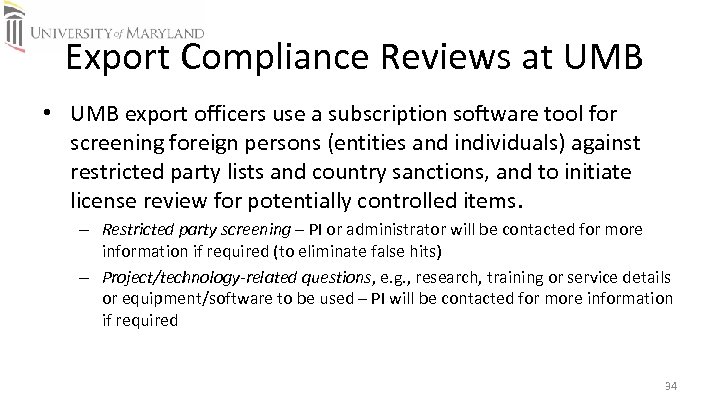
Export Compliance Reviews at UMB • UMB export officers use a subscription software tool for screening foreign persons (entities and individuals) against restricted party lists and country sanctions, and to initiate license review for potentially controlled items. – Restricted party screening – PI or administrator will be contacted for more information if required (to eliminate false hits) – Project/technology-related questions, e. g. , research, training or service details or equipment/software to be used – PI will be contacted for more information if required 34
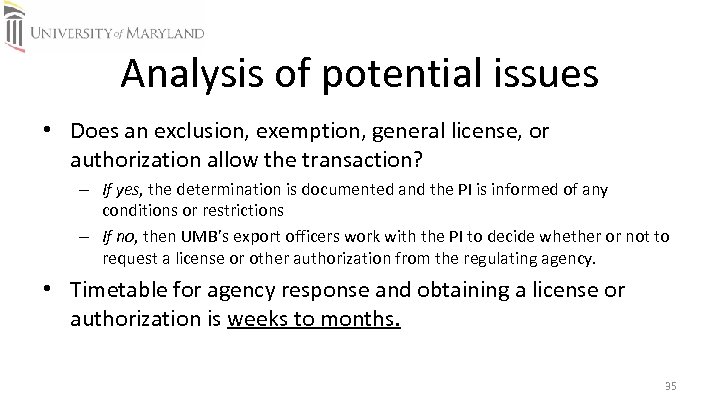
Analysis of potential issues • Does an exclusion, exemption, general license, or authorization allow the transaction? – If yes, the determination is documented and the PI is informed of any conditions or restrictions – If no, then UMB’s export officers work with the PI to decide whether or not to request a license or other authorization from the regulating agency. • Timetable for agency response and obtaining a license or authorization is weeks to months. 35
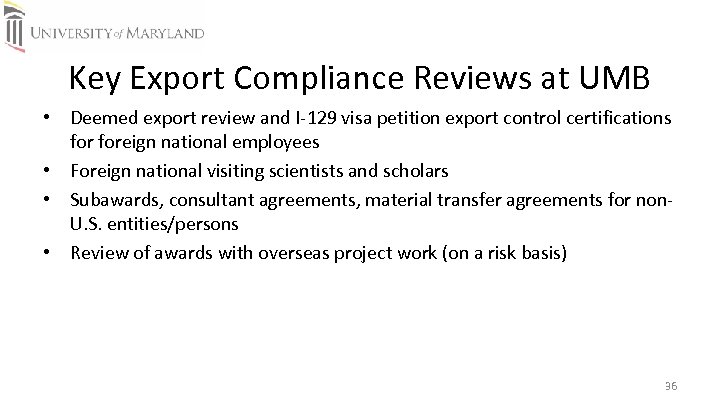
Key Export Compliance Reviews at UMB • Deemed export review and I‐ 129 visa petition export control certifications foreign national employees • Foreign national visiting scientists and scholars • Subawards, consultant agreements, material transfer agreements for non‐ U. S. entities/persons • Review of awards with overseas project work (on a risk basis) 36
Other available reviews • • Potential issues at the proposal stage International travel International shipping Restricted party screening may be requested for any transaction with foreign individuals or entities, e. g. , international conference attendees on campus, overseas wire transfer not associated with a subaward, foreign national consultants, etc. 37
Deemed Export Control review Submit the Deemed Export Control Form for review of all foreign national employees on work visas including H‐ 1 B, paid J‐ 1, F‐ 1 OPT, etc. – Included with HR and Office of International Services packets http: //www. umaryland. edu/media/umb/ord/documents/DEForm‐rev‐Aug 2016. pdf http: //www. umaryland. edu/ord/export‐compliance/procedures/deemed‐exports/ 38
Visiting scientists/scholars http: //www. umaryland. edu/ord/export‐compliance/procedures/international‐visitors/ • Export review includes restricted party screening of visitor and their home organization (if any) and review of proposed activities at UMB • Visiting scientist agreement required – Visitors/Volunteers who are not paid by UMB and who will have independent access to facilities (i. e. , a UMB One Card) must sign a Visiting Scientist Agreement • Protects UMB and PI with terms addressing intellectual property, confidentiality, other issues 39
Subawards • Export control review usually occurs after the department submits a Subaward Request naming a foreign subrecipient • Export officer reviews the scope of work and screens organization, subrecipient PI and other key individuals against the restricted party lists http: //www. umaryland. edu/ord/export‐compliance/procedures/international‐ subrecipients/ 40
Transactions that you might “red flag” • Potential issues in proposal development – We do not routinely review proposals for export compliance concerns but will do so on request (to jsimons@umaryland. edu). Proposals to flag should include: • Proposals involving sanctioned countries • Proposals potentially involving a “Defense Article” or “Defense Service” (defined on the next two slides) – Teaming agreements and other affiliation agreements should be reviewed. Contact jsimons@umaryland. edu http: //www. umaryland. edu/spa/developing‐proposals/projects‐with‐international‐ components/mous‐for‐international‐initiatives/ 41
“Defense article” defined: Defense Article: 22 CFR § 120. 6 Any item or technical data (defined on next slide) listed on the United Stated Munitions List (USML) (22 CFR § 121. 1), including technical data recorded or stored in any physical form, models, mockups or other items that reveal technical data directly relating to items on the USML. It does not include basic marketing information on function or purpose or general system descriptions. Defense Articles listed in the USML include weapons, ammunition, vehicles, explosives, military training and equipment, personal protective equipment, certain lasers, infrared cameras and other detection equipment/devices, certain chemical agents, biological agents and nerve agents. The USML also defines certain items funded specifically by the Department of Defense as Defense Articles. The detailed specifications in the USML must be reviewed carefully. The determination for inclusion on the U. S. Munitions List is guided by the following criteria: • specifically designed, developed, configured, adapted, or modified for a military application, • does not have predominant civil applications, and • does not have performance equivalent (defined by form, fit and function) to those of an article or service used for civil applications; 42
“Defense service” defined Defense Service: 22 CFR § 120. 9 • The furnishing of assistance (including training) to foreign persons, whether in the U. S. or abroad in the design, development, engineering, manufacture, production, assembly, testing, repair, maintenance, modification, operation, demilitarization, destruction, processing or use of Defense Articles; • The furnishing to foreign persons of any technical data (as defined in § 120. 10), whether in the United States or abroad; or • Military training of foreign units and forces including formal or informal instruction of foreign persons in the U. S. or abroad or by correspondence courses, technical, educational, or information publications and media of all kinds, training aid, orientation, training exercise, and military advice. Technical data: 22 CFR § 120. 10 • Information other than software which is required for the design, development, production, manufacture, assembly, operation, repair, testing, maintenance, or modification of Defense Articles, and classified information relating to Defense Articles and Defense Services on the USML and 600‐series items controlled by the [EAR] Commerce Control List • Software directly related to Defense Articles • NOT information concerning general scientific, mathematical or engineering principles commonly taught in schools, colleges and universities or information in the public domain (i. e. , public domain and fundamental research exclusions as defined in 22 CFR § 120. 11) 22 CFR § 120. 3 (Note): The intended use of the article or service after its export (i. e. , for a military or civilian purpose), by itself, is not a factor in determining whether the article or service is subject to the controls of this subchapter [ITAR controls]. 43
International travel http: //www. umaryland. edu/ord/export‐compliance/procedures/international‐ travel/ • International travel to meetings or for other scientific exchange is generally exempt from export controls UNLESS the findings to be presented include detailed information regarding controlled items or technologies, or research identified as DURC. • Research or educational activities (including conference attendance or presentation) are restricted in sanctioned countries. • Taking UMB‐owned equipment out of the country? – Some equipment (e. g. , GPS, specialty software) may require a license. 44
International travel and technology Take security precautions when visiting sensitive countries/areas (Middle East, China, Russia, and others). Recommendations for highest security include: Use clean laptops or other IT devices when available; Ensure systems are updated with the most recent security and malware definition files prior to travel; Remove all unnecessary UMB data and/or personal data from laptops or electronic devices before taking such devices overseas (only what you need to complete the reason for your visit). If you cannot afford to lose it, or if the loss of the information or data would create financial or reputational risk to the University, leave it at home; • Remove ALL third‐party proprietary, confidential, or sensitive data and all export controlled data and materials from any electronic devices prior to travel; • Remove any encrypted files and encryption capable software, other than system critical or software support encryption technologies (for instance, built‐in Windows encryption resources). Encryption technologies are strictly controlled for entry and exit from countries such as China; • Do not use any Wi‐Fi connections from unknown third‐party providers/sources; • Always use VPN back into UMB systems; note that China prohibits use of VPN unless specifically approved for use • Refrain from use of publicly available Wi‐Fi connections if possible, even if labeled as secure and/or requiring passwords for use, as these connection points are often subject to intrusion software risks such as keystroke loggers; • To the extent possible, keep laptops/devices in your personal possession at all times. • Never accept or attach unknown devices or drives (including flash/USB drives) as malicious code may be installed on such devices at any time, including at manufacture or after; and, • Have your electronic devices scanned for malware upon return prior to connection to the UMB network. Source: Pennsylvania State University, edited 45 • • •
International travel and technology In most countries, you have no expectation of privacy in internet cafes, hotels, offices, or public places. In some countries, hotel rooms are often searched. • All information you send electronically – no matter the method – can be intercepted. • Security services and criminals can track your movements using your mobile computing/electronic device and can even turn on the microphone in your computing/electronic device when you think that it’s off. • Security services and criminals can insert malicious software into your computing/electronic device through any connection that they control. When connecting to your home or University systems or networks, this malware can be transmitted back to these systems as well. • Transmitting sensitive information from abroad is risky. • If your mobile computing/electronic device is examined, or if your hotel room is searched while you are not present, you should assume that your device’s data has been copied and/or compromised. Source: Pennsylvania State University, edited 46 •
International travel and anti‐bribery regulations • Foreign Corrupt Practices Act • Unlawful for a U. S. person, including UMB and its personnel, to bribe a foreign official for the purpose of obtaining or retaining business, or to otherwise securing an improper advantage • Bribes include money, favors, and other inducements • More information and training: http: //www. umaryland. edu/ord/export‐compliance/foreign‐ corrupt‐practices‐act/ 47
Shipping • Be aware of the requirements for proper labeling and marking. • Shipping tangible items outside of the United States usually requires an export license determination to correctly complete the shipping documentation. • Contact Environmental Health and Safety for information and training. 48
UMB Export Officers • Office of Research and Development Janet Simons, Director, Research Policy 410‐ 706‐ 5632 jsimons@umaryland. edu • Environmental Health and Safety Melissa Morland, Biosafety Officer 410‐ 706‐ 7845 mmorland@umaryland. edu 49
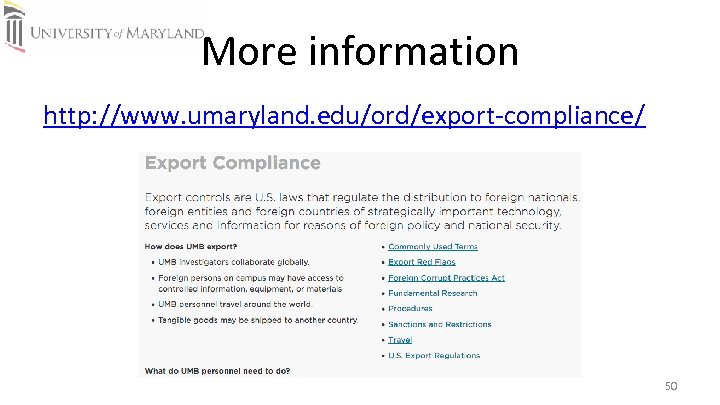
More information http: //www. umaryland. edu/ord/export‐compliance/ 50
Dig Deeper The following slides provide additional references, links and information about: • • • EAR ITAR Country Issues (Embargoes/Sanctions) Violations and Penalties Related Laws Flowcharts and Questionnaires 51
Regulations • Export Administration Regulations (EAR) Department of Commerce export controls (15 CFR §§ 734‐ 774) • International Traffic in Arms Regulations (ITAR) Department of State export controls (22 CFR §§ 120‐ 130) • Foreign Assets Control Regulations (FACR) U. S. Treasury exchange controls (31 CFR §§ 500‐ 599) • US Customs Service Regulations Automated Export Shipping documentation (15 CFR §§ 30‐ 199) Look up a CFR reference: https: //www. ecfr. gov/cgi‐bin/ECFR 52
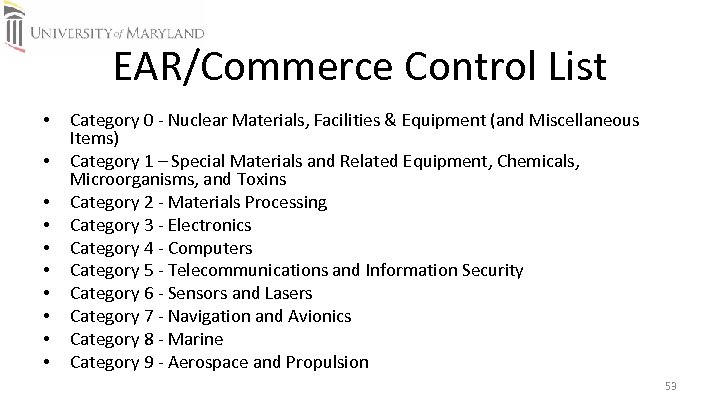
EAR/Commerce Control List • • • Category 0 ‐ Nuclear Materials, Facilities & Equipment (and Miscellaneous Items) Category 1 – Special Materials and Related Equipment, Chemicals, Microorganisms, and Toxins Category 2 ‐ Materials Processing Category 3 ‐ Electronics Category 4 ‐ Computers Category 5 ‐ Telecommunications and Information Security Category 6 ‐ Sensors and Lasers Category 7 ‐ Navigation and Avionics Category 8 ‐ Marine Category 9 ‐ Aerospace and Propulsion 53
EAR/Commerce Control List Copy and paste this link into your browser to view the Commerce Control List (CCL): https: //www. ecfr. gov/cgi‐bin/text‐ idx? SID=8 c 4 f 74 d 9182 f 632 f 40 e 160 ffeaa 797 d 9&mc=true&node=pt 15. 2. 774&rgn=div 5 54
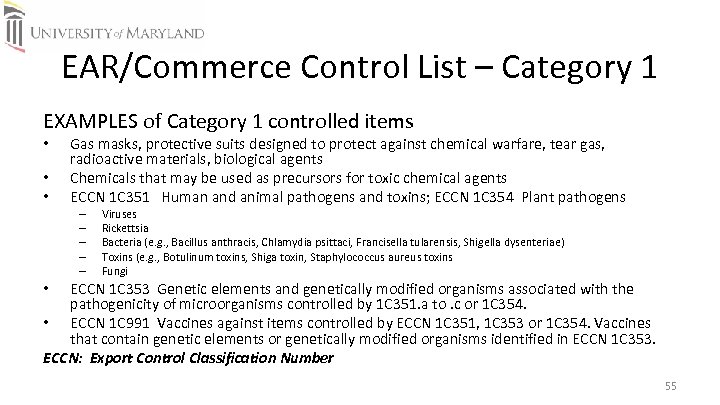
EAR/Commerce Control List – Category 1 EXAMPLES of Category 1 controlled items • • • Gas masks, protective suits designed to protect against chemical warfare, tear gas, radioactive materials, biological agents Chemicals that may be used as precursors for toxic chemical agents ECCN 1 C 351 Human and animal pathogens and toxins; ECCN 1 C 354 Plant pathogens – – – Viruses Rickettsia Bacteria (e. g. , Bacillus anthracis, Chlamydia psittaci, Francisella tularensis, Shigella dysenteriae) Toxins (e. g. , Botulinum toxins, Shiga toxin, Staphylococcus aureus toxins Fungi ECCN 1 C 353 Genetic elements and genetically modified organisms associated with the pathogenicity of microorganisms controlled by 1 C 351. a to. c or 1 C 354. • ECCN 1 C 991 Vaccines against items controlled by ECCN 1 C 351, 1 C 353 or 1 C 354. Vaccines that contain genetic elements or genetically modified organisms identified in ECCN 1 C 353. ECCN: Export Control Classification Number • 55
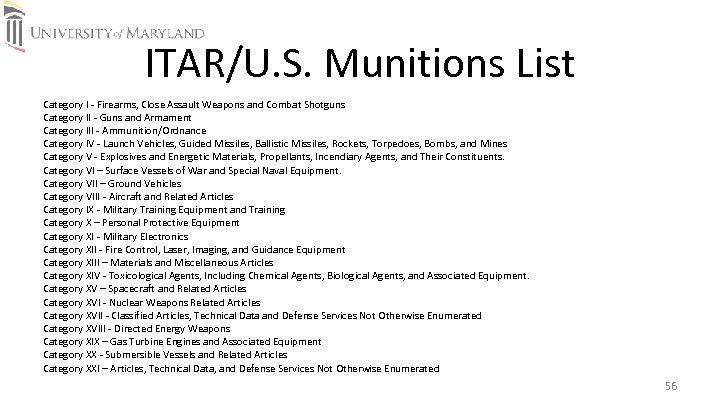
ITAR/U. S. Munitions List Category I ‐ Firearms, Close Assault Weapons and Combat Shotguns Category II ‐ Guns and Armament Category III ‐ Ammunition/Ordnance Category IV ‐ Launch Vehicles, Guided Missiles, Ballistic Missiles, Rockets, Torpedoes, Bombs, and Mines Category V ‐ Explosives and Energetic Materials, Propellants, Incendiary Agents, and Their Constituents. Category VI – Surface Vessels of War and Special Naval Equipment. Category VII – Ground Vehicles Category VIII ‐ Aircraft and Related Articles Category IX ‐ Military Training Equipment and Training Category X – Personal Protective Equipment Category XI ‐ Military Electronics Category XII ‐ Fire Control, Laser, Imaging, and Guidance Equipment Category XIII – Materials and Miscellaneous Articles Category XIV ‐ Toxicological Agents, Including Chemical Agents, Biological Agents, and Associated Equipment. Category XV – Spacecraft and Related Articles Category XVI ‐ Nuclear Weapons Related Articles Category XVII ‐ Classified Articles, Technical Data and Defense Services Not Otherwise Enumerated Category XVIII ‐ Directed Energy Weapons Category XIX – Gas Turbine Engines and Associated Equipment Category XX ‐ Submersible Vessels and Related Articles Category XXI – Articles, Technical Data, and Defense Services Not Otherwise Enumerated 56
ITAR/U. S. Munitions List Copy and paste link into your browser to view the U. S. Munitions List (USML): https: //www. ecfr. gov/cgi‐bin/text‐ idx? SID=8 c 4 f 74 d 9182 f 632 f 40 e 160 ffeaa 797 d 9&mc=true&node=pt 22. 1. 121&rgn=div 5 57
ITAR/USML – Category XIV EXAMPLES of Category XIV controlled items • (a) Nerve agents (as specified) • (b) Biological agents and biologically derived substances specifically developed, configured, adapted, or modified for the purpose of increasing their capability to produce casualties in humans or livestock, degrade equipment or damage crops • (h) Medical countermeasures, to include pre‐ and post‐treatments, vaccines, antidotes and medical diagnostics, specifically designed or modified for use with the chemical agents listed in paragraph (a) of this category and vaccines with the sole purpose of protecting against biological agents identified in paragraph (b) of this category. • Technical data and defense services related to the defense articles enumerated in this category 58
Country Issues • For export purposes, the United States comprises: – – – 50 States and District of Columbia Puerto Rico U. S. Virgin Islands Guam American Samoa Northern Mariana Islands 59
OFAC Sanctions/Embargoes • OFAC sanctioned countries of highest concern include: Cuba, Iran, Ukraine/Russia, Libya, North Korea, Sudan, and Syria (as of 5/1/2017) • Always check the latest sanctions and embargoes which change frequently http: //www. treasury. gov/resource‐ center/sanctions/Programs/Pages/Programs. aspx • Any type of transaction – including financial, collaboration, and travel – should be reviewed for the countries listed above. We must review and document: – Screening for restricted/prohibited parties – Whether a specific license must be applied for, if not, – What provision(s) of the regulations authorize the transaction 60
Country Issues ‐ ITAR‐prohibited Export Destinations • • • • Afghanistan Belarus Burma (Myanmar) Central African Republic China Cote d'Ivoire Cuba Cyprus Democratic Republic of Congo Eritrea Haiti Iran Iraq As of 5/1/2017 • • • Kyrgyzstan Lebanon Libya North Korea Russia Somalia Sudan Syria Venezuela Zimbabwe 61
Country Issues ‐ EAR • Country sanctions under EAR: Cuba, Iran, North Korea, Sudan, Syria • In addition, most export restrictions are determined by the technology or product to be exported and the country of destination • EAR Part 744 – Supplement 4 – Entity List (downloads a document) – Lists certain entities subject to license requirements for specified items – Examples: Kitro Corporation (Canada); Sichuan University (China); 54 th Research Institute of China; Northwestern Polytechnical University (China); Ben Gurion University (Israel); Pyramid Technologies (U. A. E. ) 62
Penalties for Violation of the U. S. Export Control Regulations • • Denial of export privileges Seizure and forfeiture of goods Suspension; debarment Negative publicity UMB: Disciplinary action up to termination and dismissal May apply to the individual(s) involved and/or the university Federal penalties applied may be Criminal and/or Civil 63
Penalties for Violation EXAMPLES: • • • OFAC: Criminal – University – A fine of up to $1, 000 for each violation OFAC: Criminal – Individual – A fine of up to $1, 000 or up to twenty years in prison, or both, for each violation ITAR: Civil penalty up to $500, 000 fine for each violation ITAR: Criminal penalty, willful violation, up to $1, 000 fine and/or imprisonment not more than 10 years EAR: Civil penalty up to $500, 000 fine for each violation EAR: Criminal penalty, fine of up to five times the value of the exports or reexports involved or $50, 000, whichever is greater and/or imprisonment not more than 5 years; in more egregious cases of willful violation, fine of up to $250, 000 and/or imprisonment not more than 10 years 64
University‐related export cases • Roth case, University of Tennessee: Why the Professor Went to Prison • Graduate student, Iowa State University: – Accused ‐ http: //www. umaryland. edu/media/umb/ord/documents/ISU_student _accused_amestrib. pdf – Sentenced ‐ http: //www. umaryland. edu/media/umb/ord/documents/ISU_Sentenc ed_Department. Of. Justice. pdf 65
Related Laws • Trading with the Enemy Act (1917) authorized the use of economic sanctions against foreign nations, citizens and nationals of foreign countries, or other persons aiding a foreign country and is the oldest such statute still in use by the United States. 50 U. S. C. App. §§ 1‐ 44 • International Emergency Economic Powers Act (1977), 50 U. S. C. §§ 1701‐ 1707 • USA PATRIOT Act (Uniting and Strengthening America by Providing Appropriate Tools Required to Intercept and Obstruct Terrorism Act of 2001) – makes it a crime to provide material support to a foreign organization engaged in terrorist activity. 66
Other U. S. regulations that may affect international collaborations • • Nuclear Regulatory Commission (NRC) (Nuclear imports/exports) Department of Energy (Do. E) (Assistance with foreign atomic energy activities) Bureau of Alcohol, Tobacco, Firearms and Explosives (ATF) Patent and Trademarks Office (PTO) (Foreign IP licenses) Customs and Border Protection (CBP) (Imports/Exports) US Bureau of the Census (Foreign trade statistics) US Fish & Wildlife Service (Certain flora and fauna) Animal and Plant Health Inspection Service (APHIS) (Animals & plants, soil& organisms) • Food and Drug Administration (FDA)(imports of samples of food, drugs, tobacco, cosmetic, etiological agents, med devices) • Federal Aviation Administration (FAA)(Hazardous materials) • Drug Enforcement Agency (DEA) (controlled substances) • BIS: Anti‐boycott Regulations • • Department of Justice (Do. J) (Foreign corrupt practices) U. S. Citizenship and Immigration Service (USCIS) (Visas) 67
External Resources • University of Maryland, College Park’s Export 101 • Stanford University’s Decision Tree (copy and paste link into your browser) https: //doresearch. stanford. edu/research‐scholarship/export‐ controls/export‐controls‐decision‐tree • University of Tennessee’s FAQs 68
Скачать презентацию Does UMB export Complying with the U S
40ceb0d2d96a915774541146b4439be0.ppt