 Скачать презентацию Does school fit in mobile phones The whole
a8f75fb22eb5a4de58bac7ae249ee7b1.ppt
- Количество слайдов: 19



Does school fit in mobile phones? The whole world does Eduarda Ferreira Escola Secundária Sebastião da Gama epcferreira@gmail. com 3 rd WLE Mobile Learning Symposium, 27 March 2009, WLE London
In a not so far away future … 3 rd WLE Mobile Learning Symposium, 27 March 2009, WLE London 2
In a not so far away future … School will • Use students’ own technologies • Build on students’ skills of networked learning and informal collaboration • Take advantage of the interests, enthusiasms and passions of the individual in informal learning contexts • Facilitate personalised learning environments in which learners can create a coherent experience of learning in diverse locations • Acknowledge and value the learning that goes on outside the classroom crossing boundaries between formal and informal learning 3 rd WLE Mobile Learning Symposium, 27 March 2009, WLE London 3
Futurology? Utopia? How do we get there? Using technology Focus on the ability of mobile phones to cross boundaries Young people and mobile phones School and mobile phones 3 rd WLE Mobile Learning Symposium, 27 March 2009, WLE London 4
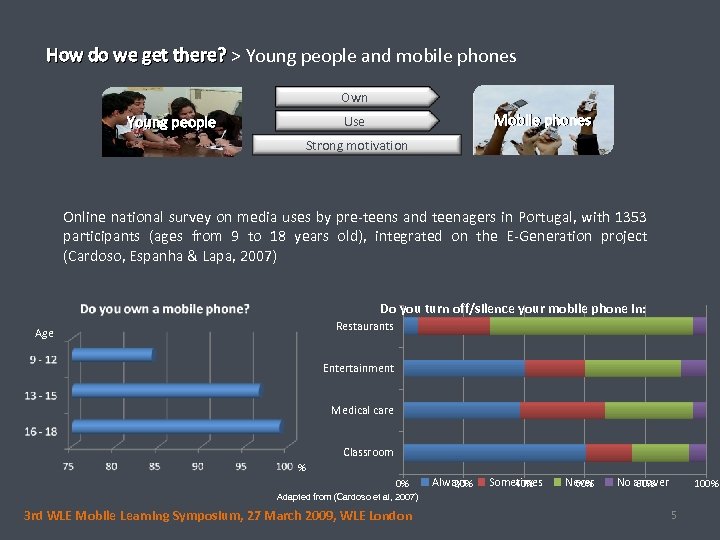
How do we get there? > Young people and mobile phones Own Young people Mobile phones Use Strong motivation Online national survey on media uses by pre-teens and teenagers in Portugal, with 1353 participants (ages from 9 to 18 years old), integrated on the E-Generation project (Cardoso, Espanha & Lapa, 2007) Do you turn off/silence your mobile phone in: Restaurants Age Entertainment Medical care Classroom % 0% Always 20% Sometimes 40% Never 60% No answer 80% 100% Adapted from (Cardoso et al, 2007) 3 rd WLE Mobile Learning Symposium, 27 March 2009, WLE London 5
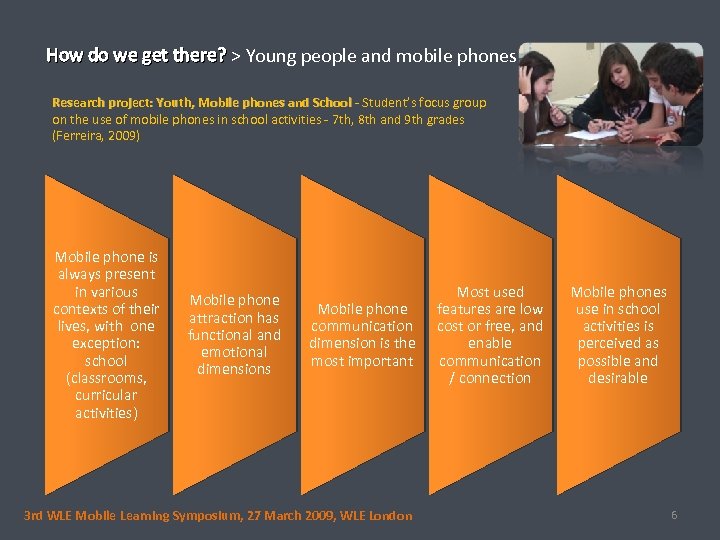
How do we get there? > Young people and mobile phones Research project: Youth, Mobile phones and School - Student’s focus group on the use of mobile phones in school activities - 7 th, 8 th and 9 th grades (Ferreira, 2009) Mobile phone is always present in various contexts of their lives, with one exception: school (classrooms, curricular activities) Mobile phone attraction has functional and emotional dimensions Mobile phone communication dimension is the most important 3 rd WLE Mobile Learning Symposium, 27 March 2009, WLE London Most used features are low cost or free, and enable communication / connection Mobile phones use in school activities is perceived as possible and desirable 6
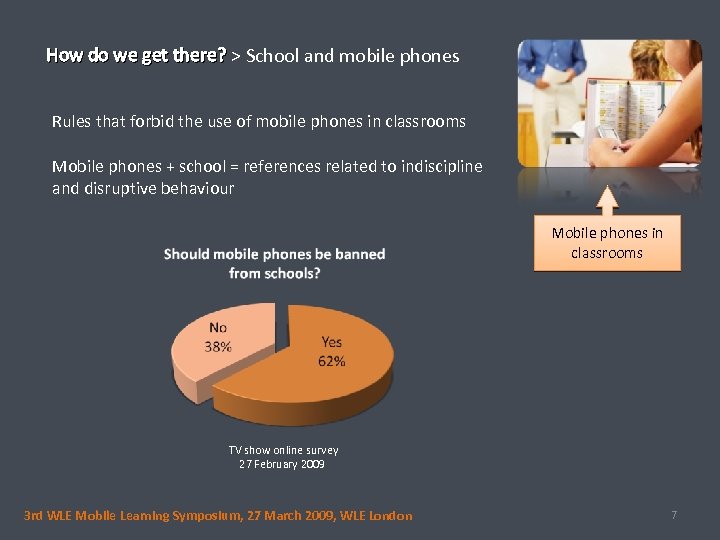
How do we get there? > School and mobile phones Rules that forbid the use of mobile phones in classrooms Mobile phones + school = references related to indiscipline and disruptive behaviour Mobile phones in classrooms TV show online survey 27 February 2009 3 rd WLE Mobile Learning Symposium, 27 March 2009, WLE London 7
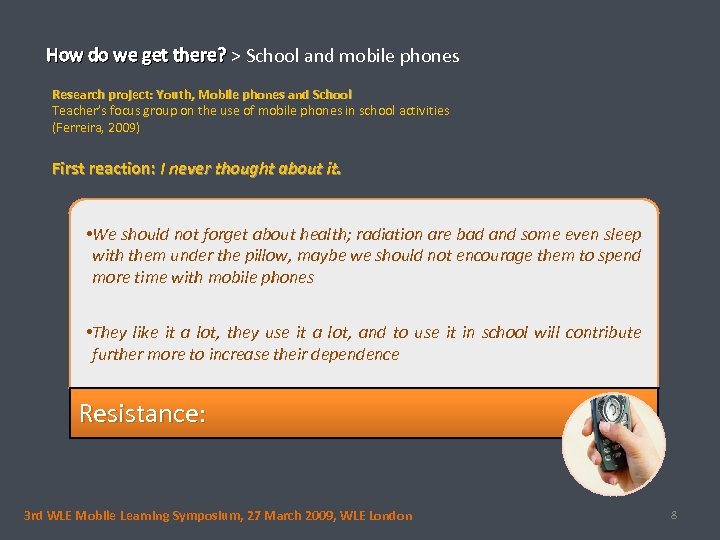
How do we get there? > School and mobile phones Research project: Youth, Mobile phones and School Teacher’s focus group on the use of mobile phones in school activities (Ferreira, 2009) First reaction: I never thought about it. • We should not forget about health; radiation are bad and some even sleep with them under the pillow, maybe we should not encourage them to spend more time with mobile phones • They like it a lot, they use it a lot, and to use it in school will contribute further more to increase their dependence Resistance: 3 rd WLE Mobile Learning Symposium, 27 March 2009, WLE London 8
How do we get there? > School and mobile phones • There is no comparison between the significance of technologies for them and for us, they always lived with them, it is difficult for us to understand the importance of mobile phones in their lives • Our school’s rules prohibits the use of mobile phones in the classroom, but I think it does not prohibit teachers who want to use it as a curricula resource, I think the rule purpose is to avoid distraction Advantages of mobile phones in curricula activities: • If I send content via SMS to students, they will not resist to see it • Using mobile phones to teach would be a way to get into their space But there is hope: 3 rd WLE Mobile Learning Symposium, 27 March 2009, WLE London 9
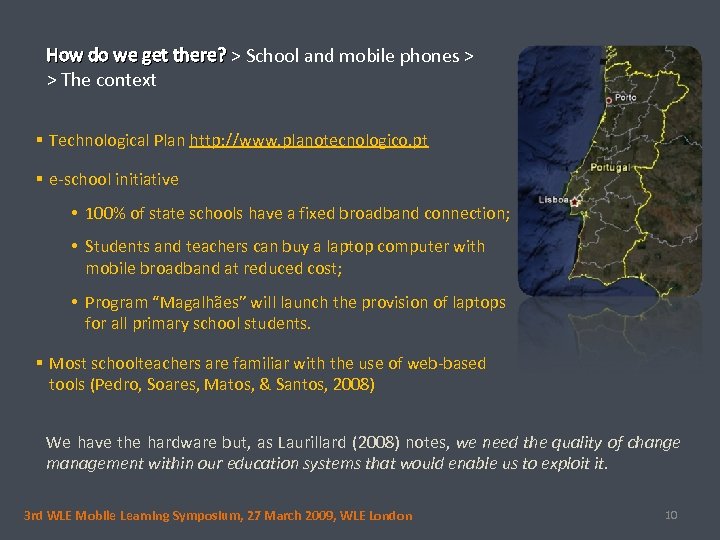
How do we get there? > School and mobile phones > > The context § Technological Plan http: //www. planotecnologico. pt § e-school initiative • 100% of state schools have a fixed broadband connection; • Students and teachers can buy a laptop computer with mobile broadband at reduced cost; • Program “Magalhães” will launch the provision of laptops for all primary school students. § Most schoolteachers are familiar with the use of web-based tools (Pedro, Soares, Matos, & Santos, 2008) We have the hardware but, as Laurillard (2008) notes, we need the quality of change management within our education systems that would enable us to exploit it. 3 rd WLE Mobile Learning Symposium, 27 March 2009, WLE London 10
How do we get there? > School and mobile phones > > Teachers are key to change “Bottom-up” system change perspective We must not undervalue isolated individual teacher’s initiatives in innovation. Minor, scattered changes may create a forceful impetus for structural change if they are promoted and coordinated. “Open teaching” essentials (Laurillard, 2008): Support for some personal development in how to teach The means to build on the work of others to design their approach The means to experiment and reflect on what the results imply for their design and their understanding The means to articulate and disseminate their contribution 3 rd WLE Mobile Learning Symposium, 27 March 2009, WLE London 11
How do we get there? > School and mobile phones > > “m. School” discussion board Teacher support online discussion board to promote and facilitate the use of mobile phones as a curricular resource. Educational activities that can be implemented with students’ mobile phones and with no additional costs. Ownership To allow students to use their own technologies challenges one key aspect in schools attitude towards ICT in education: control Young people digital practices Recognise and value out of school student’s digital practices 3 rd WLE Mobile Learning Symposium, 27 March 2009, WLE London 12
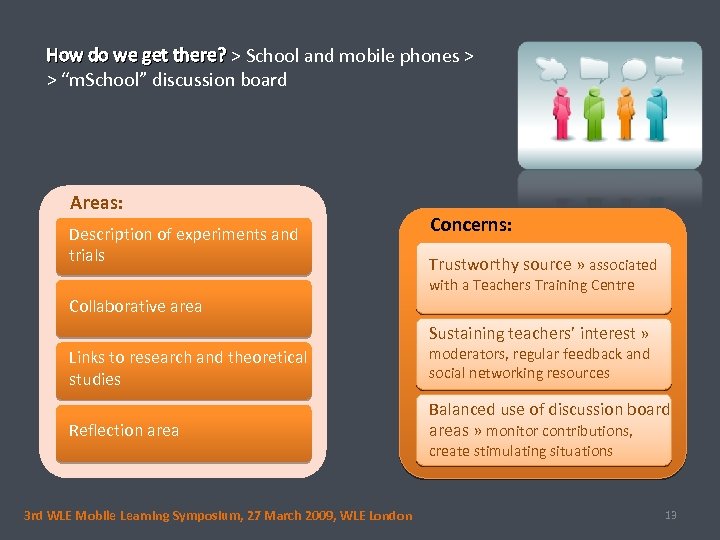
How do we get there? > School and mobile phones > > “m. School” discussion board Areas: Description of experiments and trials Concerns: Trustworthy source » associated with a Teachers Training Centre Collaborative area Sustaining teachers’ interest » Links to research and theoretical studies moderators, regular feedback and social networking resources Reflection area Balanced use of discussion board areas » monitor contributions, create stimulating situations 3 rd WLE Mobile Learning Symposium, 27 March 2009, WLE London 13
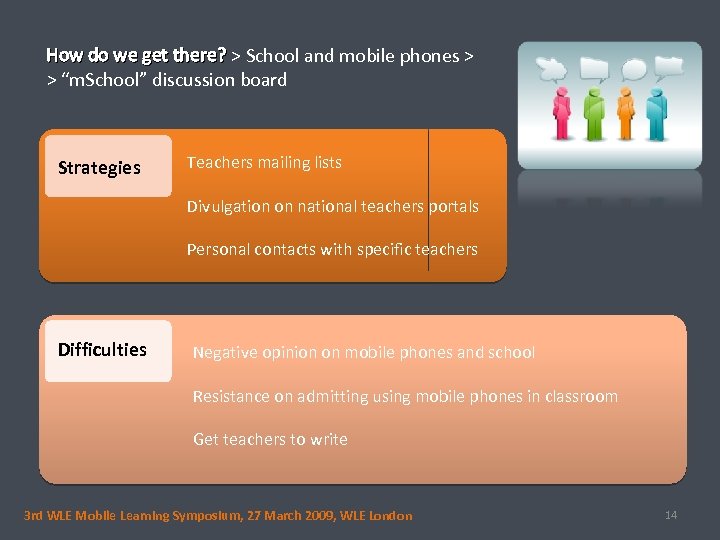
How do we get there? > School and mobile phones > > “m. School” discussion board Strategies Teachers mailing lists Divulgation on national teachers portals Personal contacts with specific teachers Difficulties Negative opinion on mobile phones and school Resistance on admitting using mobile phones in classroom Get teachers to write 3 rd WLE Mobile Learning Symposium, 27 March 2009, WLE London 14
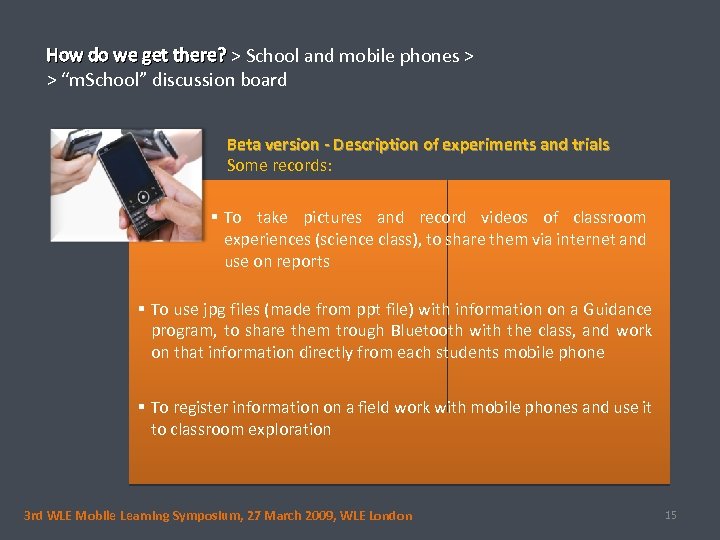
How do we get there? > School and mobile phones > > “m. School” discussion board Beta version - Description of experiments and trials Some records: § To take pictures and record videos of classroom experiences (science class), to share them via internet and use on reports § To use jpg files (made from ppt file) with information on a Guidance program, to share them trough Bluetooth with the class, and work on that information directly from each students mobile phone § To register information on a field work with mobile phones and use it to classroom exploration 3 rd WLE Mobile Learning Symposium, 27 March 2009, WLE London 15
How do we get there? > School and mobile phones > > “m. School” discussion board Beta version - Description of experiments and trials Some records: § To challenge students to take photos of the most important things of their life, transfer to a computer, and produce a slideshow including their comments. To be presented in classroom through data show. § To record parts of class in mp 3 audio files and to listen while studying at home § To create a Valentine’s day collaborative poem using SMS. One student starts and sends to another that adds a line, and so forth. 3 rd WLE Mobile Learning Symposium, 27 March 2009, WLE London 16
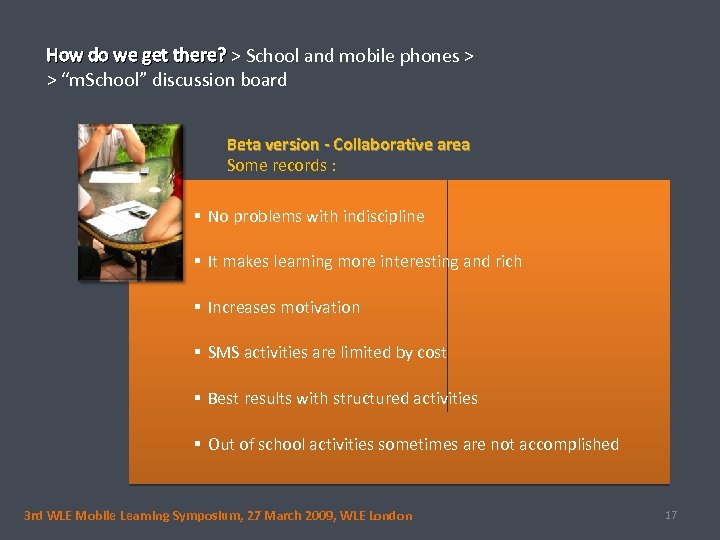
How do we get there? > School and mobile phones > > “m. School” discussion board Beta version - Collaborative area Some records : § No problems with indiscipline § It makes learning more interesting and rich § Increases motivation § SMS activities are limited by cost § Best results with structured activities § Out of school activities sometimes are not accomplished 3 rd WLE Mobile Learning Symposium, 27 March 2009, WLE London 17
In a not so far away future … School system will integrate mobile phones as a way … to extend education outside the classroom, into the conversations and interactions of everyday life. Sharples, Milrad, Arnedillo Sánchez & Vavoula (2008) 3 rd WLE Mobile Learning Symposium, 27 March 2009, WLE London 18
References Cardoso, C. , Espanha, R. & Lapa, T. (2007). E-Generation: Os Usos de Media pelas Crianças e Jovens em Portugal. Lisbon: CIES/ISCTE – Centro de Investigação e Estudos. Capgemini (2007). The User Challenge Benchmarking The Supply Of Online Public Services (report of the 7º measurement). European Commission Directorate General for Information Society and Media, Setembro de 2007. Retrieved January 05, 2009, from http: //ec. europa. eu/information_society/eeurope/i 2010/docs/benchmarking/egov_benchmark_2007. pdf Cook, J. , Pachler, N. and Bradley, C. (2008). Bridging the gap? Mobile phones at the interface between informal and formal learning. Journal of the Research Centre for Educational Technology. Special Issue on Learning While Mobile, 4 (1) pp. 3 -18. Drotner, K. (2008). Leisure Is Hard Work: Digital Practices and Future Competencies. In David Buckingham (Ed. ), Youth, Identity, and Digital Media (pp. 167– 184). Cambridge, MA: The MIT Press. Ferreira, E. , (2009). Jovens, Telemóveis e Escola. Trabalho de Projecto do Mestrado de Gestão de Sistemas de e-Learning da Faculdade de Ciências Sociais e Humanas da Universidade de Lisboa. Green, H. , Facer, K. , Rudd, T. , Dillon, P. & Humphreys, P. (2005). Personalisation and Digital Technologies. Bristol: Futurelab. Green, H. & Hannon, C. (2007). Their Space: Education for a digital generation. London: Demos. Laurillard, D. (2008 a). Digital technologies and their role in achieving our ambitions for education. Professorial lecture. London: Institute of Education, University of London. Laurillard, D. (2008 b). Open Teaching: The Key to Sustainable and Effective Open Education. In T. Iiyoshi and M. S. Vijay Kumar (Ed. ), Opening Up Education (pp. 319 -335). Cambridge: MIT Press. Pedro, N. , Soares, F. , Matos, J. F. , & Santos, M. (2008). Utilização de plataformas de gestão de aprendizagem em contexto escolar: Estudo nacional. Lisbon: DGIDC. Retrieved November 22, 2008, from http: //moodle. crie. minedu. pt/file. php/400/relatorio_final_estudo_plataformas _2008. pdf (Use of learning management systems in schools: national study – available in Portuguese) Prensky, M. (2005). What Can You Learn from a Cell Phone? Almost Anything!. Innovate, 1 (5). Sharples, M. , Taylor, J. , & Vavoula, G. (2007). A Theory of Learning for the Mobile Age. In R. Andrews and C. Haythornthwaite (eds. ) The Sage Handbook of Elearning Research. London: Sage, pp. 221 -47. Sharples M. , Milrad M. , Arnedillo Sánchez I. , Vavoula G. (2008) Mobile Learning: Small devices, Big Issues. To be published in Balacheff, N. , Ludvigsen, S. , de Jong, T. , Lazonder, A. , Barnes, S. & Montandon, L. Technology Enhanced Learning: Principles and Products. 3 rd WLE Mobile Learning Symposium, 27 March 2009, WLE London 19
Скачать презентацию Does school fit in mobile phones The whole
a8f75fb22eb5a4de58bac7ae249ee7b1.ppt