


 Скачать презентацию Does Cross-Listing Mitigate Insider Trading Adriana Korczak and
3623fd0030d19b63f4dbf914c1d4173d.ppt
- Количество слайдов: 21
 Does Cross-Listing Mitigate Insider Trading? Adriana Korczak and Meziane Lasfer Cass Business School, London m. a. lasfer@city. ac. uk
 Introduction • Evidence that insiders trade profitably around major corporate events using private information – – – – Bankruptcy protection: Seyhun & Bradley (1997) New issues: Karpoff and Lee (1991) Buybacks: Lee, Mikkelson & Partch (1992) Earnings forecasts: Penman (1982) Takeovers: Seyhun (1990), Bris (2005) Dividend announcements: John and Lang (1991) Exchange listings/de-listings: Lamba and Khan (1999) • Evidence that insiders earn significant exceptional returns – US: Jaffe (1974), Finnerty (1976), Seyhun (1986), Lakonishok and Lee (2001) – U. K: Pope et al (1990), Gregory et al (1994) & in other countries… • But is Insider Trading profitable after transaction costs? m. a. lasfer@city. ac. uk 2
 Issues: Should insider trading be regulated? • What and How to regulate – Controversies: – What is insider trading and who is the insider – How to treat non-information trading (e. g. , portfolio changes, liquidity) and trading on miss-valuation • Insider trading should not be regulated because: – It increases market efficiency, thus, • Prices will reflect all information – Closer to strong form EMH • Signalling Buy (sell) trades to signal under- (over-) valuation • Insider trading should be regulated because: – Trading on private information implies transfer of wealth – Decrease market efficiency through • Reduction in liquidity • Informed investors set up strategies to mimic insider trades m. a. lasfer@city. ac. uk 3
 Objective of the paper • Test whether cross-listing mitigates the trading on insider information • The legal and reputational bonding hypotheses • UK and US roughly same governance, thus not testing the bonding hypothesis as defined by (Cofee 1999, 2002; Stulz, 1999) • Cross-listed companies are subject to both domestic and foreign Legislation – US and UK are relatively complementary – Table 1 • Increased disclosure requirements • Less information asymmetries because more thorough investor monitoring • Stronger bad image effects… m. a. lasfer@city. ac. uk 4
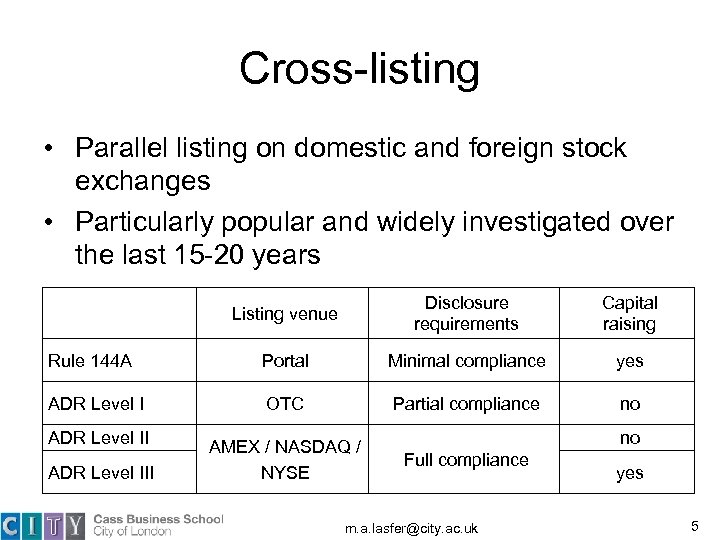 Cross-listing • Parallel listing on domestic and foreign stock exchanges • Particularly popular and widely investigated over the last 15 -20 years Listing venue Disclosure requirements Capital raising Rule 144 A Portal Minimal compliance yes ADR Level I OTC Partial compliance no ADR Level II AMEX / NASDAQ / NYSE ADR Level III no Full compliance m. a. lasfer@city. ac. uk yes 5
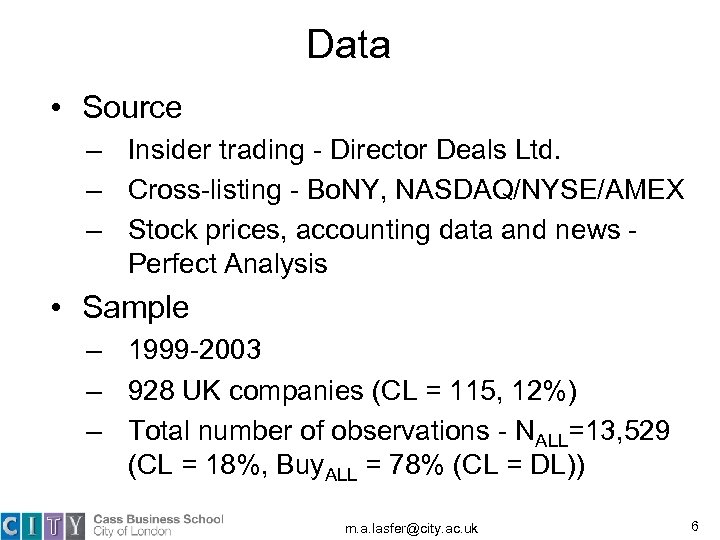 Data • Source – Insider trading - Director Deals Ltd. – Cross-listing - Bo. NY, NASDAQ/NYSE/AMEX – Stock prices, accounting data and news Perfect Analysis • Sample – 1999 -2003 – 928 UK companies (CL = 115, 12%) – Total number of observations - NALL=13, 529 (CL = 18%, Buy. ALL = 78% (CL = DL)) m. a. lasfer@city. ac. uk 6
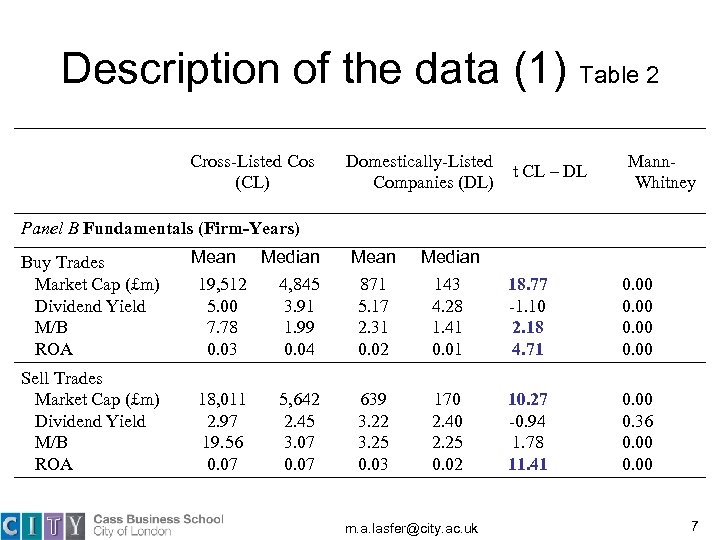 Description of the data (1) Table 2 Cross-Listed Cos (CL) Domestically-Listed Companies (DL) t CL – DL Mann. Whitney Panel B Fundamentals (Firm-Years) Buy Trades Market Cap (£m) Dividend Yield M/B ROA Sell Trades Market Cap (£m) Dividend Yield M/B ROA Mean Median 19, 512 5. 00 7. 78 0. 03 4, 845 3. 91 1. 99 0. 04 871 5. 17 2. 31 0. 02 143 4. 28 1. 41 0. 01 18. 77 -1. 10 2. 18 4. 71 0. 00 18, 011 2. 97 19. 56 0. 07 5, 642 2. 45 3. 07 0. 07 639 3. 22 3. 25 0. 03 170 2. 40 2. 25 0. 02 10. 27 -0. 94 1. 78 11. 41 0. 00 0. 36 0. 00 m. a. lasfer@city. ac. uk 7
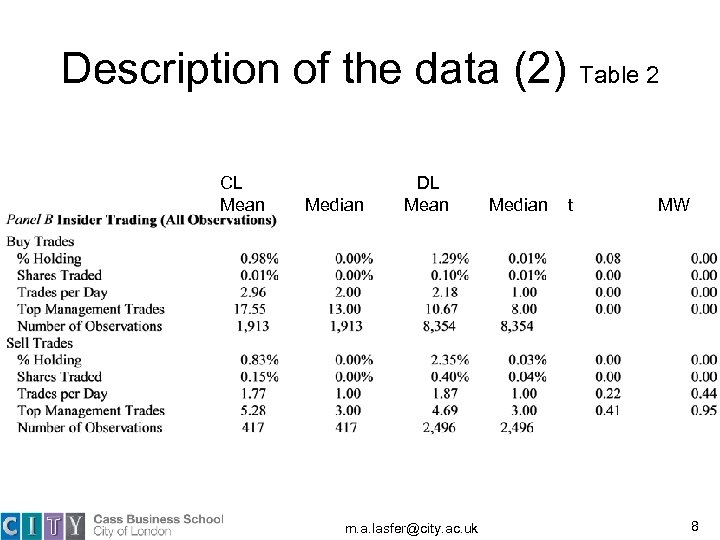 Description of the data (2) Table 2 CL Mean Median DL Mean m. a. lasfer@city. ac. uk Median t MW 8
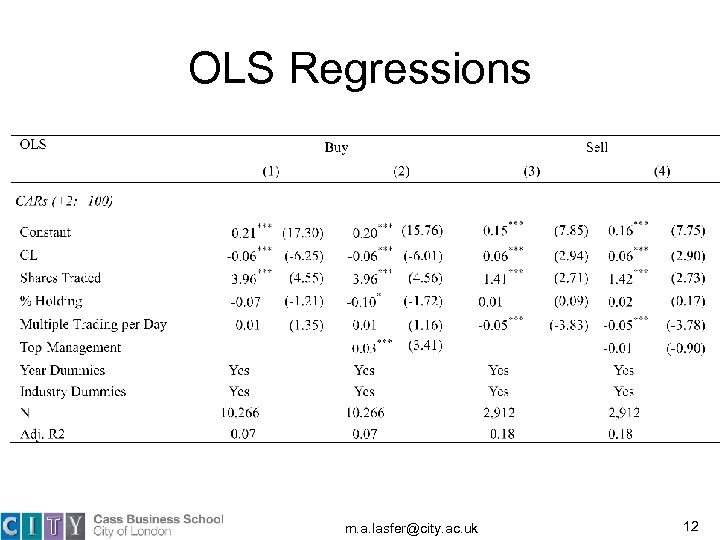
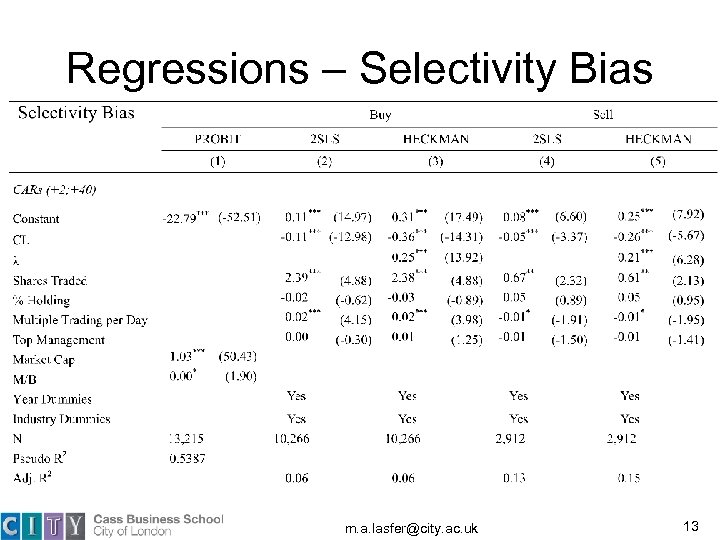
![Methodology • Event study methodology – Event day [day 0] • • – Insider](https://present5.com/presentation/3623fd0030d19b63f4dbf914c1d4173d/image-9.jpg "Methodology • Event study methodology – Event day [day 0] • • – Insider") Methodology • Event study methodology – Event day [day 0] • • – Insider trading announcement date Insider trading date Event window [-100; +100] • Estimation window [-360; -101] • News announcements • Regressions – – – OLS To account for fundamental characteristics of crosslisted firms (Reese and Weisbach, 2002; Doidge et al. , 2004): Larger, higher growth and profitability • 2 SLS and 2 -stage Heckman estimation (Heckman, 1978) m. a. lasfer@city. ac. uk 9
Methodology • Event study methodology – Event day [day 0] • • – Insider trading announcement date Insider trading date Event window [-100; +100] • Estimation window [-360; -101] • News announcements • Regressions – – – OLS To account for fundamental characteristics of crosslisted firms (Reese and Weisbach, 2002; Doidge et al. , 2004): Larger, higher growth and profitability • 2 SLS and 2 -stage Heckman estimation (Heckman, 1978) m. a. lasfer@city. ac. uk 9
 Summary of the results CL DL DL CL Buy Trades m. a. lasfer@city. ac. uk 10
 Empirical Results m. a. lasfer@city. ac. uk 11
 OLS Regressions m. a. lasfer@city. ac. uk 12
 Regressions – Selectivity Bias m. a. lasfer@city. ac. uk 13
![Robustness checks • Confounding events [-5, +5] – Same results • Announcement day vs.](https://present5.com/presentation/3623fd0030d19b63f4dbf914c1d4173d/image-14.jpg "Robustness checks • Confounding events [-5, +5] – Same results • Announcement day vs.") Robustness checks • Confounding events [-5, +5] – Same results • Announcement day vs. Trading day – – Similar results Announcement dates provide more information than trading dates • Bull vs. bear markets – – Cross-listed companies: More information in bear period More differences in domestically-listed firms • Alternative event study methodologies – Same results using market adjusted model, mean adjusted model… • Control sample – Size effect, similar results m. a. lasfer@city. ac. uk 14
Robustness checks • Confounding events [-5, +5] – Same results • Announcement day vs. Trading day – – Similar results Announcement dates provide more information than trading dates • Bull vs. bear markets – – Cross-listed companies: More information in bear period More differences in domestically-listed firms • Alternative event study methodologies – Same results using market adjusted model, mean adjusted model… • Control sample – Size effect, similar results m. a. lasfer@city. ac. uk 14
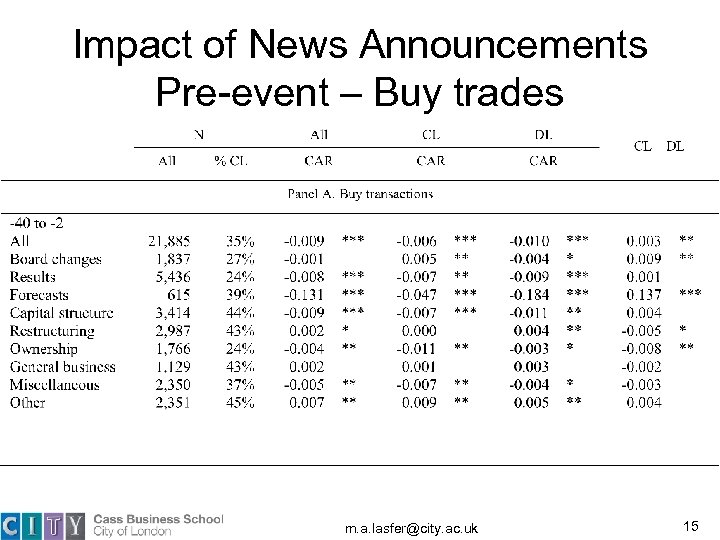 Impact of News Announcements Pre-event – Buy trades m. a. lasfer@city. ac. uk 15
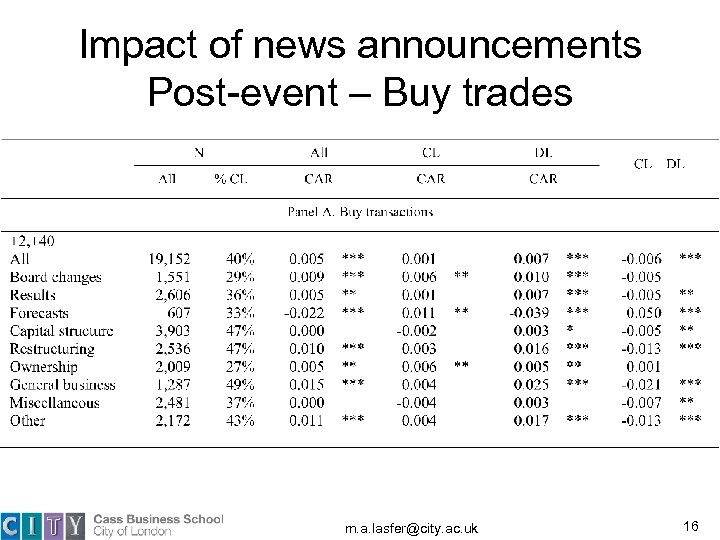 Impact of news announcements Post-event – Buy trades m. a. lasfer@city. ac. uk 16
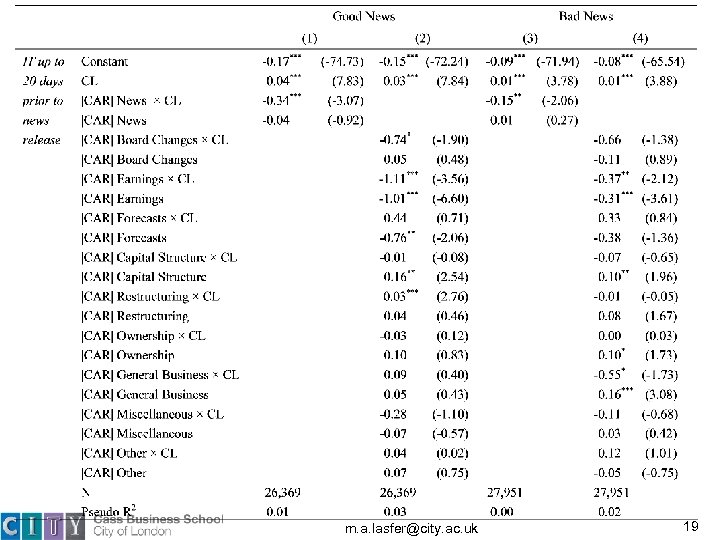
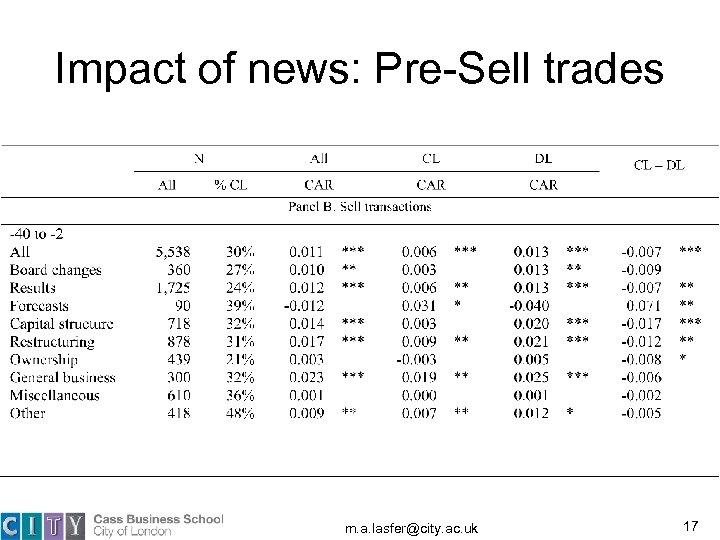 Impact of news: Pre-Sell trades m. a. lasfer@city. ac. uk 17
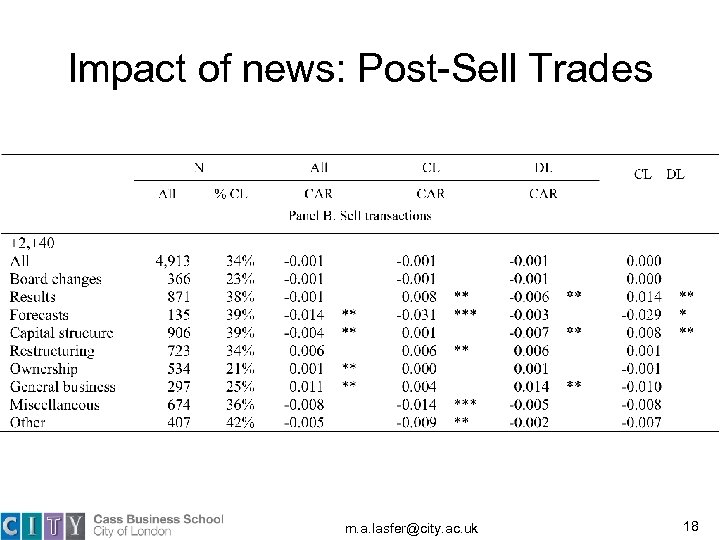 Impact of news: Post-Sell Trades m. a. lasfer@city. ac. uk 18
 m. a. lasfer@city. ac. uk 19
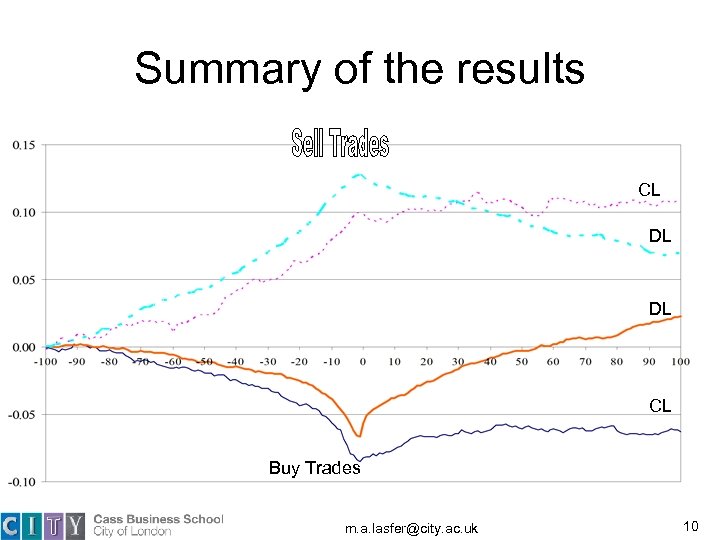
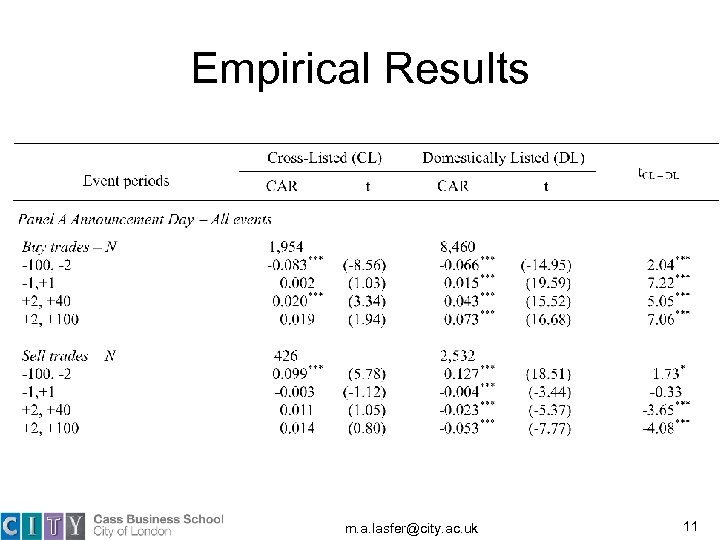
 Conclusions • Insiders are informed investors because – – They are contrarians: Negative (Positive) CARs before buy (sell) trades Positive (negative) CARs after buy (sell) trades • Significant differences between cross-listed and domestically-listed companies – – Abnormal returns and news impacts • are significantly smaller for cross-listed firms • Implication: – bonding contract limits the propensity of insiders to trade on insider information • Coffee (1999), Reese and Weisbach (2002), Doidge (2004) and Doidge, Karolyi and Stulz (2004) m. a. lasfer@city. ac. uk 20
 Questions • Why do managers still trade before news is announced, despite the legal constraints? – Is the bonding contract not binding? • King and Segal (2004), Segal (2005) and Licht (2003) – Use other markets • US domestic vs. UK cross-listed companies • Other cross-listed companies in US – Use other news, especially financial analysts forecasts • Market micros-structure effect – Bid-ask spread – adverse selection problem m. a. lasfer@city. ac. uk 21