


 Скачать презентацию Documenting Your Teaching and Student Evaluations Center for
b0f797f2db06d49e4db143e72a89637d.ppt
- Количество слайдов: 14
 Documenting Your Teaching and Student Evaluations Center for Teaching Excellence Duquesne University
 What to Keep for Documenting Your Teaching ü ü ü ü Syllabus Sample assignments Samples of student work (with permission) Sample lesson plans Sample tests and quizzes Notes and reflections ALL Course evaluations --Written and electronic portions ü Any observation forms and notes completed for you by faculty and TA colleagues
 Benefits of Documenting Your Teaching § All your teaching files are organized for future use/revision § Immediately document any necessary changes on quizzes, assignments, etc. § Teaching materials are often required for: § The job search/application process § TA award dossier § Aspects of Certificate of University Teaching
 Faculty or Peer Observations • Several weeks in advance, ask an instructor to observe you • Some supervisors visit classes regularly and give you feedback • Meet with the observer beforehand to tell him/her your goals for the particular class period. You may also want to provide a syllabus so the observer can see how the class fits into the larger goals of the semester • Meet with the observer afterward, to get his/her feedback • CTE can provide you with guiding questions or an observation form • Faculty observations are required for the TA award
 Early Course Evaluation • Benefits: Ø You have time to make changes to the course before the semester ends Ø You open the lines of communication between teacher and student Ø You choose the method, time, and type of evaluation, which allows you to tailor it to your own concerns and/or teaching goals • Early course evaluation is optional, but encouraged
 Methods of Early Course Evaluation • Open-ended questions § I learn best when my professor… § I learn best when I… § In order to prepare for class I… • “K Q S” § Keep doing § Quit doing § Start doing • Traffic Light Survey § Red (Stop) § Yellow (Slow) § Green (Go)
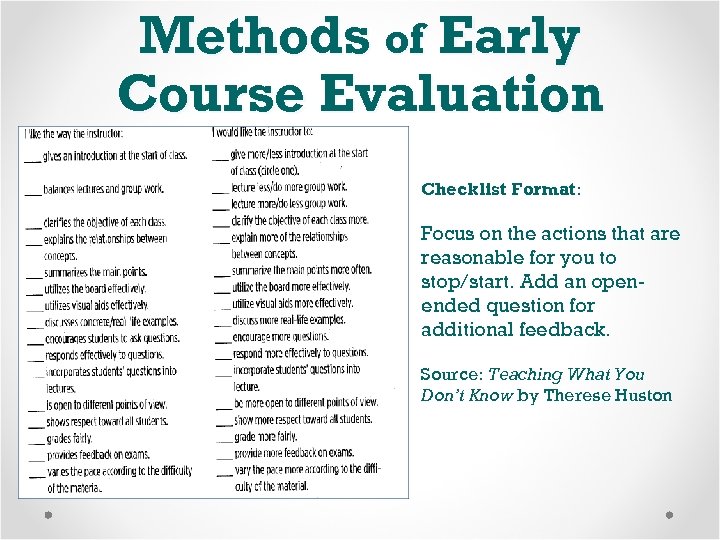 Methods of Early Course Evaluation Checklist Format: Focus on the actions that are reasonable for you to stop/start. Add an openended question for additional feedback. Source: Teaching What You Don’t Know by Therese Huston
 End of Semester Student Evaluation Survey (SES) § Required by University § Anonymous student responses § Survey open to students online 2 weeks prior to final exam § Students receive email notices for each course § Faculty can see response rate throughout 2 week period and encourage students to participate § An idea: you may ask students to complete SES as homework to increase participation (CTE recommends NOT for grade points) § Approx 4 weeks after final exam period, instructor will have access to results
 Student Evaluation: § Students indicate how much they agree with statements about the instructor § Items are randomly ordered for students § 25 Questions in 5 Domains § Items are grouped by domain on the report to faculty: A. Instructional design B. Instructional delivery C. Attitudes toward student learning D. Out of class availability
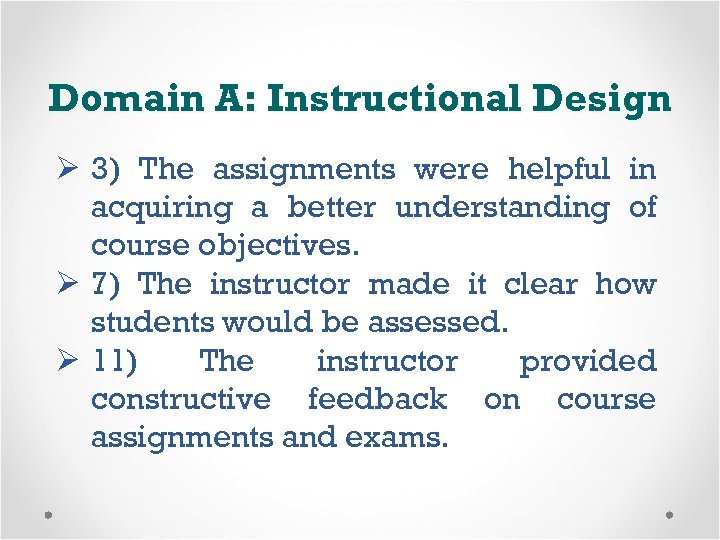 Domain A: Instructional Design Ø 3) The assignments were helpful in acquiring a better understanding of course objectives. Ø 7) The instructor made it clear how students would be assessed. Ø 11) The instructor provided constructive feedback on course assignments and exams.
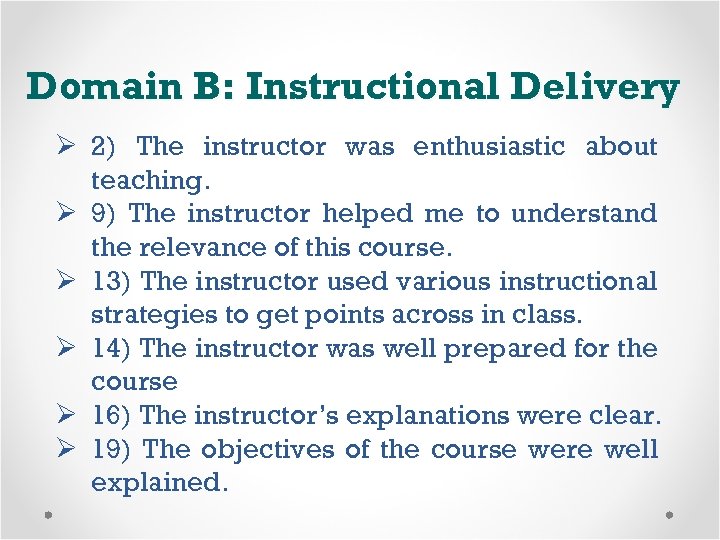 Domain B: Instructional Delivery Ø 2) The instructor was enthusiastic about teaching. Ø 9) The instructor helped me to understand the relevance of this course. Ø 13) The instructor used various instructional strategies to get points across in class. Ø 14) The instructor was well prepared for the course Ø 16) The instructor’s explanations were clear. Ø 19) The objectives of the course were well explained.
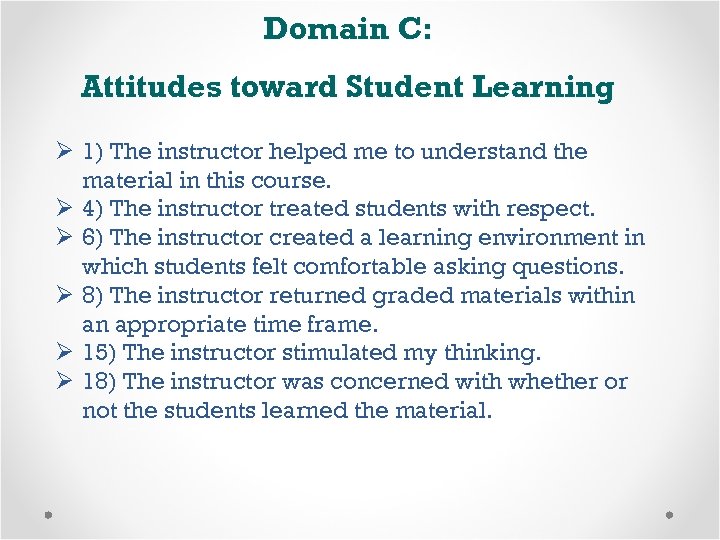 Domain C: Attitudes toward Student Learning Ø 1) The instructor helped me to understand the material in this course. Ø 4) The instructor treated students with respect. Ø 6) The instructor created a learning environment in which students felt comfortable asking questions. Ø 8) The instructor returned graded materials within an appropriate time frame. Ø 15) The instructor stimulated my thinking. Ø 18) The instructor was concerned with whether or not the students learned the material.
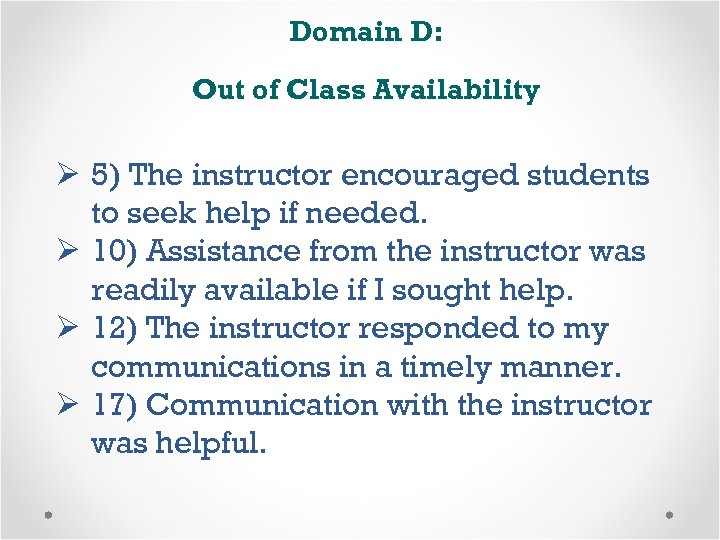 Domain D: Out of Class Availability Ø 5) The instructor encouraged students to seek help if needed. Ø 10) Assistance from the instructor was readily available if I sought help. Ø 12) The instructor responded to my communications in a timely manner. Ø 17) Communication with the instructor was helpful.
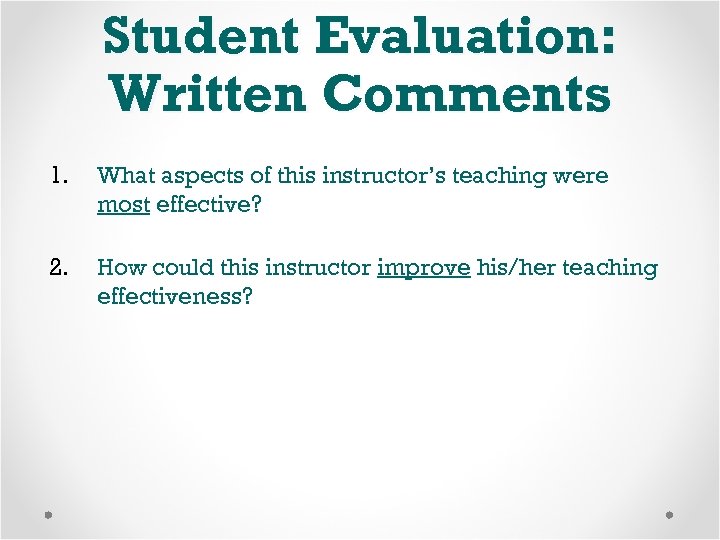 Student Evaluation: Written Comments 1. What aspects of this instructor’s teaching were most effective? 2. How could this instructor improve his/her teaching effectiveness?