


 Скачать презентацию Documenting suicide risk assessment and management Making use
45ddebe86def451cd5f70c66111b98e0.ppt
- Количество слайдов: 85
 Documenting suicide risk assessment and management: Making use of the evidence to facilitate decision making Lisa A. Brenner, Ph. D, ABPP VISN 19 Mental Illness Research Education and Clinical Center, University of Colorado, Denver, School of Medicine Seattle VAMC 9/2012
 Disclosure This presentation is based on work supported, in part, by the Department of Veterans Affairs, but does not necessarily represent the views of the Department of Veterans Affairs or the United States Government.
 “I think it took awhile before I realized and then when I started thinking about things and realizing that I was going to be like this for the rest of my life, it gives me a really down feeling and it makes me think like—why should I be around like this for the rest of my life? ” - VA Patient/TBI Survivor
 Suicide Risk Assessment • Refers to the establishment of a – clinical judgment of risk in the near future, – based on the weighing of a very large amount of available clinical detail. Jacobs 2003
 We assess risk to… Identify modifiable and treatable risk factors that inform treatment Simon 2001 Take care of our patients Hal Wortzel, MD
 We should also assess to…Take care of ourselves • Risk management is a reality of psychiatric practice • 15 -68% of psychiatrists have experienced a patient suicide (Alexander 2000, Chemtob 1988) • About 33% of trainees have a patient die by suicide • Paradox of training - toughest patients often come earliest in our careers Hal Wortzel, MD
 Is a common language necessary to facilitate suicide risk assessment? Do we have a common language?
 Case Example 1 A healthy 21 -year-old female is brought by her boyfriend to the Emergency Department after telling him she ingested 4 -6 regular strength acetaminophen [Tylenol] capsules (1300 -1950 mg total dose). She reports no ill effects. Lab tests done at the time of admission to the ED reported her acetaminophen level within therapeutic range. Four hours later, lab tests reported levels within the low therapeutic range. During triage, she states that before she took the capsules, she was upset and wished she was dead. She feels better now and requests to go home.
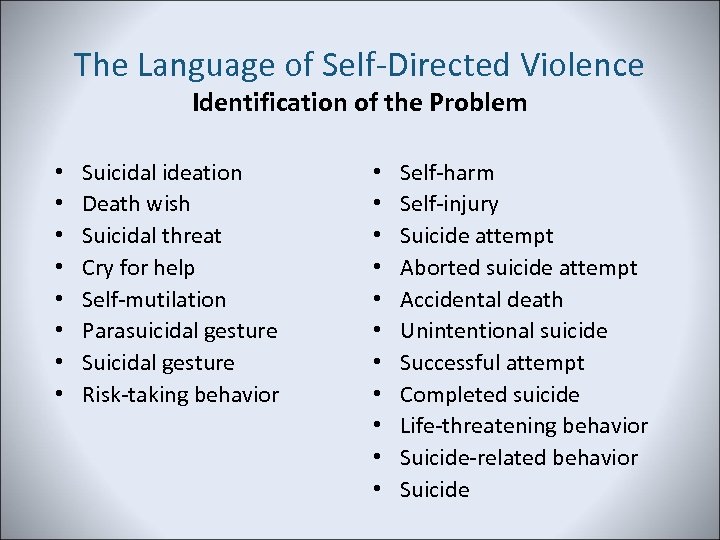 The Language of Self-Directed Violence Identification of the Problem • • Suicidal ideation Death wish Suicidal threat Cry for help Self-mutilation Parasuicidal gesture Suicidal gesture Risk-taking behavior • • • Self-harm Self-injury Suicide attempt Aborted suicide attempt Accidental death Unintentional suicide Successful attempt Completed suicide Life-threatening behavior Suicide-related behavior Suicide
 The Language of Suicidology Implications of the Problem • Clinical • Research • Public Health
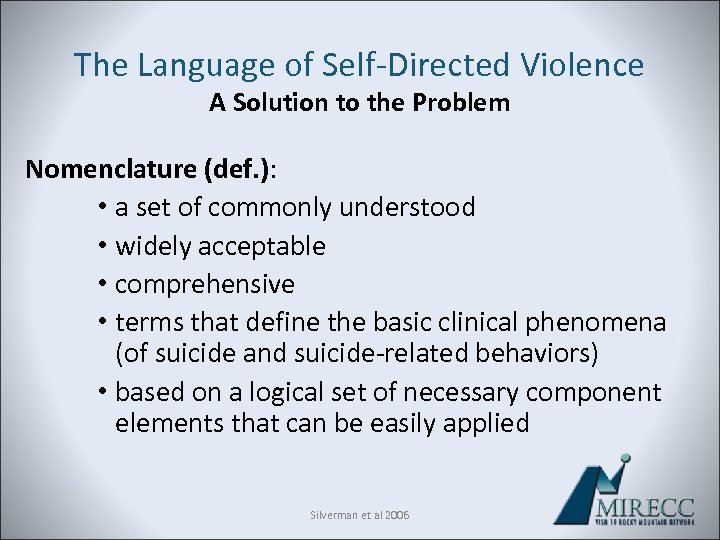 The Language of Self-Directed Violence A Solution to the Problem Nomenclature (def. ): • a set of commonly understood • widely acceptable • comprehensive • terms that define the basic clinical phenomena (of suicide and suicide-related behaviors) • based on a logical set of necessary component elements that can be easily applied Silverman et al 2006
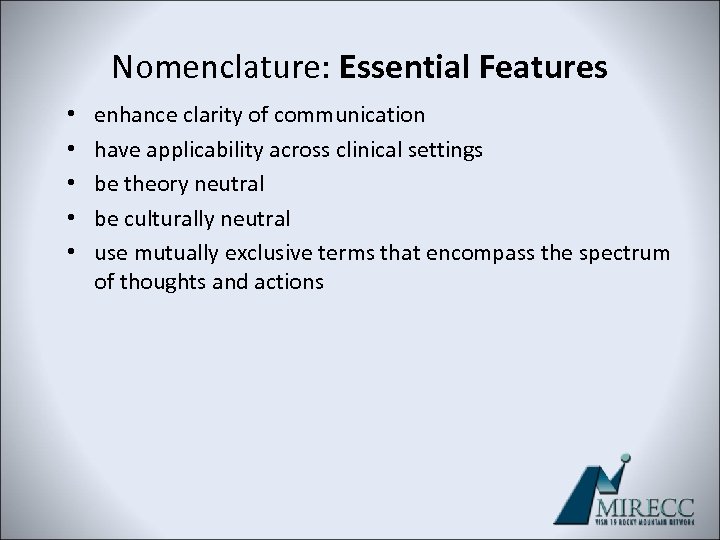 Nomenclature: Essential Features • • • enhance clarity of communication have applicability across clinical settings be theory neutral be culturally neutral use mutually exclusive terms that encompass the spectrum of thoughts and actions
 Classification System Essential Features • “Exhaustive” • Builds upon a nomenclature • Further differentiates between like phenomena Silverman et al 2006
 Self-Directed Violence Classification System Lisa A. Brenner, Ph. D. Morton M. Silverman, M. D. Lisa M. Betthauser, M. B. A. Ryan E. Breshears, Ph. D. Katherine K. Bellon, Ph. D. Herbert. T. Nagamoto, M. D.
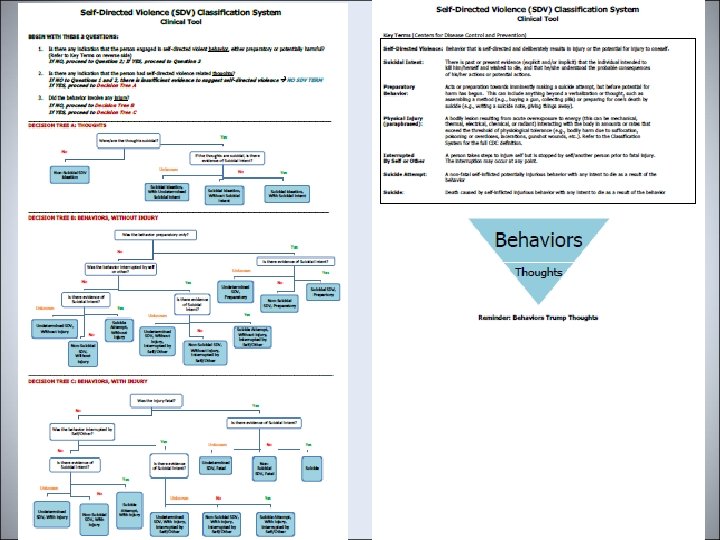
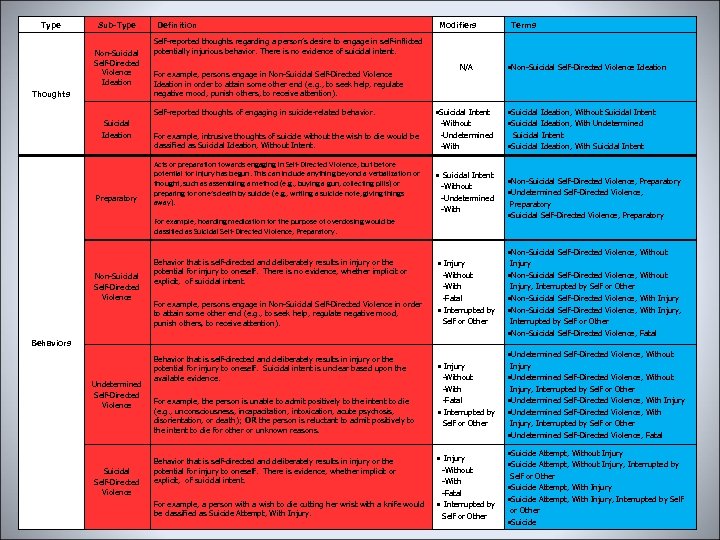 Type Sub-Type Non-Suicidal Self-Directed Violence Ideation Thoughts Definition Modifiers Self-reported thoughts regarding a person’s desire to engage in self-inflicted potentially injurious behavior. There is no evidence of suicidal intent. For example, persons engage in Non-Suicidal Self-Directed Violence Ideation in order to attain some other end (e. g. , to seek help, regulate negative mood, punish others, to receive attention). N/A Self-reported thoughts of engaging in suicide-related behavior. Suicidal Ideation Preparatory • Suicidal Intent For example, intrusive thoughts of suicide without the wish to die would be classified as Suicidal Ideation, Without Intent. -Without -Undetermined -With Acts or preparation towards engaging in Self-Directed Violence, but before potential for injury has begun. This can include anything beyond a verbalization or thought, such as assembling a method (e. g. , buying a gun, collecting pills) or preparing for one’s death by suicide (e. g. , writing a suicide note, giving things away). • Suicidal Intent -Without -Undetermined -With For example, hoarding medication for the purpose of overdosing would be classified as Suicidal Self-Directed Violence, Preparatory. Non-Suicidal Self-Directed Violence Terms Behavior that is self-directed and deliberately results in injury or the potential for injury to oneself. There is no evidence, whether implicit or explicit, of suicidal intent. • Non-Suicidal Self-Directed Violence Ideation • Suicidal Ideation, Without Suicidal Intent • Suicidal Ideation, With Undetermined Suicidal Intent • Suicidal Ideation, With Suicidal Intent • Non-Suicidal Self-Directed Violence, Preparatory • Undetermined Self-Directed Violence, Preparatory • Suicidal Self-Directed Violence, Preparatory • Non-Suicidal Self-Directed Violence, Without • Injury -Without -With -Fatal For example, persons engage in Non-Suicidal Self-Directed Violence in order to attain some other end (e. g. , to seek help, regulate negative mood, • Interrupted by Self or Other punish others, to receive attention). Injury • Non-Suicidal Self-Directed Violence, Without Injury, Interrupted by Self or Other • Non-Suicidal Self-Directed Violence, With Injury, Interrupted by Self or Other • Non-Suicidal Self-Directed Violence, Fatal Behaviors Undetermined Self-Directed Violence Suicidal Self-Directed Violence Behavior that is self-directed and deliberately results in injury or the potential for injury to oneself. Suicidal intent is unclear based upon the available evidence. • Undetermined Self-Directed Violence, Without • Injury -Without -With For example, the person is unable to admit positively to the intent to die -Fatal (e. g. , unconsciousness, incapacitation, intoxication, acute psychosis, • Interrupted by disorientation, or death); OR the person is reluctant to admit positively to Self or Other the intent to die for other or unknown reasons. Behavior that is self-directed and deliberately results in injury or the potential for injury to oneself. There is evidence, whether implicit or explicit, of suicidal intent. For example, a person with a wish to die cutting her wrist with a knife would be classified as Suicide Attempt, With Injury. • Injury -Without -With -Fatal • Interrupted by Self or Other Injury • Undetermined Self-Directed Violence, Without Injury, Interrupted by Self or Other • Undetermined Self-Directed Violence, With Injury • Undetermined Self-Directed Violence, With Injury, Interrupted by Self or Other • Undetermined Self-Directed Violence, Fatal • Suicide Attempt, Without Injury, Interrupted by Self or Other • Suicide Attempt, With Injury, Interrupted by Self or Other • Suicide
 Now that we are using a common language How should we be assessing risk?
 Elements of Useful Assessment Tools • Clear operational definitions of construct assessed • Focused on specific domains (suicidality? ) • Developed through systematic, multistage process – empirical support for item content, clear administration and scoring instructions, reliability, and validity • Range of normative data available Gutierrez and Osman, 2008
 Basic Considerations • Context specific – schools, military, clinical settings • Available resources – time, money, staffing • Infrastructure to support outcomes – available referrals – trained clinical staff in-house
 Self-Report Measures • Advantages • Fast and easy to administer • Patients often more comfortable disclosing sensitive information • Quantitative measures of risk/protective factors • Disadvantages • Report bias • Face validity
 Evidence-Based Measures Suicidal Ideation - Beck Scale for Suicide Ideation Depressive Symptoms – Beck Depression Inventory II Hopelessness - Beck Hopelessness Scale Thoughts about the future - Suicide Cognitions Scale History of Suicide - Related Behaviors - Self-Harm Behavior Questionnaire • Protective Factors - Reasons for Living Inventory • • •
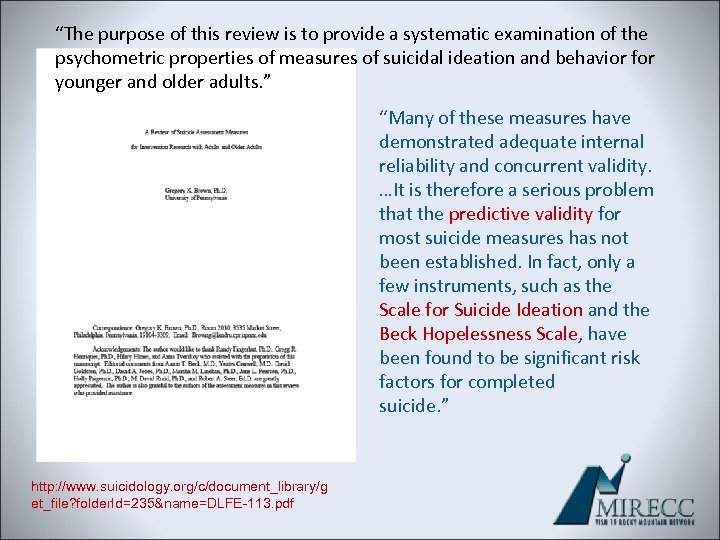 “The purpose of this review is to provide a systematic examination of the psychometric properties of measures of suicidal ideation and behavior for younger and older adults. ” “Many of these measures have demonstrated adequate internal reliability and concurrent validity. …It is therefore a serious problem that the predictive validity for most suicide measures has not been established. In fact, only a few instruments, such as the Scale for Suicide Ideation and the Beck Hopelessness Scale, have been found to be significant risk factors for completed suicide. ” http: //www. suicidology. org/c/document_library/g et_file? folder. Id=235&name=DLFE-113. pdf
 “Although self-report measures are often used as screening tools, an adequate evaluation of suicidality should include both interviewer-administered and self-report measures. ” http: //www. suicidology. org/c/document_li brary/get_file? folder. Id=235&name=DLFE 113. pdf
 What are the key components? Suicide focused clinical interview Psychological/Psychiatric Evaluation
 What is a Suicide Risk Factor? • A major focus of research for past 30 years • Factors – Demographic (e. g. , male gender, age over 65, Caucasian) – Psychosocial (e. g. , diagnosed serious mental illness, loss of significant relationship, impulsivity) – Past history (e. g. , suicide attempt, sexual or physical abuse)
 Risk Factors • Overall level of clinical concern about an individual • Guide screening and assessment efforts • Developing models to explain suicide • Distal to suicidal behavior • May or may not be modifiable • Risk factors do not predict individual behavior
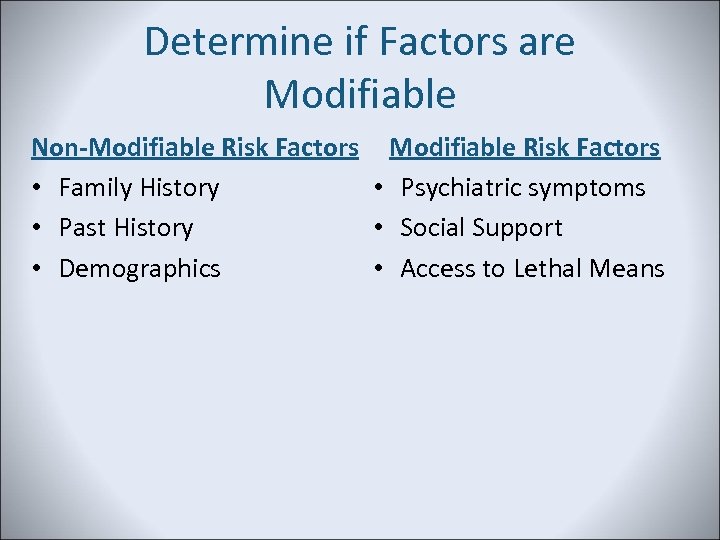 Determine if Factors are Modifiable Non-Modifiable Risk Factors • Family History • Psychiatric symptoms • Past History • Social Support • Demographics • Access to Lethal Means
 Warning Signs • Warning signs – person-specific emotions, thoughts, or behaviors precipitating suicidal behavior – Thoughts of suicide – Thoughts of death – Sudden changes in personality, behavior, eating or sleeping patterns • Proximal to the suicidal behavior and imply imminent risk Rudd et al. 2006
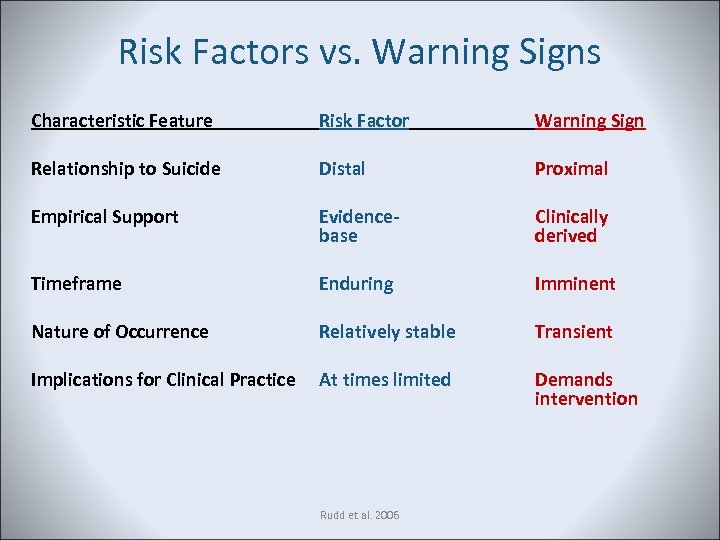 Risk Factors vs. Warning Signs Characteristic Feature Risk Factor Warning Sign Relationship to Suicide Distal Proximal Empirical Support Evidencebase Clinically derived Timeframe Enduring Imminent Nature of Occurrence Relatively stable Transient Implications for Clinical Practice At times limited Demands intervention Rudd et al. 2006
 Empirical test of warning signs almost non-existent
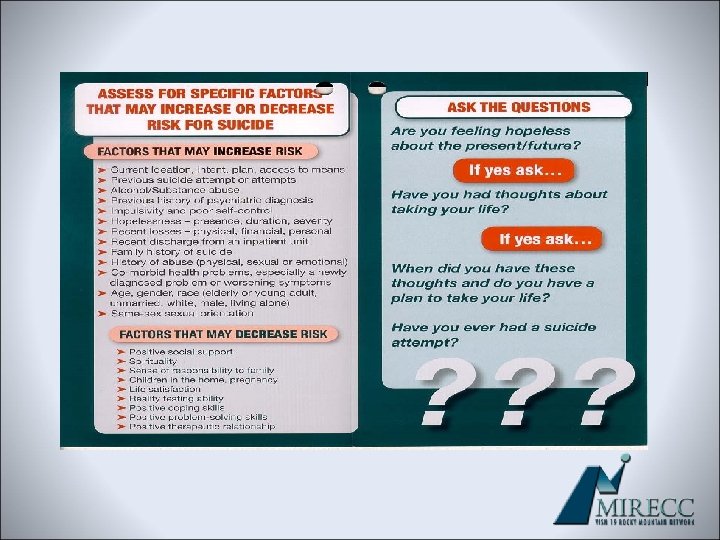
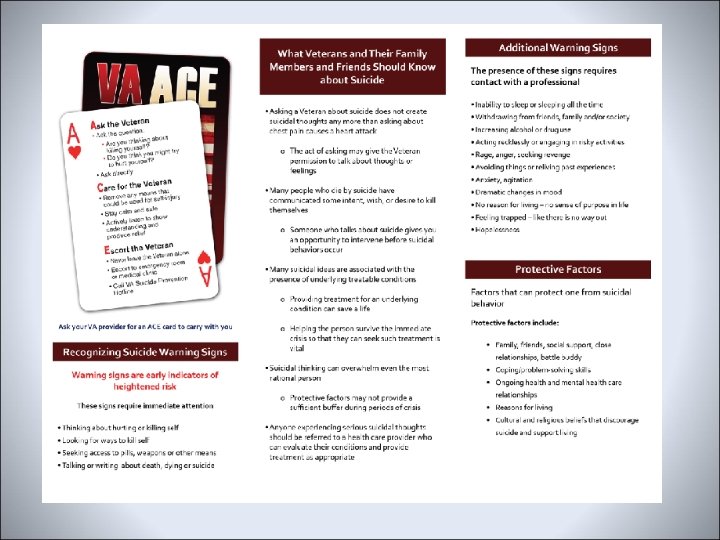
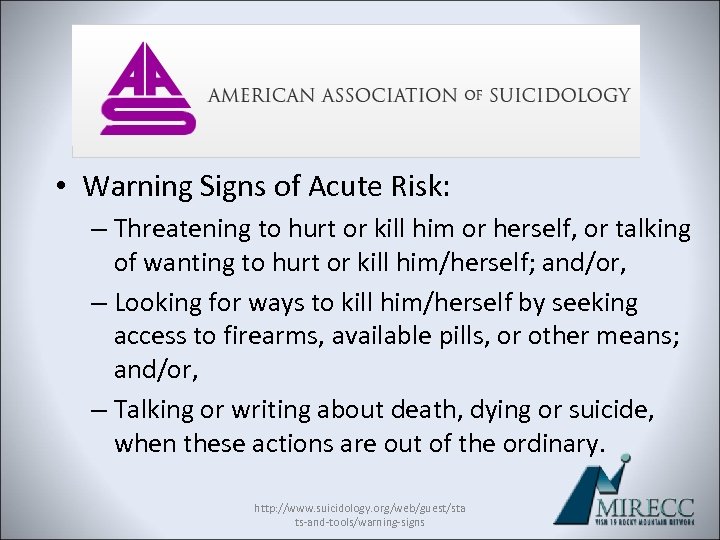 • Warning Signs of Acute Risk: – Threatening to hurt or kill him or herself, or talking of wanting to hurt or kill him/herself; and/or, – Looking for ways to kill him/herself by seeking access to firearms, available pills, or other means; and/or, – Talking or writing about death, dying or suicide, when these actions are out of the ordinary. http: //www. suicidology. org/web/guest/sta ts-and-tools/warning-signs
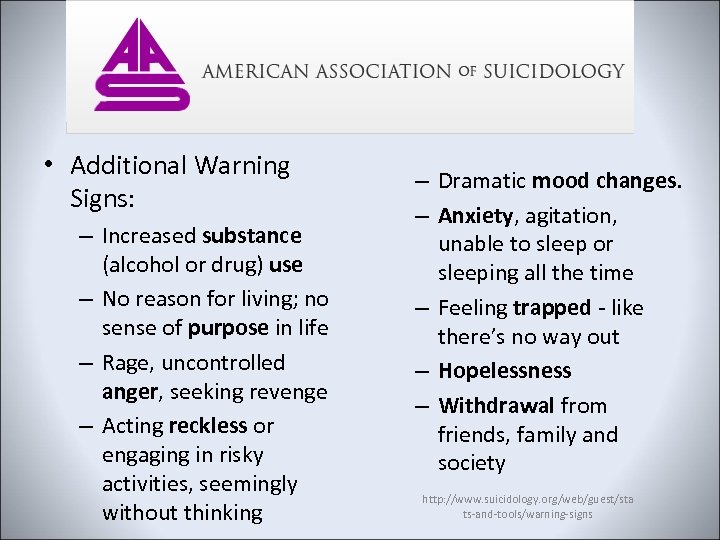 • Additional Warning Signs: – Increased substance (alcohol or drug) use – No reason for living; no sense of purpose in life – Rage, uncontrolled anger, seeking revenge – Acting reckless or engaging in risky activities, seemingly without thinking – Dramatic mood changes. – Anxiety, agitation, unable to sleep or sleeping all the time – Feeling trapped - like there’s no way out – Hopelessness – Withdrawal from friends, family and society http: //www. suicidology. org/web/guest/sta ts-and-tools/warning-signs
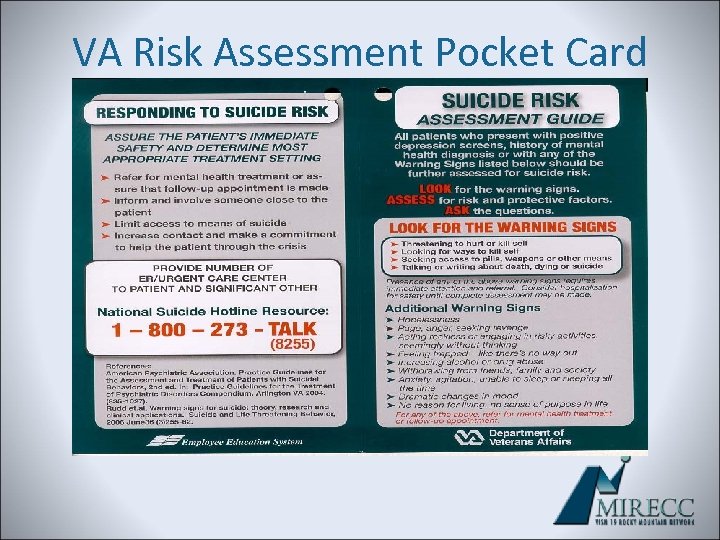 VA Risk Assessment Pocket Card
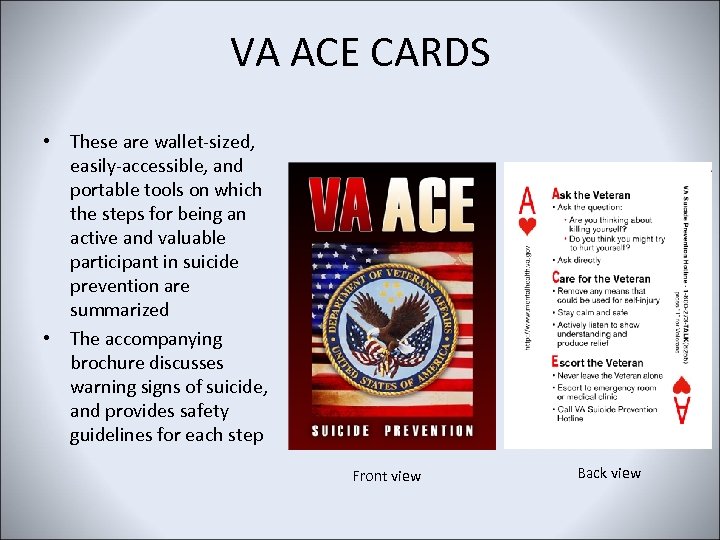 VA ACE CARDS • These are wallet-sized, easily-accessible, and portable tools on which the steps for being an active and valuable participant in suicide prevention are summarized • The accompanying brochure discusses warning signs of suicide, and provides safety guidelines for each step Front view Back view
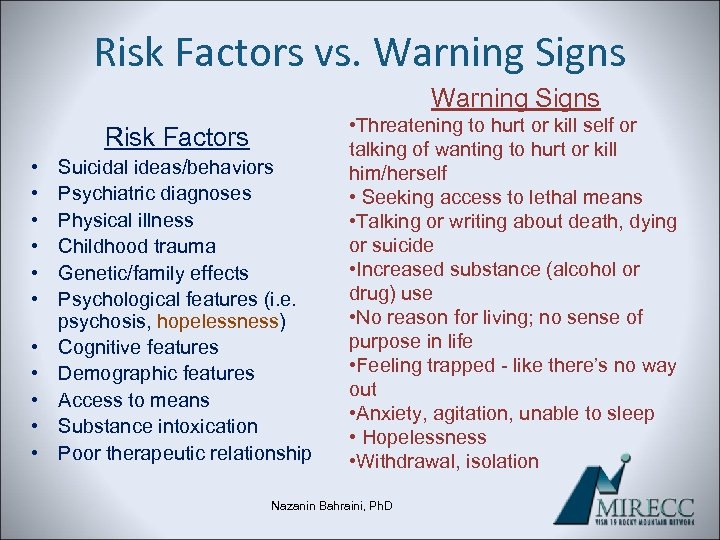 Risk Factors vs. Warning Signs Risk Factors • • • Suicidal ideas/behaviors Psychiatric diagnoses Physical illness Childhood trauma Genetic/family effects Psychological features (i. e. psychosis, hopelessness) Cognitive features Demographic features Access to means Substance intoxication Poor therapeutic relationship • Threatening to hurt or kill self or talking of wanting to hurt or kill him/herself • Seeking access to lethal means • Talking or writing about death, dying or suicide • Increased substance (alcohol or drug) use • No reason for living; no sense of purpose in life • Feeling trapped - like there’s no way out • Anxiety, agitation, unable to sleep • Hopelessness • Withdrawal, isolation Nazanin Bahraini, Ph. D
 Population of Interest: Operation Enduring Freedom/Operation Iraqi Freedom At risk for traumatic brain injury (TBI), post traumatic stress disorder, and suicide Can we draw from what we know about these conditions, suicidology, and rehabilitation medicine to identify novel means of assessing risk?
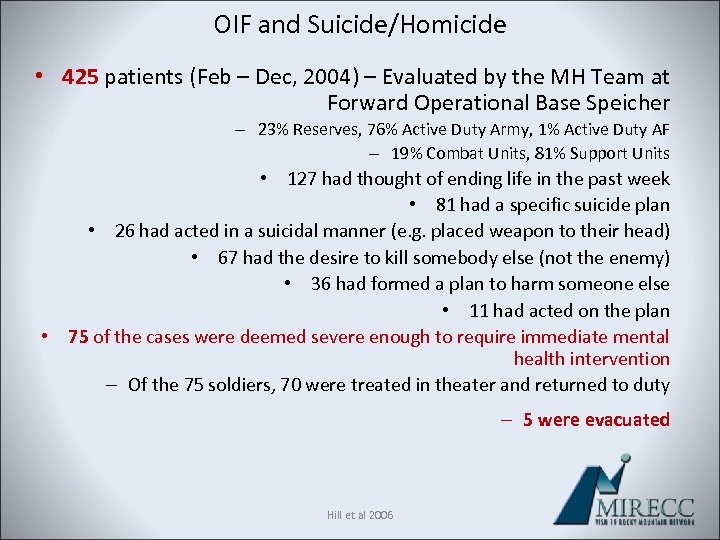 OIF and Suicide/Homicide • 425 patients (Feb – Dec, 2004) – Evaluated by the MH Team at Forward Operational Base Speicher – 23% Reserves, 76% Active Duty Army, 1% Active Duty AF – 19% Combat Units, 81% Support Units • 127 had thought of ending life in the past week • 81 had a specific suicide plan • 26 had acted in a suicidal manner (e. g. placed weapon to their head) • 67 had the desire to kill somebody else (not the enemy) • 36 had formed a plan to harm someone else • 11 had acted on the plan • 75 of the cases were deemed severe enough to require immediate mental health intervention – Of the 75 soldiers, 70 were treated in theater and returned to duty – 5 were evacuated Hill et al 2006
 Risk Factors for those with a History of TBI Individuals with a history of TBI are at increased risk of dying by suicide Members of the military are sustaining TBIs
 Role of Pre-injury vs. Post-Injury Risk Factors Post-injury psychosocial factors, in particular the presence of post injury emotional/psychiatric disturbance (E/PD) had far greater significance than pre-injury vulnerabilities or injury variables, in predicting elevated levels of suicidality post injury. Higher levels of hopelessness were the strongest predictor of suicidal ideation, and high levels of SI, in association E/PD was the strongest predictor of post-injury attempts Simpson and Tate 2002
 Respondents with a co-morbid history of psychiatric/emotional disturbance and substance abuse were 21 times more likely to have made a post-TBI suicide attempt. Simpson and Tate 2005
 TBI – Symptoms, Functioning and Outcomes Qualitative Analysis of Suicide Precipitating Events, Protective Factors and Prevention Strategies among Veterans with Traumatic Brain Injury Brenner, L. , Homaifar, B. , Wolfman, J. , Kemp, J. , & Adler, L. , Qualitative Analysis of Suicide Precipitating Events, Protective Factors and Prevention Strategies among Veterans with Traumatic Brain Injury, Rehabilitation Psychology.
 Cognitive Impairment and Suicidality • “I knew what I wanted to say although I'd get into a thought about half-way though and it would just dissolve into my brain. I wouldn't know where it was, what it was and five minutes later I couldn't even remember that I had a thought. And that added to a lot of frustration going on. …and you know because of the condition a couple of days later you can't even remember that you were frustrated. ” • “I get to the point where I fight with my memory and other things…and it’s not worth it. ”
 Emotional and Psychiatric Disturbances and Suicidality • I got depressed about a lot of things and figured my wife could use a $400, 000 tax-free life insurance plan a lot better than…. I went jogging one morning, and was feeling this bad, and I said "well, it's going to be easy for me to slip and fall in front of this next truck that goes by…"
 Loss of Sense of Self and Suicidality • Veterans spoke about a shift in their selfconcepts post-injury, which was frequently associated with a sense of loss – "…when you have a brain trauma…it's kind of like two different people that split…it’s kind of like a split personality. You have the person that’s still walking around but then you have the other person who’s the brain trauma. "
 Evidence-Based Measures: Suicidality in Those With TBI: 1 CH AR ! SE D!! RE DE EE N
 PTSD and Suicide Members of the military developing PTSD
 Those with PTSD at Increased Risk for Suicidal Behavior 14. 9 times more likely to attempt suicide than those without PTSD (community sample) Davidson et al 1991
 Why? • Veteran Population – Survivor guilt (Hendin and Haas, 1991) – Being an agent of killing (Fontana et al. , 1992) – Intensity of sustaining a combat injury (Bullman and Kang, 1996)
 Self-harm as a means of regulating overwhelming internal experiences unwanted emotions flashbacks unpleasant thoughts
 Post-Traumatic Symptoms and Suicidality • Avoidance/Numbing • Hyperarousal • Re-experiencing Symptom Cluster Associated with Suicidal Ideation Nye et al. , 2007
 A Qualitative Study of Potential Suicide Risk Factors in Returning Combat Veterans Brenner LA, Gutierrez PM, Cornette MM, Betthauser LM, Bahraini N, Staves P. A qualitative study of potential suicide risk factors in returning combat veterans. Journal of Mental Health Counseling. 2008; 30(3): 211 -225. . 2009; 24(1): 14 -23.
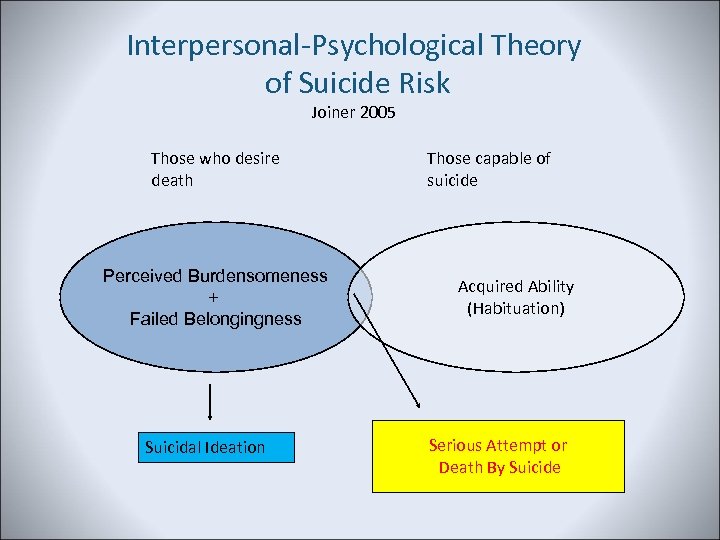 Interpersonal-Psychological Theory of Suicide Risk Joiner 2005 Those who desire death Perceived Burdensomeness + Failed Belongingness Suicidal Ideation Those capable of suicide Acquired Ability (Habituation) Serious Attempt or Death By Suicide
 Themes • Combat experiences were a setting for exposure to pain • It takes more to be hurt now than in the past • Increased tolerance for pain in conjunction with a variety of maladaptive coping strategies
 Pain • “I think that during the time that I was overseas I ah, kind of lost connection with reality and lost connection with my feelings…if you don’t have any emotions, then you are not scared or afraid either, which really helps you to get through the days in such a dangerous environment. ”
 Belongingness • Feeling disconnection from civilians and/or society in general • “I separate myself from society, that part of society. I don’t know how to deal with those people…. I just keep myself away. ”
![Findings – Belongingness • “That connection [to other veterans] never weakens. That’s the strange](https://present5.com/presentation/45ddebe86def451cd5f70c66111b98e0/image-58.jpg "Findings – Belongingness • “That connection [to other veterans] never weakens. That’s the strange") Findings – Belongingness • “That connection [to other veterans] never weakens. That’s the strange thing about it. I mean I may not communicate as much with active duty soldiers, soldiers from my unit…but every where I go, I run into vets. It’s just the way of life, and we talk about things we’ve done…”
Findings – Belongingness • “That connection [to other veterans] never weakens. That’s the strange thing about it. I mean I may not communicate as much with active duty soldiers, soldiers from my unit…but every where I go, I run into vets. It’s just the way of life, and we talk about things we’ve done…”
 Belongingness • Loss of sense of self post-discharge – This loss seemed to be exacerbated when separation from the military was not their choice • “They made me retire when I got back from this one, and it wasn't a choice…I still haven’t redefined who I am. ”
 Burdensomeness • Despite ambivalence - veterans reported feeling a sense of importance regarding their mission overseas relative to their civilian avocational and occupational activities • “I said I'm going to try and find something where I don't have to worry about hurting people. That would be nice for once in my life, but I don't know what that is. So I'm trying to redefine myself. ”
 Burdensomeness • “I feel like I am burden, 100%, I don’t feel like I belong anywhere … like if I'm out with some friends, I don't feel like I belong. Family, I'm the outsider. ”
 The International Classification of Functioning (ICF) • Disability – impairment in bodily function (e. g. , cognitive dysfunction) • Activity limitation – “…difficulties an individual may have in executing” a task or action (e. g. , not being able to drive) • Participation restriction – “…problems an individual may experience in involvement with life situations” (e. g. , not being able to work)
 The International Classification of Functioning (ICF) Model developed by the World Health Organization (WHO) Means of understanding factors that can impact how people live with TBI REGARDLESS OF INJURY SEVERITY
 Key Terms • Disability – impairment in bodily function (e. g. , cognitive dysfunction) • Activity limitation – “…difficulties an individual may have in executing” a task or action (e. g. , not being able to drive) • Participation restriction – “…problems an individual may experience in involvement with life situations” (e. g. , not being able to work)
 It is necessary to consider individual functioning and disability post-TBI in the context of personal and environmental factors of bat om of c tory nce His rie xpe e blic d pu tion e imit orta L nsp tra tory I his B e-T sion Pr es r dep ed s it Lim ial s oc ts por up
 TBI and Suicide Risk Assessment Strategy • Assess for – Acquired Ability – Burdensomeness – Failed Belongingness • In the context of – Disability – Activity limitation – Participation restriction
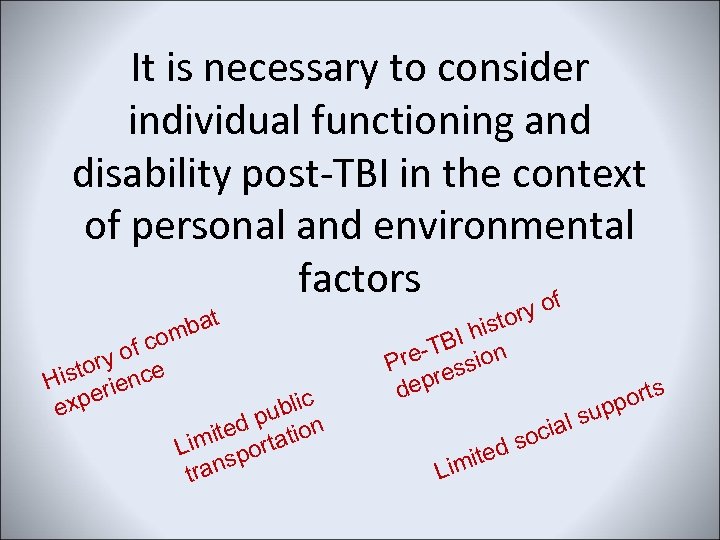
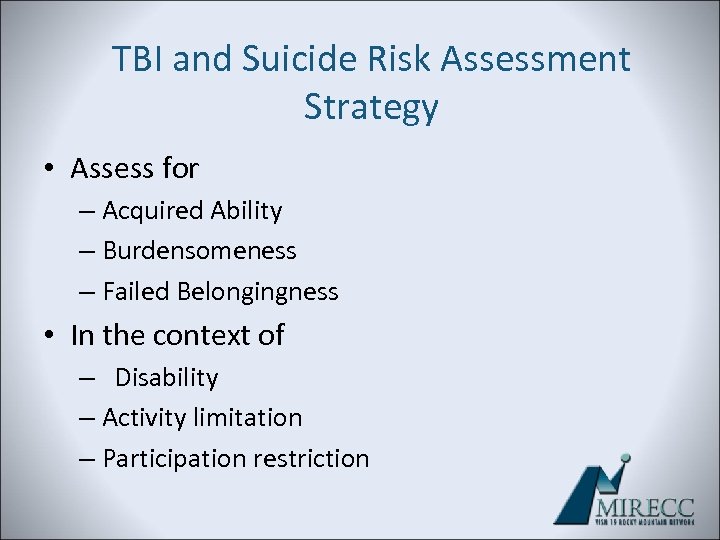
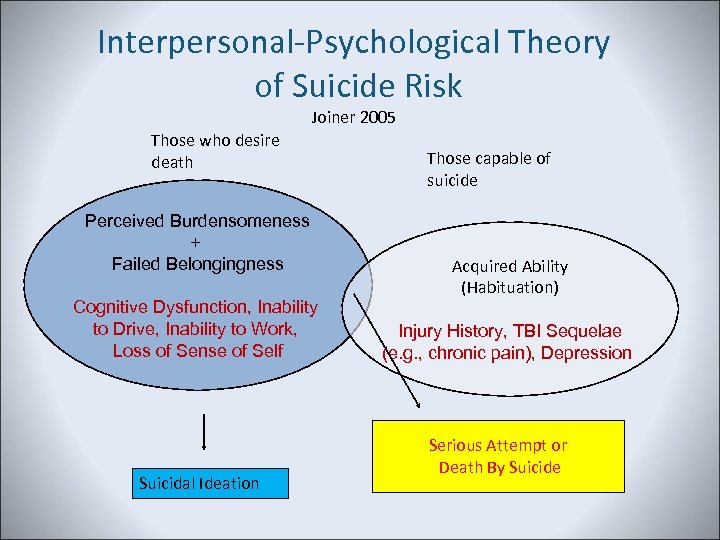 Interpersonal-Psychological Theory of Suicide Risk Joiner 2005 Those who desire death Perceived Burdensomeness + Failed Belongingness Cognitive Dysfunction, Inability to Drive, Inability to Work, Loss of Sense of Self Suicidal Ideation Those capable of suicide Acquired Ability (Habituation) Injury History, TBI Sequelae (e. g. , chronic pain), Depression Serious Attempt or Death By Suicide
 “Never worry alone” Gutheil 2002
 Clinical Consultation Services for Providers with Patients at Suicide Risk
 What is the consult service? • Interdisciplinary group of clinicians with expertise in suicide, treatment, and assessment – (e. g. , psychodiagnostic, neuropsychological) • Provides assistance with diagnostic and treatment conceptualization • Consultees – VA outpatient Mental Health Clinic and a psychiatric inpatient unit 70
 Fundamental Components • The larger system as context must be considered • Consultation is an inherently complex process involving a triadic relationship - client, consultee, and consultant • Ultimately, the consultant relationship is non-coercive – The consultee is free to accept or reject whatever the consultant says • Didactic element - helps consultees and clients function with an increased sense autonomy when similar situations arise in the future 71
 Components of a Consult • Medical record review • Clinical interview • Standardized psychological and neuropsychological measures – Self report measures of suicide-related constructs • Collateral data
 The consultant first reviews the case with the consultee and makes sure that the idea of the consult has been discussed with the veteran The consultant and client meet for an average of 8 -10 hours With outpatient consults this process may occur over the course of 4 -6 weeks 73
 Facilitating Communication • Preliminary findings discussed throughout the assessment – Progress note in the client's medical record at each appointment • Veteran is aware that this sharing will occur • Encourage consultees to remain active participants throughout the consultation process
 Risk and Protective Factors • Risk - historical events, psychopathology, personality structure, cognitive functioning, and current stressors • Protective factors - responses to treatment, available supports, and religious, spiritual, and cultural beliefs Early, 1992; Jobes & Mann, 1999; Malone et al. , 2000; Quinnett, 2000; Simpson & Tate, 2007 75
 Warning Signs and Safety Planning • Warning signs - the "earliest detectable sign that indicated heightened risk for suicide in the near term (i. e. , within minutes, hours, or days)" (Rudd et al 2006, p. 258) • Identified veteran specific warning signs discussed with clients and consultants -potentially imminent risk and facilitate safety planning (Stanley, Brown, Karlin, Kemp, & Von. Bergen, 2008) 76
 Feedback • Components – Psychodiagnostic information – Conceptualization of suicide risk – Treatment recommendations (therapy, meds) – Recommendations - systemic factors • Feedback meetings • Written report
 Process Issues for Veterans • Assessment can be activating to the client – Concept of self-discovery - the ability to organize and understand one’s life experiences - quite powerful – Normalize clients’ experience - talking openly, candidly, and non-judgmentally about suicidality COLLABORATION 78
 Termination • Addressed early in the consultation process • Revisited throughout • Facilitated by the ongoing message that consultant is the primary provider Brown et al. , 2001
 Lessons Learned • Maintaining good collaborative relationships with the mental health staff – Active involvement with mental health team meetings, complex case reviews, and morbidity and mortality conferences • Vital for the consultant provide recognition of the clinicians’ skills and efforts
 Lessons Learned • The “consultant-consultee” dyad embodies its own dynamics – requires respect for the complexity of this relationship and attention • Systemic challenges can also arise • Consultant’s responsibility to convey and manage the boundaries in the triad
 1 -800 -273 -8255
 “…talk to a professional. That's why you guys are here professionally trained to deal with people with my problem or problems like I have, you know…Left to myself, I'd probably kill myself. But that didn't feel right so I turned to professionals, you guys. “ - VA Patient/TBI Survivor
 Use Your Smartphone to Visit the VISN 19 MIRECC Website Requirements: 1. 2. Smartphone with a camera QR scanning software (available for free download just look at your phones marketplace) www. mirecc. va. gov/visn 19
 There is more work to be done! Thank you Lisa. Brenner@va. gov http: //www. mirecc. va. gov/visn 19/