


 Скачать презентацию Documentation Costs Avoided using Python and other Open
fd83cf8566aabb9ca963dc18ff748c13.ppt
- Количество слайдов: 20
 Documentation Costs Avoided using Python and other Open Standards Andrew Jonathan Fine Operating Systems Software Organization Engines, Systems, and Services Honeywell International
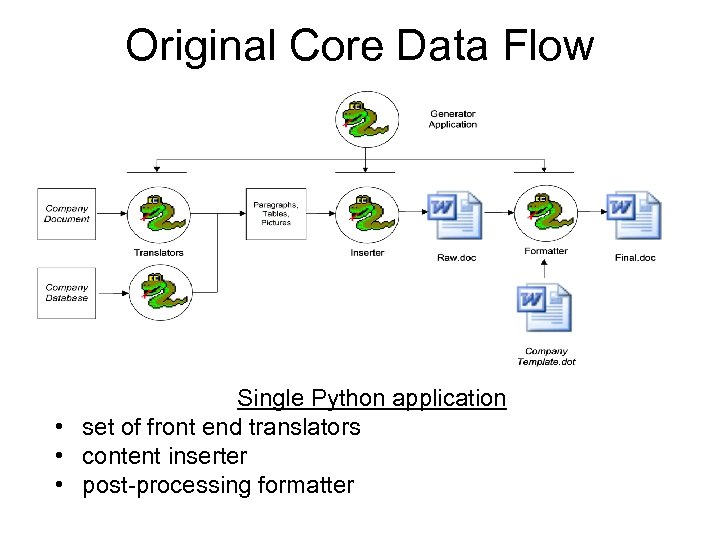 Original Core Data Flow Single Python application • set of front end translators • content inserter • post-processing formatter
 Front End Translator • Selected by caller • Caller specifies input file containing corporate data • Extracts components from file ü Pictures ü Tables ü Paragraphs • Saves to Python dictionary
 Inserter • Caller selects components from Python dictionaries made by front-ends for respective documents. • Inserter creates a Word document • Inserter uses Python/Com to insert components into document
 Back End Formatter • Scans corporate Word document template • Scans Word document made by inserter • Makes final style corrections.
 Why? The flow was designed to cope with changes in requirements! • • New projects New teams New data source formats New standards for existing formats
 First front-end translator Take pictures, tables, and data from a recursive property list constructed by an aerospace industry software visual programming tool called BEACON. (… actual design of translator outside the scope of this paper…)
 Initial Design of Inserter • Straightforward use of principles demonstrated by Mark Hammond's book, Python Programming in Win 32. • Chapter containing a thorough treatment of how to have Python use the Word 97 COM object model to create and manipulate a Word Document.
 Problems!!! • Must cope with huge amounts of corporate data such as table cells. . • Speed of COM interface for new individual elements. • Reuse issues for detailed typesetting of elements.
 What I wanted: • Faster conversion • Existing standard • Callable from Python What I found: • Faster conversion (Open. Jade) • Existing standard (Doc. Book SGML)
 Why Call from Python? • New scripting language to replace islands of automation (Perl, MSDOS, internal test stand controller language). • Easier to connect islands after writing in Python. • Open source thus continuously peer reviewed. • Tremendous user base! Plenty of wrappers written in Python around open source libraries supporting open standards. … so I wrote a Python wrapper around some Doc. Book rules …
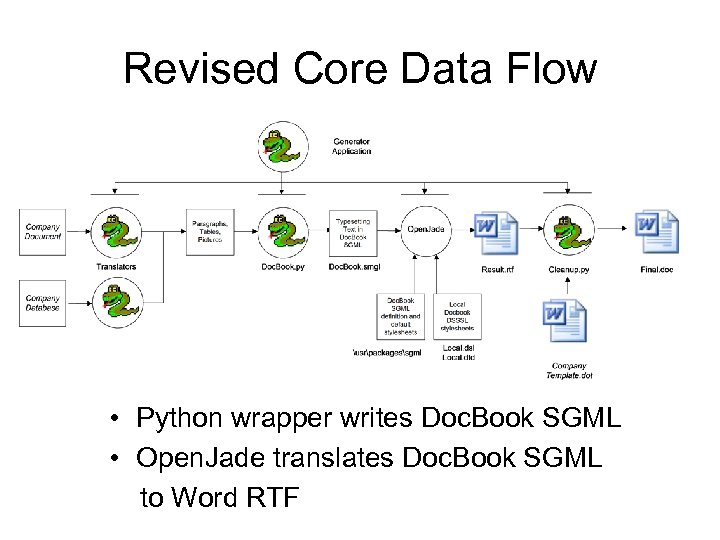 Revised Core Data Flow • Python wrapper writes Doc. Book SGML • Open. Jade translates Doc. Book SGML to Word RTF
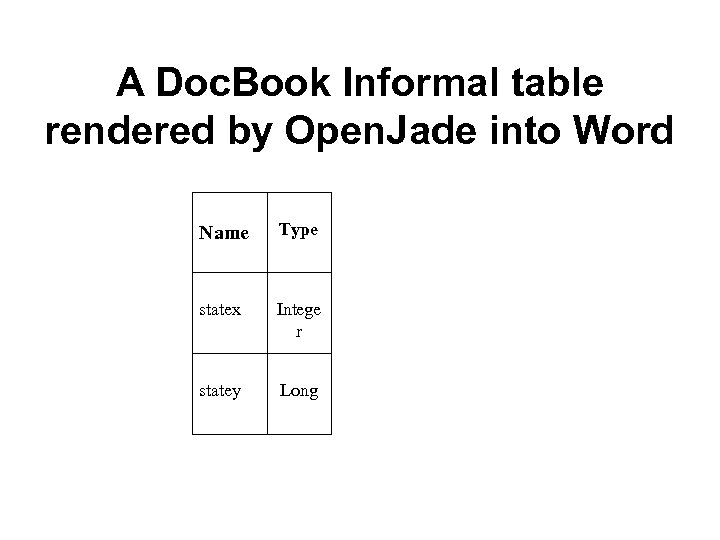 A Doc. Book Informal table rendered by Open. Jade into Word Name Type statex Intege r statey Long
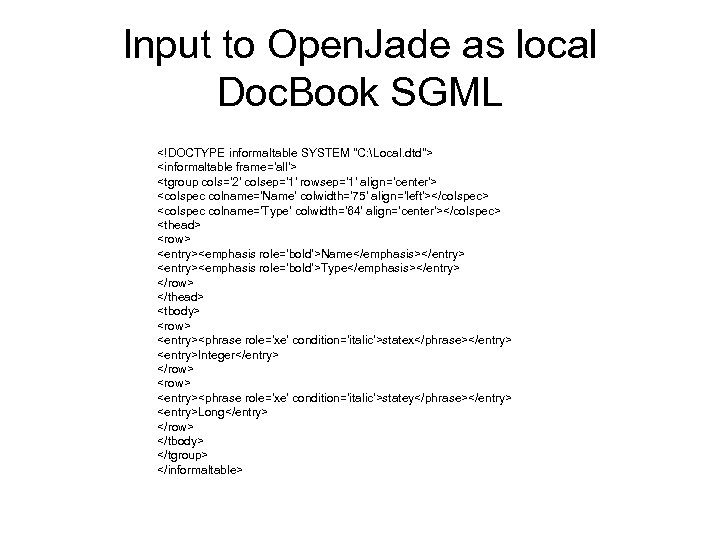 Input to Open. Jade as local Doc. Book SGML
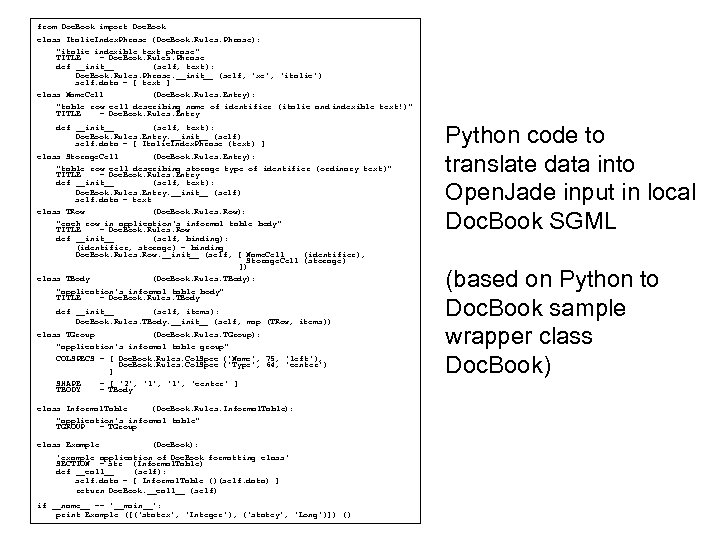 from Doc. Book import Doc. Book class Italic. Index. Phrase (Doc. Book. Rules. Phrase): "italic indexible text phrase" TITLE = Doc. Book. Rules. Phrase def __init__ (self, text): Doc. Book. Rules. Phrase. __init__ (self, 'xe', 'italic') self. data = [ text ] class Name. Cell (Doc. Book. Rules. Entry): "table row cell describing name of identifier (italic and indexible text!)" TITLE = Doc. Book. Rules. Entry def __init__ (self, text): Doc. Book. Rules. Entry. __init__ (self) self. data = [ Italic. Index. Phrase (text) ] class Storage. Cell (Doc. Book. Rules. Entry): "table row cell describing storage type of identifier (ordinary text)" TITLE = Doc. Book. Rules. Entry def __init__ (self, text): Doc. Book. Rules. Entry. __init__ (self) self. data = text class TRow (Doc. Book. Rules. Row): "each row in application's informal table body" TITLE = Doc. Book. Rules. Row def __init__ (self, binding): (identifier, storage) = binding Doc. Book. Rules. Row. __init__ (self, [ Name. Cell (identifier), Storage. Cell (storage) ]) class TBody (Doc. Book. Rules. TBody): "application's informal table body" TITLE = Doc. Book. Rules. TBody def __init__ (self, items): Doc. Book. Rules. TBody. __init__ (self, map (TRow, items)) class TGroup (Doc. Book. Rules. TGroup): "application's informal table group" COLSPECS = [ Doc. Book. Rules. Col. Spec ('Name', 75, 'left'), Doc. Book. Rules. Col. Spec ('Type', 64, 'center') ] SHAPE TBODY = [ '2', '1', 'center' ] = TBody class Informal. Table (Doc. Book. Rules. Informal. Table): "application's informal table" TGROUP = TGroup class Example (Doc. Book): 'example application of Doc. Book formatting class' SECTION = str (Informal. Table) def __call__ (self): self. data = [ Informal. Table ()(self. data) ] return Doc. Book. __call__ (self) if __name__ == '__main__': print Example ([('statex', 'Integer'), ('statey', 'Long')]) () Python code to translate data into Open. Jade input in local Doc. Book SGML (based on Python to Doc. Book sample wrapper class Doc. Book)
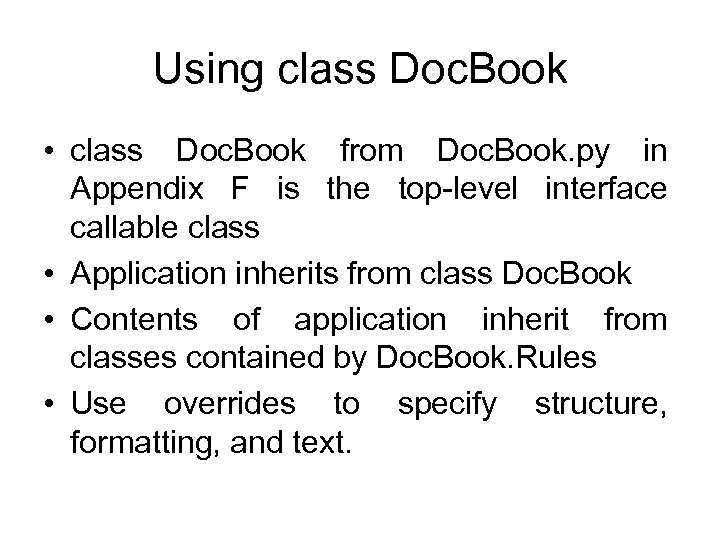 Using class Doc. Book • class Doc. Book from Doc. Book. py in Appendix F is the top-level interface callable class • Application inherits from class Doc. Book • Contents of application inherit from classes contained by Doc. Book. Rules • Use overrides to specify structure, formatting, and text.
 Open. Jade • Open. Jade is an open source DSSSL execution engine available from Source. Forge. • DSSSL is an ISO standard for typesetting specification and document conversion. • Open. Jade reads Doc. Book DSSSL stylesheets and our local DSSSL stylesheets if any. • The DSSSL is executed by Open. Jade upon SGML source text to write a final document for later loading into a word processor.
 Doc. Book Post-Processing using Word Automation with Python/COM • Doc. Book/Open. Jade emits RTF with different Word document style identifier names than in corporate Word DOT file. • Much faster to change document using Python/COM than to create document! • Cannibalized Python code from inserter first draft to create post-processor. • Reads RTF, changes, saves as final DOC.
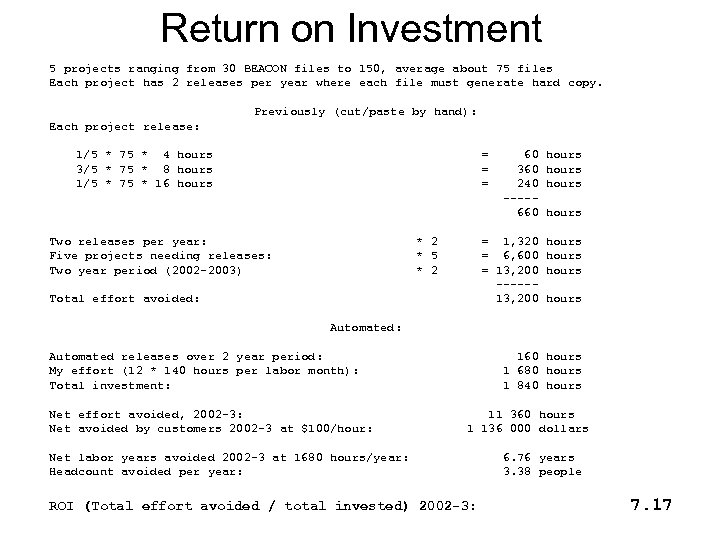 Return on Investment 5 projects ranging from 30 BEACON files to 150, average about 75 files Each project has 2 releases per year where each file must generate hard copy. Previously (cut/paste by hand): Each project release: 1/5 * 75 * 4 hours 3/5 * 75 * 8 hours 1/5 * 75 * 16 hours = = = Two releases per year: Five projects needing releases: Two year period (2002 -2003) Total effort avoided: hours = 1, 320 = 6, 600 = 13, 200 -----13, 200 * 2 * 5 * 2 60 360 240 ----660 hours hours Automated: Automated releases over 2 year period: My effort (12 * 140 hours per labor month): Total investment: Net effort avoided, 2002 -3: Net avoided by customers 2002 -3 at $100/hour: 160 hours 1 680 hours 1 840 hours 11 360 hours 1 136 000 dollars Net labor years avoided 2002 -3 at 1680 hours/year: Headcount avoided per year: ROI (Total effort avoided / total invested) 2002 -3: 6. 76 years 3. 38 people 7. 17
 Python and Doc. Book together • Python connects our department’s engineering specific islands of automation. • Python with Doc. Book created Word documents from engineering data. • The combination of an open language with an open standard eliminated a real-world business process bottleneck. • The return on investment was substantial.