


 Скачать презентацию Document No GSC 17 -PLEN-52 Source ETSI Contact
c6e4b8f165c63fd38f671909880d1b0a.ppt
- Количество слайдов: 28
 Document No: GSC 17 -PLEN-52 Source: ETSI Contact: Jonas Sundborg Sources: Beniamino Gorini, Chairman TC EE, Dominique Roche, Chairman TC ATTM Keith Dickerson, ETSI Board member GSC Session: PLEN Agenda Item: 6. 6 ICT and Environment (Green Agenda) Jonas Sundborg ETSI Board Chairman Jeju, 13 – 16 May 2013 Standards for Shared ICT
 GSC 17 -PLEN-52 Highlight of Current Activities • ETSI is currently focusing on the following standardization activities on “green” ICTs: – – – – Determination of energy efficiency Monitoring and controlling the energy efficiency Determination of energy management of ICT areas Monitoring the energy management of ICT areas Assessment of environmental impact Best practices to reduce power consumption General engineering of efficient ICT areas Promotion of electronic working tools GSC-17, Jeju / Korea 2 Standards for Shared ICT
 GSC 17 -PLEN-52 Highlight of Current Activities • Determination of energy efficiency – ETSI TC ”Environmental Engineering” (TCEE) is working on a set of publications on measurement methods of energy efficiency – Publications have already been done for: • • • Wireline broadband access equipment Wireless broadband access equipment Customer Premises Equipment (CPE) Core Network equipment Transport Equipment Switching and router equipment – Ongoing work is on Radio Access Networks GSC-17, Jeju / Korea 3 Standards for Shared ICT
 GSC 17 -PLEN-52 Highlight of Current Activities • Monitoring and controlling energy efficiency – ETSI TC-EE has developed a number of standards to monitor and control power consumption of ICT network and infrastructure equipment – Work is ongoing on an architectural interface that will give a flexible access to the power management capabilities of future energy aware telecommunications fixed network nodes GSC-17, Jeju / Korea 4 Standards for Shared ICT
 GSC 17 -PLEN-52 Highlight of Current Activities • Determination of energy management of ICT areas (Sites & Networks) – ETSI TC ATTM and TC EE have managed publications on • KPIs for Operational infrastructures: General Requirements • Energy efficiency KPIs for data centers • Energy efficiency KPIs for mobile access networks GSC-17, Jeju / Korea 5 Standards for Shared ICT
 GSC 17 -PLEN-52 Highlight of Current Activities • Monitoring of the energy management – ETSI ISG OEU (ICT Users) have managed the publication on • Defining global KPIs that will lead to reduction in energy consumption through improved energy management by means of a scale of “green” levels. • Providing referential specifications on “Green” ICT areas GSC-17, Jeju / Korea 6 Standards for Shared ICT
 GSC 17 -PLEN-52 Highlight of Current Activities • Assessment of environmental impact – ETSI TC-EE has published “Life Cycle Assessment” methodology of: • ICT equipment • ICT network • Services – This methodology was evaluated during the European Commission pilot tests – Ongoing work with ITU-T SG 5 to publish a common ETSI / ITU-T methodology GSC-17, Jeju / Korea 7 Standards for Shared ICT
 GSC 17 -PLEN-52 Highlight of Current Activities • Best practices to reduce power consumption – Guidelines have been published on: • Reduction of energy consumption in ICT equipment and infrastructures • Use of alternative energy sources in telecommunications installations • Alternative energy solutions (e. g. batteries) – Standards have been developed for: • Low Voltage DC power supply network for customer ICT devices with renewable energy and energy storage options • Power architecture with improved energy efficiency GSC-17, Jeju / Korea 8 Standards for Shared ICT
 GSC 17 -PLEN-52 Highlight of Current Activities • General engineering of efficient ICT areas – ETSI TC ”Access Terminals Transmission Multiplexing” (TC-ATTM) is working on a Series of publications on general engineering of efficient ICT areas – Publications have already been done and will be updated on: • Sites: data centre and operator site (transmission node) • Fixe access networks • Customer Premises networks – Ongoing work is on: • Mobile access networks • Core Networks GSC-17, Jeju / Korea 9 Standards for Shared ICT
 GSC 17 -PLEN-52 Strategic Direction • Technical standardization activity – Complete the set of deliverables for “green” ICTs to support: • “green” deployment of ICTs • EC mandates ( e. g. M/462 Energy efficiency of ICT, M/478 Green House Gas emissions, M/479 Energy audit, …) • Usage of ICT in other sectors in order to reduce the energy consumption (e. g. Smart Metering, Smart Grids, …) GSC-17, Jeju / Korea 10 Standards for Shared ICT
 GSC 17 -PLEN-52 Strategic Direction • Electronic Working Tools – Promotion of such tools in place of physical meetings – Continuous evaluation of electronic working tools with recommendations for their more effective use – Updating ETSI Special Report 002 959 • Extend ETSI’s coverage of ‘Mitigating Technologies’ – e. g. ITS, e. Health, Cloud, M 2 M, AFI, NFV GSC-17, Jeju / Korea 11 Standards for Shared ICT
 GSC 17 -PLEN-52 Challenges • To develop common worldwide methodologies in co-operation with other SDOs, e. g. : – ETSI & ITU-T methodology for Life Cycle Assessment of ICTs – ETSI, ITU-T, 3 GPP energy efficiency of wireless access networks – ISO/IEC/CENELEC/ETSI/ITU-T recommendations for Green Data Centers GSC-17, Jeju / Korea 12 Standards for Shared ICT
 GSC 17 -PLEN-52 Challenges • Extend the cooperation/collaboration with Research groups in the standardization of eco-environmental requirements – In progress co-operations: • EARTH(*) for the energy efficiency of radio base stations and networks (*) Energy Aware Radio and ne. Twork tec. Hnologies • ECONET (+) for the power management capabilities of future energy aware telecommunication fixed network nodes (+) low Energy COnsumption NETworks GSC-17, Jeju / Korea 13 Standards for Shared ICT
 GSC 17 -PLEN-52 Next Steps / Actions • Extend collaboration with other SDOs to develop common methodologies for “green” ICTs • Organize workshops on “green” ICTs to: – Share information on standardization initiatives and research projects – Receive feedback on application of published deliverables – Identify gaps ETSI Workshop on Environmental Impact Assessment and Energy Efficiency; 7 -8 October 2013, Athens – Greece http: //www. etsi. org/EEWORKSHOP GSC-17, Jeju / Korea 14 Standards for Shared ICT
 GSC 17 -PLEN-52 Supplementary Slides GSC-17, Jeju / Korea 15 Standards for Shared ICT
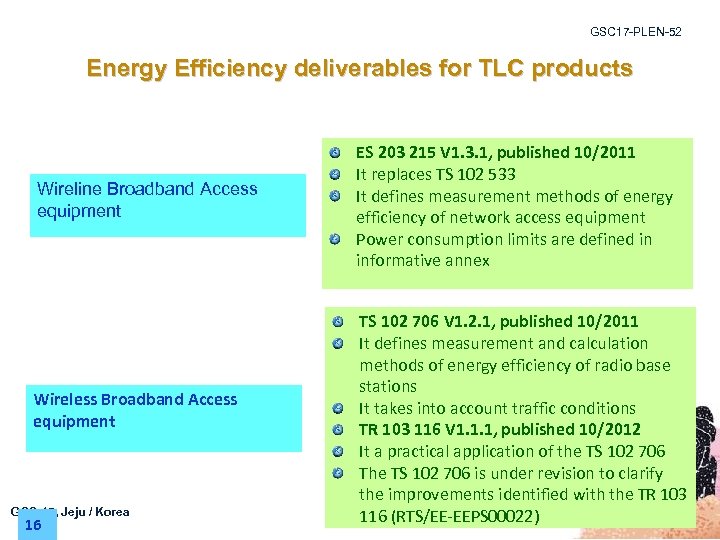 GSC 17 -PLEN-52 Energy Efficiency deliverables for TLC products Wireline Broadband Access equipment ES 203 215 V 1. 3. 1, published 10/2011 It replaces TS 102 533 It defines measurement methods of energy efficiency of network access equipment Power consumption limits are defined in informative annex Wireless Broadband Access equipment TS 102 706 V 1. 2. 1, published 10/2011 It defines measurement and calculation methods of energy efficiency of radio base stations It takes into account traffic conditions TR 103 116 V 1. 1. 1, published 10/2012 It a practical application of the TS 102 706 The TS 102 706 is under revision to clarify the improvements identified with the TR 103 116 (RTS/EE-EEPS 00022)Standards for Shared ICT GSC-17, Jeju / Korea 16
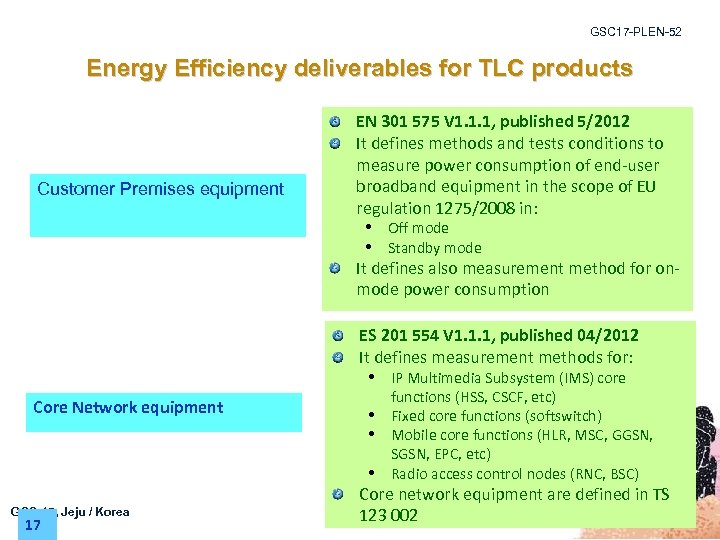 GSC 17 -PLEN-52 Energy Efficiency deliverables for TLC products Customer Premises equipment EN 301 575 V 1. 1. 1, published 5/2012 It defines methods and tests conditions to measure power consumption of end-user broadband equipment in the scope of EU regulation 1275/2008 in: • Off mode • Standby mode It defines also measurement method for onmode power consumption ES 201 554 V 1. 1. 1, published 04/2012 It defines measurement methods for: • IP Multimedia Subsystem (IMS) core Core Network equipment • • • GSC-17, Jeju / Korea 17 functions (HSS, CSCF, etc) Fixed core functions (softswitch) Mobile core functions (HLR, MSC, GGSN, SGSN, EPC, etc) Radio access control nodes (RNC, BSC) Core network equipment are defined in TS Standards for Shared ICT 123 002
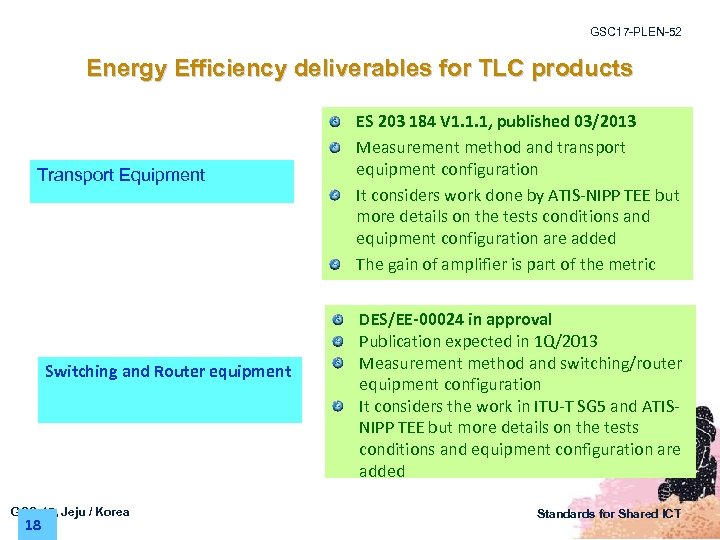 GSC 17 -PLEN-52 Energy Efficiency deliverables for TLC products Transport Equipment Switching and Router equipment GSC-17, Jeju / Korea 18 ES 203 184 V 1. 1. 1, published 03/2013 Measurement method and transport equipment configuration It considers work done by ATIS-NIPP TEE but more details on the tests conditions and equipment configuration are added The gain of amplifier is part of the metric DES/EE-00024 in approval Publication expected in 1 Q/2013 Measurement method and switching/router equipment configuration It considers the work in ITU-T SG 5 and ATISNIPP TEE but more details on the tests conditions and equipment configuration are added Standards for Shared ICT
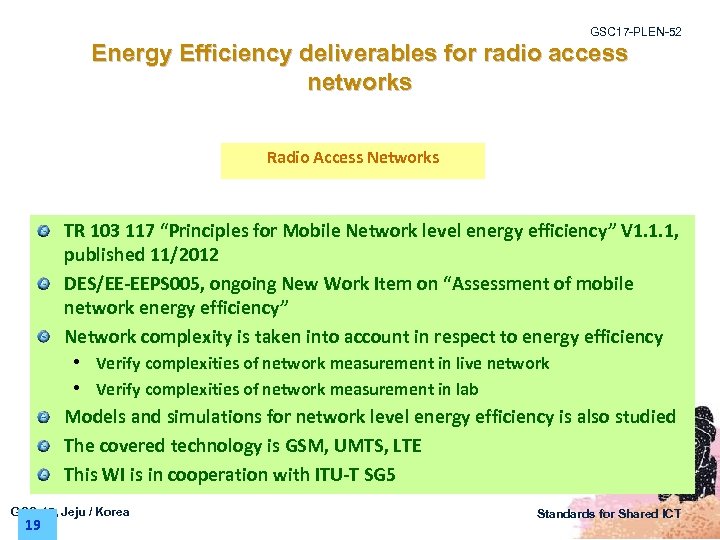 GSC 17 -PLEN-52 Energy Efficiency deliverables for radio access networks Radio Access Networks TR 103 117 “Principles for Mobile Network level energy efficiency” V 1. 1. 1, published 11/2012 DES/EE-EEPS 005, ongoing New Work Item on “Assessment of mobile network energy efficiency” Network complexity is taken into account in respect to energy efficiency • Verify complexities of network measurement in live network • Verify complexities of network measurement in lab Models and simulations for network level energy efficiency is also studied The covered technology is GSM, UMTS, LTE This WI is in cooperation with ITU-T SG 5 GSC-17, Jeju / Korea 19 Standards for Shared ICT
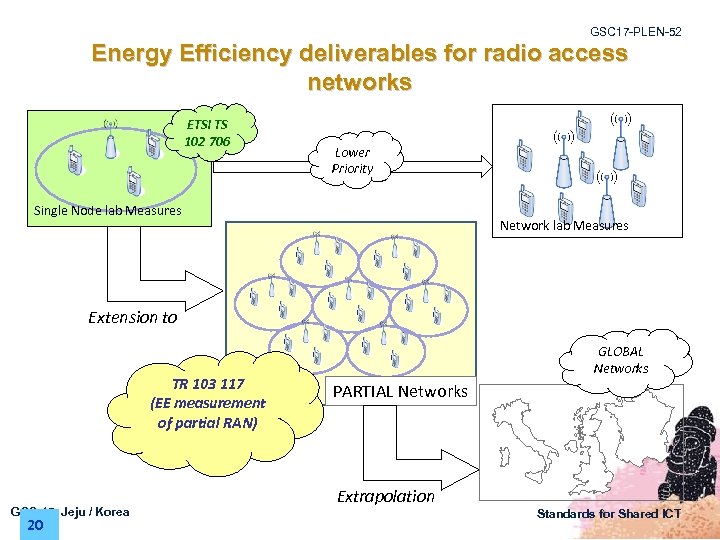 GSC 17 -PLEN-52 Energy Efficiency deliverables for radio access networks ETSI TS 102 706 Lower Priority Single Node lab Measures Network lab Measures Extension to TR 103 117 (EE measurement of partial RAN) GSC-17, Jeju / Korea 20 GLOBAL Networks PARTIAL Networks Extrapolation Standards for Shared ICT
 GSC 17 -PLEN-52 Environmental impact assessment deliverable Methods for assessing the environmental impact of ICTs TS 103 199 V 1. 1. 1 “Life Cycle Assessment of ICT equipment, ICT network and service: General definition and common requirement” Published (11/2011) The purpose of this TS is to: • harmonize the LCA of ICT: • Equipment • Networks • Services It includes specific requirements for LCA of ICTs in respect to: ISO 14040 Environmental management, Life cycle assessment, Principles and framework ISO 14044 Environmental management, Life cycle assessment, Requirements and guidelines International Reference Life Cycle Data System (ILCD) Handbook - GSC-17, Jeju / Korea Standards for Shared ICT General guide for Life Cycle Assessment 21
 GSC 17 -PLEN-52 Environmental impact assessment deliverable RES/EE-EEPS 006 New Work Item on the revision of TS 103 199 Life Cycle Assessment (LCA) TS 103 199 was evaluated during the European Commission pilot test During the pilot test, some questions have been raised that allowed to identify the strengths and weaknesses of the ETSI LCA document The identified weaknesses will be addressed in this revision of TS 103 199 Improvements will be: Provide more guidance for recycling allocation rules Clarification on how to assess the LCA uncertainty More guidance/clarifications on Network and Service LCAs Clarify applicability of annexes when only GHG emissions are assessed This Work Items will be managed in cooperation with ITU-T SG 5 GSC-17, Jeju / Korea 22 Standards for Shared ICT
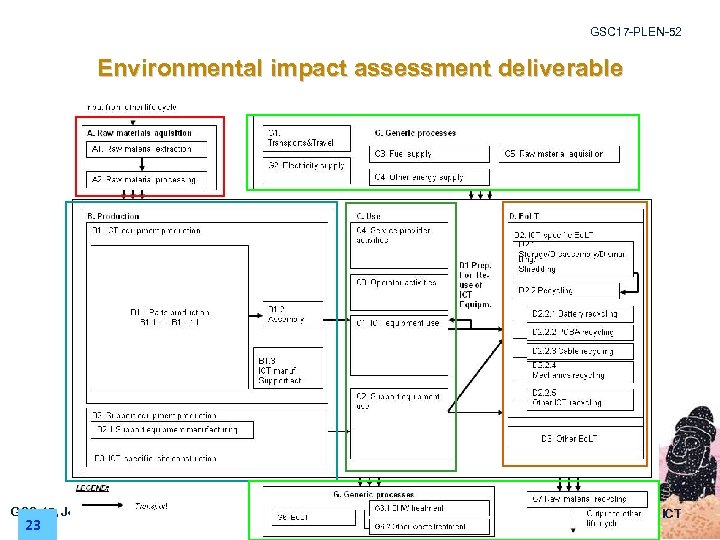 GSC 17 -PLEN-52 Environmental impact assessment deliverable GSC-17, Jeju / Korea 23 Standards for Shared ICT
 GSC 17 -PLEN-52 Energy Efficiency monitoring ES 202 336 -x: “Infrastructure equipment control and monitoring system interface” series 11 subparts for each specific interface/application • “ 1” General interface (V 1. 2. 1, 07/2011) • “ 2” DC power systems (V 1. 1. 1, 03/2009) • “ 3” AC-UPS power systems (V 1. 1. 1, 10/2009) • “ 4” AC distribution power system (V 1. 1. 1, 03/2013) • “ 5” AC-diesel backup generators (V 1. 1. 1, 04/2010) • “ 6” Air conditioning systems (V 1. 1. 1, 09/2012) • “ 7” Other utilities (V 1. 1. 1, 12/2009) • “ 8” Remote power feeding (V 1. 1. 1, 09/2009) • “ 9” Alternative power systems (V 1. 1. 1, 09/2012) • “ 10” AC inverter power system control (V 1. 1. 1, 09/2011) • “ 11” Battery systems (in preparation) Control processes defined in these publications reduce the energy consumption by optimizing equipment settings (e. g. cooling systems) Furthermore, the remote monitoring and setting reduce the CO 2 emissions GSC-17, Jeju / Korea Standards for Shared ICT (less on-site interventions) 24
 GSC 17 -PLEN-52 Energy Efficiency monitoring DES/EE-02048 New Work Item on “Monitoring and Control Interface for Telecom/ICT equipment Power, Energy and Environmental parameters” It will define the control/monitoring interface of telecommunication/ICT equipment to keep under control the power consumption and environmental values Parameters to be monitored are: power consumption environmental parameters (e. g. temperature) Traffic/data parameters (throughput, number of connected lines, radio setting, etc) GSC-17, Jeju / Korea 25 Standards for Shared ICT
 GSC 17 -PLEN-52 Energy Efficiency monitoring DES/EE-0030 New Work Item of “Green Abstraction Layer (GAL), power management capabilities of the future energy telecommunication fixed network nodes” This WI is in cooperation with EU project ECONET The Green Abstraction Layer (GAL) is an architectural interface that will give a flexible access to the power management capabilities of future energy aware telecommunication fixed network nodes It will allows the adapting of energy consumption of the network nodes with respect to the load variations. The WI will cover the definition of: the Green Abstraction Layer general architecture the interoperable interface between the Network Control Protocols and the power management capabilities of the fixed network devices the Energy States describing the different configurations and GSC-17, Jeju / Korea Standards for Shared corresponding performances with respect to energy consumptions ICT 26
 GSC 17 -PLEN-52 Energy Efficiency power architecture Power supply interface requirements for products to be connected to: • direct current source up to 400 V: EN 300 132 -3 -1, V 2. 1. 1 (02 -2012) • alternating current source up to 400 V: EN 300 132 -3 -2 (to start) • rectified current source up to 400 V: EN 300 132 -3 -3 (to start) Energy efficiency of this power architecture up to 400 V is greater than the classical 48 V-DC solution It is a power distribution, with backup, suitable to supply all type of equipment in a data center without using UPS or AC/DC converters at 48 V The EN 300 132 -3 series define the requirements for the power supply interface of the equipment to be connected to such power architecture (nominal voltage, abnormal service voltage, inrush current, etc. ) EN 301 605 V 1. 1. 1 “Earthing and bonding of 400 VDC data and telecom (ICT) equipment” In approval process, closing date: 11 May 2013 GSC-17, Jeju / Korea Standards for Shared ICT 27
 GSC 17 -PLEN-52 GUIDELINES FOR IMPROVEMENT OF ENERGY EFFICIENCY AND ALTERNATIVE ENERGY SOURCES TR 102 530 V 1. 2. 1 (07/2011): “The reduction of energy consumption in telecommunications equipment and related infrastructure” TR 102 532 V 1. 2. 1 (11/2012): “The use of alternative energy sources in telecommunication installations” • It includes an overview of the alternative energy sources and • • guidelines for its use (both for powering and cooling) Disposal of waste materials LCA analysis related to alternative energy solutions (e. g. batteries) DTR/EE-02042 (in progress): “Safety Extra Low Voltage DC power supply network for customer ICT devices with renewable energy and energy storage options” • Improved efficiency with less conversion stages • Reduction of CO 2 emissions using renewable energy options GSC-17, Jeju / Korea 28 Standards for Shared ICT