


 Скачать презентацию Document No GSC 14 18_014 Source ETSI Contact Adrian Scrase
15e3b9ddb202180f3014c7a63e12734c.ppt
- Количество слайдов: 24
 Document No: GSC(14)18_014 Source: ETSI Contact: Adrian Scrase Agenda Item: 7. 7 ETSI ACTIVITIES ON CRITICAL COMMUNICATIONS Adrian Scrase, ETSI GSC-18 Meeting, 22 -23 July 2014, Sophia Antipolis, France
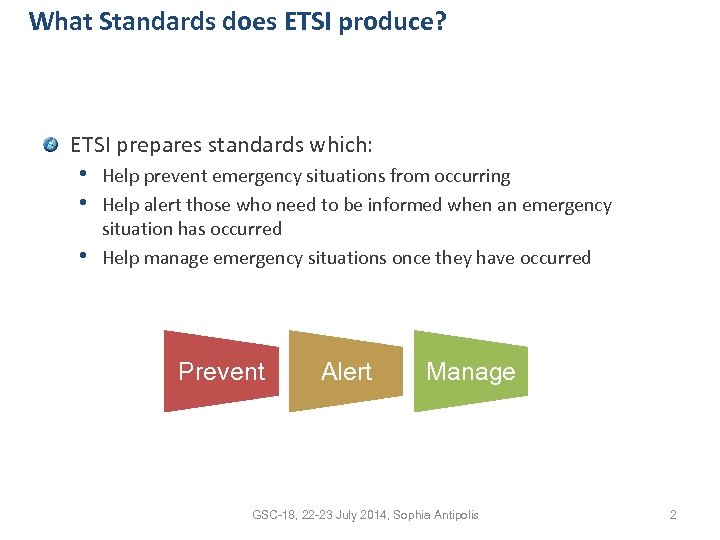 What Standards does ETSI produce? ETSI prepares standards which: • Help prevent emergency situations from occurring • Help alert those who need to be informed when an emergency • situation has occurred Help manage emergency situations once they have occurred Prevent Alert Manage GSC-18, 22 -23 July 2014, Sophia Antipolis 2
 PREVENTING EMERGENCY SITUATIONS Prevent Alert Manage GSC-18, 22 -23 JULY 2014, SOPHIA ANTIPOLIS 3
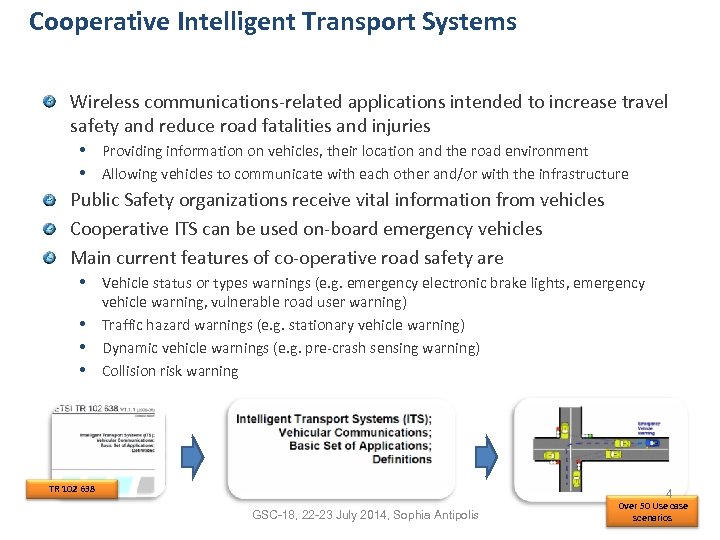 Cooperative Intelligent Transport Systems Wireless communications-related applications intended to increase travel safety and reduce road fatalities and injuries • Providing information on vehicles, their location and the road environment • Allowing vehicles to communicate with each other and/or with the infrastructure Public Safety organizations receive vital information from vehicles Cooperative ITS can be used on-board emergency vehicles Main current features of co-operative road safety are • Vehicle status or types warnings (e. g. emergency electronic brake lights, emergency • • • vehicle warning, vulnerable road user warning) Traffic hazard warnings (e. g. stationary vehicle warning) Dynamic vehicle warnings (e. g. pre-crash sensing warning) Collision risk warning TR 102 638 4 GSC-18, 22 -23 July 2014, Sophia Antipolis Over 50 Use case scenarios
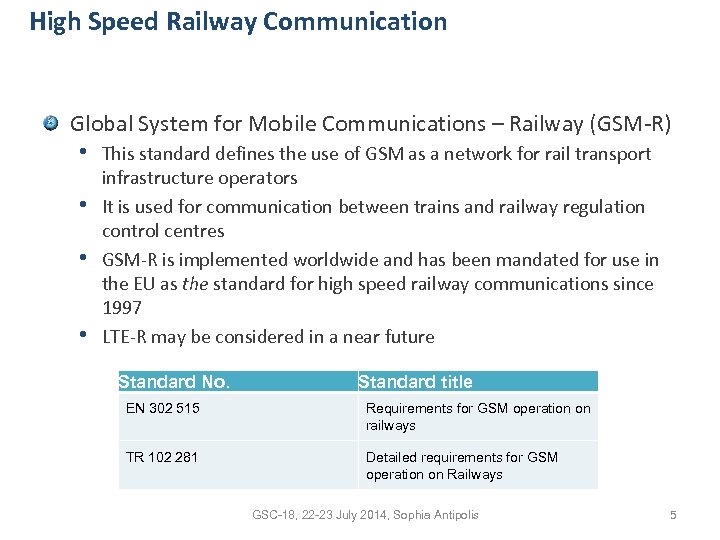 High Speed Railway Communication Global System for Mobile Communications – Railway (GSM-R) • This standard defines the use of GSM as a network for rail transport • • • infrastructure operators It is used for communication between trains and railway regulation control centres GSM-R is implemented worldwide and has been mandated for use in the EU as the standard for high speed railway communications since 1997 LTE-R may be considered in a near future Standard No. Standard title EN 302 515 Requirements for GSM operation on railways TR 102 281 Detailed requirements for GSM operation on Railways GSC-18, 22 -23 July 2014, Sophia Antipolis 5
 ALERTING IN CASE OF EMERGENCY Prevent Alert Manage GSC-18, 22 -23 JULY 2014, SOPHIA ANTIPOLIS 6
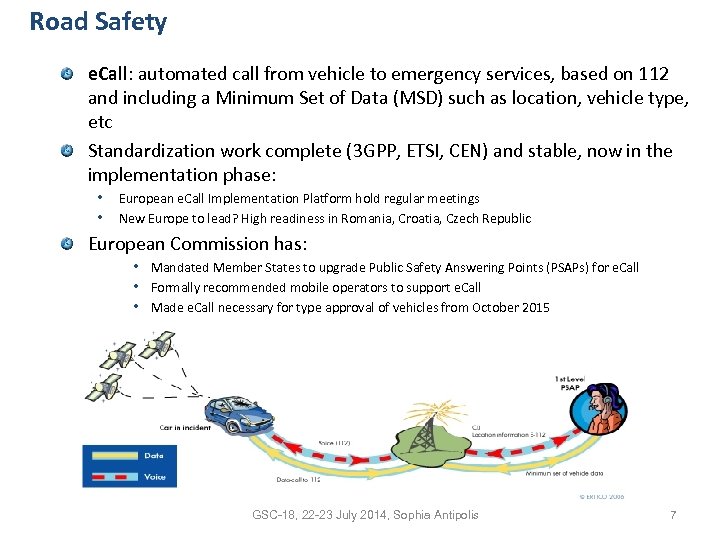 Road Safety e. Call: automated call from vehicle to emergency services, based on 112 and including a Minimum Set of Data (MSD) such as location, vehicle type, etc Standardization work complete (3 GPP, ETSI, CEN) and stable, now in the implementation phase: • European e. Call Implementation Platform hold regular meetings • New Europe to lead? High readiness in Romania, Croatia, Czech Republic European Commission has: • Mandated Member States to upgrade Public Safety Answering Points (PSAPs) for e. Call • Formally recommended mobile operators to support e. Call • Made e. Call necessary for type approval of vehicles from October 2015 GSC-18, 22 -23 July 2014, Sophia Antipolis 7
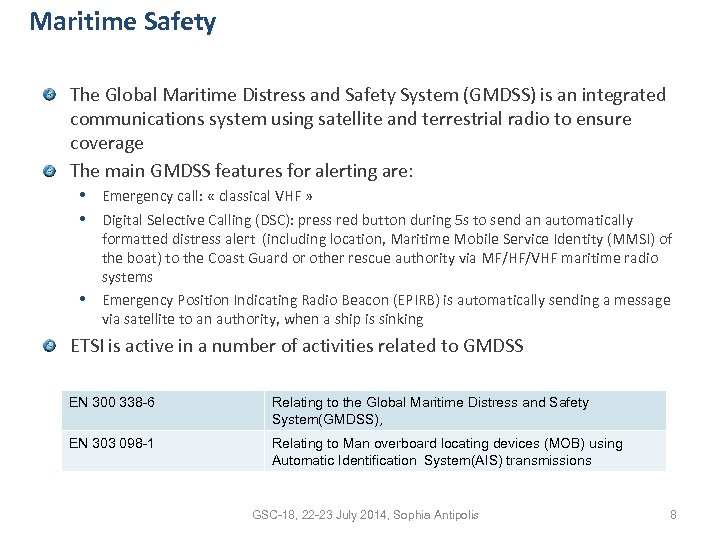 Maritime Safety The Global Maritime Distress and Safety System (GMDSS) is an integrated communications system using satellite and terrestrial radio to ensure coverage The main GMDSS features for alerting are: • Emergency call: « classical VHF » • Digital Selective Calling (DSC): press red button during 5 s to send an automatically • formatted distress alert (including location, Maritime Mobile Service Identity (MMSI) of the boat) to the Coast Guard or other rescue authority via MF/HF/VHF maritime radio systems Emergency Position Indicating Radio Beacon (EPIRB) is automatically sending a message via satellite to an authority, when a ship is sinking ETSI is active in a number of activities related to GMDSS EN 300 338 -6 Relating to the Global Maritime Distress and Safety System(GMDSS), EN 303 098 -1 Relating to Man overboard locating devices (MOB) using Automatic Identification System(AIS) transmissions GSC-18, 22 -23 July 2014, Sophia Antipolis 8
 Non-voice Emergency Communications People with disabilities need to successfully access emergency services ETSI has produced a specification on “Total Conversation” whereby emergency services authorities may be alerted using video and real-time text in addition to audio (TS 101 470) SMS for emergency calls • Delivery inconsistencies and delays are a factor • May lead to an increase in hoax calls • A number of European countries have implemented SMS for hearing impaired • people, but under a pre-registration scheme The future of SMS emergency calls in Europe is at present uncertain GSC-18, 22 -23 July 2014, Sophia Antipolis 9
 Enhanced Caller Location For emergency calls using traditional networks (fixed or mobile) the caller location information is readily available. This is not the case for Vo. IP services (such as Skype). ETSI is responding to the European Mandate (M/493) in support of the location enhanced emergency call service • The aim of the mandate is to standardize the determination and transport of caller • location information for Vo. IP including a single functional model, the necessary interfaces and protocols This includes routing of the emergency call to the most appropriate PSAP and transmission of the location information of the caller Work is underway • A functional architecture (e. g. identification of all interfaces) to determine the • standardization work needed has been produced (ES 203 178) The definition of protocols, based on the previous deliverable, has started (ES 203 283) GSC-18, 22 -23 July 2014, Sophia Antipolis 10
 Public Warning Systems The Public Warning System (PWS) is an emergency service that delivers alert messages to mobile devices using the Cell Broadcast Service (CBS) PWS was first defined to cope with natural disasters such as Earthquakes and Tsunamis It has now been generalized to cover other emergency situations Cell Broadcast uses a dedicated signalling channel, different to that used for voice/data, and therefore not affected by network congestion The European implementation is called EU-Alert GSC-18, 22 -23 July 2014, Sophia Antipolis 11
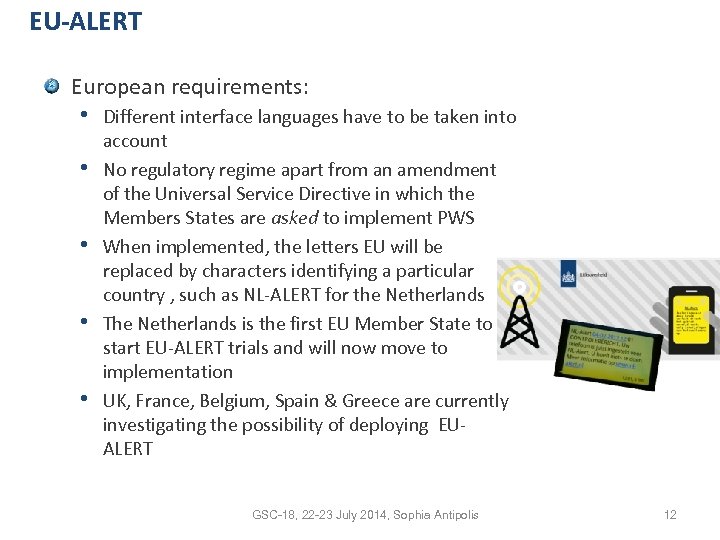 EU-ALERT European requirements: • Different interface languages have to be taken into • • account No regulatory regime apart from an amendment of the Universal Service Directive in which the Members States are asked to implement PWS When implemented, the letters EU will be replaced by characters identifying a particular country , such as NL-ALERT for the Netherlands The Netherlands is the first EU Member State to start EU-ALERT trials and will now move to implementation UK, France, Belgium, Spain & Greece are currently investigating the possibility of deploying EUALERT GSC-18, 22 -23 July 2014, Sophia Antipolis 12
 MANAGING EMERGENCY SITUATIONS Prevent Alert Manage GSC-18, 22 -23 JULY 2014, SOPHIA ANTIPOLIS 13
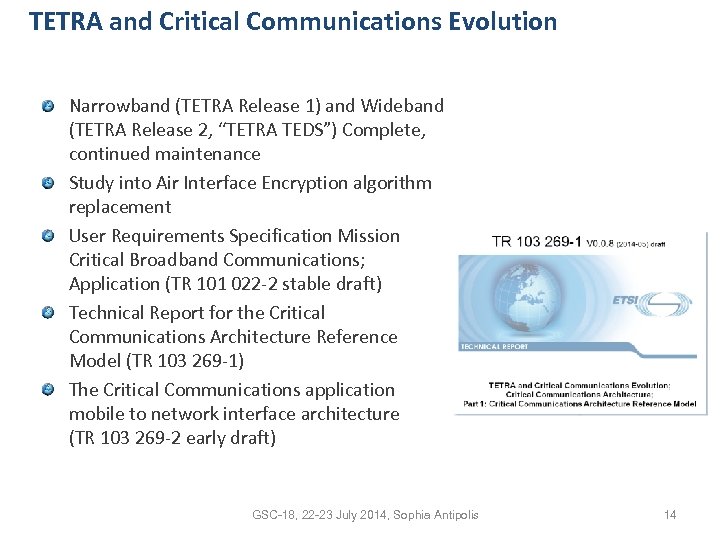 TETRA and Critical Communications Evolution Narrowband (TETRA Release 1) and Wideband (TETRA Release 2, “TETRA TEDS”) Complete, continued maintenance Study into Air Interface Encryption algorithm replacement User Requirements Specification Mission Critical Broadband Communications; Application (TR 101 022 -2 stable draft) Technical Report for the Critical Communications Architecture Reference Model (TR 103 269 -1) The Critical Communications application mobile to network interface architecture (TR 103 269 -2 early draft) GSC-18, 22 -23 July 2014, Sophia Antipolis 14
 Digital Mobile Radio (DMR) is a technology standardized by ETSI and divided into three tiers: • Tier 1: License-exempt: direct mode, no infrastructure for consumers, and • • short range professionals Tier 2: Licensed conventional: direct mode including infrastructure for business applications Tier 3: Licensed trunked: for public safety and mission critical users DMR was intended as a direct replacement of analogue PMR • It started with DMO but now also includes trunking capabilities • Further work needed to ensure interoperability GSC-18, 22 -23 July 2014, Sophia Antipolis 15
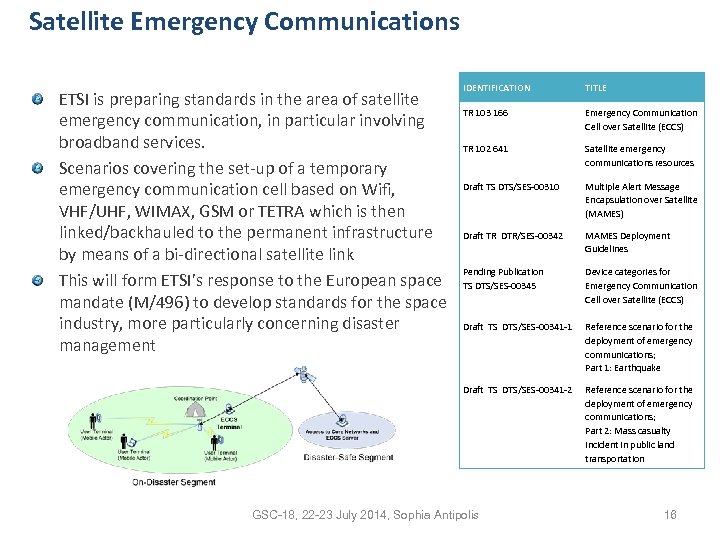 Satellite Emergency Communications TITLE TR 103 166 Emergency Communication Cell over Satellite (ECCS) TR 102 641 Satellite emergency communications resources Draft TS DTS/SES-00310 Multiple Alert Message Encapsulation over Satellite (MAMES) Draft TR DTR/SES-00342 MAMES Deployment Guidelines Pending Publication TS DTS/SES-00345 Device categories for Emergency Communication Cell over Satellite (ECCS) Draft TS DTS/SES-00341 -1 Reference scenario for the deployment of emergency communications; Part 1: Earthquake Draft TS DTS/SES-00341 -2 ETSI is preparing standards in the area of satellite emergency communication, in particular involving broadband services. Scenarios covering the set-up of a temporary emergency communication cell based on Wifi, VHF/UHF, WIMAX, GSM or TETRA which is then linked/backhauled to the permanent infrastructure by means of a bi-directional satellite link This will form ETSI’s response to the European space mandate (M/496) to develop standards for the space industry, more particularly concerning disaster management IDENTIFICATION Reference scenario for the deployment of emergency communications; Part 2: Mass casualty incident in public land transportation GSC-18, 22 -23 July 2014, Sophia Antipolis 16
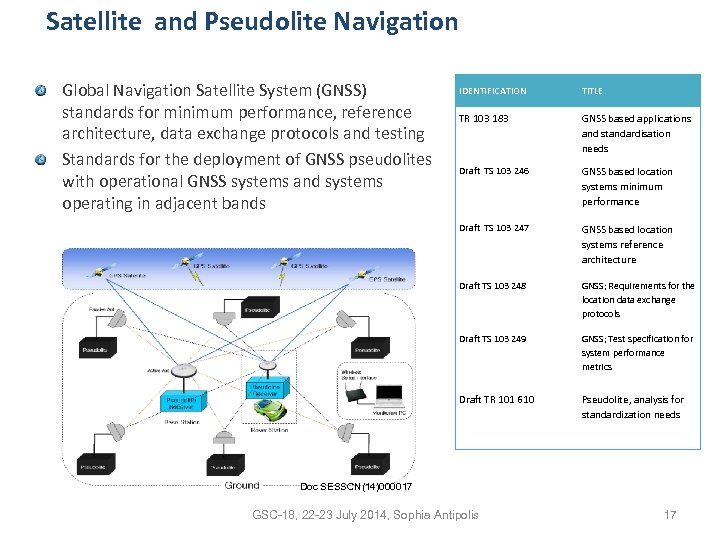 Satellite and Pseudolite Navigation Global Navigation Satellite System (GNSS) standards for minimum performance, reference architecture, data exchange protocols and testing Standards for the deployment of GNSS pseudolites with operational GNSS systems and systems operating in adjacent bands IDENTIFICATION TITLE TR 103 183 GNSS based applications and standardisation needs Draft TS 103 246 GNSS based location systems minimum performance Draft TS 103 247 GNSS based location systems reference architecture Draft TS 103 248 GNSS; Requirements for the location data exchange protocols Draft TS 103 249 GNSS; Test specification for system performance metrics Draft TR 101 610 Pseudolite, analysis for standardization needs Doc SESSCN(14)000017 GSC-18, 22 -23 July 2014, Sophia Antipolis 17
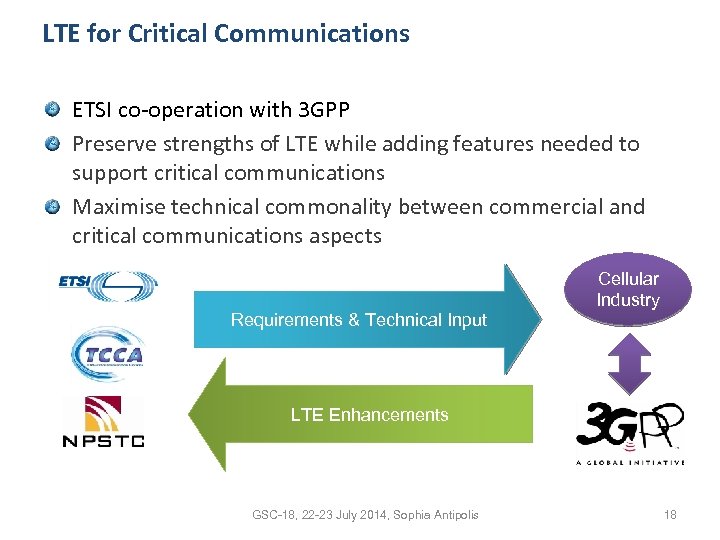 LTE for Critical Communications ETSI co-operation with 3 GPP Preserve strengths of LTE while adding features needed to support critical communications Maximise technical commonality between commercial and critical communications aspects Requirements & Technical Input Cellular Industry LTE Enhancements GSC-18, 22 -23 July 2014, Sophia Antipolis 18
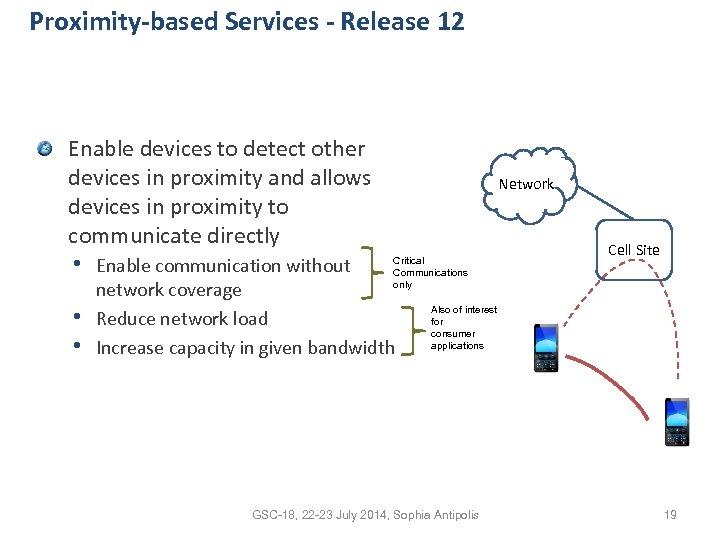 Proximity-based Services - Release 12 Enable devices to detect other devices in proximity and allows devices in proximity to communicate directly • Enable communication without • • Network Critical Communications only network coverage Reduce network load Increase capacity in given bandwidth Cell Site Also of interest for consumer applications GSC-18, 22 -23 July 2014, Sophia Antipolis 19
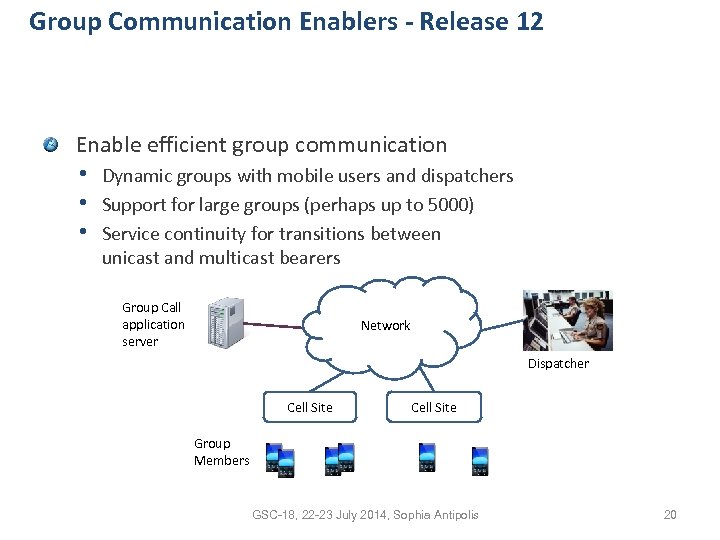 Group Communication Enablers - Release 12 Enable efficient group communication • Dynamic groups with mobile users and dispatchers • Support for large groups (perhaps up to 5000) • Service continuity for transitions between unicast and multicast bearers Group Call application server Network Dispatcher Cell Site Group Members GSC-18, 22 -23 July 2014, Sophia Antipolis 20
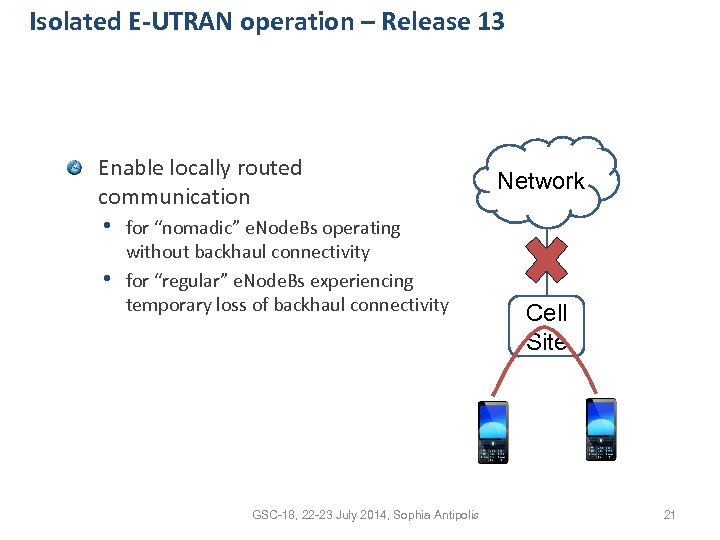 Isolated E-UTRAN operation – Release 13 Enable locally routed communication • for “nomadic” e. Node. Bs operating • without backhaul connectivity for “regular” e. Node. Bs experiencing temporary loss of backhaul connectivity GSC-18, 22 -23 July 2014, Sophia Antipolis Network Cell Site 21
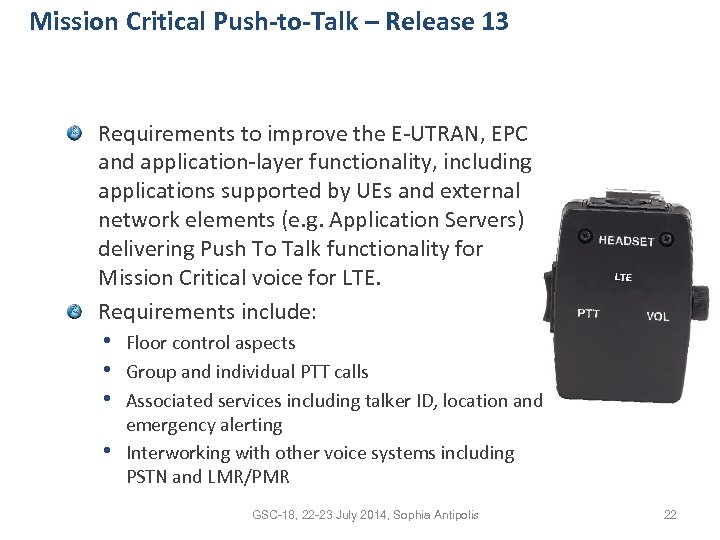 Mission Critical Push-to-Talk – Release 13 Requirements to improve the E-UTRAN, EPC and application-layer functionality, including applications supported by UEs and external network elements (e. g. Application Servers) delivering Push To Talk functionality for Mission Critical voice for LTE. Requirements include: • Floor control aspects • Group and individual PTT calls • Associated services including talker ID, location and • emergency alerting Interworking with other voice systems including PSTN and LMR/PMR GSC-18, 22 -23 July 2014, Sophia Antipolis 22
 Conclusions The standardization of Critical Communication systems is essential… …and so is the participation of the wider Critical Communications community in preparing those standards Better knowledge sharing and collaboration is required between all stakeholders Global solutions offer significant economy of scale advantages Intelligent use of modern ICT technologies will help save lives But, Prevention is always better than cure…. . GSC-18, 22 -23 July 2014, Sophia Antipolis 23
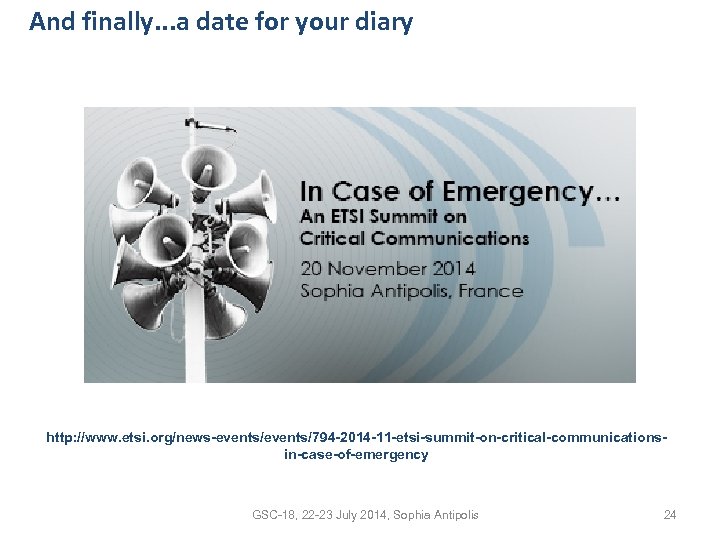 And finally. . . a date for your diary http: //www. etsi. org/news-events/794 -2014 -11 -etsi-summit-on-critical-communicationsin-case-of-emergency GSC-18, 22 -23 July 2014, Sophia Antipolis 24