 Скачать презентацию Document Development WOCN Society Phyllis Bonham Ph D
d9f0c26889808f0a4b6ee03aed39baaf.ppt
- Количество слайдов: 33



Document Development WOCN® Society Phyllis Bonham, Ph. D, MSN, RN, CWOCN, DPNAP, FAAN Clinical Editor-at-Large
Introduction Welcome Purpose of call • Review WOCN® Society document development by committees/task forces • Review new role for Society: Clinical Editor -at-Large Background
Author/Society Responsibilities Authors & Society have an obligation to provide current & accurate info to members & adhere to best practices in publications. It is the responsibility of the author(s) to adhere to ethical & legal standards for publishing including: ethical conduct of research, avoiding conflict of interest/bias in publication, & citing references & obtaining permission for using materials from other sources to avoid plagiarism or copyright violations (APA, 2010).
Document Development Guideline for Developing WOCN Society Documents Available in the Policy & Procedure Manual (WOCN, 2012) and as a separate document in Members Only library, Other WOCN Documents Section at https: //wocn. siteym. com/? page=My. Library Defines types documents Provides templates & flow charts for development & review
Types of Documents Most common documents include: Fact sheets, white papers, position papers, evidence-based clinical practice guidelines, some manuals Key differences • Focus/purpose • Source of content • Type of review
Types of Document: Differences Ø Focus-Purpose • Goal to provide general info/education/position (i. e. , fact sheets, white paper, position paper, CE) • Goal to provide research/evidencebased, clinical practice guidelines & recommendations
Types of Documents: Differences Ø Source of content • Expert opinion • Ex: Does not have sufficient research (i. e. , Ostomy Best Practice ) • Research/Evidence–based • Ex: Developed from exhaustive systematic lit review, grades each research study & rates each level of evidence for recommendations (i. e. , LEND, LEVD, LEAD, Pressure Ulcer)
Types of Documents: Differences Ø Type review • Peer review • All documents are peer reviewed • Content validation: A special type of peer review, coordinated by CCI for docs that do not have a research/evidence base (best practice) • Doc undergoes multiple rounds of review by panel of experts to reach consensus on the content (See Appendix J. a, WOCN Society P & P Manual, WOCN, 2012)
New Document: Quick Reference Guide Ø Compilation of information about common practice for specific WOC topic/procedure to meet need/gap • Uses research & published expert opinion • Does not use a structured/extensive or “systematic review” that grades research & rates levels of evidence for recommendations • Peer reviewed • Ex: ABI Quick Reference Guide
How to Start? Ø Determine purpose/aim of document • Determine the origin of request or need? – Members’ educational needs survey, board request, strategic plan, update existing document? • Determine format: Print, web, CEC ? Ø Type of document? • Review the document guide • Discuss with Dr. B if questions
How to Start? Ø Approach like writing any paper for publication Ø Develop a content outline of the key topics Ø What do WOC nurses need to know (i. e. , gaps/needs)? • Avoid duplicating existing resources/text • Must know vs. nice to know • If topic unfamiliar, conduct prelim lit review to determine what key areas to include
How to Start? Divide up the work (topics/questions) • Seek individuals with access to electronic data-bases for literature search • Facility medical/physician’s library, university/college library, etc. Ø Determine a coordinator/lead person Ø Start search for the information: topics/questions Ø
Literature Search Whether new publication or an update, conduct a search for current literature ! Ø Data bases: Pub. Med, MEDLINE, CINAHL, Cochrane Library • PUb. Med access free; CINAHL access with ANA membership • Pay Per view-submit cost to Society Ø JWOCN, NGCH, core texts Ø Check WOCN guidelines & documents for relevance/consistency with topic (e. g. , position papers, Scope & Standards etc. ) Ø
Literature Search Ø Use current information • 5 -6 years unless is the sentinel or only research available, or a classic/important historical reference • Use the primary source of research studies (not taken from another source/review article) • Briefly describe study: author, type/focus of study, date, sample size (N), results
Literature Search • • Use peer-reviewed literature that is published in journals/books that are retrievable & have an author & date Avoid web pages & sites without authors or dates – Questionable sources, questionable quality/integrity of information. – Web pages change & often not retrievable – APA (2010) recommends if web page no longer retrievable, update or omit
Citing References Ø Cite sources • Conveys best practice, insures quality of information/evidence, supports answers to CE questions (need reliable/valid sources) • Gives source so reader can follow up, access resources: Readers do check with authors/Society • Even if paraphrase, acknowledge source: Check APA for quotes etc. • Legal protection from plagiarism/selfplagiarism, copyright infringement
Citing References Ø Citations for Power. Point Slides • Cite source within text on slides for research findings, facts, figures, statistics, unusual/new information • Reference list at end of slides • Need citations from current, reliable sources to substantiate answers to CE test questions • Note: Test questions should derive from objectives
Permissions-Copyright Release Ø Note: Permissions required from copyright holder to use/adapt tables, diagrams, figures, photos, large amounts of info from an article, including some web materials Ø Sample permission form in Society’s Document Development Guide (pg. 23, Appendix J. b). Ø Author(s): Start early to request permissions -or can significantly delay review & publication.
Seeking Permissions Ø Many publishers have online request sites • Need specific info: full citation article (author, title, source, date; page number title of table or figure) • Might be a fee to reprint/use • If unable to get permission to use/reprint or is cost prohibitive, omit or determine if can incorporate into text & cite source
WOCN Society Uses APA Reference Style for Documents American Psychological Association (2010). Washington, DC: Author Examples/sources APA Publication Manual of the American Psychological Association (6 th ed. ). • http: //owl. english. purdue. edu/owl/resource/589 /01/ • APA Examples in WOCN Society Document Development Guide (WOCN, 2012)
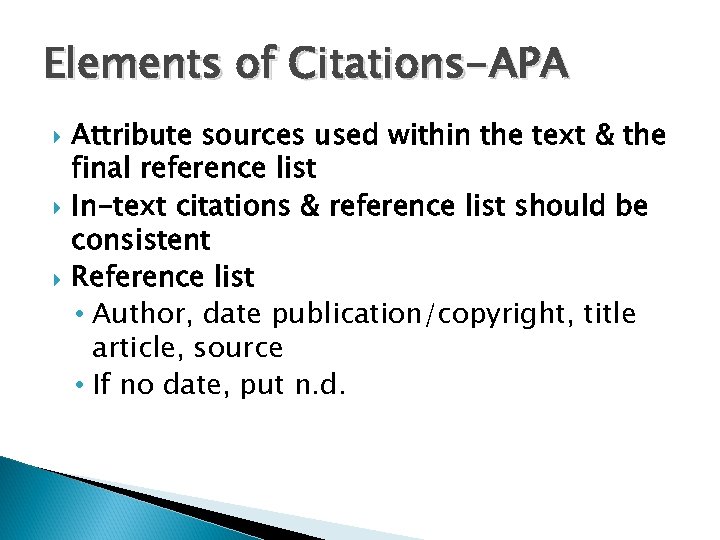
Elements of Citations-APA Attribute sources used within the text & the final reference list In-text citations & reference list should be consistent Reference list • Author, date publication/copyright, title article, source • If no date, put n. d.
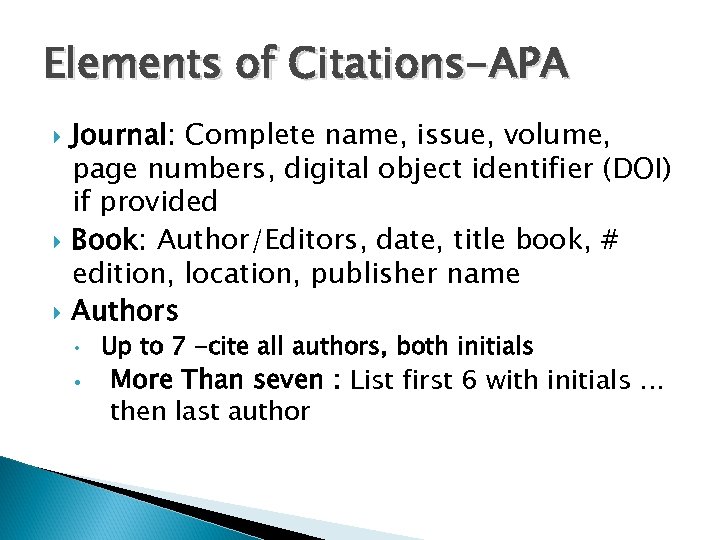
Elements of Citations-APA Journal: Complete name, issue, volume, page numbers, digital object identifier (DOI) if provided Book: Author/Editors, date, title book, # edition, location, publisher name Authors • • Up to 7 -cite all authors, both initials More Than seven : List first 6 with initials … then last author
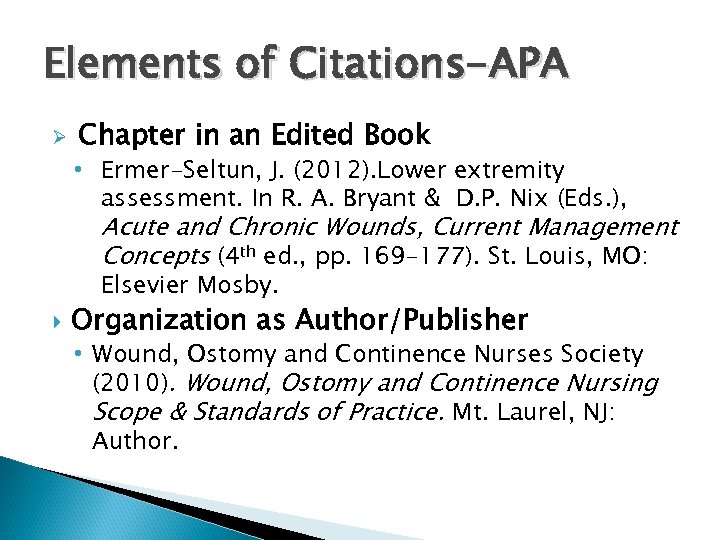
Elements of Citations-APA Ø Chapter in an Edited Book • Ermer-Seltun, J. (2012). Lower extremity assessment. In R. A. Bryant & D. P. Nix (Eds. ), Acute and Chronic Wounds, Current Management Concepts (4 th ed. , pp. 169 -177). St. Louis, MO: Elsevier Mosby. Organization as Author/Publisher • Wound, Ostomy and Continence Nurses Society (2010). Wound, Ostomy and Continence Nursing Scope & Standards of Practice. Mt. Laurel, NJ: Author.
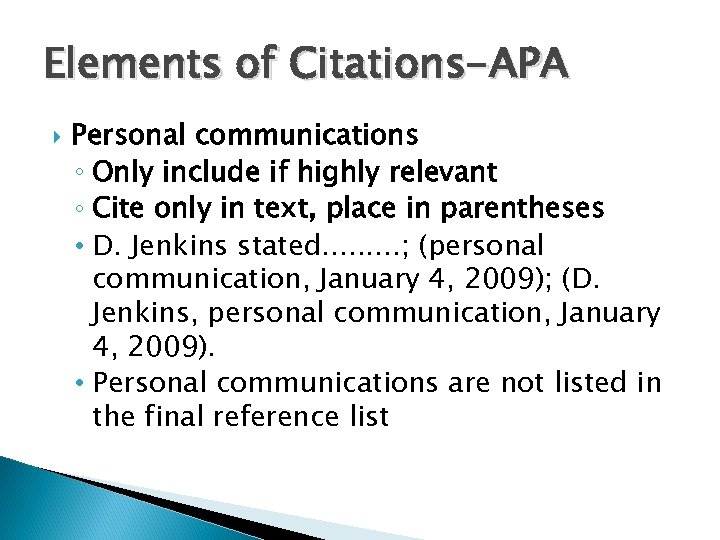
Elements of Citations-APA Personal communications ◦ Only include if highly relevant ◦ Cite only in text, place in parentheses • D. Jenkins stated. . ; (personal communication, January 4, 2009); (D. Jenkins, personal communication, January 4, 2009). • Personal communications are not listed in the final reference list
Elements of Citations-APA Ø Proceedings meetings/symposia • Published, cite same as a periodical Ø Oral/Poster Presentations ØPresenter (year, mo), title of poster or paper. Presented at the meeting of Organization(name), location Ø Other unpublished materials-check APA
Online References Ø Online articles: author, title, date, site • If go to a site & link to another page on the site—give precise URL • Include digital object identifier (DOI) • Use retrieval date if likely to change • Ex: Purdue Writing Lab. (n. d. ). Fact sheet. Retrieved November 2012, from http: //owl. english. purdue. edu/writinglab/factsheet Ø CHECK THE URL!
Missing Pieces: APA sources If there are missing pieces, include all the available information, move information into the previous space. APA source on missing pieces • http: //blog. apastyle. org/apastyle/2012/0 5/missing-pieces. html • http: //blog. apastyle. org/files/missingpieces---apa-style-reference-table. pdf
Final Touches & Submission for Review Organize content for clarity-flow • Introduction? Headings? Conclusion Check references (citations in text & reference list should be consistent) Document Submission Guide/Checklist: • Developed for tracking/completeness of info • Name group, key contact, title/type document, dates of development, suggestions for peer reviewers, expected final format, copyright disclaimer (permissions, etc. )
Role Clinical Editor-at-Large Responsibilities • Work with committees, task forces, & Society National Office staff in document development • Available for pre-planning, questions re: format, process, issues, etc. • Review/edit documents prior to peer review, content validation, Board review, & final publication
Role Clinical Editor-at-Large Assess/Assist • 6 Cs: Clarity, cohesion, coherence, composition, currency & consistency • Check: Content’s accuracy, consistency with current Society materials & other literature • Readability: Organization, grammar (voice), spelling, style • Work with National Office staff to validate references, copyright permissions, format
Future Areas Review/update Document Development Guide as needed Continue to refine the process for updating/developing/reviewing documents ◦ Are there ways to streamline? Assess process for establishing priorities for updates, archives, & development of new documents
The End Thanks to each of you for your contributions & efforts to develop & maintain a high caliber of resources & educational materials to support our members & the WOC specialty nursing practice Mega thanks to Chrissy and Becky!!! Questions/Comments
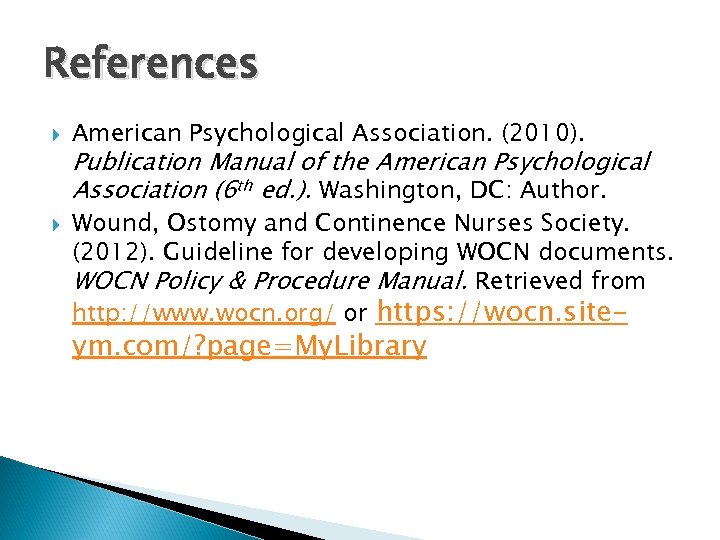
References American Psychological Association. (2010). Publication Manual of the American Psychological Association (6 th ed. ). Washington, DC: Author. Wound, Ostomy and Continence Nurses Society. (2012). Guideline for developing WOCN documents. WOCN Policy & Procedure Manual. Retrieved from http: //www. wocn. org/ or https: //wocn. site- ym. com/? page=My. Library
Скачать презентацию Document Development WOCN Society Phyllis Bonham Ph D
d9f0c26889808f0a4b6ee03aed39baaf.ppt