


 Скачать презентацию DOCSIS 3 0 from a test and measurement
bcc94f61747ef32129abb86f10b65646.ppt
- Количество слайдов: 45
 DOCSIS 3. 0 from a test and measurement point of view Randy Francis Cable Networks Division
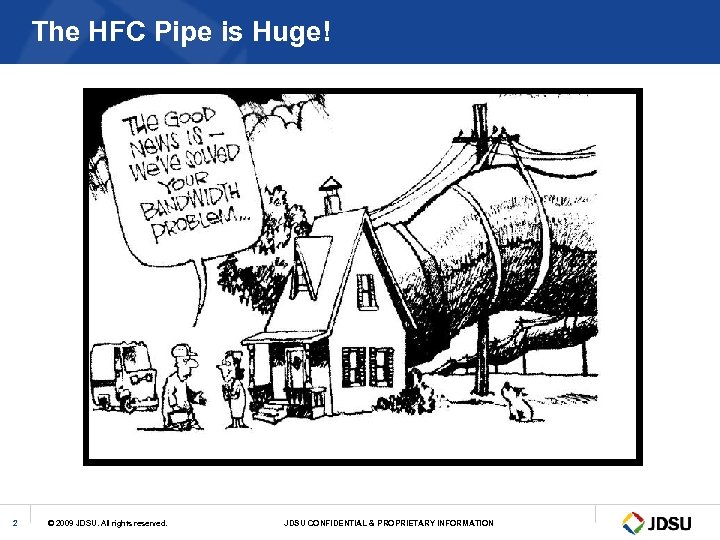 The HFC Pipe is Huge! 2 © 2009 JDSU. All rights reserved. JDSU CONFIDENTIAL & PROPRIETARY INFORMATION
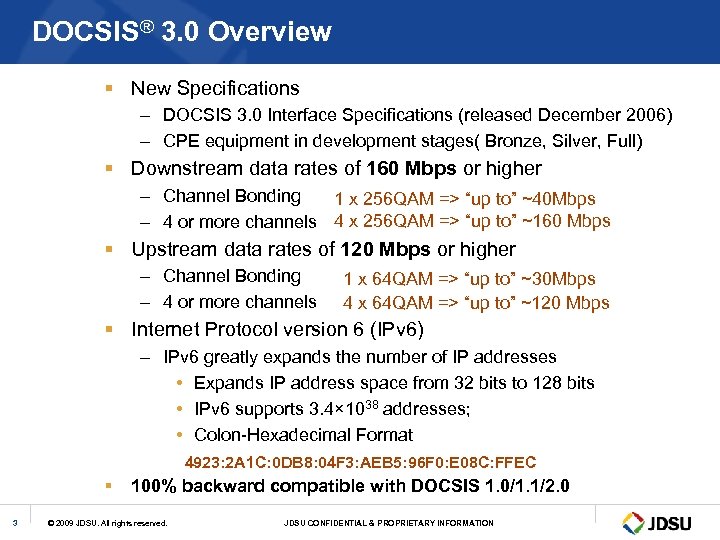 DOCSIS® 3. 0 Overview § New Specifications – DOCSIS 3. 0 Interface Specifications (released December 2006) – CPE equipment in development stages( Bronze, Silver, Full) § Downstream data rates of 160 Mbps or higher – Channel Bonding 1 x 256 QAM => “up to” ~40 Mbps – 4 or more channels 4 x 256 QAM => “up to” ~160 Mbps § Upstream data rates of 120 Mbps or higher – Channel Bonding – 4 or more channels 1 x 64 QAM => “up to” ~30 Mbps 4 x 64 QAM => “up to” ~120 Mbps § Internet Protocol version 6 (IPv 6) – IPv 6 greatly expands the number of IP addresses • Expands IP address space from 32 bits to 128 bits • IPv 6 supports 3. 4× 1038 addresses; • Colon-Hexadecimal Format 4923: 2 A 1 C: 0 DB 8: 04 F 3: AEB 5: 96 F 0: E 08 C: FFEC § 3 100% backward compatible with DOCSIS 1. 0/1. 1/2. 0 © 2009 JDSU. All rights reserved. JDSU CONFIDENTIAL & PROPRIETARY INFORMATION
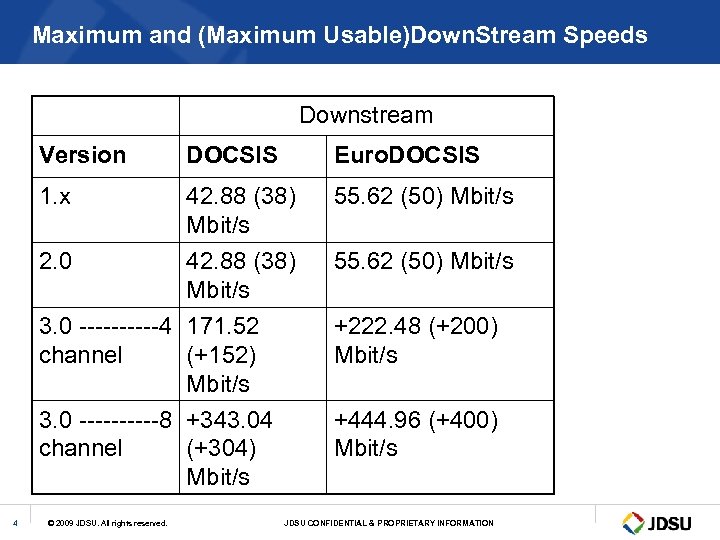 Maximum and (Maximum Usable)Down. Stream Speeds Downstream Version DOCSIS Euro. DOCSIS 1. x 42. 88 (38) Mbit/s 55. 62 (50) Mbit/s 42. 88 (38) Mbit/s 3. 0 -----4 171. 52 channel (+152) Mbit/s 55. 62 (50) Mbit/s 3. 0 -----8 +343. 04 channel (+304) Mbit/s +444. 96 (+400) Mbit/s 2. 0 4 © 2009 JDSU. All rights reserved. +222. 48 (+200) Mbit/s JDSU CONFIDENTIAL & PROPRIETARY INFORMATION
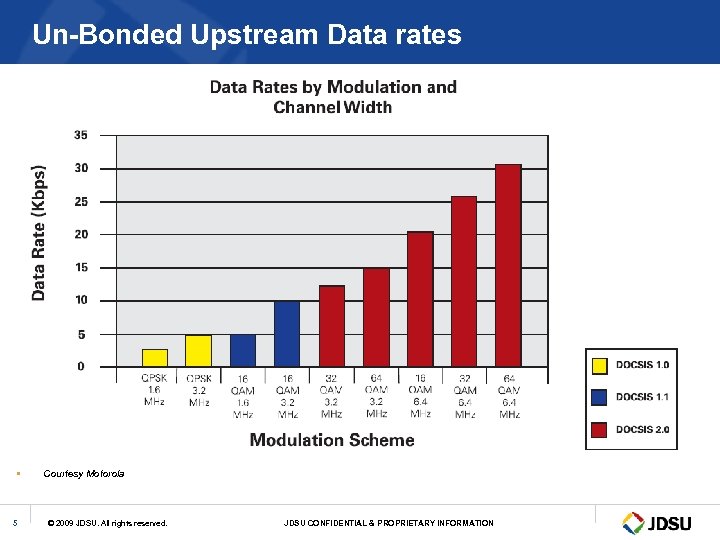 Un-Bonded Upstream Data rates § 5 Courtesy Motorola © 2009 JDSU. All rights reserved. JDSU CONFIDENTIAL & PROPRIETARY INFORMATION
 Channel Requirements § Combines down and upstream channels for added performance • “Technically” could support 10 bonded down streams. • Plans are currently for 4 DS and up to 4 u/s channels to be bonded – Do not have to be adjacent to each other – but must be within 60 MHz. » “Bonded” in data layer – not Physical layer » Each DS channel remains a 6 MHz 256 QAM » A DOCSIS 3. 0 QAM can be a Primary or Secondary » Primaries carry all info needed for a CM to register » Secondary's do not have registration data – only payload » ALL down streams can be provisioned as primaries but there MUST be at least 1 primary. – Possible combinations of u/s and d/s – 2 x 1, 2 x 2, 3 x 1, 3 x 2, 3 x 3, 4 x 1, 4 x 2, 4 x 3, 4 x 4 – Each provides its own performance capability - and is scalable. 6 © 2009 JDSU. All rights reserved. JDSU CONFIDENTIAL & PROPRIETARY INFORMATION
 Security § DOCSIS 1. 0 had BPI ( Baseline Privacy Interface) – Did not hardware authenticate Cable Modems § DOCSIS 1. 1 and 2. 0 have BPI+ – Digital Certificate based security – No more spoofing MAC addresses § DOCSIS 3. 0 adds more enhancements – and the specification is now named “Security”, or BPI/SEC § BPI/SEC encrypts data flows between the CPE and the CMTS – BPI/BPI+ use 56 bit encryption – SEC uses 128 bit encryption 7 © 2009 JDSU. All rights reserved. JDSU CONFIDENTIAL & PROPRIETARY INFORMATION
 Pre-Equalization taps Better performance under adverse plant enviroment § Docsis 1. 1 has 8 tap u/s eq § DOCSIS 2. 0/3. 0 uses u/s 24 tap eq § Configured in response to the CMTS ranging request ( RNG-RSP) § CMTS says give me a taste – CM responds with a burst § CMTS analyzes response of the burst – and instructs CM on how to configure its EQ taps ( Equalizer Coefficients) 8 © 2009 JDSU. All rights reserved. JDSU CONFIDENTIAL & PROPRIETARY INFORMATION
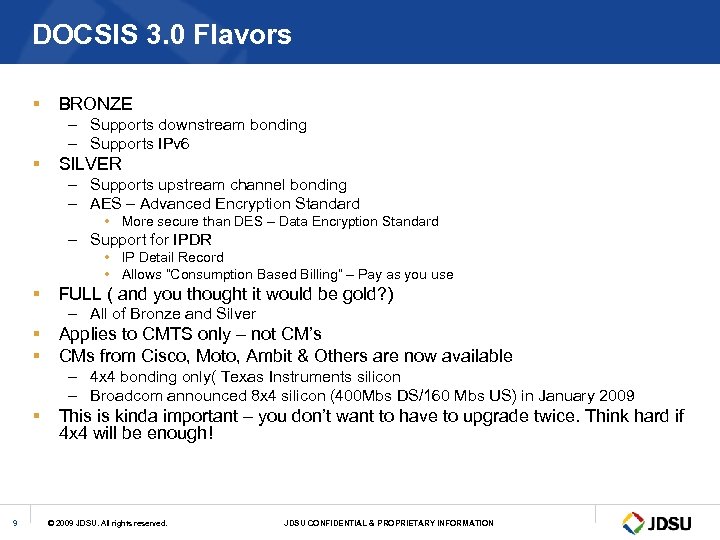 DOCSIS 3. 0 Flavors § BRONZE – Supports downstream bonding – Supports IPv 6 § SILVER – Supports upstream channel bonding – AES – Advanced Encryption Standard • More secure than DES – Data Encryption Standard – Support for IPDR • IP Detail Record • Allows “Consumption Based Billing” – Pay as you use § FULL ( and you thought it would be gold? ) – All of Bronze and Silver § § Applies to CMTS only – not CM’s CMs from Cisco, Moto, Ambit & Others are now available – 4 x 4 bonding only( Texas Instruments silicon – Broadcom announced 8 x 4 silicon (400 Mbs DS/160 Mbs US) in January 2009 § 9 This is kinda important – you don’t want to have to upgrade twice. Think hard if 4 x 4 will be enough! © 2009 JDSU. All rights reserved. JDSU CONFIDENTIAL & PROPRIETARY INFORMATION
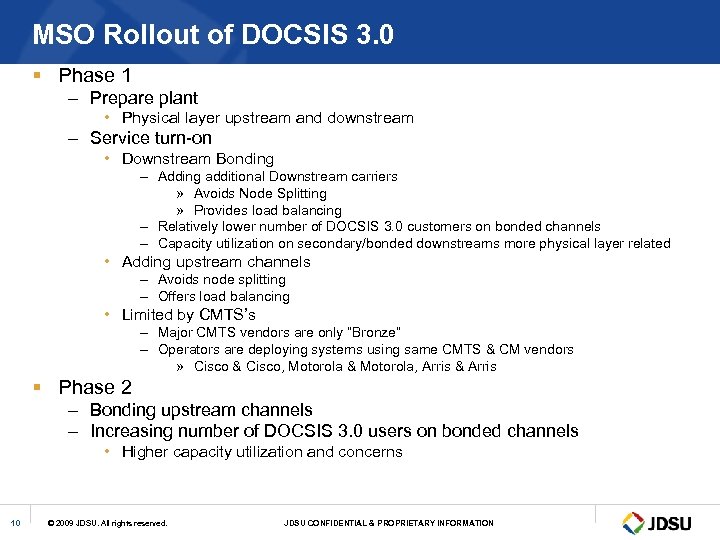 MSO Rollout of DOCSIS 3. 0 § Phase 1 – Prepare plant • Physical layer upstream and downstream – Service turn-on • Downstream Bonding – Adding additional Downstream carriers » Avoids Node Splitting » Provides load balancing – Relatively lower number of DOCSIS 3. 0 customers on bonded channels – Capacity utilization on secondary/bonded downstreams more physical layer related • Adding upstream channels – Avoids node splitting – Offers load balancing • Limited by CMTS’s – Major CMTS vendors are only “Bronze” – Operators are deploying systems using same CMTS & CM vendors » Cisco & Cisco, Motorola & Motorola, Arris & Arris § Phase 2 – Bonding upstream channels – Increasing number of DOCSIS 3. 0 users on bonded channels • Higher capacity utilization and concerns 10 © 2009 JDSU. All rights reserved. JDSU CONFIDENTIAL & PROPRIETARY INFORMATION
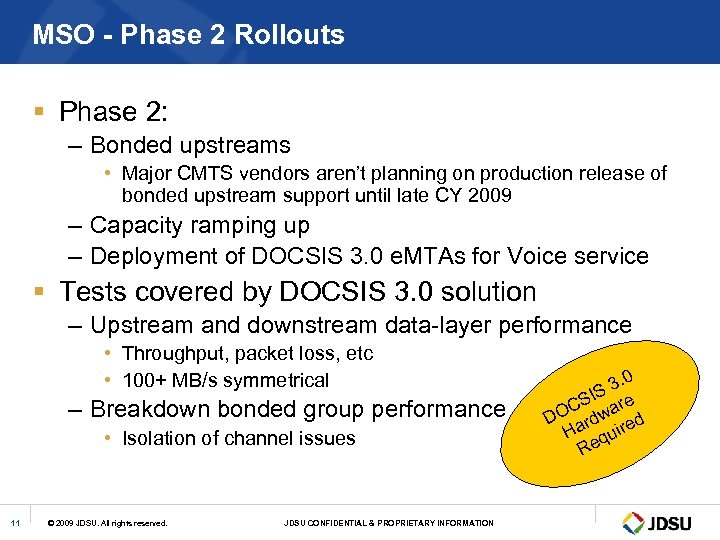 MSO - Phase 2 Rollouts § Phase 2: – Bonded upstreams • Major CMTS vendors aren’t planning on production release of bonded upstream support until late CY 2009 – Capacity ramping up – Deployment of DOCSIS 3. 0 e. MTAs for Voice service § Tests covered by DOCSIS 3. 0 solution – Upstream and downstream data-layer performance • Throughput, packet loss, etc • 100+ MB/s symmetrical – Breakdown bonded group performance • Isolation of channel issues 11 © 2009 JDSU. All rights reserved. JDSU CONFIDENTIAL & PROPRIETARY INFORMATION 3. 0 SIS are C DO ardw red H qui Re
 Testing during the Transition § What and How can we toast now? 12 © 2009 JDSU. All rights reserved. JDSU CONFIDENTIAL & PROPRIETARY INFORMATION
 Sorry – I meant “Test” 13 © 2009 JDSU. All rights reserved. JDSU CONFIDENTIAL & PROPRIETARY INFORMATION
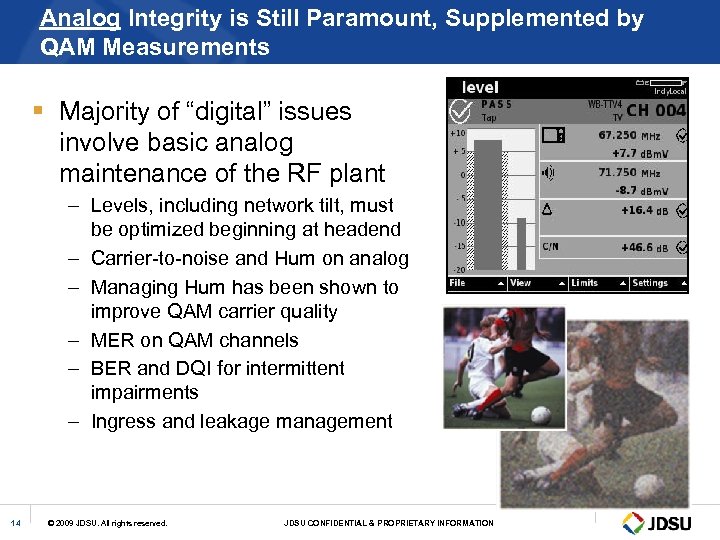 Analog Integrity is Still Paramount, Supplemented by QAM Measurements § Majority of “digital” issues involve basic analog maintenance of the RF plant – Levels, including network tilt, must be optimized beginning at headend – Carrier-to-noise and Hum on analog – Managing Hum has been shown to improve QAM carrier quality – MER on QAM channels – BER and DQI for intermittent impairments – Ingress and leakage management 14 © 2009 JDSU. All rights reserved. JDSU CONFIDENTIAL & PROPRIETARY INFORMATION
 “Back to the Basics” Troubleshooting § Majority of problems are basic physical layer issues § Do a visual inspection of cable, connectors and passives and replace as needed § Check for proper grounding § Tighten F-connectors per your company’s installation policy – Be very careful not to over tighten connectors on CPE (TVs, VCRs, converters etc. ) and crack or damage input RFI integrity § Check forward and return RF levels, analog and digital § Check for reverse ingress coming from home § Most of the test strategy remains the same divide and conquer technique – bad here-good there-problem in between! 15 © 2009 JDSU. All rights reserved. JDSU CONFIDENTIAL & PROPRIETARY INFORMATION
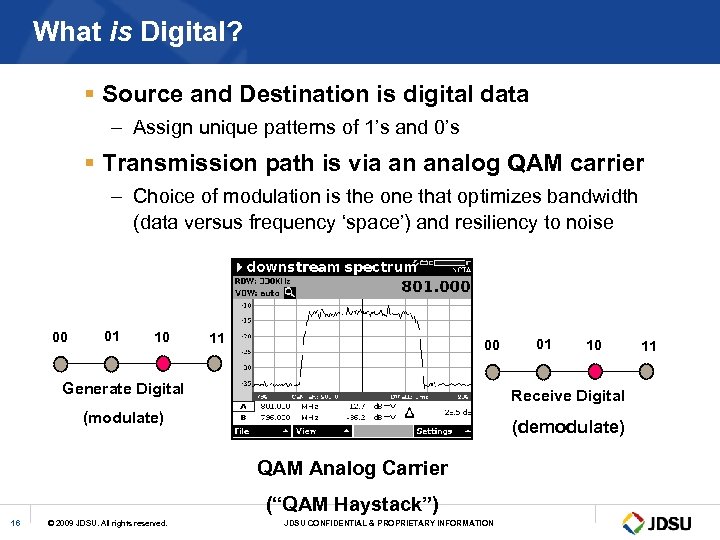 What is Digital? § Source and Destination is digital data – Assign unique patterns of 1’s and 0’s § Transmission path is via an analog QAM carrier – Choice of modulation is the one that optimizes bandwidth (data versus frequency ‘space’) and resiliency to noise 00 01 10 11 00 Generate Digital (demodulate) QAM Analog Carrier (“QAM Haystack”) © 2009 JDSU. All rights reserved. 10 Receive Digital (modulate) 16 01 JDSU CONFIDENTIAL & PROPRIETARY INFORMATION 11
 QAM Measurements § Spectrum & Digital Average Power Level § MER (Modulation Error Ratio) § Pre/Post FEC BER (Bit Error Ratio) § QAM Constellation Display § QAM “Ingress Under The Carrier” § QAM DQI (Digital Quality Index) § AGC Stress § Group Delay § In-Channel Frequency Response § Equalizer Stress – 17 © 2009 JDSU. All rights reserved. Items in red are really ANALOG impairments measured on a QAM channel JDSU CONFIDENTIAL & PROPRIETARY INFORMATION
 Hum § Low frequency amplitude modulation (<1 k. Hz) of a carrier when passing through an active or passive component § FCC states that Hum must be < 3% § Caused By: – – – – 18 Power Supply Filter Failure Bad Solder Connections Corroded Connectors Bad power supplies in amplifiers Earth-loops on coax cables Bad connection to ground Earth-loops in headend, interfering with the TV modulators © 2009 JDSU. All rights reserved. JDSU CONFIDENTIAL & PROPRIETARY INFORMATION
 Hum Modulation Characteristics § Diagnosis - if hum caused by. . . – 60 Hz Component - Check for bad ground connections – CAREFULLY! – 120 Hz Component - Check DC Power Supply For Ripple (possible filter capacitor or diode failure) • Can be customer equipment – old TV or VCR or radio ( remember them) power supply § Effect on analog TV picture: one or two bars slowly scroll up the picture § Effect on Digital picture: digital tiling in the picture § Effect on DOCSIS® data: packet loss/slow throughput § Effect on Vo. IP data: packet loss/robotized voice 19 © 2009 JDSU. All rights reserved. JDSU CONFIDENTIAL & PROPRIETARY INFORMATION
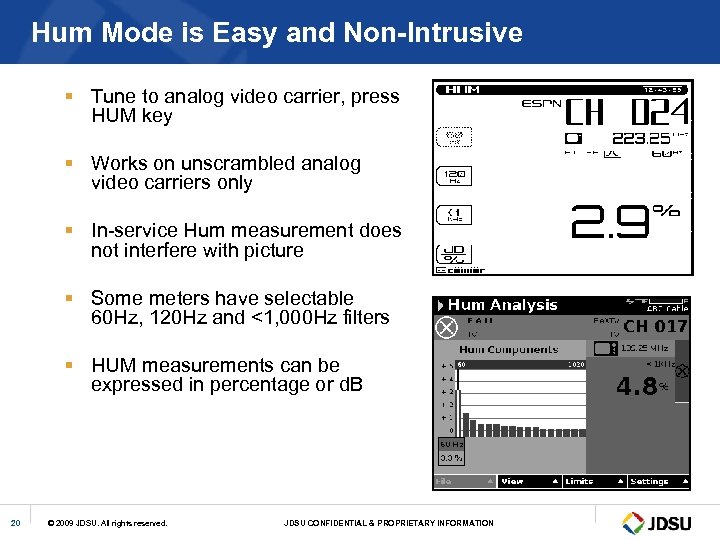 Hum Mode is Easy and Non-Intrusive § Tune to analog video carrier, press HUM key § Works on unscrambled analog video carriers only § In-service Hum measurement does not interfere with picture § Some meters have selectable 60 Hz, 120 Hz and <1, 000 Hz filters § HUM measurements can be expressed in percentage or d. B 20 © 2009 JDSU. All rights reserved. JDSU CONFIDENTIAL & PROPRIETARY INFORMATION
 AGC Stress § Triggers alarm flag when meter AGC detects signal level change of >. 5 d. B in 1 second of time. § This small but rapid up and down change in level can cause problems with digital set tops boxes and CM’s. § Single channel can be caused by a problem with the QAM modulator § Flagging on multiple channels indicates a problem with the plant trunk/bridger AGC circuits 21 © 2009 JDSU. All rights reserved. JDSU CONFIDENTIAL & PROPRIETARY INFORMATION
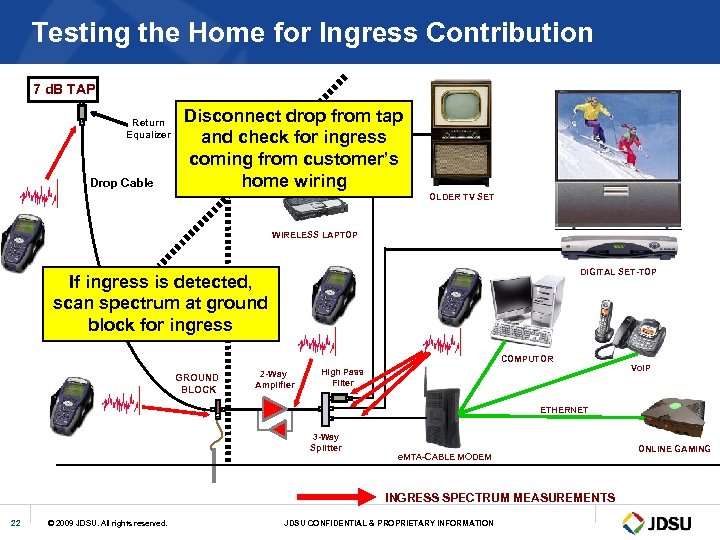 Testing the Home for Ingress Contribution 7 d. B TAP Return Equalizer Drop Cable Disconnect drop from tap and check for ingress House coming from customer’s home wiring OLDER TV SET WIRELESS LAPTOP DIGITAL SET-TOP If ingress is detected, scan spectrum at ground block for ingress COMPUTOR GROUND BLOCK 2 -Way Amplifier High Pass Filter Vo. IP ETHERNET 3 -Way Splitter e. MTA-CABLE MODEM INGRESS SPECTRUM MEASUREMENTS 22 © 2009 JDSU. All rights reserved. JDSU CONFIDENTIAL & PROPRIETARY INFORMATION ONLINE GAMING
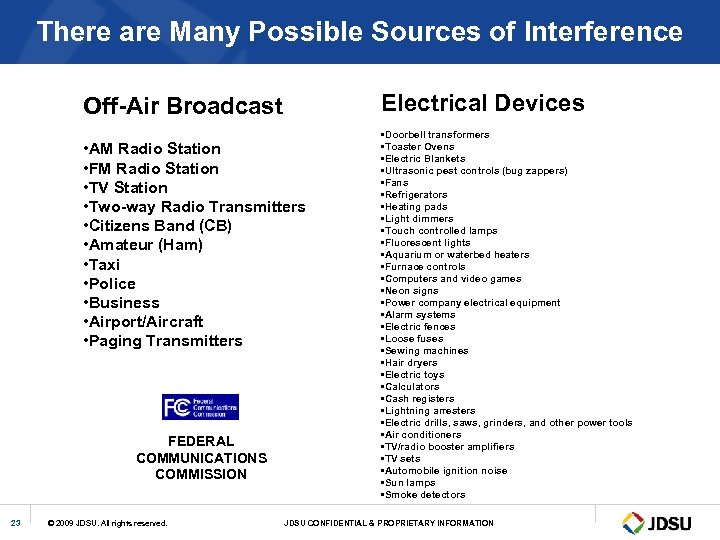 There are Many Possible Sources of Interference Electrical Devices Off-Air Broadcast • AM Radio Station • FM Radio Station • TV Station • Two-way Radio Transmitters • Citizens Band (CB) • Amateur (Ham) • Taxi • Police • Business • Airport/Aircraft • Paging Transmitters FEDERAL COMMUNICATIONS COMMISSION 23 © 2009 JDSU. All rights reserved. • Doorbell transformers • Toaster Ovens • Electric Blankets • Ultrasonic pest controls (bug zappers) • Fans • Refrigerators • Heating pads • Light dimmers • Touch controlled lamps • Fluorescent lights • Aquarium or waterbed heaters • Furnace controls • Computers and video games • Neon signs • Power company electrical equipment • Alarm systems • Electric fences • Loose fuses • Sewing machines • Hair dryers • Electric toys • Calculators • Cash registers • Lightning arresters • Electric drills, saws, grinders, and other power tools • Air conditioners • TV/radio booster amplifiers • TV sets • Automobile ignition noise • Sun lamps • Smoke detectors JDSU CONFIDENTIAL & PROPRIETARY INFORMATION
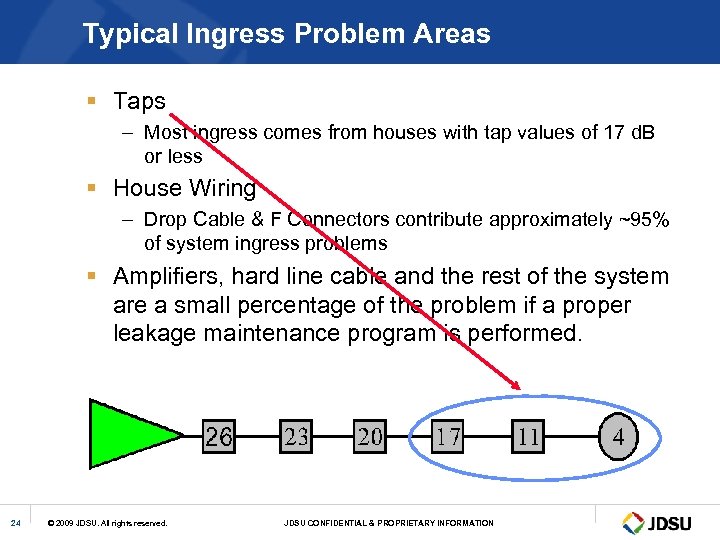 Typical Ingress Problem Areas § Taps – Most ingress comes from houses with tap values of 17 d. B or less § House Wiring – Drop Cable & F Connectors contribute approximately ~95% of system ingress problems § Amplifiers, hard line cable and the rest of the system are a small percentage of the problem if a proper leakage maintenance program is performed. 24 © 2009 JDSU. All rights reserved. JDSU CONFIDENTIAL & PROPRIETARY INFORMATION
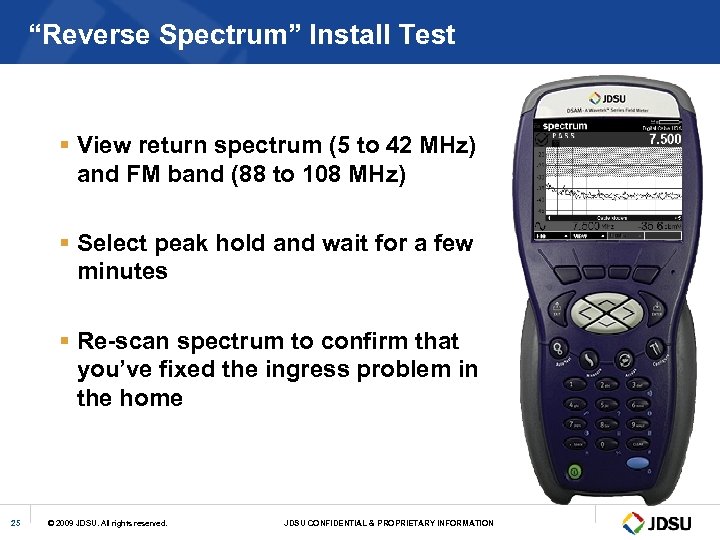 “Reverse Spectrum” Install Test § View return spectrum (5 to 42 MHz) and FM band (88 to 108 MHz) § Select peak hold and wait for a few minutes § Re-scan spectrum to confirm that you’ve fixed the ingress problem in the home 25 © 2009 JDSU. All rights reserved. JDSU CONFIDENTIAL & PROPRIETARY INFORMATION
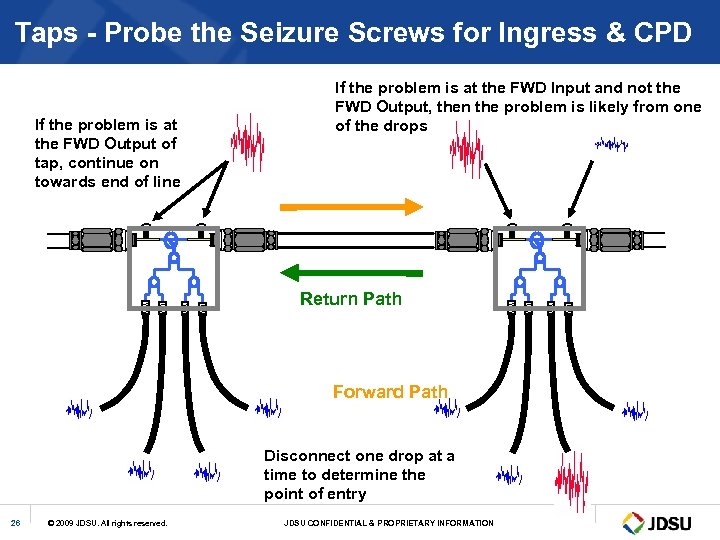 Taps - Probe the Seizure Screws for Ingress & CPD If the problem is at the FWD Output of tap, continue on towards end of line If the problem is at the FWD Input and not the FWD Output, then the problem is likely from one of the drops Return Path Forward Path Disconnect one drop at a time to determine the point of entry 26 © 2009 JDSU. All rights reserved. JDSU CONFIDENTIAL & PROPRIETARY INFORMATION
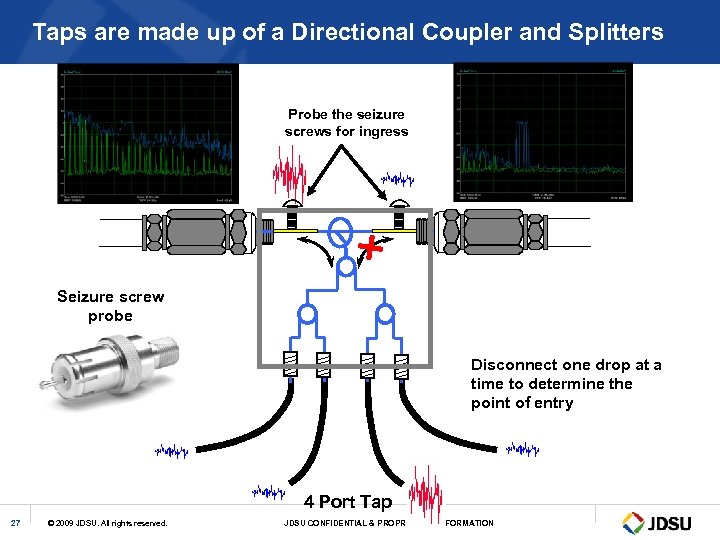 Taps are made up of a Directional Coupler and Splitters Probe the seizure screws for ingress Seizure screw probe Disconnect one drop at a time to determine the point of entry 4 Port Tap 27 © 2009 JDSU. All rights reserved. JDSU CONFIDENTIAL & PROPRIETARY INFORMATION
 Equalizer Stress § Digital demodulation receivers utilize adaptive equalizers to negate the effects of signals arriving other than the desired signal. § Signals can arrive ahead of or after the desired signal. In a cable system, the majority of signals are reflections and micro-reflections that arrive after the desired signal. § Cable modems and digital set top boxes must be able to handle pre and post signals at levels defined by DVB standards. If the equalizer is pushed beyond those limits, errors will occur. § By using the Velocity of Propagation, the distance to the source of the reflection can sometimes be located. If the reflections occur before the next upstream amplifier, they are simply amplified and passed downstream thereby eliminating the ability to perform fault detection based on reflection time. § Equalizer stress is used more as a figure of merit for the margin available to the set top box or cable modem. 28 © 2009 JDSU. All rights reserved. JDSU CONFIDENTIAL & PROPRIETARY INFORMATION
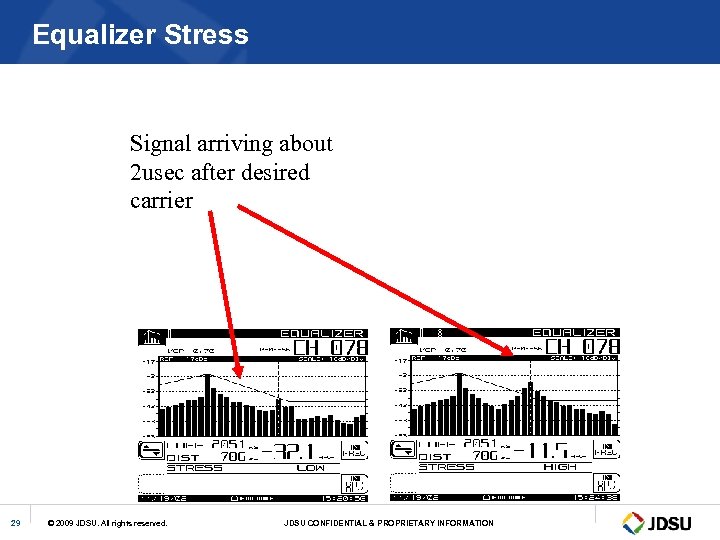 Equalizer Stress Signal arriving about 2 usec after desired carrier 29 © 2009 JDSU. All rights reserved. JDSU CONFIDENTIAL & PROPRIETARY INFORMATION
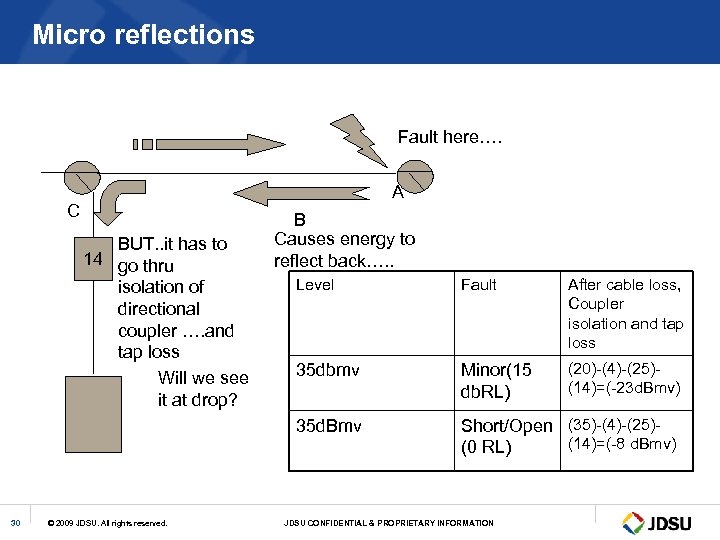 Micro reflections Fault here…. A C BUT. . it has to 14 go thru isolation of directional coupler …. and tap loss Will we see it at drop? B Causes energy to reflect back…. . © 2009 JDSU. All rights reserved. Fault After cable loss, Coupler isolation and tap loss 35 dbmv Minor(15 db. RL) (20)-(4)-(25)(14)=(-23 d. Bmv) 35 d. Bmv 30 Level Short/Open (35)-(4)-(25)(14)=(-8 d. Bmv) (0 RL) JDSU CONFIDENTIAL & PROPRIETARY INFORMATION
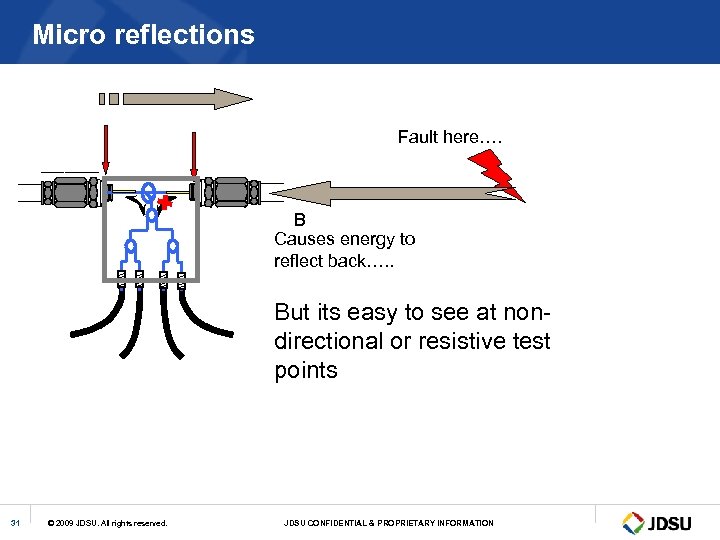 Micro reflections Fault here…. B Causes energy to reflect back…. . But its easy to see at nondirectional or resistive test points 31 © 2009 JDSU. All rights reserved. JDSU CONFIDENTIAL & PROPRIETARY INFORMATION
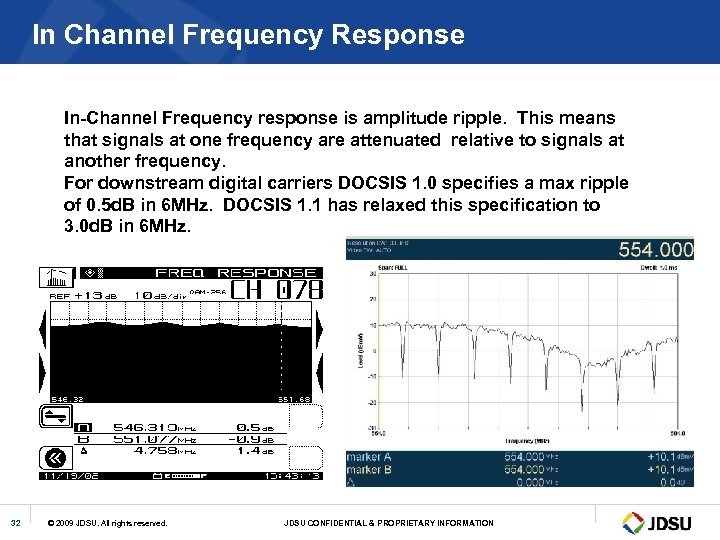 In Channel Frequency Response In-Channel Frequency response is amplitude ripple. This means that signals at one frequency are attenuated relative to signals at another frequency. For downstream digital carriers DOCSIS 1. 0 specifies a max ripple of 0. 5 d. B in 6 MHz. DOCSIS 1. 1 has relaxed this specification to 3. 0 d. B in 6 MHz. 32 © 2009 JDSU. All rights reserved. JDSU CONFIDENTIAL & PROPRIETARY INFORMATION
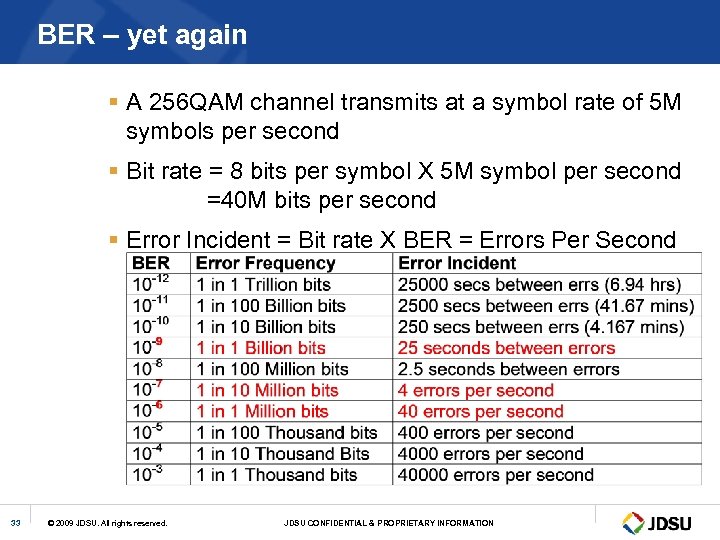 BER – yet again § A 256 QAM channel transmits at a symbol rate of 5 M symbols per second § Bit rate = 8 bits per symbol X 5 M symbol per second =40 M bits per second § Error Incident = Bit rate X BER = Errors Per Second 33 © 2009 JDSU. All rights reserved. JDSU CONFIDENTIAL & PROPRIETARY INFORMATION
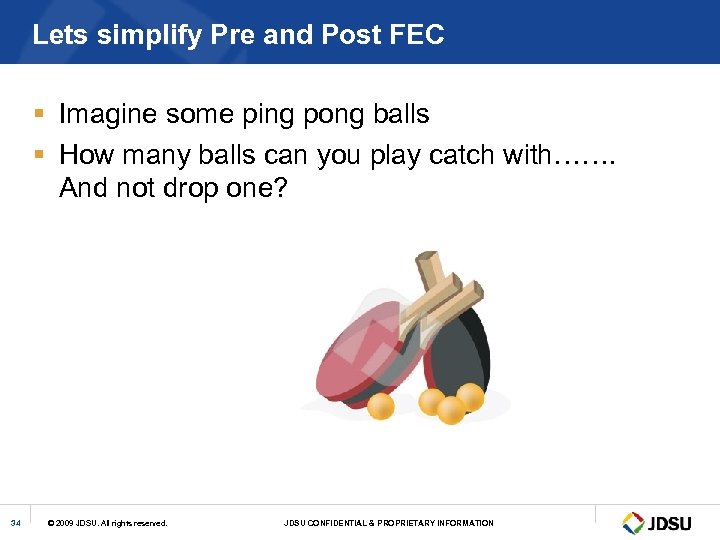 Lets simplify Pre and Post FEC § Imagine some ping pong balls § How many balls can you play catch with……. And not drop one? 34 © 2009 JDSU. All rights reserved. JDSU CONFIDENTIAL & PROPRIETARY INFORMATION
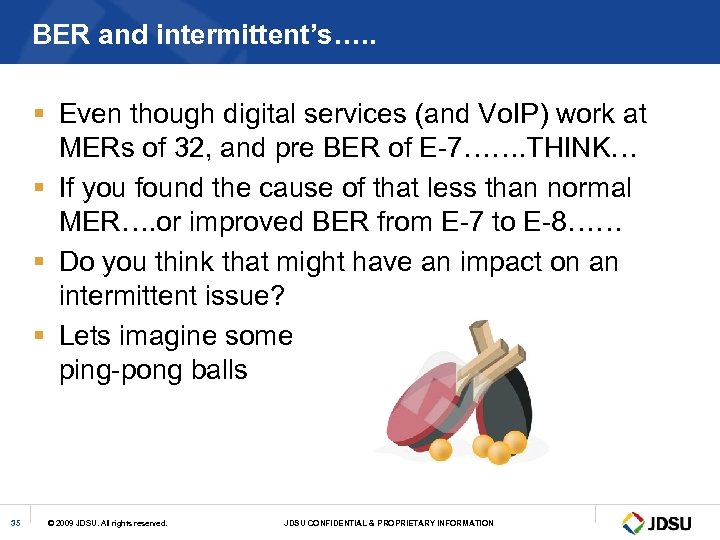 BER and intermittent’s…. . § Even though digital services (and Vo. IP) work at MERs of 32, and pre BER of E-7……. THINK… § If you found the cause of that less than normal MER…. or improved BER from E-7 to E-8…… § Do you think that might have an impact on an intermittent issue? § Lets imagine some ping-pong balls 35 © 2009 JDSU. All rights reserved. JDSU CONFIDENTIAL & PROPRIETARY INFORMATION
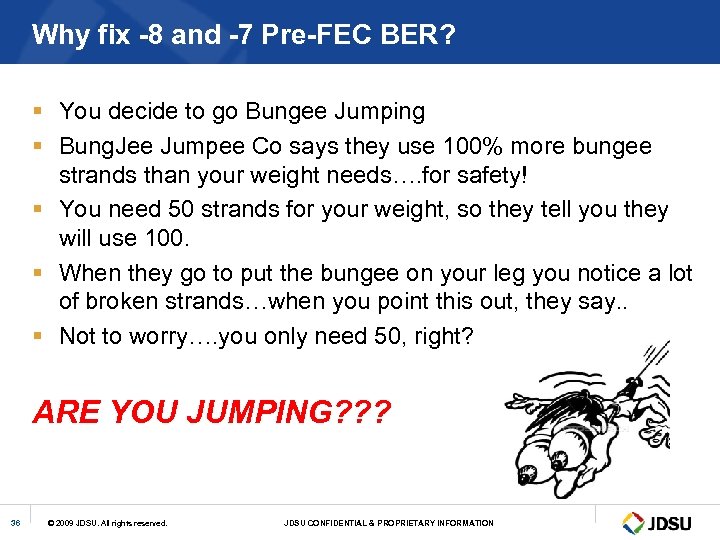 Why fix -8 and -7 Pre-FEC BER? § You decide to go Bungee Jumping § Bung. Jee Jumpee Co says they use 100% more bungee strands than your weight needs…. for safety! § You need 50 strands for your weight, so they tell you they will use 100. § When they go to put the bungee on your leg you notice a lot of broken strands…when you point this out, they say. . § Not to worry…. you only need 50, right? ARE YOU JUMPING? ? ? 36 © 2009 JDSU. All rights reserved. JDSU CONFIDENTIAL & PROPRIETARY INFORMATION
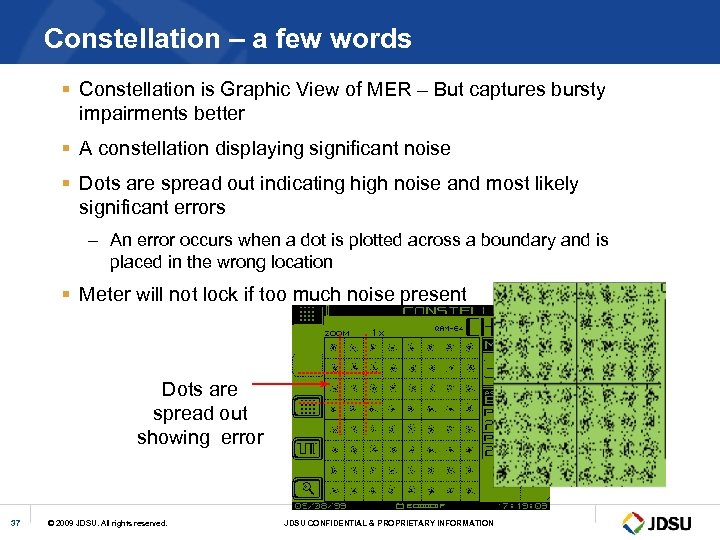 Constellation – a few words § Constellation is Graphic View of MER – But captures bursty impairments better § A constellation displaying significant noise § Dots are spread out indicating high noise and most likely significant errors – An error occurs when a dot is plotted across a boundary and is placed in the wrong location § Meter will not lock if too much noise present Dots are spread out showing error 37 © 2009 JDSU. All rights reserved. JDSU CONFIDENTIAL & PROPRIETARY INFORMATION
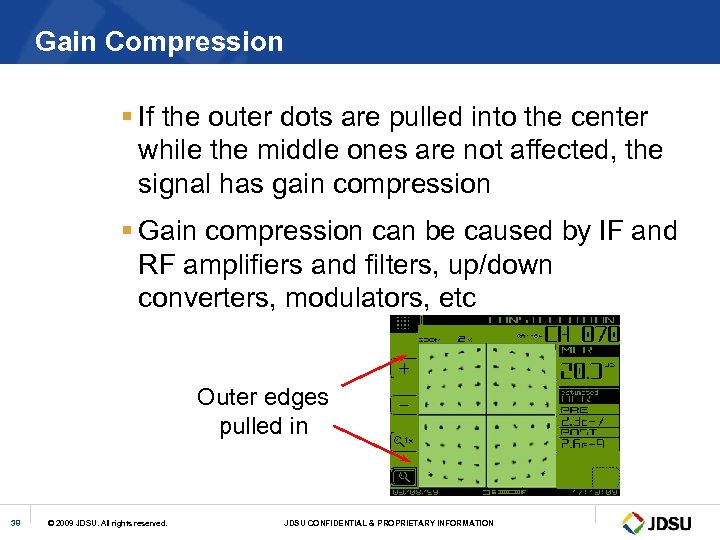 Gain Compression § If the outer dots are pulled into the center while the middle ones are not affected, the signal has gain compression § Gain compression can be caused by IF and RF amplifiers and filters, up/down converters, modulators, etc Outer edges pulled in 38 © 2009 JDSU. All rights reserved. JDSU CONFIDENTIAL & PROPRIETARY INFORMATION
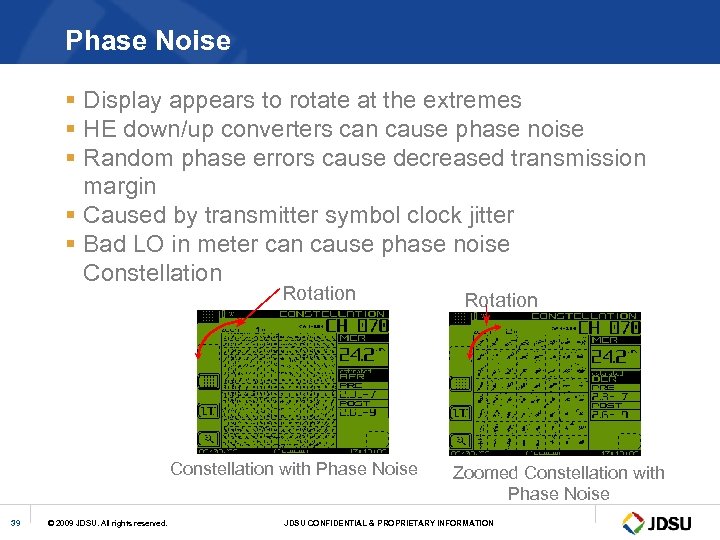 Phase Noise § Display appears to rotate at the extremes § HE down/up converters can cause phase noise § Random phase errors cause decreased transmission margin § Caused by transmitter symbol clock jitter § Bad LO in meter can cause phase noise Constellation Rotation Constellation with Phase Noise 39 © 2009 JDSU. All rights reserved. Rotation Zoomed Constellation with Phase Noise JDSU CONFIDENTIAL & PROPRIETARY INFORMATION
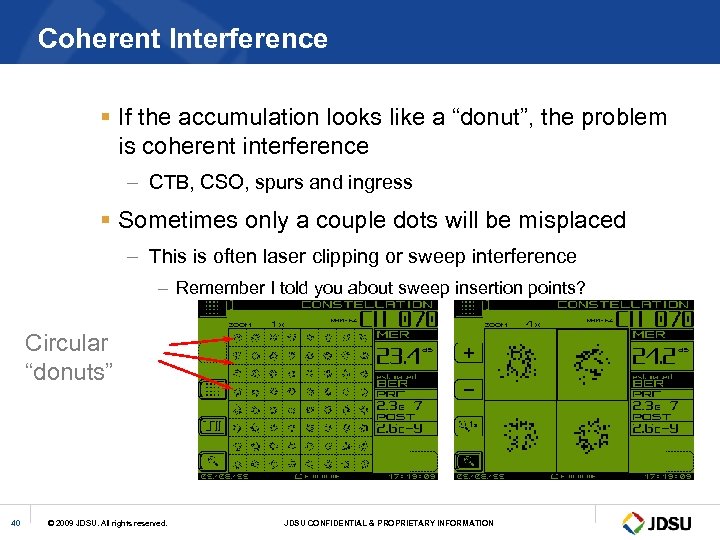 Coherent Interference § If the accumulation looks like a “donut”, the problem is coherent interference – CTB, CSO, spurs and ingress § Sometimes only a couple dots will be misplaced – This is often laser clipping or sweep interference – Remember I told you about sweep insertion points? Circular “donuts” 40 © 2009 JDSU. All rights reserved. JDSU CONFIDENTIAL & PROPRIETARY INFORMATION
 BUT……. § Constellation still doesn’t tell the whole story § Constellation is ‘Sampled’ – For each point ( Symbol ) plotted, there are 1000’s that are not. – So transient intermittents can still be missed. § DQI is a method of showing transients that BER/Consellation views can still miss – Accesses I/Q data before the Constellation sampler 41 © 2009 JDSU. All rights reserved. JDSU CONFIDENTIAL & PROPRIETARY INFORMATION
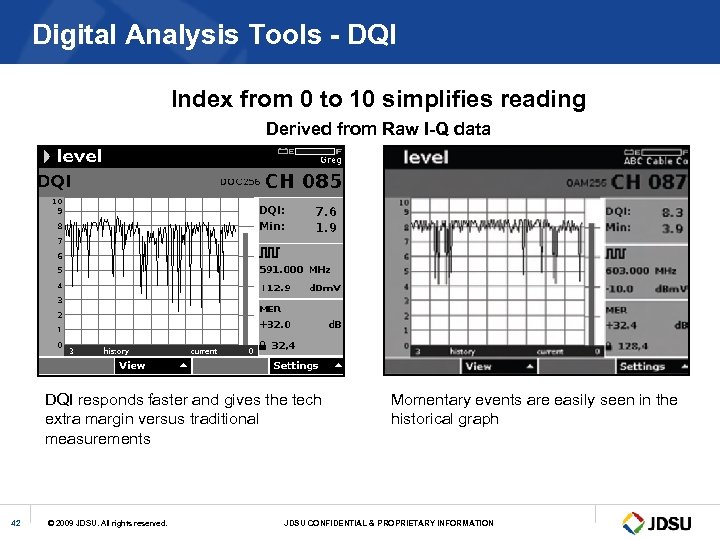 Digital Analysis Tools - DQI Index from 0 to 10 simplifies reading Derived from Raw I-Q data DQI responds faster and gives the tech extra margin versus traditional measurements 42 © 2009 JDSU. All rights reserved. Momentary events are easily seen in the historical graph JDSU CONFIDENTIAL & PROPRIETARY INFORMATION
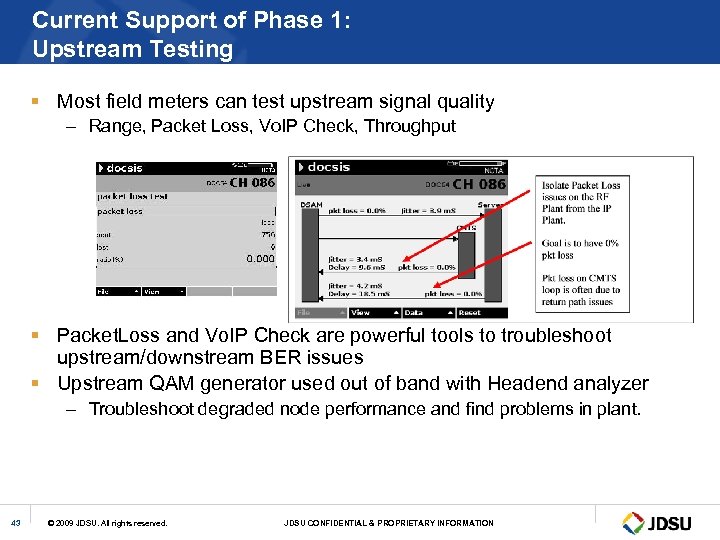 Current Support of Phase 1: Upstream Testing § Most field meters can test upstream signal quality – Range, Packet Loss, Vo. IP Check, Throughput § Packet. Loss and Vo. IP Check are powerful tools to troubleshoot upstream/downstream BER issues § Upstream QAM generator used out of band with Headend analyzer – Troubleshoot degraded node performance and find problems in plant. 43 © 2009 JDSU. All rights reserved. JDSU CONFIDENTIAL & PROPRIETARY INFORMATION
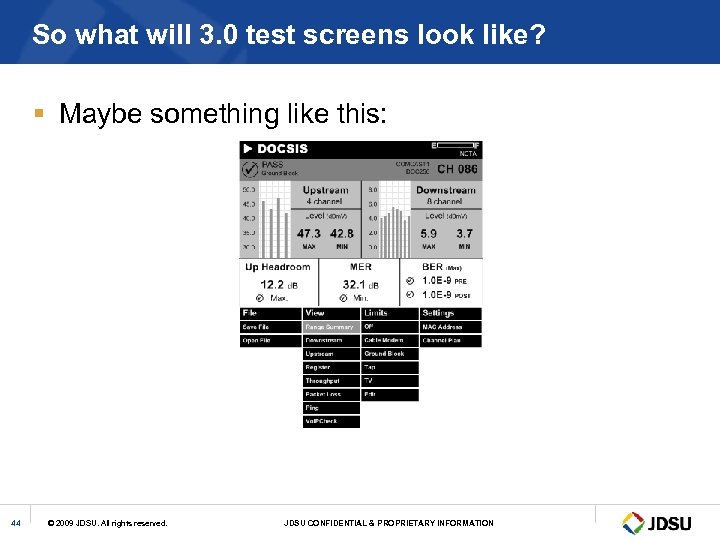 So what will 3. 0 test screens look like? § Maybe something like this: 44 © 2009 JDSU. All rights reserved. JDSU CONFIDENTIAL & PROPRIETARY INFORMATION
 Thank you – Randy Francis JDSU