


 Скачать презентацию doc IEEE 802 15 -xx-00 xx-xx-007 r
186f38a845a5c70567d92a7c0445e484.ppt
- Количество слайдов: 11
 doc. : IEEE 802. 15 -xx-00 xx-xx-007 r 1 January 2015 Project: IEEE P 802. 15 Working Group for Wireless Personal Area Networks (WPANs) Submission Title: [Use Cases of Optical Wireless Communication] Date Submitted: [January, 2015] Source: [Yeong Min Jang, Md. Shareef Ifthekhar, Trang Nguyen, Nirzhar Saha, Nam Tuan Le, Mohammad Arif Hossain and Chang Hyun Hong ] [Kookmin University] Address [Kookmin University, Seoul, Korea] Voice: [82 -2 -910 -5068], FAX: [82 -2 -910 -5068], E-Mail: [yjang@kookmin. ac. kr] Re: [] Abstract: [This document present use cases of optical wireless communication] Purpose: [Contribution to IEEE 802. 15. SG 7 r 1] Notice: This document has been prepared to assist the IEEE P 802. 15. It is offered as a basis for discussion and is not binding on the contributing individual(s) or organization(s). The material in this document is subject to change in form and content after further study. The contributor(s) reserve(s) the right to add, amend or withdraw material contained herein. Release: The contributor acknowledges and accepts that this contribution becomes the property of IEEE and may be made publicly available by P 802. 15. Submission Slide 1 Yeong Min Jang, Kookmin
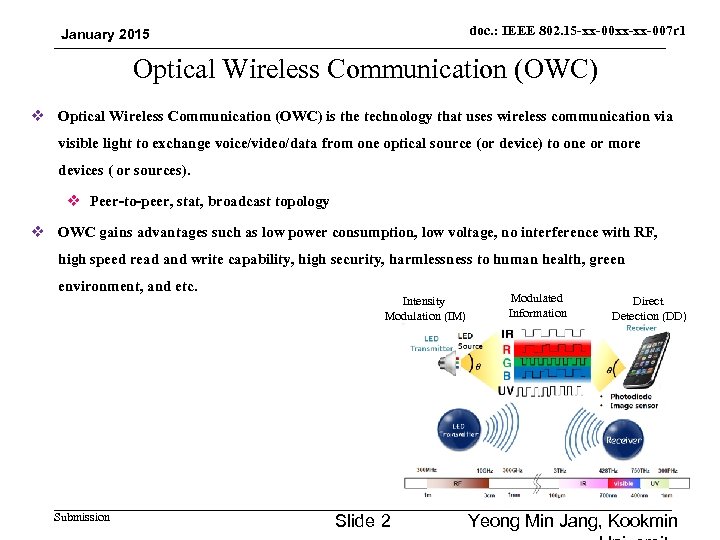 doc. : IEEE 802. 15 -xx-00 xx-xx-007 r 1 January 2015 Optical Wireless Communication (OWC) v Optical Wireless Communication (OWC) is the technology that uses wireless communication via visible light to exchange voice/video/data from one optical source (or device) to one or more devices ( or sources). v Peer-to-peer, stat, broadcast topology v OWC gains advantages such as low power consumption, low voltage, no interference with RF, high speed read and write capability, high security, harmlessness to human health, green environment, and etc. Intensity Modulation (IM) Submission Slide 2 Modulated Information Direct Detection (DD) Yeong Min Jang, Kookmin
 doc. : IEEE 802. 15 -xx-00 xx-xx-007 r 1 January 2015 IEEE 802. 15. 7 vs. IEEE 802. 15. 7 r 1 v IEEE 802. 15. 7 considers only photo diode as receiver. v IEEE 802. 15. 7 r 1 consider camera and/or image sensor as receiver along with photo diode. v The spectrum considered in IEEE 802. 15. 7 r 1 is 10, 000 nm (IR to near UV region) compared to 400 nm VLC spectrum considered in IEEE 802. 15. 7. v There is basic difference in receiving technique between photo diode and camera v Existing standard doesn’t consider some special issue related to camera v Need to consider following issues v Flickering v Dimming v Synchronization v Exposure time and Variation in camera frame-rate v Low camera frame-rate Submission Slide 3 Yeong Min Jang, Kookmin
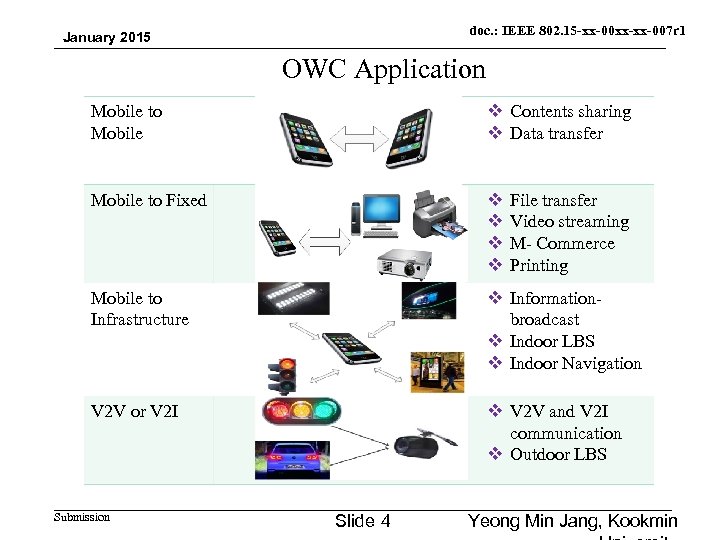 doc. : IEEE 802. 15 -xx-00 xx-xx-007 r 1 January 2015 OWC Application Mobile to Mobile v Contents sharing v Data transfer Mobile to Fixed v v Mobile to Infrastructure v Informationbroadcast v Indoor LBS v Indoor Navigation V 2 V or V 2 I v V 2 V and V 2 I communication v Outdoor LBS Submission Slide 4 File transfer Video streaming M- Commerce Printing Yeong Min Jang, Kookmin
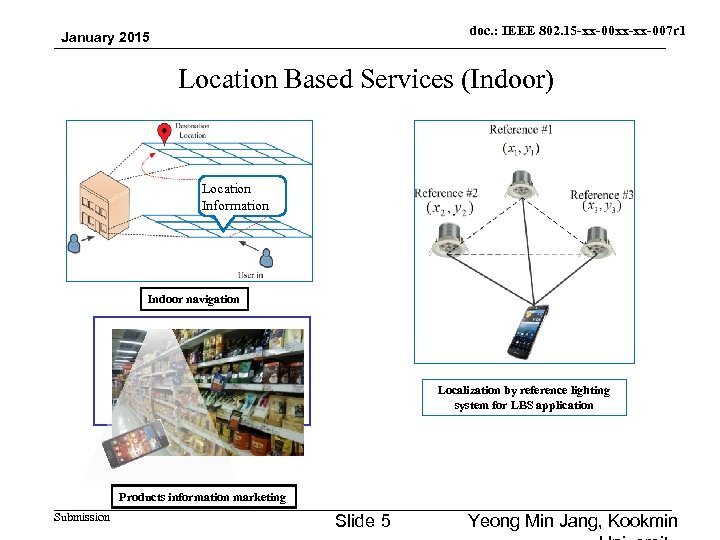 doc. : IEEE 802. 15 -xx-00 xx-xx-007 r 1 January 2015 Location Based Services (Indoor) Location Information Indoor navigation Localization by reference lighting system for LBS application Products information marketing Submission Slide 5 Yeong Min Jang, Kookmin
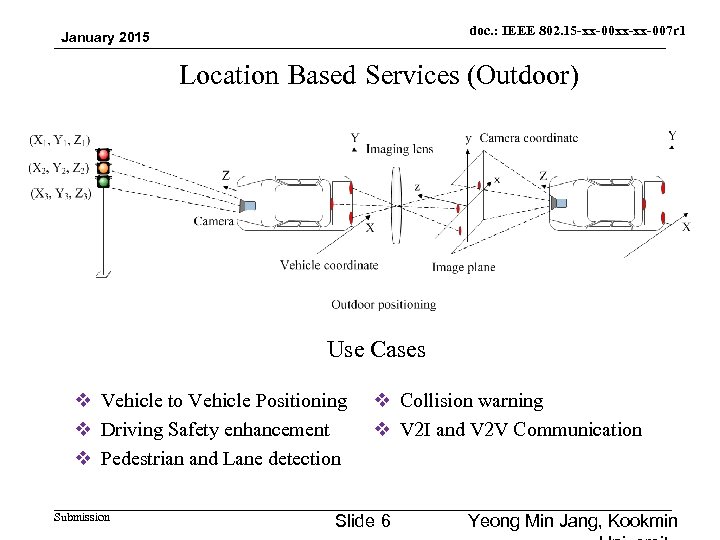 doc. : IEEE 802. 15 -xx-00 xx-xx-007 r 1 January 2015 Location Based Services (Outdoor) Use Cases v Vehicle to Vehicle Positioning v Driving Safety enhancement v Pedestrian and Lane detection Submission v Collision warning v V 2 I and V 2 V Communication Slide 6 Yeong Min Jang, Kookmin
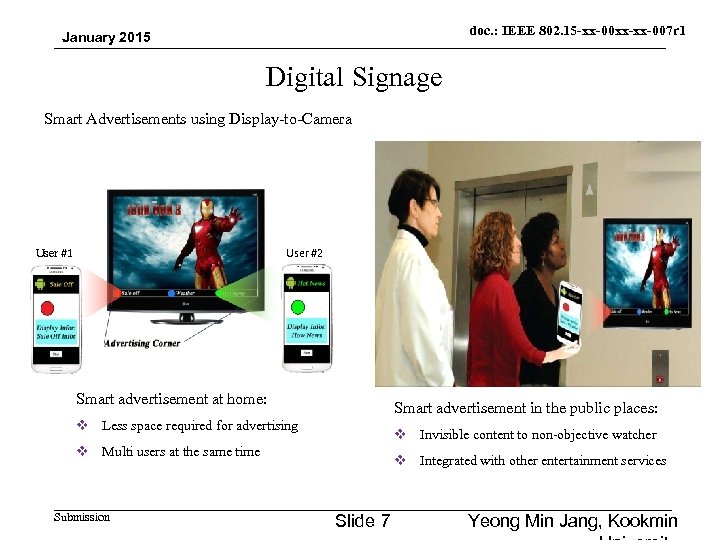 doc. : IEEE 802. 15 -xx-00 xx-xx-007 r 1 January 2015 Digital Signage Smart Advertisements using Display-to-Camera User #2 User #1 Smart advertisement at home: Smart advertisement in the public places: v Less space required for advertising v Invisible content to non-objective watcher v Multi users at the same time Submission v Integrated with other entertainment services Slide 7 Yeong Min Jang, Kookmin
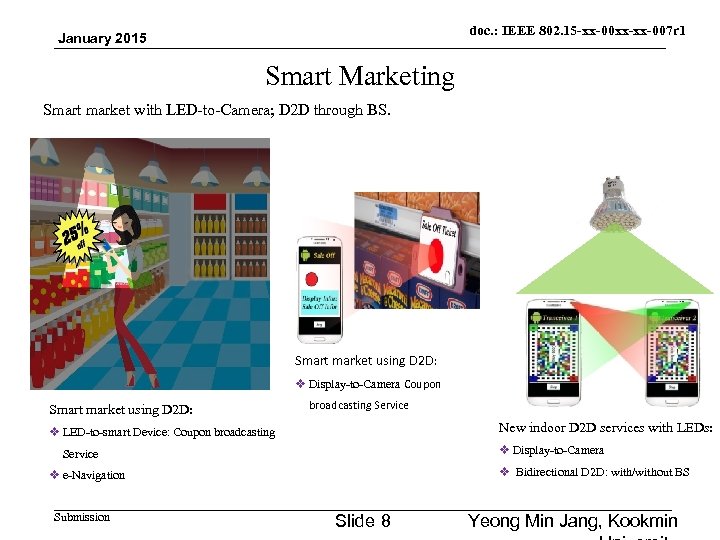 doc. : IEEE 802. 15 -xx-00 xx-xx-007 r 1 January 2015 Smart Marketing Smart market with LED-to-Camera; D 2 D through BS. Smart market using D 2 D: v Display-to-Camera Coupon Smart market using D 2 D: broadcasting Service New indoor D 2 D services with LEDs: v LED-to-smart Device: Coupon broadcasting v Display-to-Camera Service v Bidirectional D 2 D: with/without BS v e-Navigation Submission Slide 8 Yeong Min Jang, Kookmin
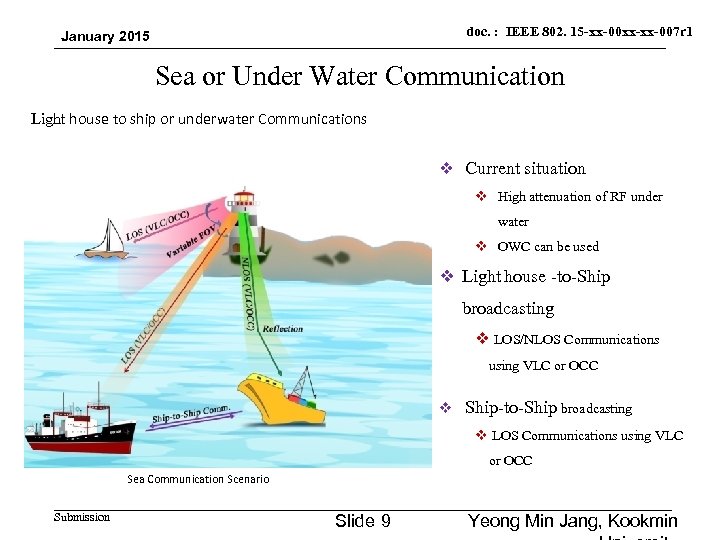 doc. : IEEE 802. 15 -xx-00 xx-xx-007 r 1 January 2015 Sea or Under Water Communication Light house to ship or underwater Communications v Current situation v High attenuation of RF under water v OWC can be used v Light house -to-Ship broadcasting v LOS/NLOS Communications using VLC or OCC v Ship-to-Ship broadcasting v LOS Communications using VLC or OCC Sea Communication Scenario Submission Slide 9 Yeong Min Jang, Kookmin
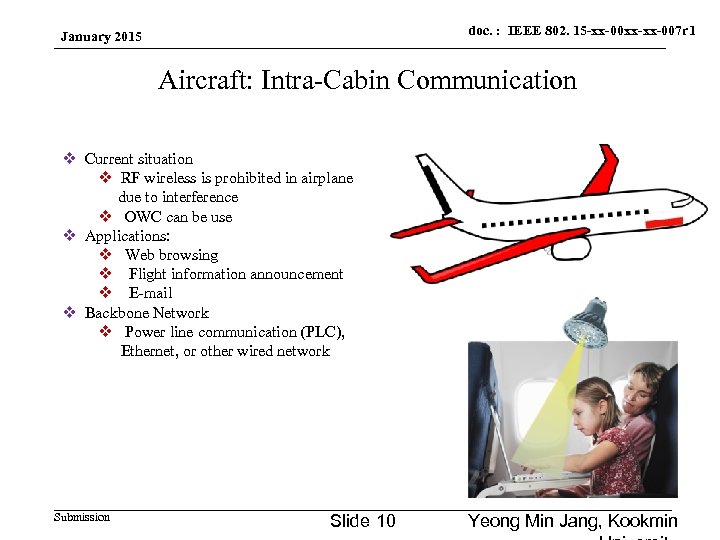 doc. : IEEE 802. 15 -xx-00 xx-xx-007 r 1 January 2015 Aircraft: Intra-Cabin Communication v Current situation v RF wireless is prohibited in airplane due to interference v OWC can be use v Applications: v Web browsing v Flight information announcement v E-mail v Backbone Network v Power line communication (PLC), Ethernet, or other wired network Submission Slide 10 Yeong Min Jang, Kookmin
 doc. : IEEE 802. 15 -xx-00 xx-xx-007 r 1 January 2015 Conclusion v Optical Communication for Cameras (OCC) will be the new paradigm in the IEEE 802. 15. 7 r 1 OWC v D 2 D using OCC brings many promising applications and services v Revise the IEEE 802. 15. 7 standard: IEEE 802. 15. 7 r 1 OWC v Call for contributions and participation Submission Slide 11 Yeong Min Jang, Kookmin