


 Скачать презентацию doc IEEE 802 15 -00 214 r 4
a9c2d38b1922306acd5ef74729900855.ppt
- Количество слайдов: 35
 doc. : IEEE 802. 15 -00/214 r 4 July 2000 Project: IEEE P 802. 15 Working Group for Wireless Personal Area Networks (WPANs) Submission Title: [Kodak - High Rate PHY Proposal] Date Submitted: [11 July 2000] Source: [James D. Allen] Company: [Eastman Kodak Co. ] Address: [1669 Eastman Ave. Rochester, NY, 14650 -2015] Voice: [(716) 588 -1906], FAX: [(716) 722 -9053], E-Mail: [james. d. allen@kodak. com, grantbc@earthlink. net] Re: [802. 15. 3 final Call for Proposals] Abstract: [This presentation outlines Kodak’s PHY proposal to 802. 15. 3 High Rate Task Group] Purpose: [To communicate the proposal for consideration by the standards team] Notice: This document has been prepared to assist the IEEE P 802. 15. It is offered as a basis for discussion and is not binding on the contributing individual(s) or organization(s). The material in this document is subject to change in form and content after further study. The contributor(s) reserve(s) the right to add, amend or withdraw material contained herein. Release: The contributor acknowledges and accepts that this contribution becomes the property of IEEE and may be made publicly available by P 802. 15. Submission 1 Grant B. Carlson, Eastman Kodak Co, Walt Davis, Motorola
 doc. : IEEE 802. 15 -00/214 r 4 July 2000 Kodak’s High Rate PHY Proposal to IEEE 802. 15. 3 Presented by Jim Allen Submission 2 Grant B. Carlson, Eastman Kodak Co, Walt Davis, Motorola
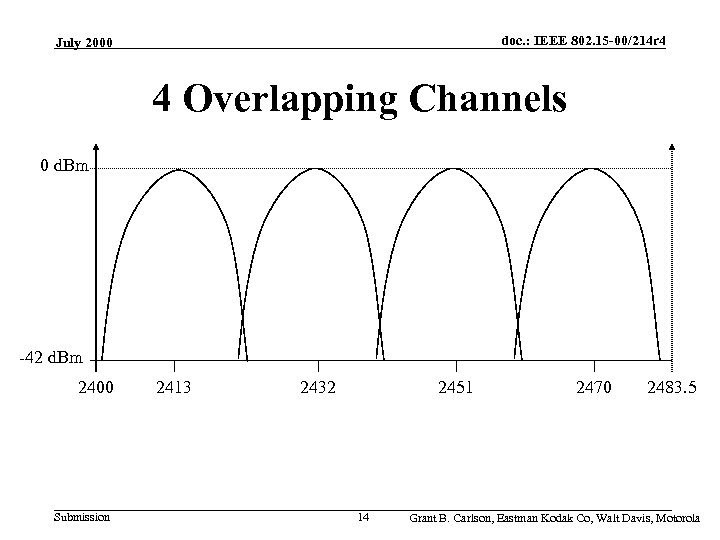
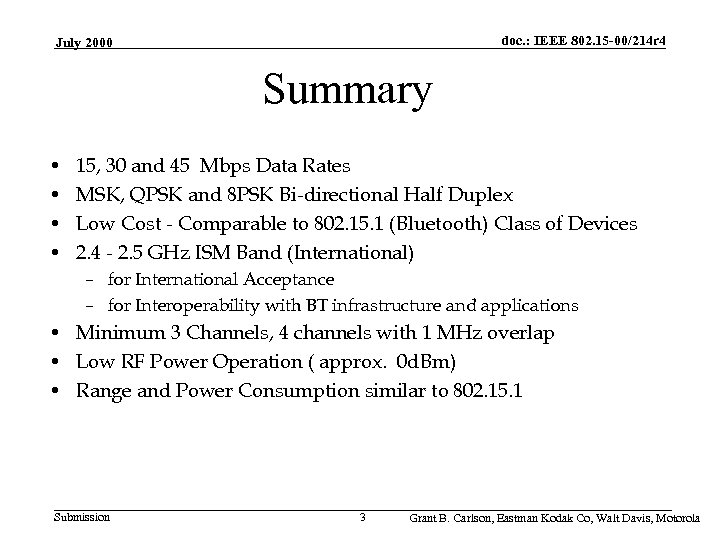 doc. : IEEE 802. 15 -00/214 r 4 July 2000 Summary • • 15, 30 and 45 Mbps Data Rates MSK, QPSK and 8 PSK Bi-directional Half Duplex Low Cost - Comparable to 802. 15. 1 (Bluetooth) Class of Devices 2. 4 - 2. 5 GHz ISM Band (International) – for International Acceptance – for Interoperability with BT infrastructure and applications • Minimum 3 Channels, 4 channels with 1 MHz overlap • Low RF Power Operation ( approx. 0 d. Bm) • Range and Power Consumption similar to 802. 15. 1 Submission 3 Grant B. Carlson, Eastman Kodak Co, Walt Davis, Motorola
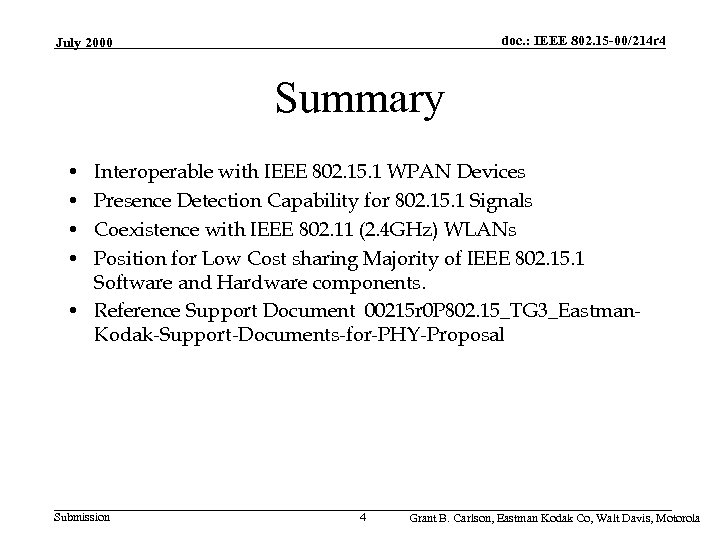 doc. : IEEE 802. 15 -00/214 r 4 July 2000 Summary • • Interoperable with IEEE 802. 15. 1 WPAN Devices Presence Detection Capability for 802. 15. 1 Signals Coexistence with IEEE 802. 11 (2. 4 GHz) WLANs Position for Low Cost sharing Majority of IEEE 802. 15. 1 Software and Hardware components. • Reference Support Document 00215 r 0 P 802. 15_TG 3_Eastman. Kodak-Support-Documents-for-PHY-Proposal Submission 4 Grant B. Carlson, Eastman Kodak Co, Walt Davis, Motorola
 doc. : IEEE 802. 15 -00/214 r 4 July 2000 Comparative Comments • Same Scheme as 802. 15. 1 but: – – Submission Doesn’t hop Faster MAC Wider BW Different Base-Band Signal 5 Grant B. Carlson, Eastman Kodak Co, Walt Davis, Motorola
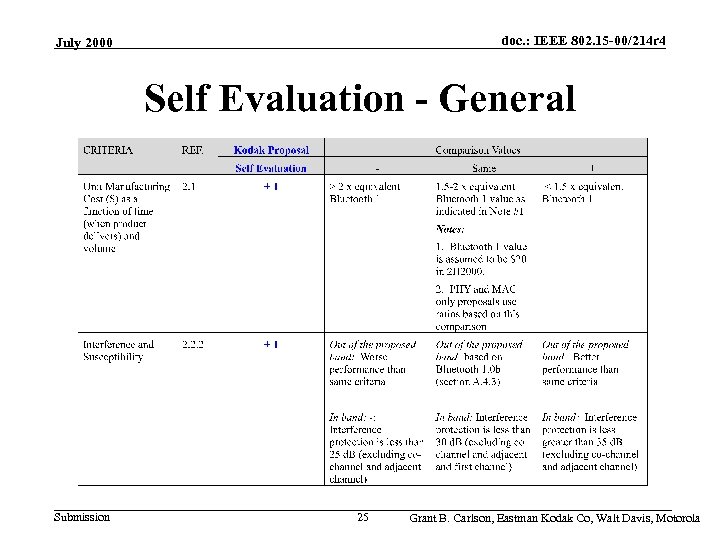
 doc. : IEEE 802. 15 -00/214 r 4 July 2000 Unit Manufacturing Cost • Due to Similarities with BT – Same IC Processes are applicable – Cost about $1 more for External Components. – Slightly More Cost for Antenna System (Stearable Array) • Potentially Less Expensive than 5 GHz Solutions. Submission 6 Grant B. Carlson, Eastman Kodak Co, Walt Davis, Motorola
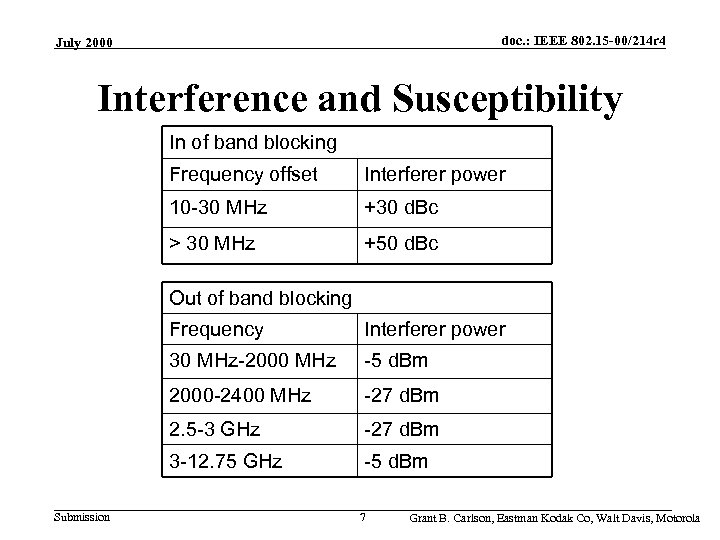 doc. : IEEE 802. 15 -00/214 r 4 July 2000 Interference and Susceptibility In of band blocking Frequency offset Interferer power 10 -30 MHz +30 d. Bc > 30 MHz +50 d. Bc Out of band blocking Frequency 30 MHz-2000 MHz -5 d. Bm 2000 -2400 MHz -27 d. Bm 2. 5 -3 GHz -27 d. Bm 3 -12. 75 GHz Submission Interferer power -5 d. Bm 7 Grant B. Carlson, Eastman Kodak Co, Walt Davis, Motorola
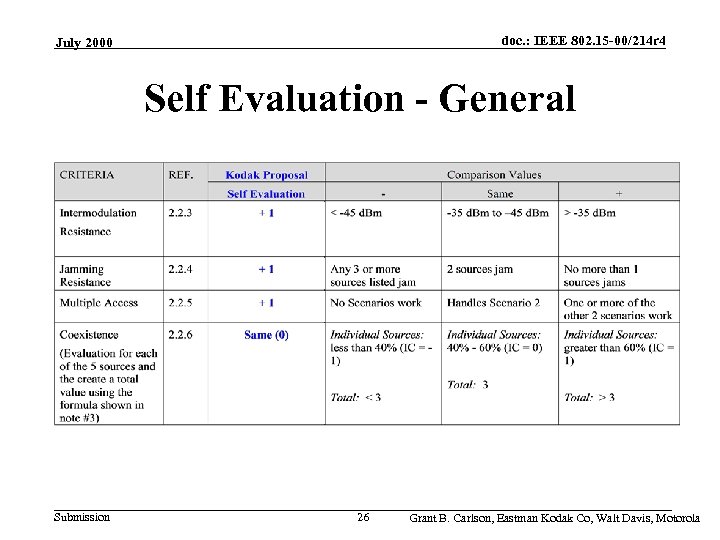
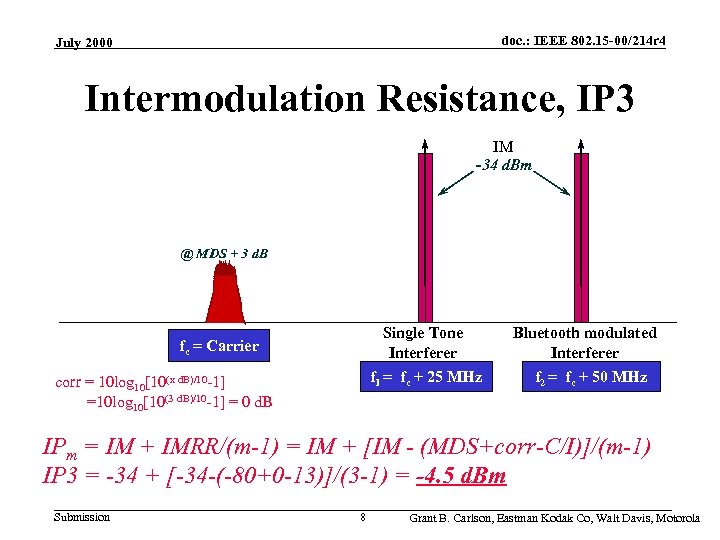 doc. : IEEE 802. 15 -00/214 r 4 July 2000 Intermodulation Resistance, IP 3 IM -34 d. Bm @ MDS + 3 d. B Single Tone Interferer fc = Carrier f 1 = fc + 25 MHz corr = 10 log 10[10(x d. B)/10 -1] =10 log 10[10(3 d. B)/10 -1] = 0 d. B Bluetooth modulated Interferer f 2 = fc + 50 MHz IPm = IM + IMRR/(m-1) = IM + [IM - (MDS+corr-C/I)]/(m-1) IP 3 = -34 + [-34 -(-80+0 -13)]/(3 -1) = -4. 5 d. Bm Submission 8 Grant B. Carlson, Eastman Kodak Co, Walt Davis, Motorola
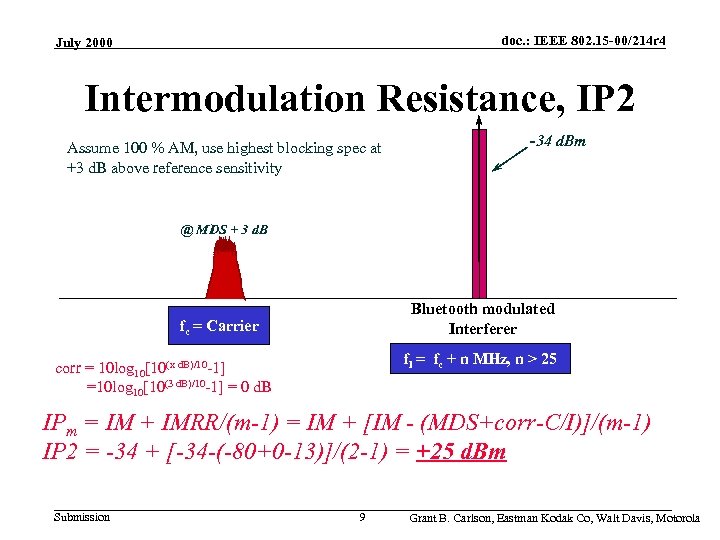 doc. : IEEE 802. 15 -00/214 r 4 July 2000 Intermodulation Resistance, IP 2 Assume 100 % AM, use highest blocking spec at +3 d. B above reference sensitivity -34 d. Bm @ MDS + 3 d. B Bluetooth modulated Interferer fc = Carrier f 1 = fc + n MHz, n > 25 corr = 10 log 10[10(x d. B)/10 -1] =10 log 10[10(3 d. B)/10 -1] = 0 d. B IPm = IM + IMRR/(m-1) = IM + [IM - (MDS+corr-C/I)]/(m-1) IP 2 = -34 + [-34 -(-80+0 -13)]/(2 -1) = +25 d. Bm Submission 9 Grant B. Carlson, Eastman Kodak Co, Walt Davis, Motorola
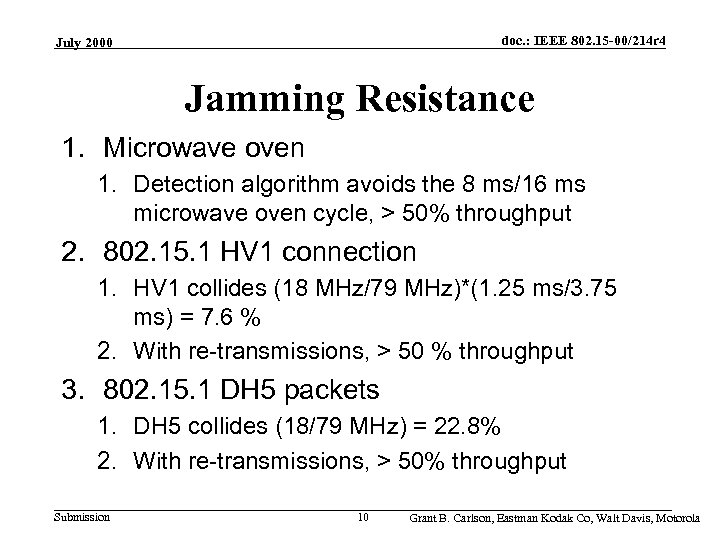 doc. : IEEE 802. 15 -00/214 r 4 July 2000 Jamming Resistance 1. Microwave oven 1. Detection algorithm avoids the 8 ms/16 ms microwave oven cycle, > 50% throughput 2. 802. 15. 1 HV 1 connection 1. HV 1 collides (18 MHz/79 MHz)*(1. 25 ms/3. 75 ms) = 7. 6 % 2. With re-transmissions, > 50 % throughput 3. 802. 15. 1 DH 5 packets 1. DH 5 collides (18/79 MHz) = 22. 8% 2. With re-transmissions, > 50% throughput Submission 10 Grant B. Carlson, Eastman Kodak Co, Walt Davis, Motorola
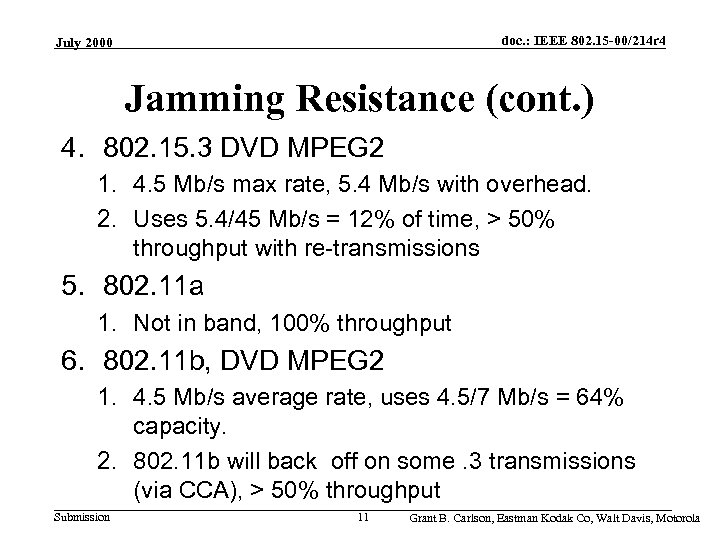 doc. : IEEE 802. 15 -00/214 r 4 July 2000 Jamming Resistance (cont. ) 4. 802. 15. 3 DVD MPEG 2 1. 4. 5 Mb/s max rate, 5. 4 Mb/s with overhead. 2. Uses 5. 4/45 Mb/s = 12% of time, > 50% throughput with re-transmissions 5. 802. 11 a 1. Not in band, 100% throughput 6. 802. 11 b, DVD MPEG 2 1. 4. 5 Mb/s average rate, uses 4. 5/7 Mb/s = 64% capacity. 2. 802. 11 b will back off on some. 3 transmissions (via CCA), > 50% throughput Submission 11 Grant B. Carlson, Eastman Kodak Co, Walt Davis, Motorola
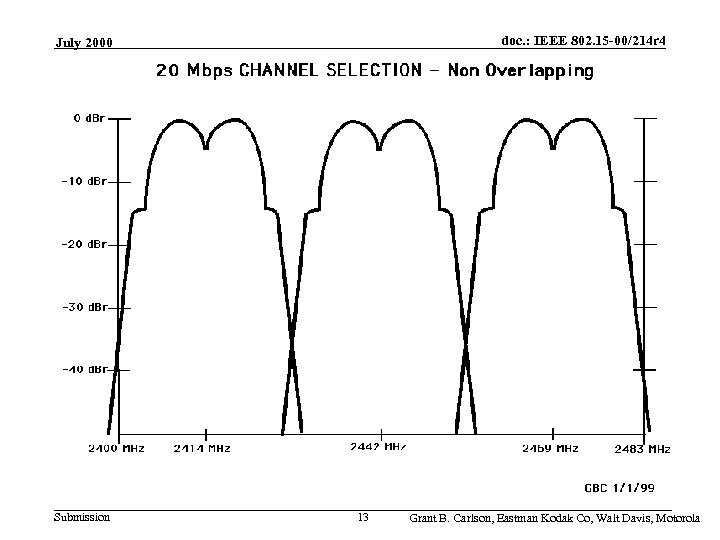
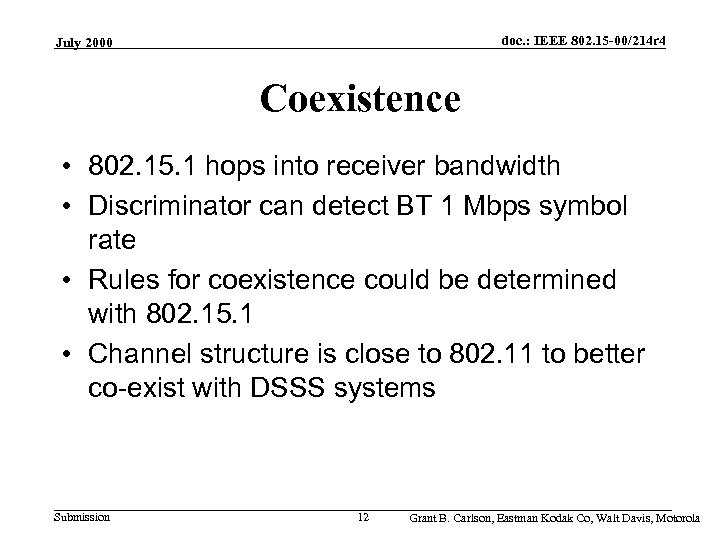 doc. : IEEE 802. 15 -00/214 r 4 July 2000 Coexistence • 802. 15. 1 hops into receiver bandwidth • Discriminator can detect BT 1 Mbps symbol rate • Rules for coexistence could be determined with 802. 15. 1 • Channel structure is close to 802. 11 to better co-exist with DSSS systems Submission 12 Grant B. Carlson, Eastman Kodak Co, Walt Davis, Motorola
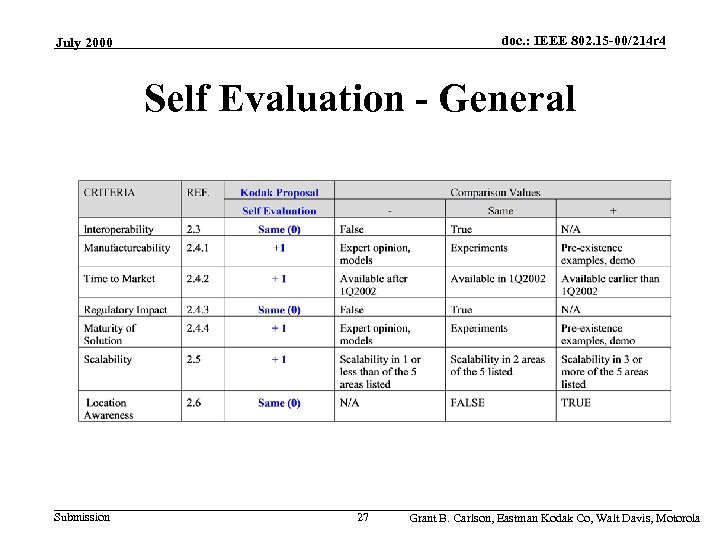
 doc. : IEEE 802. 15 -00/214 r 4 July 2000 Submission 13 Grant B. Carlson, Eastman Kodak Co, Walt Davis, Motorola
 doc. : IEEE 802. 15 -00/214 r 4 July 2000 4 Overlapping Channels 0 d. Bm -42 d. Bm 2400 Submission 2413 2432 2451 14 2470 2483. 5 Grant B. Carlson, Eastman Kodak Co, Walt Davis, Motorola
 doc. : IEEE 802. 15 -00/214 r 4 July 2000 Interoperability • Digital modem has bandwidth to demodulate 802. 15. 1 • PHY layer has FH capability and follows 802. 15. 1 rules • MAC controls PHY Mode • Is not interoperable with 802. 11 • . 1 and. 3 modes can not operate in the same Frame Submission 15 Grant B. Carlson, Eastman Kodak Co, Walt Davis, Motorola
 doc. : IEEE 802. 15 -00/214 r 4 July 2000 Time to Market • Standard technologies • No New Inventions Required • No New Agency Regulations Required Submission 16 Grant B. Carlson, Eastman Kodak Co, Walt Davis, Motorola
 doc. : IEEE 802. 15 -00/214 r 4 July 2000 Scalability • Power Consumption – Similar to 802. 15. 1 – Two RF power modes – Power Management • Data Rates – Variable from 15 to 45 Mbps – 802. 15. 1 compatibility mode Submission 17 Grant B. Carlson, Eastman Kodak Co, Walt Davis, Motorola
 doc. : IEEE 802. 15 -00/214 r 4 July 2000 Scalability • Cost – TBD - Depends on implementation • Functions – Can be implemented as 802. 15: • . 1 only • . 1 and. 3 • . 3 only Submission 18 Grant B. Carlson, Eastman Kodak Co, Walt Davis, Motorola
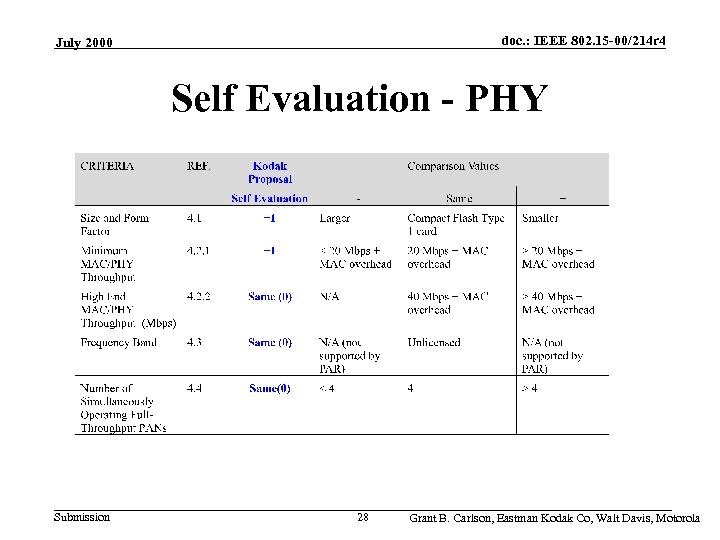
 doc. : IEEE 802. 15 -00/214 r 4 July 2000 Form and Size Factor • Similar to 802. 15. 1 class designs – Same RF band, digital demod can do either – Baseband channel filters can select 10 or 1 MHz spacing (VLIF with IR mixers for 802. 15. 1) – BT MAC is re-used for high rate, available for compatibility • 2 Chip solution – RF chip: 6 x 6 mm 0. 35 um Bi. CMOS technology – MAC + Baseband: 400 kgates, 6 x 6 mm in 0. 11 um CMOS • Minimal external parts – 1 crystal, 1 RF bandpass filter and 2 LDO regulators • Compatible with Compact Flash Cards Submission 19 Grant B. Carlson, Eastman Kodak Co, Walt Davis, Motorola
 doc. : IEEE 802. 15 -00/214 r 4 July 2000 Maturity • Prototypes – Built from Discrete Components – Tested in Open Range Submission 20 Grant B. Carlson, Eastman Kodak Co, Walt Davis, Motorola
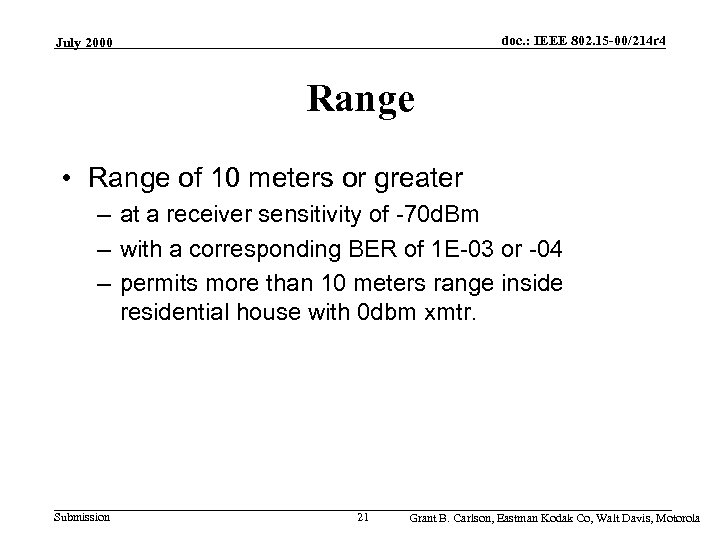 doc. : IEEE 802. 15 -00/214 r 4 July 2000 Range • Range of 10 meters or greater – at a receiver sensitivity of -70 d. Bm – with a corresponding BER of 1 E-03 or -04 – permits more than 10 meters range inside residential house with 0 dbm xmtr. Submission 21 Grant B. Carlson, Eastman Kodak Co, Walt Davis, Motorola
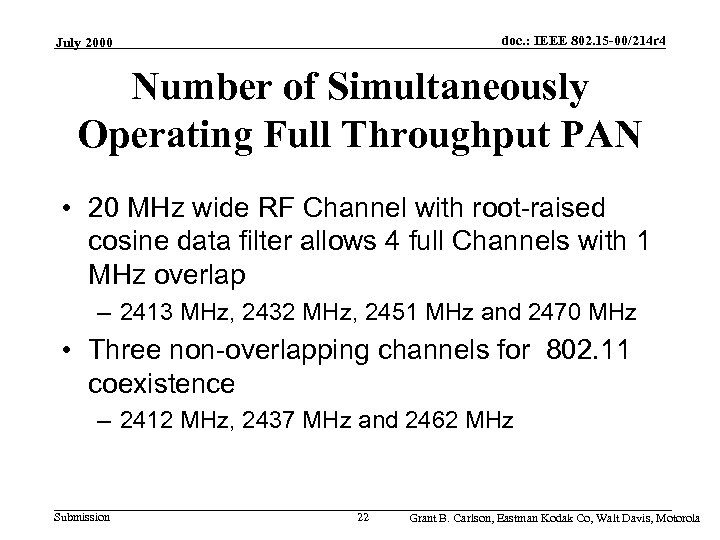 doc. : IEEE 802. 15 -00/214 r 4 July 2000 Number of Simultaneously Operating Full Throughput PAN • 20 MHz wide RF Channel with root-raised cosine data filter allows 4 full Channels with 1 MHz overlap – 2413 MHz, 2432 MHz, 2451 MHz and 2470 MHz • Three non-overlapping channels for 802. 11 coexistence – 2412 MHz, 2437 MHz and 2462 MHz Submission 22 Grant B. Carlson, Eastman Kodak Co, Walt Davis, Motorola
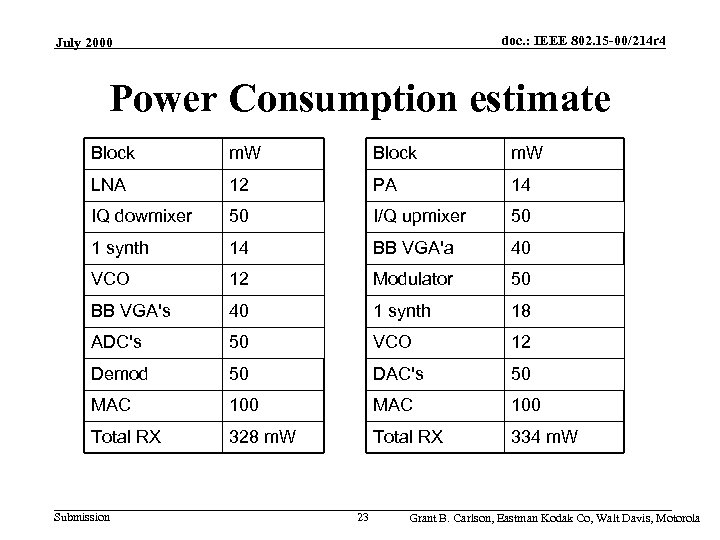 doc. : IEEE 802. 15 -00/214 r 4 July 2000 Power Consumption estimate Block m. W LNA 12 PA 14 IQ dowmixer 50 I/Q upmixer 50 1 synth 14 BB VGA'a 40 VCO 12 Modulator 50 BB VGA's 40 1 synth 18 ADC's 50 VCO 12 Demod 50 DAC's 50 MAC 100 Total RX 328 m. W Total RX 334 m. W Submission 23 Grant B. Carlson, Eastman Kodak Co, Walt Davis, Motorola
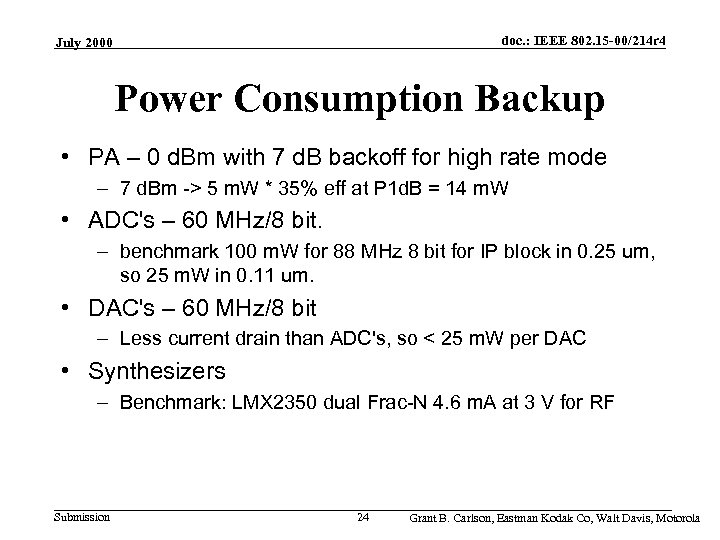 doc. : IEEE 802. 15 -00/214 r 4 July 2000 Power Consumption Backup • PA – 0 d. Bm with 7 d. B backoff for high rate mode – 7 d. Bm -> 5 m. W * 35% eff at P 1 d. B = 14 m. W • ADC's – 60 MHz/8 bit. – benchmark 100 m. W for 88 MHz 8 bit for IP block in 0. 25 um, so 25 m. W in 0. 11 um. • DAC's – 60 MHz/8 bit – Less current drain than ADC's, so < 25 m. W per DAC • Synthesizers – Benchmark: LMX 2350 dual Frac-N 4. 6 m. A at 3 V for RF Submission 24 Grant B. Carlson, Eastman Kodak Co, Walt Davis, Motorola
 doc. : IEEE 802. 15 -00/214 r 4 July 2000 Self Evaluation - General Submission 25 Grant B. Carlson, Eastman Kodak Co, Walt Davis, Motorola
 doc. : IEEE 802. 15 -00/214 r 4 July 2000 Self Evaluation - General Submission 26 Grant B. Carlson, Eastman Kodak Co, Walt Davis, Motorola
 doc. : IEEE 802. 15 -00/214 r 4 July 2000 Self Evaluation - General Submission 27 Grant B. Carlson, Eastman Kodak Co, Walt Davis, Motorola
 doc. : IEEE 802. 15 -00/214 r 4 July 2000 Self Evaluation - PHY Submission 28 Grant B. Carlson, Eastman Kodak Co, Walt Davis, Motorola
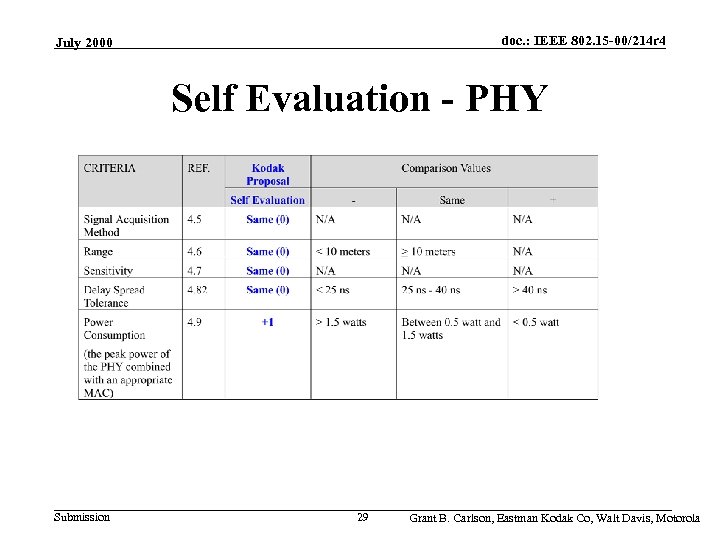 doc. : IEEE 802. 15 -00/214 r 4 July 2000 Self Evaluation - PHY Submission 29 Grant B. Carlson, Eastman Kodak Co, Walt Davis, Motorola
 doc. : IEEE 802. 15 -00/214 r 4 July 2000 Conclusion • This Simple Proposal Provides a Good Combination of: – – – Submission Cost Speed Coexistence/Commonality with 802. 15. 1 Time to Market Minimum Risks 30 Grant B. Carlson, Eastman Kodak Co, Walt Davis, Motorola
 doc. : IEEE 802. 15 -00/214 r 4 July 2000 Criteria Changes • Propose PHY Criteria is Data Rate, and listed Independent of MAC. • Propose Max. 2. 4 GHz channel bandwidth is limited to 20 MHz to support 802. 11 channel plan Submission 31 Grant B. Carlson, Eastman Kodak Co, Walt Davis, Motorola
 doc. : IEEE 802. 15 -00/214 r 4 July 2000 Appendix I - Criteria Ranking Comments • This appendix addresses the issues brought up in the various committee discussions, in order to make the feedback official. Submission 32 Grant B. Carlson, Eastman Kodak Co, Walt Davis, Motorola
 doc. : IEEE 802. 15 -00/214 r 4 July 2000 Appendix I • PHY issues for September 12 th. – Section 2. 5 Rating “ 0” Request “+1” • Submission This factor requires 3 or more scaleable factors to justify a "+1 rating. We already proposed Data rate (1 Mbps BT and 22 Mbps high rate), and Range (0 dbm and lower power for Kiosk work at less than one meter) This lower range also implies one of the several power saving modes. Our architecture provides many ways to power only necessary systems functions. In Addition, this architecture is compatible with 2. 4 or 5 GHz bands, although we recommend its uses only at 2. 4 GHz for cost and performance reasons. This provides a count of 4. In addition, one of the original functions of our architecture and implementation included an IF capable of receiving control, or low bandwidth signals from the ~400 MHz band even without the RF Rcvr or Xmtr sections being powered. Although not currently in our plans, this architecture still has that potential for this function and should be considered a feature for this body of experts to consider. 33 Grant B. Carlson, Eastman Kodak Co, Walt Davis, Motorola
 doc. : IEEE 802. 15 -00/214 r 4 July 2000 Appendix I – Section 4. 6 Rated “? ”, Request “ 0” • Submission In version two of this submission we requested a change from a "? " to a "0". It may not have been noticed. Our prototype was tested in an open range to over 300 feet, at BERs of 10 -6 as charted in previous submissions. Structural testing indicated ranges in excess of 10 meters. This configuration met FCC and ETSI rules for low power devices, and did have a patch antenna configuration. 34 Grant B. Carlson, Eastman Kodak Co, Walt Davis, Motorola
 doc. : IEEE 802. 15 -00/214 r 4 July 2000 Appendix I – Section 4. 8. 2 Rated “ 0”, Request “+1” • Submission The capture effect of 2 and 4 FSK systems, tend to reduce the multi-path affects when the incident signal strength exceeds any reflected signal by about 6 db. Consequently, this criteria should include magnitude aspects in addition to time. Walt Davis has volunteered to present simulation data to support the field and lab results we observed in our prototypes. It is being planed for the September meeting. Since this affect simplifies the architecture for a given price/performance point, I would like to argue for a +1 rating. 35 Grant B. Carlson, Eastman Kodak Co, Walt Davis, Motorola