


 Скачать презентацию doc IEEE 802 11 -16 0977 r 0
263ba314b8bfc9357dadc236ded3fc22.ppt
- Количество слайдов: 18
 doc. : IEEE 802. 11 -16/0977 r 0 July 2016 Measurements of 802. 11 behavior in different environments Authors: Submission Date: 2016 -07 -26 Slide 1 Jim Lansford (Qualcomm/CU-Boulder)
 doc. : IEEE 802. 11 -16/0977 r 0 July 2016 Abstract As a class project, students made measurements of channel occupancy of WLAN traffic in different environments to assess how much time is spent in each of the data rates and overall protocol efficiency. Submission Slide 2 Jim Lansford (Qualcomm/CU-Boulder)
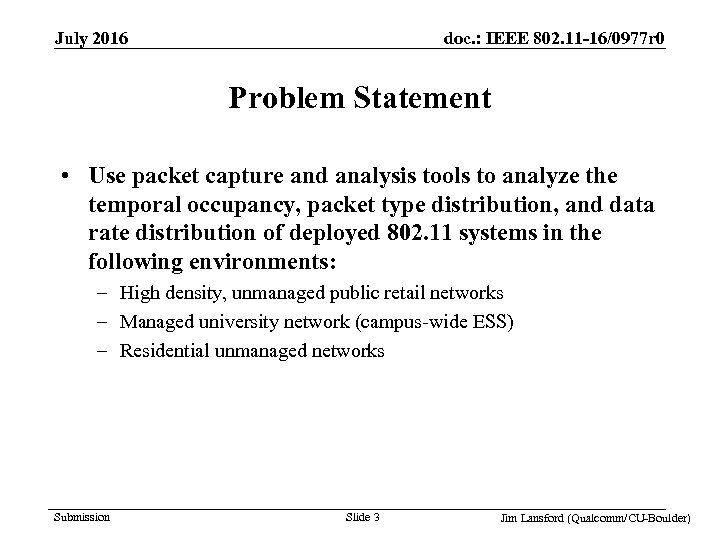 doc. : IEEE 802. 11 -16/0977 r 0 July 2016 Problem Statement • Use packet capture and analysis tools to analyze the temporal occupancy, packet type distribution, and data rate distribution of deployed 802. 11 systems in the following environments: – High density, unmanaged public retail networks – Managed university network (campus-wide ESS) – Residential unmanaged networks Submission Slide 3 Jim Lansford (Qualcomm/CU-Boulder)
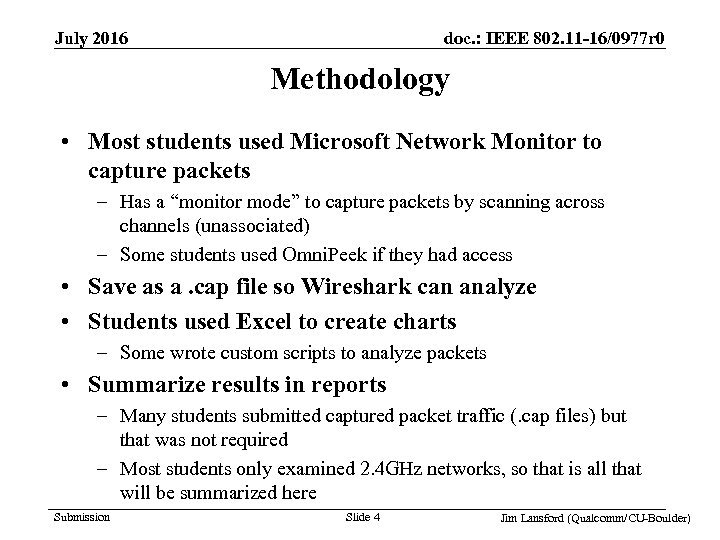 doc. : IEEE 802. 11 -16/0977 r 0 July 2016 Methodology • Most students used Microsoft Network Monitor to capture packets – Has a “monitor mode” to capture packets by scanning across channels (unassociated) – Some students used Omni. Peek if they had access • Save as a. cap file so Wireshark can analyze • Students used Excel to create charts – Some wrote custom scripts to analyze packets • Summarize results in reports – Many students submitted captured packet traffic (. cap files) but that was not required – Most students only examined 2. 4 GHz networks, so that is all that will be summarized here Submission Slide 4 Jim Lansford (Qualcomm/CU-Boulder)
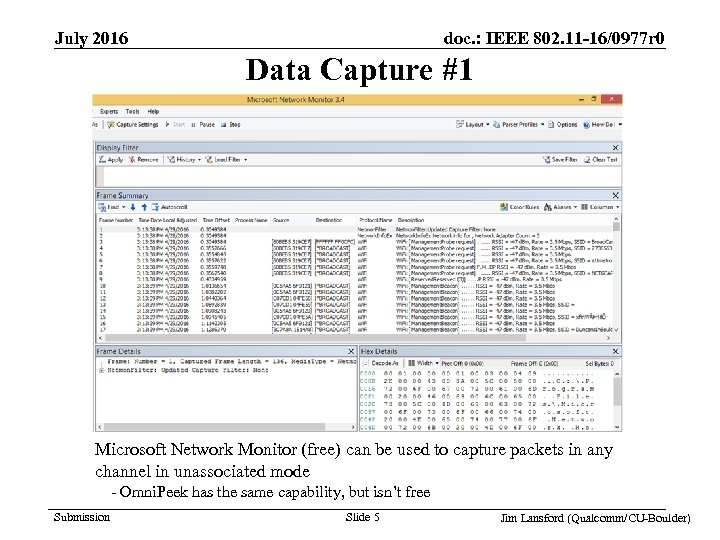 doc. : IEEE 802. 11 -16/0977 r 0 July 2016 Data Capture #1 Microsoft Network Monitor (free) can be used to capture packets in any channel in unassociated mode - Omni. Peek has the same capability, but isn’t free Submission Slide 5 Jim Lansford (Qualcomm/CU-Boulder)
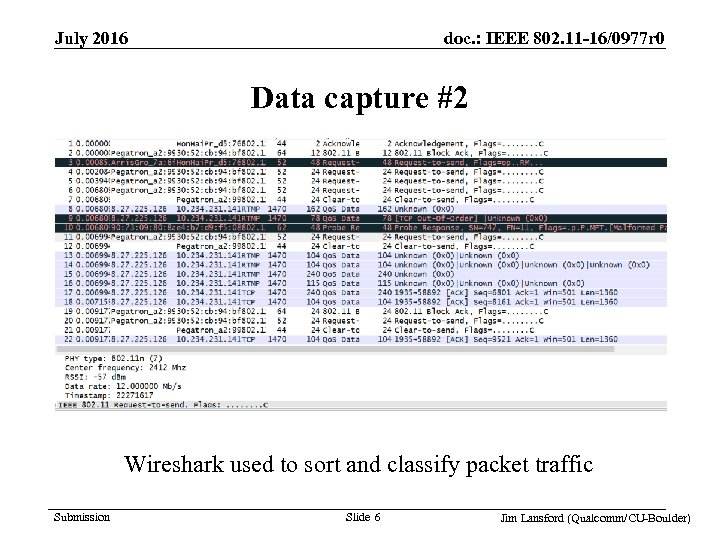 doc. : IEEE 802. 11 -16/0977 r 0 July 2016 Data capture #2 Wireshark used to sort and classify packet traffic Submission Slide 6 Jim Lansford (Qualcomm/CU-Boulder)
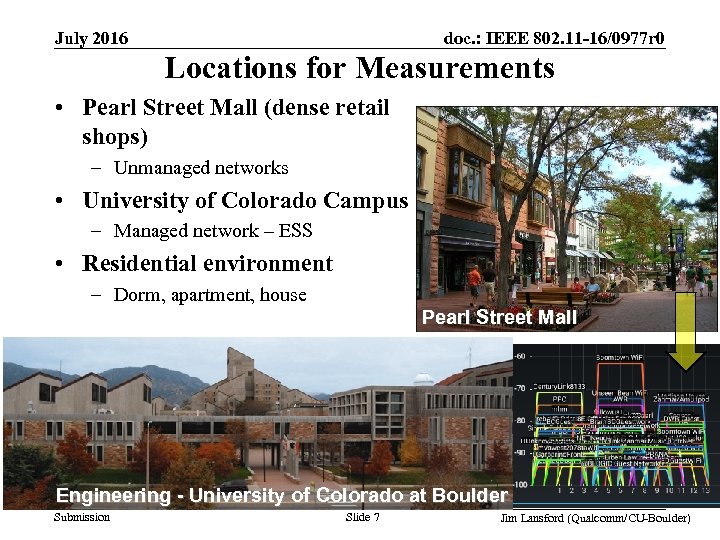 doc. : IEEE 802. 11 -16/0977 r 0 July 2016 Locations for Measurements • Pearl Street Mall (dense retail shops) – Unmanaged networks • University of Colorado Campus – Managed network – ESS • Residential environment – Dorm, apartment, house Pearl Street Mall Engineering - University of Colorado at Boulder Submission Slide 7 Jim Lansford (Qualcomm/CU-Boulder)
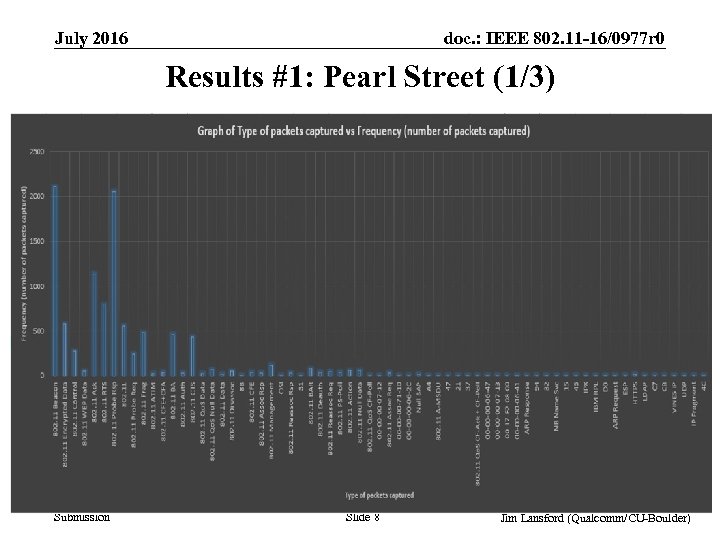 doc. : IEEE 802. 11 -16/0977 r 0 July 2016 Results #1: Pearl Street (1/3) Submission Slide 8 Jim Lansford (Qualcomm/CU-Boulder)
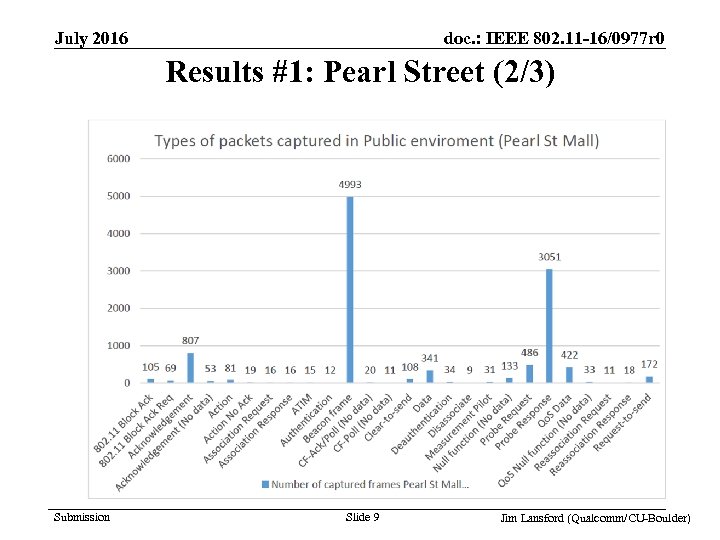 doc. : IEEE 802. 11 -16/0977 r 0 July 2016 Results #1: Pearl Street (2/3) Submission Slide 9 Jim Lansford (Qualcomm/CU-Boulder)
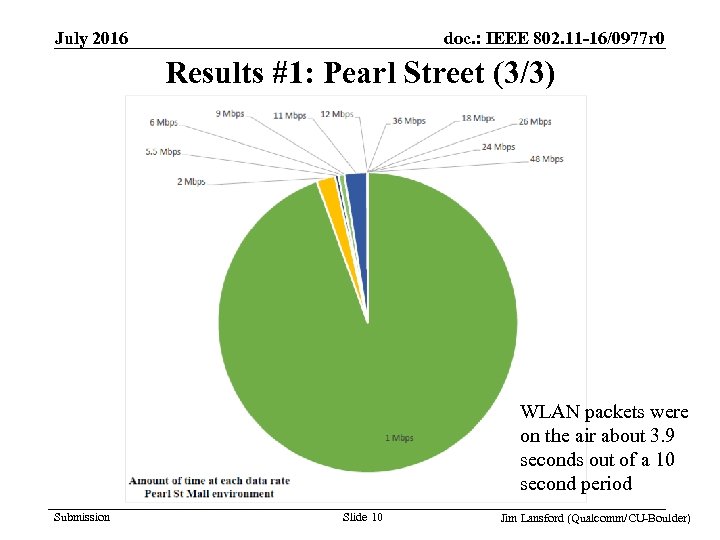 doc. : IEEE 802. 11 -16/0977 r 0 July 2016 Results #1: Pearl Street (3/3) WLAN packets were on the air about 3. 9 seconds out of a 10 second period Submission Slide 10 Jim Lansford (Qualcomm/CU-Boulder)
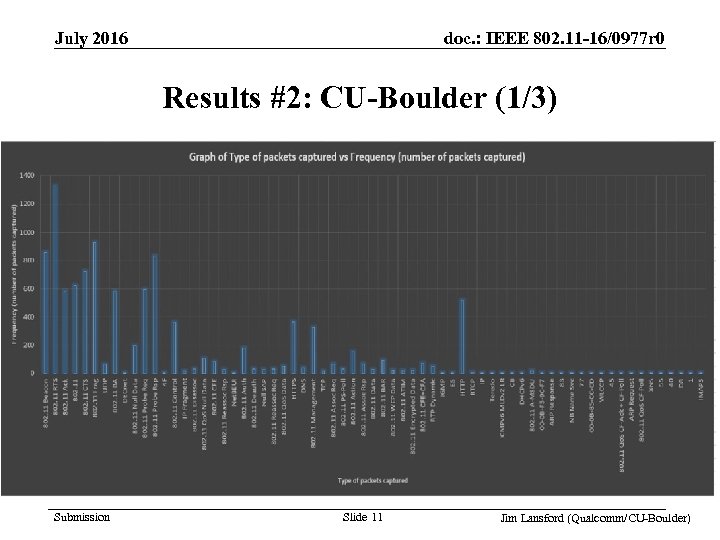 doc. : IEEE 802. 11 -16/0977 r 0 July 2016 Results #2: CU-Boulder (1/3) Submission Slide 11 Jim Lansford (Qualcomm/CU-Boulder)
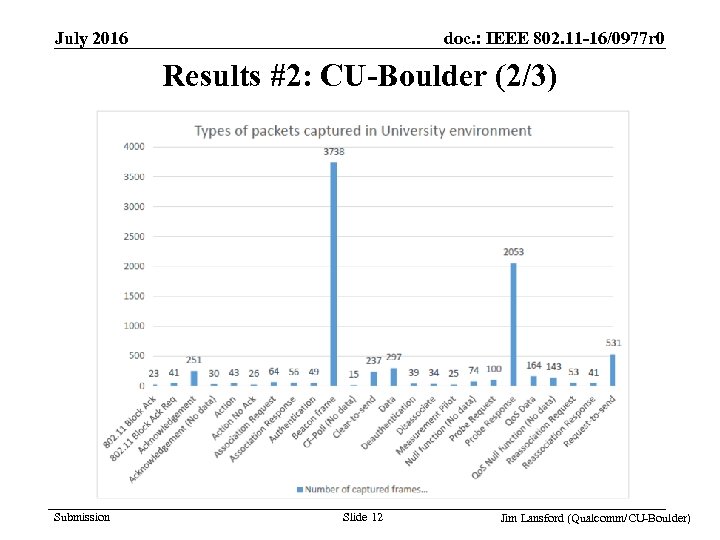 doc. : IEEE 802. 11 -16/0977 r 0 July 2016 Results #2: CU-Boulder (2/3) Submission Slide 12 Jim Lansford (Qualcomm/CU-Boulder)
 doc. : IEEE 802. 11 -16/0977 r 0 July 2016 Results #2: CU-Boulder (3/3) WLAN packets were on the air about 0. 8 seconds out of a 10 second period Submission Slide 13 Jim Lansford (Qualcomm/CU-Boulder)
 doc. : IEEE 802. 11 -16/0977 r 0 July 2016 Results #3: Residential (1/4) Submission Slide 14 Jim Lansford (Qualcomm/CU-Boulder)
 doc. : IEEE 802. 11 -16/0977 r 0 July 2016 Results #3: Residential (2/4) Submission Slide 15 Jim Lansford (Qualcomm/CU-Boulder)
 doc. : IEEE 802. 11 -16/0977 r 0 July 2016 Results #3: Residential (3/4) WLAN packets were on the air about 3. 1 seconds out of a 10 second period Submission Slide 16 Jim Lansford (Qualcomm/CU-Boulder)
 doc. : IEEE 802. 11 -16/0977 r 0 July 2016 Results #3: Residential (4/4) As expected, Channels 1, 6 and 11 are most popular in 2. 4 GHz, and 1 Mbps packets are most common Submission Slide 17 Jim Lansford (Qualcomm/CU-Boulder)
 doc. : IEEE 802. 11 -16/0977 r 0 July 2016 Summary • (2. 4 GHz) 1 Mbps traffic predominates – Beacons – Probe request/response - In congested environment, many more probe responses than probe requests – RTS/CTS • Significant amount of dead time even in congested environments – Roughly 40% temporal occupancy • One student examined retries and found about 35% of packets needed retries in the mall environment • Over 75% of packets were management frames in congested environments • Impact of 802. 11 ax? • All papers are available as well as much of the raw data Submission Slide 18 Jim Lansford (Qualcomm/CU-Boulder)