


 Скачать презентацию doc IEEE 802 11 -09 1153 r 2
6f2a73aca2c280259bac033f85a3ac84.ppt
- Количество слайдов: 13
 doc. : IEEE 802. 11 -09/1153 r 2 November 2009 Motivation and Requirements on 60 GHz Beamforming Date: 2009 -11 -15 Authors: Name Affiliations Address Phone Email Carlos Cordeiro Intel Corp. OR, USA 503 -712 -9356 Carlos. Cordeiro@intel. com Sai Shankar Broadcom CA, USA nsai@broadcom. com Hongyuan Zhang Marvell CA, USA Hongyuan. Zhang@marvell. com Gal Basson Wilocity Israel Gal. Basson@wilocity. com Liwen Chu ST Micro CA, USA Liwen. Chu@st. com James Yee Media. Tek Taiwan James. Yee@mediatek. com Assaf Kasher Intel Corp. Israel Assaf. Kasher@intel. com Chris Hansen Broadcom CA, USA chansen@broadcom. com Yong Liu Marvell CA, USA Yong. Liu@marvell. com Chao-Chun Wang Media. Tek Taiwan Chao-chun. wang@mediatek. com Jason Trachewsky Broadcom CA, USA jat@broadcom. com Submission Slide 1 Carlos Cordeiro, Intel
 doc. : IEEE 802. 11 -09/1153 r 2 November 2009 Outline • • Introduction and Goals Motivation for beamforming (BF) BF terminology Requirements on BF protocol – – – One BF protocol for all usages/scenarios Discovery mode Antenna sub-assembly and antenna types Sector level BF and beam refinement When to do BF • Conclusions Submission Slide 2 Carlos Cordeiro, Intel
 doc. : IEEE 802. 11 -09/1153 r 2 November 2009 Introduction and Goals • In 09/0572 r 0, the authors show that most usages in 60 GHz require directional communication in order to meet link budget requirements • BF enables a pair of devices to train their transmit and/or receive antennas in order to achieve directional communication • Therefore, in this presentation we: – Motivate the need for BF and introduce selected BF terminology – Discuss various requirements that a BF protocol for 60 GHz must meet Submission Slide 3 Carlos Cordeiro, Intel
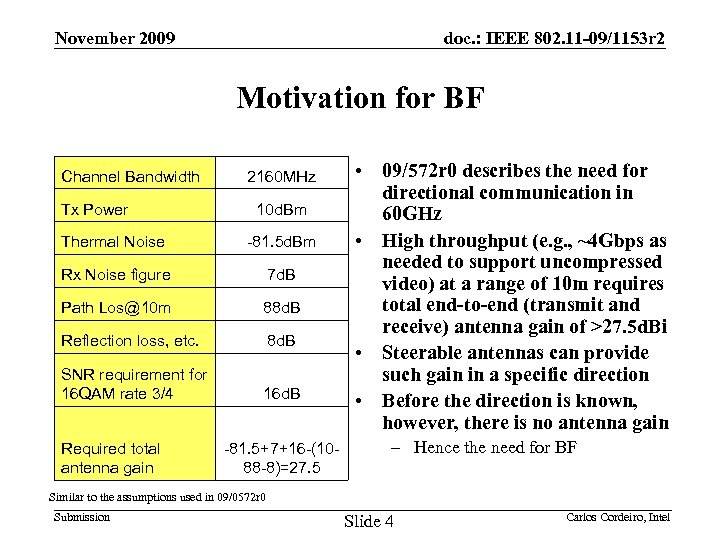 doc. : IEEE 802. 11 -09/1153 r 2 November 2009 Motivation for BF Channel Bandwidth Tx Power 2160 MHz 10 d. Bm Thermal Noise -81. 5 d. Bm Rx Noise figure 7 d. B Path Los@10 m 88 d. B Reflection loss, etc. 8 d. B SNR requirement for 16 QAM rate 3/4 16 d. B Required total antenna gain -81. 5+7+16 -(1088 -8)=27. 5 • 09/572 r 0 describes the need for directional communication in 60 GHz • High throughput (e. g. , ~4 Gbps as needed to support uncompressed video) at a range of 10 m requires total end-to-end (transmit and receive) antenna gain of >27. 5 d. Bi • Steerable antennas can provide such gain in a specific direction • Before the direction is known, however, there is no antenna gain – Hence the need for BF Similar to the assumptions used in 09/0572 r 0 Submission Slide 4 Carlos Cordeiro, Intel
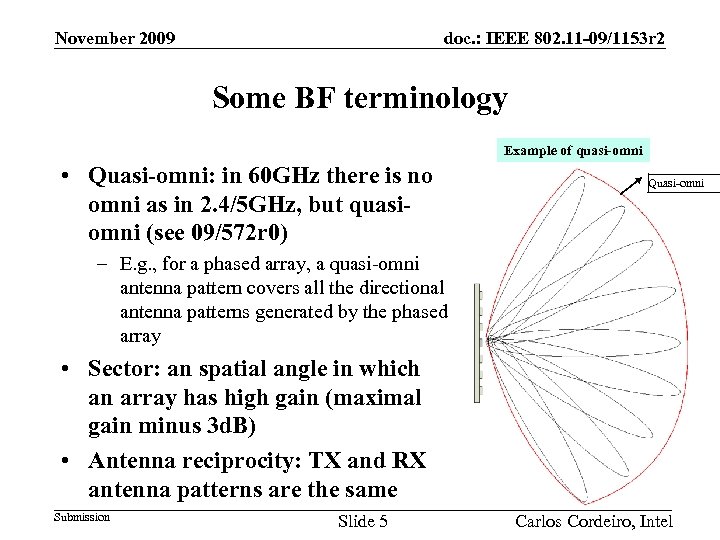 doc. : IEEE 802. 11 -09/1153 r 2 November 2009 Some BF terminology Example of quasi-omni • Quasi-omni: in 60 GHz there is no omni as in 2. 4/5 GHz, but quasiomni (see 09/572 r 0) Quasi-omni – E. g. , for a phased array, a quasi-omni antenna pattern covers all the directional antenna patterns generated by the phased array • Sector: an spatial angle in which an array has high gain (maximal gain minus 3 d. B) • Antenna reciprocity: TX and RX antenna patterns are the same Submission Slide 5 Carlos Cordeiro, Intel
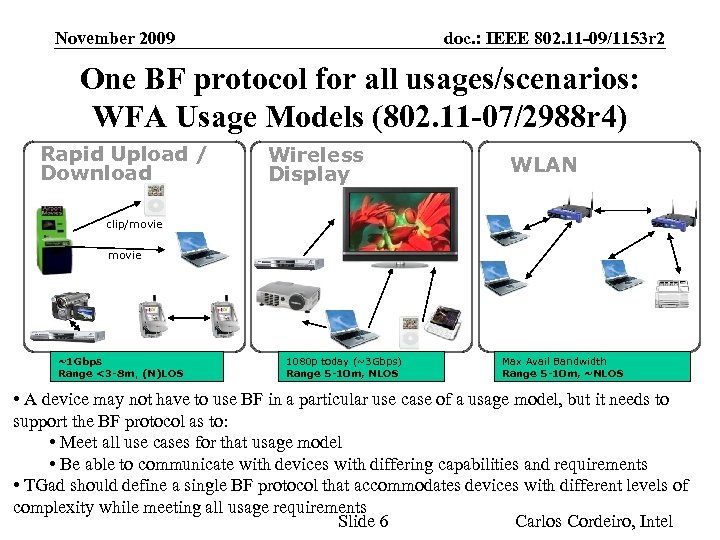 doc. : IEEE 802. 11 -09/1153 r 2 November 2009 One BF protocol for all usages/scenarios: WFA Usage Models (802. 11 -07/2988 r 4) Rapid Upload / Download Wireless Display WLAN clip/movie ~1 Gbps Range <3 -8 m, (N)LOS 1080 p today (~3 Gbps) Range 5 -10 m, NLOS Max Avail Bandwidth Range 5 -10 m, ~NLOS • A device may not have to use BF in a particular use case of a usage model, but it needs to support the BF protocol as to: • Meet all use cases for that usage model • Be able to communicate with devices with differing capabilities and requirements • TGad should define a single BF protocol that accommodates devices with different levels of complexity while meeting all usage requirements Submission Slide 6 Carlos Cordeiro, Intel
 doc. : IEEE 802. 11 -09/1153 r 2 November 2009 Discovery mode • Until BF is done devices do not know the right direction to use for communication with each other (assuming at least one of them have more than one direction available) • Need to provide a mode that compensates for the lack of antenna gain (e. g. , up to 15 d. Bi loss at each end of a link) so that devices can, at a minimum, discover each other – BF can be done at or after discovery – If BF is done at discovery, then certain frames (e. g. , beacon) may be used in support of BF • Needless to say, the lower SNR caused by the lost gain will result in a lower rate for the discovery mode – In 09/0572 r 0, a net bit-rate of ~2 Mbps is shown for an 8 element antenna Submission Slide 7 Carlos Cordeiro, Intel
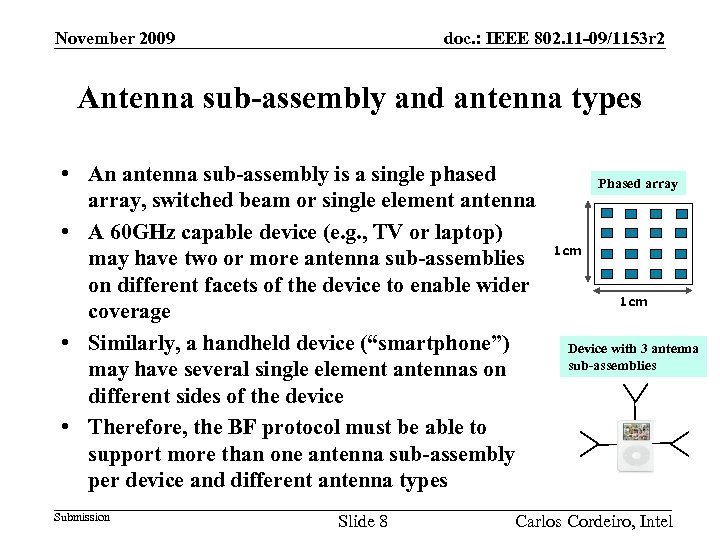 doc. : IEEE 802. 11 -09/1153 r 2 November 2009 Antenna sub-assembly and antenna types • An antenna sub-assembly is a single phased array, switched beam or single element antenna • A 60 GHz capable device (e. g. , TV or laptop) may have two or more antenna sub-assemblies on different facets of the device to enable wider coverage • Similarly, a handheld device (“smartphone”) may have several single element antennas on different sides of the device • Therefore, the BF protocol must be able to support more than one antenna sub-assembly per device and different antenna types Submission Slide 8 Phased array 1 cm Device with 3 antenna sub-assemblies Carlos Cordeiro, Intel
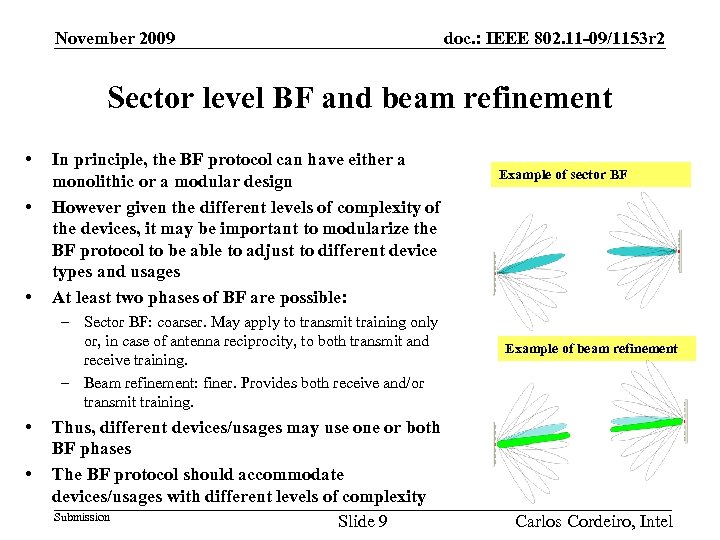 November 2009 doc. : IEEE 802. 11 -09/1153 r 2 Sector level BF and beam refinement • • • In principle, the BF protocol can have either a monolithic or a modular design However given the different levels of complexity of the devices, it may be important to modularize the BF protocol to be able to adjust to different device types and usages At least two phases of BF are possible: – Sector BF: coarser. May apply to transmit training only or, in case of antenna reciprocity, to both transmit and receive training. – Beam refinement: finer. Provides both receive and/or transmit training. • • Thus, different devices/usages may use one or both BF phases The BF protocol should accommodate devices/usages with different levels of complexity Submission Slide 9 Example of sector BF Example of beam refinement Carlos Cordeiro, Intel
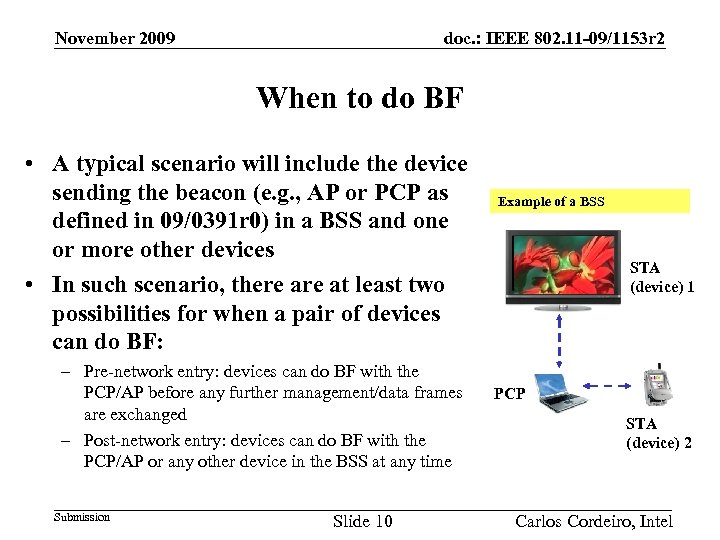 doc. : IEEE 802. 11 -09/1153 r 2 November 2009 When to do BF • A typical scenario will include the device sending the beacon (e. g. , AP or PCP as defined in 09/0391 r 0) in a BSS and one or more other devices • In such scenario, there at least two possibilities for when a pair of devices can do BF: – Pre-network entry: devices can do BF with the PCP/AP before any further management/data frames are exchanged – Post-network entry: devices can do BF with the PCP/AP or any other device in the BSS at any time Submission Slide 10 Example of a BSS STA (device) 1 PCP STA (device) 2 Carlos Cordeiro, Intel
 doc. : IEEE 802. 11 -09/1153 r 2 November 2009 When to do BF: pre-network entry BF • As shown in 09/0572 r 0, the discovery mode can have a net bit-rate about 1000 x lower than that achieved after BF is done • To minimize the use of low rate modes, the spec should allow devices to quickly bring up a BF link between them • Therefore, the spec should allow a device to do BF with the PCP/AP before it enters the network – Once the BF link is up, the device can then exchange frames in a high bitrate BF mode • Pre-network entry BF implies that the BF protocol can be executed without assuming that the BF devices: – Know the capabilities of each other (e. g. , antenna type, number of antenna phased arrays, antenna reciprocity, etc. ) – Have time synchronization Submission Slide 11 Carlos Cordeiro, Intel
 doc. : IEEE 802. 11 -09/1153 r 2 November 2009 When to do BF: post-network entry BF • Once the device joins the network, capabilities may be exchanged with any other device that already participates in the same network • Once the device knows the capability of the another device, the BF protocol can be configured to be executed on the basis of the specific capabilities of both the transmitter and the receiver – In some cases, it may be even possible to assume timing synchronization • TGad should define a single BF protocol that is applicable to both pre-network entry and post-network entry BF Submission Slide 12 Carlos Cordeiro, Intel
 doc. : IEEE 802. 11 -09/1153 r 2 November 2009 Conclusions • We believe BF is one of the most important features in the TGad 60 GHz specification and will be decisive in enabling successful 60 GHz products • We believe TGad should define a unified BF protocol that, among other things, : – Enables the MAC/PHY to meet the requirements of all usage models and support all device types – Supports different antenna types, more than one steerable antenna per device, and does not assume antenna reciprocity – Has a modular design – Supports pre-network entry and post-network entry BF – Allows fast BF link (re-)establishment and tracking Submission Slide 13 Carlos Cordeiro, Intel