 Скачать презентацию Dobrý deň means Good afternoon in
14f50137e0c2b1ce1987138ba465ca17.ppt
- Количество слайдов: 20



„Dobrý deň!“ * * means „Good afternoon“ in the Slovak language
Slovak Academic Association For International Cooperation • Non-governmental association (members are Slovak higher education institutions) • Support and Coordination of International Cooperation of Slovak universities • Information, consulting and advisory services about international educational programmes (LLP, Tempus, Erasmus Mundus and other EU programmes and projects) • Publish information materials and promote Slovak education abroad.
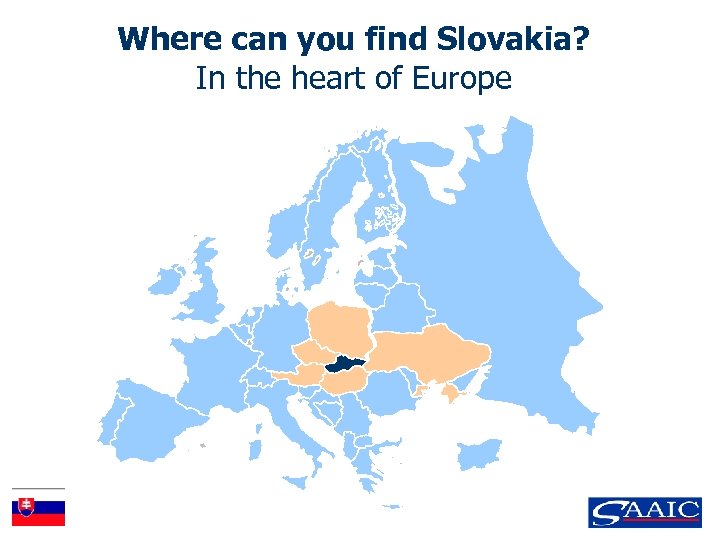
Where can you find Slovakia? In the heart of Europe
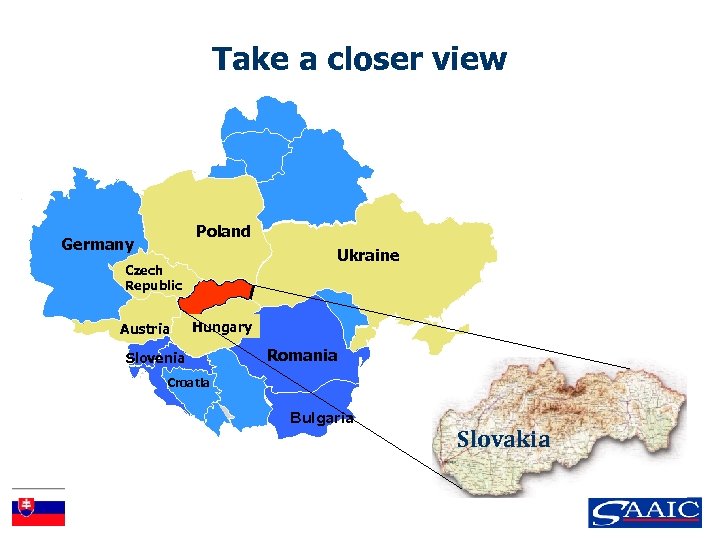
Take a closer view Poland Germany Ukraine Czech Republic Austria Hungary Slovenia Romania Croatia Bulgaria Slovakia
Some facts on Slovakia Establishment: January 1 st, 1993 (former part of Czecho-slovakia) State organisation: Republic Political system: Parliamentary democracy Official language: Slovak Capital city: Bratislava Area: 49, 035 km 2 Population: 5. 4 million Population density: 109/km 2
. . . more facts Ethnicity of the population: Slovak (85. 8%), Hungarian (9. 7%), Romany (1. 7%), Czech (0. 8%), Ruthenians, Ukrainian, Russian, German, Polish and others (2%) Population by religion: Roman Catholic (68. 9%), Evangelical Lutheran (6. 9%), Greek Catholic (4. 1%), Reform Christian (2%), Orthodox (0, 09%)Jewish (0, 04%), without denomination (13. 7%) Currency: Slovak crown (1 EUR = 33, 4 SKK) Climate: continental character with warm summers and cold winters
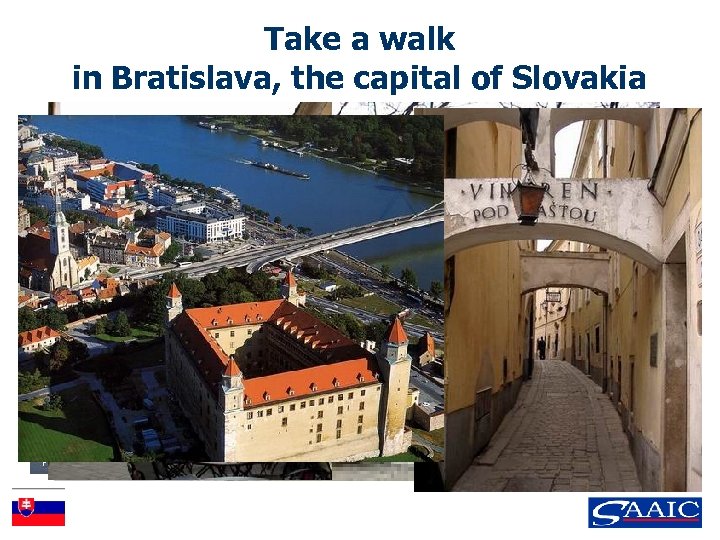
Take a walk in Bratislava, the capital of Slovakia
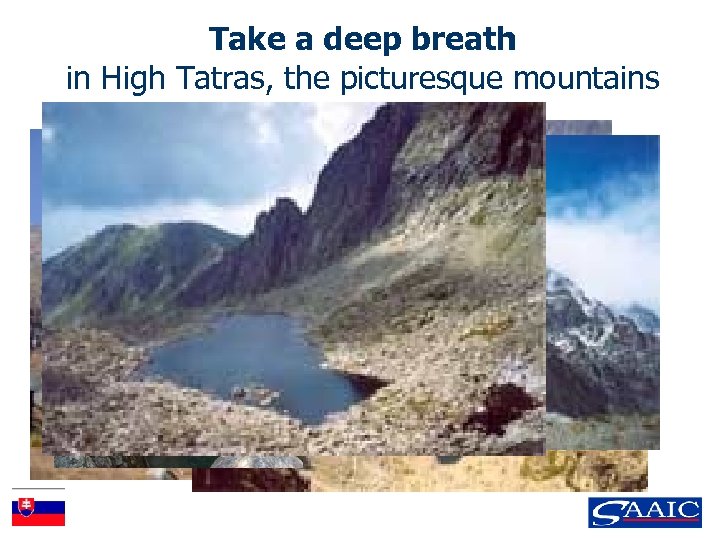
Take a deep breath in High Tatras, the picturesque mountains
The overview of Higher Education Institutions in the Slovak Republic • 20 public HEIs (mainly state budget) – in all regional capitals Bratislava, Trnava, Nitra, Trenčín, Žilina, B. Bystrica, Prešov, Košice) • 10 private HEIs (mainly own financial means) • 3 state HEIs (mainly state budget) Until today – all public HEIs – university type At present – new law under the preparation – 3 types: university, HEI, professional HEI
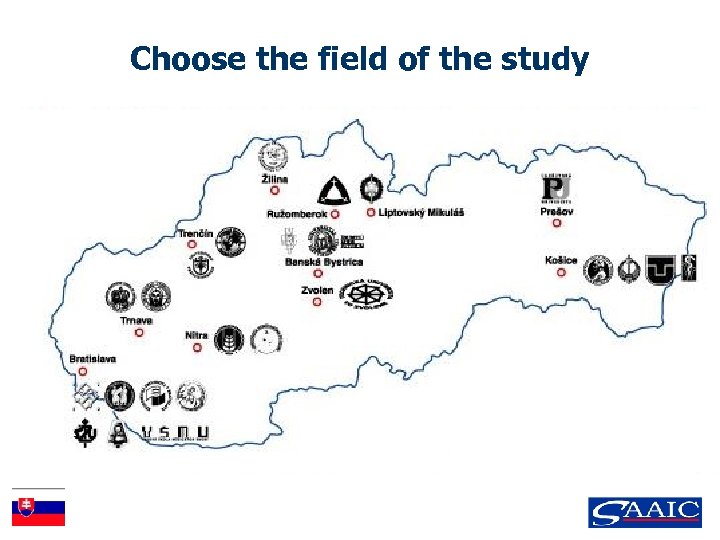
Choose the field of the study
Bologna process in the Slovak Republic Slovakia is among the first countries which signed the Bologna declaration – today 46 countries signed Implementation of BP Legislative changes: Act on HE introduced 3 cycle system in 2002 (it was already declared before the Bologna declaration) Separate decree introduced the credit system in 2002 Starting academic year 2005/2006 all new study programmes have to follow the new legislation completely (3 cycle and credits)
System of Higher Education According the Higher Education Act adapted in April 2002 : 3 -cycle system of HE: • Bachelor – 3 -4 years (180 -240 credits) • Master- 1, 5 -2 years (90 – 120 credits) • Ph. D study- 3 years (180 credits) Starting 2005/2006 – long-cycle study programmes have been phased out (there are exceptions – theology, medicine, veterinary medicine, pharmacy) New study programmes – according to the new legislation
System of Higher Education ECTS – starting 2002 the credit system has been implemented (for both transfer and accumulation purposes)and the information packages issued by all HEIs starting the academic year 2005/2006 as obligatory at all 3 levels. ECTS – academic year/2 semesters/60 credits Diploma supplement – to be introduced for the graduates starting to study in 2005/2006 Recognition – individual study/Erasmus mobility diplomas/ NARIC
System of Higher Education Accreditation & Evaluation Accreditation Commission (state body) – gives the opinion on ability of the HEI to carry out: • the study programmes, change of the field of study Ph. D study programmes; • habilitation procedures and nomination of the professors; • classification of the HEIs (e. g. research university); • complex accreditation of HEIs (every 6 years).
System of Higher Education External evaluation Accreditation Commission – using internal evaluation processes, peer reviews Project of the Institutional evaluation of the HEIs: all 20 public HEIs, 2 state and 1 private HEI participate in the cooperation with EUA: 1. Quality of HE as the priority of the Slovak HEIs; 2. Creation of the system of QE/separation of the accreditation; 3. Institutional evaluation and self-evaluation.
Internationalization of Slovak Higher Education 1990 – change of the HEIs position & new possibilities opened to the Western countries Tempus – support to the development of HE multilateral cooperation projects; 1998 - Socrates/Erasmus new dimension /not only outgoing students but incoming (very low amounts, after 2004 rapidly increased bilateral agreements – with all EU, EFTA and candidate countries; 2007 - Life-long learning Programme/Erasmus, Comenius, Grundtvig, Jean Monet;
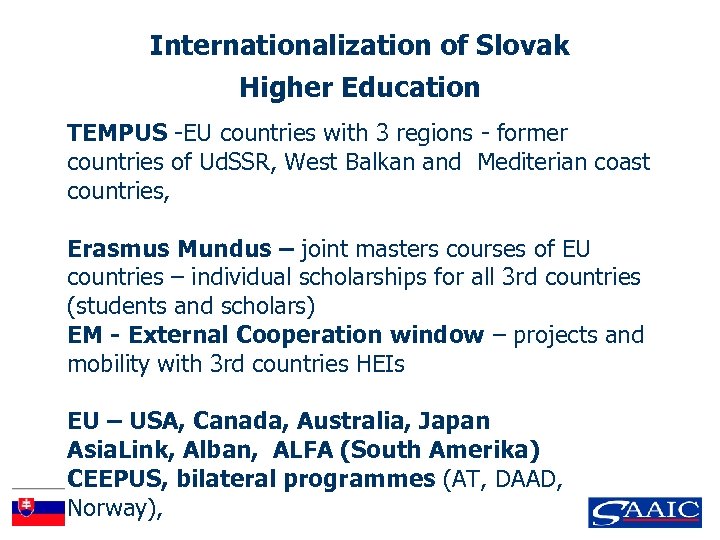
Internationalization of Slovak Higher Education TEMPUS -EU countries with 3 regions - former countries of Ud. SSR, West Balkan and Mediterian coast countries, Erasmus Mundus – joint masters courses of EU countries – individual scholarships for all 3 rd countries (students and scholars) EM - External Cooperation window – projects and mobility with 3 rd countries HEIs EU – USA, Canada, Australia, Japan Asia. Link, Alban, ALFA (South Amerika) CEEPUS, bilateral programmes (AT, DAAD, Norway),
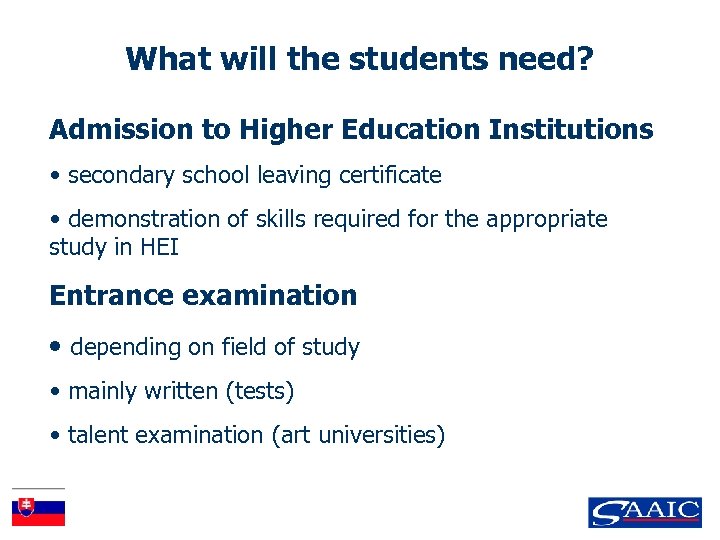
What will the students need? Admission to Higher Education Institutions • secondary school leaving certificate • demonstration of skills required for the appropriate study in HEI Entrance examination • depending on field of study • mainly written (tests) • talent examination (art universities)
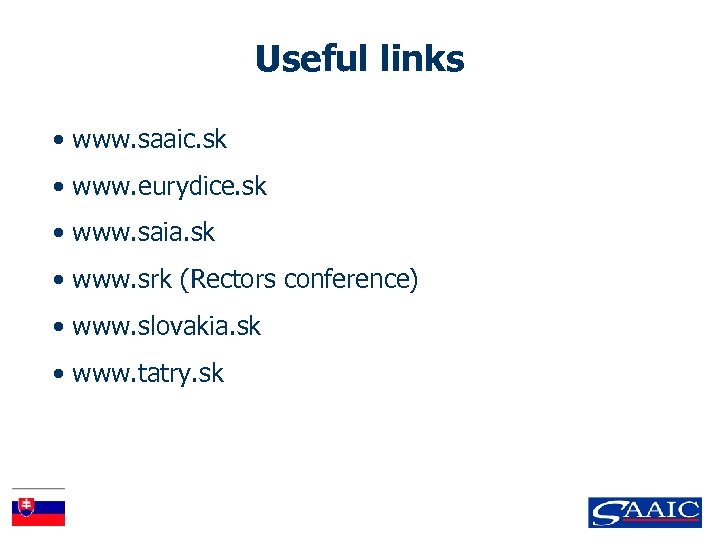
Useful links • www. saaic. sk • www. eurydice. sk • www. saia. sk • www. srk (Rectors conference) • www. slovakia. sk • www. tatry. sk
Thank you for your attention! Contact: Viera Farkašová Head of Unit of Academic programmes and projects SAAIC, Stare grunty 52, Bratislava e-mail: viera. farkasova@saaic. sk T: +421 2 654 12 336
Скачать презентацию Dobrý deň means Good afternoon in
14f50137e0c2b1ce1987138ba465ca17.ppt