 Скачать презентацию Do you believe the Articles of Confederation could
3abba3af4de20ccb792e8ab186de18b8.ppt
- Количество слайдов: 16



Do you believe the Articles of Confederation could have survived with out changes?
Assembly of the Demi-Gods n n Who were the Delegates? (Read the handout) Delegates were the “well-bred, the wellfed, the well-read, and the well-wed” n Wealthy Merchants of the North Wealthy Slave holders of the South n q q Today’s Government q q n $96, 000 average family Hard to run q n Senate – 67 millionaires Sen - $2. 6 mill average worth House $750, 000 average Avg Salary - $175, 000 Cant relate Inside tips
The Constitutional Convention • Many were frustrated with the Articles of Confederation: farmers, veterans, merchants doing business between states, and creditors of the Continental Congress who had not been paid. • Congress called all the states to meet in Philadelphia in May 1787 to revise the Articles of Confederation. • 12 states attended some or all of the meetings. • Politicians in Rhode Island were opposed to a stronger government; they chose not to take part in the convention. • James Madison kept a detailed account of the convention in his diary.
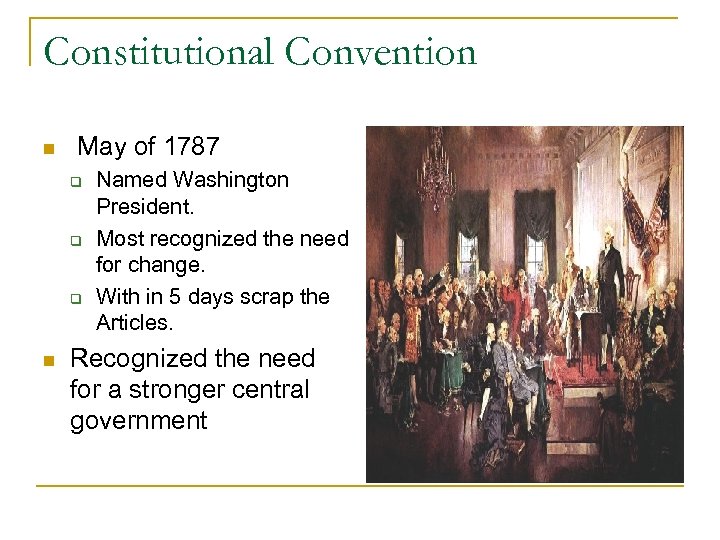
Constitutional Convention n May of 1787 q q q n Named Washington President. Most recognized the need for change. With in 5 days scrap the Articles. Recognized the need for a stronger central government
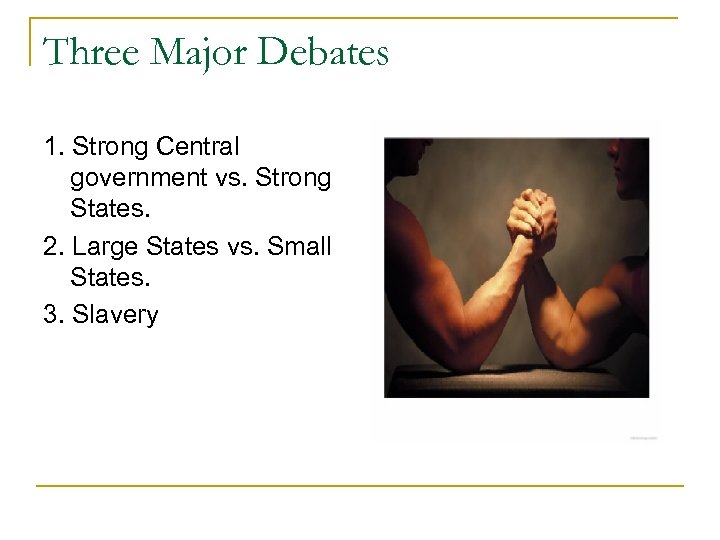
Three Major Debates 1. Strong Central government vs. Strong States. 2. Large States vs. Small States. 3. Slavery
Making a Consitituion • • • No Chief Executive No National Court System No Power to Draft Soldiers No Power to Control Interstate Commerce No Power to Enforce Treaties No Power to Collect Taxes from the States Difficult to Pass Laws (2/3 vote) No National Currency Difficult to Amend (Unanimous Vote Needed to Change Articles) n Outline a Constitution you would make addressing the following issues: q q q Weaknesses of the Articles Balancing Power Slaves?
Ideas for Constitution
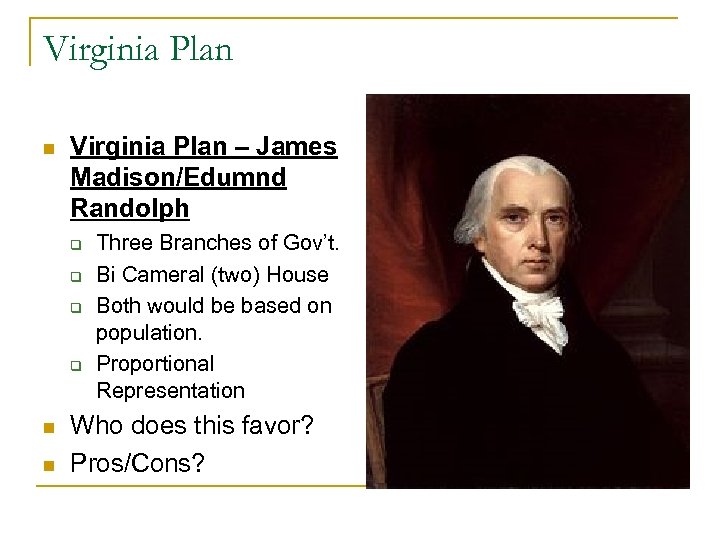
Virginia Plan n Virginia Plan – James Madison/Edumnd Randolph q q n n Three Branches of Gov’t. Bi Cameral (two) House Both would be based on population. Proportional Representation Who does this favor? Pros/Cons?
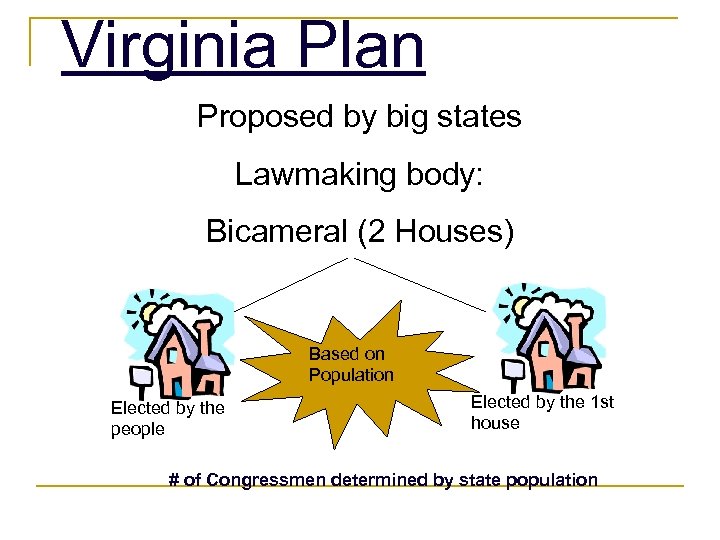
Virginia Plan Proposed by big states Lawmaking body: Bicameral (2 Houses) Based on Population Elected by the people Elected by the 1 st house # of Congressmen determined by state population
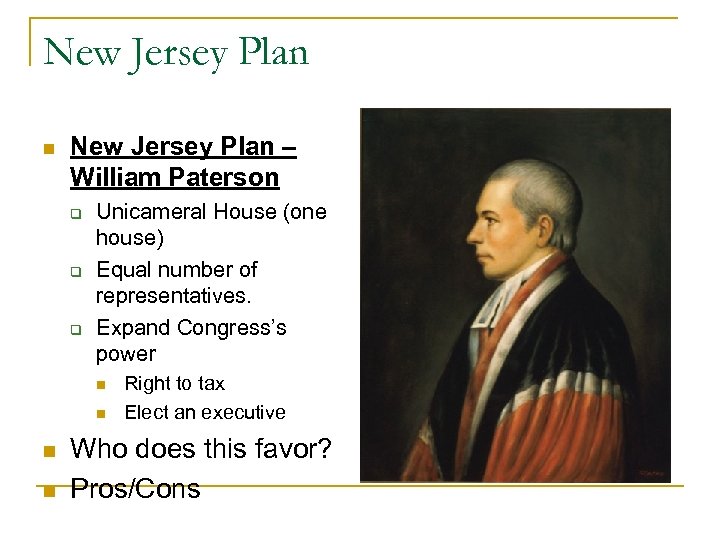
New Jersey Plan n New Jersey Plan – William Paterson q q q Unicameral House (one house) Equal number of representatives. Expand Congress’s power n n Right to tax Elect an executive Who does this favor? Pros/Cons
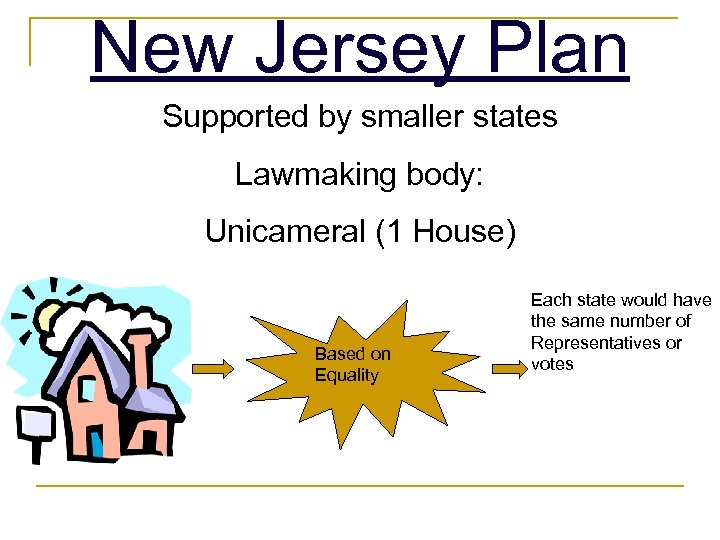
New Jersey Plan Supported by smaller states Lawmaking body: Unicameral (1 House) Based on Equality Each state would have the same number of Representatives or votes
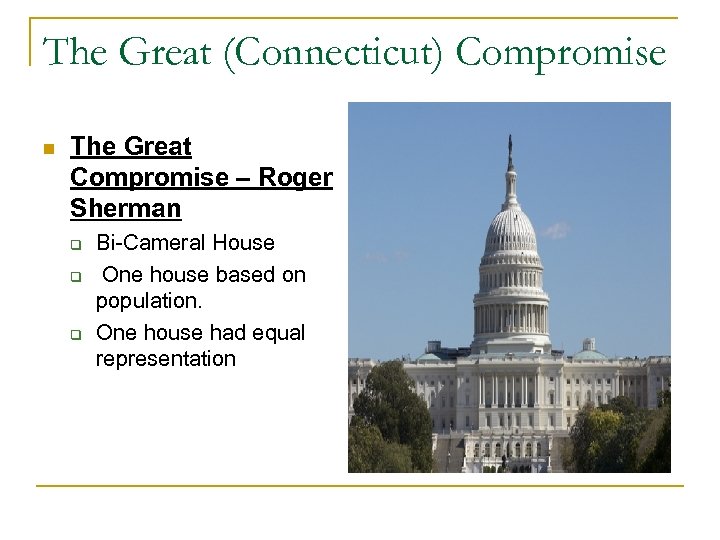
The Great (Connecticut) Compromise n The Great Compromise – Roger Sherman q q q Bi-Cameral House One house based on population. One house had equal representation
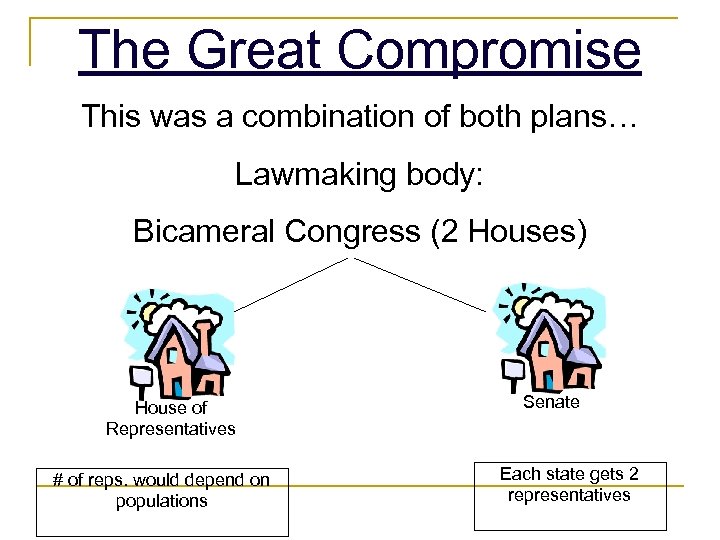
The Great Compromise This was a combination of both plans… Lawmaking body: Bicameral Congress (2 Houses) House of Representatives # of reps. would depend on populations Senate Each state gets 2 representatives
Compromises on Slavery • Southern states wanted to count all slaves for representation purposes but none for taxation. • Northern states objected. • In order to maintain unity between North and South, delegates agreed to a clause allowing the slave trade to continue for 20 years. • Another clause, the fugitive slave clause, stated that a slave who fled to another state had to be returned to his or her original state.
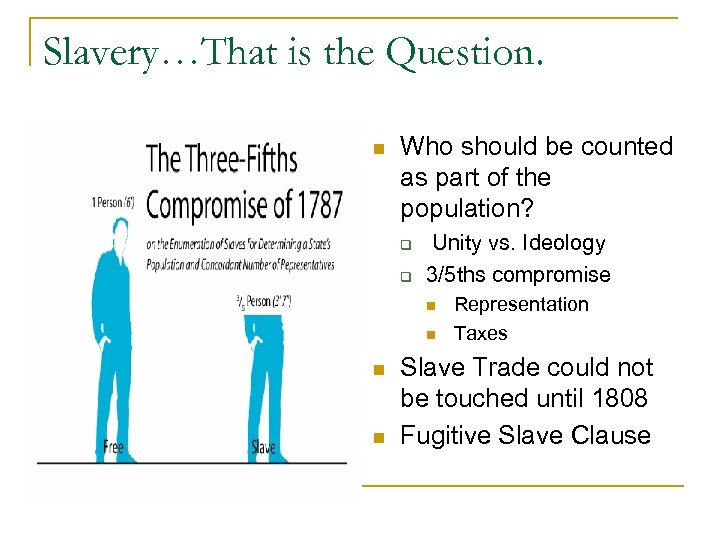
Slavery…That is the Question. n Who should be counted as part of the population? q q Unity vs. Ideology 3/5 ths compromise n n Representation Taxes Slave Trade could not be touched until 1808 Fugitive Slave Clause
What issues did the Constitution leave unresolved? n n n 1. 2. 3.
Скачать презентацию Do you believe the Articles of Confederation could
3abba3af4de20ccb792e8ab186de18b8.ppt