


 Скачать презентацию Do we know JAPAN Inyong Ham Distinguished Prof
f19a0b0ef08d907471c9f9561fc7ff39.ppt
- Количество слайдов: 32
 Do we know JAPAN? Inyong Ham, Distinguished Prof. Emeritus, Pennsylvania Sate U, 1
 PARADOX Contrary to the general belief of American businesses and industrial communities with regard to the unique features and real strengths that characterize the Japanese industry’s success, it is not ‘JIT’, ‘QC Circles’, Life-time Employment, etc. Two of the most important facts are: 1. Subcontractor System (Big Company vs. Small Company) 2. Management of Technology Inyong Ham, Distinguished Prof. Emeritus, Pennsylvania Sate U, 2
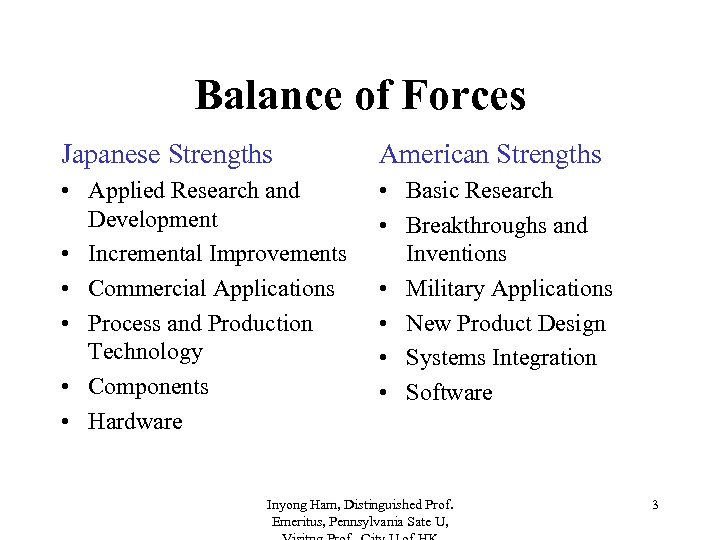 Balance of Forces Japanese Strengths American Strengths • Applied Research and Development • Incremental Improvements • Commercial Applications • Process and Production Technology • Components • Hardware • Basic Research • Breakthroughs and Inventions • Military Applications • New Product Design • Systems Integration • Software Inyong Ham, Distinguished Prof. Emeritus, Pennsylvania Sate U, 3
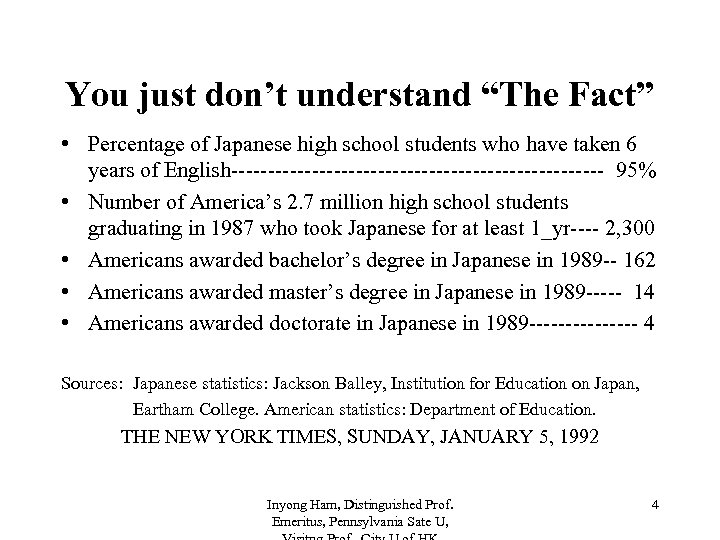 You just don’t understand “The Fact” • Percentage of Japanese high school students who have taken 6 years of English-------------------------- 95% • Number of America’s 2. 7 million high school students graduating in 1987 who took Japanese for at least 1_yr---- 2, 300 • Americans awarded bachelor’s degree in Japanese in 1989 -- 162 • Americans awarded master’s degree in Japanese in 1989 ----- 14 • Americans awarded doctorate in Japanese in 1989 -------- 4 Sources: Japanese statistics: Jackson Balley, Institution for Education on Japan, Eartham College. American statistics: Department of Education. THE NEW YORK TIMES, SUNDAY, JANUARY 5, 1992 Inyong Ham, Distinguished Prof. Emeritus, Pennsylvania Sate U, 4
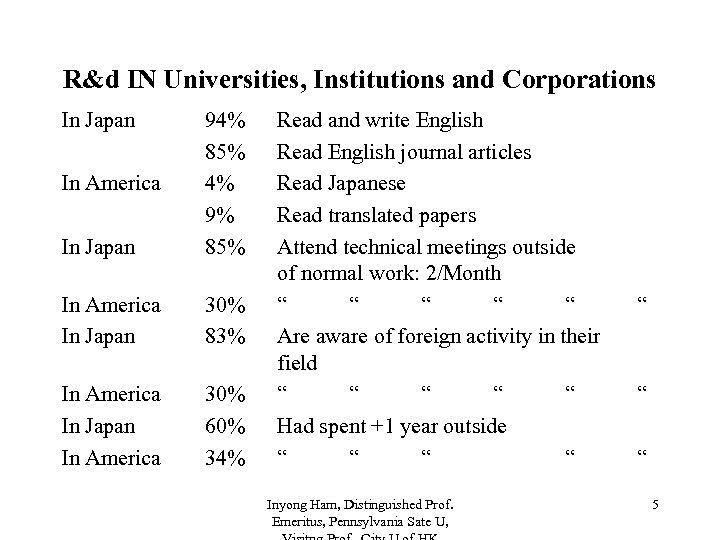 R&d IN Universities, Institutions and Corporations In Japan 94% 85% 4% 9% 85% In America In Japan 30% 83% In America In Japan In America 30% 60% 34% In America Read and write English Read English journal articles Read Japanese Read translated papers Attend technical meetings outside of normal work: 2/Month “ “ “ Are aware of foreign activity in their field “ “ “ Had spent +1 year outside “ “ Inyong Ham, Distinguished Prof. Emeritus, Pennsylvania Sate U, “ “ “ 5
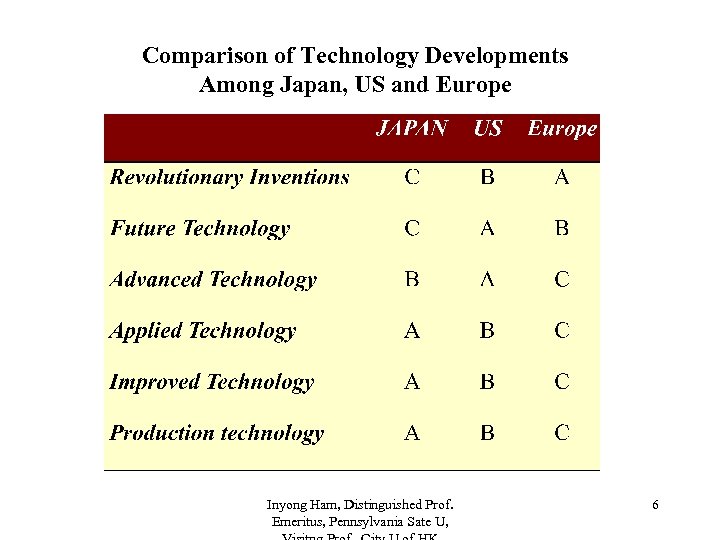 Comparison of Technology Developments Among Japan, US and Europe Inyong Ham, Distinguished Prof. Emeritus, Pennsylvania Sate U, 6
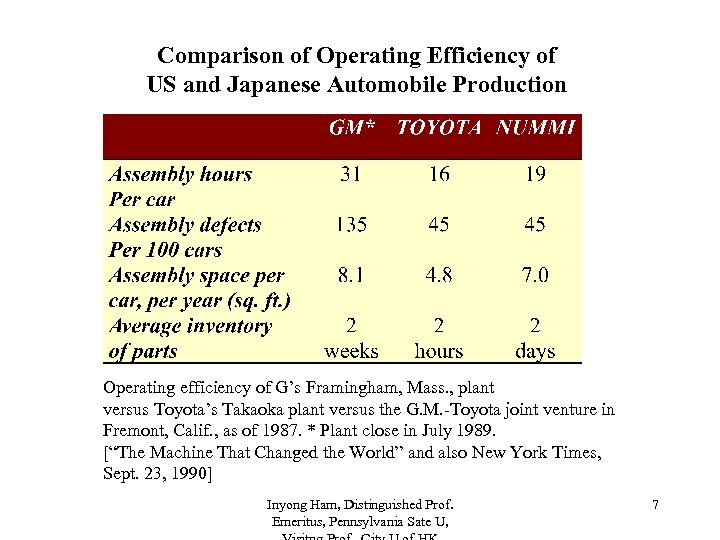 Comparison of Operating Efficiency of US and Japanese Automobile Production Operating efficiency of G’s Framingham, Mass. , plant versus Toyota’s Takaoka plant versus the G. M. -Toyota joint venture in Fremont, Calif. , as of 1987. * Plant close in July 1989. [“The Machine That Changed the World” and also New York Times, Sept. 23, 1990] Inyong Ham, Distinguished Prof. Emeritus, Pennsylvania Sate U, 7
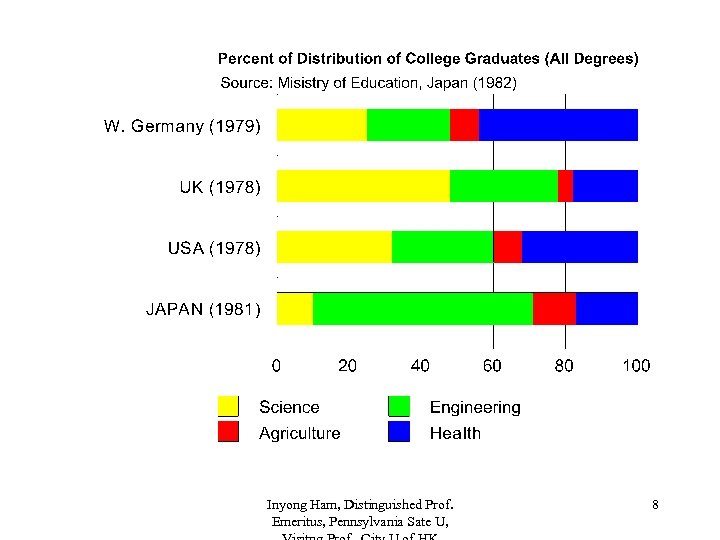 Inyong Ham, Distinguished Prof. Emeritus, Pennsylvania Sate U, 8
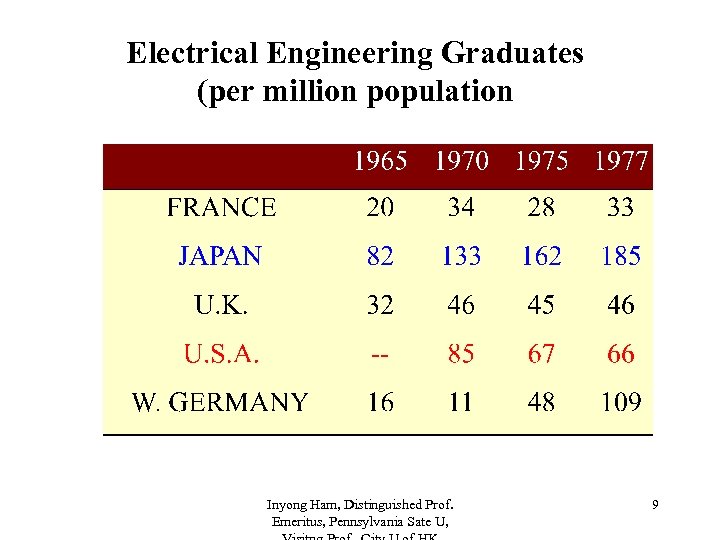 Electrical Engineering Graduates (per million population Inyong Ham, Distinguished Prof. Emeritus, Pennsylvania Sate U, 9
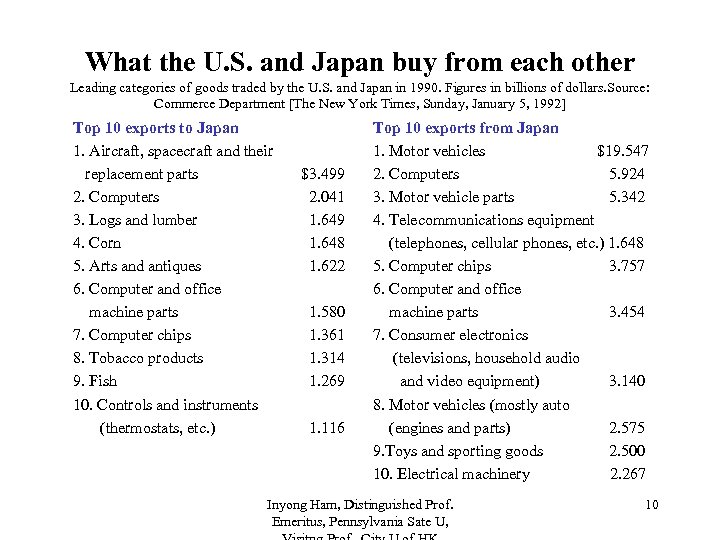 What the U. S. and Japan buy from each other Leading categories of goods traded by the U. S. and Japan in 1990. Figures in billions of dollars. Source: Commerce Department [The New York Times, Sunday, January 5, 1992] Top 10 exports to Japan 1. Aircraft, spacecraft and their replacement parts 2. Computers 3. Logs and lumber 4. Corn 5. Arts and antiques 6. Computer and office machine parts 7. Computer chips 8. Tobacco products 9. Fish 10. Controls and instruments (thermostats, etc. ) $3. 499 2. 041 1. 649 1. 648 1. 622 1. 580 1. 361 1. 314 1. 269 1. 116 Top 10 exports from Japan 1. Motor vehicles $19. 547 2. Computers 5. 924 3. Motor vehicle parts 5. 342 4. Telecommunications equipment (telephones, cellular phones, etc. ) 1. 648 5. Computer chips 3. 757 6. Computer and office machine parts 3. 454 7. Consumer electronics (televisions, household audio and video equipment) 3. 140 8. Motor vehicles (mostly auto (engines and parts) 2. 575 9. Toys and sporting goods 2. 500 10. Electrical machinery 2. 267 Inyong Ham, Distinguished Prof. Emeritus, Pennsylvania Sate U, 10
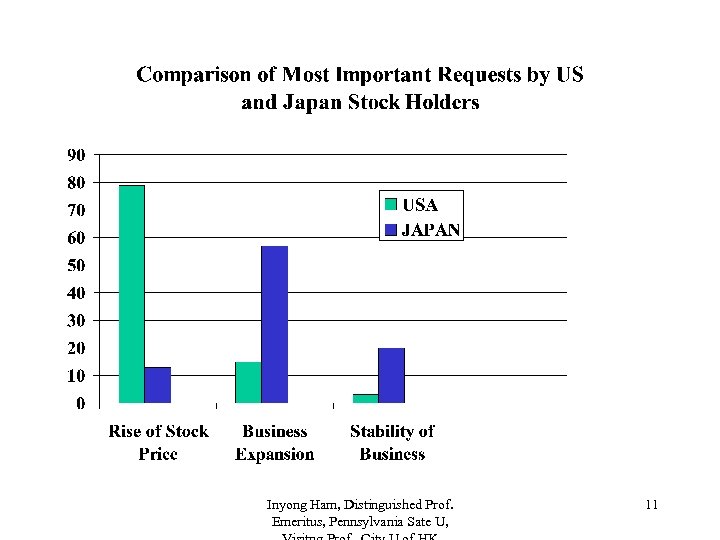 Inyong Ham, Distinguished Prof. Emeritus, Pennsylvania Sate U, 11
 An Example of Successful Japanese Industrial Developments Inyong Ham, Distinguished Prof. Emeritus, Pennsylvania Sate U, 12
 An Example of Successful Japanese Management of Technology FANUC Ltd. And “Management Philosophy” of Dr. Seiuemon Inaba, CEO Inyong Ham, Distinguished Prof. Emeritus, Pennsylvania Sate U, 13
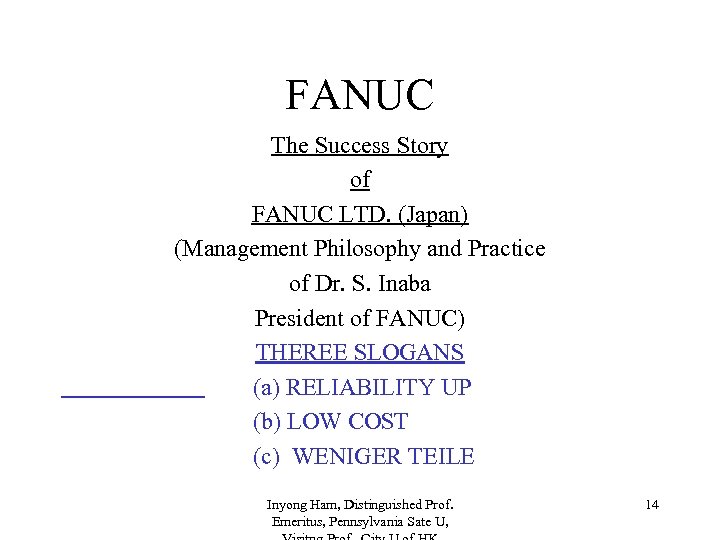 FANUC The Success Story of FANUC LTD. (Japan) (Management Philosophy and Practice of Dr. S. Inaba President of FANUC) THEREE SLOGANS (a) RELIABILITY UP (b) LOW COST (c) WENIGER TEILE Inyong Ham, Distinguished Prof. Emeritus, Pennsylvania Sate U, 14
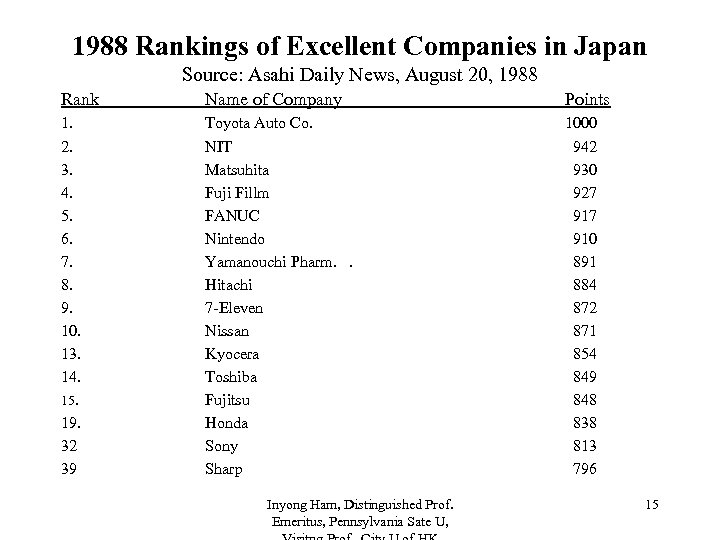 1988 Rankings of Excellent Companies in Japan Source: Asahi Daily News, August 20, 1988 Rank Name of Company Points 1. 2. 3. 4. 5. 6. 7. 8. 9. 10. 13. 14. Toyota Auto Co. NIT Matsuhita Fuji Fillm FANUC Nintendo Yamanouchi Pharm. . Hitachi 7 -Eleven Nissan Kyocera Toshiba Fujitsu Honda Sony Sharp 1000 942 930 927 910 891 884 872 871 854 849 848 838 813 796 15. 19. 32 39 Inyong Ham, Distinguished Prof. Emeritus, Pennsylvania Sate U, 15
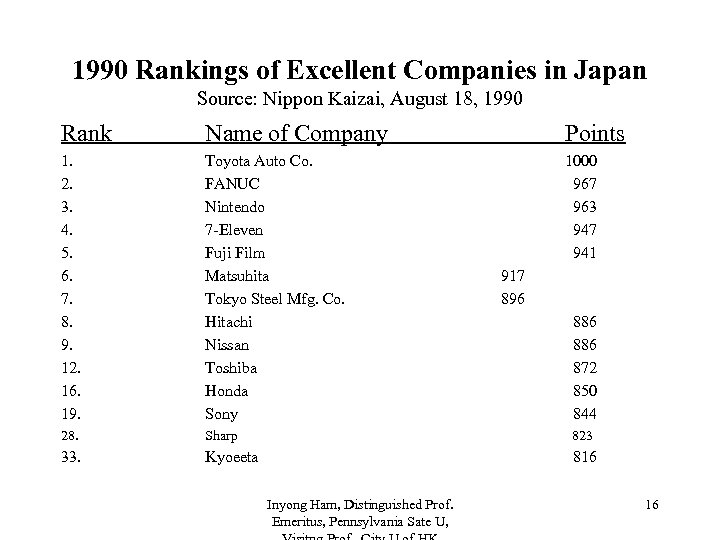 1990 Rankings of Excellent Companies in Japan Source: Nippon Kaizai, August 18, 1990 Rank Name of Company Points 1. 2. 3. 4. 5. 6. 7. 8. 9. 12. 16. 19. Toyota Auto Co. FANUC Nintendo 7 -Eleven Fuji Film Matsuhita Tokyo Steel Mfg. Co. Hitachi Nissan Toshiba Honda Sony 1000 967 963 947 941 28. Sharp 823 33. Kyoeeta 816 Inyong Ham, Distinguished Prof. Emeritus, Pennsylvania Sate U, 917 896 886 872 850 844 16
 FANUC Products Development • Difference between Products” and “Commodities” FANUC’s definition of “Commodities” (merchandises): “Products which bring high profit and excellent competitive position”. • Develop “Commodities (saleable and competitive products) to be marketed throughout the world. Inyong Ham, Distinguished Prof. Emeritus, Pennsylvania Sate U, 17
 FANUC’s Procedures for New Product development (a) Through world-wide market survey. (b) Lower “price” than any other competitive items (worldwide) with better quality. FANUC price is decided at the beginning stage of design. (c) Profit rate must be more than 30%. Production cot is then decided to meet the above b) and © requirements. (d) The R&D staff design a product to meet the cost and quality requirements, and also are responsible to design the necessary manufacturing systems to produce products. (e) The same R&D staff will be assigned as a temporary production team to install the specific manufacturing systems, and will be relieved the job after the successful implementation. Inyong Ham, Distinguished Prof. Emeritus, Pennsylvania Sate U, 18
 FANUC’s Management Philosophy (Some Selected “Highlights”) (1) “Cost Down”, “Quality In” & “Fewer Parts”. (2) Continuously pursue “New Technological Innovation” and “Engineering Excellence”. (3) Invest “Money” & “Time” for “Technical Excellence”. (4) Better “Design” for “Economic Manufacture”. (5) “Quality” built into “Design” and “Production”. Inyong Ham, Distinguished Prof. Emeritus, Pennsylvania Sate U, 19
 FANUC’s Research Management (1) (2) (3) (4) For “Engineering”, the history is important. For “Engineers”, “Innovation” is important. No conventional library for the research staff (Because any published book is already obsolete). Pursue “New Idea”, “New Information”, “new Innovation”. “Product with new invention is not successful commercial commodity. ” Inyong Ham, Distinguished Prof. Emeritus, Pennsylvania Sate U, 20
 QUALITY CIRCLE (FANUC”s View) “FANUC does not practice Quality Circle activity is a sales’ ceremony. If shop-floor operators can provide any suggestion for further quality improvements, something is basically wrong with the manufacturing system. Any quality problem must be dealt with at R&D stage. ” Inyong Ham, Distinguished Prof. Emeritus, Pennsylvania Sate U, 21
 FANUC’s Sales Motto (a) First “Friendship” and then “Sales”. (b) Never discount to bargain. If the price is high, go back to design drawing board. (c) Better service and maintenance. (d) More salesmen with engineering background. Inyong Ham, Distinguished Prof. Emeritus, Pennsylvania Sate U, 22
 FANUC emphasizes R, D & E • • “R” is not a primary function of FANUC. “D & E” are more important for FANUC.
 (6) More “Engineers” 80% than “Administrative Staff” (20%). (7) Emphasis on balanced “Engineering Excellence” and “Efficient Management”. (8) Train and cultivate te “Next Generation of Executive Managers”. (9) Rational and Regimental Management is better than non-responsible loose democratic management. (10) Loyalty and Trust to the company is most important. Inyong Ham, Distinguished Prof. Emeritus, Pennsylvania Sate U, 24
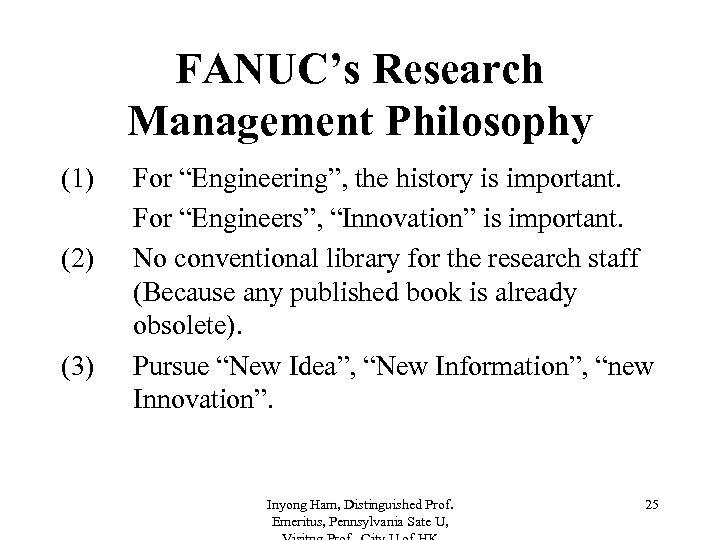 FANUC’s Research Management Philosophy (1) (2) (3) For “Engineering”, the history is important. For “Engineers”, “Innovation” is important. No conventional library for the research staff (Because any published book is already obsolete). Pursue “New Idea”, “New Information”, “new Innovation”. Inyong Ham, Distinguished Prof. Emeritus, Pennsylvania Sate U, 25
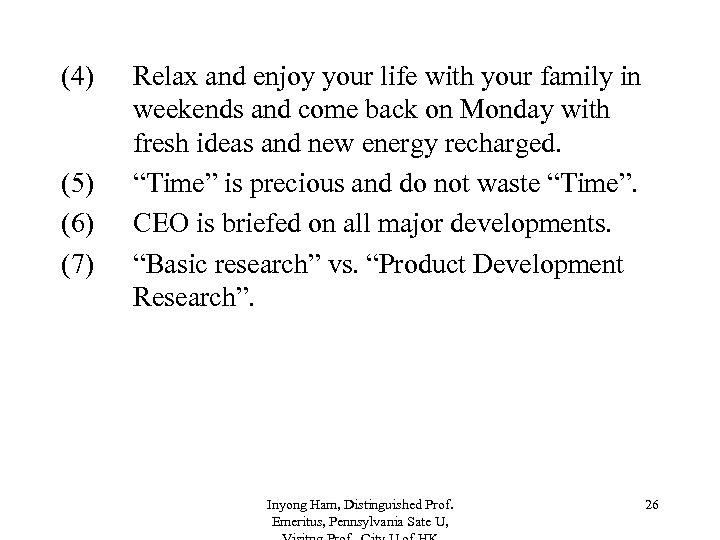 (4) (5) (6) (7) Relax and enjoy your life with your family in weekends and come back on Monday with fresh ideas and new energy recharged. “Time” is precious and do not waste “Time”. CEO is briefed on all major developments. “Basic research” vs. “Product Development Research”. Inyong Ham, Distinguished Prof. Emeritus, Pennsylvania Sate U, 26
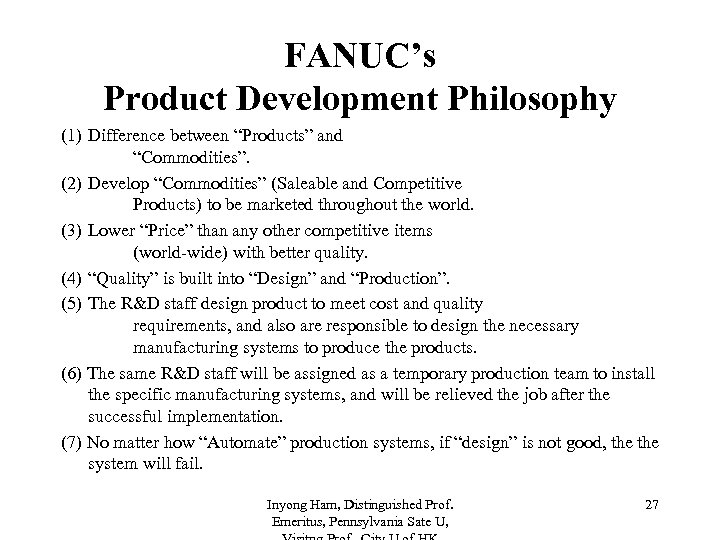 FANUC’s Product Development Philosophy (1) Difference between “Products” and “Commodities”. (2) Develop “Commodities” (Saleable and Competitive Products) to be marketed throughout the world. (3) Lower “Price” than any other competitive items (world-wide) with better quality. (4) “Quality” is built into “Design” and “Production”. (5) The R&D staff design product to meet cost and quality requirements, and also are responsible to design the necessary manufacturing systems to produce the products. (6) The same R&D staff will be assigned as a temporary production team to install the specific manufacturing systems, and will be relieved the job after the successful implementation. (7) No matter how “Automate” production systems, if “design” is not good, the system will fail. Inyong Ham, Distinguished Prof. Emeritus, Pennsylvania Sate U, 27
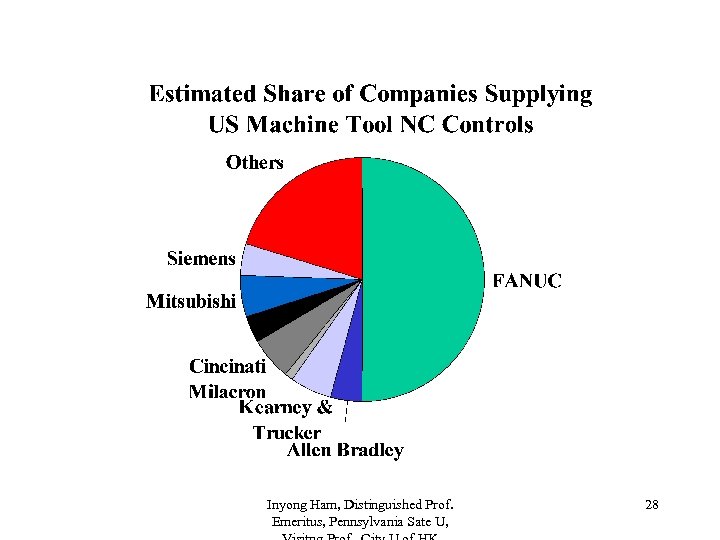 Inyong Ham, Distinguished Prof. Emeritus, Pennsylvania Sate U, 28
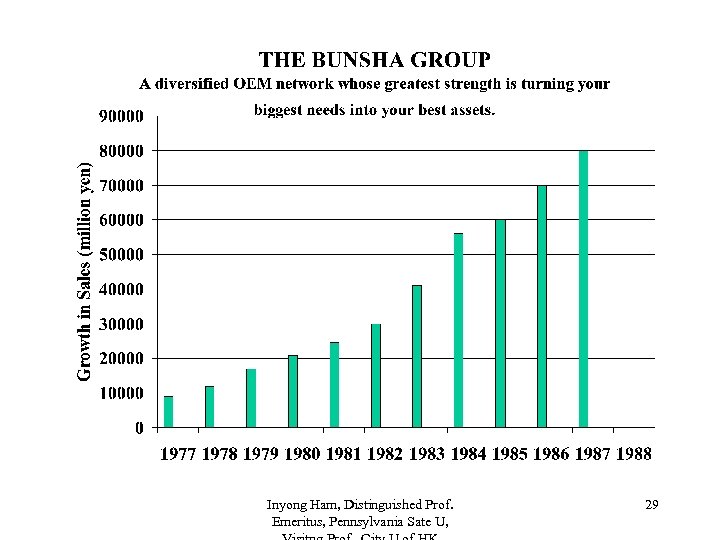 Inyong Ham, Distinguished Prof. Emeritus, Pennsylvania Sate U, 29
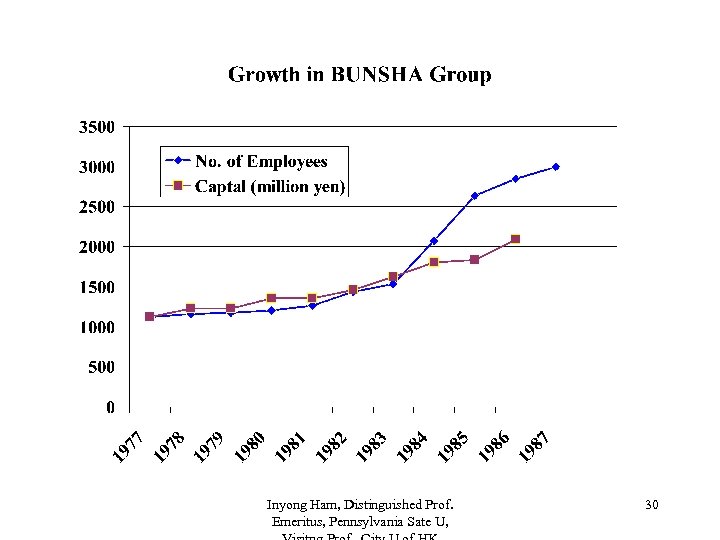 Inyong Ham, Distinguished Prof. Emeritus, Pennsylvania Sate U, 30
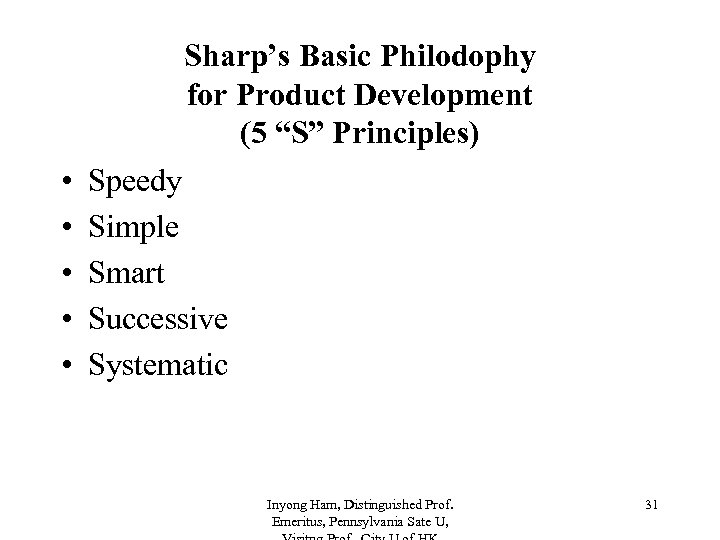 Sharp’s Basic Philodophy for Product Development (5 “S” Principles) • • • Speedy Simple Smart Successive Systematic Inyong Ham, Distinguished Prof. Emeritus, Pennsylvania Sate U, 31
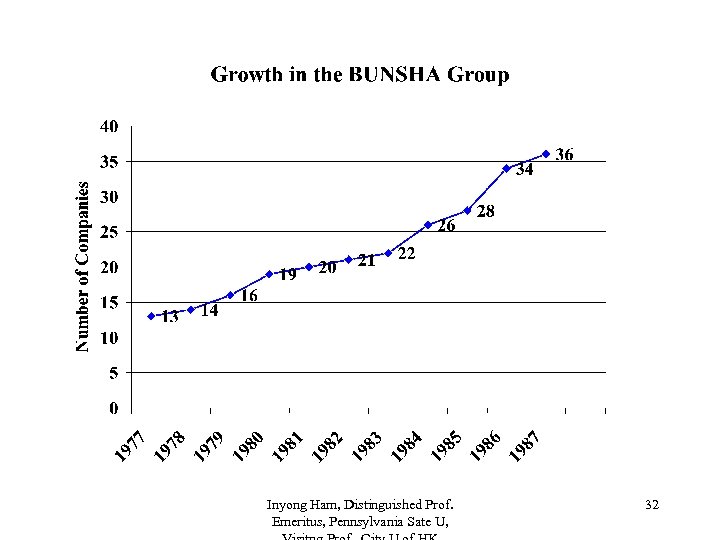 Inyong Ham, Distinguished Prof. Emeritus, Pennsylvania Sate U, 32