Скачать презентацию Do Now What are some modern day
fb6f302d34ddba2b21e2d3b06a8aa6a7.ppt
- Количество слайдов: 18
 Do Now • What are some modern day benefits of religion today? • What are some criticisms of religion today?
 Do Now • What are some modern day benefits of religion today? • • Unity Mom and Dad said so! Comfort in death Charity, good deeds • What are some criticisms of religion today? • Outdated – ex. dietary restrictions • Divisions in Society – ex. Terrorism, Crusades – Christians vs. Muslims, Muslims vs. Jews, etc. • Hate, intolerance of other faiths • Ethnocentricm • Restriction of certain freedoms
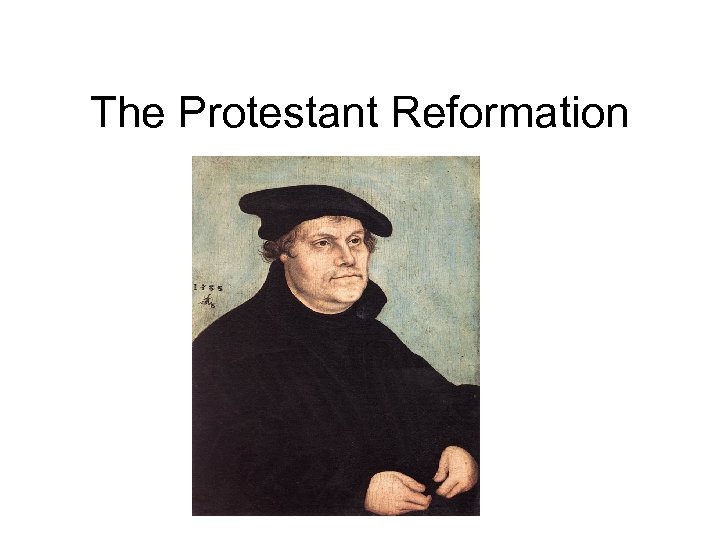 The Protestant Reformation
 The Reformation • As the Renaissance spread throughout Europe the standard of living among Europeans greatly improved. . • More people could afford to have their children receive a formal education.
 The Reformation • Christian Humanism (the ability of humans to reason and improve themselves) was a development that grew from these changes in intellectual thought. Reform of the Catholic Church was a major goal of this movement.
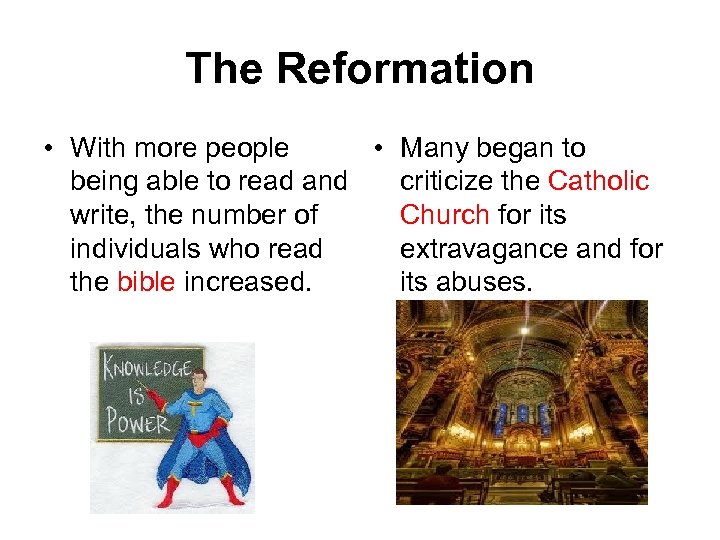 The Reformation • With more people • Many began to being able to read and criticize the Catholic write, the number of Church for its individuals who read extravagance and for the bible increased. its abuses.
 The Reformation • There were many people who felt that the practices and teachings of the Catholic Church were not consistent with the teachings found in the scriptures of the bible. The result was what historians call the Protestant Reformation.
 The Reformation • A well-known Christian Humanist was Desiderius Erasmus who was one of the first to criticize the abuses of the Catholic Church in his work The Praise of Folly. He stressed that Christianity should show people how to live good lives on an everyday basis rather than a false system of beliefs that people had to practice in order to be saved. “Erasmus laid the egg that Luther hatched. ”
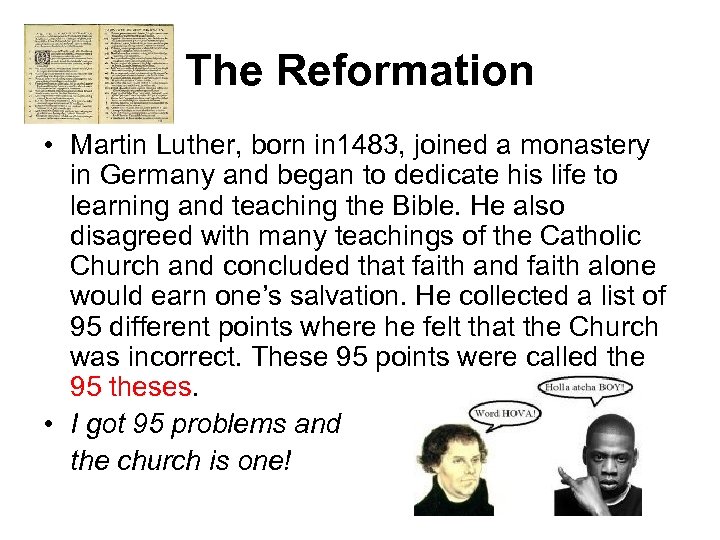 The Reformation • Martin Luther, born in 1483, joined a monastery in Germany and began to dedicate his life to learning and teaching the Bible. He also disagreed with many teachings of the Catholic Church and concluded that faith and faith alone would earn one’s salvation. He collected a list of 95 different points where he felt that the Church was incorrect. These 95 points were called the 95 theses. • I got 95 problems and the church is one!
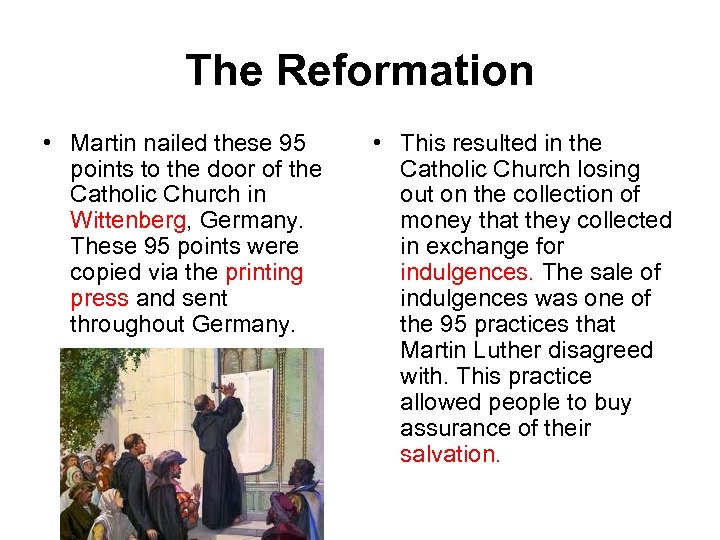 The Reformation • Martin nailed these 95 points to the door of the Catholic Church in Wittenberg, Germany. These 95 points were copied via the printing press and sent throughout Germany. • This resulted in the Catholic Church losing out on the collection of money that they collected in exchange for indulgences. The sale of indulgences was one of the 95 practices that Martin Luther disagreed with. This practice allowed people to buy assurance of their salvation.
 What were some other criticisms of the Catholic Church? • Corruption • Papal leaders failing to meet spiritual needs • Italian politics • Worldly interests such as elaborate churches, career advancement, and personal wealth
 The Reformation • By 1520 the Catholic • Luther escaped and Church had enough. went into hiding, He was wanted by the where he translated Holy Roman Emperor, the Bible into German. Charles V. By the • Martin Luther founded Edict of Worms they a new religion known declared Martin as Lutheranism. Luther a heretic, or outlaw, a crime punishable by death.
 The Reformation • As many rulers of the German states supported Luther, The Peace of Augsburg was created which accepted the division of Christianity in Germany. • As Lutheranism gained influence in Germany, religious leaders in the neighboring country of Switzerland began a reformation of their own. Unlike Martin Luther, however, these leaders wanted to establish a theocracy, or a government, based on their new religion, so that they could rule the lives of their people.
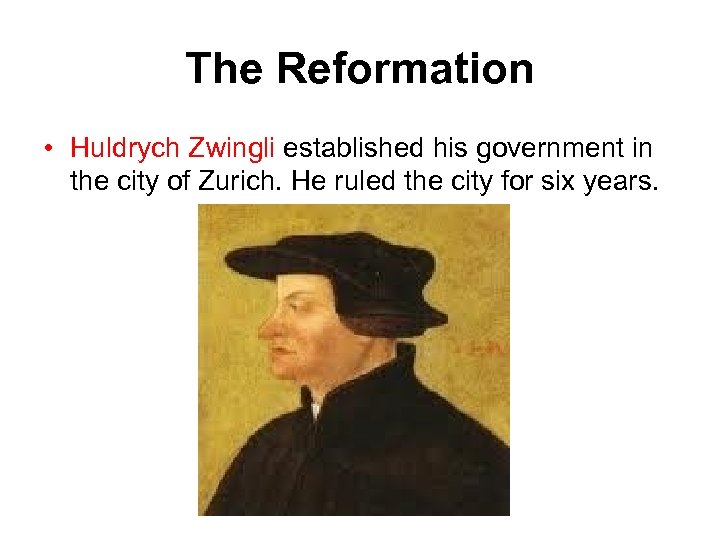 The Reformation • Huldrych Zwingli established his government in the city of Zurich. He ruled the city for six years.
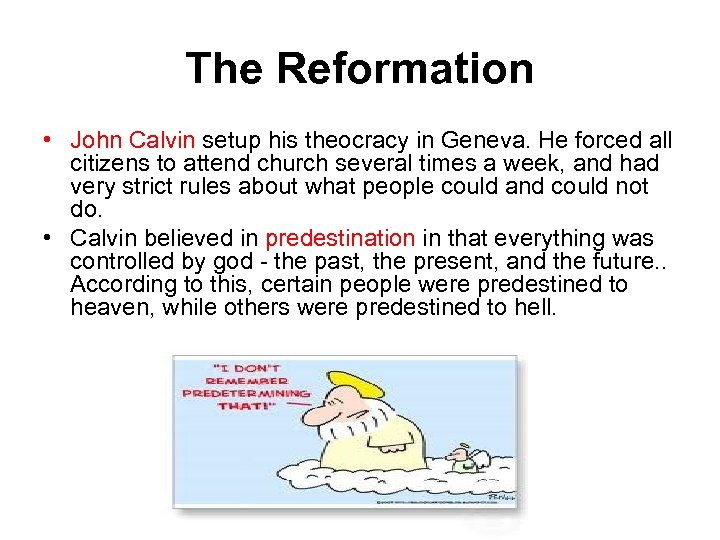 The Reformation • John Calvin setup his theocracy in Geneva. He forced all citizens to attend church several times a week, and had very strict rules about what people could and could not do. • Calvin believed in predestination in that everything was controlled by god - the past, the present, and the future. . According to this, certain people were predestined to heaven, while others were predestined to hell.
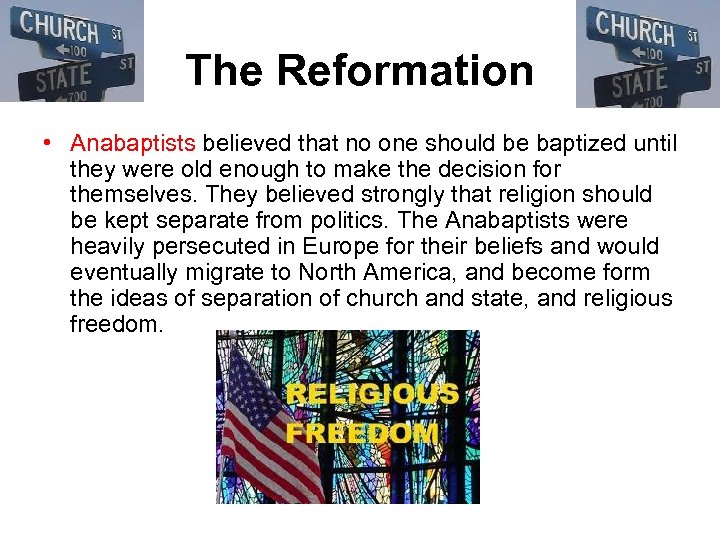 The Reformation • Anabaptists believed that no one should be baptized until they were old enough to make the decision for themselves. They believed strongly that religion should be kept separate from politics. The Anabaptists were heavily persecuted in Europe for their beliefs and would eventually migrate to North America, and become form the ideas of separation of church and state, and religious freedom.
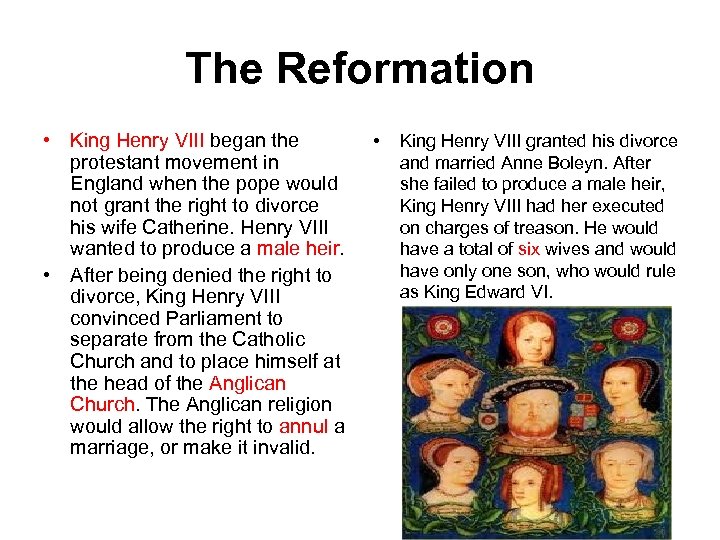 The Reformation • King Henry VIII began the protestant movement in England when the pope would not grant the right to divorce his wife Catherine. Henry VIII wanted to produce a male heir. • After being denied the right to divorce, King Henry VIII convinced Parliament to separate from the Catholic Church and to place himself at the head of the Anglican Church. The Anglican religion would allow the right to annul a marriage, or make it invalid. • King Henry VIII granted his divorce and married Anne Boleyn. After she failed to produce a male heir, King Henry VIII had her executed on charges of treason. He would have a total of six wives and would have only one son, who would rule as King Edward VI.