


 Скачать презентацию Do Not Resuscitate Protocols and Identification The Alaska
57546402e3cf9fd0bd77ec5dcf28d5e6.ppt
- Количество слайдов: 40
 Do Not Resuscitate Protocols and Identification The Alaska Comfort One Program Revised 7/2000
 Presentation Sequence and Content v Purpose of the Program v Overview and History v The Comfort One Materials and Process v Recent Related Legislation w House Bill 383 (1998) v The Future of the Comfort One Program
 Purpose Allows patients’ wishes regarding resuscitation to be honored v Provides System for Identifying Patients with Valid Do-Not-Resuscitate Orders v Provides Protocol for Withholding or Terminating CPR When Caring for a Patient with a Valid DNR Order v Provides some immunities from civil liability v
 Relevant Laws v Authorizing Statute w AS 18. 12. 035 w Became effective in 1994 v Regulations (Identification and Protocol) w 7 AAC 16. 010 w Became effective in October, 1996
 Overview Single system in Alaska v Augments existing laws related to pronouncement of death. v Does NOT change the process used by the patient and physician to decide whether a DNR order is appropriate. v
 History Lack of standardized means of identifying and responding to DNR orders outside the hospital. v Fear of inappropriate resuscitations v EMS was being called to the homes of expected home death patients by those who “panicked” v Program acknowledged excellent “expected home death” programs already in existence. v
 History Program was based on the very successful “Montana Comfort One Program. ” v The program is now known as the Alaska Comfort One Program. v
 History Protocols (regulations) are required to be approved by the Alaska State Medical Board. v Hospice and home health care nurses were exceptionally helpful in the revision of the forms and policies. v State Medical Examiner’s Office assisted in the revisions of forms and policies. v
 Enrollment Materials v Forms w Single Page, Multi-part carbonless w Free v Cards w Free v Bracelets (Optional) w $20. 00
 Comfort One Form v Signature Section w Patient and Physician v Additional Information Section w Does not affect patient care v Patient Information Section v Recommendations for Health Care Providers
 Educational Materials v Brochure for Patients and Families v Brochure for Health Care Providers v Guide for EMTs in Alaska v Web Page w Regulations and Statute w http: //www. chems. ak. us
 Comfort One Logo Copyrighted logo is found on: • Forms • Wallet Cards • Bracelets • Educational Materials
 Obtaining Forms v Forms, cards, bracelets and other materials can be obtained from: w Southern Region EMS Council, Inc. (Anchorage) - 562 -6449 w Interior Region EMS Council, Inc. (Fairbanks) 456 -3978 w Southeast Region EMS Council, Inc. (Sitka) 747 -8005
 Patient Enrollment Process Decision made by physician and patient. v Physician must sign Comfort One form for it to be operative. v Patient can leave office with evidence that a valid DNR order is in effect (form and card). v Comfort One Data Form (postcard) is returned by physician to Regional EMS Office. v Patient can order optional bracelet. v
 Comfort One Form Distribution Original - Patient v Second Copy - Patient’s Medical File v Third copy - May be given to the local law enforcement agency v The bottom copy - For use by other agencies, e. g. Fire Department, EMS, Home Health, Hospice, etc. v
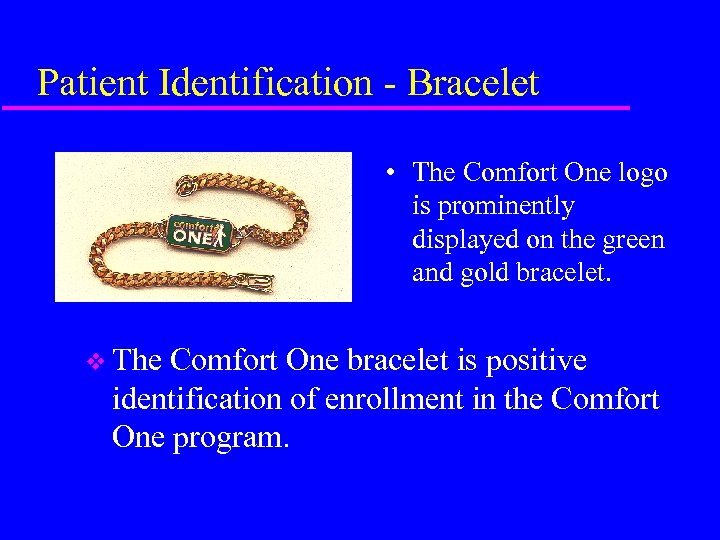 Patient Identification - Bracelet • The Comfort One logo is prominently displayed on the green and gold bracelet. v The Comfort One bracelet is positive identification of enrollment in the Comfort One program.
 Local DNR Programs v DNR regulations specify statewide system for identification of DNR patients and withholding CPR. v Communities and agencies may develop local systems for: w palliative (comfort) care; w expected home deaths.
 The Response v Patient Identification v Establishing Do Not Resuscitate Status
 Definition of Health Care Provider “. . . a person who is licensed, certified, or otherwise authorized by the law of this state to administer health care in the ordinary course of of business or practice of a profession. v Individuals with only CPR training may be considered health care providers for the purposes of the Comfort One Program. v
 Confirming Patient Identity v Applicable confirmations include: w the patient communicating the patient's name; w the patient's hospital or other institutional identification arm band; w the patient being personally known to the physician or other health care provider; w the patient's driver's license or credit card; or w another person having identified the patient.
 Unconscious Patients v If a patient is unconscious or otherwise unresponsive to questions regarding the patient's identity, the physician or other health care provider may rely solely on the department approved DNR necklace or bracelet worn by the patient without using further methods to identify the patient.
 Establishing DNR Status v Valid confirmations include: w a department-approved DNR form for the patient; w department-approved DNR card for the patient; or w a department-approved DNR necklace or bracelet worn, or carried by the patient.
 Establishing DNR Status (Cont. ) v an attending physician's DNR order, when w the order is in writing and a copy has been provided or seen by the physician or other health care provider; or w a verbal order has been issued directly to the physician or health care provider by the attending physician.
 Searching for Identification v The physician or other health care provider shall immediately proceed with patient assessment and care, including cardiopulmonary resuscitation, until the required information is obtained.
 Response to DNR Identification After establishing that the patient is a qualified DNR patient, the physician or health care provider may not attempt CPR for a patient who does not have a pulse or is not breathing. v The DNR order does not affect other care or services that the physician or other health care provider determined are appropriate for the patient and may lawfully be performed by that provider, (e. g. “palliative care. ”) v
 Revocation of DNR Status The qualified DNR patient or the patient's attending physician may revoke the patient's DNR status at any time and in any manner in accordance with AS 18. 12. v A declaration may be revoked at any time and in any manner by which the individual for whom the DNR order was issued is able to communicate an intent to revoke, without regard to mental or physical condition. v
 Revocation (Cont. ) v The revocation must be communicated by the person for whom the Comfort One Order was issued or by another person to whom the revocation was communicated.
 Revocation (Cont. ) The parent of a minor may revoke the DNR status of his/her child. v A person with a “durable power of attorney” may revoke the DNR status of a patient who has given the individual that authority. v A legal guardian may revoke the DNR status of a patient if given that authority by the courts. v
 Out of State DNR Orders v A declaration, do not resuscitate order, or DNR identification executed, issued, or authorized in another state or a territory or possession of the United States in compliance with the law of that jurisdiction is effective for purposes of this chapter (AS 18. 12. 090).
 Anatomical Gifts and DNR Orders v Inside a hospital w “. . . the do not resuscitate order may not be implemented until the donated organ can be evaluated to determine if it is suitable for donation. (AS 18. 12. 035(d)) v Outside a hospital w The DNR order takes precedence w Life Alaska should be notified
 Palliative Care Palliative care may include: w repositioning the patient for comfort; w administering oxygen; w performing suction; w providing emotional support; and w contacting Hospice or home health agencies. v Pain medication may be used when appropriately authorized and administered. v
 Transfer Requirements exist in statute w (AS 18. 12. 050) v Requirements exist for both physicians and health care facilities v Continuity of Care Must Be Maintained v
 Penalties v Penalities exist for: w failure of an attending physician to comply with the DNR protocol or make necessary transfer arrangements; w forging or falsifying a living will, DNR order, or revocation; and w concealing, canceling, defacing, obliterating, or otherwise damaging the DNR identification or living will without the patient’s consent. v Penalties help ensure that patient’s wishes are honored.
 Immunities A physician, a health care professional, or a health care facility is not subject to civil or criminal liability for actions under this chapter that are in accord with reasonable medical standards. v Other immunities exist in statute for those health care providers who withhold or provide CPR in accordance with the statutes and Do Not Resuscitate Protocol (regulations). v
 Recent Related Legislation v HB 383 Signed and effective September 14, 1998 v Amended AS 12. 65 - Death Investigations and Medical Examiners v Sec 12. 65. 007. No duty for peace officer to respond to the scene of an expected home death.
 HB 383 death was expected to occur v the death occurred at the dead person’s home v a person authorized to determine and pronounce death was present v a form signed by the dead person’s physician is on file with the law enforcement agency for that jurisdiction. v
 The Future of Comfort One v Slight changes to forms and other materials based on new or amended legislation v Continued refinement of policies for distribution of forms v No funding for program is anticipated
 Summary v This program has been in place since 1996 and provides advantages to both the patient and the health care provider. v Health care personnel, particularly those involved in the care of the terminally ill, should become familiar with the program and encourage its use in appropriate situations.
 Applicable Statutes & Regulations Living Wills and Do Not Resuscitate Orders w AS 18. 12. 010 - AS 18. 12. 010 v Do Not Resuscitate Protocols and Identification w 7 AAC 16. 010 - 7 AAC 16. 090 v Some communities have existing programs about which health care providers should be informed. v
 Additional Information Shelley Owens 465 -3028 465 -4101 (fax) Shelley_owens@health. state. ak. us Web Page: http: //www. chems. alaska. gov Regions: • Southeast Region EMS Council, Inc (Sitka): 747 -8005 • Southern Region EMS Council, Inc (Anchorage): 562 -6449 • Interior Region EMS Council, Inc (Fairbanks): 456 -3978