


 Скачать презентацию Do D IT Consolidation Roadmap What s Ahead with
d549272fbffa2636832c15e4c75f774c.ppt
- Количество слайдов: 23
 Do. D IT Consolidation Roadmap: What’s Ahead with the Do. D ESI Floyd Groce, DON CIO ESI Co-Chair Jim Clausen, Do. D CIO ESI Co-Chair Jim Cecil, Consultant to Do. D CIO & ESI DON West Coast IT Conference – 26 January 2011
 Agenda • SECDEF & Federal CIO Agendas • ESI Overview • ESI Projects • Summary 1
 Top-Level Objectives and Guidance are Driving Change in IT • SECDEF Robert Gates, 8/9/2010 briefing: – Reduce $100 billion overhead to redirect to programs and warfighting • • • Improve efficiencies in contracting to get better buying power Reduce duplication in overhead functions Create a system of fewer, flatter and more agile and responsive structures Centralize IT processes to achieve economies of scale Consolidate IT infrastructure • U. S. CIO, Vivek Kundra, “ 25 Point Implementation Plan to Reform Federal Information Technology Management” (12/9/2010): – Achieve Operational Efficiencies • • • Shift to a “cloud first” policy Leverage shared services of commodity applications such as e-mail Adopt modular implementation approaches for IT solutions – Effectively Manage Large Scale IT Programs • • Develop IT acquisition professionals to increase effectiveness Use Working Capital Funds (WCF) and pool funds to serve agency-wide purposes Increase transparency in use of IT funds Consolidate IT spending – adopt strategic sourcing solutions 2
 What is Do. D ESI? Do. D ESI is a joint initiative sponsored by the Do. D Chief Information Officer to save time and money on commercial software, IT hardware, and services. Knowledgeable and experienced Component team members identify and consolidate Do. D-wide IT requirements to establish enterprise agreements with IT providers. Impacts include lower procurement costs, more efficient acquisition processes, and greater visibility into IT assets across the entire department. ü Executive sponsor: Do. D CIO ü Team composition: Army, Dept of Navy, Air Force, DLA, DISA, NGA, OSD ü Goals: v Save time and money on commercial IT acquisition v IT Asset Management ü Operations: v Award enterprise agreements for IT products and services v Implement unified vendor and contract management strategy ü Results: v Over 80 enterprise software agreements for widely-used software v Over $4 billion cost avoidance sinception 3
 ESI Foundation: Target Do. D Customer Needs & Maximum Efficiencies • Lead implementation of Do. D enterprise agreements for Commercial Off the Shelf Information Technology (COTS IT), enterprise IT asset management (ITAM), and IT acquisition policy to lower the total cost of IT ownership for the Do. D enterprise • Establish and maintain enterprise strategic sourcing relationships with leading IT vendors • Operate using an agile, low overhead model executed through Software Product Managers (SPMs) in five Do. D Components • Work closely with the OMB/GSA Smart. BUY Program to optimize IT acquisition policy and implement Smart. BUY within Do. D 4
 ESI Model: Lean & Agile • Lean enterprise governance & management structure – – Authority: G&PM, BIC memo, CIO memos, FAR/DFARs, Do. D 5000 Executive oversight: Aligned under Enterprise Governance Board (EGB) Management: Bi-Weekly ESI Working Group meeting Coordination: Monthly ESI Team Meetings • Agile operations – ESI Operating Principles established at its formation: • “The Enterprise Software Initiative (ESI) and Steering Group (SG) operate with a minimum of process and paperwork. ” • “The Working Group (WG) is empowered to act unless there is a disagreement that cannot be resolved. Then the SG will decide. ” – Decision process: Empowered Working Group with minimal decision points for authorizing an ESI Enterprise Software Agreements (ESAs) – Flexible framework for selecting target acquisitions • Small team footprint embedded across Do. D – Less than five dedicated Do. D personnel and contractor staff – Matrixed execution through five Component Software Product Management (SPM) organizations – Supported by five Component contracting shops • Self-funded – Reimbursable through contracting fees – Programs retain cost avoidance 5
 Do. D ESI IT Strategic Sourcing • Enterprise agreements and acquisition vehicles – – • Enterprise licenses – – – • Aggregate demand Volume discounts Leverage Do. D buying power in vendor negotiations Establish special contract terms and conditions for enterprise needs Over $4 B in cost avoidance since 1999 – retained by Programs! Streamlined acquisition processes – – – • Common software deployed across Do. D Net-centric enterprise licenses for core infrastructure Shared acquisition and license management processes Economies of scale – – • Software licenses Software maintenance Selected software and technical services Enterprise access: All Do. D Components, Intelligence Community (IC), NATO, Auth. Contractors Central contract negotiation and administration by ESI SPMs and Contracting Officers Standard, streamlined enterprise-wide ordering processes Expertise in software licensing: ESI Software Product Managers (SPMs) and Contracting Officers Do. D CIO Enterprise Perspective at Federal Level – – Smart. BUY executive agent within Do. D Federal working groups for strategic sourcing, e-mail Saa. S, etc. FAR Sub-committee for IT GSA Lo. B representation (e. g. , SAIR) 6
 ESI Strategic Projects 1. Enterprise licensing 2. Compass systems integration agreements 3. Consolidate Do. D IT hardware buying 4. GSA Smart. BUY e-mail Saa. S acquisition 5. Enterprise standards for ITAM Each project is summarized in the pages that follow… 7
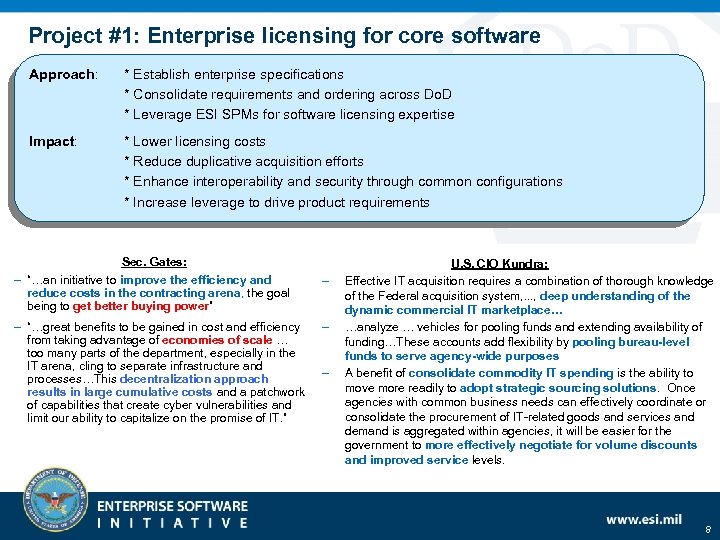 Project #1: Enterprise licensing for core software Approach: * Establish enterprise specifications * Consolidate requirements and ordering across Do. D * Leverage ESI SPMs for software licensing expertise Impact: * Lower licensing costs * Reduce duplicative acquisition efforts * Enhance interoperability and security through common configurations * Increase leverage to drive product requirements Sec. Gates: – “…an initiative to improve the efficiency and reduce costs in the contracting arena, the goal being to get better buying power” – “…great benefits to be gained in cost and efficiency from taking advantage of economies of scale … too many parts of the department, especially in the IT arena, cling to separate infrastructure and processes…This decentralization approach results in large cumulative costs and a patchwork of capabilities that create cyber vulnerabilities and limit our ability to capitalize on the promise of IT. ” – – – U. S. CIO Kundra: Effective IT acquisition requires a combination of thorough knowledge of the Federal acquisition system, . . . , deep understanding of the dynamic commercial IT marketplace… …analyze … vehicles for pooling funds and extending availability of funding…These accounts add flexibility by pooling bureau-level funds to serve agency-wide purposes A benefit of consolidate commodity IT spending is the ability to move more readily to adopt strategic sourcing solutions. Once agencies with common business needs can effectively coordinate or consolidate the procurement of IT-related goods and services and demand is aggregated within agencies, it will be easier for the government to more effectively negotiate for volume discounts and improved service levels. 8
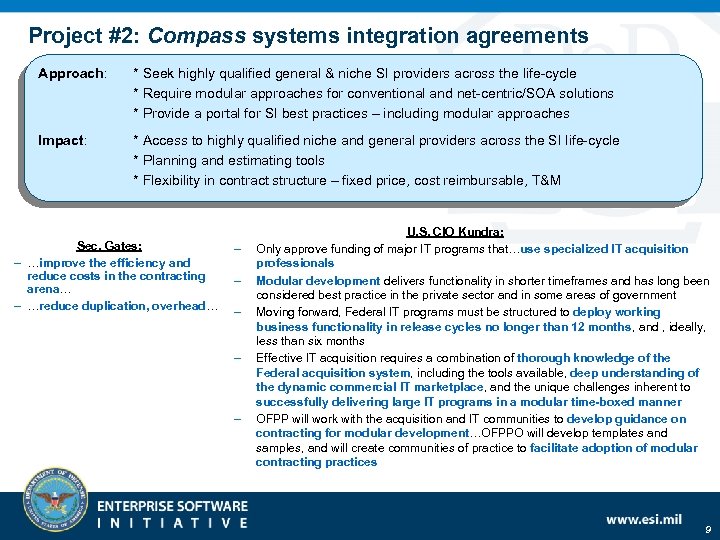 Project #2: Compass systems integration agreements Approach: * Seek highly qualified general & niche SI providers across the life-cycle * Require modular approaches for conventional and net-centric/SOA solutions * Provide a portal for SI best practices – including modular approaches Impact: * Access to highly qualified niche and general providers across the SI life-cycle * Planning and estimating tools * Flexibility in contract structure – fixed price, cost reimbursable, T&M Sec. Gates: – …improve the efficiency and reduce costs in the contracting arena… – …reduce duplication, overhead… – – – U. S. CIO Kundra: Only approve funding of major IT programs that…use specialized IT acquisition professionals Modular development delivers functionality in shorter timeframes and has long been considered best practice in the private sector and in some areas of government Moving forward, Federal IT programs must be structured to deploy working business functionality in release cycles no longer than 12 months, and , ideally, less than six months Effective IT acquisition requires a combination of thorough knowledge of the Federal acquisition system, including the tools available, deep understanding of the dynamic commercial IT marketplace, and the unique challenges inherent to successfully delivering large IT programs in a modular time-boxed manner OFPP will work with the acquisition and IT communities to develop guidance on contracting for modular development…OFPPO will develop templates and samples, and will create communities of practice to facilitate adoption of modular contracting practices 9
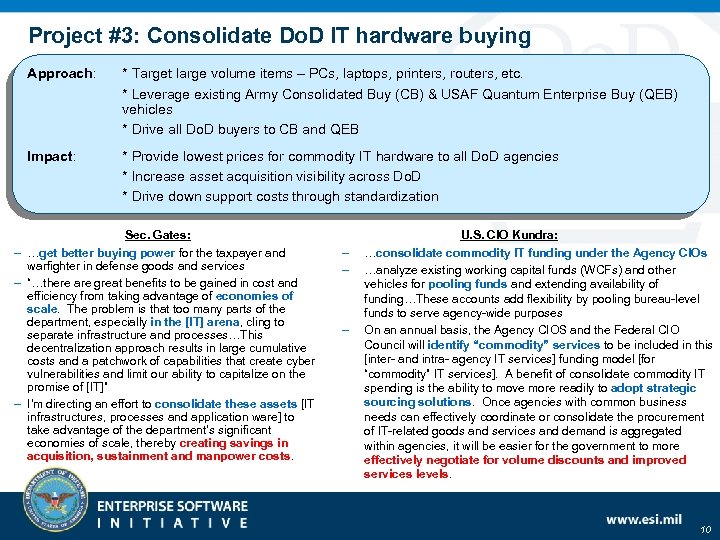 Project #3: Consolidate Do. D IT hardware buying Approach: * Target large volume items – PCs, laptops, printers, routers, etc. * Leverage existing Army Consolidated Buy (CB) & USAF Quantum Enterprise Buy (QEB) vehicles * Drive all Do. D buyers to CB and QEB Impact: * Provide lowest prices for commodity IT hardware to all Do. D agencies * Increase asset acquisition visibility across Do. D * Drive down support costs through standardization Sec. Gates: – …get better buying power for the taxpayer and warfighter in defense goods and services – “…there are great benefits to be gained in cost and efficiency from taking advantage of economies of scale. The problem is that too many parts of the department, especially in the [IT] arena, cling to separate infrastructure and processes…This decentralization approach results in large cumulative costs and a patchwork of capabilities that create cyber vulnerabilities and limit our ability to capitalize on the promise of [IT]” – I'm directing an effort to consolidate these assets [IT infrastructures, processes and application ware] to take advantage of the department's significant economies of scale, thereby creating savings in acquisition, sustainment and manpower costs. – – – U. S. CIO Kundra: …consolidate commodity IT funding under the Agency CIOs …analyze existing working capital funds (WCFs) and other vehicles for pooling funds and extending availability of funding…These accounts add flexibility by pooling bureau-level funds to serve agency-wide purposes On an annual basis, the Agency CIOS and the Federal CIO Council will identify “commodity” services to be included in this [inter- and intra- agency IT services] funding model [for “commodity” IT services]. A benefit of consolidate commodity IT spending is the ability to move more readily to adopt strategic sourcing solutions. Once agencies with common business needs can effectively coordinate or consolidate the procurement of IT-related goods and services and demand is aggregated within agencies, it will be easier for the government to more effectively negotiate for volume discounts and improved services levels. 10
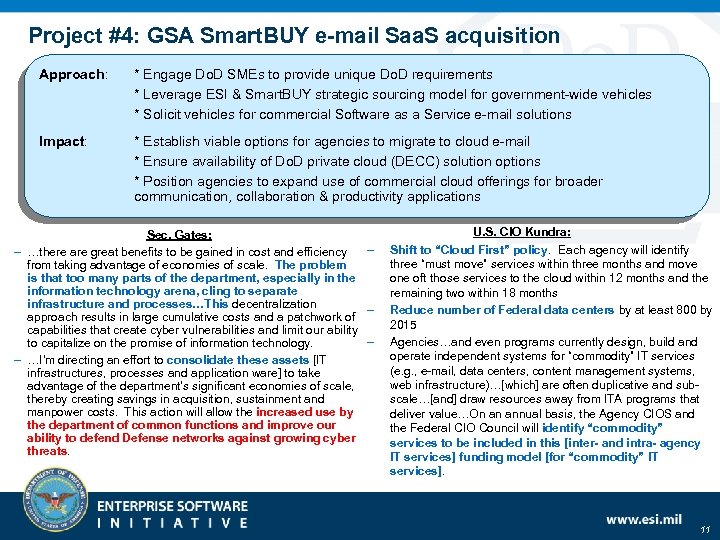 Project #4: GSA Smart. BUY e-mail Saa. S acquisition Approach: * Engage Do. D SMEs to provide unique Do. D requirements * Leverage ESI & Smart. BUY strategic sourcing model for government-wide vehicles * Solicit vehicles for commercial Software as a Service e-mail solutions Impact: * Establish viable options for agencies to migrate to cloud e-mail * Ensure availability of Do. D private cloud (DECC) solution options * Position agencies to expand use of commercial cloud offerings for broader communication, collaboration & productivity applications Sec. Gates: – – …there are great benefits to be gained in cost and efficiency from taking advantage of economies of scale. The problem is that too many parts of the department, especially in the information technology arena, cling to separate infrastructure and processes…This decentralization – approach results in large cumulative costs and a patchwork of capabilities that create cyber vulnerabilities and limit our ability – to capitalize on the promise of information technology. – …I'm directing an effort to consolidate these assets [IT infrastructures, processes and application ware] to take advantage of the department's significant economies of scale, thereby creating savings in acquisition, sustainment and manpower costs. This action will allow the increased use by the department of common functions and improve our ability to defend Defense networks against growing cyber threats. U. S. CIO Kundra: Shift to “Cloud First” policy. Each agency will identify three “must move” services within three months and move one oft those services to the cloud within 12 months and the remaining two within 18 months Reduce number of Federal data centers by at least 800 by 2015 Agencies…and even programs currently design, build and operate independent systems for “commodity” IT services (e. g. , e-mail, data centers, content management systems, web infrastructure)…[which] are often duplicative and subscale…[and] draw resources away from ITA programs that deliver value…On an annual basis, the Agency CIOS and the Federal CIO Council will identify “commodity” services to be included in this [inter- and intra- agency IT services] funding model [for “commodity” IT services]. 11
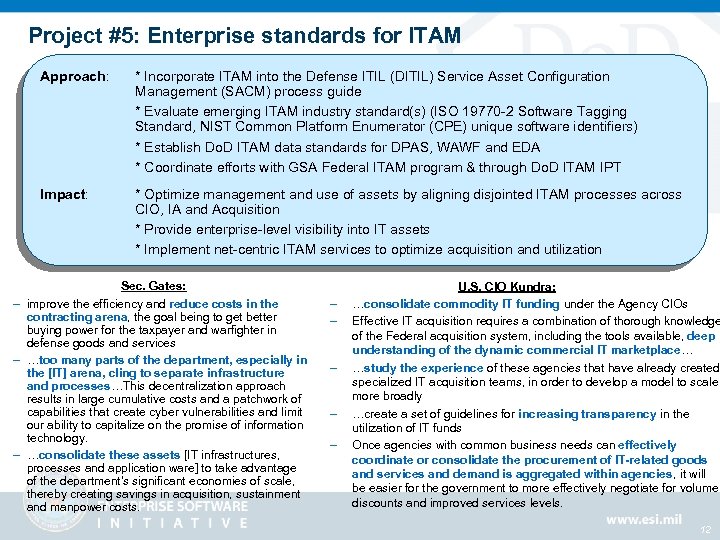 Project #5: Enterprise standards for ITAM Approach: * Incorporate ITAM into the Defense ITIL (DITIL) Service Asset Configuration Management (SACM) process guide * Evaluate emerging ITAM industry standard(s) (ISO 19770 -2 Software Tagging Standard, NIST Common Platform Enumerator (CPE) unique software identifiers) * Establish Do. D ITAM data standards for DPAS, WAWF and EDA * Coordinate efforts with GSA Federal ITAM program & through Do. D ITAM IPT Impact: * Optimize management and use of assets by aligning disjointed ITAM processes across CIO, IA and Acquisition * Provide enterprise-level visibility into IT assets * Implement net-centric ITAM services to optimize acquisition and utilization Sec. Gates: – improve the efficiency and reduce costs in the contracting arena, the goal being to get better buying power for the taxpayer and warfighter in defense goods and services – …too many parts of the department, especially in the [IT] arena, cling to separate infrastructure and processes…This decentralization approach results in large cumulative costs and a patchwork of capabilities that create cyber vulnerabilities and limit our ability to capitalize on the promise of information technology. – …consolidate these assets [IT infrastructures, processes and application ware] to take advantage of the department's significant economies of scale, thereby creating savings in acquisition, sustainment and manpower costs. – – – U. S. CIO Kundra: …consolidate commodity IT funding under the Agency CIOs Effective IT acquisition requires a combination of thorough knowledge of the Federal acquisition system, including the tools available, deep understanding of the dynamic commercial IT marketplace… …study the experience of these agencies that have already created specialized IT acquisition teams, in order to develop a model to scale more broadly …create a set of guidelines for increasing transparency in the utilization of IT funds Once agencies with common business needs can effectively coordinate or consolidate the procurement of IT-related goods and services and demand is aggregated within agencies, it will be easier for the government to more effectively negotiate for volume discounts and improved services levels. 12
 Increasing Efficiencies through Enterprise Behaviors excerpts from Secretary Gates’ August 9 2010 speech: • “…the task before us…is significantly to reduce [the department’s] excess overhead costs and apply the savings to force structure and modernization” • “… this year the military services were assigned the task of finding more than $100 billion in overhead savings over the next five years. Unlike budget cutting efforts of the past, the services will be able to keep the savings they generate to reinvest in higher-priority warfighting needs and modernization programs” • “…[USD AT&L] has launched an initiative to improve the efficiency and reduce costs in the contracting arena, the goal being to get better buying power for the taxpayer and warfighter in defense goods and services” • “…I am announcing an initial set of decisions designed to reduce duplication, overhead and excess in the defense enterprise and over time instill a culture of savings and restraint in this department” • “We need to create a system of fewer, flatter and more agile and responsive structures” • “…there are great benefits to be gained in cost and efficiency from taking advantage of economies of scale. The problem is that too many parts of the department, especially in the information technology arena, cling to separate infrastructure and processes…This decentralization approach results in large cumulative costs and a patchwork of capabilities that create cyber vulnerabilities and limit our ability to capitalize on the promise of information technology. ” • “…I'm directing an effort to consolidate these assets [IT infrastructures, processes and application ware] to take advantage of the department's significant economies of scale, thereby creating savings in acquisition, sustainment and manpower costs. This action will allow the increased use by the department of common functions and improve our ability to defend Defense networks against growing cyber threats. ” 13
 ESI promotes efficiencies, cost avoidance and enterprise IT management Ø Provides economies of scale for IT acquisitions Ø Protects enterprise-level IT management interests in IT vendor negotiations Ø Returns significant cost avoidance to ordering agencies Ø Promotes enterprise-level visibility into IT asset inventories through ITAM Ø Promotes adoption of standards and COTS IT solutions Ø Streamlines access to net-centric technologies and services Ø Promotes partnering between Do. D and DNI Ø Promotes cyber security – SCRM, Sw. A, software asset visibility Ø Ensures that unique Do. D enterprise needs are recognized in Federal IT policy and initiatives 14
 Do. D ESI Working Group Members Do. D ESI Co-Chairs Do. D CIO: Jim Clausen 703 -601 -4729 ext 117 james. clausen@osd. mil DON CIO (co-chair): Floyd Groce 703 -607 -5658 floyd. groce@navy. mil Do. D Component Representatives Army: Dee Wardle 732 -427 -6793 adelia. wardle@us. army. mil Air Force: Celeste Booth 703 -588 -6166 celeste. booth@pentagon. af. mil DLA: Katherine Patterson (703) 767 -1667 katherine. patterson@dla. mil DISA: Andrea Cabbagestalk 703 681 -2070 andrea. cabbagestalk@disa. mil DIA: Dwight Holmes (301) 851 -7414 dwight. holmes@dia. mil NGA: Laurie Jo Litton 703 -755 -5165 laurie. j. litton@nga. mil OSD: Paul Boyles 703 -614 -7682 paul. boyles@osd. mil ODNI: Tom Mc. Lernon 571 -280 -0090 tomasam@dni. gov Do. D ITAM PM: Bob Smith (Do. D CIO) 703 -601 -4729 ext 124 robert. smith@osd. mil 15
 Do. D ESI Vendors & Product Lines 16
 Backup
 U. S. CIO: IT Management Reform • • • The 9 Dec 2010 plan for IT management reform seeks to delivery more value to taxpayers for IT spend: – Shift to “Cloud First” policy. Each agency will identify three “must move” services within three months and move one oft those services to the cloud within 12 months and the remaining two within 18 months – Reduce number of Federal data centers by at least 800 by 2015 – Only approve funding of major IT programs that…use specialized IT acquisition professionals – Work with Congress to consolidate commodity IT funding under the Agency CIOs “Cloud technologies and infrastructure-as-a-service enable IT services to efficiently share demand across infrastructure assets” Leveraging shared services of “commodity” applications such as e-mail across functional organizations allows organizations to redirect management attention and resources towards value-added activities Modular development delivers functionality in shorter timeframes and has long been considered best practice in the private sector and in some areas of government Moving forward, Federal IT programs must be structured to deploy working business functionality in release cycles no longer than 12 months, and , ideally, less than six months Effective IT acquisition requires a combination of thorough knowledge of the Federal acquisition system, including the tools available, deep understanding of the dynamic commercial IT marketplace, and the unique challenges inherent to successfully delivering large IT programs in a modular time-boxed manner OFPP will lead an effort over the next six months to study the experience of these agencies that have already created specialized IT acquisition teams, in order to develop a model to scale more broadly OFPP will work with the acquisition and IT communities to develop guidance on contracting for modular development…OFPPO will develop templates and samples, and will crate communities of practice to facilitate adoption of modular contracting practices …analyze existing working capital funds (WCFs) and other vehicles for pooling funds and extending availability of funding…These accounts add flexibility by pooling bureau-level funds to serve agency-wide purposes The Federal CFO and CIO Councils will create a set of guidelines for increasing transparency in the utilization of IT funds Agencies…and even programs currently design, build and operate independent systems for “commodity” IT services (e. g. , e-mail, data centers, content management systems, web infrastructure)…[which] are often duplicative and sub-scale…[and] draw resources away from IT programs that deliver value…On an annual basis, the Agency CIOS and the Federal CIO Council will identify “commodity” services to be included in this [inter- and intra- agency IT services] funding model [for “commodity” IT services]. A benefit of consolidate commodity IT spending is the ability to move more readily to adopt strategic sourcing solutions. Once agencies with common business needs can effectively coordinate or consolidate the procurement of IT-related goods and services and demand is aggregated within agencies, it will be easier for the government to more effectively negotiate for volume discounts and improved services levels. 18
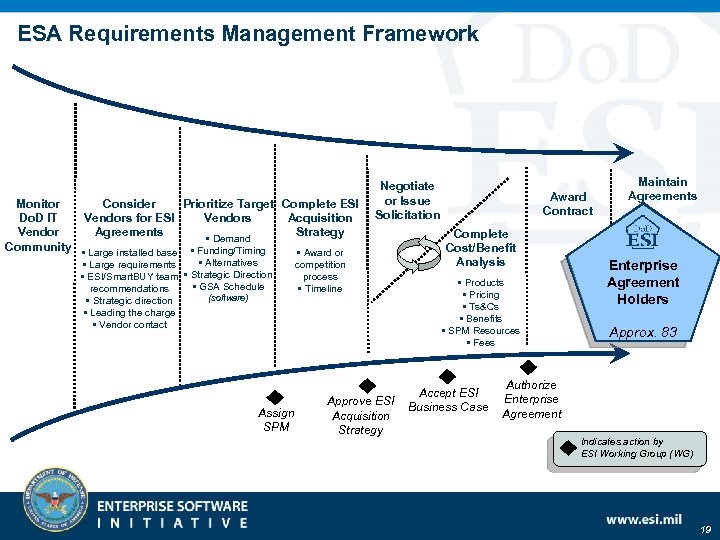 ESA Requirements Management Framework Monitor Consider Prioritize Target Complete ESI Do. D IT Vendors for ESI Vendors Acquisition Vendor Agreements Strategy • Demand Community • Large installed base • Funding/Timing • Award or • Alternatives • Large requirements • Strategic Direction • ESI/Smart. BUY team • GSA Schedule recommendations (software) • Strategic direction • Leading the charge • Vendor contact Assign SPM Negotiate or Issue Solicitation competition process • Timeline Approve ESI Acquisition Strategy Award Contract Complete Cost/Benefit Analysis • Products • Pricing • Ts&Cs • Benefits • SPM Resources • Fees Accept ESI Business Case Maintain Agreements Enterprise Agreement Holders Approx. 83 Authorize Enterprise Agreement Indicates action by ESI Working Group (WG) 19
 Factors for Selection and Award • Vendor selection – Is vendor in demand within Do. D? • • • Large existing Do. D installed base identified through ESI Working Group or SPMs Recommended by Do. D CIO community through strategic direction Vendor contact with ESI team – Is vendor “qualified” for consideration? • • Substantial Do. D demand Strategic Direction -- supports strategic policy (e. g. , Service Oriented Enterprise, IA, Cloud Computing) Vendor holds GSA schedule (for software vendors) Vendor is interested and willing to negotiate pricing, Ts&Cs and EULA – Are ESI SPM resources available? • • • Sufficient manpower is available to staff acquisition No higher priority opportunities exist (e. g. , larger funded requirements and/or cost avoidance in the shortterm) Enterprise agreement award – Acquisition strategy satisfies underlying drivers • • • Timeline Competition/award process meets ESI Working Group requirements Competition/award process meets Component’s acquisition rules and expectations – Business case supports pursuing agreement • • • Near-term funded requirements Sufficient benefits in product mix, terms and price discounts Will provide sustained, recognized value to Do. D – Do. D and vendor accept contract and licensing terms and conditions 20
 Do. D ESI & GSA Smart. BUY • Smart. BUY is administered by the General Services Administration (GSA) under the Federal Strategic Sourcing Initiative (FSSI) • Smart. BUY is implemented within Defense Dept through Do. D ESI – Do. D ESI participated on initial cross-agency Smart. BUY team and provided “lessons learned” from ESI start-up – Do. D ESI Software Product Managers actively manage 21 of the current GSA Smart. BUY agreements • Smart. BUY use is mandatory, where requirements match offerings – OMB waiver required for deviations – Do. D buyers must check Do. D ESI website (www. ESI. mil) before making commercial software buys 21
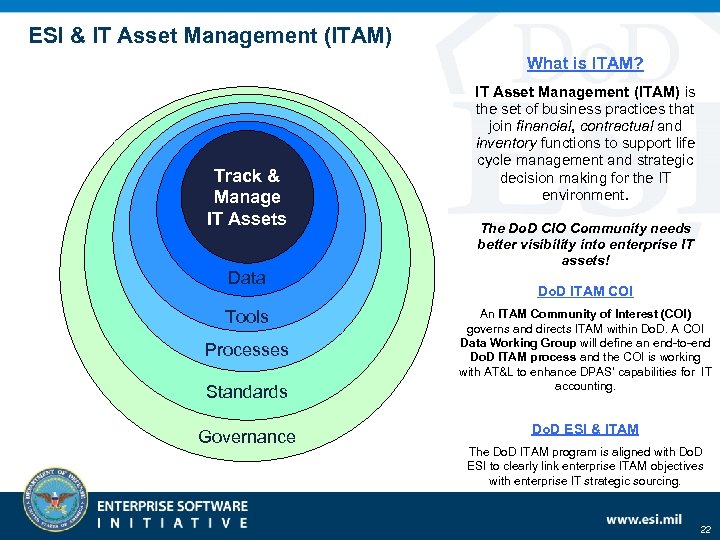 ESI & IT Asset Management (ITAM) What is ITAM? Track & Manage IT Assets Data Tools Processes Standards Governance IT Asset Management (ITAM) is the set of business practices that join financial, contractual and inventory functions to support life cycle management and strategic decision making for the IT environment. The Do. D CIO Community needs better visibility into enterprise IT assets! Do. D ITAM COI An ITAM Community of Interest (COI) governs and directs ITAM within Do. D. A COI Data Working Group will define an end-to-end Do. D ITAM process and the COI is working with AT&L to enhance DPAS’ capabilities for IT accounting. Do. D ESI & ITAM The Do. D ITAM program is aligned with Do. D ESI to clearly link enterprise ITAM objectives with enterprise IT strategic sourcing. 22