


 Скачать презентацию Do D FEAC 1 OV-5 and OV-7 Dennis
0fa37c450ef5ec540b82fb9deff9809f.ppt
- Количество слайдов: 32
 Do. D FEAC 1 OV-5 and OV-7 Dennis E. Wisnosky Wizdom Systems, Inc. 630. 357. 3000 Dwiz@wizdom. com Activity and Data Modeling in Perspective
 IDEF Do. D FEAC 1 • Created in the late ‘ 70 s • IDEF stands for Integrated DEFinition Language. • Provides a common, public-domain language for modeling and describing: – – Processes Data Requirements Functions • Has been used to improve hundreds of enterprises • IDEF is a standard modeling technique for all US Government agencies, and many private companies.
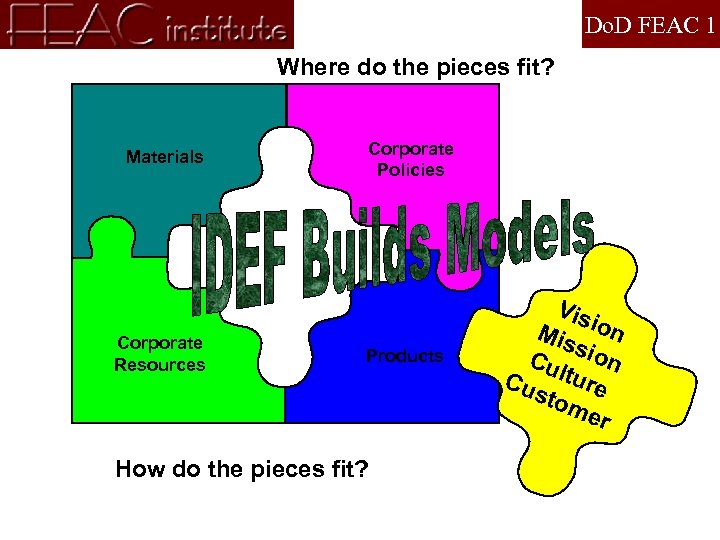 Do. D FEAC 1 Where do the pieces fit? Materials Corporate Resources Corporate Policies Products How do the pieces fit? Vis Mis ion Cu sion Cu lture sto me r
 Models Do. D FEAC 1
 Do. D FEAC 1 Effective Engineering Requires a Blueprint • Models are a basic necessity for building everything from houses to cars; marketing plans to financial forecasts. • Modeling gives you a clear picture of the current situation, as well as a plan for the future. • A model helps concepts evolve to plans and prototypes. • Modeling a structure or solution is especially worthwhile when implementation goals are obvious and important.
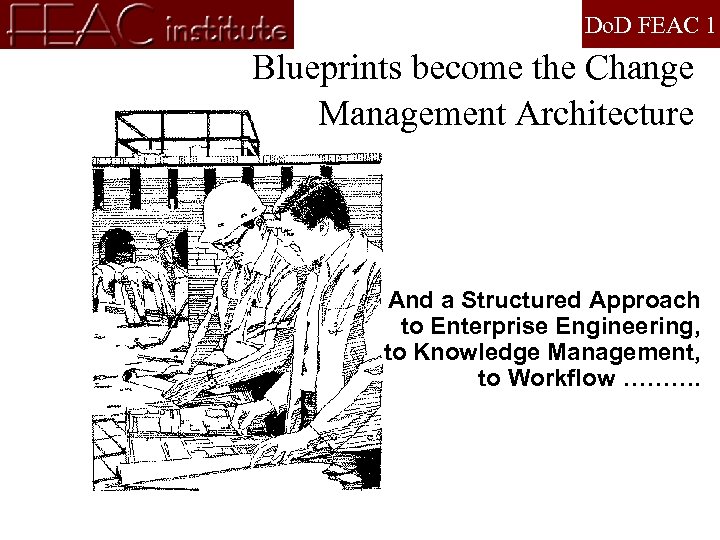 Do. D FEAC 1 Blueprints become the Change Management Architecture And a Structured Approach to Enterprise Engineering, to Knowledge Management, to Workflow ……….
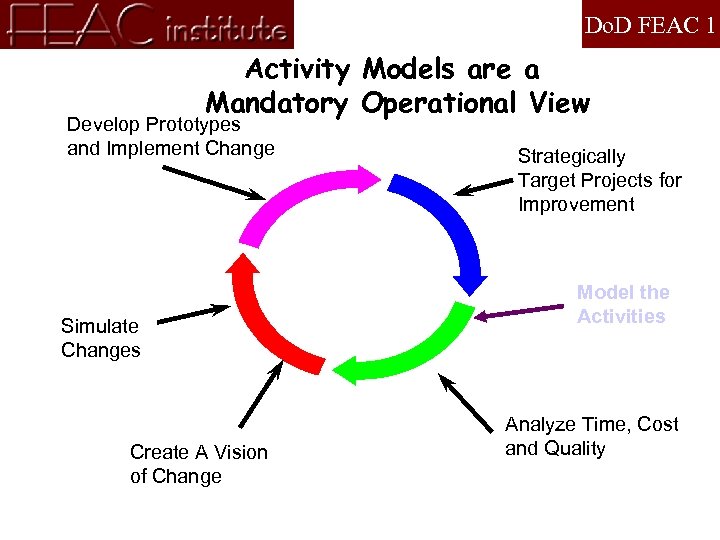 Do. D FEAC 1 Activity Models are a Mandatory Operational View Develop Prototypes and Implement Change Simulate Changes Create A Vision of Change Strategically Target Projects for Improvement Model the Activities Analyze Time, Cost and Quality
 Do. D FEAC 1 IDEF is tool for. . . describing. . . managing. . . and improving complex processes and systems To do this, we need a common framework for visualizing the processes and the systems they support, and a methodology for representing both.
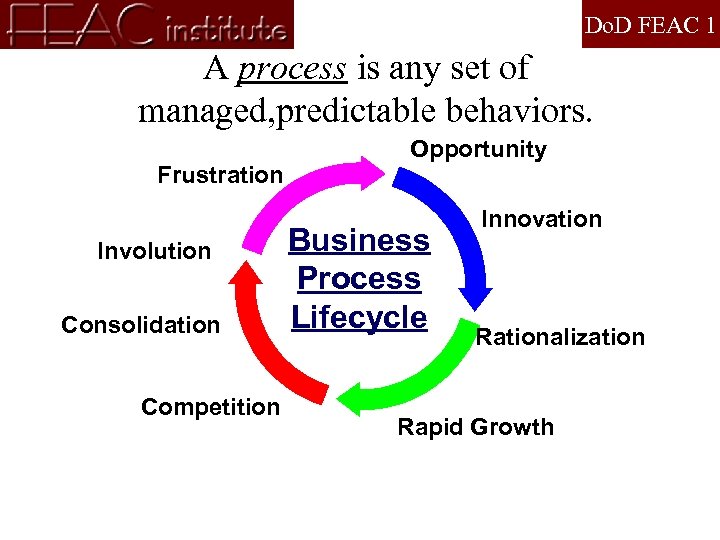 Do. D FEAC 1 A process is any set of managed, predictable behaviors. Frustration Involution Consolidation Competition Opportunity Business Process Lifecycle Innovation Rationalization Rapid Growth
 Do. D FEAC 1 Process Management The goal of process management is to minimize costs through: • Rationalization, • Consolidation, • Involution, • and to maximize the benefits of innovation, growth, and change.
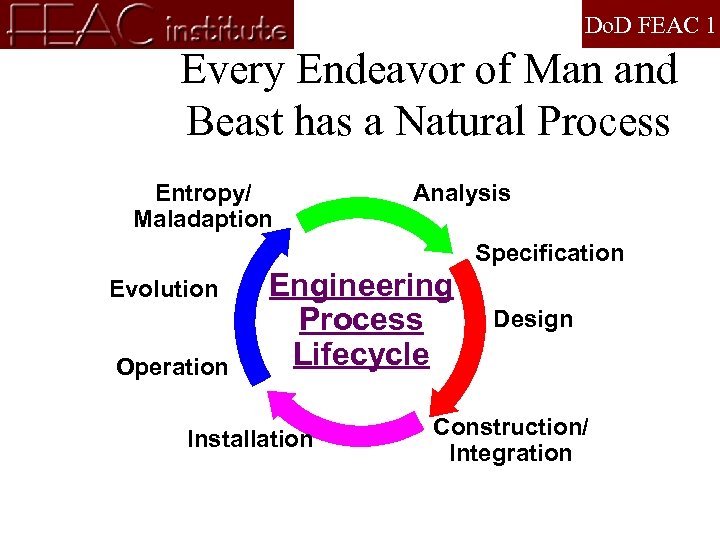 Do. D FEAC 1 Every Endeavor of Man and Beast has a Natural Process Entropy/ Maladaption Analysis Specification Evolution Operation Engineering Process Lifecycle Installation Design Construction/ Integration
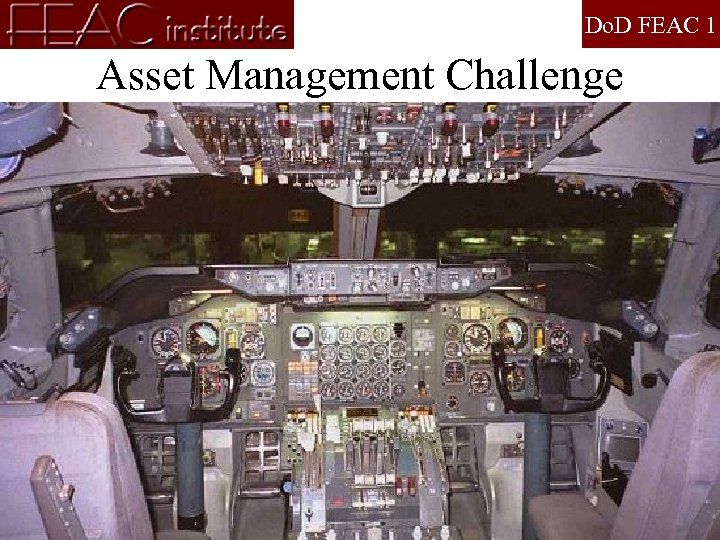
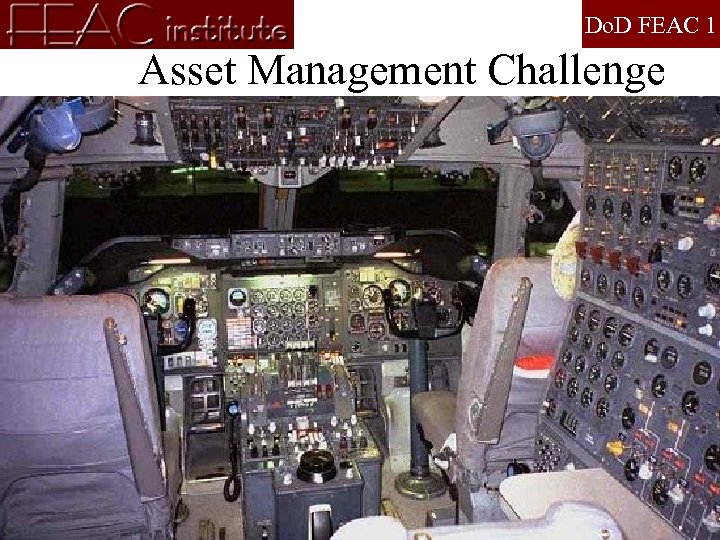
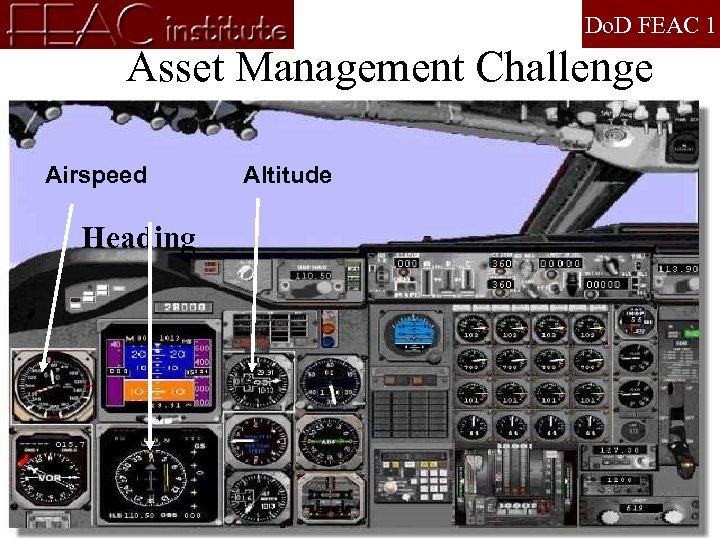
 Do. D FEAC 1 What are the Processes Doing? • The goal is to improve the management of both tangible and intangible assets according to a longrange plan while achieving continuous improvement. Since assets are all that an organization (and men and women) have, this is all that the goal can be.
 Do. D FEAC 1 Asset Management Challenge
 Do. D FEAC 1 Asset Management Challenge
 Do. D FEAC 1 Asset Management Challenge Airspeed Heading Altitude
 Do. D FEAC 1 Pooch Management
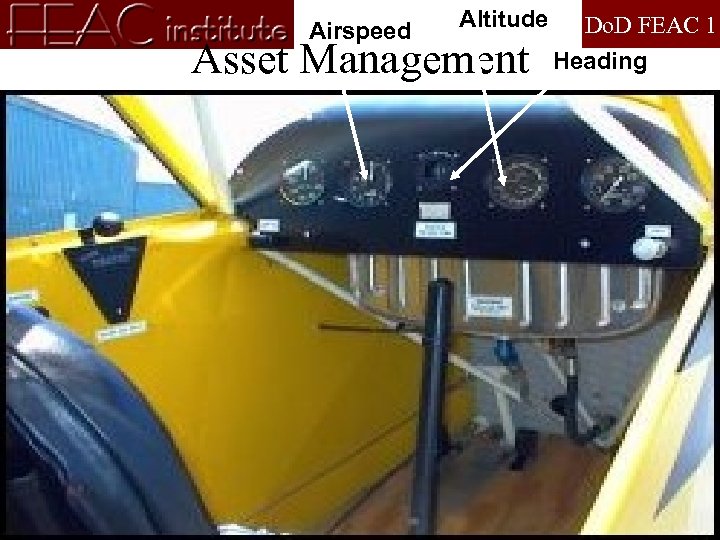 Airspeed Altitude Asset Management Do. D FEAC 1 Heading
 Do. D FEAC 1 IDEF (0 and 1 X) Is the unified modeling methodology that embraces management and user concerns in systems and process management.
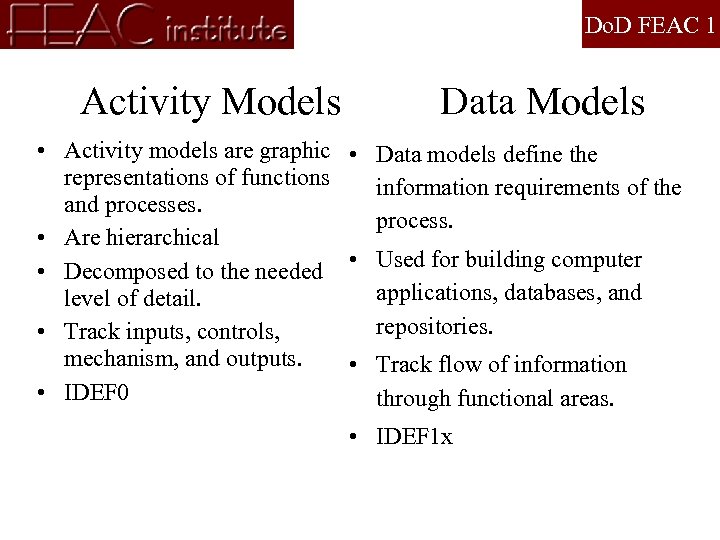 Do. D FEAC 1 Activity Models Data Models • Activity models are graphic • Data models define the representations of functions information requirements of the and processes. process. • Are hierarchical • Decomposed to the needed • Used for building computer applications, databases, and level of detail. repositories. • Track inputs, controls, mechanism, and outputs. • Track flow of information • IDEF 0 through functional areas. • IDEF 1 x
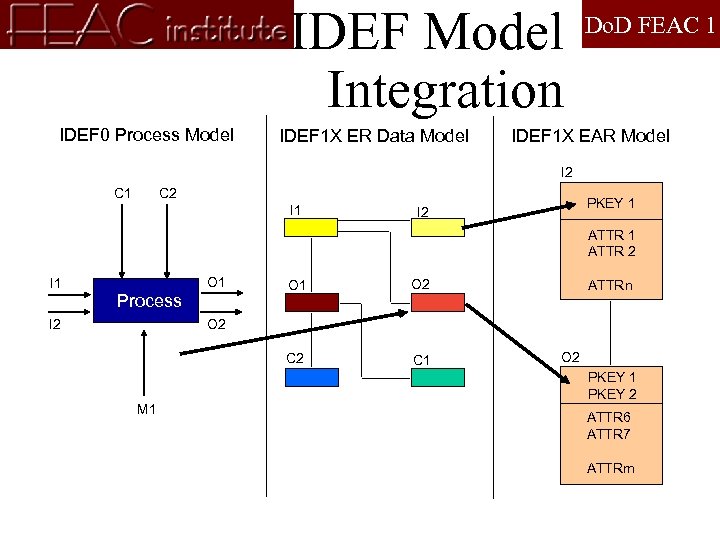 IDEF Model Integration IDEF 0 Process Model IDEF 1 X ER Data Model Do. D FEAC 1 IDEF 1 X EAR Model I 2 C 1 C 2 I 1 PKEY 1 I 2 ATTR 1 ATTR 2 I 1 O 1 I 2 O 2 C 2 Process O 1 C 1 ATTRn O 2 M 1 O 2 PKEY 1 PKEY 2 ATTR 6 ATTR 7 ATTRm
 Do. D FEAC 1 Varieties of Models come in many shapes and sizes: – – – Process Vs Data models Text Vs Graphic-based models High- Vs Low-level models Flat Vs Hierarchic models Degree of rigor in the modeling methodology Representation of additional detail: timing, data states, business rules. . .
 Do. D FEAC 1 Model Vs Reality Models represent reality in a form that can be easily controlled, evaluated, and manipulated. Complex, poorly understood processes become manageable when broken down into their component parts. Models can be used for analysis of the simplest processes; or the most complex systems with lifecycle costs in the millions of dollars
 Do. D FEAC 1 Activity Modeling links the organization to its strategic goals. • Simplification of Value-Added Activities • Consolidation of Value-Added Activities • Elimination of activities that do not add value • Automated support only after basic business processes are efficient and effective. • Provides the basis for analysis and continuous improvement.
 Do. D FEAC 1 Levels of Analysis • Strategic overview-- examination of the corporation as a whole, focusing on mission and long range goals and objectives. • Mid-level analysis of management, culture, and organizations. • Detailed look at individual processes. All analyses are done in terms of time, cost, and quality
 Do. D FEAC 1 Process Analysis IDEF models gather the data for analysis: Cost: Activity-based costing, functional economic analysis Time: Timeline, cycle time, run time, turn-around times, sequence, hierarchy, dependencies. Quality: Quality metrics, comparisons between past, present, and future , TQM, CQI. Redundant, over-lapping, non-valueadded processes become apparent while building the model.
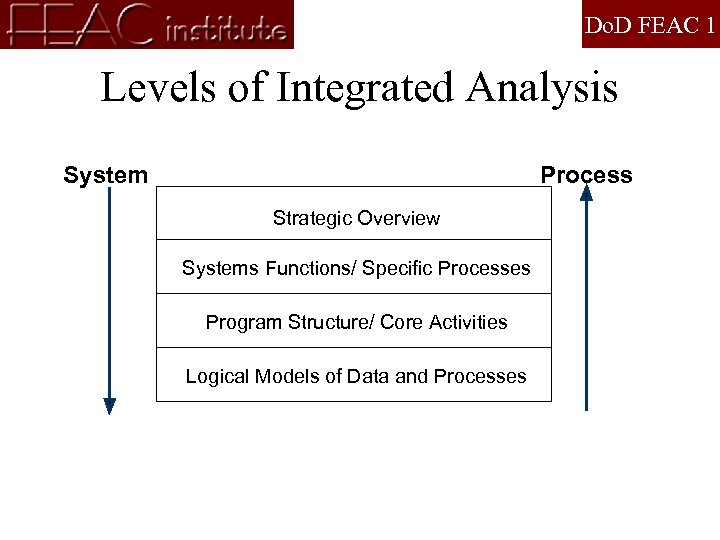 Do. D FEAC 1 Levels of Integrated Analysis System Process Strategic Overview Systems Functions/ Specific Processes Program Structure/ Core Activities Logical Models of Data and Processes
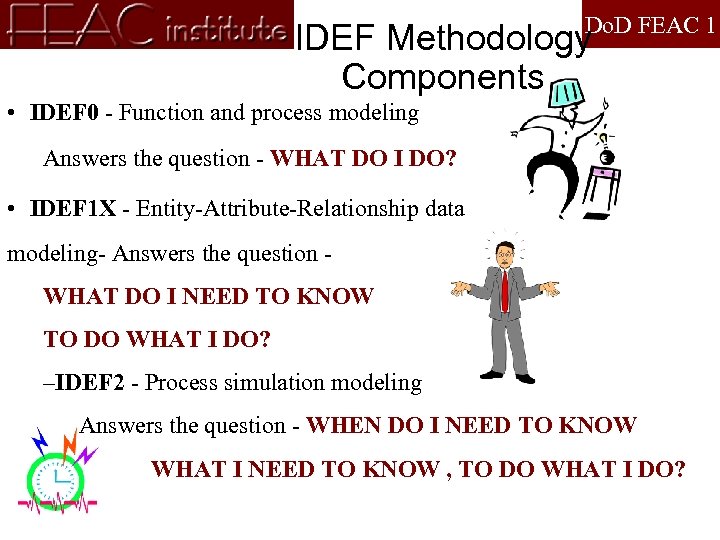 Do. D FEAC 1 IDEF Methodology Components • IDEF 0 - Function and process modeling Answers the question - WHAT DO I DO? • IDEF 1 X - Entity-Attribute-Relationship data modeling- Answers the question WHAT DO I NEED TO KNOW TO DO WHAT I DO? –IDEF 2 - Process simulation modeling Answers the question - WHEN DO I NEED TO KNOW WHAT I NEED TO KNOW , TO DO WHAT I DO?
 Benefits • Do. D FEAC 1 IDEF 0 reveals redundant and non-valueadded processes. • IDEF 0 documents the AS-IS-- the processes, the relationships between them, and the logical breakdown of those functions into their subprocesses and properties for baseline evaluation and further analysis. • IDEF 0 begins the road map from the AS-IS to the TO-BE.
 Benefits Do. D FEAC 1 (continued) • IDEF 0 provides a means for communicating and • • presenting results. IDEF 0 establishes a forum and a structure for data gathering and knowledge acquisition. IDEF 0 identifies opportunities for improvements. IDEF 0 reveals data relationships and incongruities. IDEF 0 identifies and categorizes information entities which form the foundation for information modeling (IDEF 1 x).
 Do. D FEAC 1 IDEF is not a substitute for. . . thinking. . . intelligence. . . or experience, But it can expose their absence.
 Do. D FEAC 1 This concludes Activity and Data Modeling in Perspective
 Do. D FEAC 1 Now we can begin the important work!