


 Скачать презентацию Do Countries Catch-up with the Technological Frontier Antonio
e50bf12fe2c01a5a93cbb98d7027eee8.ppt
- Количество слайдов: 19
 Do Countries Catch-up with the Technological Frontier? Antonio Álvarez University of Oviedo Alejandro Fernández CEMFI
 Technological Catch-up • Technological Catch-up: backward countries move towards the technological frontier • This is due to a process of technological diffusion which depends on the ability to assimilate and apply new knowledge • Trade Openness • Foreign Direct Investment (FDI) • Human capital
 Objective of the paper • Two main questions § Is the technological gap between rich and poor countries closing? § What factors contribute to catch-up? • In particular, study the role of institutional variables (social infrastructure)
 Empirical Models of Technological Catch-up
 Stochastic Frontiers and Catch-up • Our approach is based on the Stochastic Frontier Model § U (inefficiency) is the distance to the frontier • It is specified as a non-negative random term • It is assumed to follow a half-normal distribution § The change in U can be interpreted as a measure of catching-up with the technological frontier
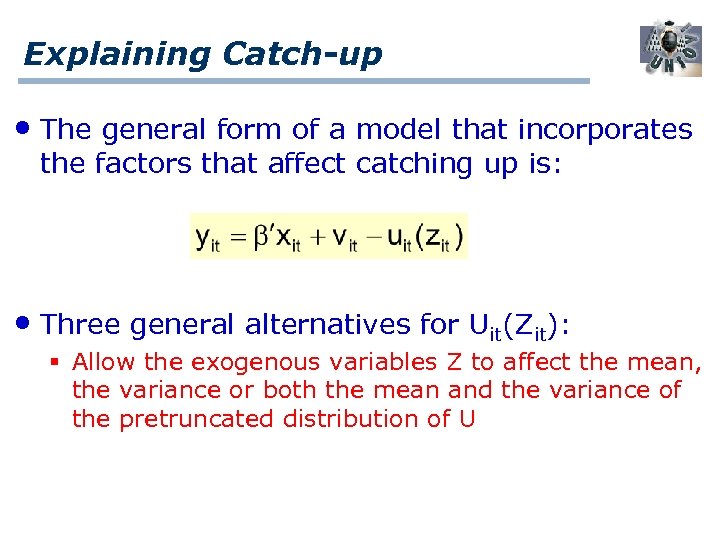 Explaining Catch-up • The general form of a model that incorporates the factors that affect catching up is: • Three general alternatives for Uit(Zit): § Allow the exogenous variables Z to affect the mean, the variance or both the mean and the variance of the pretruncated distribution of U
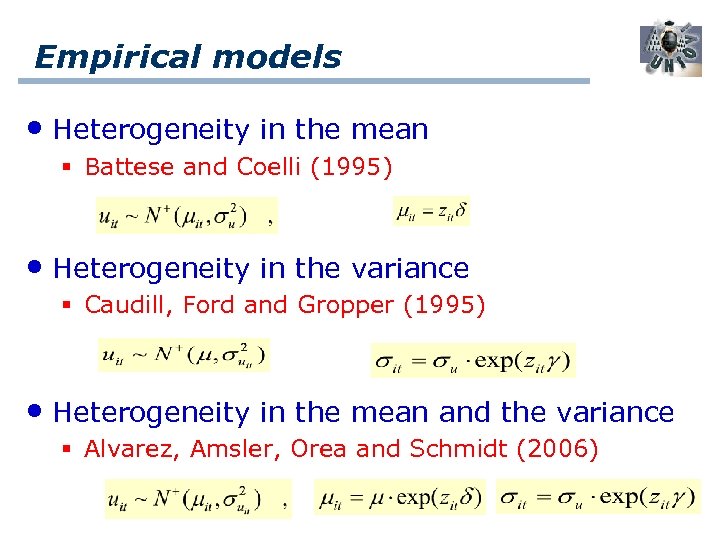 Empirical models • Heterogeneity in the mean § Battese and Coelli (1995) • Heterogeneity in the variance § Caudill, Ford and Gropper (1995) • Heterogeneity in the mean and the variance § Alvarez, Amsler, Orea and Schmidt (2006)
 Empirical Application
 Data • Balanced panel data set • 78 countries § Excluded: Eastern European countries, very small countries • 26 years (1975 -2000) • Sources: § Penn World Table 6. 2 § Other
 Variables (I) • Dependent variable: § Gross Domestic Product • Inputs: § K: Stock of private capital § L: Labor • Control variables: § Z: Percentage of Rural Population § Country-group dummies
 Variables (II) § Leading Country: USA. § Industrialized Countries: Canada, Australia, New Zealand, Japan, Israel. § Northern Europe: Denmark, Norway, Sweden, Finland, UK, Ireland, Germany, Belgium, Netherlands, Austria, Switzerland, France, Italy. § Southern Europe: Portugal, Spain, Greece. § Latin America: Argentina, Bolivia, Brazil, Chile, Colombia, Costa Rica, Dominican Rep. , Ecuador, El Salvador, Guatemala, Honduras, Nicaragua, Panama, Paraguay, Peru, Uruguay. § Asia: China, Hong Kong, India, Indonesia, Jordan, Korea, Malaysia, Nepal, Pakistan, Papua New Guinea, Philippines, Sri Lanka, Syria, Taiwan, Thailand, Turkey. § Northern Africa: Benin, Central African Rep. , Congo, Ivory Coast, Ghana, Mali, Niger, Senegal, Sierra Leone, Togo, Tunisia. § Southern Africa: Cameroon, Congo, Kenya, Malawi, Mozambique, Rwanda, South Africa, Tanzania, Uganda, Zambia, Zimbabwe. § Oil Exporting: Algeria, Mexico, Venezuela, Iran.
 Variables (III) • Efficiency determinants (Zit) § Economic variables • Human Capital (H) • Average years of schooling of the population 15+ • Source: Barro and Lee (2000) • Trade Openness • Exports plus imports over GDP • Source: PWT 6. 2
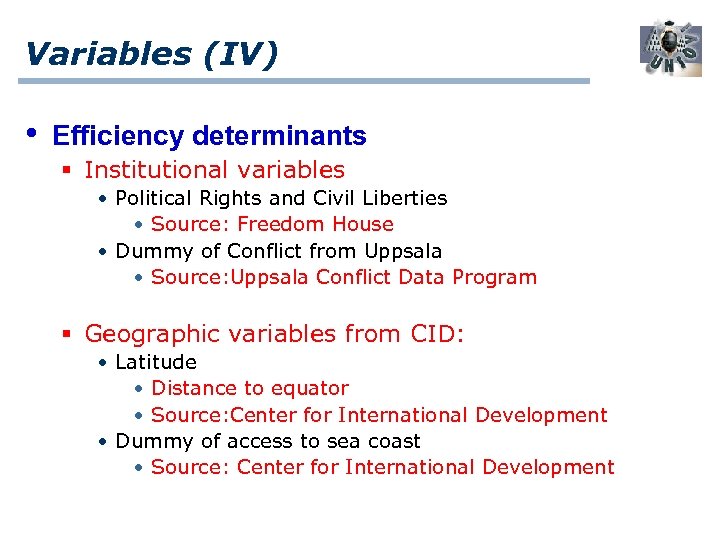 Variables (IV) • Efficiency determinants § Institutional variables • Political Rights and Civil Liberties • Source: Freedom House • Dummy of Conflict from Uppsala • Source: Uppsala Conflict Data Program § Geographic variables from CID: • Latitude • Distance to equator • Source: Center for International Development • Dummy of access to sea coast • Source: Center for International Development
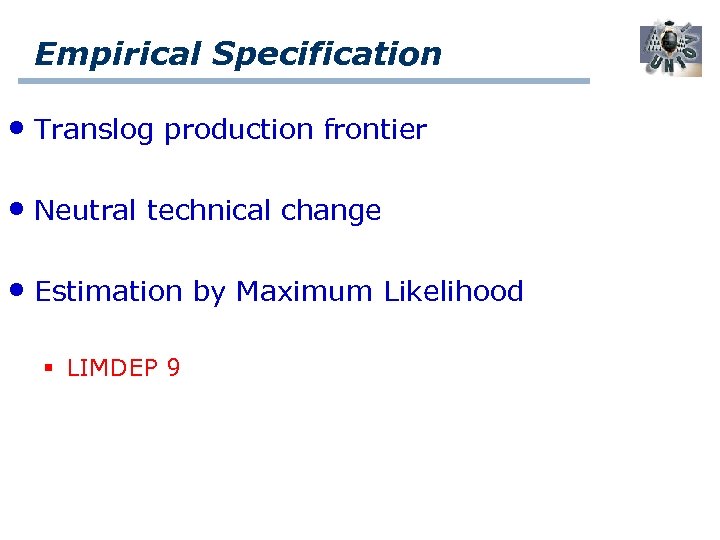 Empirical Specification • Translog production frontier • Neutral technical change • Estimation by Maximum Likelihood § LIMDEP 9
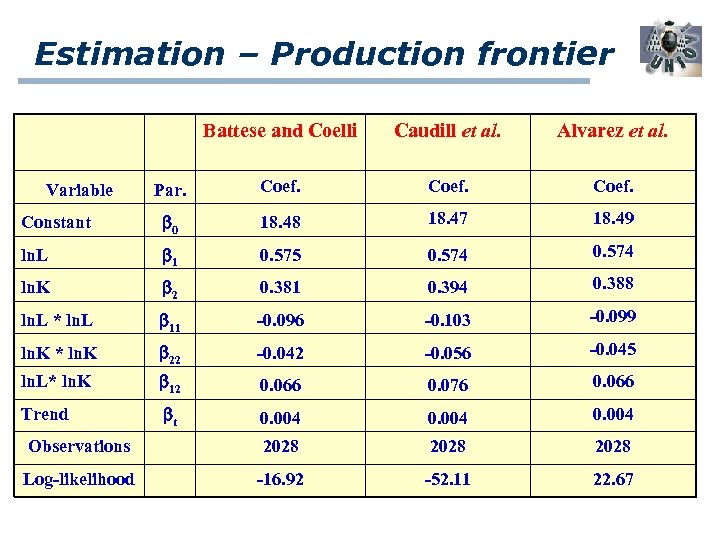 Estimation – Production frontier Battese and Coelli Caudill et al. Alvarez et al. Par. Coef. Constant 0 18. 48 18. 47 18. 49 ln. L 1 0. 575 0. 574 ln. K 2 0. 381 0. 394 0. 388 ln. L * ln. L 11 -0. 096 -0. 103 -0. 099 ln. K * ln. K 22 -0. 042 -0. 056 -0. 045 ln. L* ln. K 12 0. 066 0. 076 0. 066 Trend t 0. 004 Observations 2028 Log-likelihood -16. 92 -52. 11 22. 67 Variable
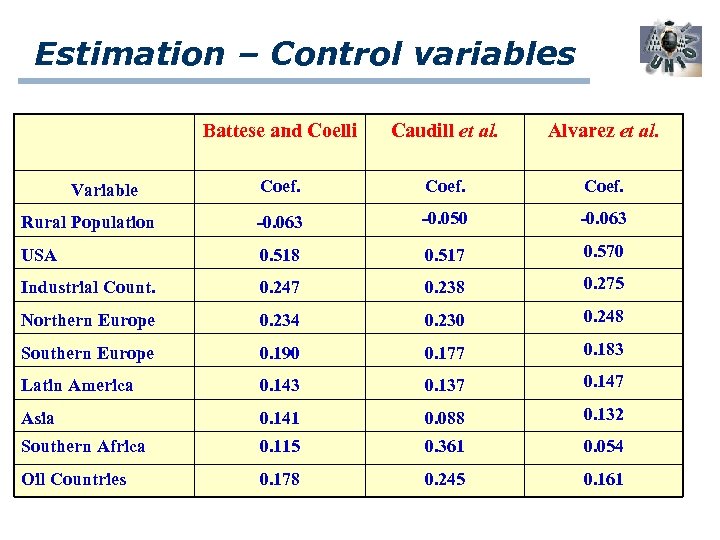 Estimation – Control variables Battese and Coelli Caudill et al. Alvarez et al. Coef. Rural Population -0. 063 -0. 050 -0. 063 USA 0. 518 0. 517 0. 570 Industrial Count. 0. 247 0. 238 0. 275 Northern Europe 0. 234 0. 230 0. 248 Southern Europe 0. 190 0. 177 0. 183 Latin America 0. 143 0. 137 0. 147 Asia 0. 141 0. 088 0. 132 Southern Africa 0. 115 0. 361 0. 054 Oil Countries 0. 178 0. 245 0. 161 Variable
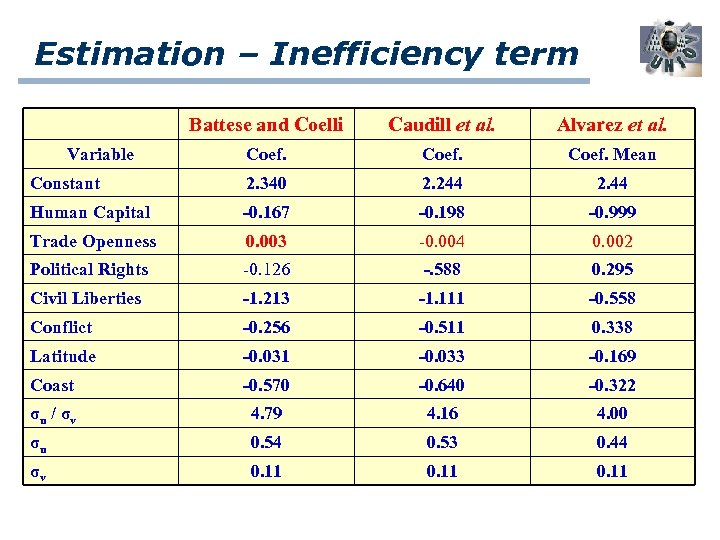 Estimation – Inefficiency term Battese and Coelli Caudill et al. Alvarez et al. Coef. Mean Constant 2. 340 2. 244 2. 44 Human Capital -0. 167 -0. 198 -0. 999 Trade Openness 0. 003 -0. 004 0. 002 Political Rights -0. 126 -. 588 0. 295 Civil Liberties -1. 213 -1. 111 -0. 558 Conflict -0. 256 -0. 511 0. 338 Latitude -0. 031 -0. 033 -0. 169 Coast -0. 570 -0. 640 -0. 322 σu / σv 4. 79 4. 16 4. 00 σu 0. 54 0. 53 0. 44 σv 0. 11 Variable
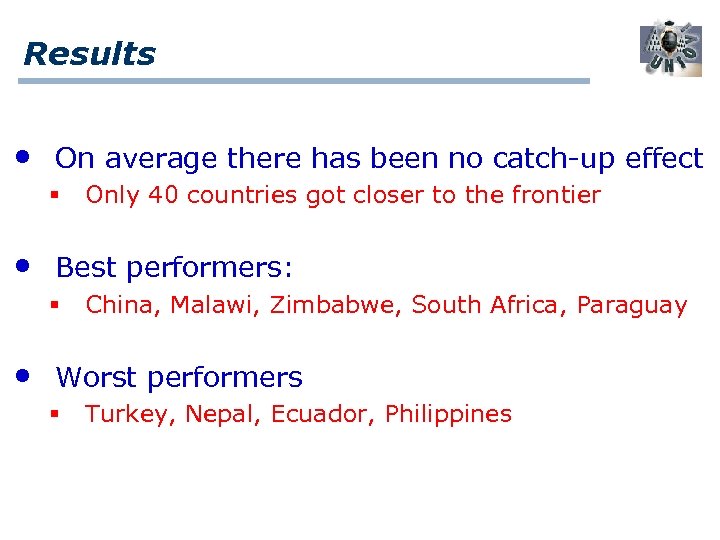 Results • On average there has been no catch-up effect § • Best performers: § • Only 40 countries got closer to the frontier China, Malawi, Zimbabwe, South Africa, Paraguay Worst performers § Turkey, Nepal, Ecuador, Philippines
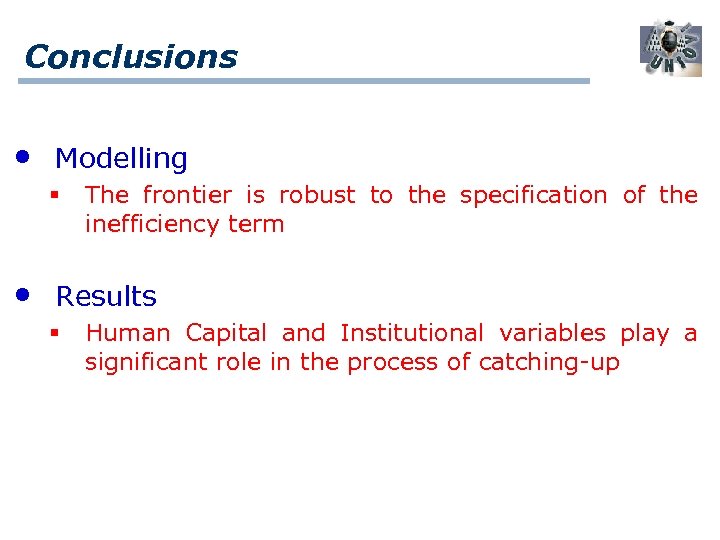 Conclusions • Modelling § • The frontier is robust to the specification of the inefficiency term Results § Human Capital and Institutional variables play a significant role in the process of catching-up