


 Скачать презентацию Dniepropetrovsk state medical academy Chair of Orthopaedy and
Политравма_2009 англ.ppt
- Количество слайдов: 71
 Dniepropetrovsk state medical academy Chair of Orthopaedy and Traumatology POLYTRAUMA. INJURIES OF PELVIS AND SPINAL COLUMN Prof. A. E. Loskutov Dr. A. S. Boguslavskiy, Ph. D 2009
 Polytrauma (Multiply trauma) – is syndrome of injury of some segments or organs of human body with following system of functional disorders. Это - обобщающая категория, которая объединяет пациентов с различными совокупностями повреждений. Multiply trauma (Множественная травма) – the simultaneous two and more injuries in one system of organs or in one cavity. Associative trauma (Сочетанная травма) - the simultaneous two and more injuries in any two systems of organs or different cavities. Combined trauma (Комбинированная травма) – the simultaneous acting of different traumatic factors: mechanical, temperature, chemical, radiation etc. In case of polytrauma the significant disorders of vital functions are developed. This results to the some difficulties in diagnostics and treatment of patients, creates the high rate of mortality and disability.
 Actuality • In Germany in 2005 due to car incidents 9896 people died, in Ukraine - 30965 persons. • In United Kingdom the costs of treatment of polytrauma are arising up to 2. 2 billion pounds (1% of gross output). • The rate of lethal outcomes of patients with polytrauma is 15 -20% in Ukraine, 3 -4% in Europe, 1. 3 -1. 4% in USA. • 7, 2% of survived after polytrauma become jobless or get a pension.
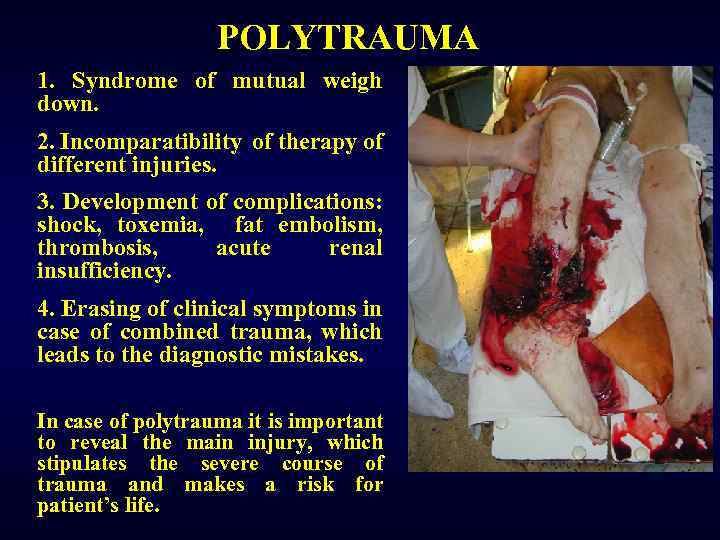 POLYTRAUMA 1. Syndrome of mutual weigh down. 2. Incomparatibility of therapy of different injuries. 3. Development of complications: shock, toxemia, fat embolism, thrombosis, acute renal insufficiency. 4. Erasing of clinical symptoms in case of combined trauma, which leads to the diagnostic mistakes. In case of polytrauma it is important to reveal the main injury, which stipulates the severe course of trauma and makes a risk for patient’s life.
 Pathogenesis of Polytrauma • Simultaneous development of some foci of pathological impulsation. • Simultaneous existing of some sources of external or internal bleeding. • Postrraumatic endotoxicosis, hypoxia. • Overload of immune system, which results to sepsis and polyorganic insufficiency.
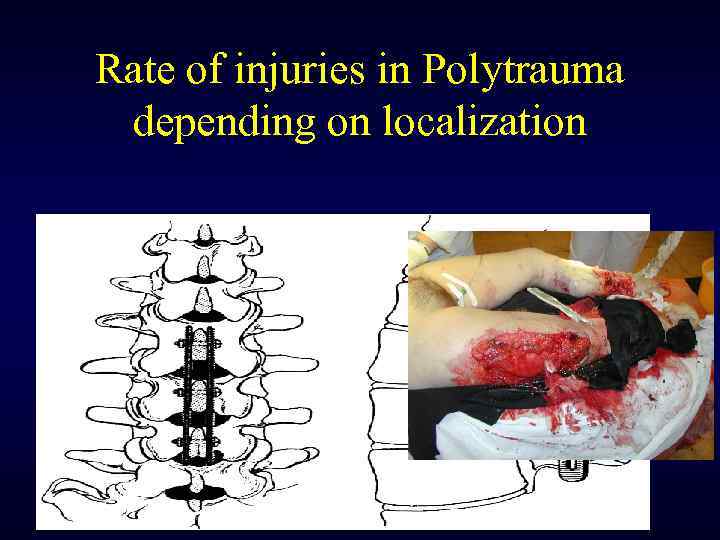 Rate of injuries in Polytrauma depending on localization
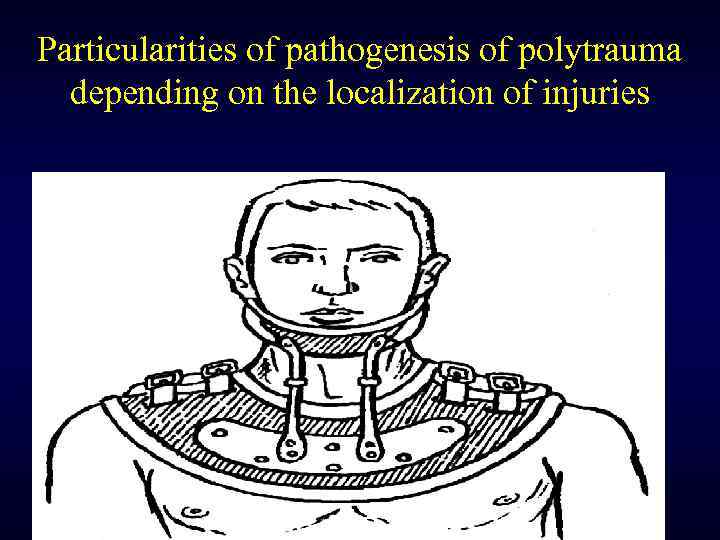 Particularities of pathogenesis of polytrauma depending on the localization of injuries
 Characteristics of Medical Trauma-Center It should be included: • Computer tomography • Ward for treatment of shock • Urgent operation room for performing surgeries of any systems and segments • Urgent laboratories • Duty staff of surgeons, neurosurgeons, traumatologists, anaesthesiologists, nurses which can perform quality work during leak of time • Supplement by modern remedies and materials
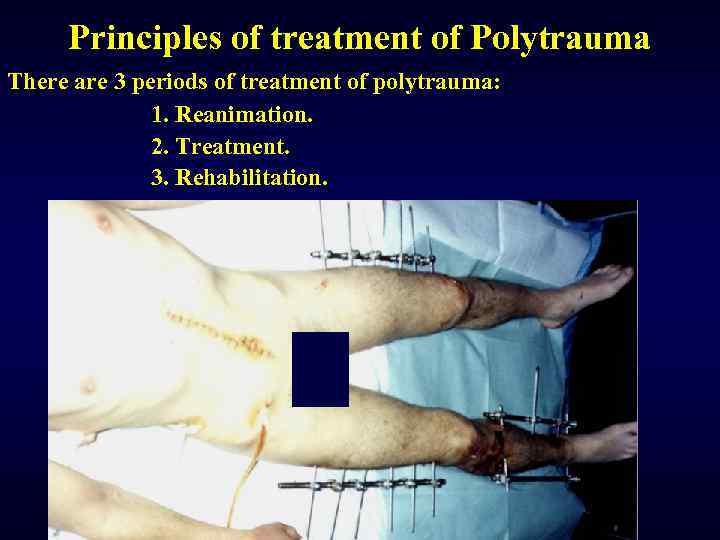 Principles of treatment of Polytrauma There are 3 periods of treatment of polytrauma: 1. Reanimation. 2. Treatment. 3. Rehabilitation.
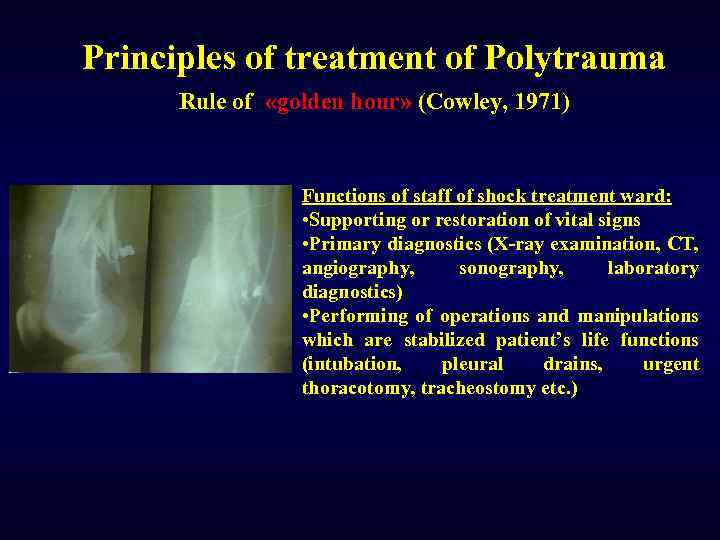 Principles of treatment of Polytrauma Rule of «golden hour» (Cowley, 1971) Functions of staff of shock treatment ward: • Supporting or restoration of vital signs • Primary diagnostics (X-ray examination, CТ, angiography, sonography, laboratory diagnostics) • Performing of operations and manipulations which are stabilized patient’s life functions (intubation, pleural drains, urgent thoracotomy, tracheostomy etc. )
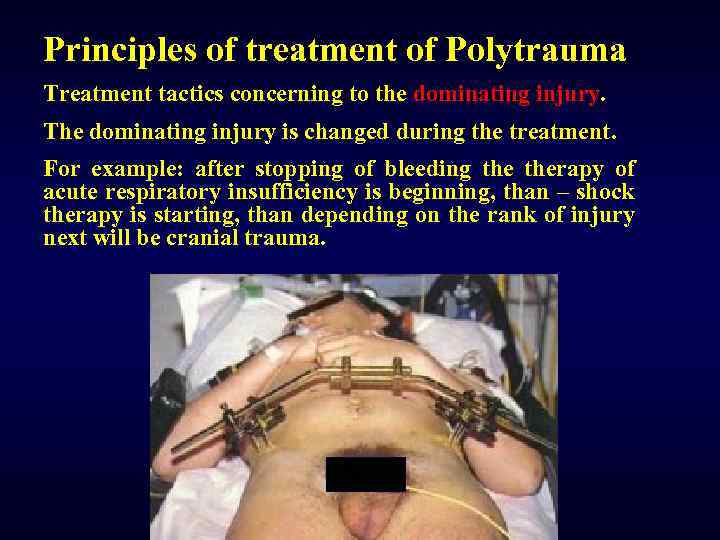 Principles of treatment of Polytrauma Treatment tactics concerning to the dominating injury. The dominating injury is changed during the treatment. For example: after stopping of bleeding therapy of acute respiratory insufficiency is beginning, than – shock therapy is starting, than depending on the rank of injury next will be cranial trauma.
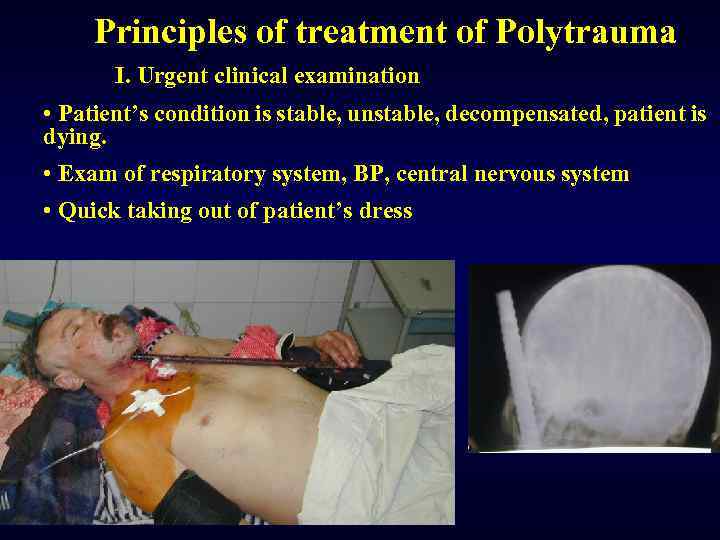 Principles of treatment of Polytrauma I. Urgent clinical examination • Patient’s condition is stable, unstable, decompensated, patient is dying. • Exam of respiratory system, BP, central nervous system • Quick taking out of patient’s dress
 Principles of treatment of Polytrauma 2. Performing of actions supporting patient’s life • Central venous approach • Good pass of air through respiratory system, including intubation • Draining of pleural cavity • Reanimation actions 3. Oxygenation and perfusion • Treatment of blood loss • Supporting of respirations • Hemodynamic and ventilation monitoring 4. Urgent diagnostics Clinical • Head, chest, abdomen, pelvis, spine, extremities • Neurological status, peripheral blood circulation • Catheter in urinary bladder, hour urination
 Laboratory diagnostics • Haemogramm (Hb, RBC, Ht), secondary control • Blood coagulation system • Toxicological screening (urine, blood) • Sonography (abdomen) • X-ray films of chest, abdomen, spine (lateral projection) • CT of cranium, spine, abdomen, pelvis • Angiogram of extremity in case of absence of pulsation, uncompleted amputation, or trauma of the proximal part of extremity • Evaluation of grade of trauma according to scales ISS, SSG 5. Urgent therapy • Treatment of shock • Stabilization of respiratory system • Intensive cure
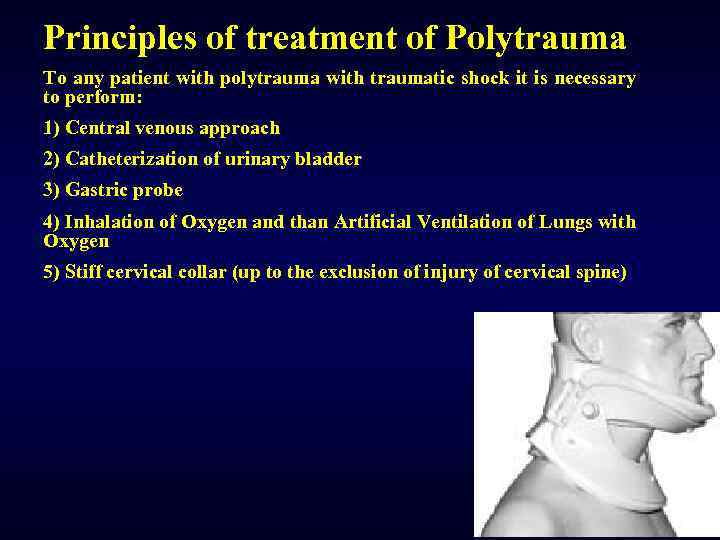 Principles of treatment of Polytrauma To any patient with polytrauma with traumatic shock it is necessary to perform: 1) Central venous approach 2) Catheterization of urinary bladder 3) Gastric probe 4) Inhalation of Oxygen and than Artificial Ventilation of Lungs with Oxygen 5) Stiff cervical collar (up to the exclusion of injury of cervical spine)
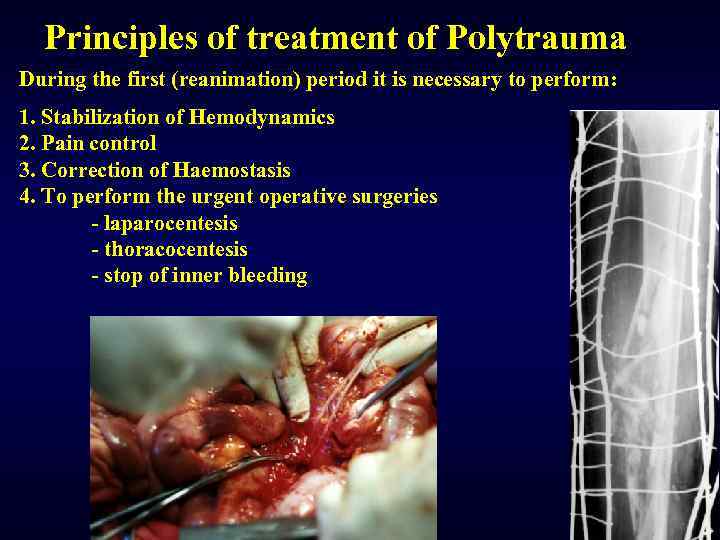 Principles of treatment of Polytrauma During the first (reanimation) period it is necessary to perform: 1. Stabilization of Hemodynamics 2. Pain control 3. Correction of Haemostasis 4. To perform the urgent operative surgeries - laparocentesis - thoracocentesis - stop of inner bleeding
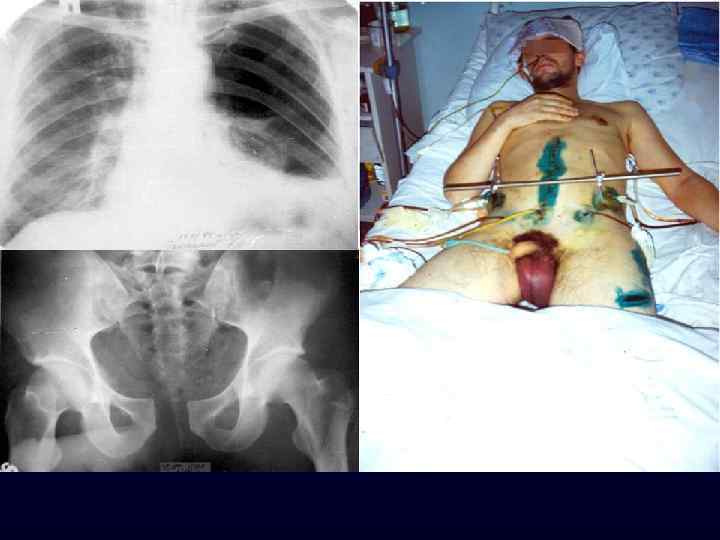
 Principles of treatment of Polytrauma Second (treatment) period is connected with the choice of optimal term and volume of operation According to the urgency all patients with polytrauma are divided in to 4 groups: 1 group. Injuries which very fast lead to death, if the urgent medical aid is absent: cardiac tamping, ruptures of parenchimatous organs, significant injuries of chest and lungs. 2 group. Injuries of bladdery organs, pneumohaemathorax, intracranial haematomas, severe injuries of pelvis and extremities. The patients need to perform the operations urgently. 3 group. Patients with dominating injury of locomotor system without of massive blood loss. After the treatment of shock these patients might be operated. 4 group. Multiply, united and combined injuries without shock.
 Principles of treatment of Polytrauma Third (rehabilitation) period 1. Restoration of functions of organs, systems and extremities. 2. Treatment of complications and consequences, which had developed during the treatment - restoration treatment; - reconstructive operations; - medical exercises; - electric physical therapy; - sanatorium treatment.
 Principles of treatment of Fracture in Polytrauma The optimal period of treatment of fracture is first day after trauma, because: 1. There are no granulations in the place of fracture (i. e. without of additional blood loss) 2. There is no muscular retraction 3. Blood loss is only consisting from the evacuation of haematoma from the place of fracture 4. The skeletation of bone fragments is not necessary It is better to perform the surgical treatment of fracture during the first day after trauma or since 10 to 14 day. Otherwise the high risk of infection complications, embolism, and in case of cranial trauma is the risk of increasing of cerebral edema. Problems of prolonged in time operative treatment of fracture 1. Destroying of granulations and connective tissue 2. Skeletation of bone fragments to achieve the reposition 3. The local and general immunity become worse. It leads to the additional blood loss, makes worse the blood circulation of bone fragments and increases the risk of complications
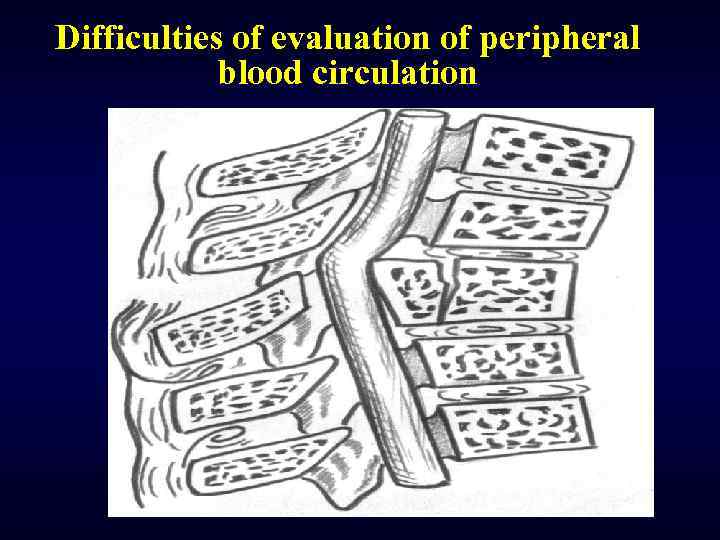
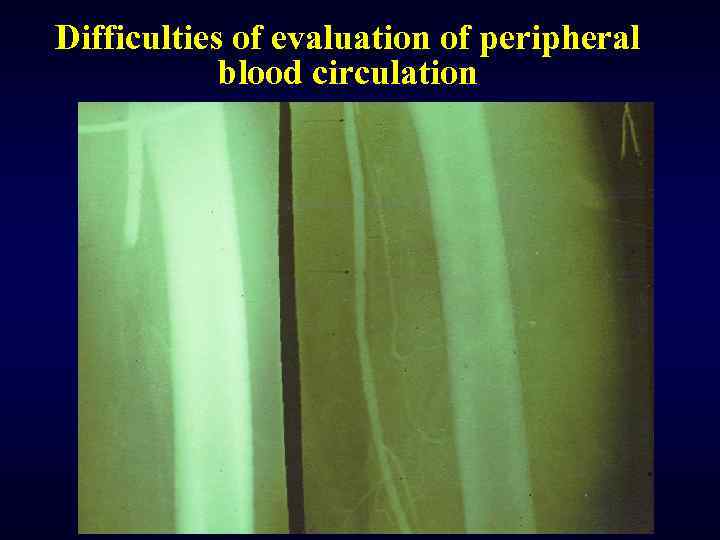
 Difficulties of evaluation of peripheral blood circulation Evaluation of peripheral blood circulation in fracture: The most often localization – injury of artetia poplitea in fracture of low part of thigh Tactics in fracture, complicated by the 1. Color of skin injury of main artery, 2. Symptom of «white spot» 3. Check the pulsation of peripheral 1. Evaluation of surviving of extremity arteries - if it will not survive - perform the 4. Ultrasound Doppler amputation on the level of fracture 5. Punction of skin of finger by needle It is important to exclude the injury of 2. Osteosynthesis of fracture main artery, because this is may 3. Operation to restore the artery result to the lost of surviving of Syndrome of reperfusion – leads to extremity. All aforesaid symptoms may be absent acute renal insufficiency in centralization of blood circulation The surviving of femur in case of and low BP ischemia is 6 -8 hours
 Difficulties of evaluation of peripheral blood circulation
 Difficulties of evaluation of peripheral blood circulation
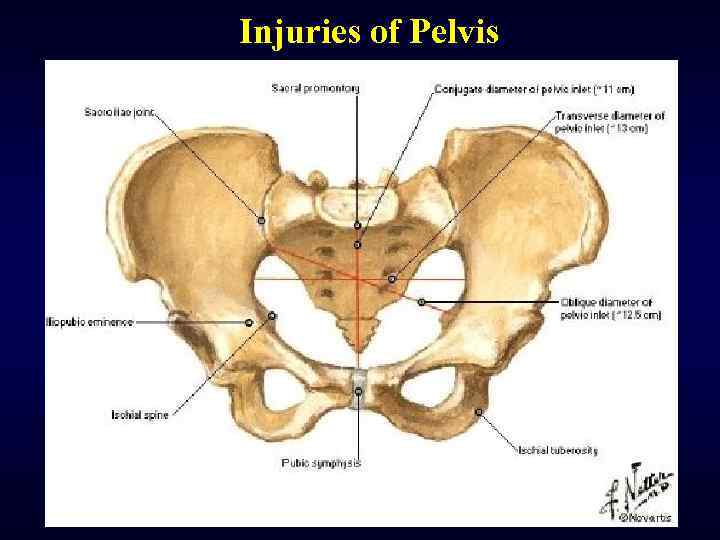 Injuries of Pelvis
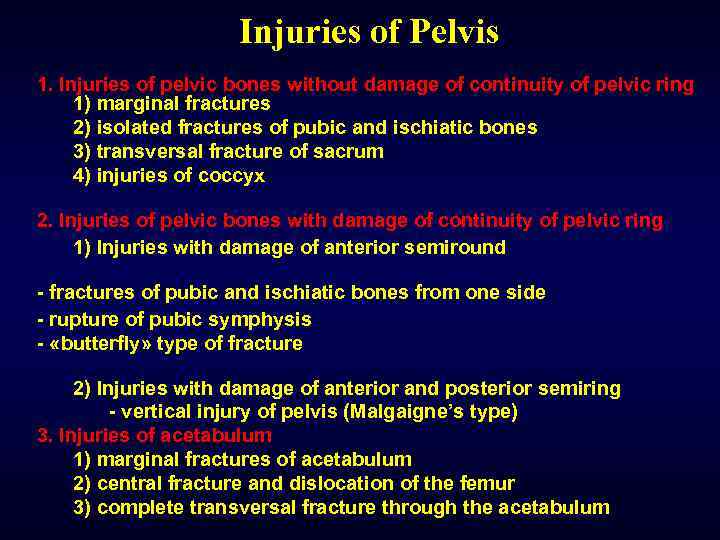 Injuries of Pelvis 1. Injuries of pelvic bones without damage of continuity of pelvic ring 1) marginal fractures 2) isolated fractures of pubic and ischiatic bones 3) transversal fracture of sacrum 4) injuries of coccyx 2. Injuries of pelvic bones with damage of continuity of pelvic ring 1) Injuries with damage of anterior semiround - fractures of pubic and ischiatic bones from one side - rupture of pubic symphysis - «butterfly» type of fracture 2) Injuries with damage of anterior and posterior semiring - vertical injury of pelvis (Malgaigne’s type) 3. Injuries of acetabulum 1) marginal fractures of acetabulum 2) central fracture and dislocation of the femur 3) complete transversal fracture through the acetabulum
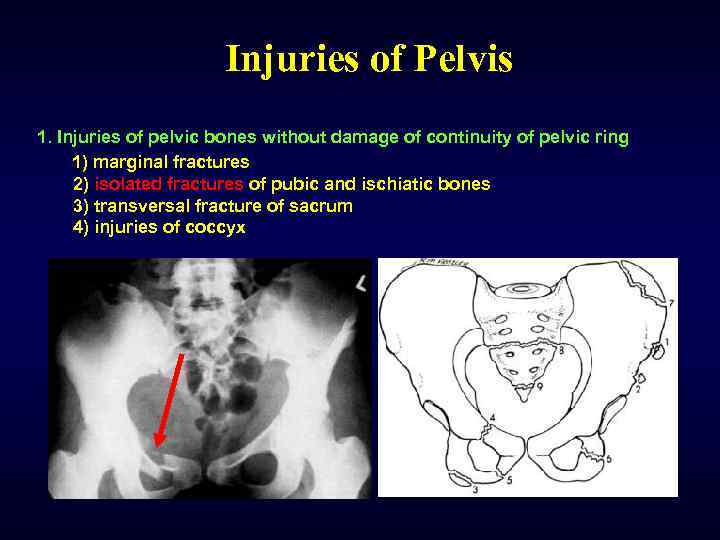 Injuries of Pelvis 1. Injuries of pelvic bones without damage of continuity of pelvic ring 1) marginal fractures 2) isolated fractures of pubic and ischiatic bones 3) transversal fracture of sacrum 4) injuries of coccyx
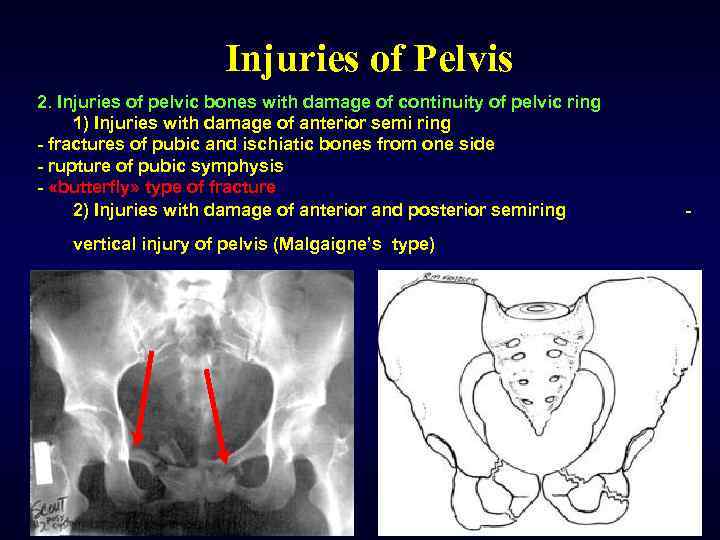 Injuries of Pelvis 2. Injuries of pelvic bones with damage of continuity of pelvic ring 1) Injuries with damage of anterior semi ring - fractures of pubic and ischiatic bones from one side - rupture of pubic symphysis - «butterfly» type of fracture 2) Injuries with damage of anterior and posterior semiring vertical injury of pelvis (Malgaigne’s type) -
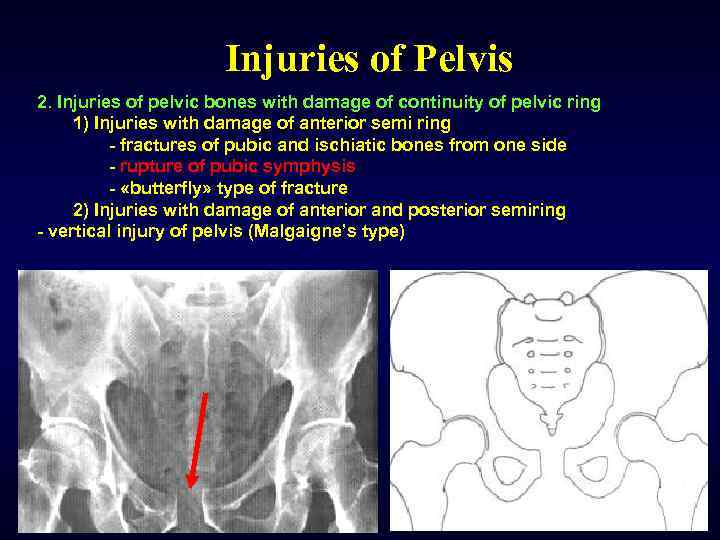 Injuries of Pelvis 2. Injuries of pelvic bones with damage of continuity of pelvic ring 1) Injuries with damage of anterior semi ring - fractures of pubic and ischiatic bones from one side - rupture of pubic symphysis - «butterfly» type of fracture 2) Injuries with damage of anterior and posterior semiring - vertical injury of pelvis (Malgaigne’s type)
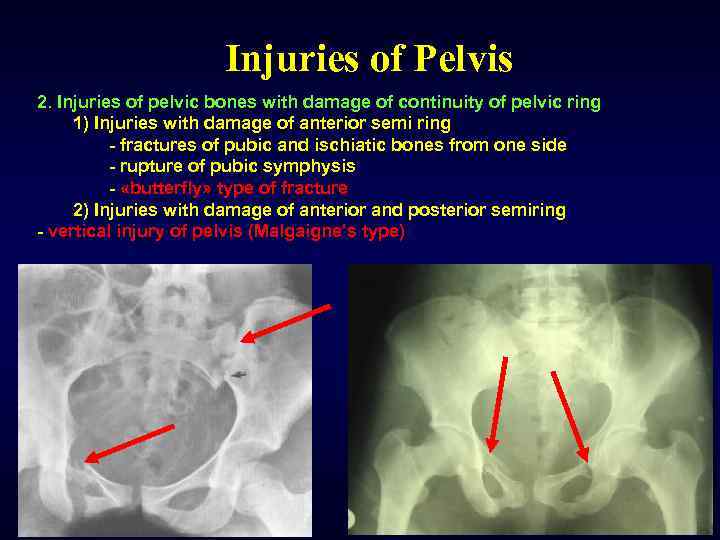 Injuries of Pelvis 2. Injuries of pelvic bones with damage of continuity of pelvic ring 1) Injuries with damage of anterior semi ring - fractures of pubic and ischiatic bones from one side - rupture of pubic symphysis - «butterfly» type of fracture 2) Injuries with damage of anterior and posterior semiring - vertical injury of pelvis (Malgaigne’s type)
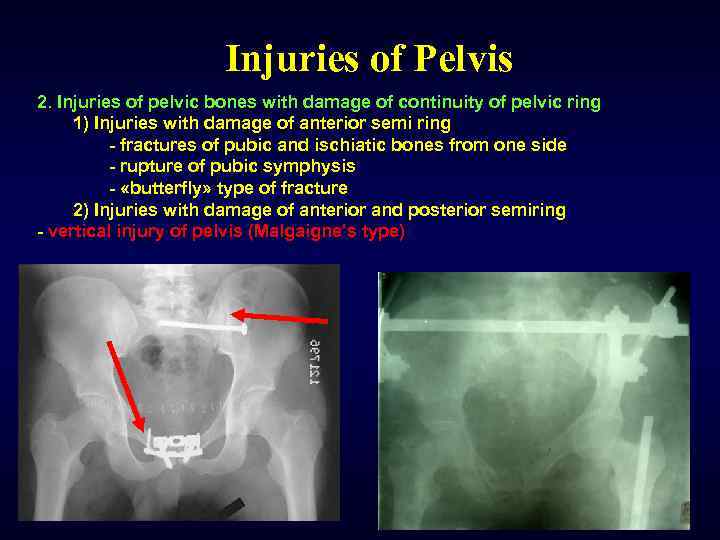 Injuries of Pelvis 2. Injuries of pelvic bones with damage of continuity of pelvic ring 1) Injuries with damage of anterior semi ring - fractures of pubic and ischiatic bones from one side - rupture of pubic symphysis - «butterfly» type of fracture 2) Injuries with damage of anterior and posterior semiring - vertical injury of pelvis (Malgaigne’s type)
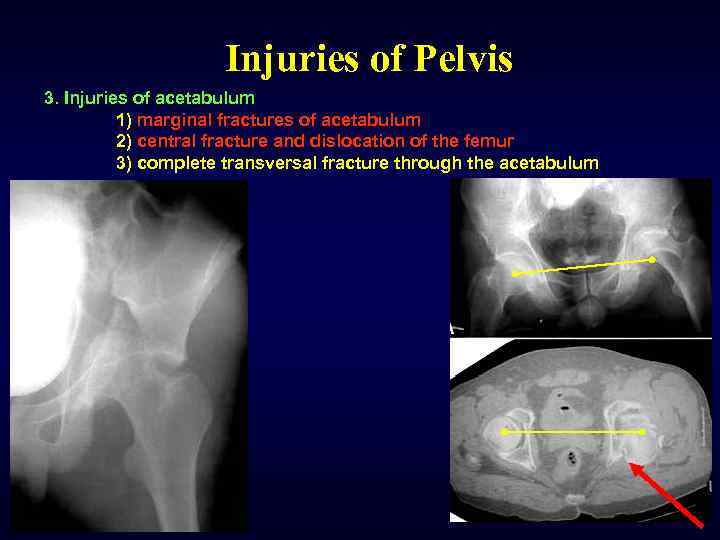 Injuries of Pelvis 3. Injuries of acetabulum 1) marginal fractures of acetabulum 2) central fracture and dislocation of the femur 3) complete transversal fracture through the acetabulum
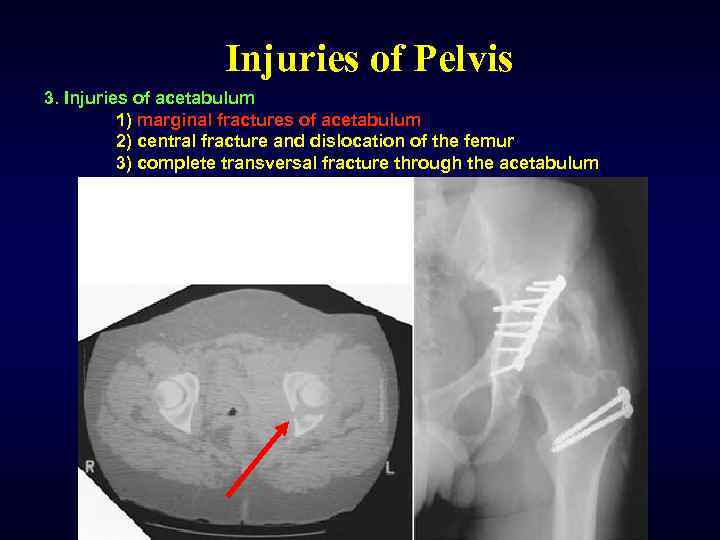 Injuries of Pelvis 3. Injuries of acetabulum 1) marginal fractures of acetabulum 2) central fracture and dislocation of the femur 3) complete transversal fracture through the acetabulum
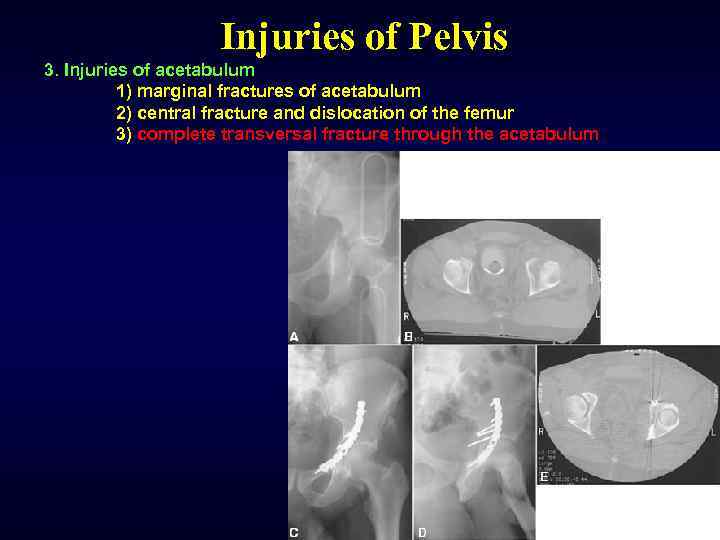 Injuries of Pelvis 3. Injuries of acetabulum 1) marginal fractures of acetabulum 2) central fracture and dislocation of the femur 3) complete transversal fracture through the acetabulum
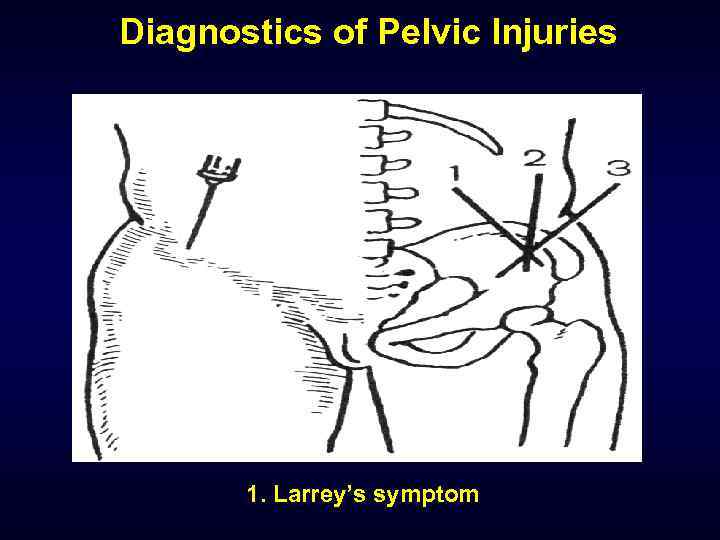 Diagnostics of Pelvic Injuries 1. Larrey’s symptom
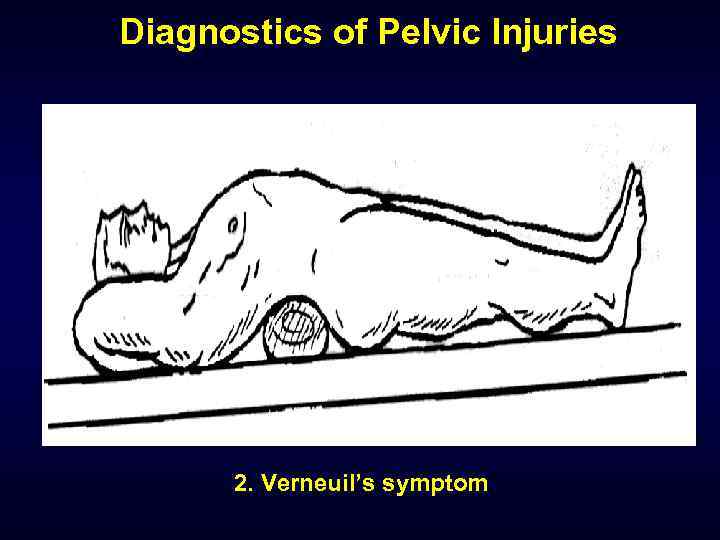 Diagnostics of Pelvic Injuries 2. Verneuil’s symptom
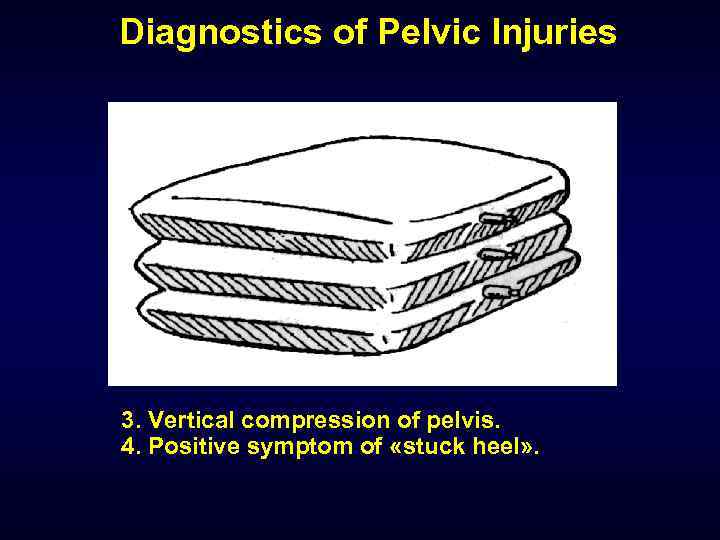 Diagnostics of Pelvic Injuries 3. Vertical compression of pelvis. 4. Positive symptom of «stuck heel» .
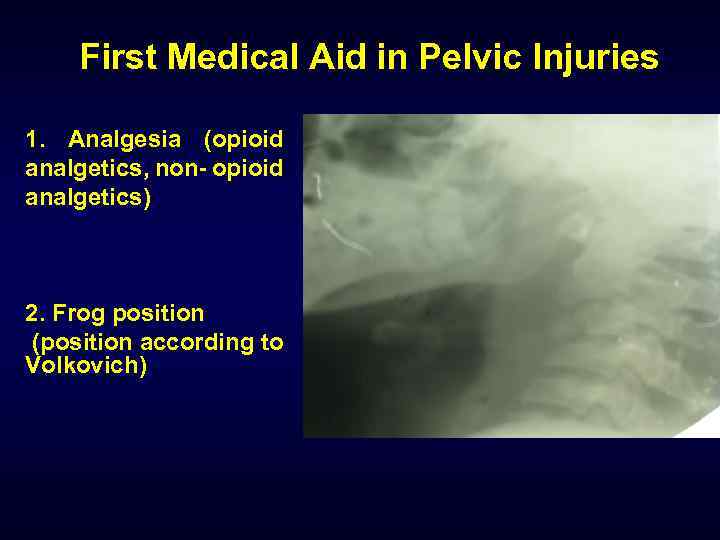 First Medical Aid in Pelvic Injuries 1. Analgesia (opioid analgetics, non- opioid analgetics) 2. Frog position (position according to Volkovich)
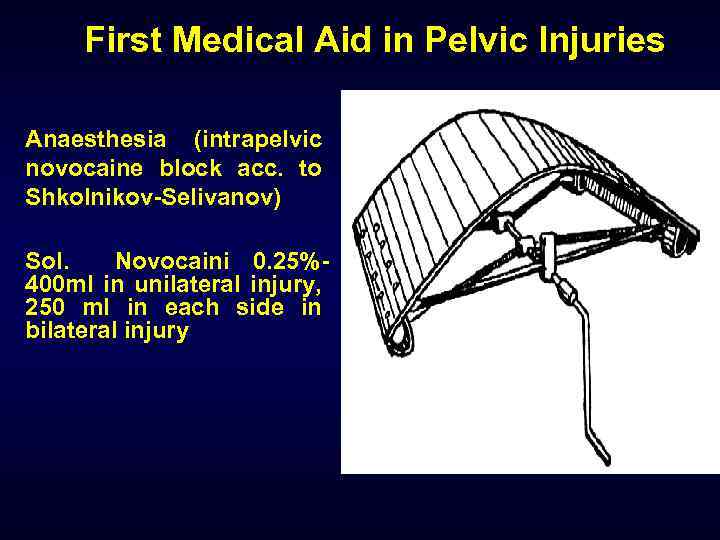 First Medical Aid in Pelvic Injuries Anaesthesia (intrapelvic novocaine block acc. to Shkolnikov-Selivanov) Sol. Novocaini 0. 25%400 ml in unilateral injury, 250 ml in each side in bilateral injury
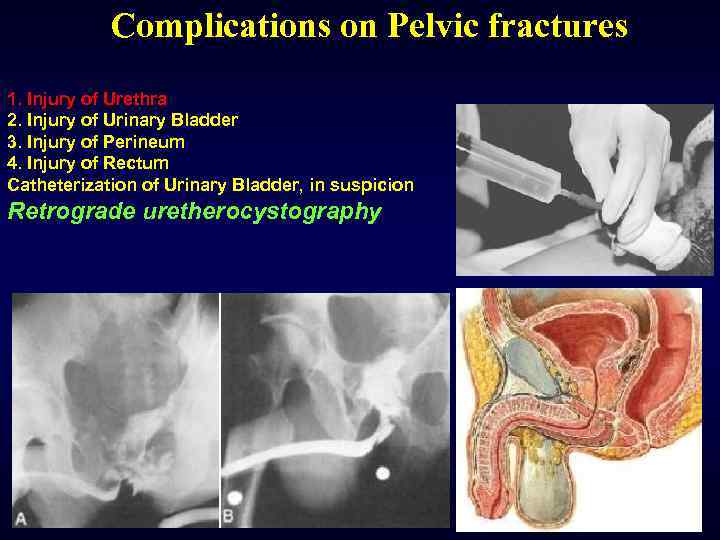 Complications on Pelvic fractures 1. Injury of Urethra 2. Injury of Urinary Bladder 3. Injury of Perineum 4. Injury of Rectum Catheterization of Urinary Bladder, in suspicion Retrograde uretherocystography
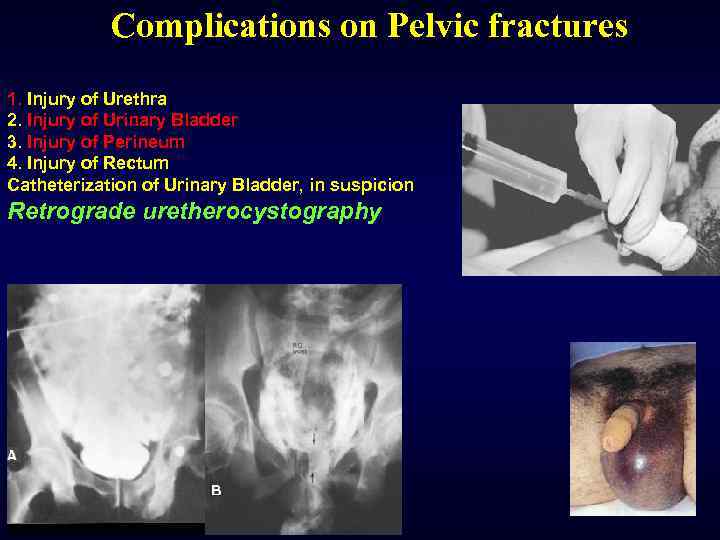 Complications on Pelvic fractures 1. Injury of Urethra 2. Injury of Urinary Bladder 3. Injury of Perineum 4. Injury of Rectum Catheterization of Urinary Bladder, in suspicion Retrograde uretherocystography
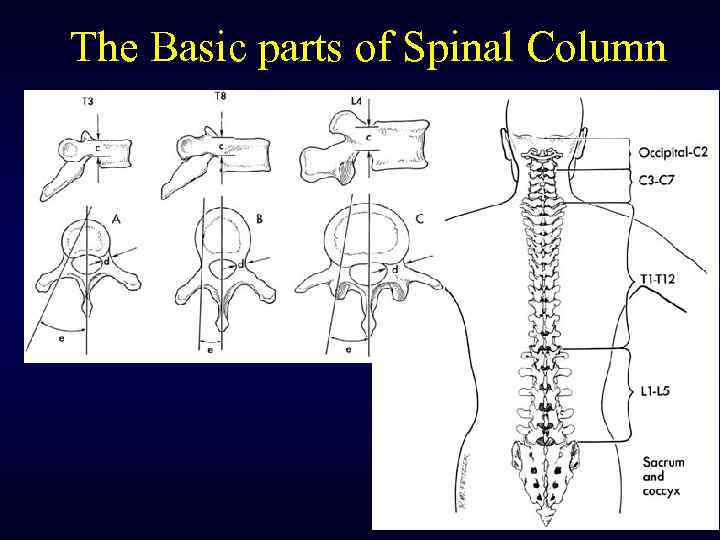 The Basic parts of Spinal Column
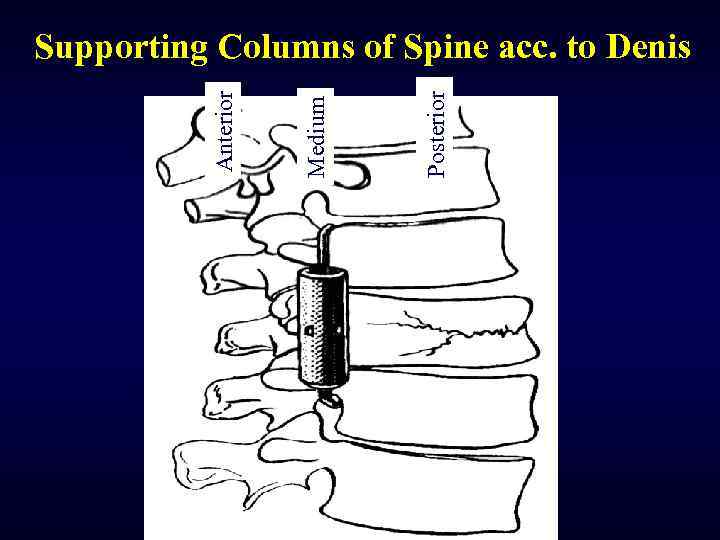 Posterior Medium Anterior Supporting Columns of Spine acc. to Denis
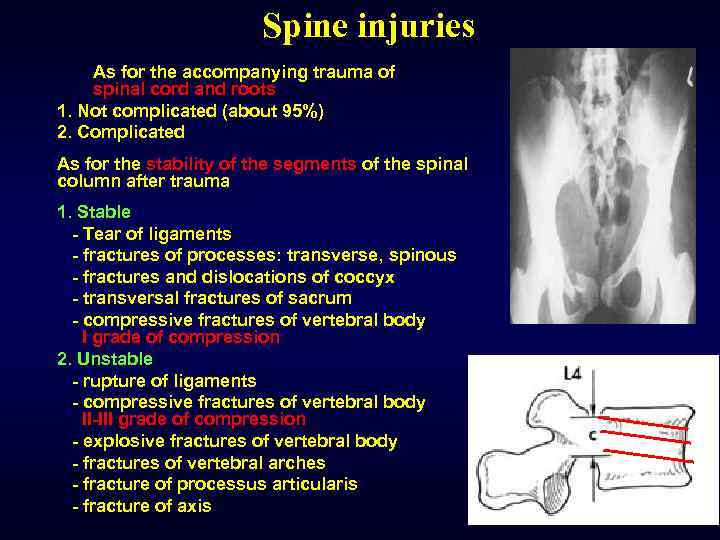
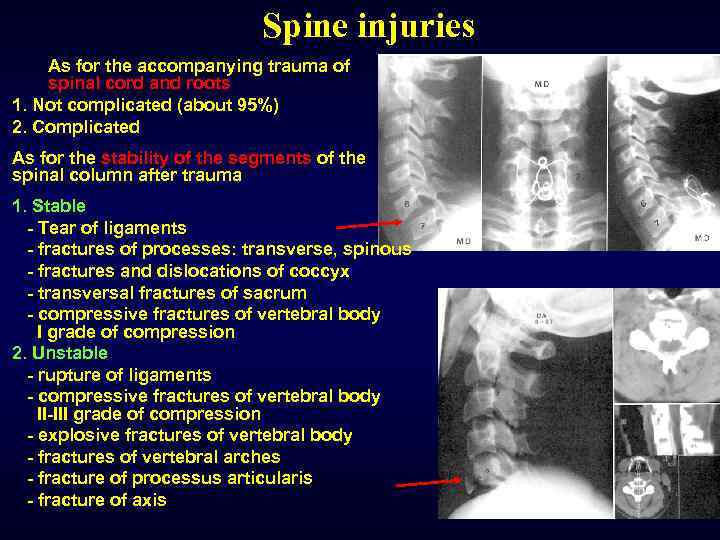
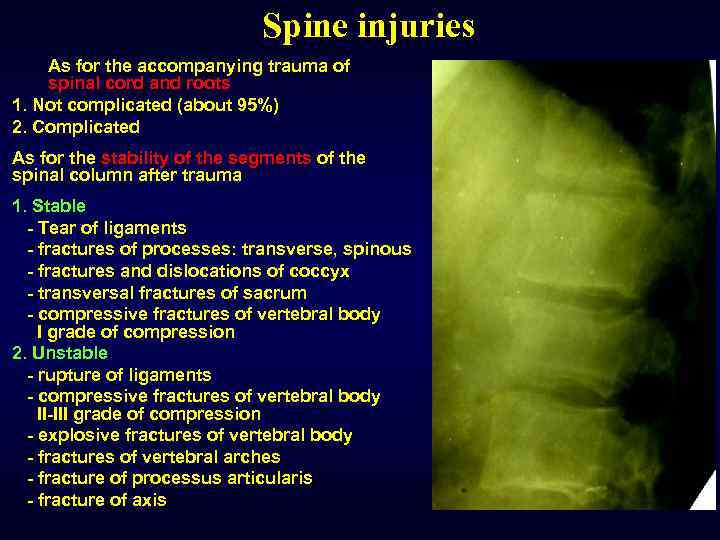
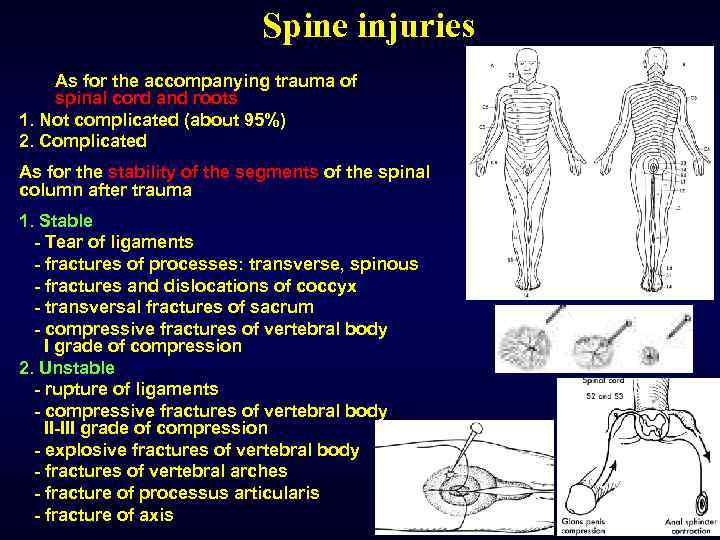 Spine injuries As for the accompanying trauma of spinal cord and roots 1. Not complicated (about 95%) 2. Complicated As for the stability of the segments of the spinal column after trauma 1. Stable - Tear of ligaments - fractures of processes: transverse, spinous - fractures and dislocations of coccyx - transversal fractures of sacrum - compressive fractures of vertebral body І grade of compression 2. Unstable - rupture of ligaments - compressive fractures of vertebral body ІI-III grade of compression - explosive fractures of vertebral body - fractures of vertebral arches - fracture of processus articularis - fracture of axis
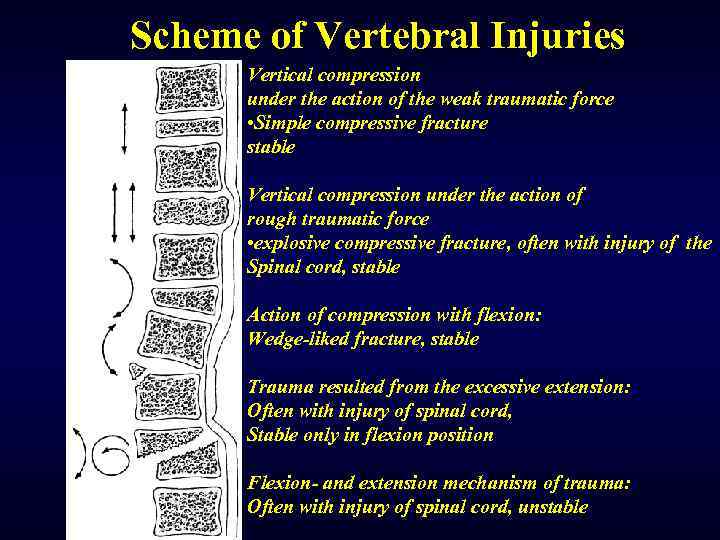 Scheme of Vertebral Injuries Vertical compression under the action of the weak traumatic force • Simple compressive fracture stable Vertical compression under the action of rough traumatic force • explosive compressive fracture, often with injury of the Spinal cord, stable Action of compression with flexion: Wedge-liked fracture, stable Trauma resulted from the excessive extension: Often with injury of spinal cord, Stable only in flexion position Flexion- and extension mechanism of trauma: Often with injury of spinal cord, unstable
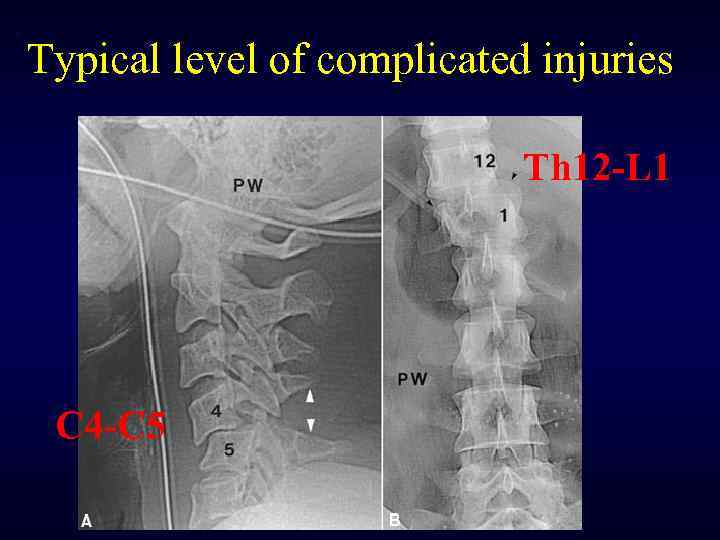 Typical level of complicated injuries Th 12 -L 1 С 4 -С 5
 Spine injuries As for the accompanying trauma of spinal cord and roots 1. Not complicated (about 95%) 2. Complicated As for the stability of the segments of the spinal column after trauma 1. Stable - Tear of ligaments - fractures of processes: transverse, spinous - fractures and dislocations of coccyx - transversal fractures of sacrum - compressive fractures of vertebral body І grade of compression 2. Unstable - rupture of ligaments - compressive fractures of vertebral body ІI-III grade of compression - explosive fractures of vertebral body - fractures of vertebral arches - fracture of processus articularis - fracture of axis
 Spine injuries As for the accompanying trauma of spinal cord and roots 1. Not complicated (about 95%) 2. Complicated As for the stability of the segments of the spinal column after trauma 1. Stable - Tear of ligaments - fractures of processes: transverse, spinous - fractures and dislocations of coccyx - transversal fractures of sacrum - compressive fractures of vertebral body І grade of compression 2. Unstable - rupture of ligaments - compressive fractures of vertebral body ІI-III grade of compression - explosive fractures of vertebral body - fractures of vertebral arches - fracture of processus articularis - fracture of axis
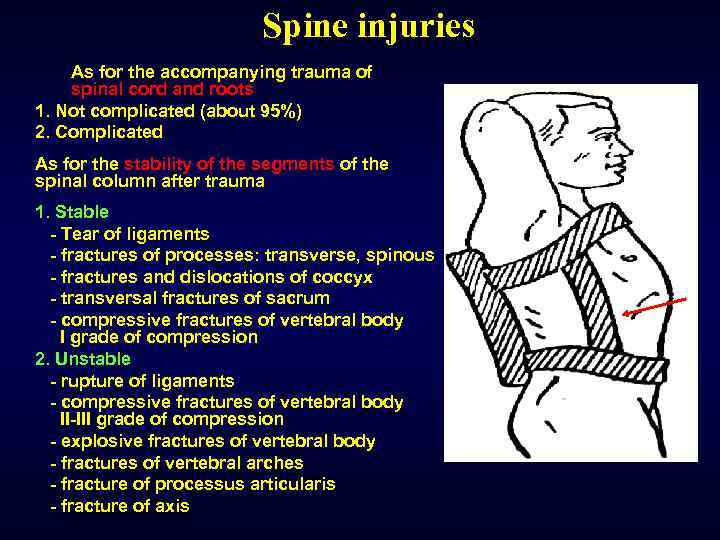 Spine injuries As for the accompanying trauma of spinal cord and roots 1. Not complicated (about 95%) 2. Complicated As for the stability of the segments of the spinal column after trauma 1. Stable - Tear of ligaments - fractures of processes: transverse, spinous - fractures and dislocations of coccyx - transversal fractures of sacrum - compressive fractures of vertebral body І grade of compression 2. Unstable - rupture of ligaments - compressive fractures of vertebral body ІI-III grade of compression - explosive fractures of vertebral body - fractures of vertebral arches - fracture of processus articularis - fracture of axis
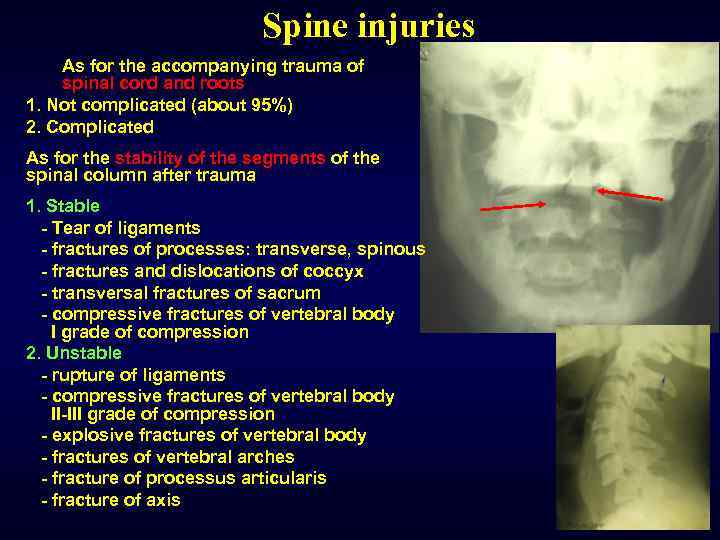 Spine injuries As for the accompanying trauma of spinal cord and roots 1. Not complicated (about 95%) 2. Complicated As for the stability of the segments of the spinal column after trauma 1. Stable - Tear of ligaments - fractures of processes: transverse, spinous - fractures and dislocations of coccyx - transversal fractures of sacrum - compressive fractures of vertebral body І grade of compression 2. Unstable - rupture of ligaments - compressive fractures of vertebral body ІI-III grade of compression - explosive fractures of vertebral body - fractures of vertebral arches - fracture of processus articularis - fracture of axis
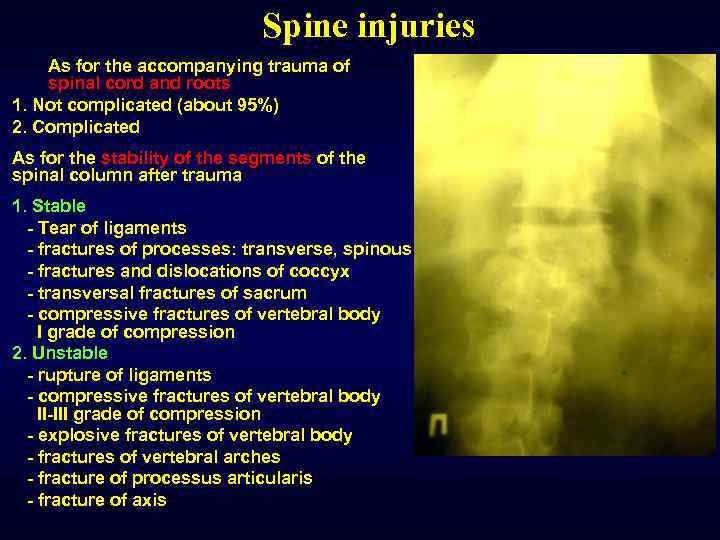 Spine injuries As for the accompanying trauma of spinal cord and roots 1. Not complicated (about 95%) 2. Complicated As for the stability of the segments of the spinal column after trauma 1. Stable - Tear of ligaments - fractures of processes: transverse, spinous - fractures and dislocations of coccyx - transversal fractures of sacrum - compressive fractures of vertebral body І grade of compression 2. Unstable - rupture of ligaments - compressive fractures of vertebral body ІI-III grade of compression - explosive fractures of vertebral body - fractures of vertebral arches - fracture of processus articularis - fracture of axis
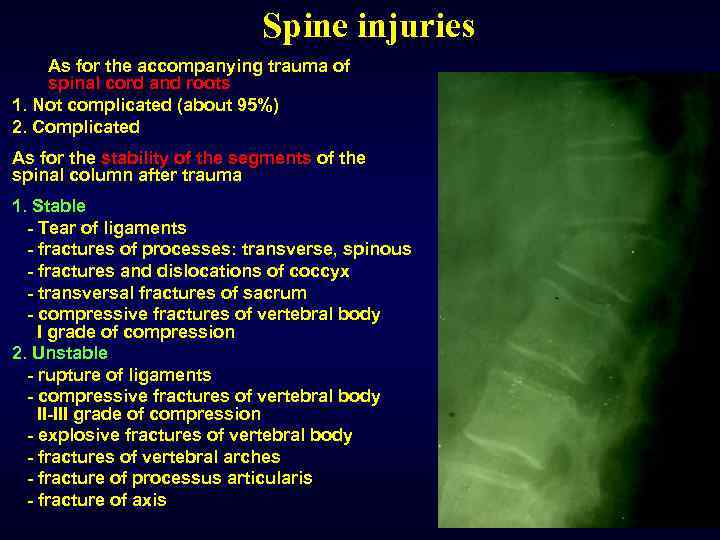 Spine injuries As for the accompanying trauma of spinal cord and roots 1. Not complicated (about 95%) 2. Complicated As for the stability of the segments of the spinal column after trauma 1. Stable - Tear of ligaments - fractures of processes: transverse, spinous - fractures and dislocations of coccyx - transversal fractures of sacrum - compressive fractures of vertebral body І grade of compression 2. Unstable - rupture of ligaments - compressive fractures of vertebral body ІI-III grade of compression - explosive fractures of vertebral body - fractures of vertebral arches - fracture of processus articularis - fracture of axis
 Spine injuries As for the accompanying trauma of spinal cord and roots 1. Not complicated (about 95%) 2. Complicated As for the stability of the segments of the spinal column after trauma 1. Stable - Tear of ligaments - fractures of processes: transverse, spinous - fractures and dislocations of coccyx - transversal fractures of sacrum - compressive fractures of vertebral body І grade of compression 2. Unstable - rupture of ligaments - compressive fractures of vertebral body ІI-III grade of compression - explosive fractures of vertebral body - fractures of vertebral arches - fracture of processus articularis - fracture of axis
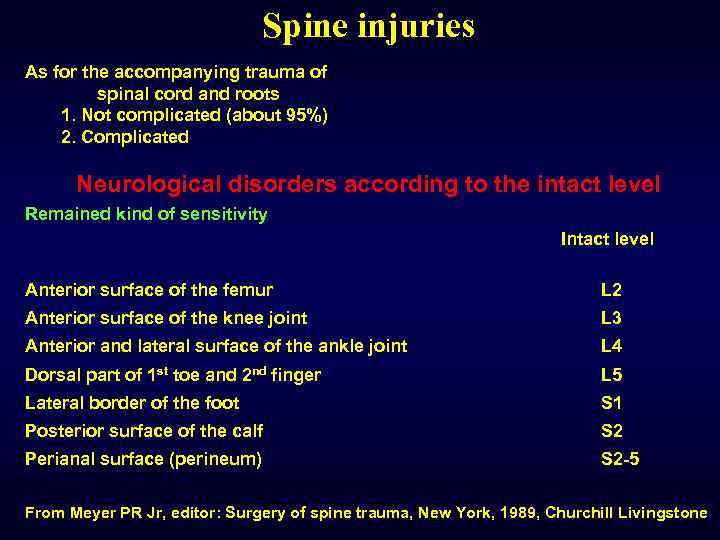 Spine injuries As for the accompanying trauma of spinal cord and roots 1. Not complicated (about 95%) 2. Complicated Neurological disorders according to the intact level Remained kind of sensitivity Intact level Anterior surface of the femur L 2 Anterior surface of the knee joint L 3 Anterior and lateral surface of the ankle joint L 4 Dorsal part of 1 st toe and 2 nd finger L 5 Lateral border of the foot S 1 Posterior surface of the calf S 2 Perianal surface (perineum) S 2 -5 From Meyer PR Jr, editor: Surgery of spine trauma, New York, 1989, Churchill Livingstone
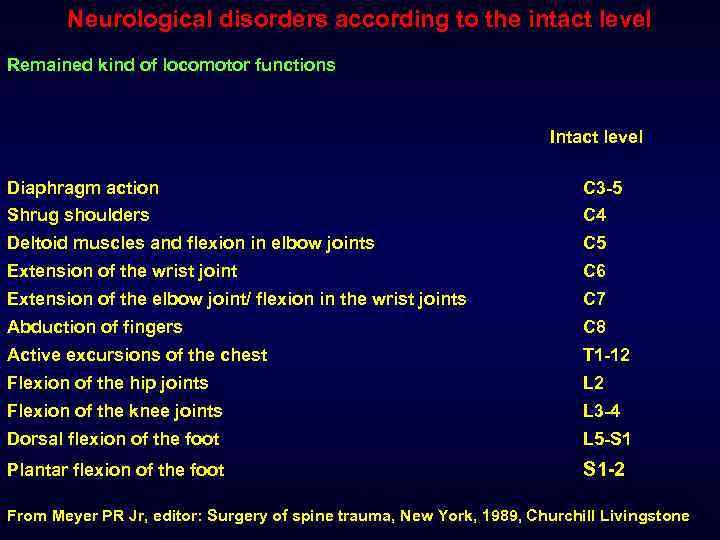 Neurological disorders according to the intact level Remained kind of locomotor functions Intact level Diaphragm action Shrug shoulders C 3 -5 C 4 Deltoid muscles and flexion in elbow joints C 5 Extension of the wrist joint C 6 Extension of the elbow joint/ flexion in the wrist joints C 7 Abduction of fingers C 8 Active excursions of the chest T 1 -12 Flexion of the hip joints L 2 Flexion of the knee joints L 3 -4 Dorsal flexion of the foot L 5 -S 1 Plantar flexion of the foot S 1 -2 From Meyer PR Jr, editor: Surgery of spine trauma, New York, 1989, Churchill Livingstone
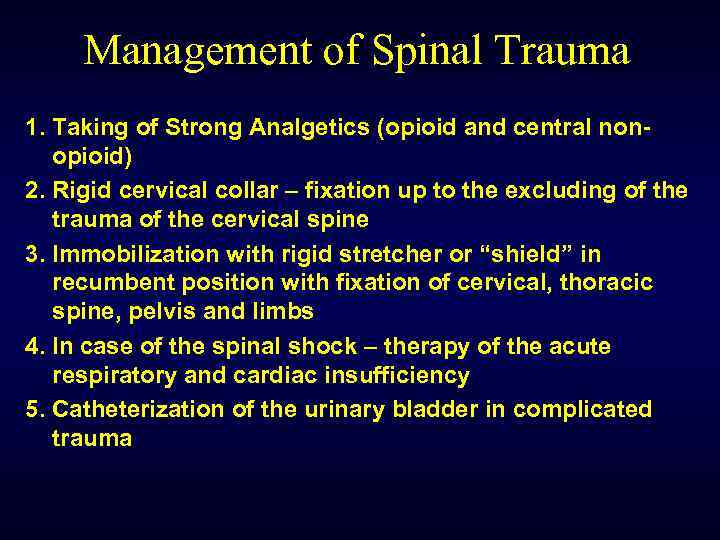 Management of Spinal Trauma 1. Taking of Strong Analgetics (opioid and central nonopioid) 2. Rigid cervical collar – fixation up to the excluding of the trauma of the cervical spine 3. Immobilization with rigid stretcher or “shield” in recumbent position with fixation of cervical, thoracic spine, pelvis and limbs 4. In case of the spinal shock – therapy of the acute respiratory and cardiac insufficiency 5. Catheterization of the urinary bladder in complicated trauma
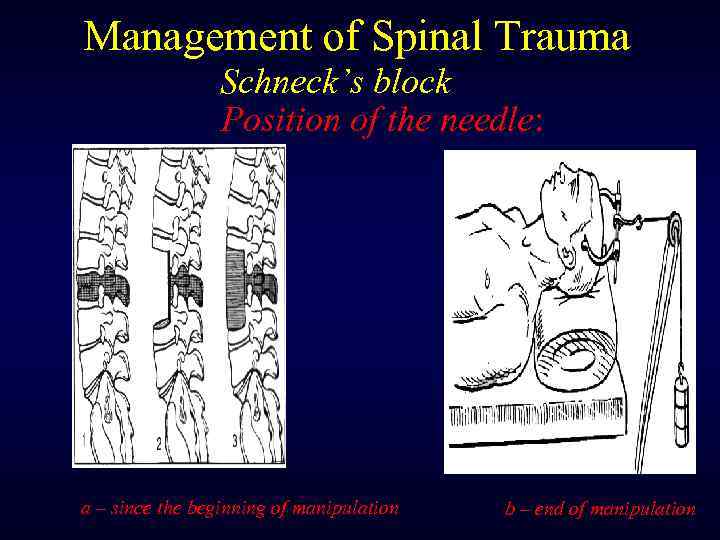 Management of Spinal Trauma Schneck’s block Position of the needle: a – since the beginning of manipulation b – end of manipulation
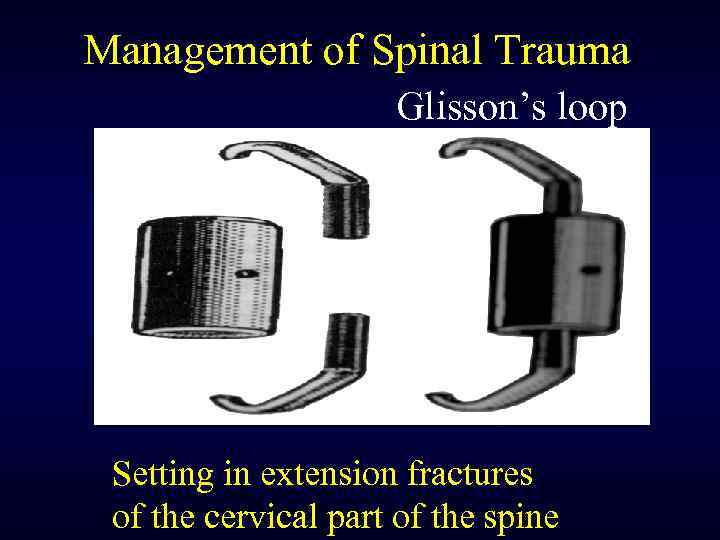 Management of Spinal Trauma Glisson’s loop Setting in extension fractures of the cervical part of the spine
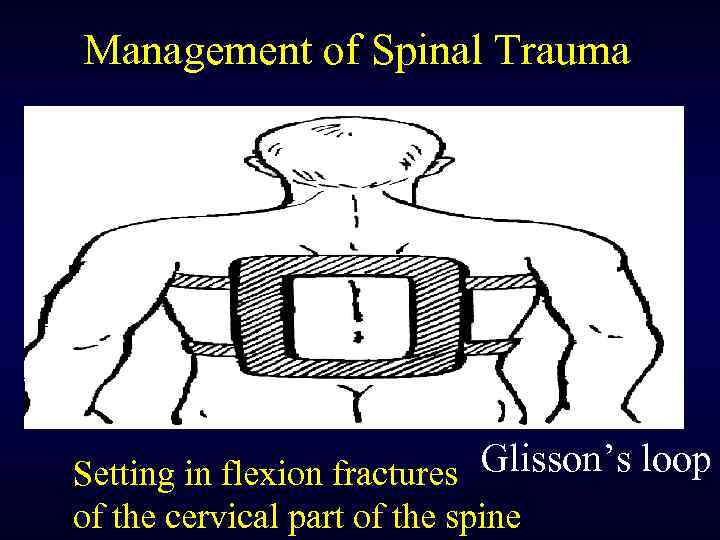 Management of Spinal Trauma Glisson’s loop Setting in flexion fractures of the cervical part of the spine
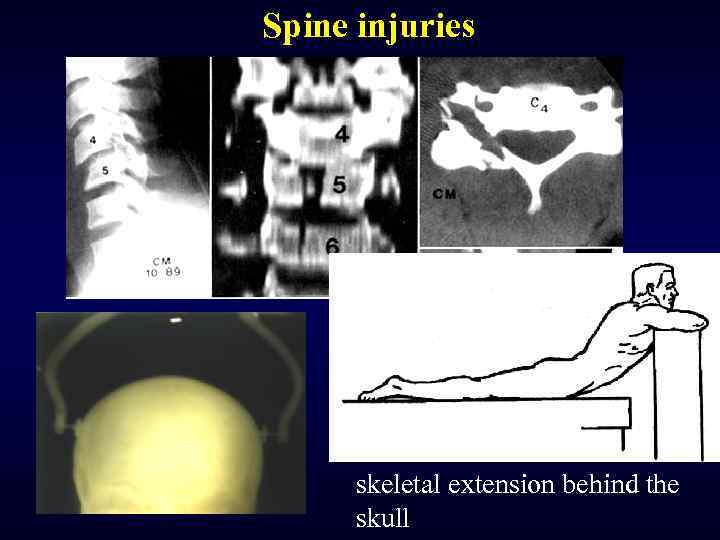 Spine injuries skeletal extension behind the skull
 Management of Spinal Trauma acc. to Davis acc. to Watson-Johnes One-step reclination
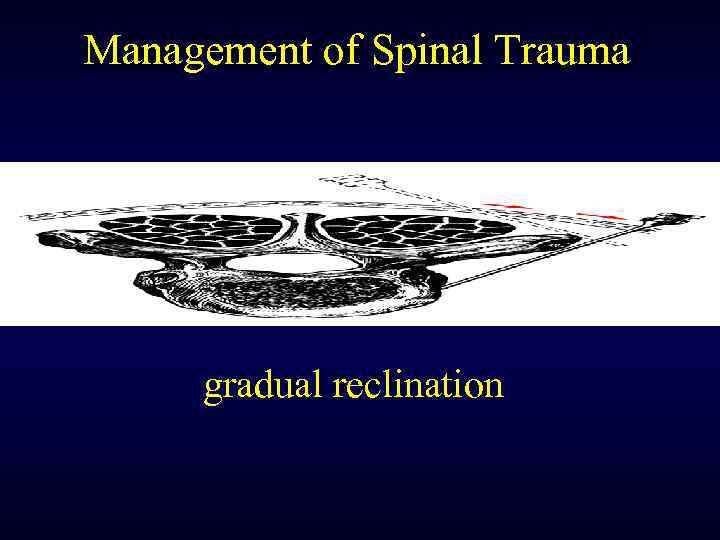 Management of Spinal Trauma gradual reclination
 Management of Spinal Trauma a- rigid b - inflated Reclinators for the gradual reclination
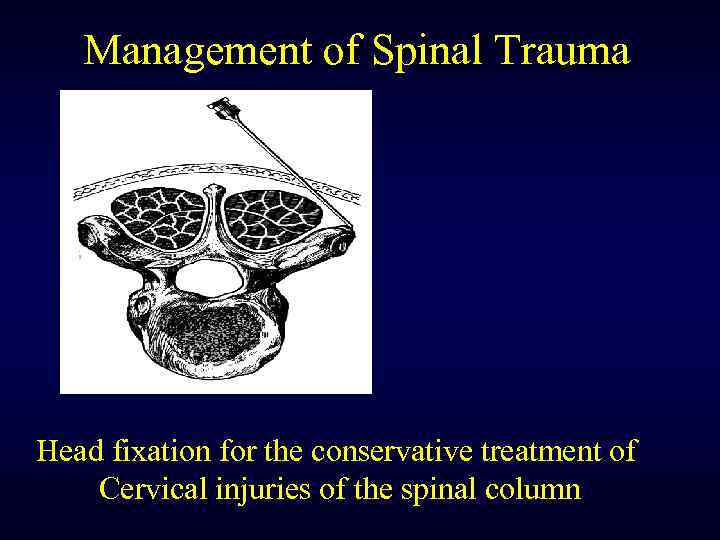 Management of Spinal Trauma Head fixation for the conservative treatment of Cervical injuries of the spinal column
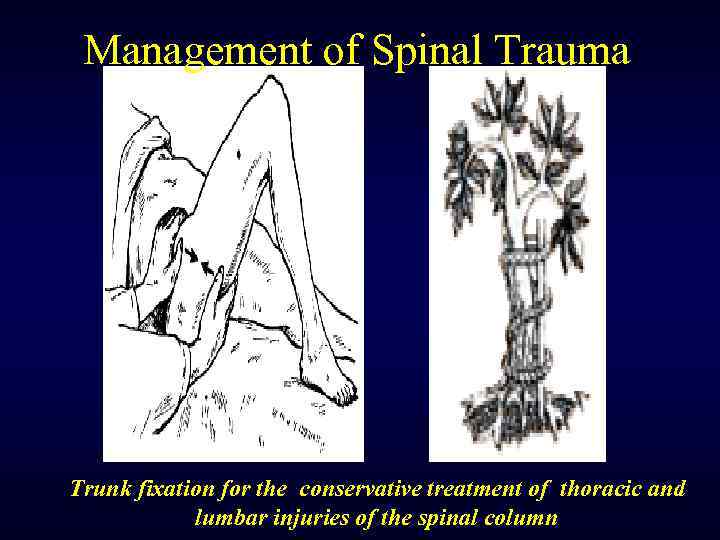 Management of Spinal Trauma Trunk fixation for the conservative treatment of thoracic and lumbar injuries of the spinal column
 Management of Spinal Trauma Posterior spondylodesis and devices for its performing
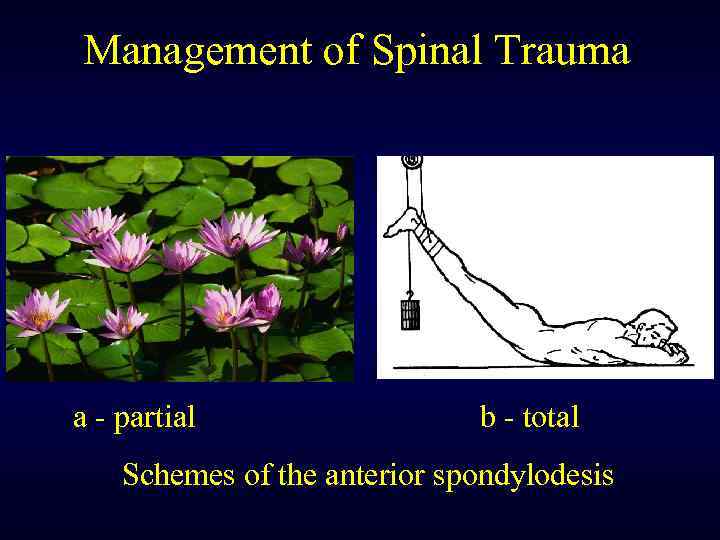 Management of Spinal Trauma a - partial b - total Schemes of the anterior spondylodesis
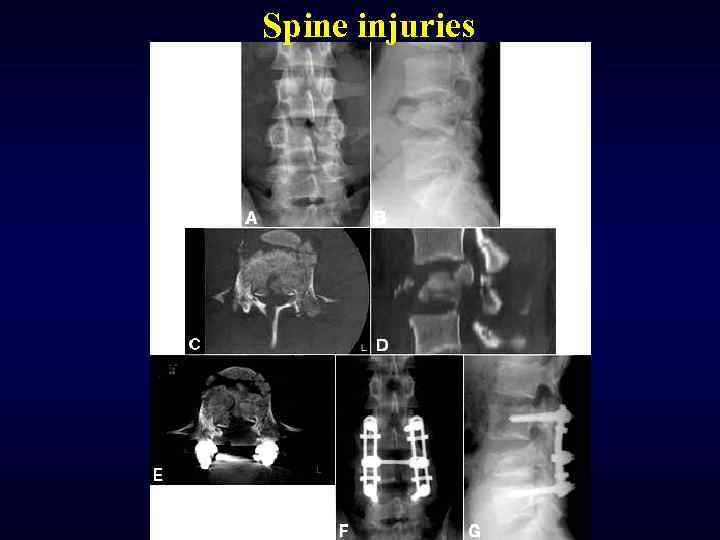 Spine injuries
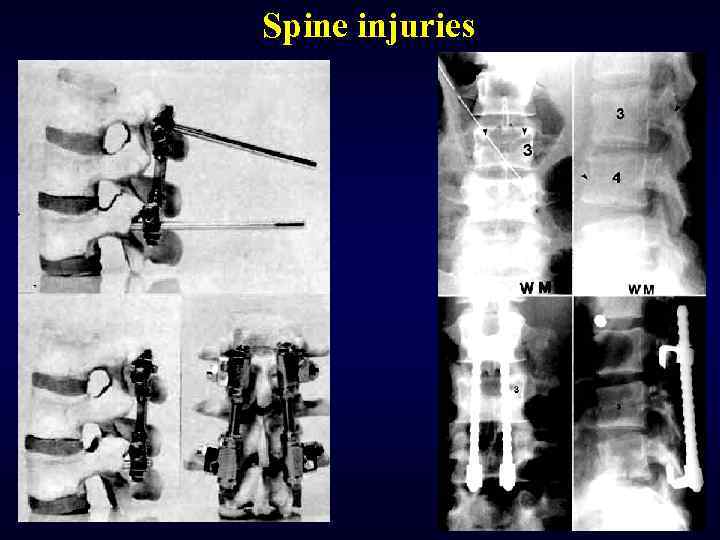 Spine injuries
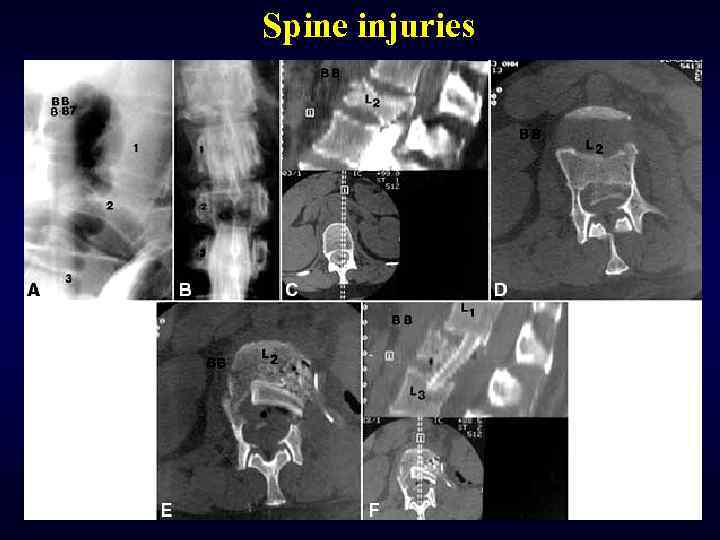 Spine injuries
 THANK YOU FOR ATTENTION !!!