


 Скачать презентацию DMS Managing Resources Agenda Financial management presentations informal
- Количество слайдов: 24
 DMS Managing Resources Agenda: Financial management presentations (informal) Budgetary Planning and Control frameworks Assessment specification
 Last time we said ‘The questions that might be asked of finance include: • • Has a surplus or deficit been made? (income statements) What is the value of assets and liabilities (balance sheet) What has happened to cash? (cash flow statements) How are individual figures made up? (notes) What do the figures mean? (analysis: ratios, interpretation) How will money be spent? (budgetary planning) How was money spent last year in comparison with the plan? (budgetary control) • What do we need to do to break even? (break even) • What is the effect of doing X? (marginal analysis) • Is it worth investing? (investment appraisal) …and…What financial statements can you bring in to explain to the class? ’
 Budgetary Planning and Control frameworks 1. Definition, need 2. Basic behavioural model 3. Subsidiary and master budgets, including cash budgets 4. Special situation budgets: 1. 2. 3. 4. Break even Investment Marginal Etc
 Definition of budgetary planning & control (BPC) • Budgeting is the process of forming & reviewing financial plans • It summarises activity by: – Time period (monthly, quarterly, annually) – Types of spending (budget lines) – Responsibility – Amounts planned – Activity level
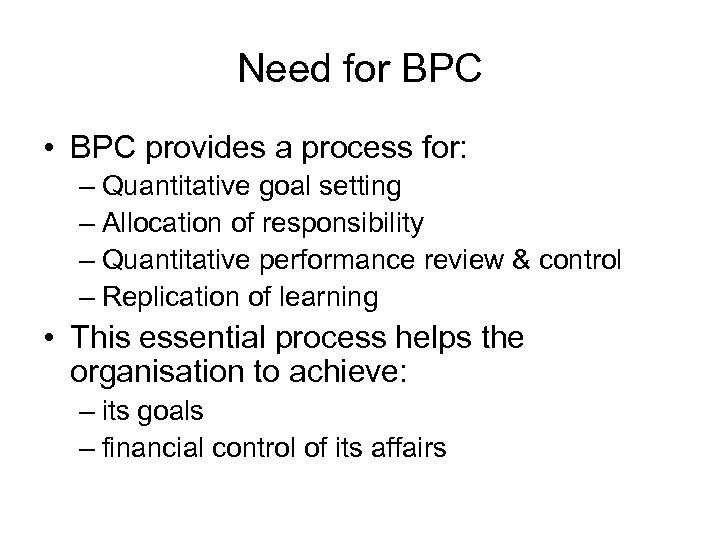 Need for BPC • BPC provides a process for: – Quantitative goal setting – Allocation of responsibility – Quantitative performance review & control – Replication of learning • This essential process helps the organisation to achieve: – its goals – financial control of its affairs
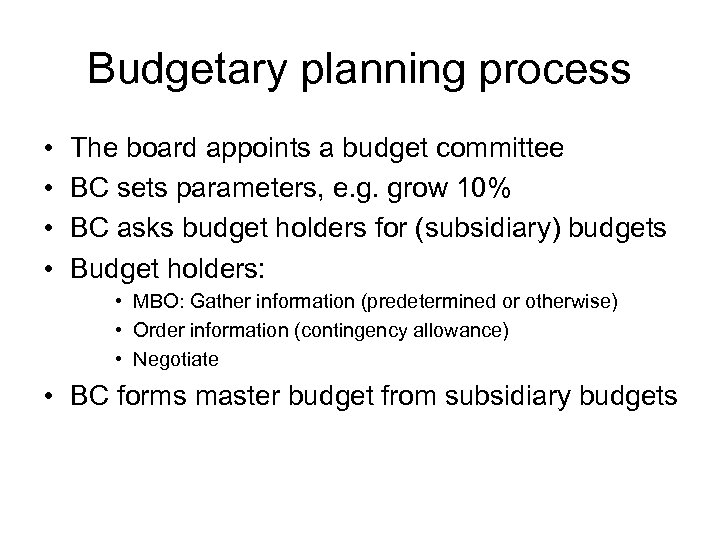 Budgetary planning process • • The board appoints a budget committee BC sets parameters, e. g. grow 10% BC asks budget holders for (subsidiary) budgets Budget holders: • MBO: Gather information (predetermined or otherwise) • Order information (contingency allowance) • Negotiate • BC forms master budget from subsidiary budgets
 Budgetary planning application What is the budgetary planning process for your organisation? What is the timescale?
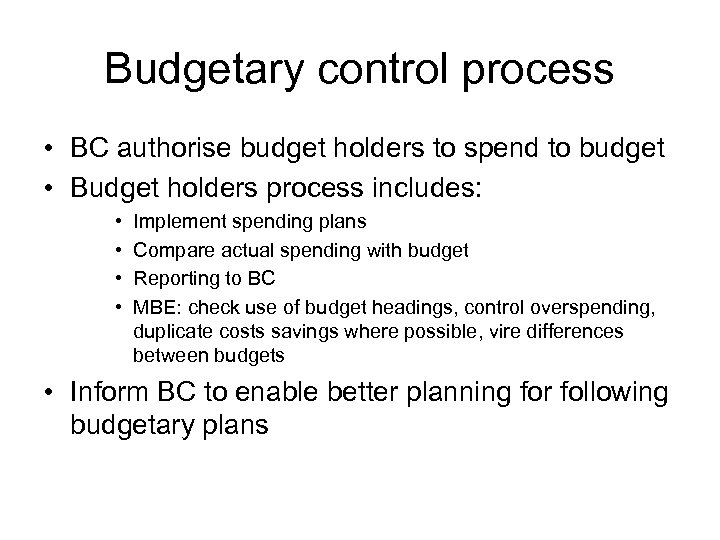 Budgetary control process • BC authorise budget holders to spend to budget • Budget holders process includes: • • Implement spending plans Compare actual spending with budget Reporting to BC MBE: check use of budget headings, control overspending, duplicate costs savings where possible, vire differences between budgets • Inform BC to enable better planning for following budgetary plans
 Budgetary control application What is the budgetary control process in your organisation?
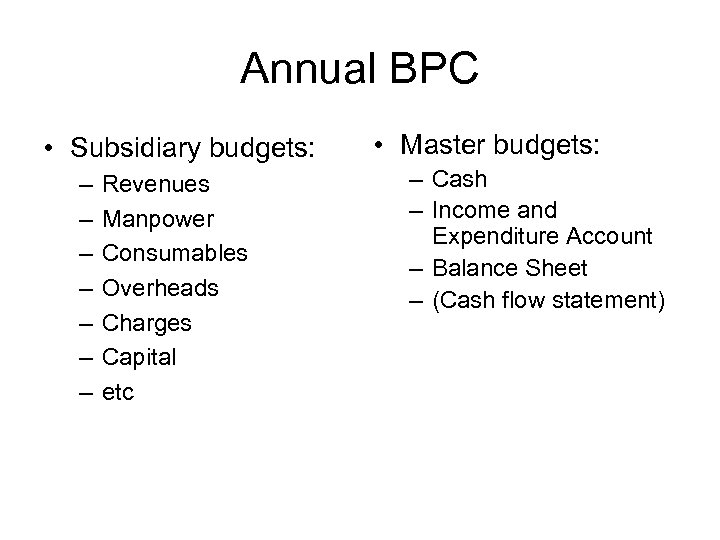 Annual BPC • Subsidiary budgets: – – – – Revenues Manpower Consumables Overheads Charges Capital etc • Master budgets: – Cash – Income and Expenditure Account – Balance Sheet – (Cash flow statement)
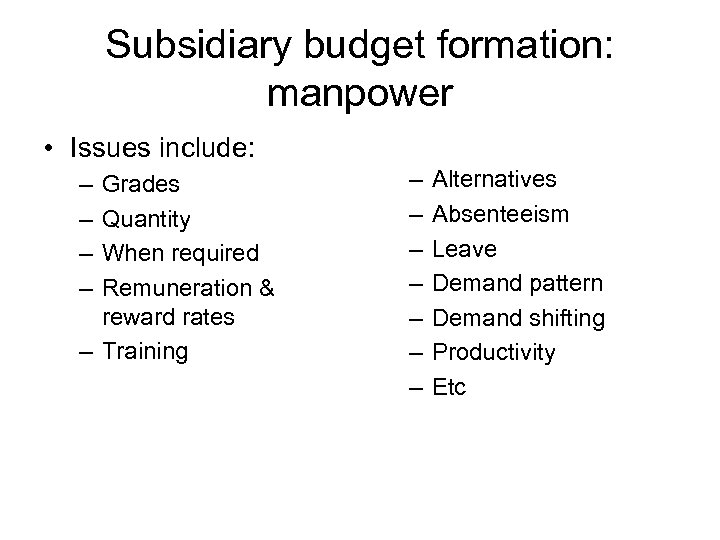 Subsidiary budget formation: manpower • Issues include: – – Grades Quantity When required Remuneration & reward rates – Training – – – – Alternatives Absenteeism Leave Demand pattern Demand shifting Productivity Etc
 Manpower planning in your organisation What manpower issues are controllable, and what are not, in your organisation?
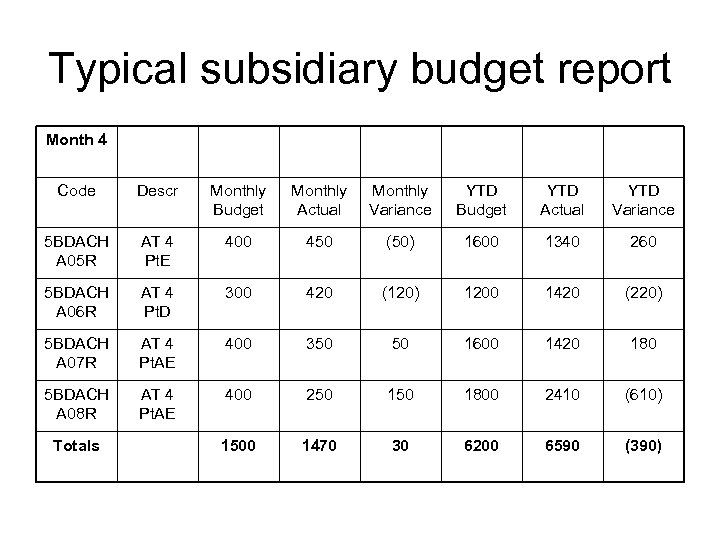 Typical subsidiary budget report Month 4 Code Descr Monthly Budget Monthly Actual Monthly Variance YTD Budget YTD Actual YTD Variance 5 BDACH A 05 R AT 4 Pt. E 400 450 (50) 1600 1340 260 5 BDACH A 06 R AT 4 Pt. D 300 420 (120) 1200 1420 (220) 5 BDACH A 07 R AT 4 Pt. AE 400 350 50 1600 1420 180 5 BDACH A 08 R AT 4 Pt. AE 400 250 1800 2410 (610) 1500 1470 30 6200 6590 (390) Totals
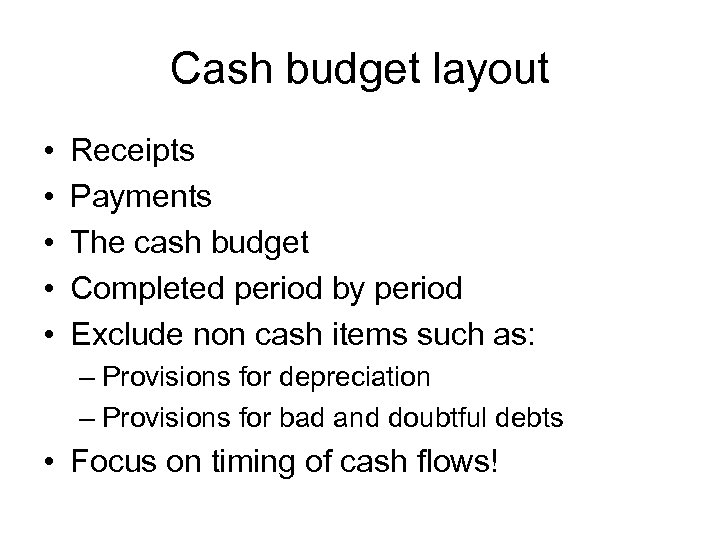 Cash budget layout • • • Receipts Payments The cash budget Completed period by period Exclude non cash items such as: – Provisions for depreciation – Provisions for bad and doubtful debts • Focus on timing of cash flows!
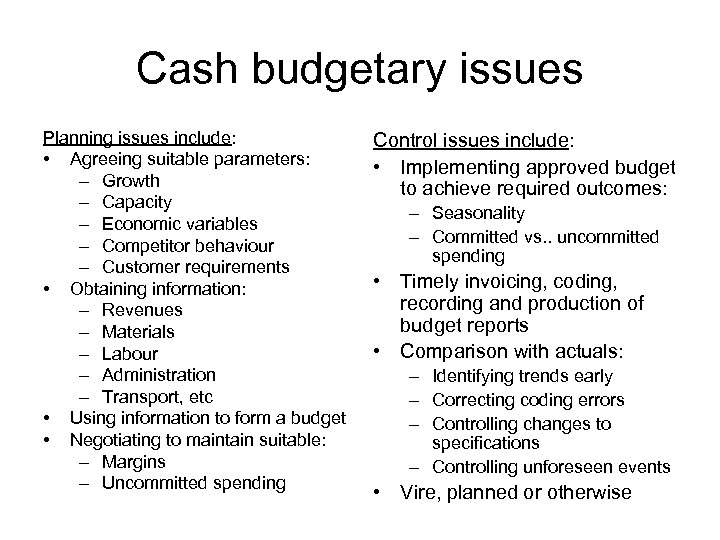 Cash budgetary issues Planning issues include: • Agreeing suitable parameters: – Growth – Capacity – Economic variables – Competitor behaviour – Customer requirements • Obtaining information: – Revenues – Materials – Labour – Administration – Transport, etc • Using information to form a budget • Negotiating to maintain suitable: – Margins – Uncommitted spending Control issues include: • Implementing approved budget to achieve required outcomes: – Seasonality – Committed vs. . uncommitted spending • Timely invoicing, coding, recording and production of budget reports • Comparison with actuals: – Identifying trends early – Correcting coding errors – Controlling changes to specifications – Controlling unforeseen events • Vire, planned or otherwise
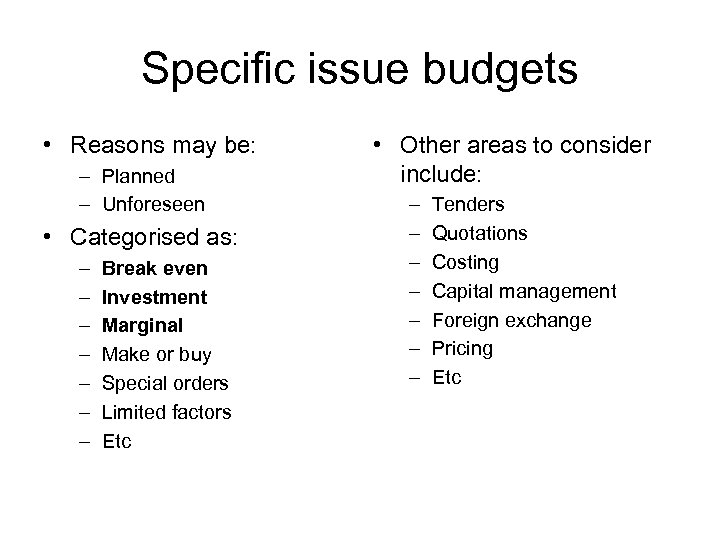 Specific issue budgets • Reasons may be: – Planned – Unforeseen • Categorised as: – – – – Break even Investment Marginal Make or buy Special orders Limited factors Etc • Other areas to consider include: – – – – Tenders Quotations Costing Capital management Foreign exchange Pricing Etc
 Break even analysis • Short term analysis of a product or service • Considers cost and revenue behaviour in fixed & variable terms • Focuses on total £’s and quantity • Tells profit or loss at different levels of output • Shows effect of changes
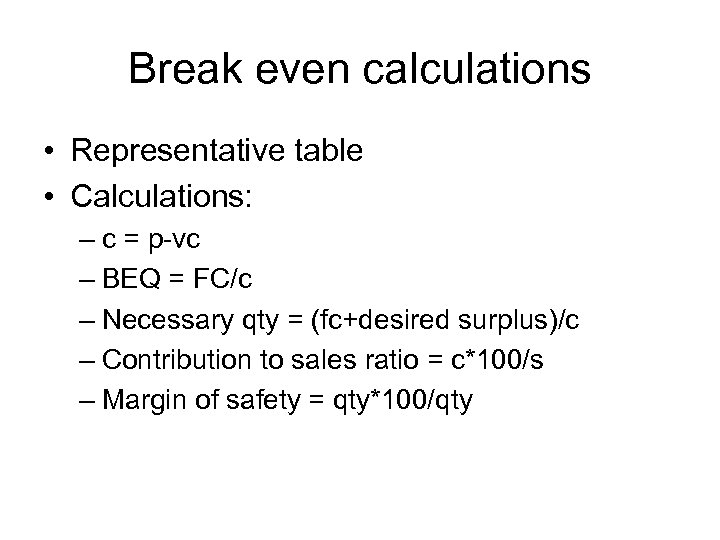 Break even calculations • Representative table • Calculations: – c = p-vc – BEQ = FC/c – Necessary qty = (fc+desired surplus)/c – Contribution to sales ratio = c*100/s – Margin of safety = qty*100/qty
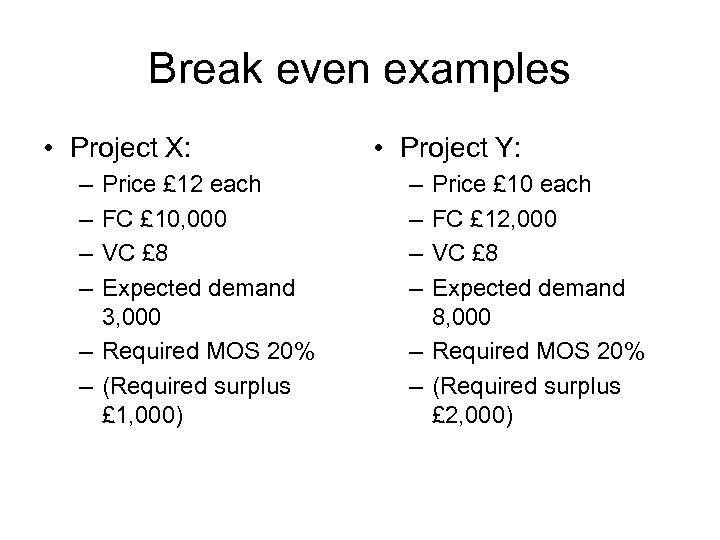 Break even examples • Project X: – – Price £ 12 each FC £ 10, 000 VC £ 8 Expected demand 3, 000 – Required MOS 20% – (Required surplus £ 1, 000) • Project Y: – – Price £ 10 each FC £ 12, 000 VC £ 8 Expected demand 8, 000 – Required MOS 20% – (Required surplus £ 2, 000)
 Investment appraisal • Implies large quantities of capital with a long life • Invariably assessed by a capital committee • Problems include shortage of cash for competing projects, estimating difficulties, & post audit • Summarise cash flows in a cash flow table • Assess with comparison of ARR; payback; NPV, IRR
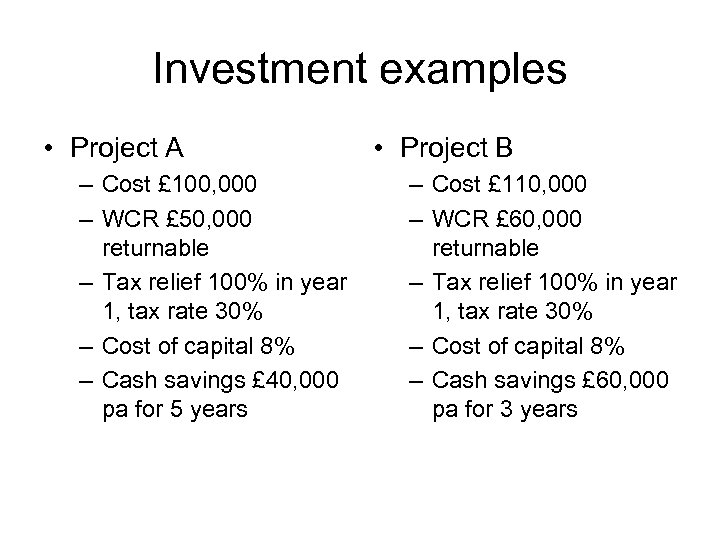 Investment examples • Project A – Cost £ 100, 000 – WCR £ 50, 000 returnable – Tax relief 100% in year 1, tax rate 30% – Cost of capital 8% – Cash savings £ 40, 000 pa for 5 years • Project B – Cost £ 110, 000 – WCR £ 60, 000 returnable – Tax relief 100% in year 1, tax rate 30% – Cost of capital 8% – Cash savings £ 60, 000 pa for 3 years
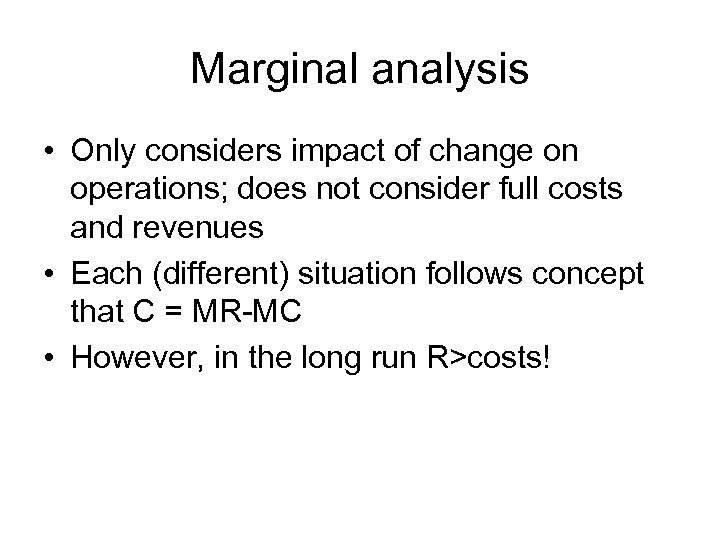 Marginal analysis • Only considers impact of change on operations; does not consider full costs and revenues • Each (different) situation follows concept that C = MR-MC • However, in the long run R>costs!
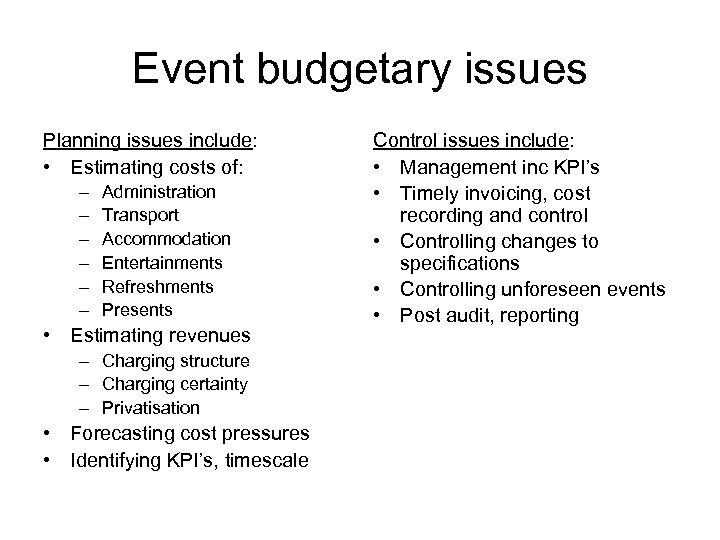 Event budgetary issues Planning issues include: • Estimating costs of: – – – Administration Transport Accommodation Entertainments Refreshments Presents • Estimating revenues – Charging structure – Charging certainty – Privatisation • Forecasting cost pressures • Identifying KPI’s, timescale Control issues include: • Management inc KPI’s • Timely invoicing, cost recording and control • Controlling changes to specifications • Controlling unforeseen events • Post audit, reporting
 Any questions? Finally, assessment handout, discussion