


 Скачать презентацию Dixie Industrial Finishing Company 4925 S Royal Atlanta
3c4c9a2d6feda5c41507b9ea54b5a74d.ppt
- Количество слайдов: 22
 Dixie Industrial Finishing Company 4925 S. Royal Atlanta Drive Tucker, GA 30084 (770) 934 -7100 Jim Jones –Vice President Terry Windham, CEF – Sales/Quality
 PLATING: What is it? • Also called electroplating, plating is the mechanically bonding of one metal to another for the purpose of corrosion protection, decorative appeal, hardness, electrical conductivity, reflectivity, and/or wear resistance • In a nut shell, plating modifies the surface properties of the base metal to make it more suitable for its intended use
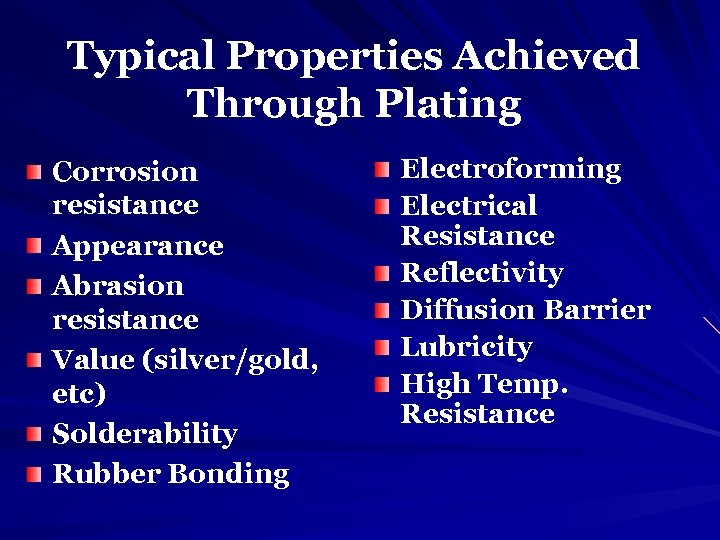 Typical Properties Achieved Through Plating Corrosion resistance Appearance Abrasion resistance Value (silver/gold, etc) Solderability Rubber Bonding Electroforming Electrical Resistance Reflectivity Diffusion Barrier Lubricity High Temp. Resistance
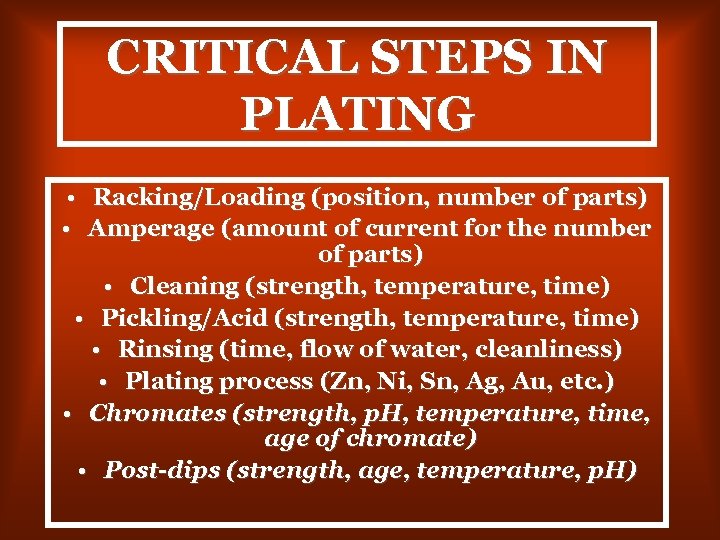 CRITICAL STEPS IN PLATING • Racking/Loading (position, number of parts) • Amperage (amount of current for the number of parts) • Cleaning (strength, temperature, time) • Pickling/Acid (strength, temperature, time) • Rinsing (time, flow of water, cleanliness) • Plating process (Zn, Ni, Sn, Ag, Au, etc. ) • Chromates (strength, p. H, temperature, time, age of chromate) • Post-dips (strength, age, temperature, p. H)
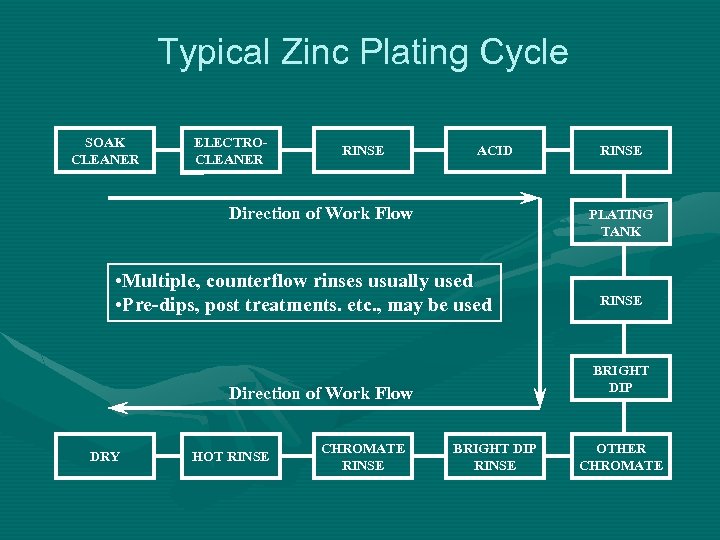 Typical Zinc Plating Cycle SOAK CLEANER ELECTROCLEANER RINSE ACID Direction of Work Flow PLATING TANK • Multiple, counterflow rinses usually used • Pre-dips, post treatments. etc. , may be used HOT RINSE CHROMATE RINSE BRIGHT DIP Direction of Work Flow DRY RINSE BRIGHT DIP RINSE OTHER CHROMATE
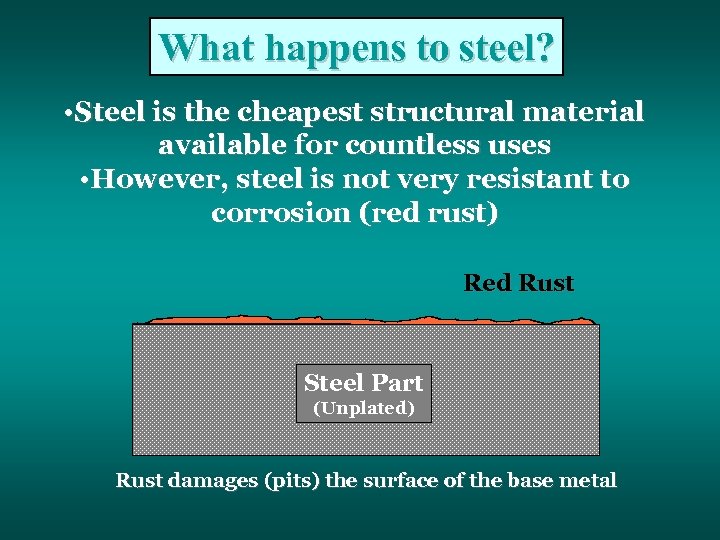 What happens to steel? • Steel is the cheapest structural material available for countless uses • However, steel is not very resistant to corrosion (red rust) Red Rust Steel Part (Unplated) Rust damages (pits) the surface of the base metal
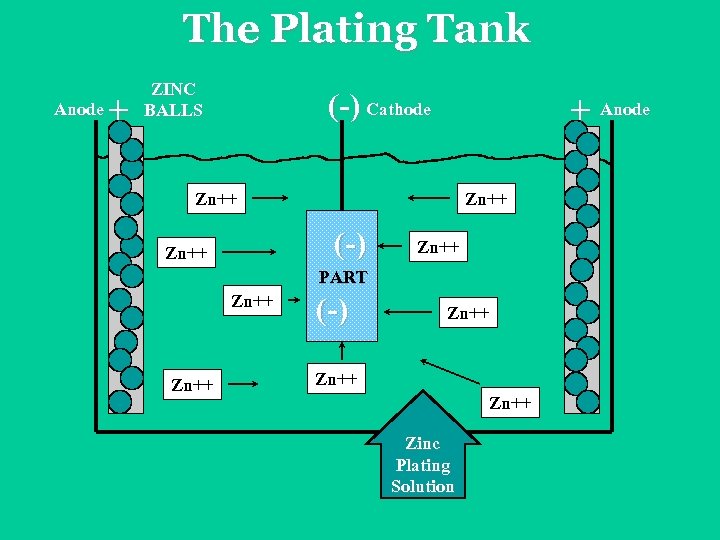 The Plating Tank Anode + ZINC BALLS (-) Cathode + Anode Zn++ (-) Zn++ PART Zn++ (-) Zn++ Zinc Plating Solution
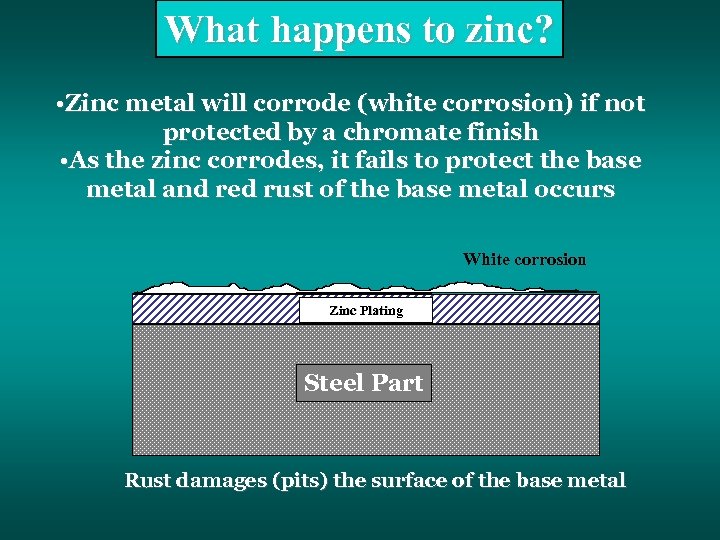 What happens to zinc? • Zinc metal will corrode (white corrosion) if not protected by a chromate finish • As the zinc corrodes, it fails to protect the base metal and red rust of the base metal occurs White corrosion Zinc Plating Steel Part Rust damages (pits) the surface of the base metal
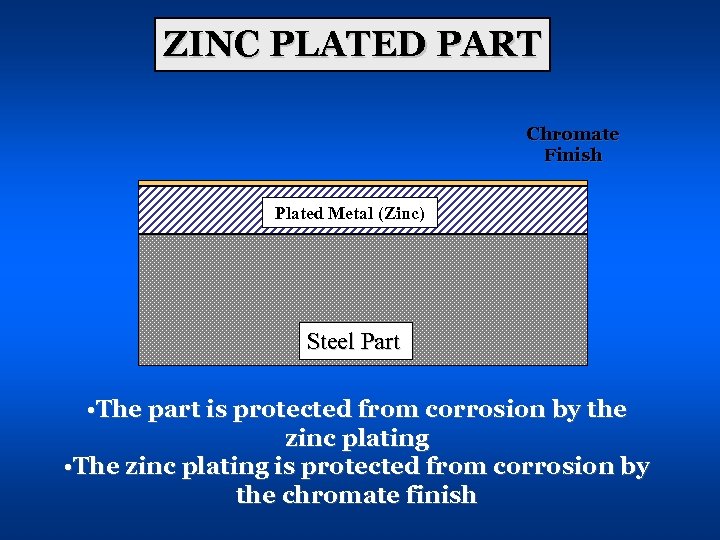 ZINC PLATED PART Chromate Finish Plated Metal (Zinc) Steel Part • The part is protected from corrosion by the zinc plating • The zinc plating is protected from corrosion by the chromate finish
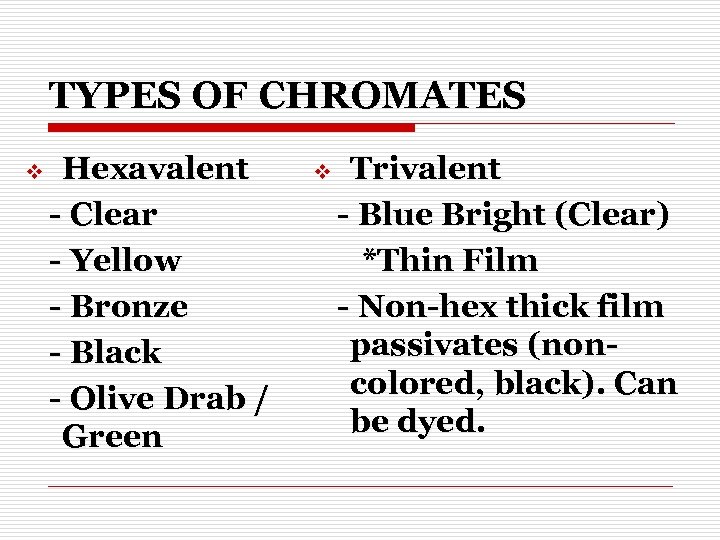 TYPES OF CHROMATES v Hexavalent - Clear - Yellow - Bronze - Black - Olive Drab / Green v Trivalent - Blue Bright (Clear) *Thin Film - Non-hex thick film passivates (noncolored, black). Can be dyed.
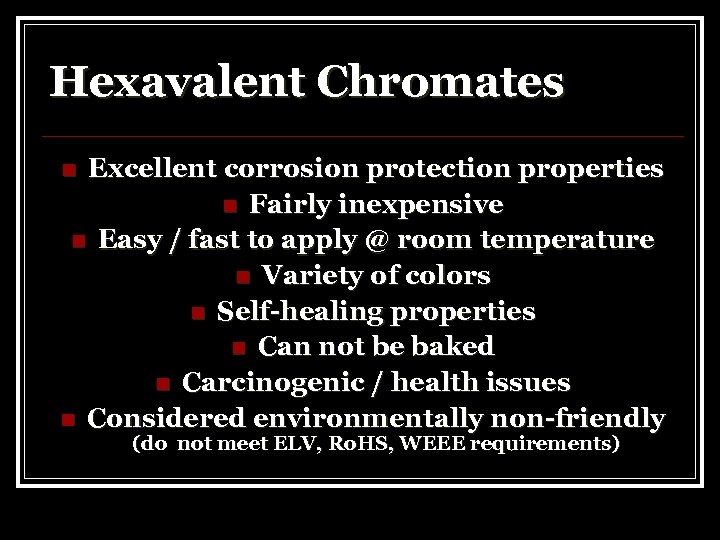 Hexavalent Chromates Excellent corrosion protection properties n Fairly inexpensive n Easy / fast to apply @ room temperature n Variety of colors n Self-healing properties n Can not be baked n Carcinogenic / health issues n Considered environmentally non-friendly n (do not meet ELV, Ro. HS, WEEE requirements)
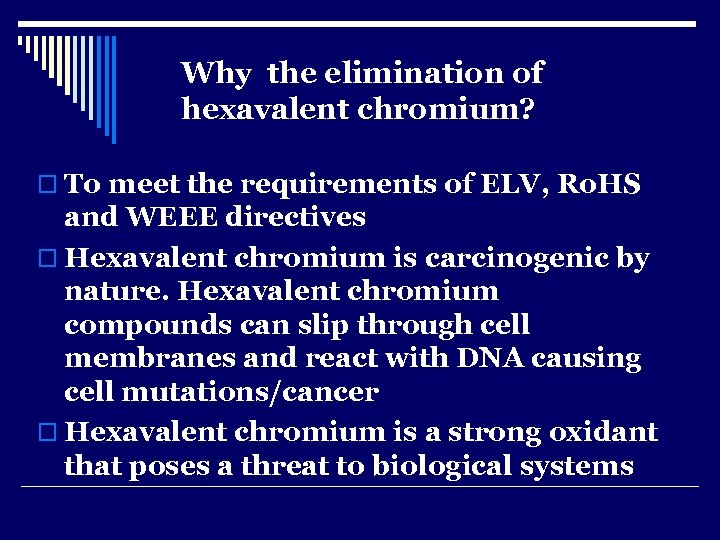 Why the elimination of hexavalent chromium? o To meet the requirements of ELV, Ro. HS and WEEE directives o Hexavalent chromium is carcinogenic by nature. Hexavalent chromium compounds can slip through cell membranes and react with DNA causing cell mutations/cancer o Hexavalent chromium is a strong oxidant that poses a threat to biological systems
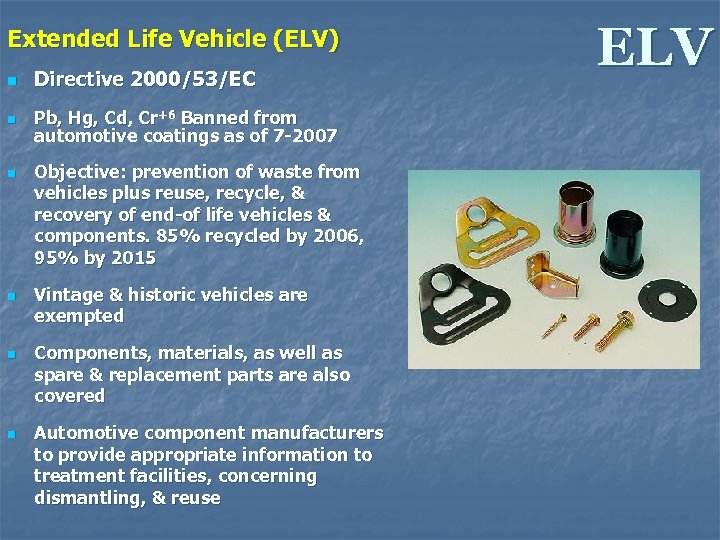 Extended Life Vehicle (ELV) n Directive 2000/53/EC n Pb, Hg, Cd, Cr+6 Banned from automotive coatings as of 7 -2007 n n Objective: prevention of waste from vehicles plus reuse, recycle, & recovery of end-of life vehicles & components. 85% recycled by 2006, 95% by 2015 Vintage & historic vehicles are exempted Components, materials, as well as spare & replacement parts are also covered Automotive component manufacturers to provide appropriate information to treatment facilities, concerning dismantling, & reuse ELV
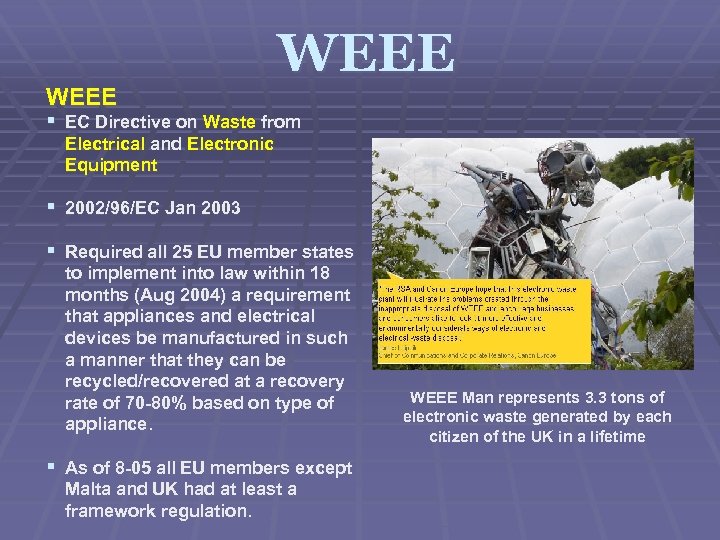 WEEE § EC Directive on Waste from Electrical and Electronic Equipment § 2002/96/EC Jan 2003 § Required all 25 EU member states to implement into law within 18 months (Aug 2004) a requirement that appliances and electrical devices be manufactured in such a manner that they can be recycled/recovered at a recovery rate of 70 -80% based on type of appliance. § As of 8 -05 all EU members except Malta and UK had at least a framework regulation. WEEE Man represents 3. 3 tons of electronic waste generated by each citizen of the UK in a lifetime
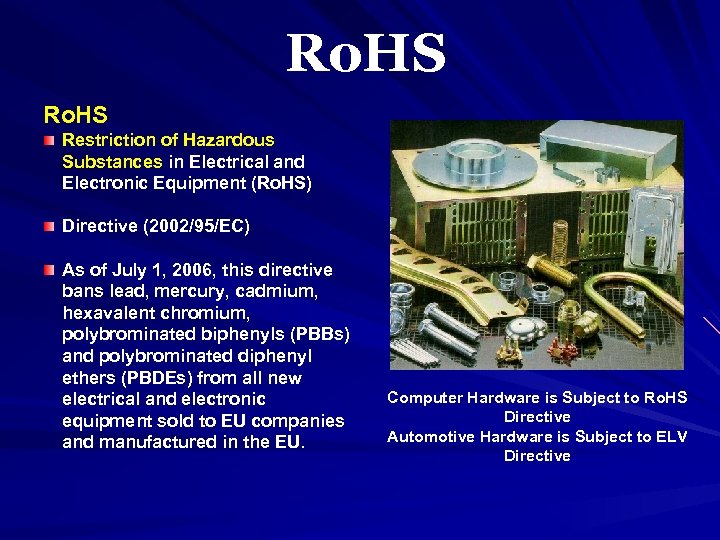 Ro. HS Restriction of Hazardous Substances in Electrical and Electronic Equipment (Ro. HS) Directive (2002/95/EC) As of July 1, 2006, this directive bans lead, mercury, cadmium, hexavalent chromium, polybrominated biphenyls (PBBs) and polybrominated diphenyl ethers (PBDEs) from all new electrical and electronic equipment sold to EU companies and manufactured in the EU. Computer Hardware is Subject to Ro. HS Directive Automotive Hardware is Subject to ELV Directive
 WEEE and Ro. HS Product Categories 1. 2. 3. 4. 5. 6. 7. 8. 9. *Excluded by Ro. HS Directive 10. Large appliances Small appliances IT/telecom equipment Consumer equipment Lighting equipment Electrical/electronic tools Toys, sport equipment Medical equipment * Monitoring/control equipment * Automatic dispensers
 Business Issues for Surface Finishers/Manufacturers n n WEEE and Ro. HS Directives signal new trend toward “product regulation. ” Customers increasingly want to know the material content and planned end-of-life disposition for products they buy. • • Achieve legal compliance Promote“green procurement” Corporate sustainability Respond to stakeholders
 Non-Hexavalent Passivates Cons: More expensive (contain expensive trichromium compounds, organic acids, and other metals) Ø Must be heated to apply (typically 140 o. F) Ø Slower to apply (increases cycle time) Ø Not self healing (require additional top coats for protection – more expense) Ø Lower corrosion protection than hexavalents (without topcoats/seals) Ø Less color variety (non-colored & black) Ø
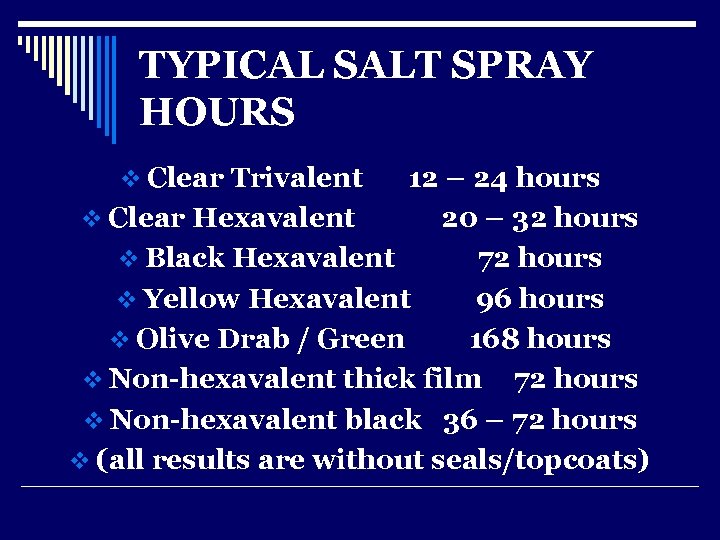 TYPICAL SALT SPRAY HOURS v Clear Trivalent 12 – 24 hours v Clear Hexavalent 20 – 32 hours v Black Hexavalent 72 hours v Yellow Hexavalent 96 hours v Olive Drab / Green 168 hours v Non-hexavalent thick film 72 hours v Non-hexavalent black 36 – 72 hours v (all results are without seals/topcoats)
 Topcoats / Seals n There a variety of topcoats / seals available. Silicated dips, polymers/lacquers, cross-linking polymers, lubricating seals (torque-ntension compounds) n Silicated dips offer some self-healing help and increase corrosion protection. These are very thin and will not cause dimensional problems with fasteners
 Topcoats / Seals (cont. ) n n Polymers / lacquers offer enhanced corrosion protection as well as scratch resistance Polymers / lacquers can pose some conductivity issues Polymer / lacquer films can be thick and may cause fit/dimensional issues in fasteners, especially in threaded areas Lubricating seals (torque-n-tension) offer enhanced corrosion protection, some self-healing help, and lubricity, changing torque values of the surface (automotive fastener requirements). These seals can be expensive to apply.
 THANK YOU! A big thanks to you for allowing us the opportunity to share this information with you today. n For questions or comments, we can be reached at: Dixie Industrial Finishing Company, Tucker, GA www. dixie-industrial. com Jim Jones (770 908 -7900) jim@dixie-industrial. com Terry Windham (770) 908 -7909 terryw@dixie-industrial. com n