


 Скачать презентацию Division of IT Convergence Engineering Applying Autonomics to
76dbbf1f0df31934e838ffc1891d1b7d.ppt
- Количество слайдов: 1
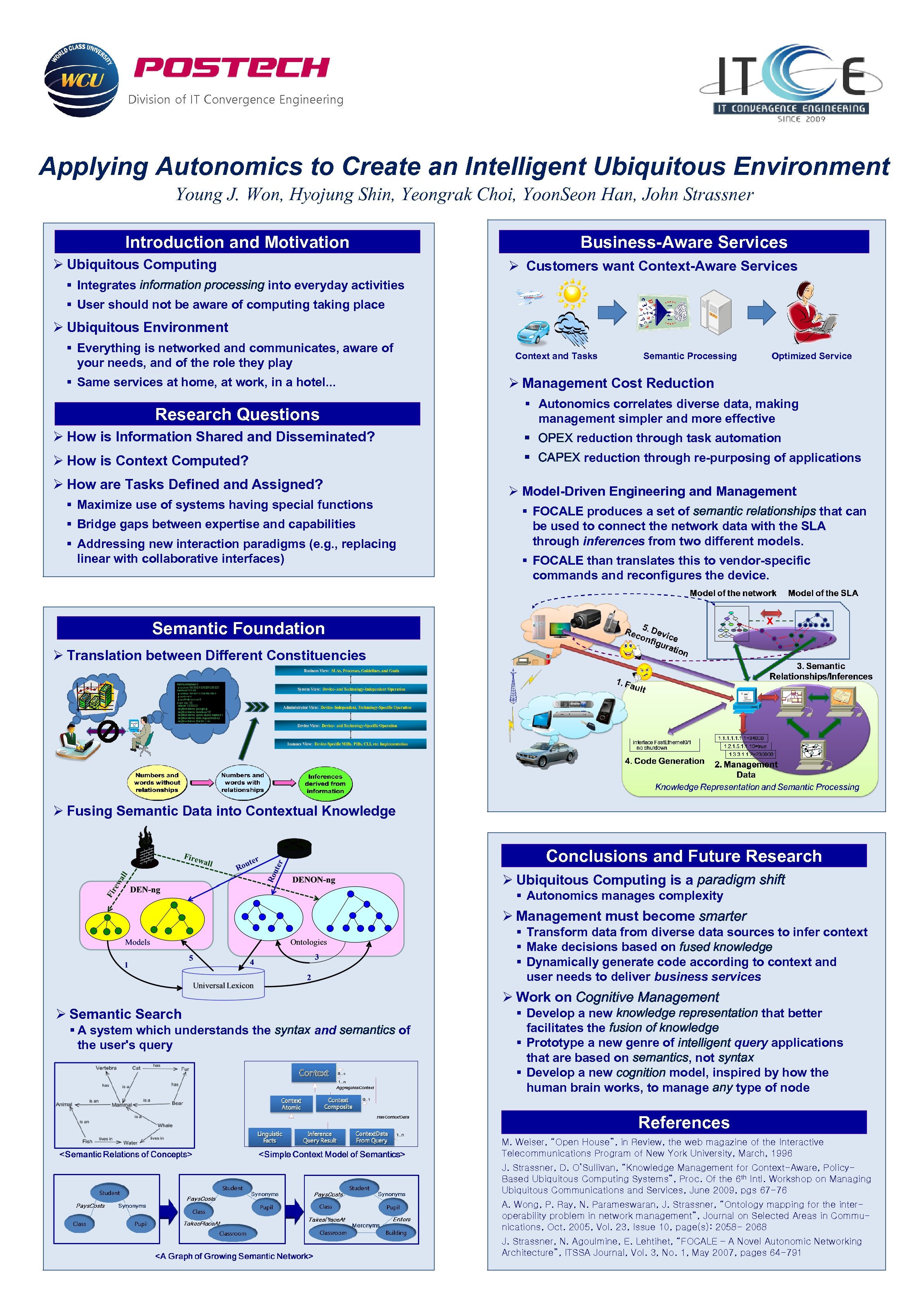 Division of IT Convergence Engineering Applying Autonomics to Create an Intelligent Ubiquitous Environment Young J. Won, Hyojung Shin, Yeongrak Choi, Yoon. Seon Han, John Strassner Introduction and Motivation Ø Ubiquitous Computing Business-Aware Services Ø Customers want Context-Aware Services § Integrates information processing into everyday activities § User should not be aware of computing taking place Ø Ubiquitous Environment § Everything is networked and communicates, aware of your needs, and of the role they play § Same services at home, at work, in a hotel. . . Research Questions Context and Tasks Semantic Processing Optimized Service Ø Management Cost Reduction § Autonomics correlates diverse data, making management simpler and more effective Ø How is Information Shared and Disseminated? § OPEX reduction through task automation Ø How is Context Computed? § CAPEX reduction through re-purposing of applications Ø How are Tasks Defined and Assigned? § Maximize use of systems having special functions § Bridge gaps between expertise and capabilities § Addressing new interaction paradigms (e. g. , replacing linear with collaborative interfaces) Ø Model-Driven Engineering and Management § FOCALE produces a set of semantic relationships that can be used to connect the network data with the SLA through inferences from two different models. § FOCALE than translates this to vendor-specific commands and reconfigures the device. Semantic Foundation Ø Translation between Different Constituencies Ø Fusing Semantic Data into Contextual Knowledge Conclusions and Future Research Ø Ubiquitous Computing is a paradigm shift § Autonomics manages complexity Ø Management must become smarter § Transform data from diverse data sources to infer context § Make decisions based on fused knowledge § Dynamically generate code according to context and user needs to deliver business services Ø Work on Cognitive Management Ø Semantic Search § A system which understands the syntax and semantics of the user's query § Develop a new knowledge representation that better facilitates the fusion of knowledge § Prototype a new genre of intelligent query applications that are based on semantics, not syntax § Develop a new cognition model, inspired by how the human brain works, to manage any type of node References M. Weiser, “Open House”, in Review, the web magazine of the Interactive Telecommunications Program of New York University, March, 1996 J. Strassner, D. O’Sullivan, “Knowledge Management for Context-Aware, Policy. Based Ubiquitous Computing Systems”, Proc. Of the 6 th Intl. Workshop on Managing Ubiquitous Communications and Services, June 2009, pgs 67 -76 A. Wong, P. Ray, N. Parameswaran, J. Strassner, “Ontology mapping for the interoperability problem in network management”, Journal on Selected Areas in Communications, Oct. 2005, Vol. 23, Issue 10, page(s): 2058 - 2068 J. Strassner, N. Agoulmine, E. Lehtihet, “FOCALE – A Novel Autonomic Networking Architecture”, ITSSA Journal, Vol. 3, No. 1, May 2007, pages 64 -791