


 Скачать презентацию Divestment of Air India Ashish Parikh Manavendra Singh
7d5e3a352362bce12ca8b17861939ebc.ppt
- Количество слайдов: 39
 Divestment of Air India Ashish Parikh Manavendra Singh Sial Nikolay Nazarov Pallav Jain
 Agenda o Case Introduction o Background Duke Air o Background India o Background Air India o Transaction o Issues o Our Analysis o Our Valuation o Case Update
 Case Introduction Synopsis o Duke Air is considering an investment in Air India Learning Objectives o Cost of capital considerations o Comprehensive DCF Modeling
 Background: Duke Air o o Finland’s leading airline Most profitable European airline in 2000 European revenues make majority of total revenues Interested to diversify into other markets
 Background: India o o o Largest Democracy Second largest country - population Per capita GDP $471 Huge income disparity In the midst of economic liberalization Severe corruption
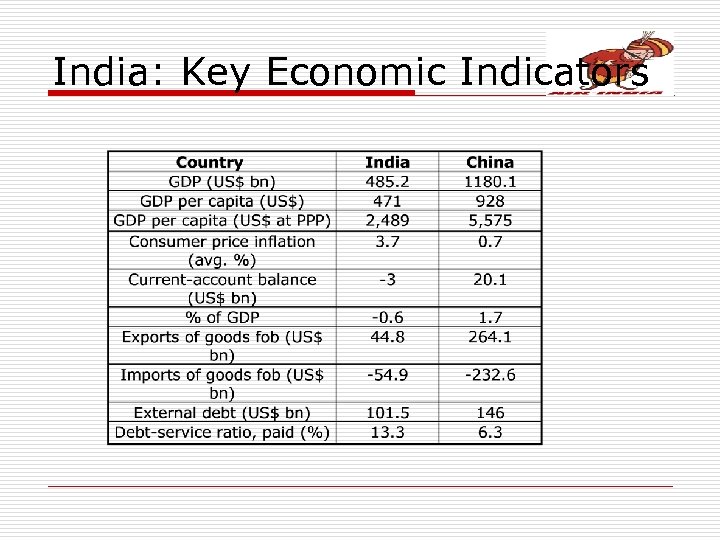 India: Key Economic Indicators
 Background: Privatization “…Learning from our experience, especially over the last decade, it is evident that disinvestment in public sector enterprises is no longer a matter of choice, but an imperative…” Address by the President to Parliament in the Budget Session
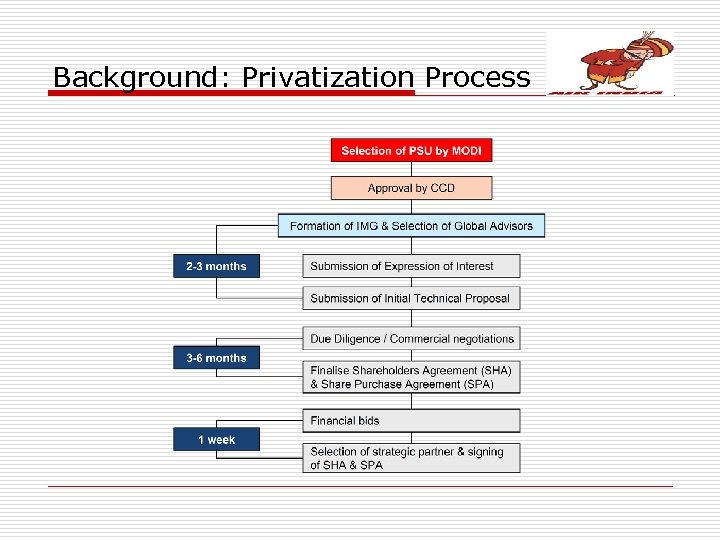 Background: Privatization Process
 Background: Air India o Founded in 1932 as Tata Airlines o Nationalized in 1946 and turned into Air India o 1999 Revenues - $1 B (Rs 44 B) o 1999 Assets - $834 M (Rs 36 B) o 18, 000 employees o 200 world-wide destinations o 3. 37 million passengers annually
 Background: Air India o o o 100% Government owned Strong Brand image Strong Operational Capabilities Strategic partner would increase operational efficiencies Competitive disadvantage due to small fleet size
 Transaction • Acquire a 40% equity stake in Air India • Requirement of an Indian partner • Foreign partner can not have more than 26% stake • Additional 20% to be sold to Indian institutional investors • All cash transaction • Possibility of Indian Airlines divestment
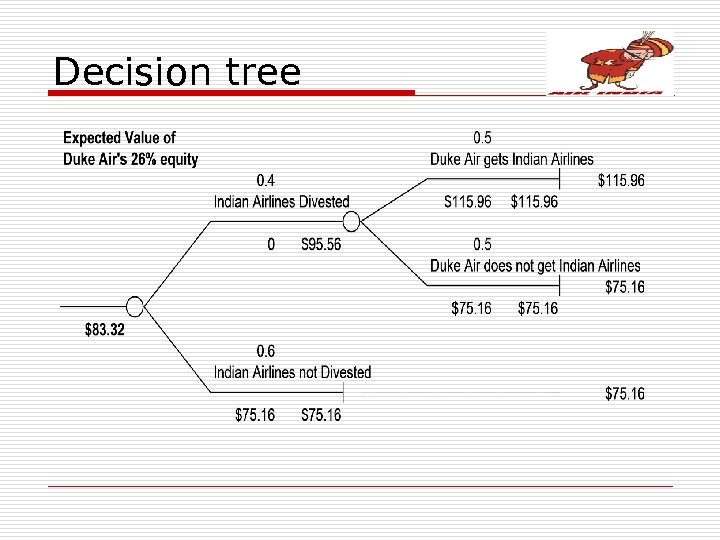
 Option to buy Indian Airlines o o o Probability of IA divestment by 2005 – 40% Probability of acquiring IA after acquiring Air India – 50% Expected synergies from such a transaction – 15% of Air India’s operating cash flows
 Air India operating details o o o Air India travel market share of 21% (air traffic in India) Indian Airlines travel market share of 11% Major markets: n n India/U. S. India/U. K. India/Europe India/South East Asia
 Air India operating details o Other sources of revenue (MM USD): Year Cargo Mail Charter 1995 -96 87 2 18 1996 -97 77 2 19 1997 -98 74 2 41 1998 -99 77 3 47 1999 -00 82 4 21
 Air India operating details o Fleet size
 Air India projections o o o Revenue growth of 10% Major costs – aircrafts and fuels tied to US dollars Fuel costs based on a stable oil price of 27. 5 USD/barrel High capital expenditure in 2003 -2004 and 2006 -2007 for fleet augmentation Prices consistent with competitive carriers Debt refinancing assumed to maintain high D/E ratio
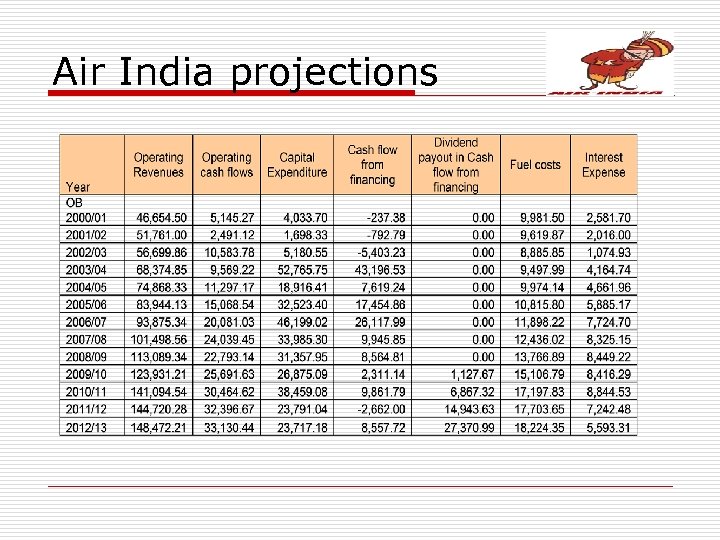 Air India projections
 Issues to consider o o o Adjustment to operating cash flows Adjustments to cost of capital Other adjustments Incorporating Indian Airlines option (probability of 0. 4 and 0. 5) Other qualitative issues
 Our Analysis
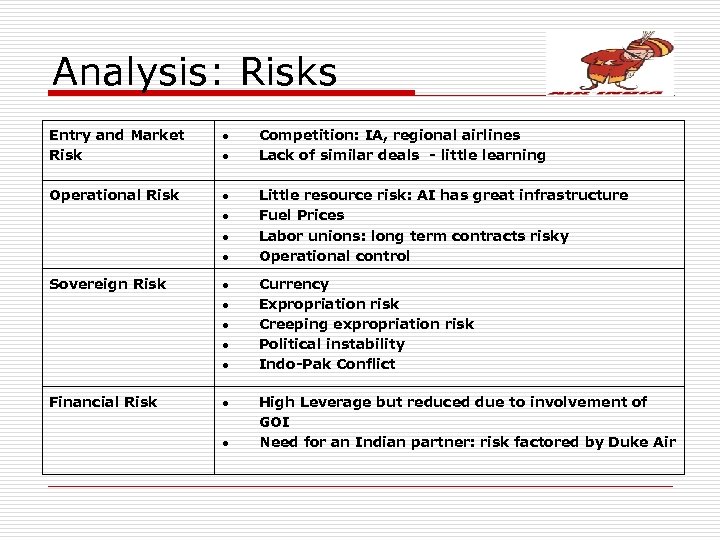 Analysis: Risks Entry and Market Risk Competition: IA, regional airlines Lack of similar deals - little learning Operational Risk Little resource risk: AI has great infrastructure Fuel Prices Labor unions: long term contracts risky Operational control Sovereign Risk Currency Expropriation risk Creeping expropriation risk Political instability Indo-Pak Conflict Financial Risk High Leverage but reduced due to involvement of GOI Need for an Indian partner: risk factored by Duke Air
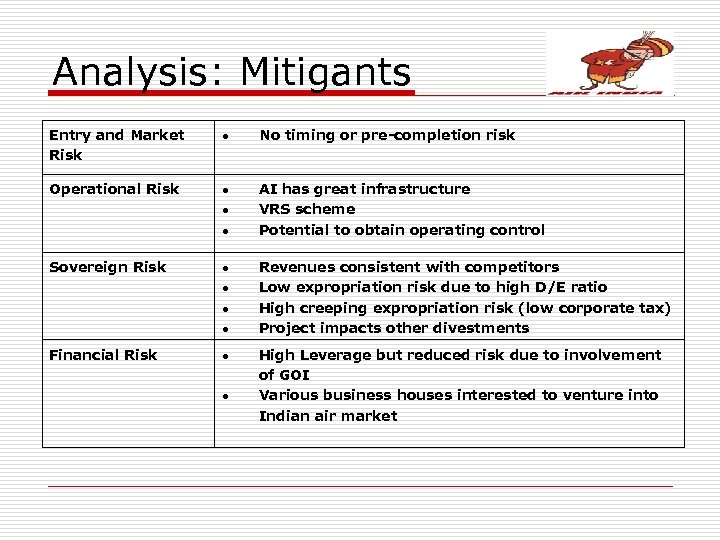 Analysis: Mitigants Entry and Market Risk No timing or pre-completion risk Operational Risk AI has great infrastructure VRS scheme Potential to obtain operating control Sovereign Risk Revenues consistent with competitors Low expropriation risk due to high D/E ratio High creeping expropriation risk (low corporate tax) Project impacts other divestments Financial Risk High Leverage but reduced risk due to involvement of GOI Various business houses interested to venture into Indian air market
 Analysis: Cost of Equity o ICCRC India n Assumptions: o o o n Risk Free Rate = 4% US Market Risk Premium = 3% Anchored to US ICCRC Cost of Capital for India Cost of Equity (ICCRC) 19. 5%
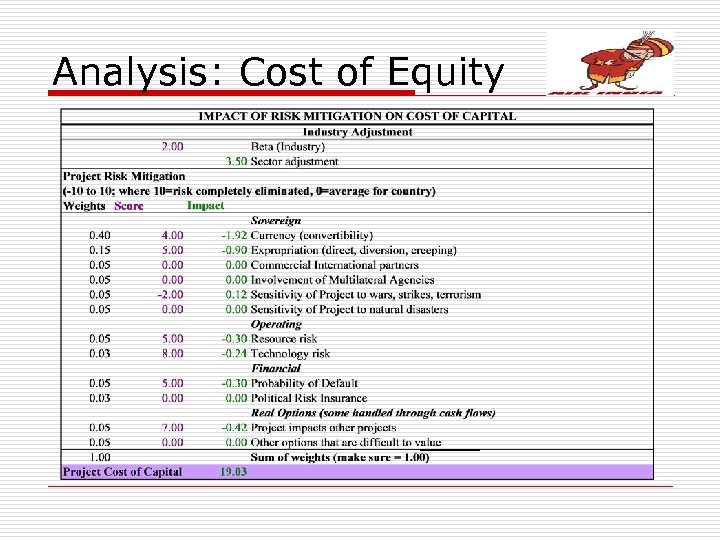 Analysis: Cost of Equity
 Analysis: Use of Multiples o Acquisition Multiples n o Not meaningful, due to regional and other differences Trading Multiples n n P/E: Regional differences, AI negative earnings EBITDAR: Best multiple for industry, but also problematic due to high leverage and lack of comparables
 Analysis: Changes in Valuation o o o DCF approach - Free Cash Flow to Common Equity (FCFCE). Operating Cash Flows were adjusted down by 5% to reflect resource risk and operational inefficiencies. Risk adjustments reduced the cost of equity capital from 19. 5% to 19. 03%
 Analysis: Changes in Valuation Scenario wrt. equity investment in Indian Airlines (real option) o Terminal Value growth rate – 2% o Exchange rate is determined from the Purchasing Power Parity - Assumptions - US inflation rate 2% - Indian inflation rate 5% o
 Our Valuation
 DCF Model o o FCFCE projections for the next 13 years Main Issues n n Revenue Projections (10% growth rate over the next 10 years) Alliance/Consolidation Benefits Fuel Costs Debt Pay down
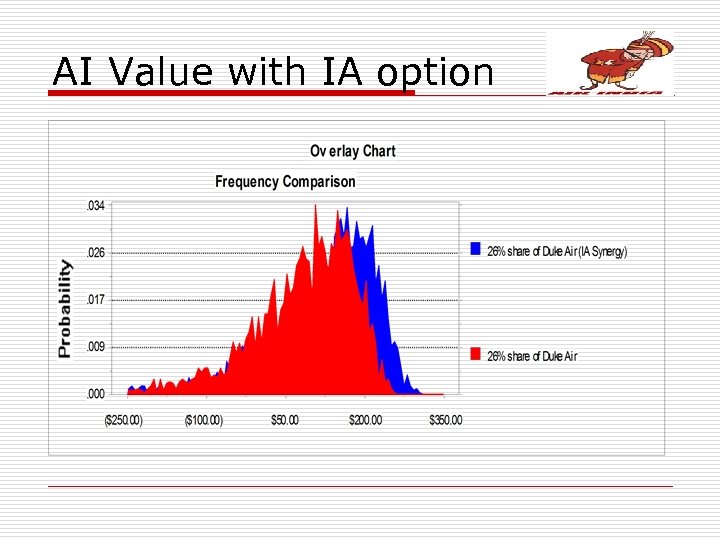
 Valuation o - Monte Carlo Simulation Jet fuel price is modeled as a function of oil price. Simulation of oil price as random walk with a drift. Embedded parameters in oil price simulation are conservative. Since jet fuel is a part of COGS, after-tax effect is imputed.
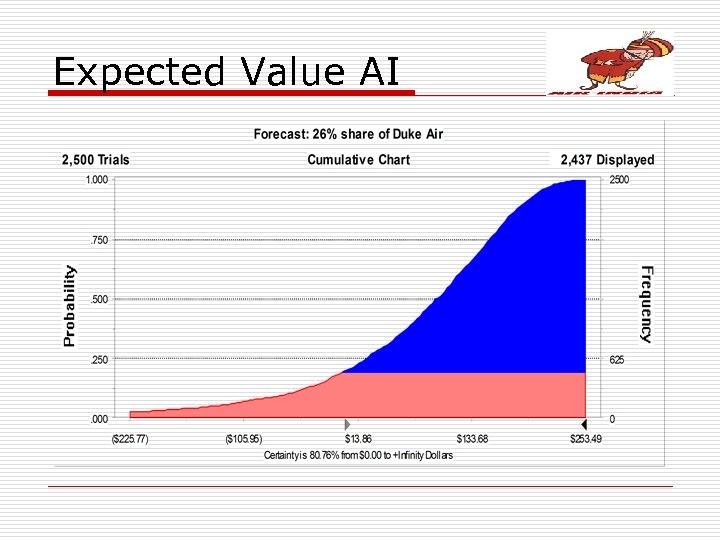 Expected Value AI
 AI Value with IA option
 DCF Present Value o o For AI only Expected PV– US $75. 16 million Likelihood of positive NPV – 80. 76% For AI considering the synergistic benefits from acquiring IA Expected PV (median) – US $115. 96 million
 Valuing AI with real option o o o Probability of IA divestment – 40% Probability of acquiring IA by Air India – 50% Decision tree framework – expected value for Air India
 Decision tree
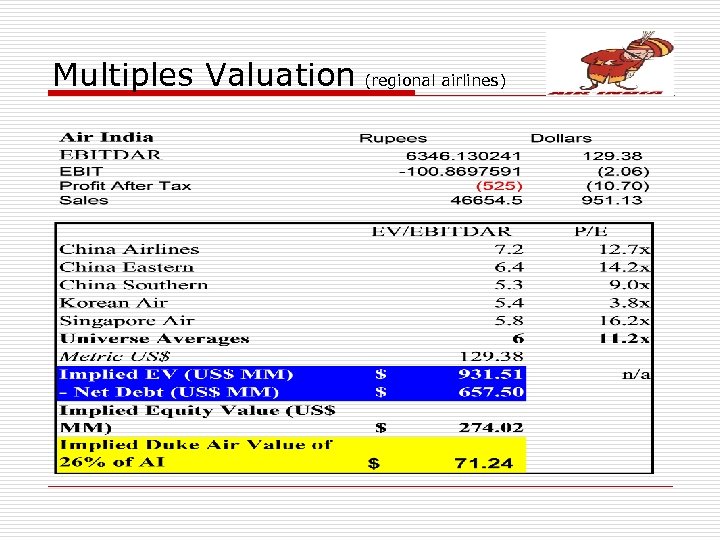 Multiples Valuation (regional airlines)
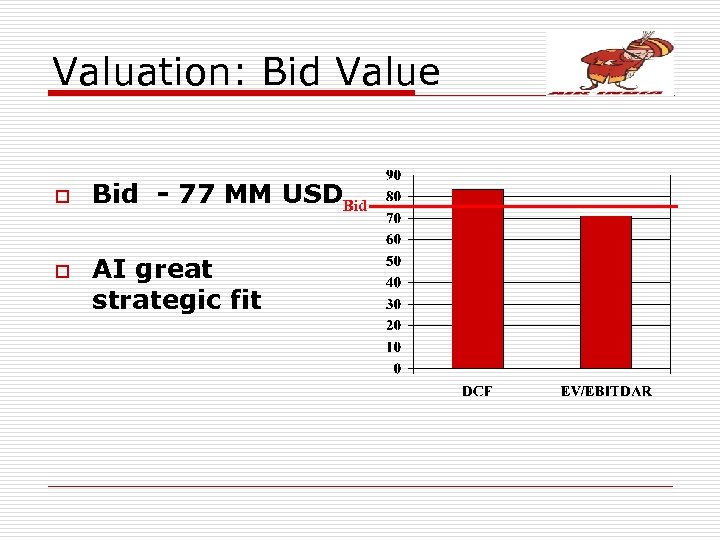 Valuation: Bid Value o o Bid - 77 MM USDBid AI great strategic fit
 Case Update o o Duke Air did not win the bid Political issues surrounded the privatization process o Trade unions raise concerns over divestment o Government defers divestment of Air India
 Questions?
 Air India References o Information memorandum and valuation model from a leading Investment Bank o Other Emerging Market cases o Presentation by HSBC on divestment in India o Discussions with Ministry of Civil Aviation o Some of the case facts, cash flow projections and probabilities have been modified for simplification