


 Скачать презентацию Diversity Measurement and Comparison Am I a Specialist
6c62a97f126cfbc49cdd6e7827760385.ppt
- Количество слайдов: 77
 Diversity Measurement and Comparison Am I a Specialist or a Generalist? My Wife: I am a specialist… because I do ‘something’; not cooking, not washing, not shopping, etc. n My Grandson: I am a generalist… because I read, play, swim, drive, draw, etc. n Degree of Specialization/Diversification is relative to categorization n 4. 2. 1
 Resource Apportionment (Time, Energy, Biomass, Abundance, …) Math Music n John: 2/3 1/3 π=(π1, π2)=(2/3, 1/3) ~ n Jane: 1/3 2/3 ~ =(ν 1, ν 2)=(2/3, 1/3) ν 4. 2. 2
 Does John have a different kind of specialization/diversification than Jane? n Answer: Yes…subject identity matters n Does John have a different degree of specialization/diversification than Jane? n Answer: No…subject identity does not matter n Degree of specialization/diversification is permutation-invariant n 4. 2. 3
 Alfred Russel Wallace -1875 To an outside observer, variety is a most striking feature of a diverse community. Wallace’s description of a tropical forest is a vivid illustration: “If the traveler notices a particular species and wishes to find more like it, he may turn his eyes in vain in any direction. Trees of varied forms, dimensions, and colors are around him, but he rarely sees any one of them repeated. 4. 2. 4
 Alfred Russel Wallace -1875 Time after time he goes towards a tree which looks like the one he seeks, but a closer examination proves it to be distinct. He may at length, perhaps, meet with a second specimen half a mile off, or may fail altogether, till on another occasion he stumbles on one by accident. ” 4. 2. 5
 Alfred Russel Wallace -1875 In a diverse community, such as that described by Wallace, the typical species is relatively rare. Consequently, we propose that diversity be defined as the average rarity within a community. 4. 2. 6
 Diversity as Average Species Rarity C = (s, ~ ) = (π1, π2, …, πs) π π R(i, π) ~ s ∆(π) = ∑ πi R(i ; π) ~ ~ i=1 4. 2. 7
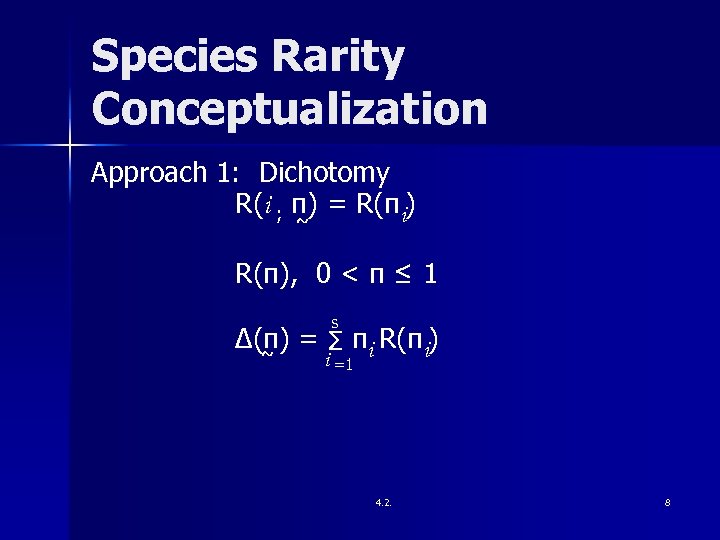 Species Rarity Conceptualization Approach 1: Dichotomy R(i ; π) = R(πi) ~ R(π), 0 < π ≤ 1 s ∆(~ ) = ∑ πi R(πi) π i =1 4. 2. 8
 Species Rarity Conceptualization Approach 2: Ranking π = ~ # = (π1#, π2#, …, πs#) π ~ R(i, π#) = R(i) ~ s ∆(~ ) = ∆(~ #) = ∑ πi# R(i) π π i=1 4. 2. 9
 Dichotomous Approach R(π) = 1 - π 1 R(π) R( ∆(π) = ∑ πi R(πi) ~ = ∑ πi (1 - πi) 0 π 1 Gini Index, Simpson Index 4. 2. 10
 Dichotomous Approach R(π) = (1/π) – 1 ∆(~ = s – 1, Species Count π) R( R(π) = log(1/π) = -log(π) π 1 ∆(π) = -∑ πi log(πi), Shannon Index ~ 4. 2. 11
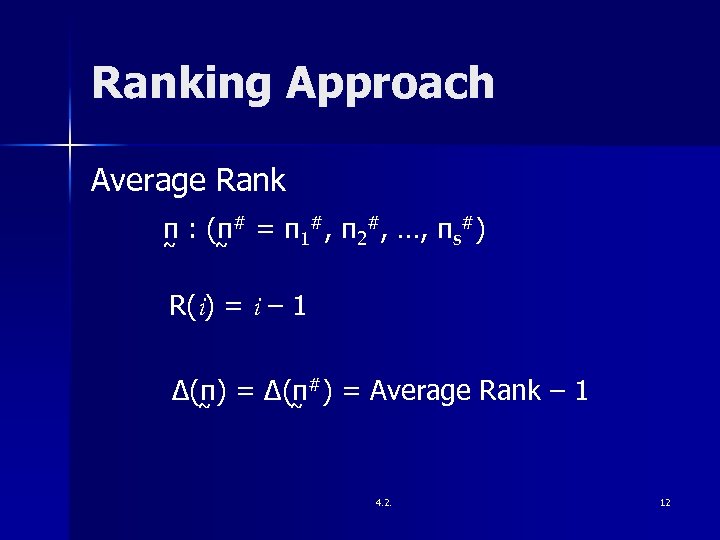 Ranking Approach Average Rank π : (π# = π1#, π2#, …, πs#) ~ ~ R(i) = i – 1 ∆(~ ) = ∆(~ #) = Average Rank – 1 π π 4. 2. 12
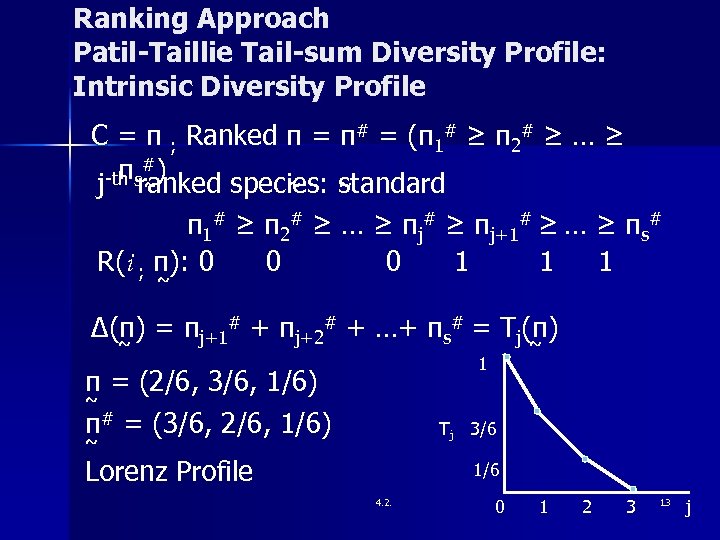 Ranking Approach Patil-Taillie Tail-sum Diversity Profile: Intrinsic Diversity Profile C = π ; Ranked π = π# = (π1# ≥ π2# ≥ … ≥ π s# ) ~ ~ ~ j-th ranked species: standard π1# ≥ π2# ≥ … ≥ πj# ≥ πj+1# ≥ … ≥ πs# R(i ; π): 0 0 0 1 1 1 ~ ∆(π) = πj+1# + πj+2# + …+ πs# = Tj(π) ∆(~ ~ 1 π = (2/6, 3/6, 1/6) ~ π# = (3/6, 2/6, 1/6) Tj 3/6 ~ Lorenz Profile 1/6 4. 2. 0 1 2 3 13 j
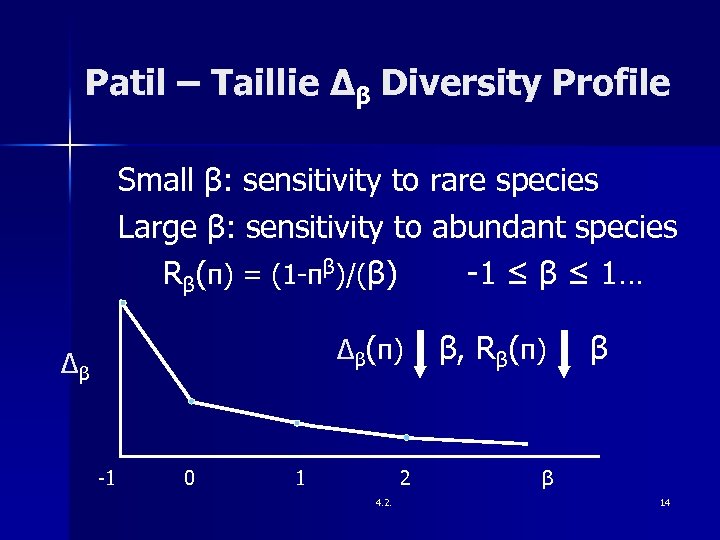 Patil – Taillie ∆β Diversity Profile Small β: sensitivity to rare species Large β: sensitivity to abundant species Rβ(π) = (1 -πβ)/(β) -1 ≤ β ≤ 1… ∆β(π) ∆β -1 0 1 2 4. 2. β, Rβ(π) β β 14
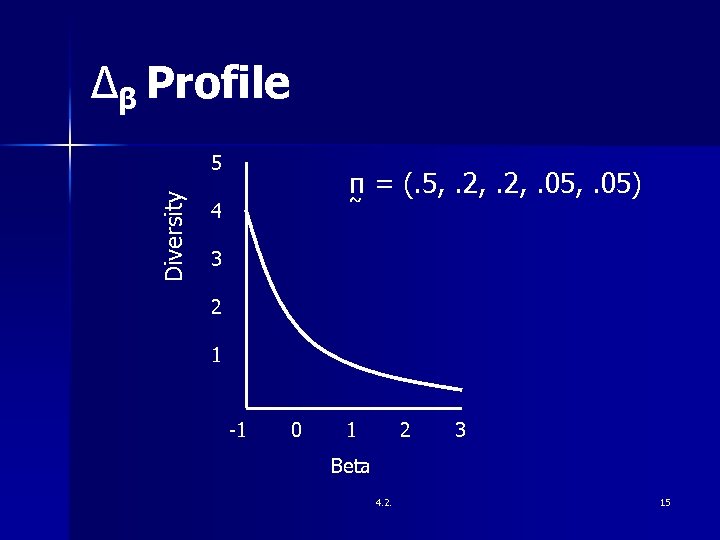 ∆β Profile Diversity 5 π = (. 5, . 2, . 05) ~ 4 3 2 1 -1 0 1 2 3 Beta 4. 2. 15
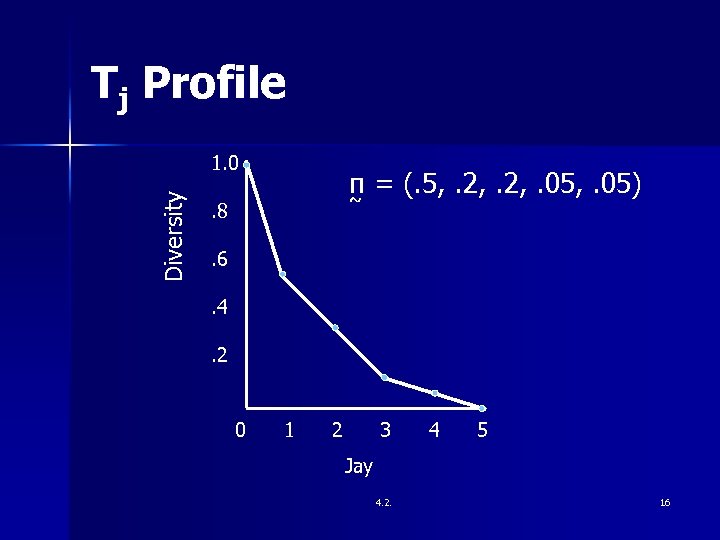 Tj Profile Diversity 1. 0 π = (. 5, . 2, . 05) ~ . 8. 6. 4. 2 0 1 2 3 4 5 Jay 4. 2. 16
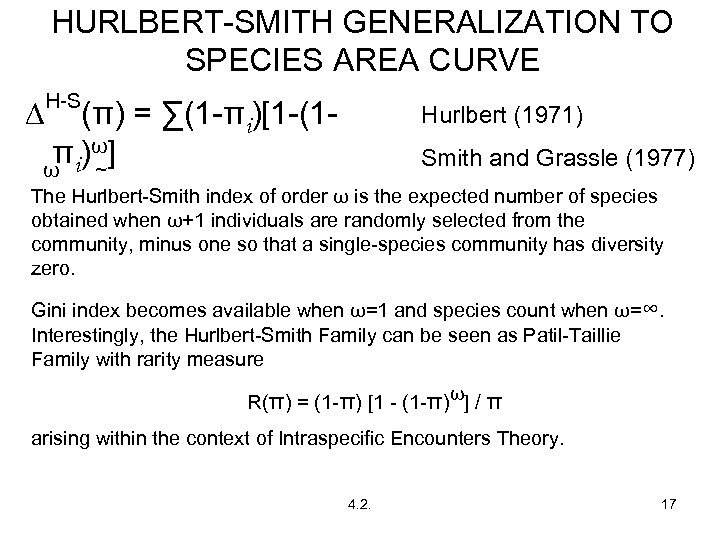 HURLBERT-SMITH GENERALIZATION TO SPECIES AREA CURVE ∆ H-S (π) = ∑(1 -πi)[1 -(1π i )ω ] ω ~ Hurlbert (1971) Smith and Grassle (1977) The Hurlbert-Smith index of order ω is the expected number of species obtained when ω+1 individuals are randomly selected from the community, minus one so that a single-species community has diversity zero. Gini index becomes available when ω=1 and species count when ω=∞. Interestingly, the Hurlbert-Smith Family can be seen as Patil-Taillie Family with rarity measure R(π) = (1 -π) [1 - (1 -π)ω] / π arising within the context of Intraspecific Encounters Theory. 4. 2. 17
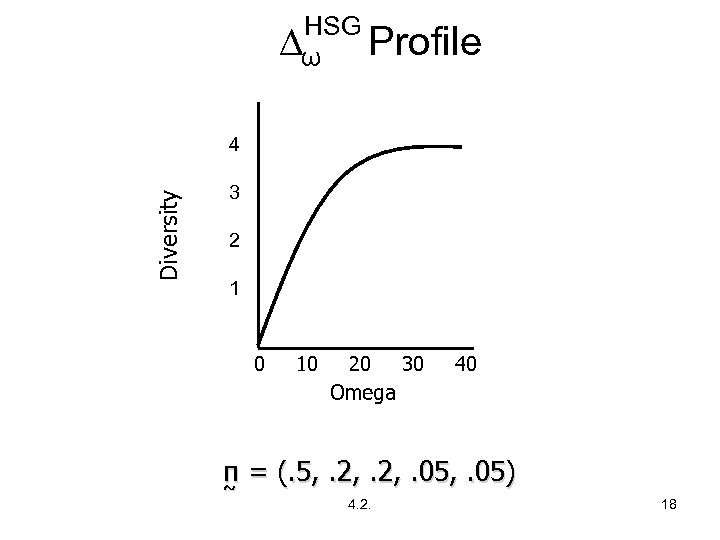 HSG ∆ω Profile Diversity 4 3 2 1 0 10 20 30 40 Omega π = (. 5, . 2, . 05) ~ 4. 2. 18
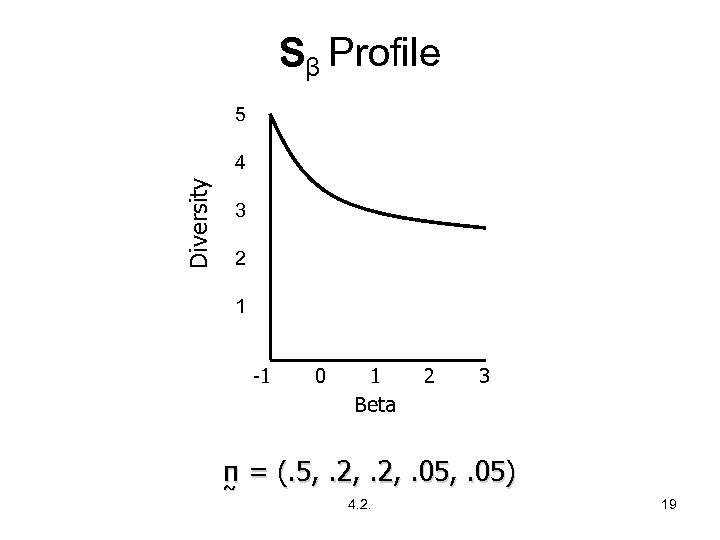 Sβ Profile 5 Diversity 4 3 2 1 -1 0 1 2 3 Beta π = (. 5, . 2, . 05) ~ 4. 2. 19
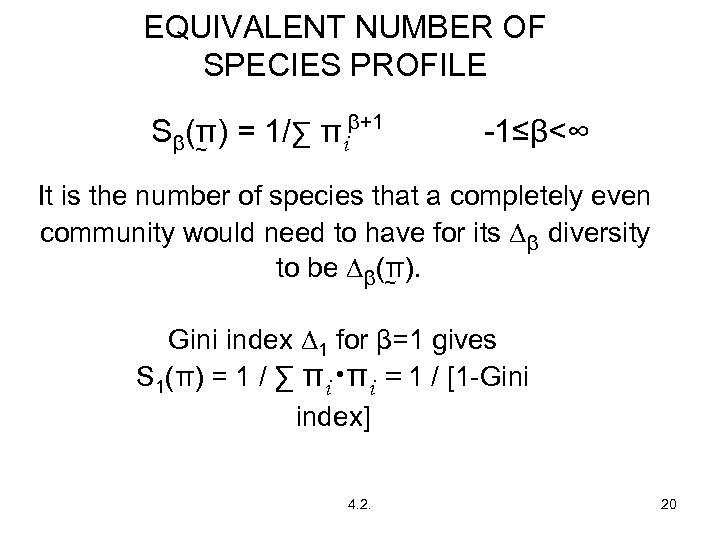 EQUIVALENT NUMBER OF SPECIES PROFILE Sβ(π) = 1/∑ πiβ+1 ~ -1≤β<∞ It is the number of species that a completely even community would need to have for its ∆β diversity to be ∆β(π). ~ Gini index ∆1 for β=1 gives S 1(π) = 1 / ∑ πi ● πi = 1 / [1 -Gini index] 4. 2. 20
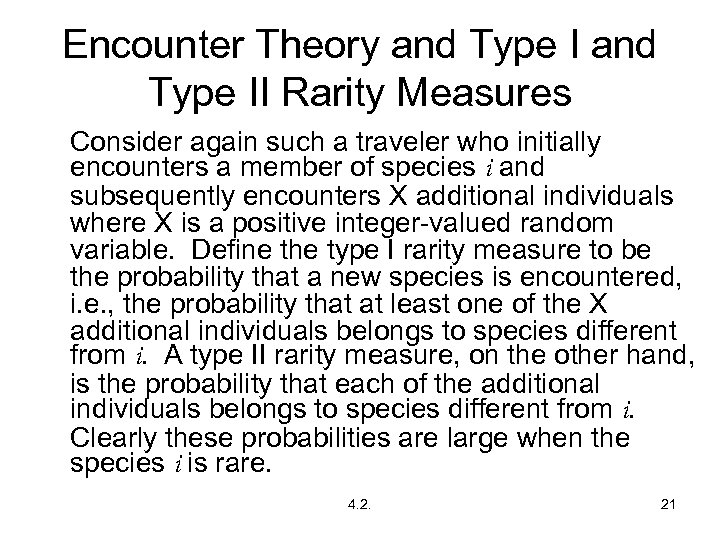 Encounter Theory and Type II Rarity Measures Consider again such a traveler who initially encounters a member of species i and subsequently encounters X additional individuals where X is a positive integer-valued random variable. Define the type I rarity measure to be the probability that a new species is encountered, i. e. , the probability that at least one of the X additional individuals belongs to species different from i. A type II rarity measure, on the other hand, is the probability that each of the additional individuals belongs to species different from i. Clearly these probabilities are large when the species i is rare. 4. 2. 21
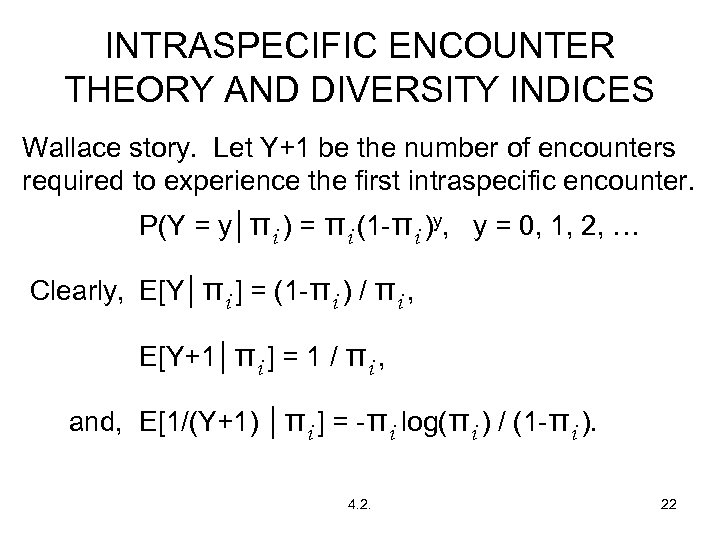 INTRASPECIFIC ENCOUNTER THEORY AND DIVERSITY INDICES Wallace story. Let Y+1 be the number of encounters required to experience the first intraspecific encounter. P(Y = y│πi ) = πi (1 -πi )y, y = 0, 1, 2, … Clearly, E[Y│πi ] = (1 -πi ) / πi , E[Y+1│πi ] = 1 / πi , and, E[1/(Y+1) │πi ] = -πi log(πi ) / (1 -πi ). 4. 2. 22
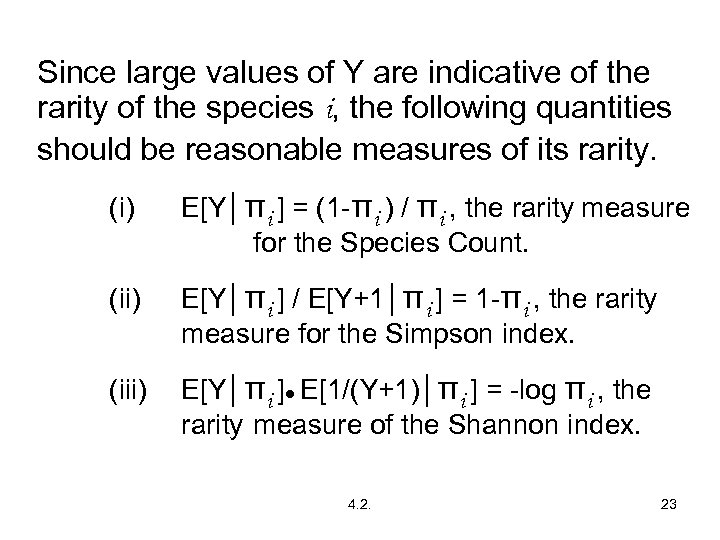 Since large values of Y are indicative of the rarity of the species i, the following quantities should be reasonable measures of its rarity. (i) E[Y│πi ] = (1 -πi ) / πi , the rarity measure for the Species Count. (ii) E[Y│πi ] / E[Y+1│πi ] = 1 -πi , the rarity measure for the Simpson index. (iii) E[Y│πi ]● E[1/(Y+1)│πi ] = -log πi , the rarity measure of the Shannon index. 4. 2. 23
 The three classical diversity indices used frequently in the ecological literature thus have a meaningful interpretation within the average community rarity formulation and also the intraspecific encounter theory. Particularly, we note that the Shannon index has an encounter theoretic interpretation and thus should not be singled out or criticized simply because of its continuing use in information theory. 4. 2. 24
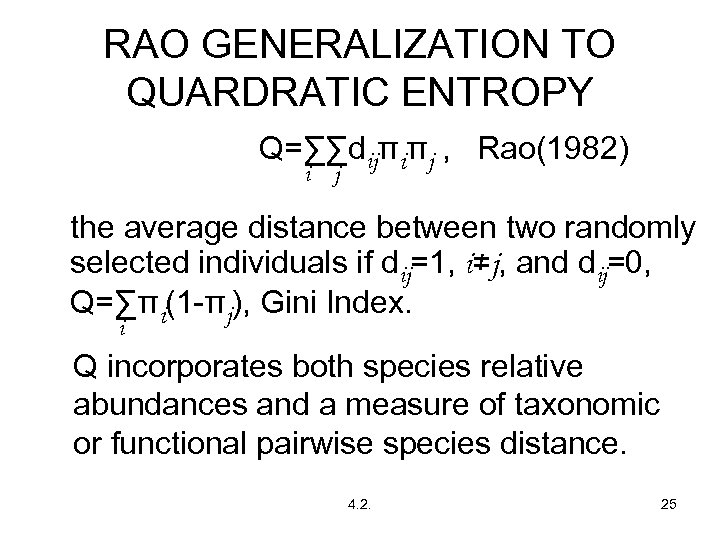 RAO GENERALIZATION TO QUARDRATIC ENTROPY Q=∑∑dijπiπj , Rao(1982) i j the average distance between two randomly selected individuals if dij=1, i≠j, and dij=0, Q=∑πi(1 -πj), Gini Index. i Q incorporates both species relative abundances and a measure of taxonomic or functional pairwise species distance. 4. 2. 25
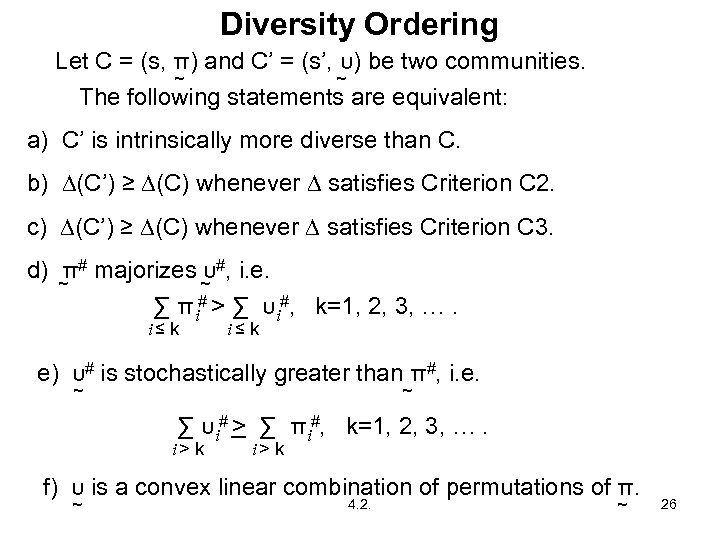 Diversity Ordering Let C = (s, π) and C’ = (s’, υ) be two communities. ~ ~ The following statements are equivalent: a) C’ is intrinsically more diverse than C. b) ∆(C’) ≥ ∆(C) whenever ∆ satisfies Criterion C 2. c) ∆(C’) ≥ ∆(C) whenever ∆ satisfies Criterion C 3. d) ~ # majorizes ~ #, i. e. π υ ∑ πi# > ∑ υi#, k=1, 2, 3, …. i≤k e) υ# is stochastically greater than π#, i. e. ~ ~ ∑ υi# > ∑ πi#, k=1, 2, 3, …. i>k f) υ is a convex linear combination of permutations of π. ~ 4. 2. ~ 26
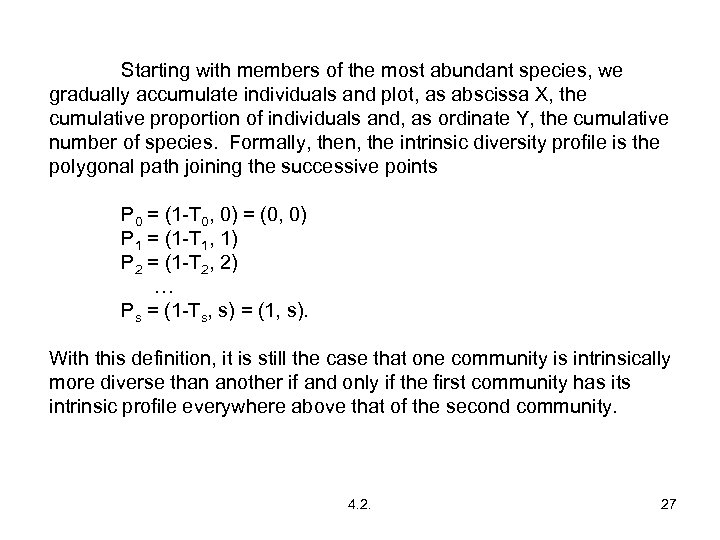 Starting with members of the most abundant species, we gradually accumulate individuals and plot, as abscissa X, the cumulative proportion of individuals and, as ordinate Y, the cumulative number of species. Formally, then, the intrinsic diversity profile is the polygonal path joining the successive points P 0 = (1 -T 0, 0) = (0, 0) P 1 = (1 -T 1, 1) P 2 = (1 -T 2, 2) … Ps = (1 -Ts, s) = (1, s). With this definition, it is still the case that one community is intrinsically more diverse than another if and only if the first community has its intrinsic profile everywhere above that of the second community. 4. 2. 27
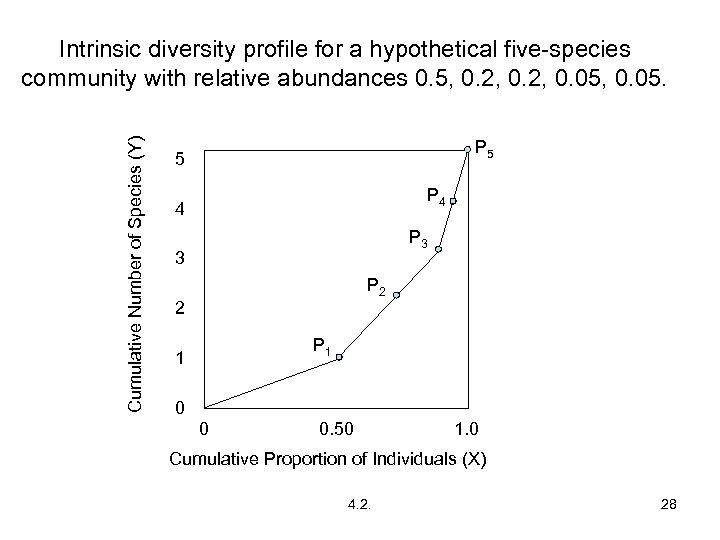 Cumulative Number of Species (Y) Intrinsic diversity profile for a hypothetical five-species community with relative abundances 0. 5, 0. 2, 0. 05. P 5 5 P 4 4 P 3 3 P 2 2 P 1 1 0 0 0. 50 1. 0 Cumulative Proportion of Individuals (X) 4. 2. 28
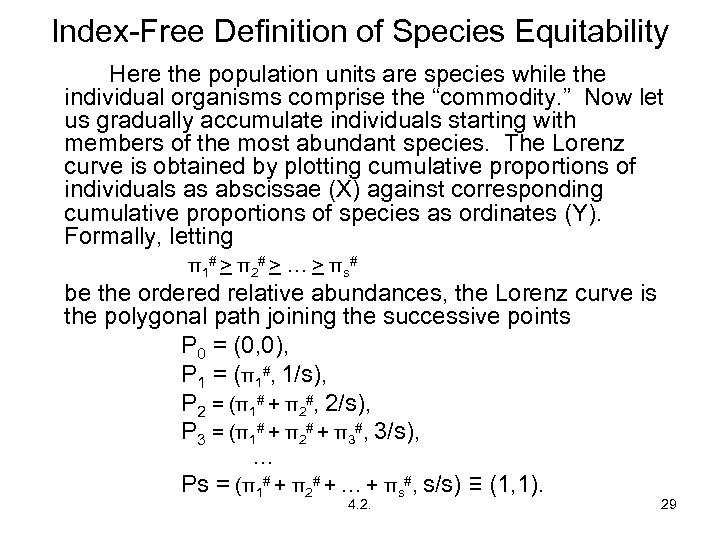 Index-Free Definition of Species Equitability Here the population units are species while the individual organisms comprise the “commodity. ” Now let us gradually accumulate individuals starting with members of the most abundant species. The Lorenz curve is obtained by plotting cumulative proportions of individuals as abscissae (X) against corresponding cumulative proportions of species as ordinates (Y). Formally, letting π1 # > π2 # > … > πs # be the ordered relative abundances, the Lorenz curve is the polygonal path joining the successive points P 0 = (0, 0), P 1 = (π1#, 1/s), P 2 = (π1# + π2#, 2/s), P 3 = (π1# + π2# + π3#, 3/s), Ps … = (π1# + π2# + … + πs#, s/s) 4. 2. ≡ (1, 1). 29
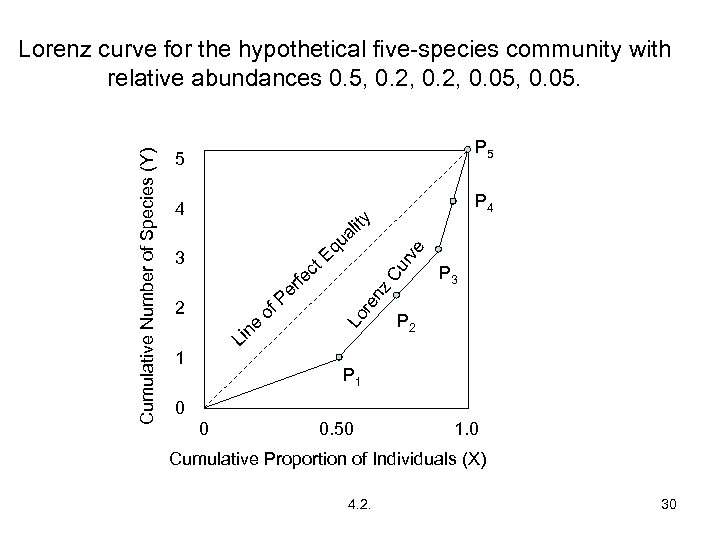 5 P 5 4 P 4 y lit a Li 1 ne o e rv re 2 Pe f P 3 nz t c fe r Cu 3 qu E Lo Cumulative Number of Species (Y) Lorenz curve for the hypothetical five-species community with relative abundances 0. 5, 0. 2, 0. 05. P 2 P 1 0 0 0. 50 1. 0 Cumulative Proportion of Individuals (X) 4. 2. 30
 How then does the Lorenz curve effect equitability comparisons when species richness varies? Consider two communities which are replicates of one another in the sense that they have the same relative abundance vectors, but no species in common. It seems plausible that combining these communities should give a community with the same evenness but twice the richness as either of the original communities. In other words, C: π1, π2, …, πs and C’: π1/2, π2/2, …, πs/2 are expected to have the same evenness. The Lorenz curves of C and C’ are indeed “extra” vertices such as P 2. 4. 2. 31
 Now suppose we wanted to compare the evenness of two communities with, say, 3 and 5 species respectively. We could replicate the 3 species community 5 times and the 5 -species community 3 times and then carry out a diversity comparison between the pair of resulting 15 species communities. The Lorenz curves do all this automatically. This interesting replication property was first pointed out by Hill (1973) in his discussion of the Ea, b measures. Hill failed to notice the connection with the Lorenz curve however. 4. 2. 32
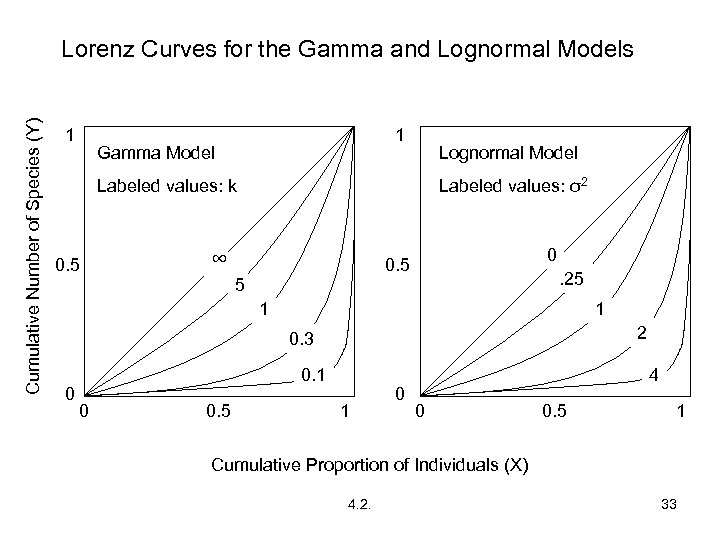 Cumulative Number of Species (Y) Lorenz Curves for the Gamma and Lognormal Models 1 1 Gamma Model Lognormal Model Labeled values: k 0. 5 Labeled values: σ2 ∞ 0 0. 5 . 25 5 1 1 2 0. 3 0 0. 1 0 0. 5 1 0 4 0 0. 5 1 Cumulative Proportion of Individuals (X) 4. 2. 33
 Describing Inequality in Plant Size or Fecundity Damgaard and Weiner (2000) Lorenz curves are used to describe inequality in plant size and fecundity, where the inequality is summarized by the Gini coefficient propose a second and complementary statistic, the Lorenz asymmetry coefficient, which characterizes an important aspect of the shape of the Lorenz curve. The statistic tells which size classes contribute most to the population’s total inequality. Helpful in interpreting the ecological significance. 4. 2. 34
 Crossings and No Crossings for Lognormal Communities Patil and Taillie (1979) • • • If the species density functions f’ and f have the starshaped property, then their intrinsic diversity profiles have at most on crossing point If C’ and C are lognormal communities with repsective parameters (s’, σ’) and (s, σ). The intrinsic diversity profiles have at most one crossing point. Further, c’ is intrinsically more diverse than C if and only if s’ > s and σ’ < σ. The parameter 1/ σ2 completely characterizes the evenness of the lognormal model, (Taillie, 1979). Therefore, in view of the above, within the lognormal family, increasing diversity is equivalent to simultaneously increasing richness and evenness/equitability. 4. 2. 35
 Crossings and No Crossings for Gamma Communities Patil and Taillie (1979) • • • Let c’ and c be two gamma communities with respective parameters (α’, k’) and (α, k). The intrinsic diversity profiles have at most one crossing point. Further, if k>0, then c’ is intrinsically more diverse than c if and only if either (i) k’ > k and α’/k’ > α/k or (ii) k’ < k and α’ > α. The exponent k characterizes equitability within the family of gamma models with positive exponent (Taillie, 1979). For lognormal and gamma communities with positive k, the Lorenz curves never cross one another. 4. 2. 36
 Monovision Viewing from a single angle impairs perception of depth. 4. 2. 37
 Selecting a single environmental indicator is like choosing to view the landscape in gray tones instead of color. 4. 2. 38
 It has been suggested that a multiplicity of biodiversity indicators/indexes is akin to a tangled jungle However, a jungle is not a jumble – there is natural order in the complexity. 4. 2. 39
 many respects, its expressions can be appropriately captured with indicators. It is fundamental to biological processes at all scales, and is not an esoteric issue of mathematical modality. 4. 2. 40
 L. R. Taylor on diversity (1978) Diversity so pervades every aspect of biology that each author may safely interpret the word as he wishes and there is consequently no central theme to the subject. We cannot be sure if this flexibility is healthy or due to lack of discipline, but it can be traced back to the beginnings of interest in biological diversity …… 4. 2. 41
 variety of various aspects of biological diversity. Biodiversity is a fundamental environmental and social concern, with concept and quantification being a part of it. 4. 2. 42
 Rigor vs. Relevance Contention regarding rigor versus relevance is one of the growing pains in maturation of science. Cross-disciplinarity is key to progress in this regard. 4. 2. 43
 an index or indicator is usefulness for ecosystem analysis and management. Restriction of utility to particular contexts does not negate the value, it only increases the importance of understanding the properties in relation to other indicators. 4. 2. 44
 makes it less relevant for working in conservation contexts with rare and endangered species. Therefore, the development of indices specifically designed to reflect the presence of several rare elements is in order. 4. 2. 45
 currently being incorporated into multiple indicators of ecosystem condition/health. A large effort of this nature for the Atlantic Slope Region of the northeastern USA is underway with a focus on condition of watersheds and wetlands. 4. 2. 46
 aspects of diversity and/or condition, it becomes desirable to evaluate the observational units jointly with regard to the several indicators rather than trying to collapse the indicators into a composite. This is where incomplete ordering scenarios become advantageous. 4. 2. 47
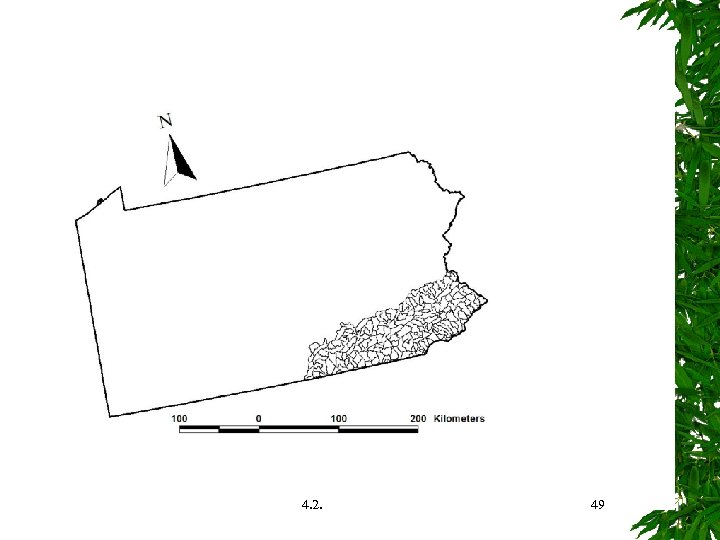
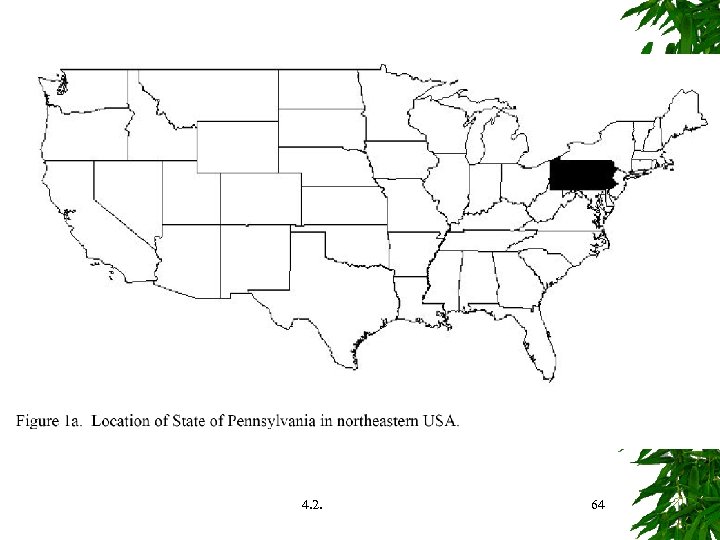
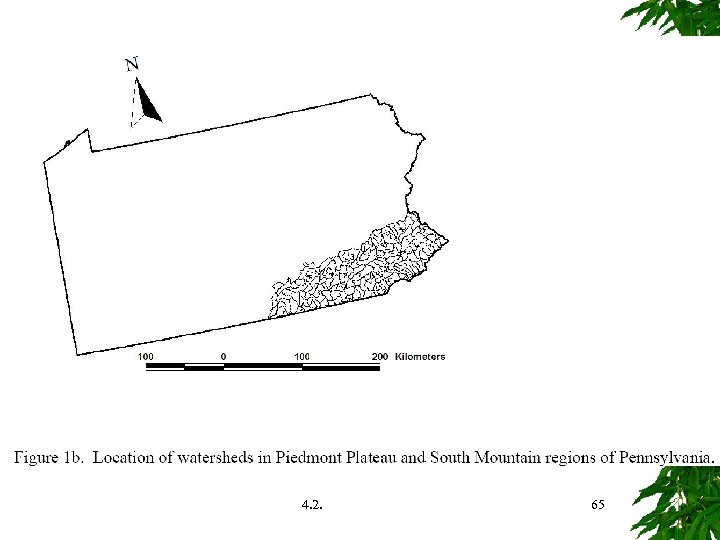
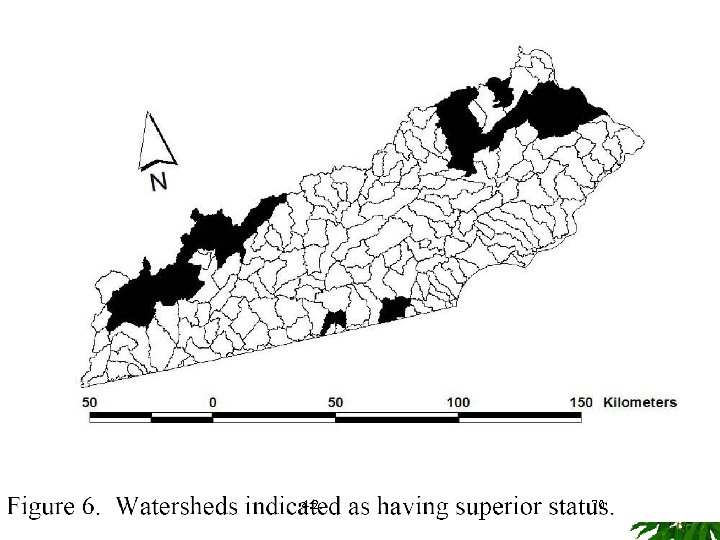
 Plateau region of the state of Pennsylvania in northeastern USA, with the watersheds being rated relative to species richness for taxonomic groupings of vertebrates having predominantly upland versus lowland habitats. 4. 2. 48
 4. 2. 49
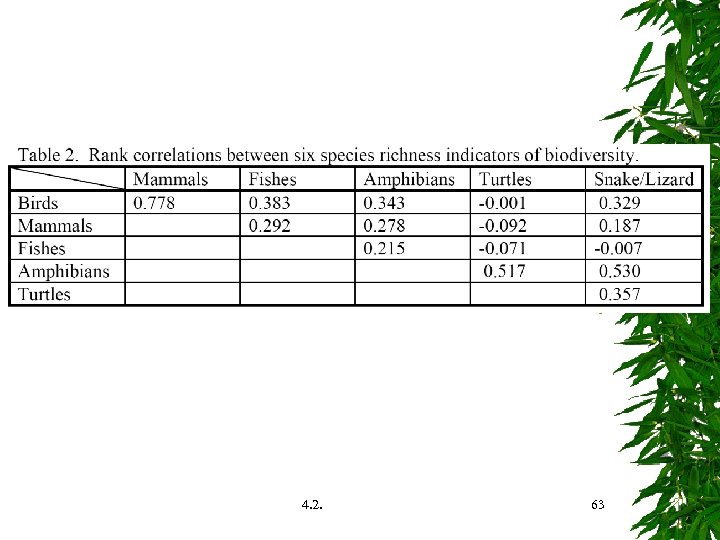
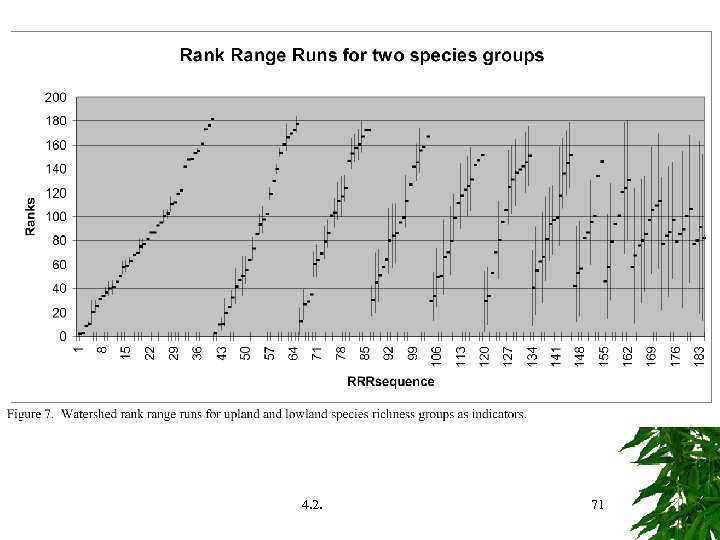
 We first rank each of the watersheds with respect to each of the indicators. In this case, there is a correlation of 0. 41 between the upland ranks and the lowland ranks. 4. 2. 50
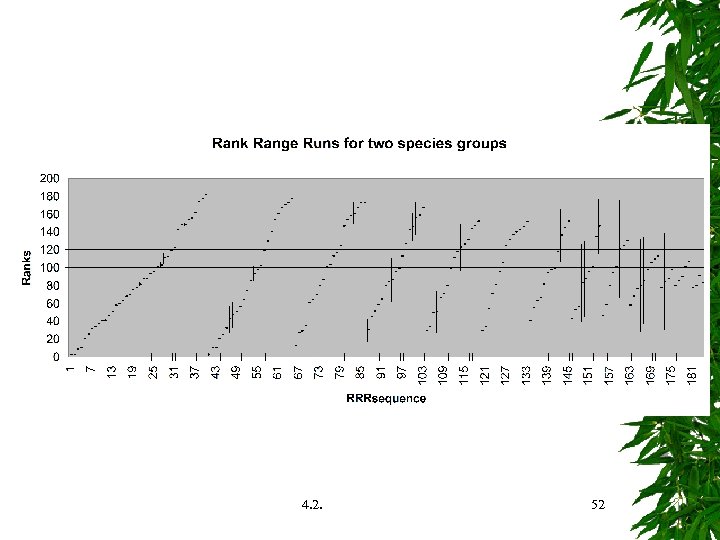
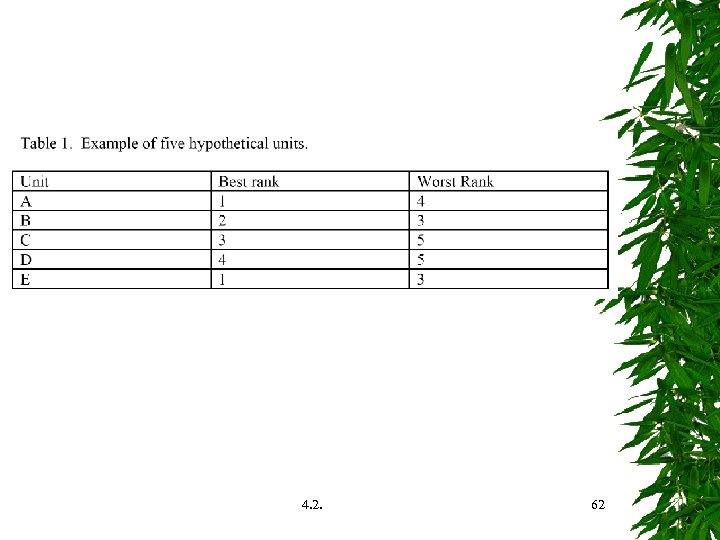
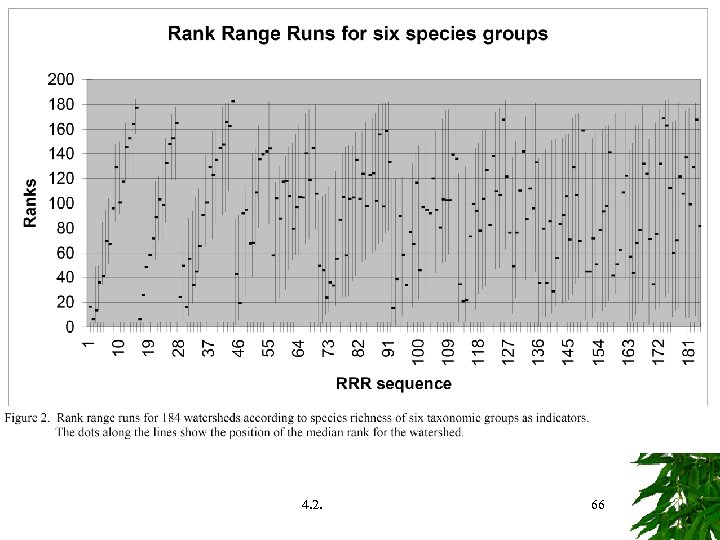
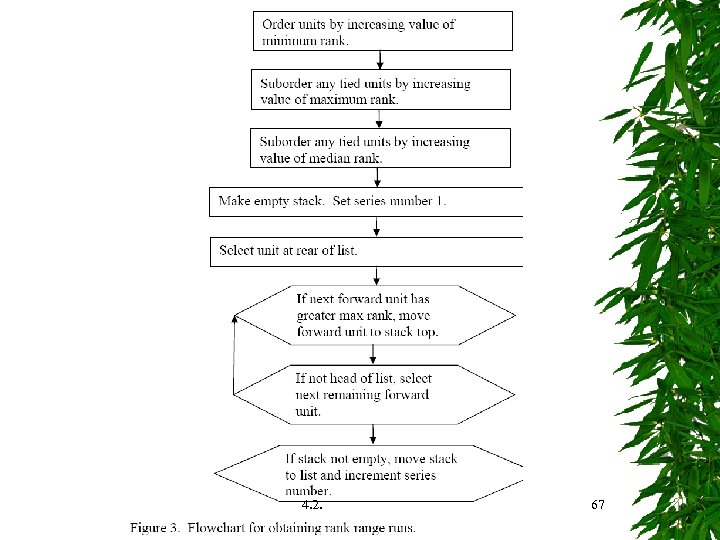
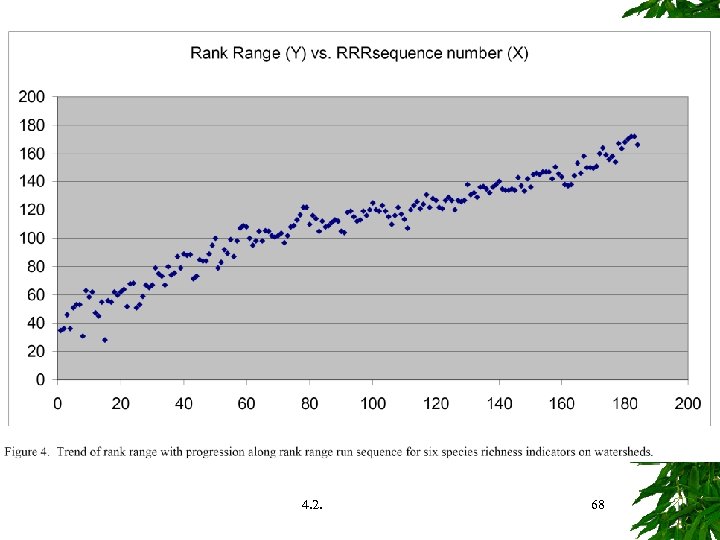
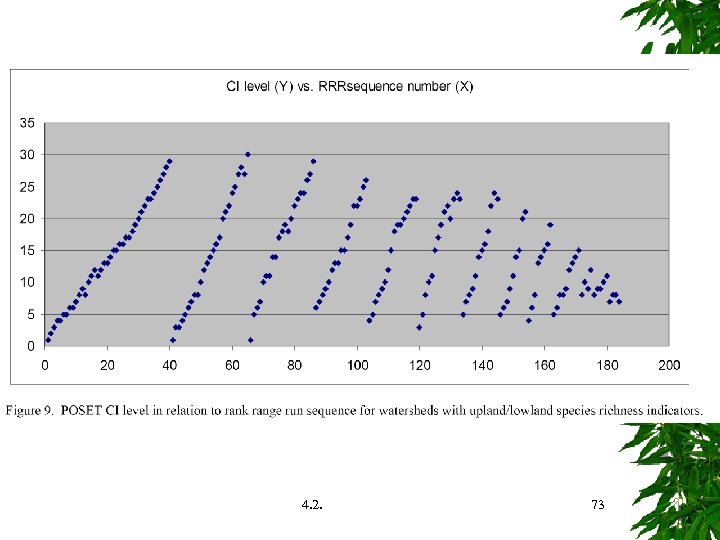
 series jointly according to inferior rank and superior rank, with rank number 1 being best (first place). In this arrangement, each successive series has larger ranges of ranks; therefore showing less agreement of upland species richness and lowland species richness. 4. 2. 51
 4. 2. 52
 The watersheds in the series on the left have substantial agreement for lowland upland ranks. Therefore, the watersheds at the bottom of this series have best diversity and those at the top of this series have worst diversity. 4. 2. 53
 In moving toward the right across the successive series, the degree of agreement between upland status and lowland status progressively declines. 4. 2. 54
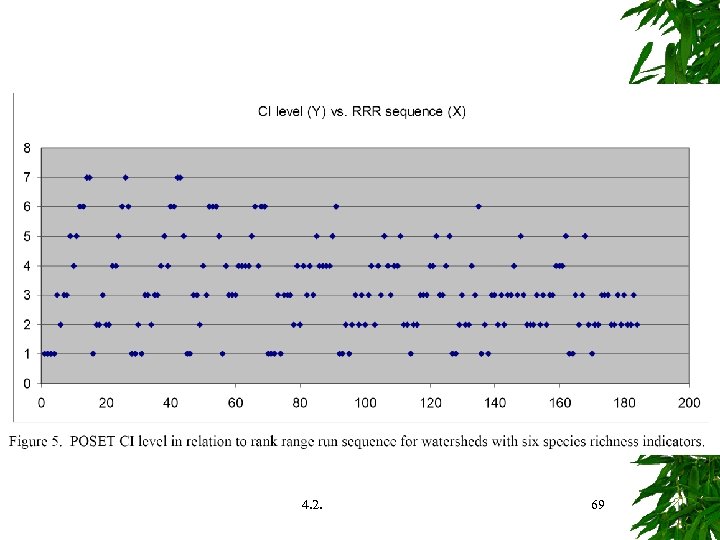
 order sets (POSETS), where the lower class number reflects less domination by other watersheds in regard to diversity. Plotting the class number against RRR sequence reveals sorting by status within each rank range run. 4. 2. 55
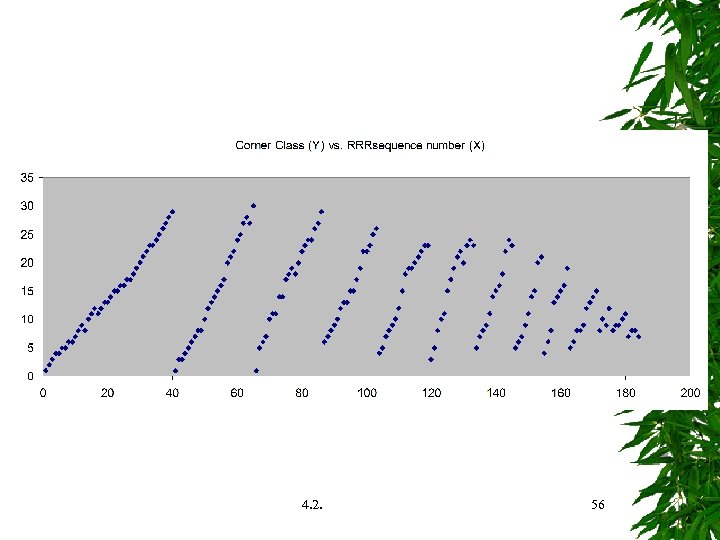 4. 2. 56
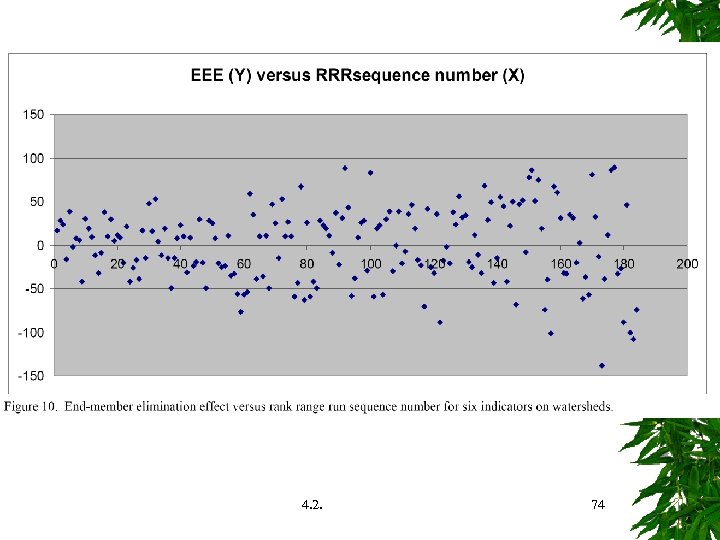
 applicable to more than two indicators. It is revealing with regard to which units (watersheds) show agreement and which show disagreement on the several indicators, as well as for joint orderings. 4. 2. 57
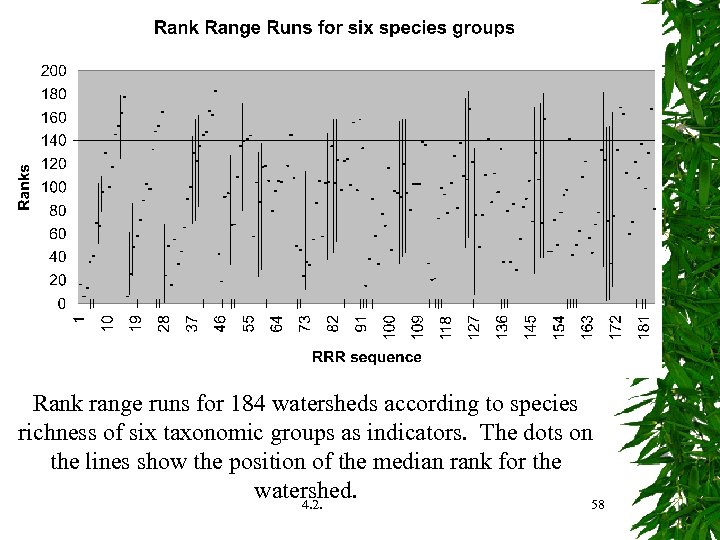 Rank range runs for 184 watersheds according to species richness of six taxonomic groups as indicators. The dots on the lines show the position of the median rank for the watershed. 4. 2. 58
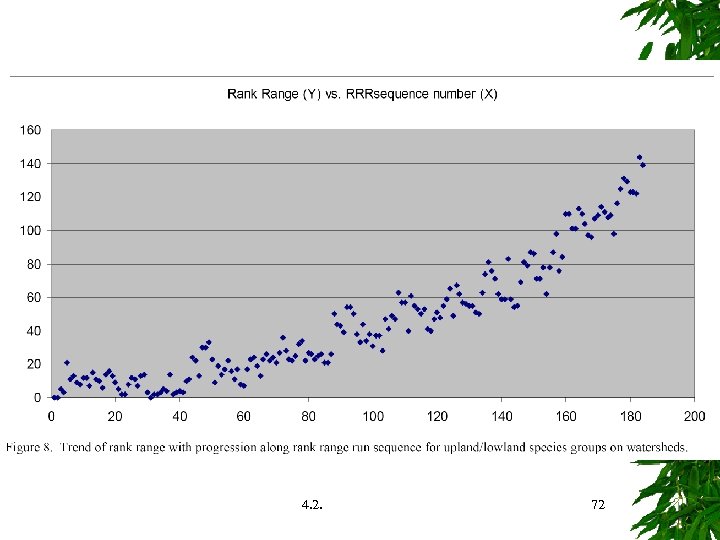
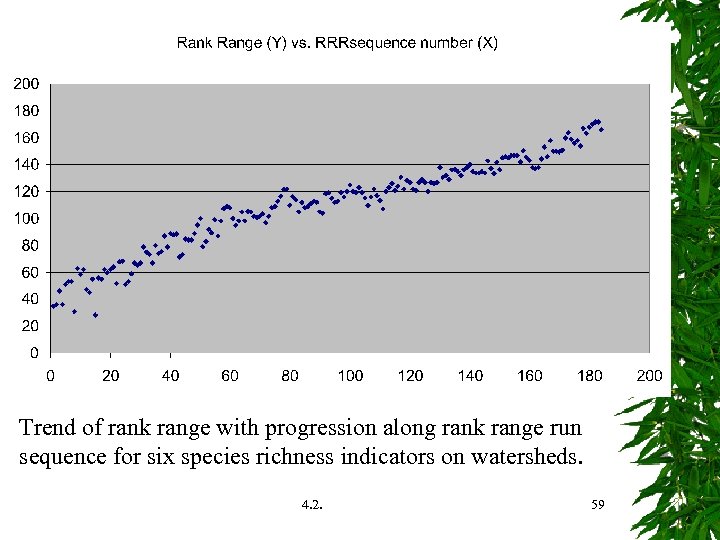 Trend of rank range with progression along rank range run sequence for six species richness indicators on watersheds. 4. 2. 59
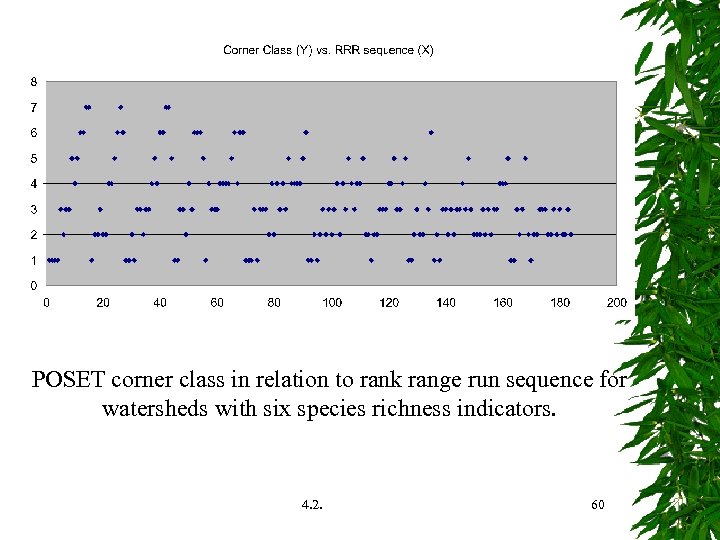 POSET corner class in relation to rank range run sequence for watersheds with six species richness indicators. 4. 2. 60
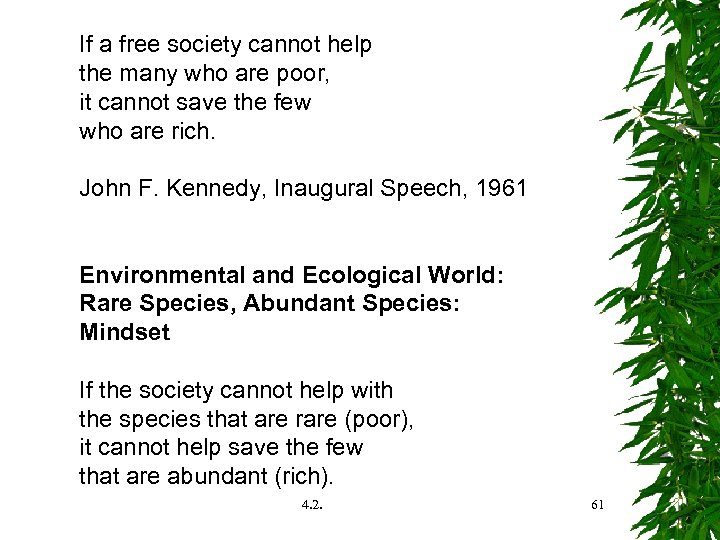 If a free society cannot help the many who are poor, it cannot save the few who are rich. John F. Kennedy, Inaugural Speech, 1961 Environmental and Ecological World: Rare Species, Abundant Species: Mindset If the society cannot help with the species that are rare (poor), it cannot help save the few that are abundant (rich). 4. 2. 61
 4. 2. 62
 4. 2. 63
 4. 2. 64
 4. 2. 65
 4. 2. 66
 4. 2. 67
 4. 2. 68
 4. 2. 69
 4. 2. 70
 4. 2. 71
 4. 2. 72
 4. 2. 73
 4. 2. 74
 Diversity Measurement and Comparison Gini, Lorenz n Equitability Measurement and Comparison Lorenz, Gini n Impurity Measurement and Comparison Gini n 4. 2. 75
 References n n n n Damgaard, C. , and Wiener, J. (2002). Describing inequality in plant size or fecundity. Ecology, 81, 11939— 11942. Fattorini, L. , and Marcheselli, M. (1999). Inference on intrinsic diversity profiles of biological populations. Environmetrics, 10, 589— 599. Gini, C. (1936). On the measure of concentration with especial reference to income and wealth. Cowles Commission. Gini, C. W. (1912). Variabilita e mutabilita. Studi Economico-Giuridici della R. Universita di Cagliaria, 3, 3— 159. Hill, M. O. (1973). Diversity and evenness: a unifying notation and its consequences. Ecology, 54, 427— 432. Hurlbert, H. (1971). The nonconcept of species diversity: A critique and alternative parameters. Ecology, 52, 577— 586. Lorenz, M. C. (1905). Methods of measuring the concentration of wealth. Journal of the American Statistical Association, 9, 209— 219. Patil, G. P. , and Rosenzweig, M. L. (eds). (1979). Contemporary Quantitative Ecology and Related Ecometrics. International Co-operative Publishing House, Fairland, MD. 4. 2. 76
 n n n n Patil, G. P. , and Taillie, C. (1979 a). An overview of diversity. In Ecological Diversity in Theory and Practice, J. F. Grassle, G. P. Patil, W. K. Smith, and C. Taillie, eds. International Co-operative Publishing House, Fairland, MD. pp. 3— 27. Patil, G. P. , and Taillie, C. (1979 b). A study of diversity profiles and orderings for a bird community in the vicinity of Colstrip, Montana. In C ontemporary Quantitative Ecology and Related Ecometrics, International Co-operative Publishing House, Fairland, MD. pp. 23— 47. Patil, G. P. and Taillie, C. (1982). Diversity as a concept and its measurement. Journal of the American Statistical Association, 77, 548— 567. Rao, C. R. (1982). Diversity and dissimilarity coefficients: a unified approach. Theoretical Population Biology, 21, 24— 43. Rao, C. R. (1982). Gini-Simpson index of diversity: A characterization, generalization and applications. Utilitus Mathematica, 21, 273— 282. Ricotta, C. (2006). Through the jungle of biological diversity. Acta Biotheoretica. (To appear). Rousseau, R. , Van. Hecke, P. , Nijssen, D. , and Bogaert, J. (1999). The relationship between diversity profiles, evenness and species richness based on partial ordering. Environmental and Ecological Statistics, 6, 211— 223. Smith, W. K. , and Grassle, J. F. (1977). Sampling properties of a family of diversity indices. Biometrics, 33, 283— 292. 4. 2. 77