 Скачать презентацию DITA and Topic Maps Bringing the Pieces Together
525d0400b42ed5ffa662321a0e7f3a6f.ppt
- Количество слайдов: 28



DITA and Topic Maps Bringing the Pieces Together Topic Maps Conference 2008, Oslo Joe Gelb President, Suite Solutions
Main Discussion Points q Who is this guy? q What is information architecture? Why is it important to technical documents? What is DITA? How can DITA and Topic Maps interoperate? Methodology for developing content using Topic Maps q q q
Who is this guy? Background in Engineering and Process Planning CTO for a leading techdoc service provider and technology vendor Built and managed professional services group § Built CMS with Topic Maps under the hood Left to form vendor-independent consulting and implementation group § Goal: implement creative and pragmatic solutions based on accepted standards and best practices
Main Discussion Points q Who is this guy? q What is information architecture? Why is it important to technical documents? What is DITA? How can DITA and Topic Maps interoperate? Methodology for developing content using Topic Maps q q q
What is Information Architecture? The science of expressing a model or concept for information Used for activities that require expressions of complex systems Consists of: § § Structural design of shared information environments Organizing and labeling information to support usability and findability From Wikipedia
What is IA for Tech Docs? Method for organizing documentation and training resources – text, media – into an overarching knowledge model The knowledge model is created and maintained separate from the actual content – like creating a global index Allows us to provide access to the information based on the model of the knowledge it contains Steve Newcombe Simple level: Organization of content by hierarchy, relationships Next level: Organization of subjects, and relating content to those subjects
Why it is it important for us? Best practices for technical content development based on topic-oriented content architecture Topic-oriented content = modular = componentbased documentation Instead of creating deliverables, we create discrete topics of information (content resources) Standards being adopted: DITA, S 1000 D, SCORM Need better methodologies to plan, create, classify, manage, localize, publish, deliver and find content
Main Discussion Points q Who is this guy? q What is information architecture? Why is it important to technical documents? What is DITA? How can DITA and Topic Maps interoperate? Methodology for developing content using Topic Maps q q q
Overview of DITA Darwin Information Typing Architecture OASIS standard Facility for customization within the standard using inheritance: “specialization” (thus Darwin) Open Source Toolkit (DITA-OT) for producing outputs Active user and development community: reaching critical mass
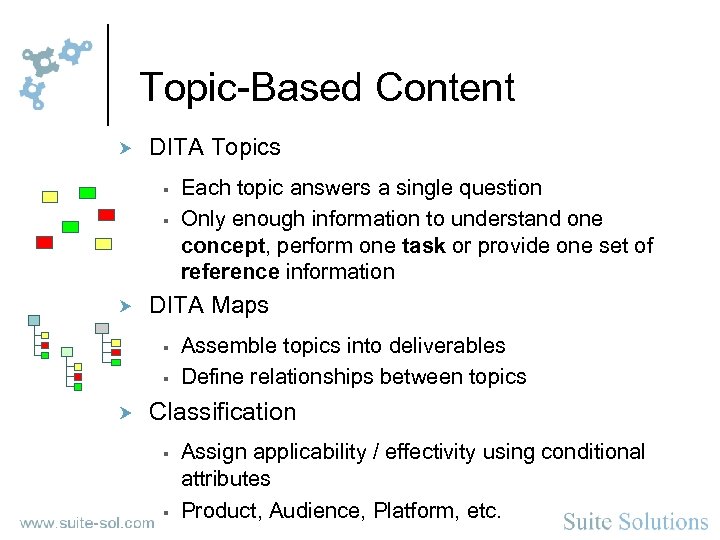
Topic-Based Content DITA Topics § § DITA Maps § § Each topic answers a single question Only enough information to understand one concept, perform one task or provide one set of reference information Assemble topics into deliverables Define relationships between topics Classification § § Assign applicability / effectivity using conditional attributes Product, Audience, Platform, etc.
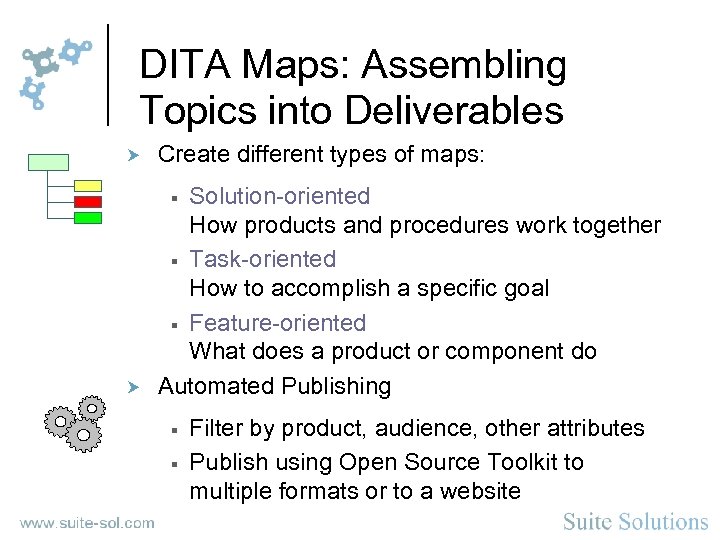
DITA Maps: Assembling Topics into Deliverables Create different types of maps: Solution-oriented How products and procedures work together § Task-oriented How to accomplish a specific goal § Feature-oriented What does a product or component do Automated Publishing § § § Filter by product, audience, other attributes Publish using Open Source Toolkit to multiple formats or to a website
Main Discussion Points q Who is this guy? q What is information architecture? Why is it important to technical documents? What is DITA? How can DITA and Topic Maps interoperate? Methodology for developing content using Topic Maps q q q
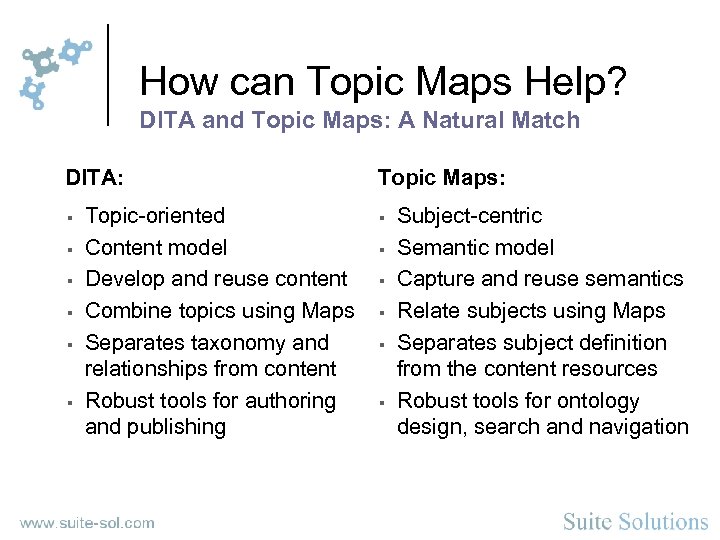
How can Topic Maps Help? DITA and Topic Maps: A Natural Match DITA: § § § Topic-oriented Content model Develop and reuse content Combine topics using Maps Separates taxonomy and relationships from content Robust tools for authoring and publishing Topic Maps: § § § Subject-centric Semantic model Capture and reuse semantics Relate subjects using Maps Separates subject definition from the content resources Robust tools for ontology design, search and navigation
How can Topic Maps Help? Provide a comprehensive ontology for our products § § § Topics: Defines subjects being expressed in the documentation: text, graphics, other media Occurrences: Content topics that relate to each subject Associations: Relationships between subjects can be used to deliver and link between the content topics
How can Topic Maps Help? Determine valid usage of metadata and applicability / effectivity values (DITA conditional attributes) Standardize index and glossary Results in better planning and content reuse on the authoring side, robust filtering and delivery on the production side
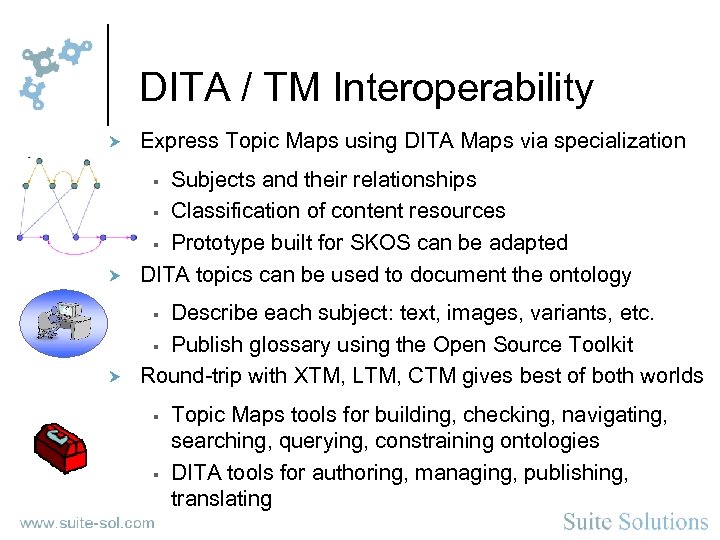
DITA / TM Interoperability Express Topic Maps using DITA Maps via specialization Subjects and their relationships § Classification of content resources § Prototype built for SKOS can be adapted DITA topics can be used to document the ontology Describe each subject: text, images, variants, etc. § Publish glossary using the Open Source Toolkit Round-trip with XTM, LTM, CTM gives best of both worlds § § Topic Maps tools for building, checking, navigating, searching, querying, constraining ontologies DITA tools for authoring, managing, publishing, translating
Main Discussion Points q Who is this guy? q What is information architecture? Why is it important to technical documents? What is DITA? How can DITA and Topic Maps interoperate? Methodology for developing content using Topic Maps q q q
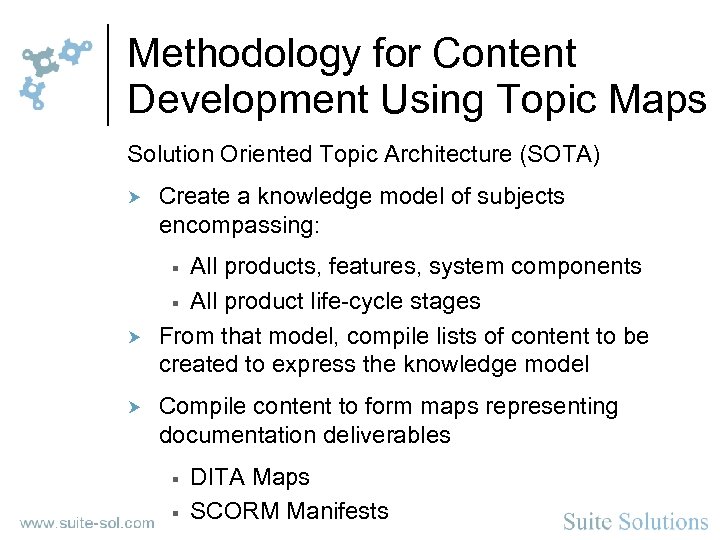
Methodology for Content Development Using Topic Maps Solution Oriented Topic Architecture (SOTA) Create a knowledge model of subjects encompassing: All products, features, system components § All product life-cycle stages From that model, compile lists of content to be created to express the knowledge model § Compile content to form maps representing documentation deliverables § § DITA Maps SCORM Manifests
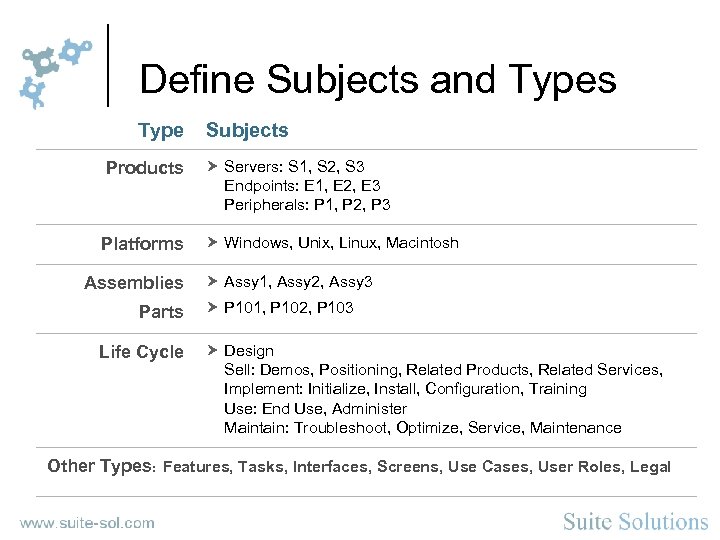
Define Subjects and Types Type Products Platforms Assemblies Parts Life Cycle Subjects Servers: S 1, S 2, S 3 Endpoints: E 1, E 2, E 3 Peripherals: P 1, P 2, P 3 Windows, Unix, Linux, Macintosh Assy 1, Assy 2, Assy 3 P 101, P 102, P 103 Design Sell: Demos, Positioning, Related Products, Related Services, Implement: Initialize, Install, Configuration, Training Use: End Use, Administer Maintain: Troubleshoot, Optimize, Service, Maintenance Other Types: Features, Tasks, Interfaces, Screens, Use Cases, User Roles, Legal
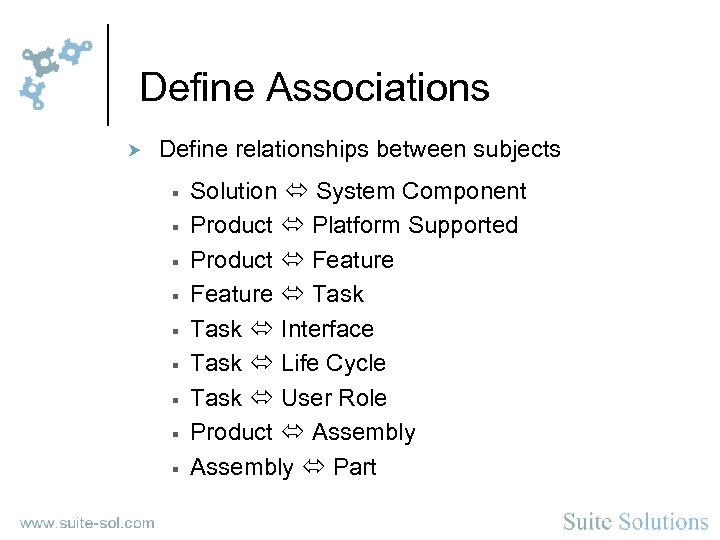
Define Associations Define relationships between subjects § § § § § Solution System Component Product Platform Supported Product Feature Task Interface Task Life Cycle Task User Role Product Assembly Part
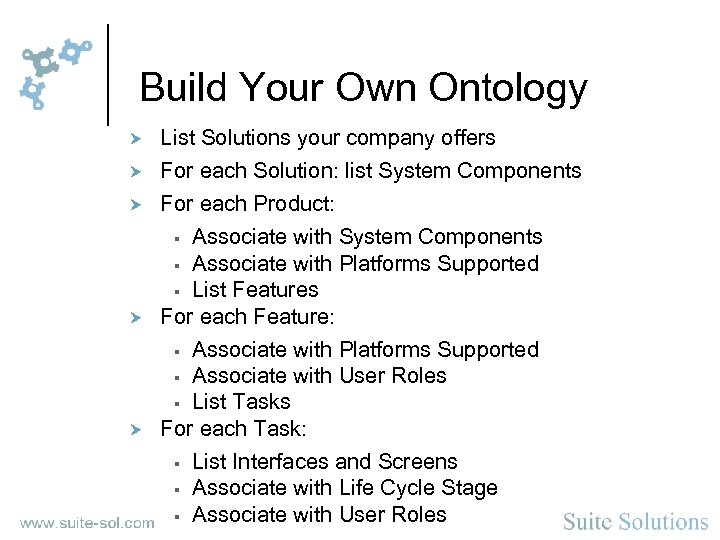
Build Your Own Ontology List Solutions your company offers For each Solution: list System Components For each Product: § Associate with System Components § Associate with Platforms Supported § List Features For each Feature: § Associate with Platforms Supported § Associate with User Roles § List Tasks For each Task: § § § List Interfaces and Screens Associate with Life Cycle Stage Associate with User Roles
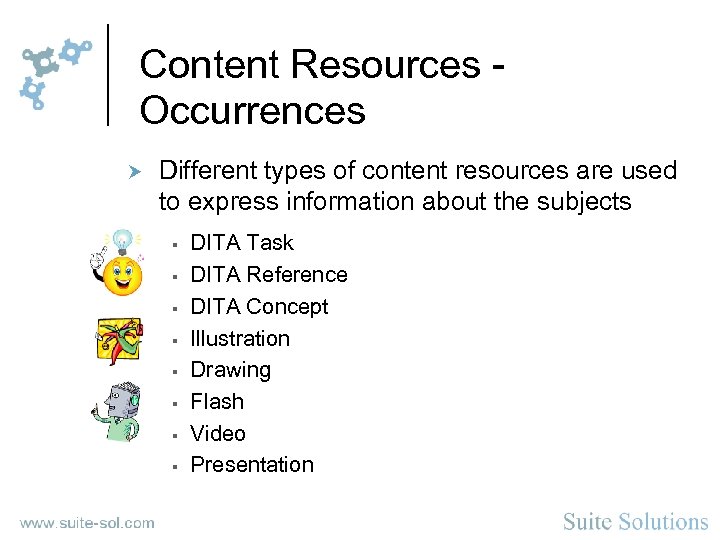
Content Resources Occurrences Different types of content resources are used to express information about the subjects § § § § DITA Task DITA Reference DITA Concept Illustration Drawing Flash Video Presentation
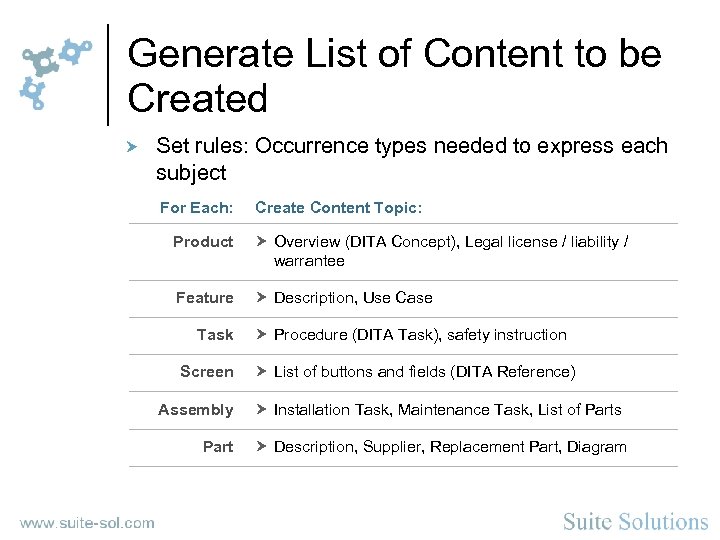
Generate List of Content to be Created Set rules: Occurrence types needed to express each subject For Each: Create Content Topic: Product Overview (DITA Concept), Legal license / liability / warrantee Feature Description, Use Case Task Screen Assembly Part Procedure (DITA Task), safety instruction List of buttons and fields (DITA Reference) Installation Task, Maintenance Task, List of Parts Description, Supplier, Replacement Part, Diagram
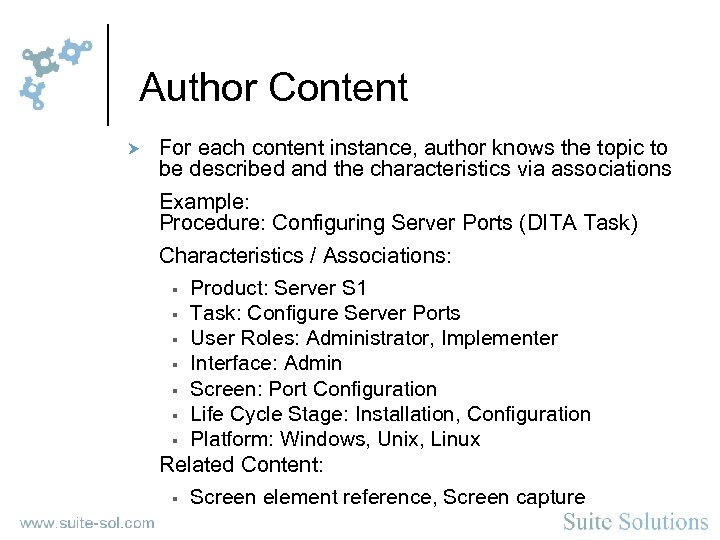
Author Content For each content instance, author knows the topic to be described and the characteristics via associations Example: Procedure: Configuring Server Ports (DITA Task) Characteristics / Associations: § Product: Server S 1 § Task: Configure Server Ports § User Roles: Administrator, Implementer § Interface: Admin § Screen: Port Configuration § Life Cycle Stage: Installation, Configuration § Platform: Windows, Unix, Linux Related Content: § Screen element reference, Screen capture
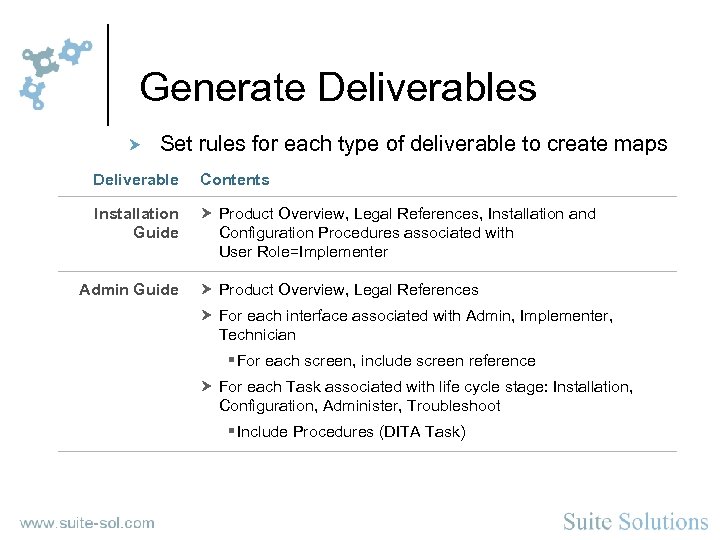
Generate Deliverables Set rules for each type of deliverable to create maps Deliverable Contents Installation Guide Product Overview, Legal References, Installation and Configuration Procedures associated with User Role=Implementer Admin Guide Product Overview, Legal References For each interface associated with Admin, Implementer, Technician § For each screen, include screen reference For each Task associated with life cycle stage: Installation, Configuration, Administer, Troubleshoot § Include Procedures (DITA Task)
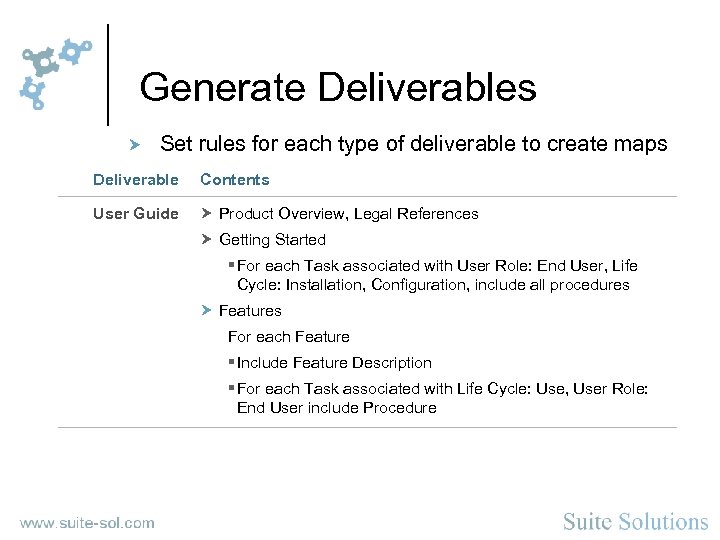
Generate Deliverables Set rules for each type of deliverable to create maps Deliverable Contents User Guide Product Overview, Legal References Getting Started § For each Task associated with User Role: End User, Life Cycle: Installation, Configuration, include all procedures Features For each Feature § Include Feature Description § For each Task associated with Life Cycle: Use, User Role: End User include Procedure
What do you think? q Which planet is he on? q Interesting, but is it feasible? q Interesting; we should consider this approach when evaluating our information architecture q Cool! I see where this can really help and want to learn more about it
Be in touch q Your feedback and ideas are appreciated! q Our team can help you evaluate your needs and implement the right solution. Joe Gelb joeg@suite-sol. com
Скачать презентацию DITA and Topic Maps Bringing the Pieces Together
525d0400b42ed5ffa662321a0e7f3a6f.ppt