 Скачать презентацию Distributed Txn Management 2003 Lecture 2 21
41dc9ba38ee90a7307a29d640d4289a6.ppt
- Количество слайдов: 54



Distributed Txn Management, 2003 Lecture 2 / 21. 10. Distributed Transaction Management – 2003 Jyrki Nummenmaa http: //www. cs. uta. fi/~dtm jyrki@cs. uta. fi
Distributed Txn Management, 2003 Lecture 2 / 21. 10. Physical clock synchronisation
Distributed Txn Management, 2003 Lecture 2 / 21. 10. Coordinated universal time n n n Atomic clocks based on atomic oscillations are the most accurate physical clocks. So-called Coordinated Universal Time based on atomic time is signaled from radio stations and satellites. You can buy a receiver (maybe not more than $100, I had a look at the web) and get accuracy in the order of 0. 1 -10 milliseconds.
Distributed Txn Management, 2003 Lecture 2 / 21. 10. Reasons for and problems in clock synchronisation n n Different clocks work at different speeds. Therefore, they need to be synchronised at times (continuously). Message delay can not be known, but must be approximated -> perfect synchronisation can not be achieved. Clock skew: difference in simultaneous readings. Clock drift: divergence of clocks because of different clock speeds.
Distributed Txn Management, 2003 Lecture 2 / 21. 10. External and Internal Synchronisation n n External synchronisation of clock C is synchronisation with some external source E. If |C-E|<d, then C is accurate (with respect to E) within the bound d. Internal synchronisation is synchronisation of clocks C and C’ between themselves. If |CC’|<d, then C and C’ agree within the bound d. C and C’ may drift from an external source, but not from each other.
Distributed Txn Management, 2003 Lecture 2 / 21. 10. Cristian’s synchronisation method n n n A clock at site S is synchronised with a clock at site S’ by sending a request Mr to S and receiving a time message Mt from S containing time t. Round-trip time Tr is the time between sending Mr and receiving Mt. This is a small time and can be measured accurately. A simple estimate: S will set its clock to t + Tr / 2.
Distributed Txn Management, 2003 Lecture 2 / 21. 10. Accuracy of Cristian’s synchronisation Assume min is shortest time for a message to travel from S to S’ (this must be approximated). n When Mt arrives to S, the clock of S’ will read in the range [t+min, t+Tr-min]. This range has width Tr - 2 min. n We set the clock of S to t + Tr/2. n -> Accuracy is plus/minus Tr / 2 -min n
Distributed Txn Management, 2003 Lecture 2 / 21. 10. Problems and improvements Problem: A single source for time. n Improvement: Poll several servers and e. g. use the fastest reply. n Problem: Faulty time servers. n Improvement: Poll several servers and use statistics. n
Distributed Txn Management, 2003 Lecture 2 / 21. 10. Further improvements n n Berkely time protocol: internal synchronisation with a server polling a number of slaves and using an average of estimates and sends the necessary correction to the slaves. The Network Time Protocol: A hierarchy of servers. Top level = UTC, second level synchronises with top level and so on. More details at http: //www. ntp. org.
Distributed Txn Management, 2003 Lecture 2 / 21. 10. Applications of clocks Clocks are needed in timestamp concurrency control to generate the timestamps! n If we are satisfied with clock accuracy (and accept the clock skew) then we can use the physical clock time stamps. n If not, then logical ordering of events needs to be used. n
Distributed Txn Management, 2003 Lecture 2 / 21. 10. Alternative Mutual Exclusion Protocols
Distributed Txn Management, 2003 Lecture 2 / 21. 10. Token-based algorithms for resource management In the token-based algorithms, there is a token to represent the permission. n Whoever has the token, has the permission, and can pass it on. n These algorithms are more suitable to share a resource like a printer, a car park gate, etc than for a huge database. Let’s see why… n
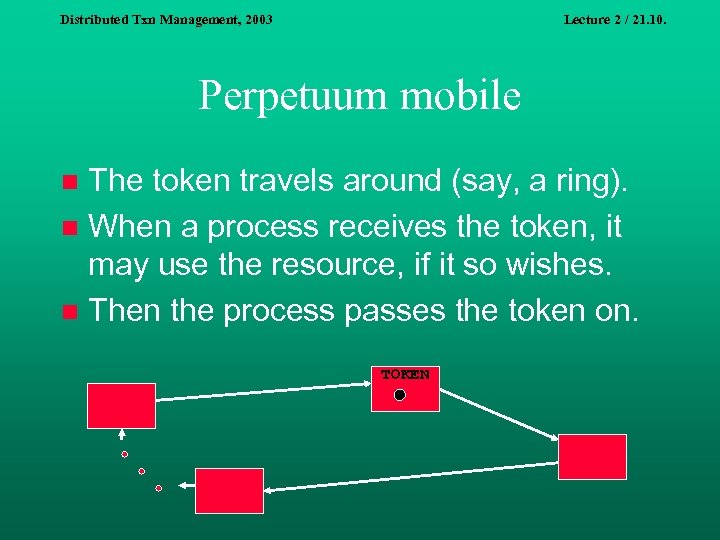
Distributed Txn Management, 2003 Lecture 2 / 21. 10. Perpetuum mobile The token travels around (say, a ring). n When a process receives the token, it may use the resource, if it so wishes. n Then the process passes the token on. n TOKEN
Distributed Txn Management, 2003 Lecture 2 / 21. 10. Token-asking algorithms The token does not travel around if it is not needed. n When a process needs the token, it asks for it. n Requests are queued. n
Distributed Txn Management, 2003 Lecture 2 / 21. 10. Analysis of token-based algorithms n n Safety – ok. Liveness – ok. Fairness – in a way ok. Drawbacks: - They are vulnerable to single-site failures. - Token management may be complicated and/or consume lots of resources, if there are lots of resources to be managed.
Distributed Txn Management, 2003 Logical clocks Lecture 2 / 21. 10.
Distributed Txn Management, 2003 Lecture 2 / 21. 10. Logical order Using physical clocks to order events is problematic, because we can not completely synchronise the clocks. n An alternative solution: use a logical (causality) order. n
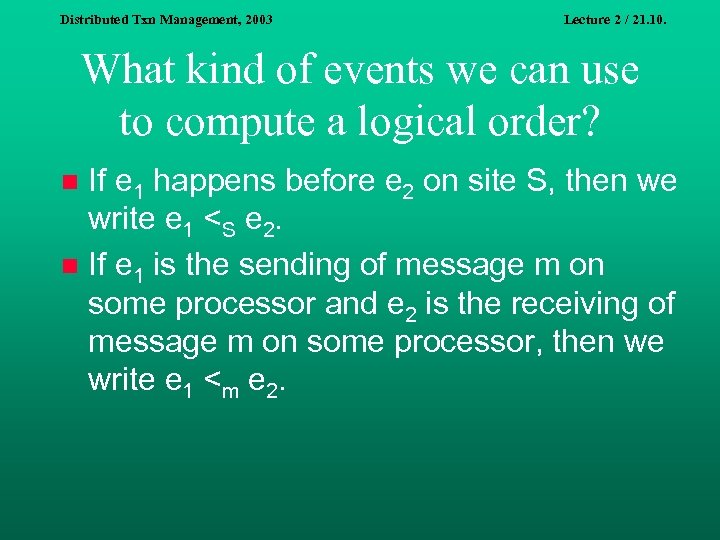
Distributed Txn Management, 2003 Lecture 2 / 21. 10. What kind of events we can use to compute a logical order? If e 1 happens before e 2 on site S, then we write e 1 <S e 2. n If e 1 is the sending of message m on some processor and e 2 is the receiving of message m on some processor, then we write e 1 <m e 2. n
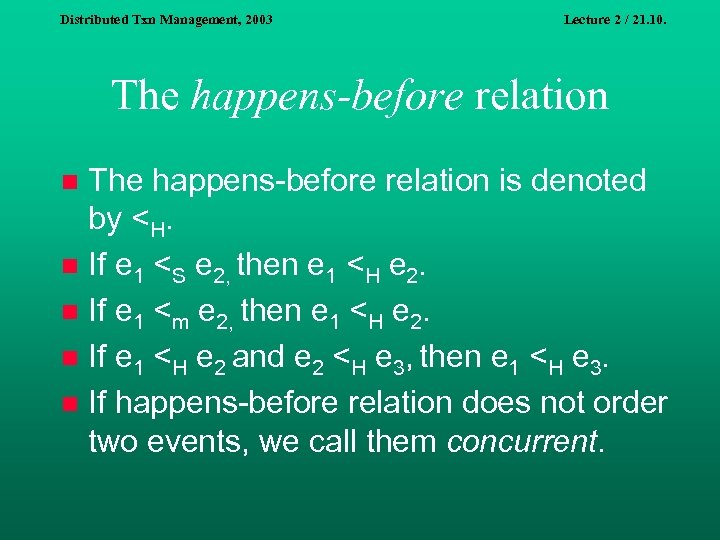
Distributed Txn Management, 2003 Lecture 2 / 21. 10. The happens-before relation is denoted by <H. n If e 1 <S e 2, then e 1 <H e 2. n If e 1 <m e 2, then e 1 <H e 2. n If e 1 <H e 2 and e 2 <H e 3, then e 1 <H e 3. n If happens-before relation does not order two events, we call them concurrent. n
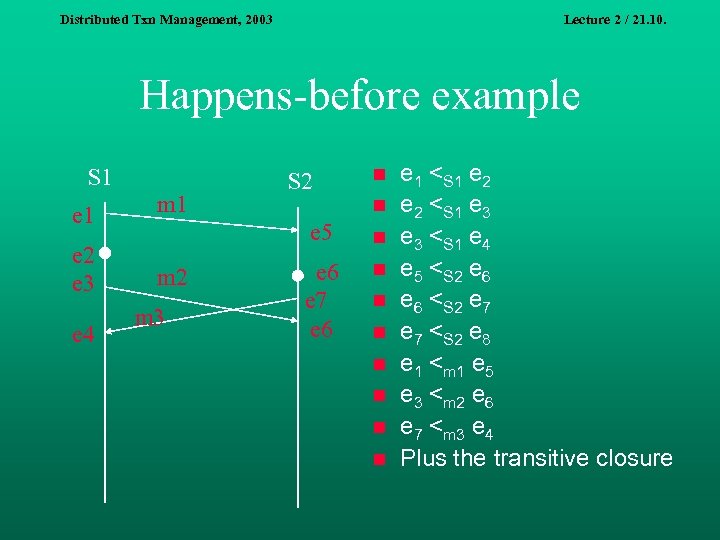
Distributed Txn Management, 2003 Lecture 2 / 21. 10. Happens-before example S 1 e 1 m 1 e 2 e 3 m 2 e 4 S 2 n n e 5 m 3 n e 6 e 7 e 6 n n n n e 1 <S 1 e 2 <S 1 e 3 <S 1 e 4 e 5 <S 2 e 6 <S 2 e 7 <S 2 e 8 e 1 <m 1 e 5 e 3 <m 2 e 6 e 7 <m 3 e 4 Plus the transitive closure
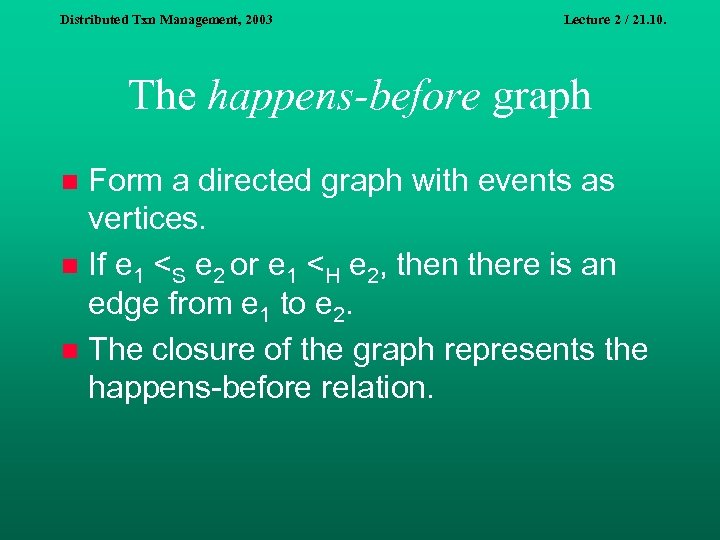
Distributed Txn Management, 2003 Lecture 2 / 21. 10. The happens-before graph Form a directed graph with events as vertices. n If e 1 <S e 2 or e 1 <H e 2, then there is an edge from e 1 to e 2. n The closure of the graph represents the happens-before relation. n
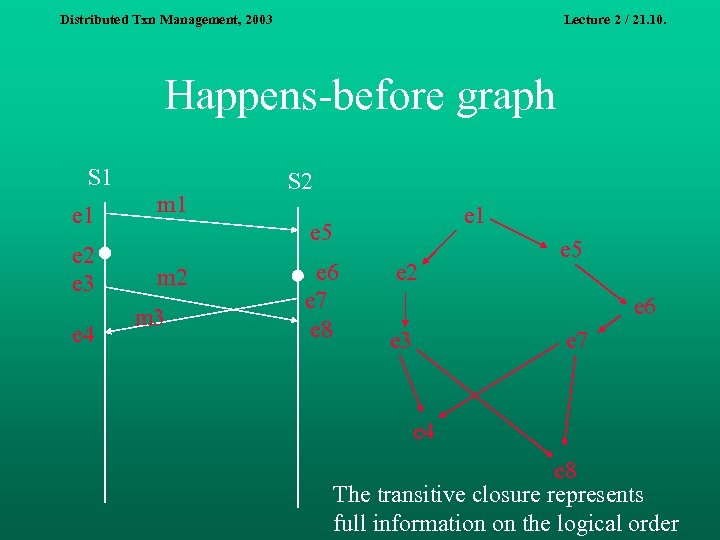
Distributed Txn Management, 2003 Lecture 2 / 21. 10. Happens-before graph S 1 e 2 e 3 e 4 m 1 S 2 e 1 e 5 m 2 m 3 e 6 e 7 e 8 e 2 e 5 e 6 e 3 e 7 e 4 e 8 The transitive closure represents full information on the logical order
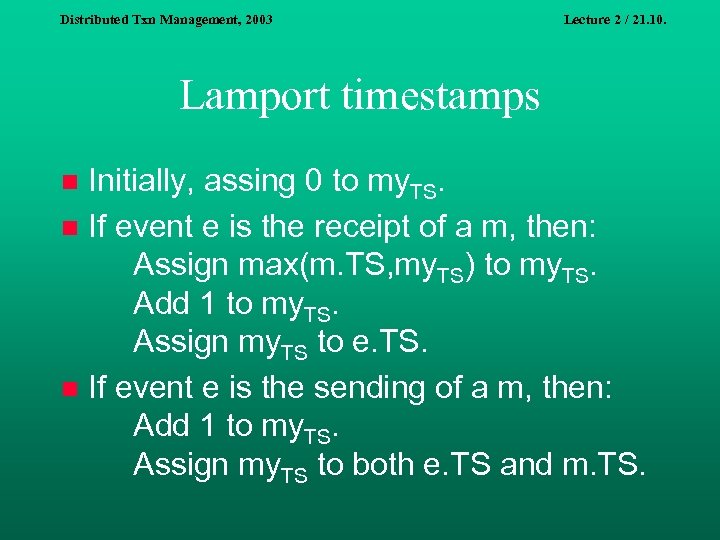
Distributed Txn Management, 2003 Lecture 2 / 21. 10. Lamport timestamps Initially, assing 0 to my. TS. n If event e is the receipt of a m, then: Assign max(m. TS, my. TS) to my. TS. Add 1 to my. TS. Assign my. TS to e. TS. n If event e is the sending of a m, then: Add 1 to my. TS. Assign my. TS to both e. TS and m. TS. n
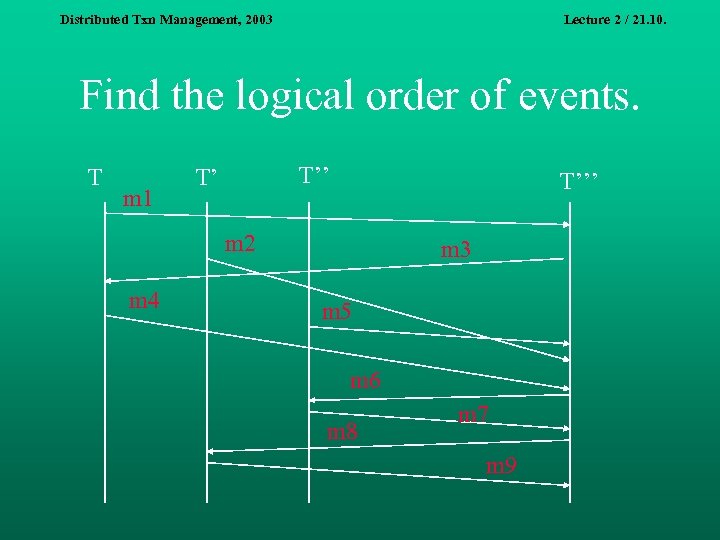
Distributed Txn Management, 2003 Lecture 2 / 21. 10. Find the logical order of events. T m 1 T’’ T’ T’’’ m 2 m 4 m 3 m 5 m 6 m 8 m 7 m 9
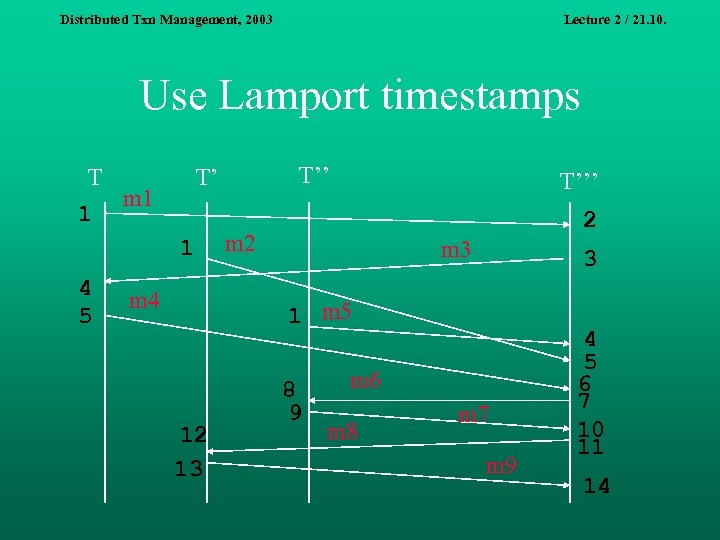
Distributed Txn Management, 2003 Lecture 2 / 21. 10. Use Lamport timestamps T m 1 1 1 4 5 T’’ T’ m 4 T’’’ 2 m 3 3 1 m 5 12 13 8 9 m 6 m 8 m 7 m 9 4 5 6 7 10 11 14
Distributed Txn Management, 2003 Lecture 2 / 21. 10. Lamport timestamps - properties Lamport timestamps guarantee that if e<H e', then e. TS < e'. TS - This follows from the definition of happens-before relation by observing the path of events from e to e’. n Lamport timestamps do not guarantee that if e. TS < e'. TS, then e <H e' (why? ). n
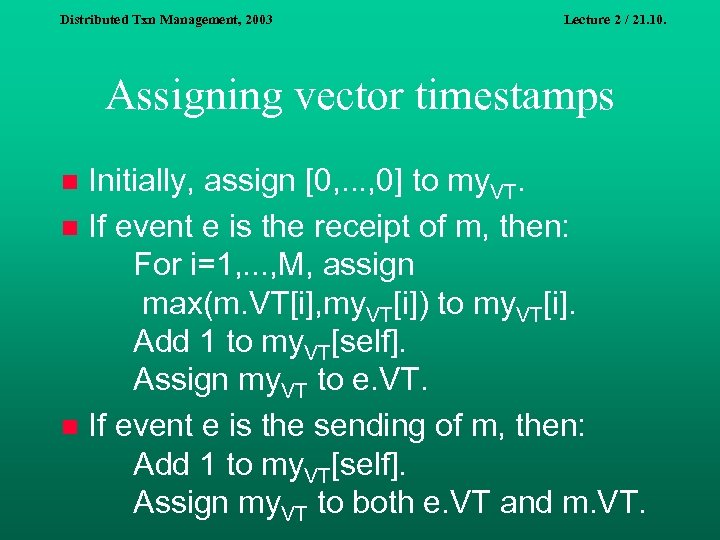
Distributed Txn Management, 2003 Lecture 2 / 21. 10. Assigning vector timestamps Initially, assign [0, . . . , 0] to my. VT. n If event e is the receipt of m, then: For i=1, . . . , M, assign max(m. VT[i], my. VT[i]) to my. VT[i]. Add 1 to my. VT[self]. Assign my. VT to e. VT. n If event e is the sending of m, then: Add 1 to my. VT[self]. Assign my. VT to both e. VT and m. VT. n
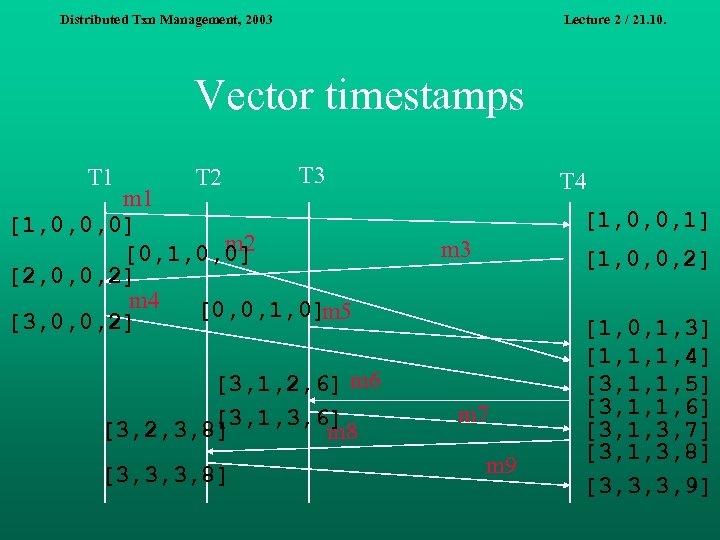
Distributed Txn Management, 2003 Lecture 2 / 21. 10. Vector timestamps T 1 T 2 T 3 m 1 [1, 0, 0, 0] m 2 [0, 1, 0, 0] [2, 0, 0, 2] m 4 [0, 0, 1, 0] m 5 [3, 0, 0, 2] [3, 1, 2, 6] m 6 [3, 1, 3, 6] [3, 2, 3, 8] m 8 [3, 3, 3, 8] T 4 [1, 0, 0, 1] m 3 [1, 0, 0, 2] m 7 m 9 [1, 0, 1, 3] [1, 1, 1, 4] [3, 1, 1, 5] [3, 1, 1, 6] [3, 1, 3, 7] [3, 1, 3, 8] [3, 3, 3, 9]
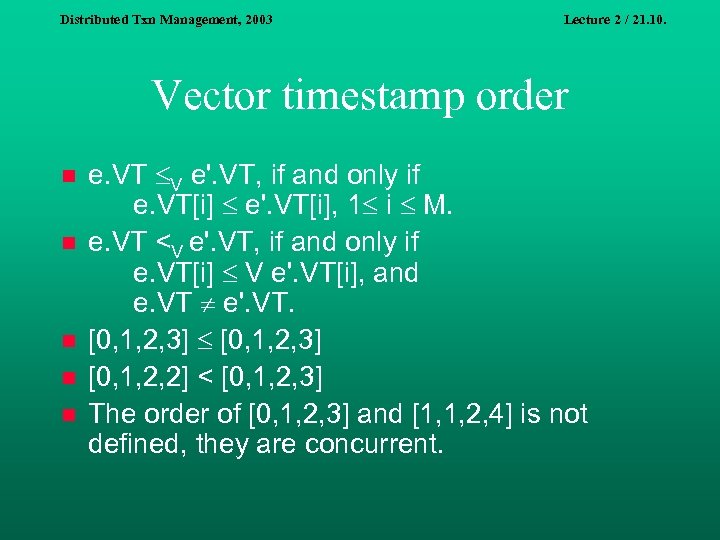
Distributed Txn Management, 2003 Lecture 2 / 21. 10. Vector timestamp order n n n e. VT V e'. VT, if and only if e. VT[i] e'. VT[i], 1 i M. e. VT <V e'. VT, if and only if e. VT[i] V e'. VT[i], and e. VT e'. VT. [0, 1, 2, 3] [0, 1, 2, 2] < [0, 1, 2, 3] The order of [0, 1, 2, 3] and [1, 1, 2, 4] is not defined, they are concurrent.
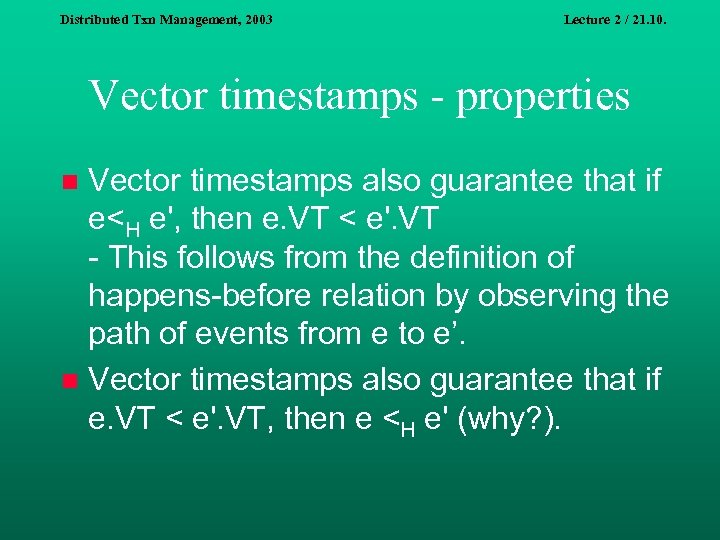
Distributed Txn Management, 2003 Lecture 2 / 21. 10. Vector timestamps - properties Vector timestamps also guarantee that if e<H e', then e. VT < e'. VT - This follows from the definition of happens-before relation by observing the path of events from e to e’. n Vector timestamps also guarantee that if e. VT < e'. VT, then e <H e' (why? ). n
Distributed Txn Management, 2003 Distributed Deadlock Management Lecture 2 / 21. 10.
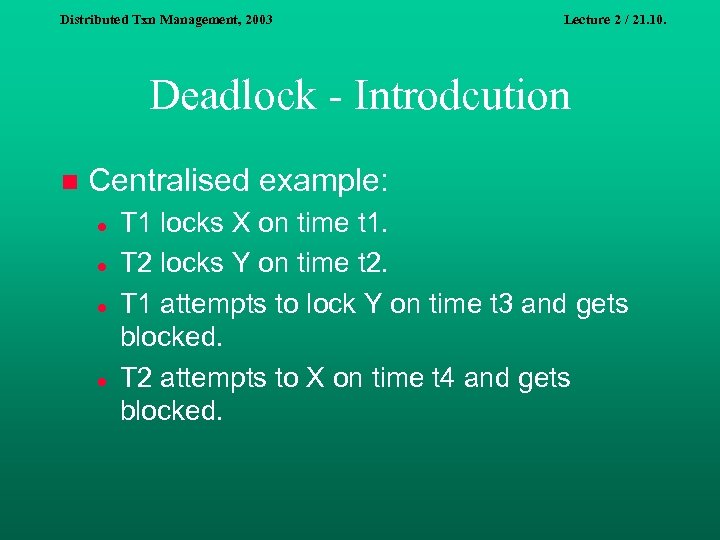
Distributed Txn Management, 2003 Lecture 2 / 21. 10. Deadlock - Introdcution n Centralised example: l l T 1 locks X on time t 1. T 2 locks Y on time t 2. T 1 attempts to lock Y on time t 3 and gets blocked. T 2 attempts to X on time t 4 and gets blocked.
Distributed Txn Management, 2003 Lecture 2 / 21. 10. Deadlock (continued) n Deadlock can occur in centralised systems. For example: l l l At the operating system level there can be resource contention between processes At the transaction processing level there can be data contention between transactions. In a poorly-designed multithread program, there can be deadlock between threads in the same process.
Distributed Txn Management, 2003 Lecture 2 / 21. 10. Distributed deadlock ”management” approaches n n The approach taken by distributed systems designers to the problem of deadlock depends on the frequency with which it occurs. Possible strategies: l l Ignore it. Detection (and recovery). Prevention and Avoidance (by statically making deadlock structurally impossible and by allocating resources carefully). Detect local deadlock and ignore global deadlock.
Distributed Txn Management, 2003 Lecture 2 / 21. 10. Ignore deadlocks? If the system ignores the deadlocks, then the application programmers have to make their applications in such a way, that a timeout will force the transaction to abort and possibly restart. n The same approach is sometimes used in the centralised world. n
Distributed Txn Management, 2003 Lecture 2 / 21. 10. Distributed Deadlock Prevention and Avoidance n n Some proposed techniques are not feasible in practice, like making a process request all of its resources at the start of execution. For transaction processing systems with timestamps, the following scheme can be implemented (like in centralised world): l l l When a process blocks, its timestamp is compared to the timestamp of the blocking process. The blocked process is only allowed to wait if it has a higher timestamp. This avoids any cyclic dependency.
Distributed Txn Management, 2003 Lecture 2 / 21. 10. Wound-wait and wound-die n n n In the wound-wait approach, if an older process requests a lock to an item held by a younger process, it wounds the younger process and effectively kills it. In the wait-die approach, if a younger process requests a lock to an item held by an older process, the younger process commits suicide. Both of these approaches kill transactions blindly. There does not need to be a deadlock.
Distributed Txn Management, 2003 Lecture 2 / 21. 10. Further considerations for wound -wait and wound-die n n n To reduce the number of unnecessarily aborted transactions, it is possible to use the cautious waiting rule: ”You are always allowed to wait for a process, which is not waiting for another process. ” The aborted processes are re-started with their original timestamps, to guarantee liveness. Otherwise, a transaction may not make progress if it gets aborted over and over again.
Distributed Txn Management, 2003 Lecture 2 / 21. 10. Local waits-for graphs n n n Each resource manager can maintain its local `waitsfor' graph. A coordinator maintains a global waits-for graph. When the coordinator detects a deadlock, it selects a victim process and kills it (thereby causing its resource locks to be released), breaking the deadlock. Problem: The information about changes must be transmitted to the coordinator. The coordinator knows nothing about change information that is in transit. Thus, in practice, many of the deadlocks that it thinks it has detected will be what they call in the trade `phantom deadlocks'.
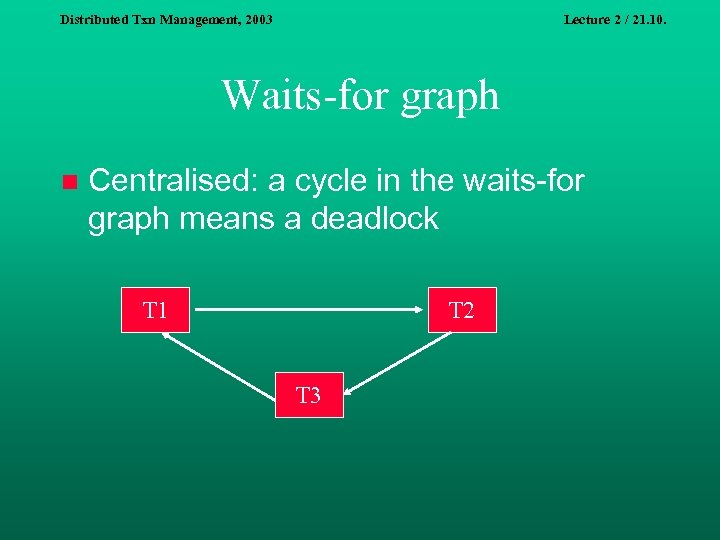
Distributed Txn Management, 2003 Lecture 2 / 21. 10. Waits-for graph n Centralised: a cycle in the waits-for graph means a deadlock T 1 T 2 T 3
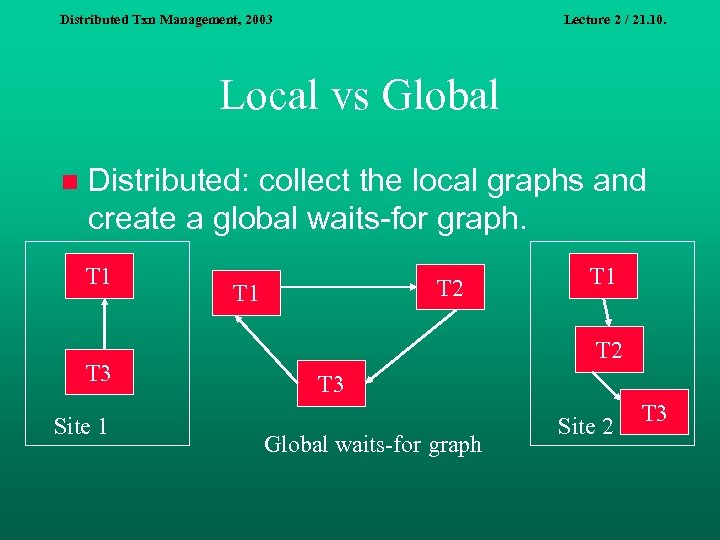
Distributed Txn Management, 2003 Lecture 2 / 21. 10. Local vs Global n Distributed: collect the local graphs and create a global waits-for graph. T 1 T 3 Site 1 T 2 T 3 Global waits-for graph Site 2 T 3
Distributed Txn Management, 2003 Lecture 2 / 21. 10. Global state We assume that between each pair (Si, Sj) of sites there is a reliable orderpreserving communication channel C{i, j}, whose contents is a list of messages L{i, j}=m 1(i, j), m 2(i, j), . . . , mk(i, j). n Let L={L{i, j}} be the collection of all message lists and K the collection of all local states. We say that the pair G=(K, L) is the global state of the system. n
Distributed Txn Management, 2003 Lecture 2 / 21. 10. Consistent cut We say that a global state G=(K, L) is a consistent cut, if for each event e in G, G contains all events e’ such that e’ <H e. n That is, there are no events missing from G such that they have happened before e. n
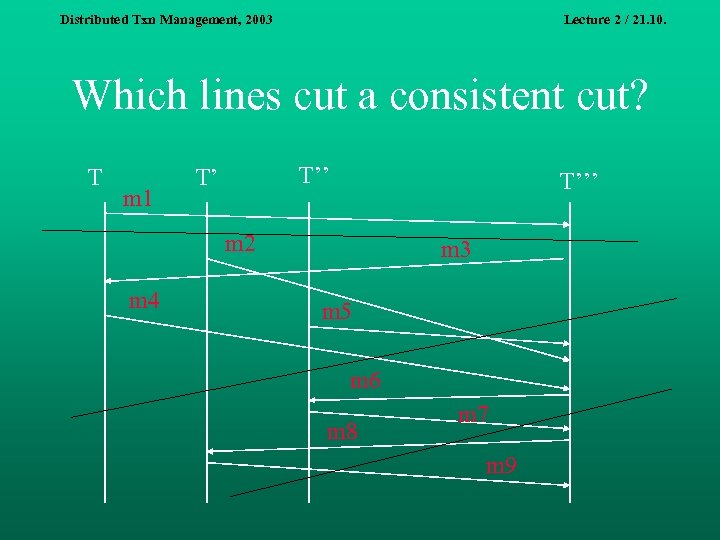
Distributed Txn Management, 2003 Lecture 2 / 21. 10. Which lines cut a consistent cut? T m 1 T’’ T’ T’’’ m 2 m 4 m 3 m 5 m 6 m 8 m 7 m 9
Distributed Txn Management, 2003 Lecture 2 / 21. 10. Distributed snapshots We denote the state of Site i by Si. n A state of a site at one time is called a snapshot. n There is no way we can take the snapshots simultaneously. If we could, that would solve the deadlock detection. n Therefore, we want to create a snapshot that reflects a consistent cut. n
Distributed Txn Management, 2003 Lecture 2 / 21. 10. Computing a distributed snapshot / Assumptions and requirements If we form a graph with sites as nodes and communication channels as edges, we assume that the graph is connected. n Neither channels nor processes fail. n Any site may initiate snapshot computation. n There may be several simultaneous snapshot computations. n
Distributed Txn Management, 2003 Lecture 2 / 21. 10. Computing a distributed snapshot / 1 n As a site Sj initiates snapshot collection, it records its state and sends snapshot token to all sites it communicates with.
Distributed Txn Management, 2003 Lecture 2 / 21. 10. Computing a distributed snapshot / 2 n If a site Si, i j, receives a snapshot token for the first time, and it receives it from Sk, it does the following: 1. Stops processing messages. 2. Makes L(k, i) the empty list. 3. Records its state. 4. Sends a snapshot token to all sites it communicates with. 5. Continues to process messages.
Distributed Txn Management, 2003 Lecture 2 / 21. 10. Computing a distributed snapshot / 3 n If a site Si receives a snapshot token from Sk and it has received a snaphost token also earlier on or i = j, then the list L(k, i) is the list of messages Si has received from Sk after recording its state.
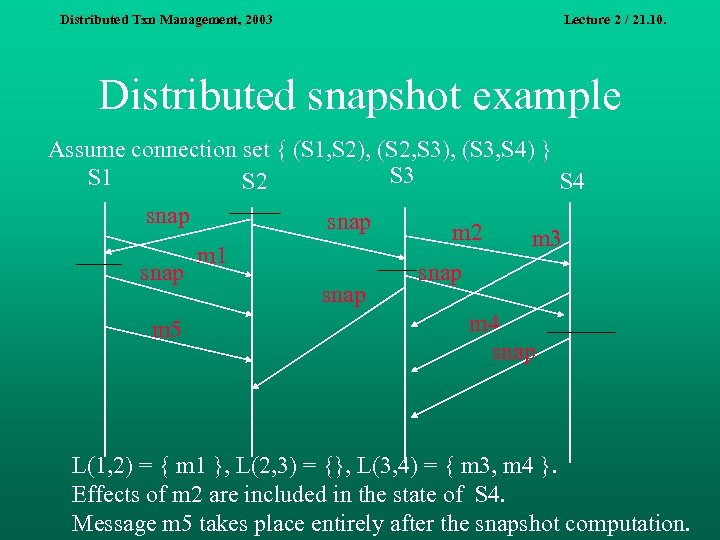
Distributed Txn Management, 2003 Lecture 2 / 21. 10. Distributed snapshot example Assume connection set { (S 1, S 2), (S 2, S 3), (S 3, S 4) } S 3 S 1 S 2 S 4 snap m 2 m 3 m 1 snap m 4 m 5 snap L(1, 2) = { m 1 }, L(2, 3) = {}, L(3, 4) = { m 3, m 4 }. Effects of m 2 are included in the state of S 4. Message m 5 takes place entirely after the snapshot computation.
Distributed Txn Management, 2003 Lecture 2 / 21. 10. Termination of the snapshot algorithm Termination is, in fact, straightforward to see. n Since the graph of sites is connected, and the local processing and message delivery between any two sites takes only a finite time, all sites will be reached and processed within a finite time. n
Distributed Txn Management, 2003 Lecture 2 / 21. 10. Theorem: The snapshot algorithm selects a consistent cut n Proof. Let ei and ej be events, which occurred on sites Si and Sj and ei <H ej. Assume that ei was in the cut produced by the snapshot algorithm. We want to show that also ej is in the cut. If Si = Sj , this is clear. Assume that Si Sj. Assume, now, for contradiction, that ej was not in the cut. Consider the sequence of messages m 1 m 2 …mk by which ei <H ej. By the way markers are sent and received, a marker message has reached Sj before each m 1 m 2 …mk and Si has therefore recorded its state before ej. Therefore, ej is not in the cut. This is a contradiction, and we are done.
Distributed Txn Management, 2003 Lecture 2 / 21. 10. Several simultaneous snapshot computations n The snapshot markers have to be different and sites just manage each separate snapshot computation separately.
Distributed Txn Management, 2003 Lecture 2 / 21. 10. Snapshots and deadlock detection n Apparently, in this case the state to be recorded is the waits-for graph and lock request / lock release messages. After the snapshot computation, the waits-for graphs are collected to a site, say, the initiator of the snapshot computation. For this, the snap messages should include the initiator of the snapshot computation.
Скачать презентацию Distributed Txn Management 2003 Lecture 2 21
41dc9ba38ee90a7307a29d640d4289a6.ppt