 Скачать презентацию Distributed Systems — Overview some systems
9268053afb9da9d35abaa3821afdfdc4.ppt
- Количество слайдов: 30



Distributed Systems - Overview • • some systems background/context some legal/social context development of technology – DS evolution ** DS fundamental characteristics ** software structure for a node model/architecture/engineering for a DS architectures for large-scale DS federated administration domains integrated domain-independent services detached, ad-hoc groups Introduction & Overview 1
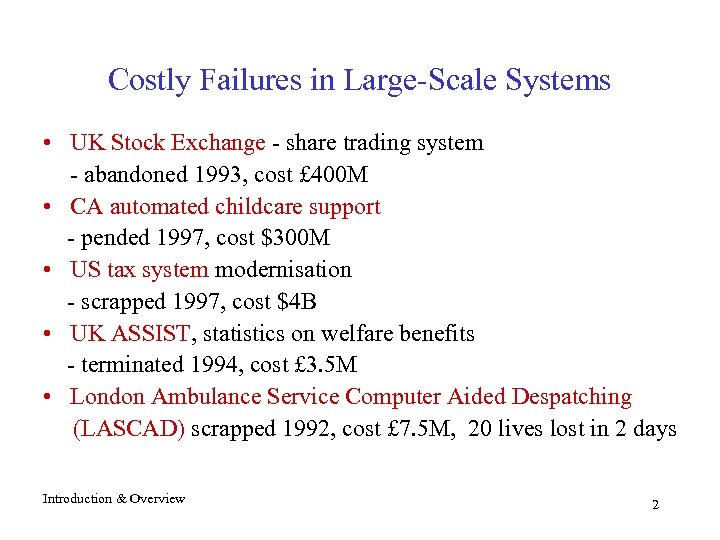
Costly Failures in Large-Scale Systems • UK Stock Exchange - share trading system - abandoned 1993, cost £ 400 M • CA automated childcare support - pended 1997, cost $300 M • US tax system modernisation - scrapped 1997, cost $4 B • UK ASSIST, statistics on welfare benefits - terminated 1994, cost £ 3. 5 M • London Ambulance Service Computer Aided Despatching (LASCAD) scrapped 1992, cost £ 7. 5 M, 20 lives lost in 2 days Introduction & Overview 2
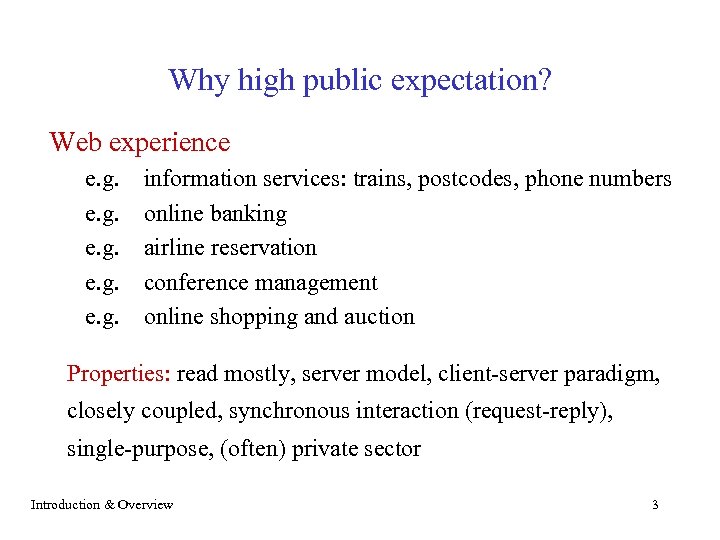
Why high public expectation? Web experience e. g. information services: trains, postcodes, phone numbers online banking airline reservation conference management online shopping and auction Properties: read mostly, server model, client-server paradigm, closely coupled, synchronous interaction (request-reply), single-purpose, (often) private sector Introduction & Overview 3
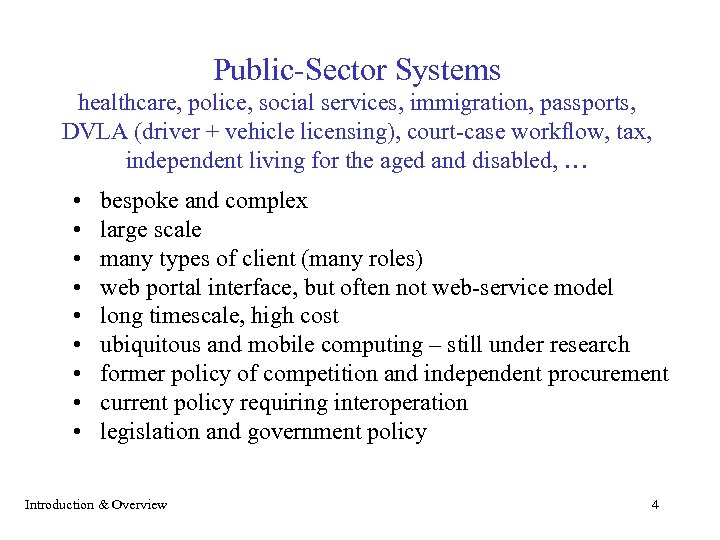
Public-Sector Systems healthcare, police, social services, immigration, passports, DVLA (driver + vehicle licensing), court-case workflow, tax, independent living for the aged and disabled, … • • • bespoke and complex large scale many types of client (many roles) web portal interface, but often not web-service model long timescale, high cost ubiquitous and mobile computing – still under research former policy of competition and independent procurement current policy requiring interoperation legislation and government policy Introduction & Overview 4
Some Legal/Policy Requirements - 1 “patients may specify who may see, and not see, their electronic health records (EHRs)” - exclusions “only the doctor with whom the patient is registered (for treatment) may e. g. prescribe drugs, read the patient’s EHR, etc. ” - relationships “the existence of certain sensitive components of EHRs must be invisible, except to explicitly authorised roles” Introduction & Overview 5
Some Legal/Policy Requirements - 2 “buses should run to time and bus operators will be punished if published timetables are not met. ” so bus operators refuse to cooperate in traffic monitoring, even though monitoring could show that delay is often not their fault. Introduction & Overview 6
Data Protection Legislation Gathered data that identifies individuals must not be stored: CCTV cameras: software must not recognise people and store identities with images (thermal imaging (infra-red) - just monitor/count) Vehicle number plate recognition: must not be associated with people then stored with identities (only police allowed to look up) Police records: accusations that are not upheld? Sally Geeson murder - previous army records of LC Atkinson Soham murders – previous police records of Huntley; Govt. now require interaction between counties UK Freedom of Information Act: Jan 2005 Introduction & Overview 7
Rapidly Developing and New Technology • can’t ever design a “second system”, it’s always possible to do more next time • rapid obsolescence - incremental growth not sustainable long-term (unlike e. g. telephone system) - a current software engineering research area • but big-bang deployment is a bad idea design for incremental deployment • mobile workers in healthcare, police, utilities etc. - integration of wired and wireless networks • ubiquitous computing: integration of camera and sensor data Introduction & Overview 8
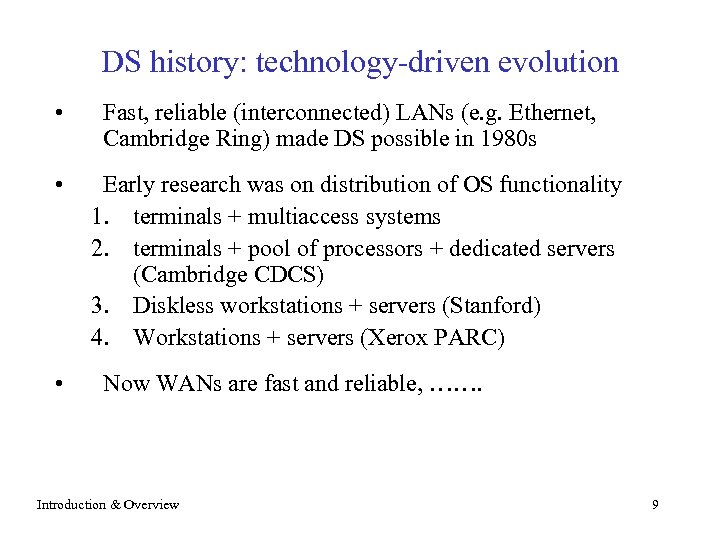
DS history: technology-driven evolution • Fast, reliable (interconnected) LANs (e. g. Ethernet, Cambridge Ring) made DS possible in 1980 s • Early research was on distribution of OS functionality 1. terminals + multiaccess systems 2. terminals + pool of processors + dedicated servers (Cambridge CDCS) 3. Diskless workstations + servers (Stanford) 4. Workstations + servers (Xerox PARC) • Now WANs are fast and reliable, ……. Introduction & Overview 9
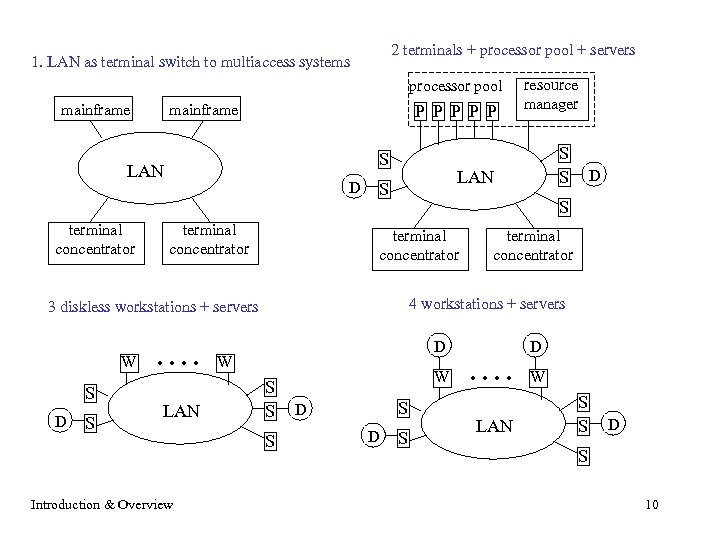
2 terminals + processor pool + servers 1. LAN as terminal switch to multiaccess systems processor pool mainframe P P P S LAN terminal concentrator D terminal concentrator S D S . . LAN Introduction & Overview S S LAN S D S terminal concentrator 4 workstations + servers 3 diskless workstations + servers W resource manager D W S S S W S D D S D . . LAN W S S D S 10
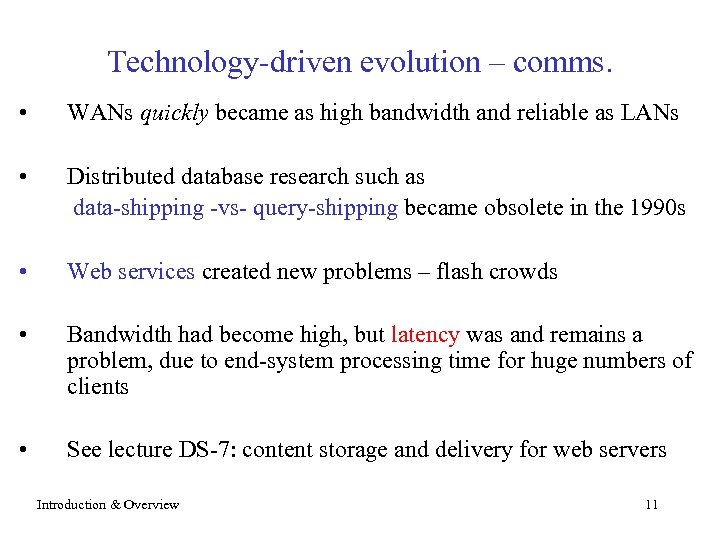
Technology-driven evolution – comms. • WANs quickly became as high bandwidth and reliable as LANs • Distributed database research such as data-shipping -vs- query-shipping became obsolete in the 1990 s • Web services created new problems – flash crowds • Bandwidth had become high, but latency was and remains a problem, due to end-system processing time for huge numbers of clients • See lecture DS-7: content storage and delivery for web servers Introduction & Overview 11
How to think about Distributed Systems • fundamental characteristics • software structure for a node • model/architecture/engineering for a system Introduction & Overview 12
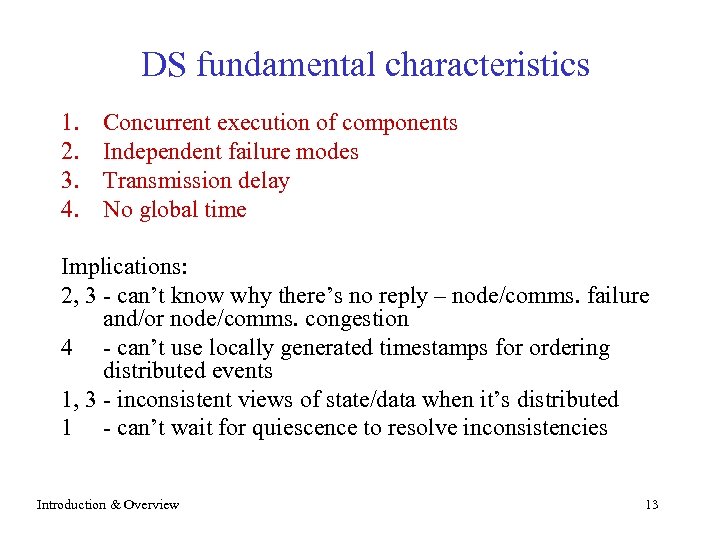
DS fundamental characteristics 1. 2. 3. 4. Concurrent execution of components Independent failure modes Transmission delay No global time Implications: 2, 3 - can’t know why there’s no reply – node/comms. failure and/or node/comms. congestion 4 - can’t use locally generated timestamps for ordering distributed events 1, 3 - inconsistent views of state/data when it’s distributed 1 - can’t wait for quiescence to resolve inconsistencies Introduction & Overview 13
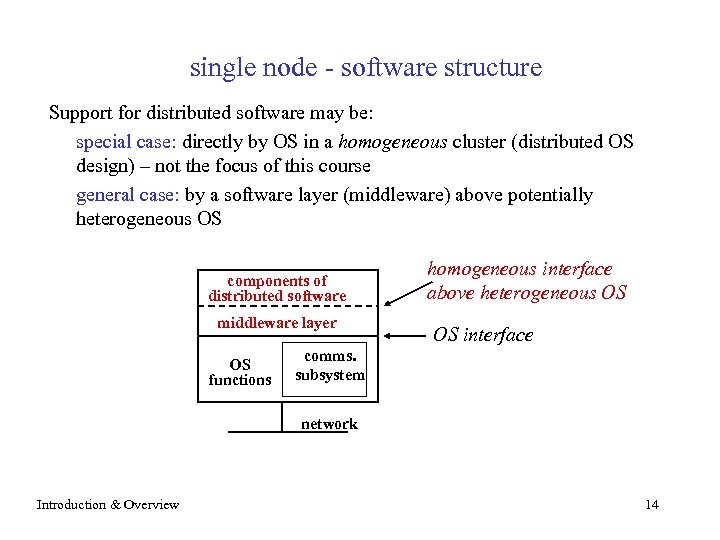
single node - software structure Support for distributed software may be: special case: directly by OS in a homogeneous cluster (distributed OS design) – not the focus of this course general case: by a software layer (middleware) above potentially heterogeneous OS components of distributed software middleware layer OS functions homogeneous interface above heterogeneous OS OS interface comms. subsystem network Introduction & Overview 14
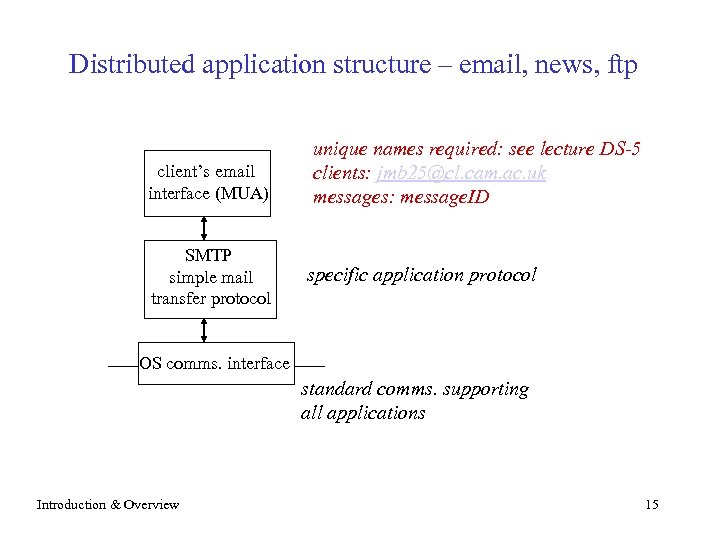
Distributed application structure – email, news, ftp client’s email interface (MUA) SMTP simple mail transfer protocol unique names required: see lecture DS-5 clients: jmb 25@cl. cam. ac. uk messages: message. ID specific application protocol OS comms. interface standard comms. supporting all applications Introduction & Overview 15
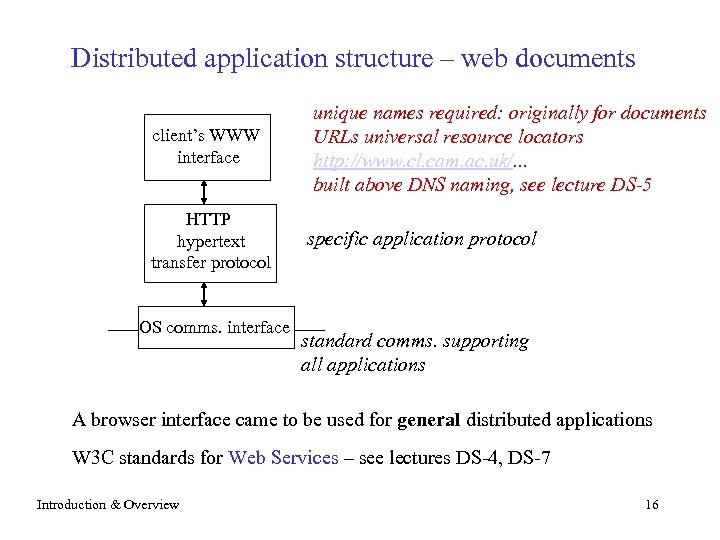
Distributed application structure – web documents client’s WWW interface HTTP hypertext transfer protocol OS comms. interface unique names required: originally for documents URLs universal resource locators http: //www. cl. cam. ac. uk/. . . built above DNS naming, see lecture DS-5 specific application protocol standard comms. supporting all applications A browser interface came to be used for general distributed applications W 3 C standards for Web Services – see lectures DS-4, DS-7 Introduction & Overview 16
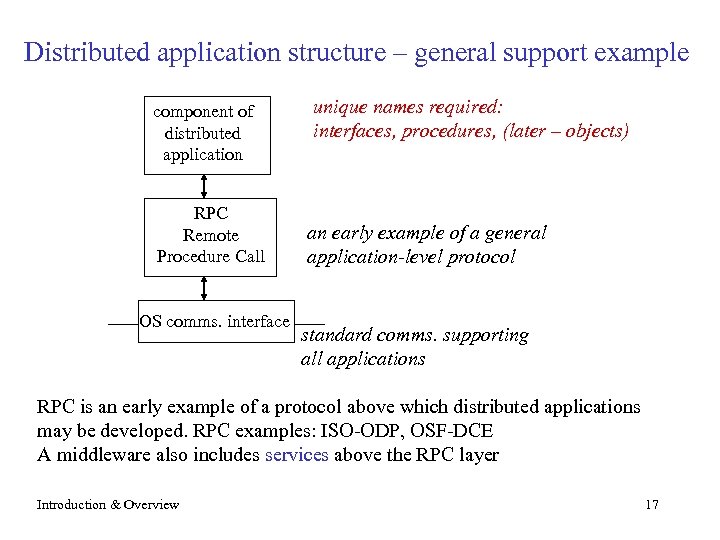
Distributed application structure – general support example component of distributed application RPC Remote Procedure Call OS comms. interface unique names required: interfaces, procedures, (later – objects) an early example of a general application-level protocol standard comms. supporting all applications RPC is an early example of a protocol above which distributed applications may be developed. RPC examples: ISO-ODP, OSF-DCE A middleware also includes services above the RPC layer Introduction & Overview 17
Open and proprietary middleware • Open: evolution is controlled by standards bodies (e. g. ISO, NIST) or consortia (e. g. OMG, W 3 C). Requests for proposals (RFPs) are issued, draft specifications published with RFCs (requests for comments). Compromise is common. • Closed, proprietary: can be changed by the owner (clients need to buy a new release). Consistency across versions is not guaranteed. Plus “embrace, enhance, extinguish”. Related issues: • single/multi language: can components be written in different languages and interoperate? • open interoperability: is desirable across middlewares (including different implementations of the same MW) Introduction & Overview 18
DS Design: model, architecture, engineering Programming model of distributed computation: • What are the named entities? objects, components, services, . . • How is communication achieved? - synchronous/blocking (request-response) invocation e. g. client-server model - asynchronous messages e. g. event notification model - one-to-one, one-to-many? • Are the communicating entities closely or loosely coupled? - must they share a programming context? - must they be running at the same time? Introduction & Overview 19
System architecture: the framework within which the entities in the model interoperate • • • Naming Location of named objects Security of communication, as required by applications Authentication of participants Access control / authorisation Replication to meet requirements for reliability, availability May be defined within administration domains. Need to consider multi-domain systems and interoperation within and between domains Introduction & Overview 20
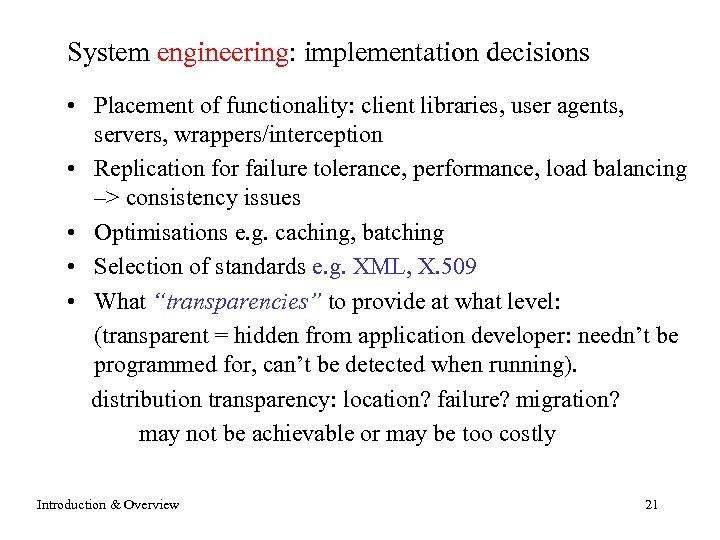
System engineering: implementation decisions • Placement of functionality: client libraries, user agents, servers, wrappers/interception • Replication for failure tolerance, performance, load balancing –> consistency issues • Optimisations e. g. caching, batching • Selection of standards e. g. XML, X. 509 • What “transparencies” to provide at what level: (transparent = hidden from application developer: needn’t be programmed for, can’t be detected when running). distribution transparency: location? failure? migration? may not be achievable or may be too costly Introduction & Overview 21
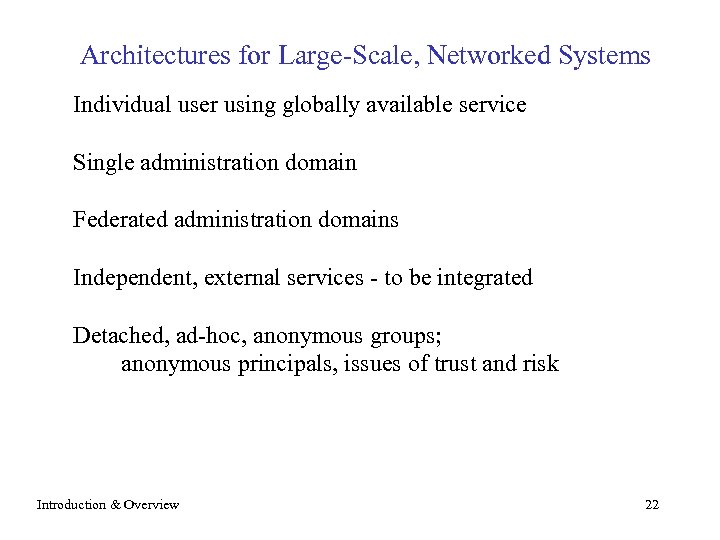
Architectures for Large-Scale, Networked Systems Individual user using globally available service Single administration domain Federated administration domains Independent, external services - to be integrated Detached, ad-hoc, anonymous groups; anonymous principals, issues of trust and risk Introduction & Overview 22
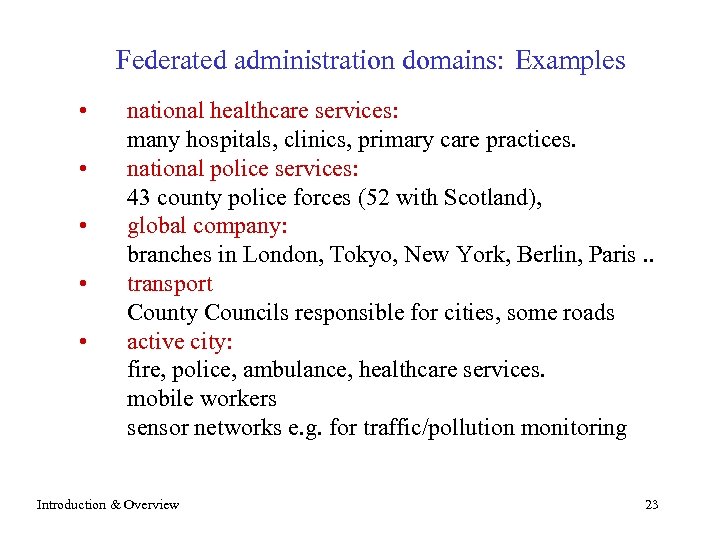
Federated administration domains: Examples • • • national healthcare services: many hospitals, clinics, primary care practices. national police services: 43 county police forces (52 with Scotland), global company: branches in London, Tokyo, New York, Berlin, Paris. . transport County Councils responsible for cities, some roads active city: fire, police, ambulance, healthcare services. mobile workers sensor networks e. g. for traffic/pollution monitoring Introduction & Overview 23
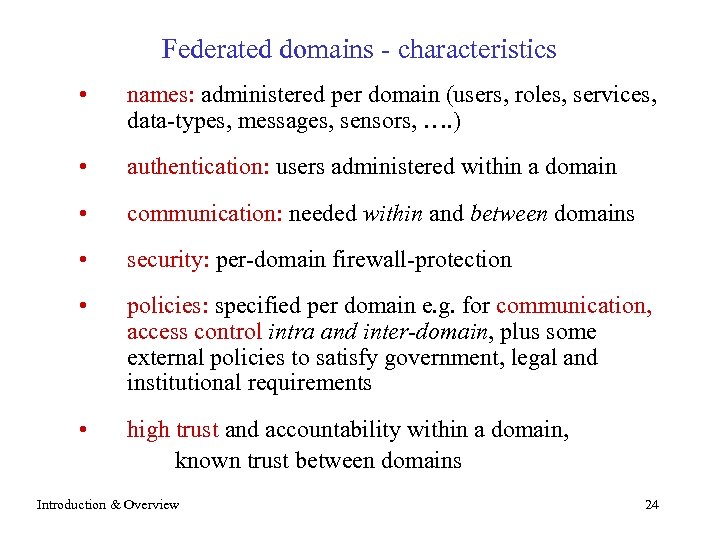
Federated domains - characteristics • names: administered per domain (users, roles, services, data-types, messages, sensors, …. ) • authentication: users administered within a domain • communication: needed within and between domains • security: per-domain firewall-protection • policies: specified per domain e. g. for communication, access control intra and inter-domain, plus some external policies to satisfy government, legal and institutional requirements • high trust and accountability within a domain, known trust between domains Introduction & Overview 24
Independent, External Services - Examples • commercial web-based services e. g. online banking, airline booking etc. • national services used by police and others e. g. DVLA, court-case workflow • national health services e. g. national Electronic Health Record (EHR) service • e-science (grid) databases and generic services e. g. astronomical, transport, medical databases for computation (e. g. Xeno. Services), or storage • e-science may support “virtual organisations” – collaborating groups across several domains Introduction & Overview 25
Independent, external services - characteristics • naming and authentication may be of individuals via trusted third parties (TTPs) and/or via home domain of client • access control policies related to client roles in domains and/or individuals support for “virtual organisations” spanning domains • need for: accounting, charging, audit these may be done by trusted third parties a basis for mutual trust (service done, client paid) trust based on evidence of behaviour clients exchange experiences, services monitor and record assume full connectivity, e. g. TTPs can authenticate/identify • Introduction & Overview 26
Examples of detached ad hoc groups and the need for trust • Commuters regularly play cards on the train • Auctions – build up trust of an ID through small honoured purchases, then default on a big one • E-purse purchases – trust in system • Recommendations: e. g. in a tourist scenario - restaurants, places to visit. Recommendations of people and their skills. • Wireless routing via peers: routing of messages P 2 P rather than by dedicated brokers – reliability, confidentiality, altruism • Trust has a context – skills may not transfer e. g. drivers of cars, trains, planes. . . Introduction & Overview 27
3. Detached, ad-hoc, anonymous groups • e. g. connected by wireless • can’t assume trusted third-parties (CAs) accessible • can’t assume knowledge of names and roles, identity likely to be by key/pseudonym • new identities can be generated (by detected villains) • parties need to decide whether to interact • each has a trust policy and a trust engine • each computes whether to proceed – policy is based on: - accumulated trust information (from recommendations and evidence from monitoring) - risk (resource-cost) and likelihood of possible outcomes Introduction & Overview 28
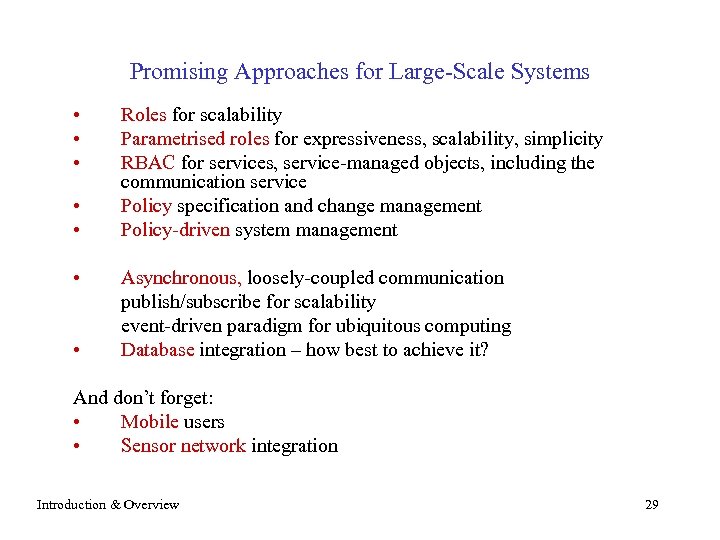
Promising Approaches for Large-Scale Systems • • Roles for scalability Parametrised roles for expressiveness, scalability, simplicity RBAC for services, service-managed objects, including the communication service Policy specification and change management Policy-driven system management Asynchronous, loosely-coupled communication publish/subscribe for scalability event-driven paradigm for ubiquitous computing Database integration – how best to achieve it? And don’t forget: • Mobile users • Sensor network integration Introduction & Overview 29
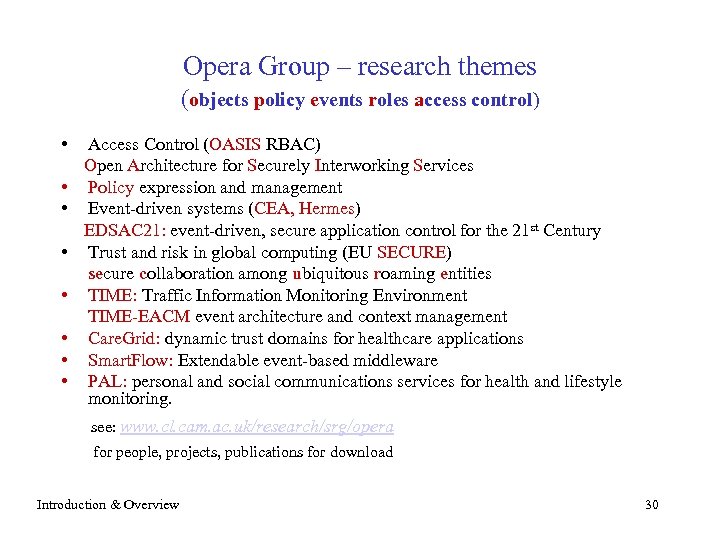
Opera Group – research themes (objects policy events roles access control) • • Access Control (OASIS RBAC) Open Architecture for Securely Interworking Services Policy expression and management Event-driven systems (CEA, Hermes) EDSAC 21: event-driven, secure application control for the 21 st Century Trust and risk in global computing (EU SECURE) secure collaboration among ubiquitous roaming entities TIME: Traffic Information Monitoring Environment TIME-EACM event architecture and context management Care. Grid: dynamic trust domains for healthcare applications Smart. Flow: Extendable event-based middleware PAL: personal and social communications services for health and lifestyle monitoring. see: www. cl. cam. ac. uk/research/srg/opera for people, projects, publications for download Introduction & Overview 30
Скачать презентацию Distributed Systems — Overview some systems
9268053afb9da9d35abaa3821afdfdc4.ppt