 Скачать презентацию DISTRIBUTED DYNAMIC MOBILITY MANAGEMENT DMM PROBLEM STATEMENT Dapeng Liu China
41a3901c31262df22a1c87bdec9f5f15.ppt
- Количество слайдов: 24



DISTRIBUTED/DYNAMIC MOBILITY MANAGEMENT(DMM) PROBLEM STATEMENT Dapeng Liu (China Mobile) Hidetoshi Yokota (KDDI) Charles E. Perkins (Tellabs) Melia Telemaco (Alcatel-Lucent) Pierrick Seite (France Telecom) H. Anthony Chan (Huawei) Wassim Haddad (Ericsson) Hui Deng (China Mobile) Elena Demaria (Telecom Italia) Carlos Bernardos (UC 3 M) Jun Song (ZTE) Nov. 2010
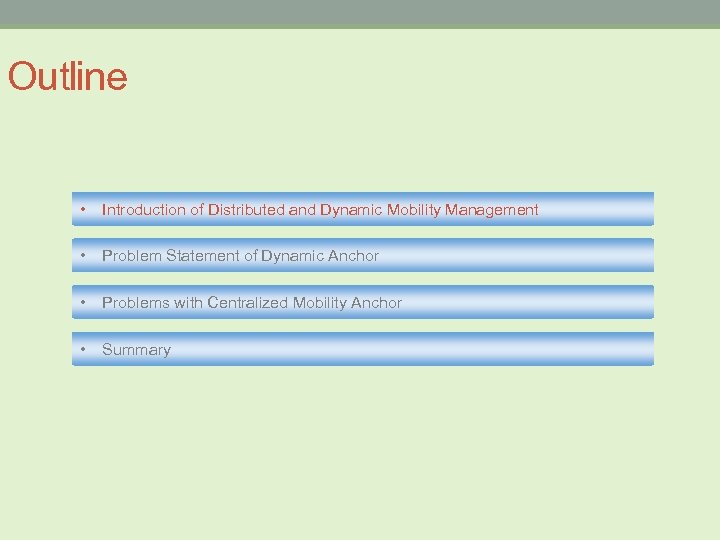
Outline • Introduction of Distributed and Dynamic Mobility Management • Problem Statement of Dynamic Anchor • Problems with Centralized Mobility Anchor • Summary
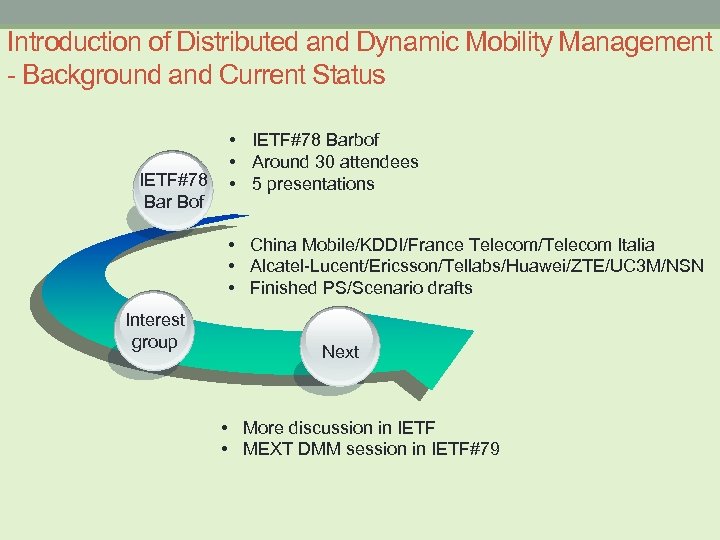
Introduction of Distributed and Dynamic Mobility Management - Background and Current Status IETF#78 Bar Bof • IETF#78 Barbof • Around 30 attendees • 5 presentations • China Mobile/KDDI/France Telecom/Telecom Italia • Alcatel-Lucent/Ericsson/Tellabs/Huawei/ZTE/UC 3 M/NSN • Finished PS/Scenario drafts Interest group Next • More discussion in IETF • MEXT DMM session in IETF#79
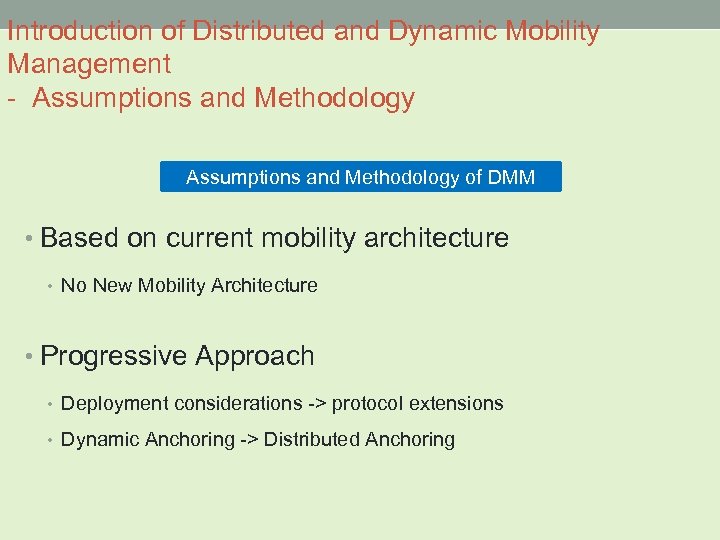
Introduction of Distributed and Dynamic Mobility Management - Assumptions and Methodology of DMM • Based on current mobility architecture • No New Mobility Architecture • Progressive Approach • Deployment considerations -> protocol extensions • Dynamic Anchoring -> Distributed Anchoring
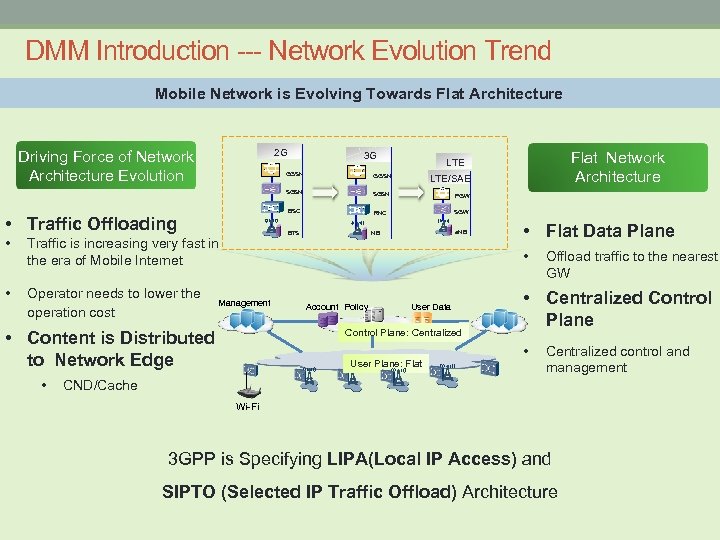
DMM Introduction --- Network Evolution Trend Mobile Network is Evolving Towards Flat Architecture 2 G Driving Force of Network Architecture Evolution 3 G Operator needs to lower the operation cost PGW RNC SGW e. NB NB • Flat Data Plane • Management Account Policy User Data Control Plane: Centralized • Content is Distributed to Network Edge • SGSN BTS Traffic is increasing very fast in the era of Mobile Internet • LTE/SAE BSC • GGSN SGSN • Traffic Offloading Flat Network Architecture LTE GGSN User Plane: Flat Offload traffic to the nearest GW • Centralized Control Plane • Centralized control and management CND/Cache Wi-Fi 3 GPP is Specifying LIPA(Local IP Access) and SIPTO (Selected IP Traffic Offload) Architecture
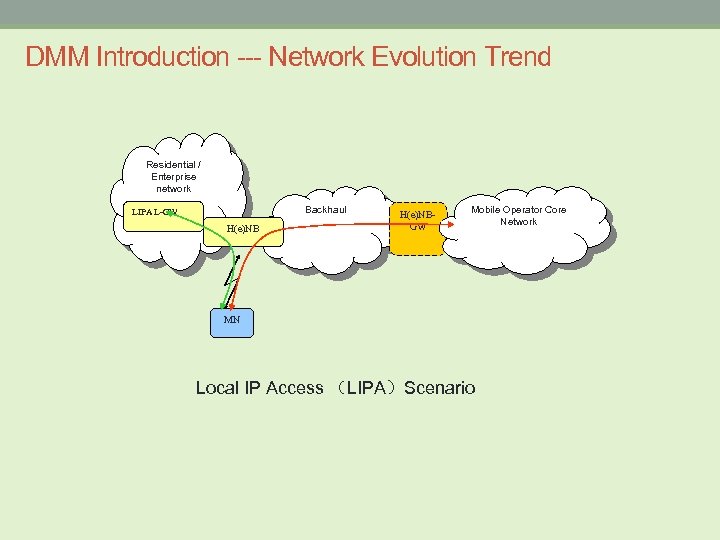
DMM Introduction --- Network Evolution Trend Residential / Enterprise network Backhaul LIPA L-GW H(e)NBGW Mobile Operator Core Network MN Local IP Access (LIPA)Scenario
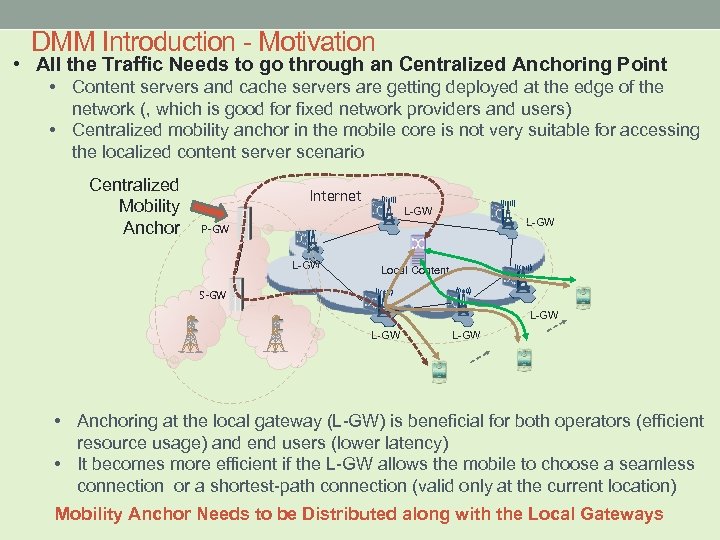
DMM Introduction - Motivation • All the Traffic Needs to go through an Centralized Anchoring Point • Content servers and cache servers are getting deployed at the edge of the network (, which is good for fixed network providers and users) • Centralized mobility anchor in the mobile core is not very suitable for accessing the localized content server scenario Centralized Mobility Anchor Internet L-GW P-GW Local Content S-GW L-GW • Anchoring at the local gateway (L-GW) is beneficial for both operators (efficient resource usage) and end users (lower latency) • It becomes more efficient if the L-GW allows the mobile to choose a seamless connection or a shortest-path connection (valid only at the current location) Mobility Anchor Needs to be Distributed along with the Local Gateways
Outline • Introduction of Distributed and Dynamic Mobility Management • Problem Statement of Dynamic Anchor • Problems with Centralized Mobility Anchor • Summary
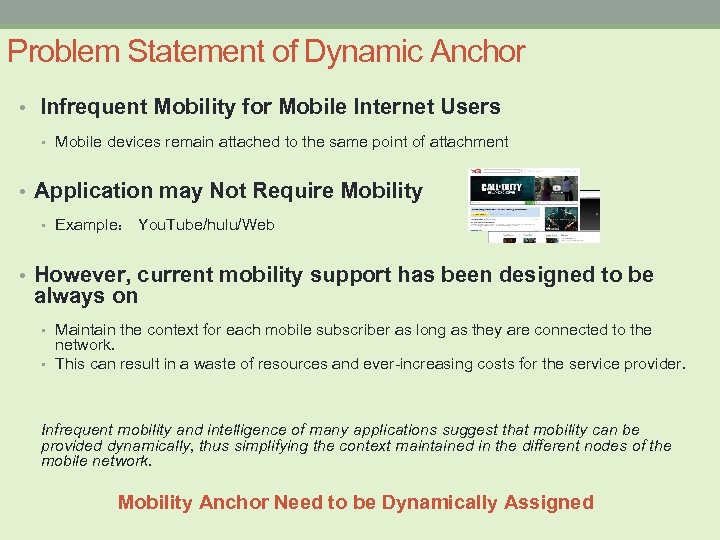
Problem Statement of Dynamic Anchor • Infrequent Mobility for Mobile Internet Users • Mobile devices remain attached to the same point of attachment • Application may Not Require Mobility • Example: You. Tube/hulu/Web • However, current mobility support has been designed to be always on • Maintain the context for each mobile subscriber as long as they are connected to the network. • This can result in a waste of resources and ever-increasing costs for the service provider. Infrequent mobility and intelligence of many applications suggest that mobility can be provided dynamically, thus simplifying the context maintained in the different nodes of the mobile network. Mobility Anchor Need to be Dynamically Assigned
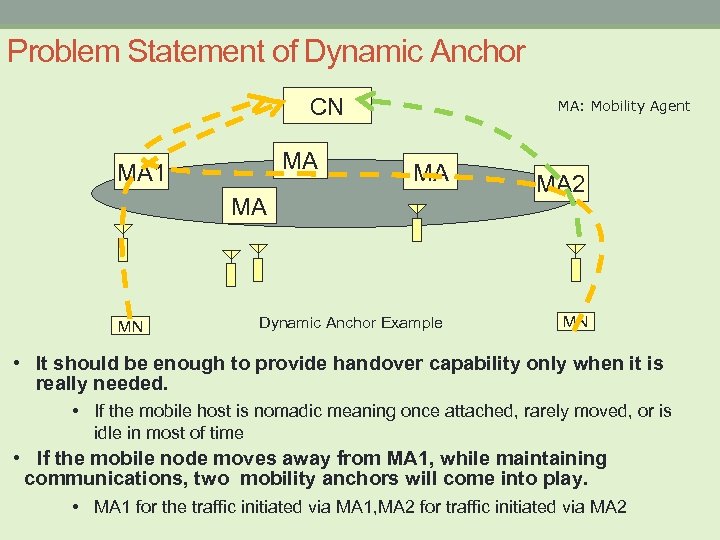
Problem Statement of Dynamic Anchor CN MA MA 1 MA: Mobility Agent MA MA MN Dynamic Anchor Example MA 2 MN • It should be enough to provide handover capability only when it is really needed. • If the mobile host is nomadic meaning once attached, rarely moved, or is idle in most of time • If the mobile node moves away from MA 1, while maintaining communications, two mobility anchors will come into play. • MA 1 for the traffic initiated via MA 1, MA 2 for traffic initiated via MA 2
Outline • Introduction of Distributed and Dynamic Mobility Management • Problem Statement of Dynamic Anchor • Problems with Centralized Mobility Anchor • Summary
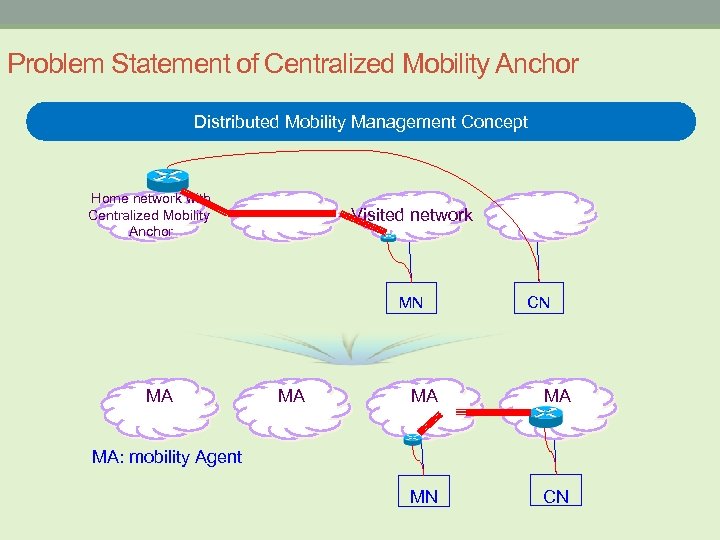
Problem Statement of Centralized Mobility Anchor Distributed Mobility Management Concept Home network with Centralized Mobility Anchor Visited network MN MA MA CN MA MA MN CN MA: mobility Agent
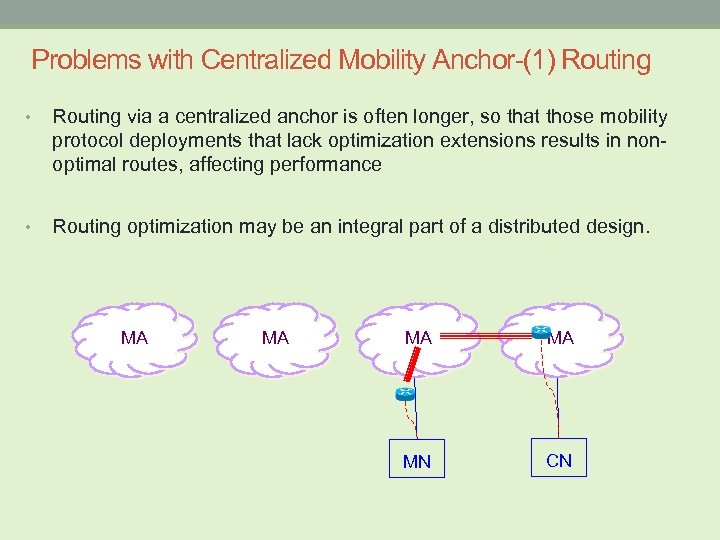
Problems with Centralized Mobility Anchor-(1) Routing • Routing via a centralized anchor is often longer, so that those mobility protocol deployments that lack optimization extensions results in nonoptimal routes, affecting performance • Routing optimization may be an integral part of a distributed design. MA MA MN CN
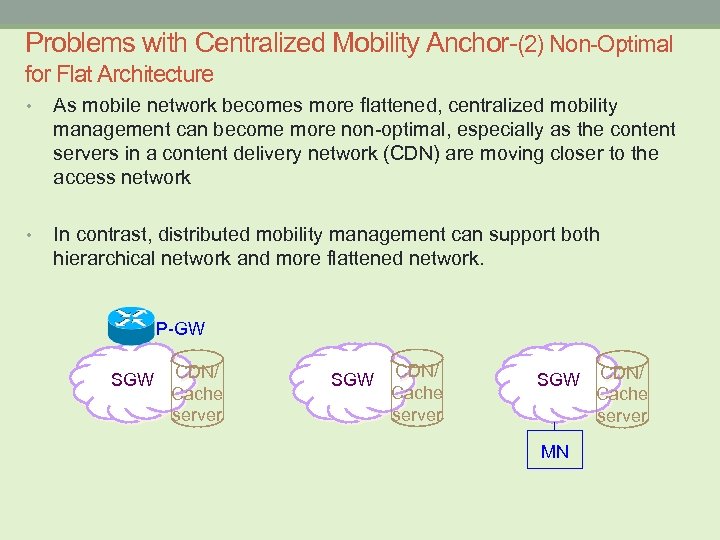
Problems with Centralized Mobility Anchor-(2) Non-Optimal for Flat Architecture • As mobile network becomes more flattened, centralized mobility management can become more non-optimal, especially as the content servers in a content delivery network (CDN) are moving closer to the access network • In contrast, distributed mobility management can support both hierarchical network and more flattened network. P-GW SGW CDN/ Cache server SGW MN CDN/ Cache server
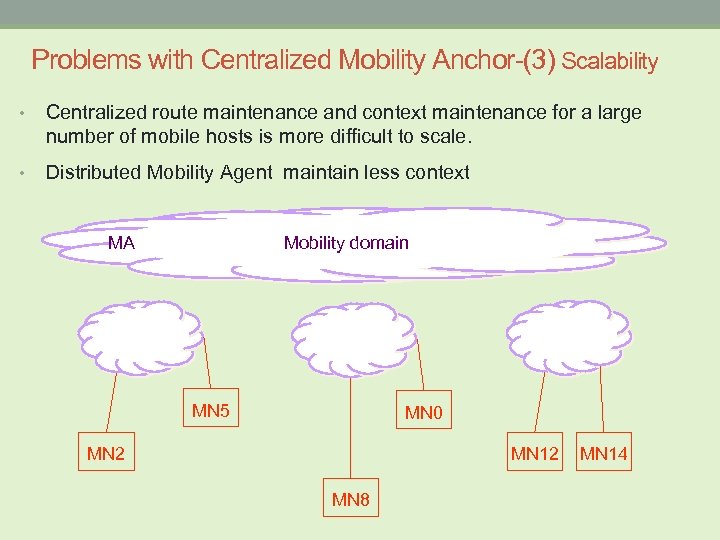
Problems with Centralized Mobility Anchor-(3) Scalability • Centralized route maintenance and context maintenance for a large number of mobile hosts is more difficult to scale. • Distributed Mobility Agent maintain less context MA Mobility domain MN 5 MN 0 MN 12 MN 8 MN 14
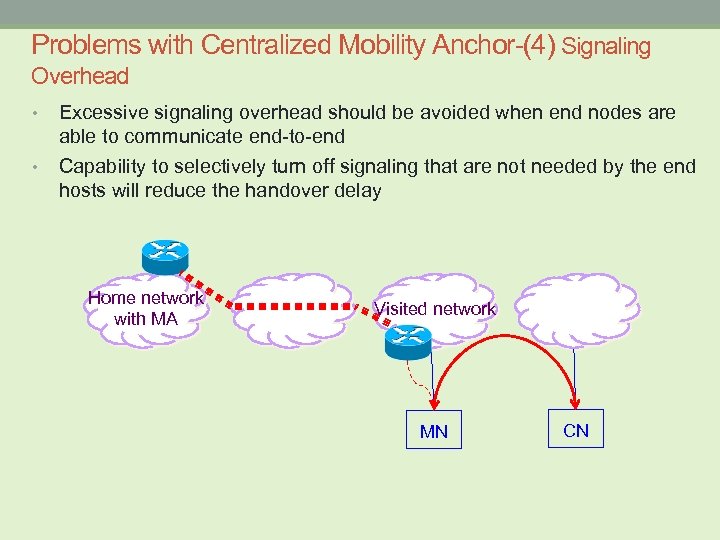
Problems with Centralized Mobility Anchor-(4) Signaling Overhead • Excessive signaling overhead should be avoided when end nodes are able to communicate end-to-end • Capability to selectively turn off signaling that are not needed by the end hosts will reduce the handover delay Home network with MA Visited network MN CN
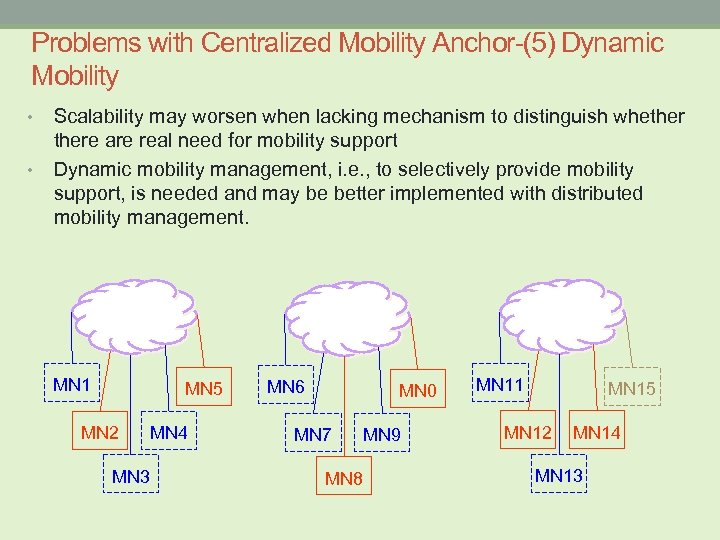
Problems with Centralized Mobility Anchor-(5) Dynamic Mobility • • Scalability may worsen when lacking mechanism to distinguish whethere are real need for mobility support Dynamic mobility management, i. e. , to selectively provide mobility support, is needed and may be better implemented with distributed mobility management. MN 1 MN 5 MN 2 MN 3 MN 4 MN 6 MN 0 MN 7 MN 8 MN 9 MN 11 MN 15 MN 12 MN 14 MN 13
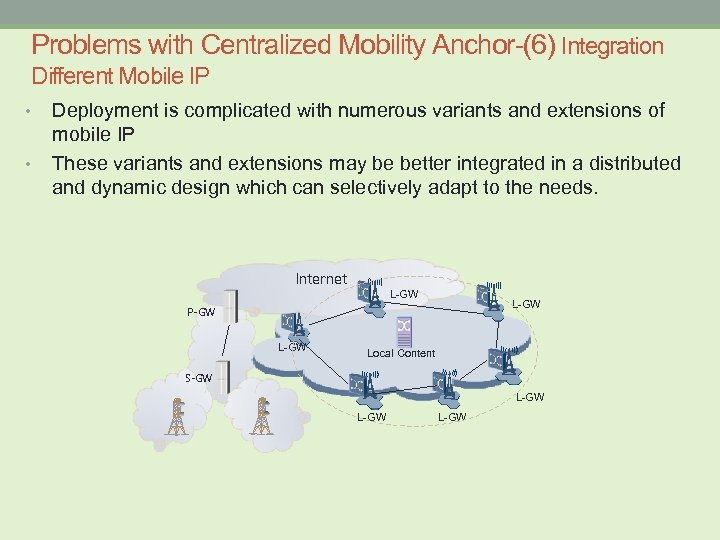
Problems with Centralized Mobility Anchor-(6) Integration Different Mobile IP • • Deployment is complicated with numerous variants and extensions of mobile IP These variants and extensions may be better integrated in a distributed and dynamic design which can selectively adapt to the needs. Internet L-GW P-GW Local Content S-GW L-GW
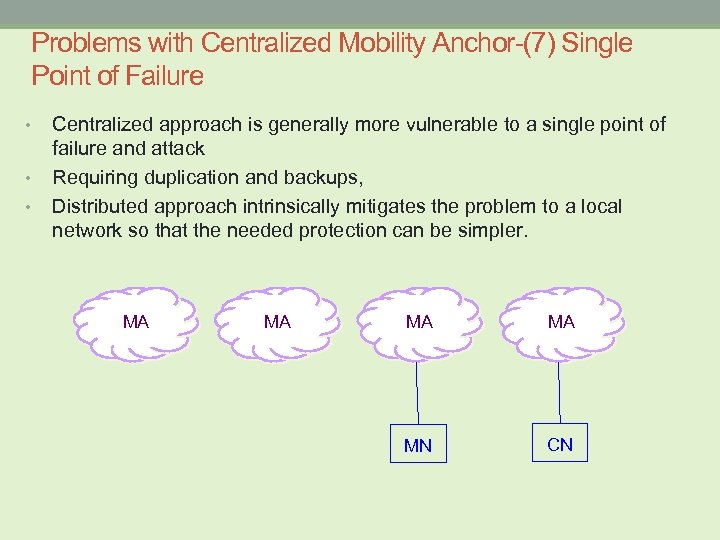
Problems with Centralized Mobility Anchor-(7) Single Point of Failure • • • Centralized approach is generally more vulnerable to a single point of failure and attack Requiring duplication and backups, Distributed approach intrinsically mitigates the problem to a local network so that the needed protection can be simpler. MA MA MN CN
Outline • Introduction of Distributed and Dynamic Mobility Management • Problem Statement of Dynamic Anchor • Problems with Centralized Mobility Anchor • Summary
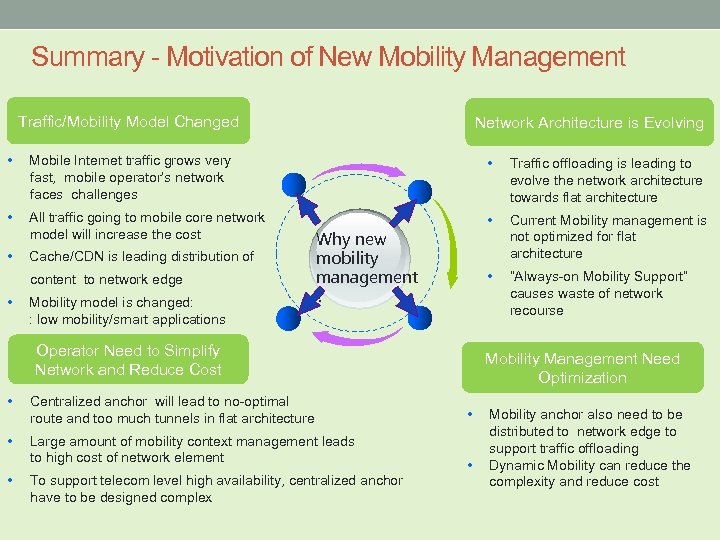
Summary - Motivation of New Mobility Management Traffic/Mobility Model Changed Network Architecture is Evolving • Mobile Internet traffic grows very fast, mobile operator’s network faces challenges • Traffic offloading is leading to evolve the network architecture towards flat architecture • All traffic going to mobile core network model will increase the cost • Current Mobility management is not optimized for flat architecture • “Always-on Mobility Support” causes waste of network recourse • Cache/CDN is leading distribution of content to network edge • Mobility model is changed: : low mobility/smart applications Why new mobility management ? Operator Need to Simplify Network and Reduce Cost • Centralized anchor will lead to no-optimal route and too much tunnels in flat architecture • Large amount of mobility context management leads to high cost of network element • To support telecom level high availability, centralized anchor have to be designed complex Mobility Management Need Optimization • • Mobility anchor also need to be distributed to network edge to support traffic offloading Dynamic Mobility can reduce the complexity and reduce cost
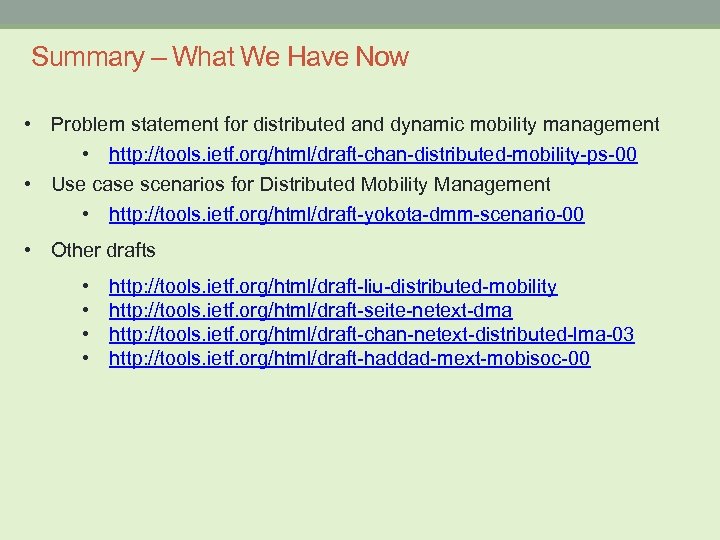
Summary – What We Have Now • Problem statement for distributed and dynamic mobility management • http: //tools. ietf. org/html/draft-chan-distributed-mobility-ps-00 • Use case scenarios for Distributed Mobility Management • http: //tools. ietf. org/html/draft-yokota-dmm-scenario-00 • Other drafts • • http: //tools. ietf. org/html/draft-liu-distributed-mobility http: //tools. ietf. org/html/draft-seite-netext-dma http: //tools. ietf. org/html/draft-chan-netext-distributed-lma-03 http: //tools. ietf. org/html/draft-haddad-mext-mobisoc-00
Other references • P. Bertin, S. Bonjour, and J-M Bonnin, “Distributed or Centralized Mobility? ” Proceedings of Global Communications Conference (Globe. Com 2009). • M. Fisher, F. U. Anderson, A. Kopsel, G. Schafer, and M. Schlager, “A Distributed IP Mobility Approach for 3 G SAE, ” 19 th International Symposium on Personal, Indoor and Mobile Radio Communications, (PIMRC 2008). • L. Zhang, R. Wakikawa, and Z. Zhu, “Support Mobility in the Global Internet, ” Proceedings of ACM Workshop on MICNET, Mobi. Com 2009, Beijing, China, 21 September 2009. • P. Bertin, S. Bonjour, and J-M Bonnin, “A Distributed Dynamic Mobility Management Scheme Designed for Flat IP Architectures, ” Proceedings of 3 rd International Conference on New Technologies, Mobility and Security, (NTMS 2008). • H. Anthony Chan, “Proxy Mobile IP with Distributed Mobility Anchors, ” GLOBECOM 2010 Workshop on Seamless Wireless Mobility, Miami, USA, 6 -10 December 2010. • H. Anthony Chan, “Integrating PMIP into LISP Network, ” draft-chan-lisp-pmip- 00. txt, October 2010.

Thanks! Q&A
Скачать презентацию DISTRIBUTED DYNAMIC MOBILITY MANAGEMENT DMM PROBLEM STATEMENT Dapeng Liu China
41a3901c31262df22a1c87bdec9f5f15.ppt