 Скачать презентацию Distributed Denial of Service Adapted from Vitaly Shmatikov
69589c8a73ec83939f519fb1f0cfa255.ppt
- Количество слайдов: 16



Distributed Denial of Service Adapted from Vitaly Shmatikov, UT Austin slide 1
Denial of Service (Do. S) Redux u. Goal: overwhelm victim machine and deny service to its legitimate clients u. Do. S often exploits networking protocols • Smurf: ICMP echo request to broadcast address with spoofed victim’s address as source • Ping of death: ICMP packets with payloads greater than 64 K crash older versions of Windows • SYN flood: “open TCP connection” request from a spoofed address • UDP flood: exhaust bandwidth by sending thousands of bogus UDP packets 2
Distributed Denial of Service (DDo. S) u. First, scan hundreds of thousands of computers on the Internet for known vulnerabilities u. Turn vulnerable computers into “zombies” • Exploit vulnerabilities to gain root access, install attack and communication tools, use them for further scans u. Form a distributed attack network from zombies • Choose a subset of compromised machines with desired network topology and characteristics u. Command zombies to stage a coordinated attack on the victim 3
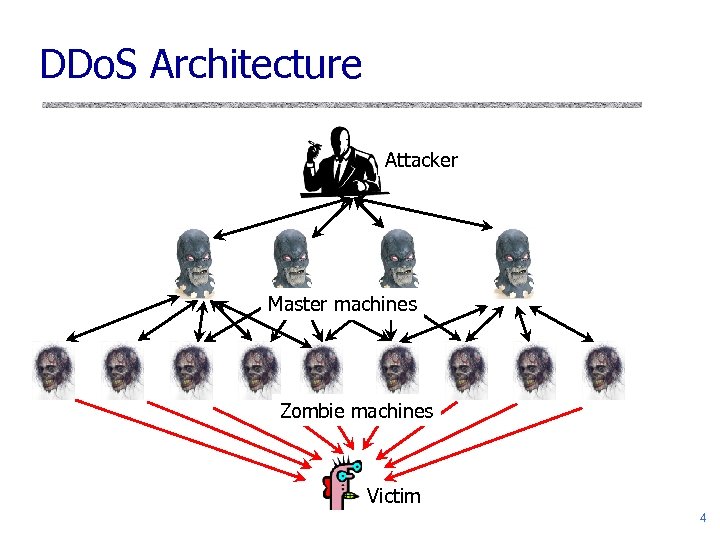
DDo. S Architecture Attacker Master machines Zombie machines Victim 4
DDo. S Tools: Trin 00 u. Scan for known buffer overflows in Linux & Solaris • Unpatched versions of wu-ftpd, statd, amd, … • Root shell on compromised host returns confirmation u. Install attack daemon using remote shell access u. Send commands (victim IP, attack parameters, etc. ), using plaintext passwords for authentication • Attacker to master: TCP, master to zombie: UDP • To avoid detection, daemon issues warning if someone connects when master is already authenticated u. In August of 1999, a network of 227 Trin 00 zombies took U. of Minnesota offline for 3 days 5
DDo. S Tools: Tribal Flood Network u. Supports multiple Do. S attack types • Smurf; ICMP, SYN, UDP floods u. Attacker runs masters directly via root backdoor; masters talk to zombies using ICMP echo reply • No authentication of master’s commands, but commands are encoded as 16 -bit binary numbers inside ICMP packets to prevent accidental triggering • Vulnerable to connection hijacking and RST sniping u. List of zombie daemons’ IP addresses is encrypted in later versions of TFN master scripts • Protects identities of zombies if master is discovered 6
DDo. S Tools: Stacheldraht u. Combines “best” features of Trin 00 and TFN • Multiple attack types (like TFN) u. Symmetric encryption for attacker-master connections u. Master daemons can be upgraded on demand u. February 2000: crippled Yahoo, e. Bay, Amazon, Schwab, E*Trade, CNN, Buy. com, ZDNet • Smurf-like attack on Yahoo consumed more than a Gigabit/sec of bandwidth • Sources of attack still unknown 7
U. of Toronto, 2004 (from David Lie’s slides) u. Date: Fri, 19 Mar 2004 u. Quote from email: “The campus switches have been bombarded with these packets […] and apparently 3 Com switches reset when they get these packets. This has caused the campus backbone to be up and down most of yesterday. The attack seems to start with connection attempts to port 1025 (Active Directory logon, which fails), then 6129 (Dame. Ware backdoor, which fails), then 80 (which works as the 3 Com’s support a web server, which can’t be disabled as far as we know). The HTTP command starts with ‘SEARCH /x 90x 02xb 1x 02’ […] then goes off into a continual pattern of ‘x 90’ ” 8
Defending Against DDo. S u. Authenticate packet sources • Not feasible with current IP (unless IPSec is used) u. Filter incoming traffic on access routers or ratelimit certain traffic types (ICMP and SYN packets) • Need to correctly measure normal rates first! u. Force clients to do an expensive computation or to prove that they are human • If connection requested, ask client to solve a “puzzle” – E. g. , invert a short hash value or solve a graphical Turing test • Honest clients can easily do this, but zombies can’t • Requires modification of TCP/IP stack (not feasible? ) 9
Finding Attack Sources u. Note: this will only locate zombies • Forensics on zombie machines can help find masters and the attacker who remotely controls them u. Can use existing IP routing infrastructure • Link testing (while attack is in progress) • Packet logging (for post-mortem path reconstruction) u…or propose changes to routing infrastructure • IP traceback (e. g. , via packet marking) • … and dozens of other proposals • Changing routing infrastructure is hard! 10
Link Testing u. Only works while attack is in progress u. Input debugging • Victim reports attack to upstream router • Router installs a filter for attack traffic, determines which upstream router originated it • Repeat upstream (requires inter-ISP cooperation) u. Controlled flooding • Iteratively flood each incoming link of the router; if attack traffic decreases, this must be the guilty link – Use a form of Do. S to throttle Do. S traffic (!!) • Need a good network map and router cooperation 11
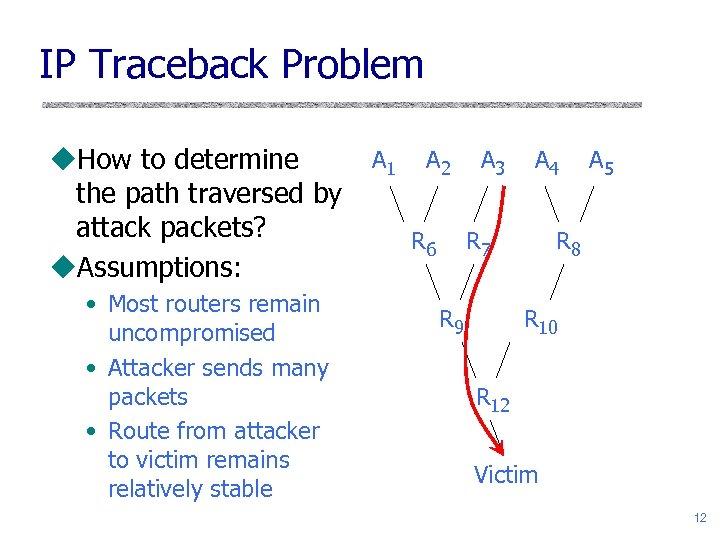
IP Traceback Problem u. How to determine the path traversed by attack packets? u. Assumptions: • Most routers remain uncompromised • Attacker sends many packets • Route from attacker to victim remains relatively stable A 1 A 2 R 6 A 3 A 4 R 7 R 9 A 5 R 8 R 10 R 12 Victim 12
Obvious Solution Doesn’t Work u. Obvious solution: have each router on the path add its IP address to packet; victim will read path from the packet u. Problem: requires space in the packet • Paths can be long • Current IP format provides no extra fields to store path information • Changes to packet format are not feasible 13
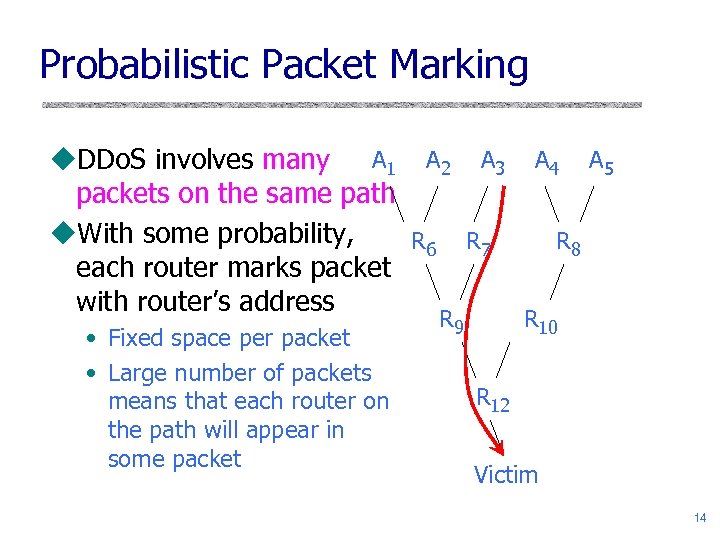
Probabilistic Packet Marking u. DDo. S involves many A 1 A 2 A 3 packets on the same path u. With some probability, R 6 R 7 each router marks packet with router’s address • Fixed space per packet • Large number of packets means that each router on the path will appear in some packet R 9 A 4 A 5 R 8 R 10 R 12 Victim 14
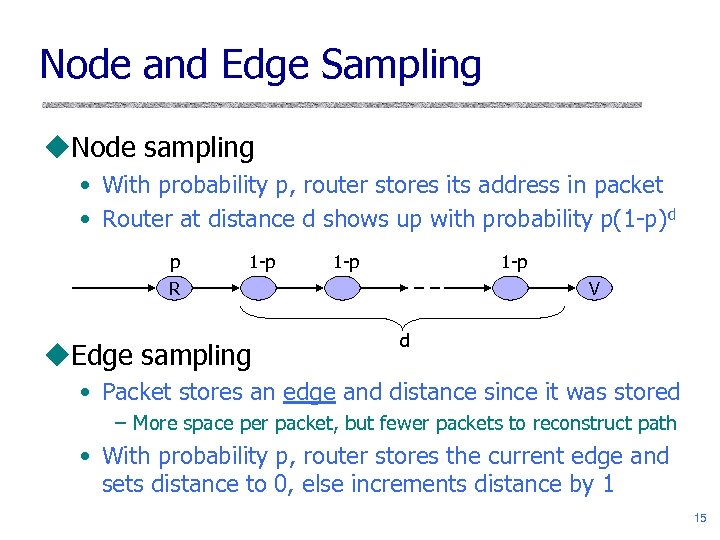
Node and Edge Sampling u. Node sampling • With probability p, router stores its address in packet • Router at distance d shows up with probability p(1 -p)d p 1 -p 1 -p R u. Edge sampling V d • Packet stores an edge and distance since it was stored – More space per packet, but fewer packets to reconstruct path • With probability p, router stores the current edge and sets distance to 0, else increments distance by 1 15
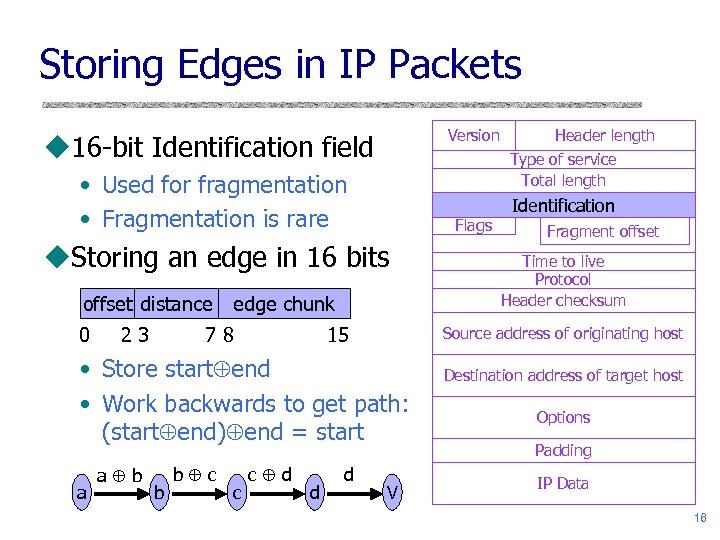
Storing Edges in IP Packets Version u 16 -bit Identification field • Used for fragmentation • Fragmentation is rare Flags u. Storing an edge in 16 bits offset distance 0 23 edge chunk 78 15 a b b c c c d d d Type of service Total length Identification Fragment offset Time to live Protocol Header checksum Source address of originating host • Store start end • Work backwards to get path: (start end) end = start a b Header length V Destination address of target host Options Padding IP Data 16
Скачать презентацию Distributed Denial of Service Adapted from Vitaly Shmatikov
69589c8a73ec83939f519fb1f0cfa255.ppt