


 Скачать презентацию Distance Learning Nursing Refresher Helping Nurses Reconnect with
839e94755a233e75c64655c9f9917c8d.ppt
- Количество слайдов: 26
 Distance Learning Nursing Refresher: Helping Nurses Reconnect with Healthcare! 2005 Regional Workshops
 Presentation Objectives n The need for nursing refresher courses n Refresher student profile n Components of a refresher course n Our Project’s purpose/goals n Current progress of the Project n Our Project deliverables
 The Problem (as of spring 2003) Nursing shortage is at a critical level n 65% of all hospital vacancies (AHA) n By 2008, another 450, 000 nurses may be needed in our country (CNN). n Texas - Projected need for 167, 580 RNs (26. 7% increase in a decade) and 70, 210 LVNs (increase of 17. 8%) by 2010 (TRC). n Austin - Estimated 12. 6% vacancy rate for RNs and a 9. 4% vacancy rate for LVNs in Central Texas; Austin needs 400 RNs (1/2003, HISC) n
 Where Have They Gone? n n n n Many are retiring (average working nurse is 45 years old, ANCC) Fewer entering nursing (31% decline in those taking the NCLEX-RN from 1995 -2002, AACN) Work conditions have worsened Some left to raise families Some left looking for “greener pastures” Inadequate capacity in nursing programs (U. S. nursing schools turned away 18, 105 qualified applicants in 2003, AACN) Nursing faculty shortage (median age of nurse faculty is 51. 2 years)
 One Solution n Re-entry nurses offer a quick way to get skilled nurses back in the clinical setting n TX Board of Nurse Examiners (BNE) – recommends that any nurse out of “professional nursing practice” for more than 4 years, take a “refresher” course
 Re-Entry Student Profile n Reinstate licensure (will need temporary permit) n Out of practice for more than 4 years, but has current license (referred by employer) n Required to obtain TX license (foreign or out-of-state) n Professional development (change of practice area)
 Barriers to Re-Entry Nurses Where available, courses are often full n Courses are not always available n Time – many have to continue working n Funding – can be an issue n Technology – need to catch up on current technology in practice n Fear – believe that they can’t catch up n Hospitals – some are hesitant to accept a reentry nurse for a clinical placement n
 Project Partners n Funding - two one-year Perkins grants from THECB (total $160, 000) n Development Group Austin Comm. College, Collin County Comm. College District, El Paso Comm. College, Midland College, North Harris College, Texas Hospital Association, and STARLINK
 Project Partners (continued) n Advisory Group – Angelina College, Houston Comm. College, Lee College, Mc. Lennan Comm. College, St. Philip’s College, San Antonio College, Tarrant County College – South, and University Health System – San Antonio n Guidance - Texas State Leadership Consortium for Curriculum Development
 Project Web Site http: //nurserefresher. austincc. edu Includes: § All project development information § Portal to Black. Board § Student information & forms § Preceptor information & forms § College information & forms
 Demo of Project Web Site http: //nurserefresher. austincc. edu
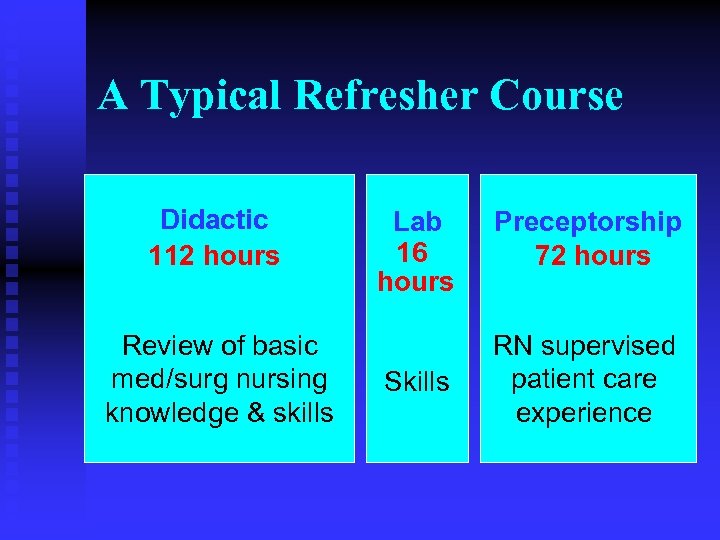 A Typical Refresher Course Didactic 112 hours Review of basic med/surg nursing knowledge & skills Lab 16 hours Preceptorship 72 hours Skills RN supervised patient care experience
 Project Goals (Year 1 – 2003 -2004) Provide a distance learning nursing refresher, delivered through the Virtual College of TX. n Develop a quality course that addresses the education needs of both the RN and LVN. n Develop flexible, effective and appropriate distance learning deliverables to make the nursing refresher course easily accessible. n Promote the use of the distance learning nursing refresher course through community colleges around the state of Texas. n
 Project Goals (Year 2 – 2004 -2005) Enhancement of current teaching units n Support for host/provider colleges (through regional information workshops) n Add medical Spanish unit and a student counseling/support module n Promotional activities including a second STARLINK broadcast n Maintenance of project web site n Packaging and marketing of stand-alone modules for remediation and CNE use n Research project to identify motivating factors in re-entry nurses n
 Features of the Program Colleges can choose to either “host” students through VCT or “provide” the complete course n All didactic self-paced content available online text, graphics, streaming video, exercises, testing, and support from Instructor n CD-ROM version of videos for those without high speed internet access n Host college will coordinate optional “skills lab” and required “preceptorship” n Technical support available for colleges n Self-sustaining after grant period n
 Program Design & Development n Surveyed all existing community college based refresher programs n Followed BNE and BVNE (now one entity) expectations for refresher content n Examined experience with ACC’s classroom based course n Involved Development and Advisory Group members in peer review of content
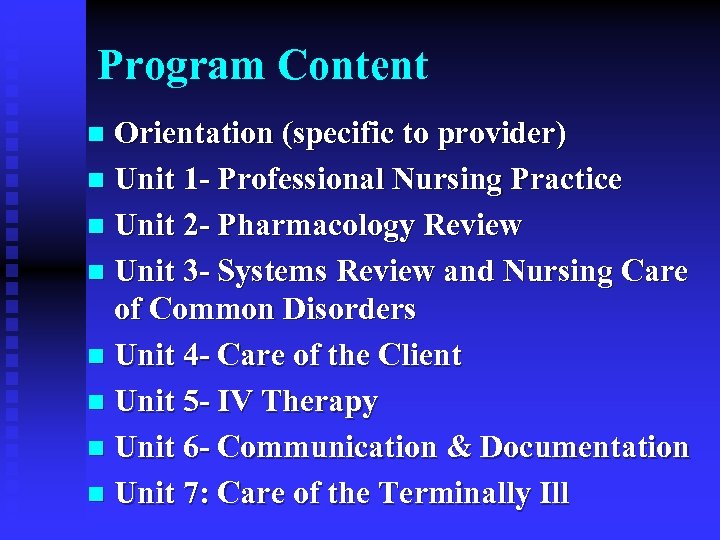 Program Content Orientation (specific to provider) n Unit 1 - Professional Nursing Practice n Unit 2 - Pharmacology Review n Unit 3 - Systems Review and Nursing Care of Common Disorders n Unit 4 - Care of the Client n Unit 5 - IV Therapy n Unit 6 - Communication & Documentation n Unit 7: Care of the Terminally Ill n
 Demo of Black. Board Course http: //itdl. austincc. edu/blackboard/ Depending on the course delivery system used (i. e. Web CT), the course layout may appear different from this demo.
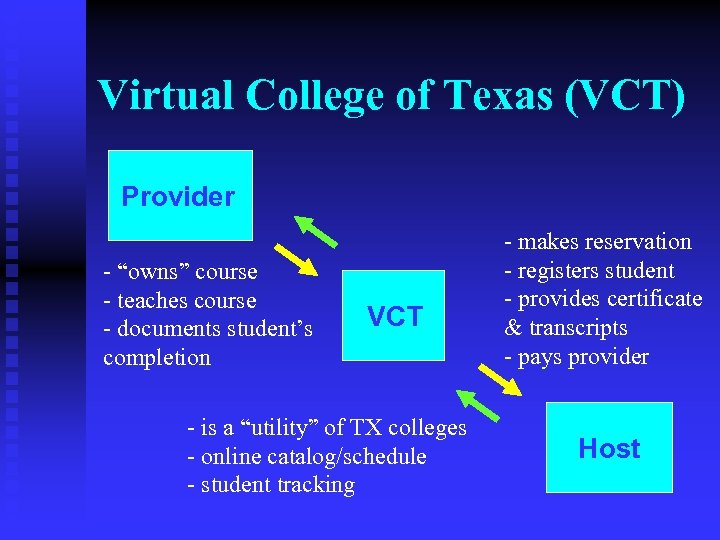 Virtual College of Texas (VCT) Provider - “owns” course - teaches course - documents student’s completion VCT - is a “utility” of TX colleges - online catalog/schedule - student tracking - makes reservation - registers student - provides certificate & transcripts - pays provider Host
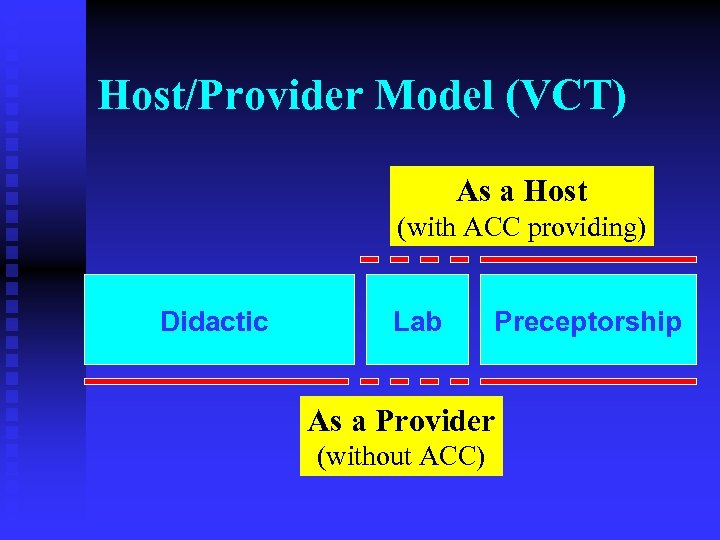 Host/Provider Model (VCT) As a Host (with ACC providing) Didactic Lab Preceptorship As a Provider (without ACC)
 Demo of VCT Web Site www. vct. org
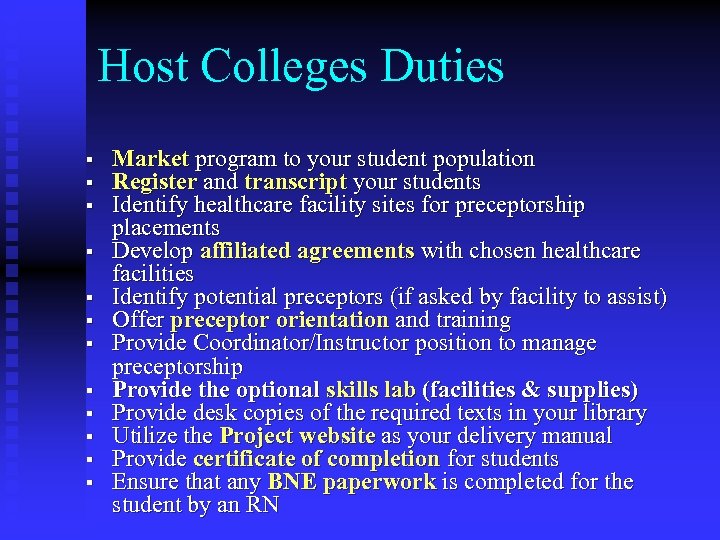 Host Colleges Duties § § § Market program to your student population Register and transcript your students Identify healthcare facility sites for preceptorship placements Develop affiliated agreements with chosen healthcare facilities Identify potential preceptors (if asked by facility to assist) Offer preceptor orientation and training Provide Coordinator/Instructor position to manage preceptorship Provide the optional skills lab (facilities & supplies) Provide desk copies of the required texts in your library Utilize the Project website as your delivery manual Provide certificate of completion for students Ensure that any BNE paperwork is completed for the student by an RN
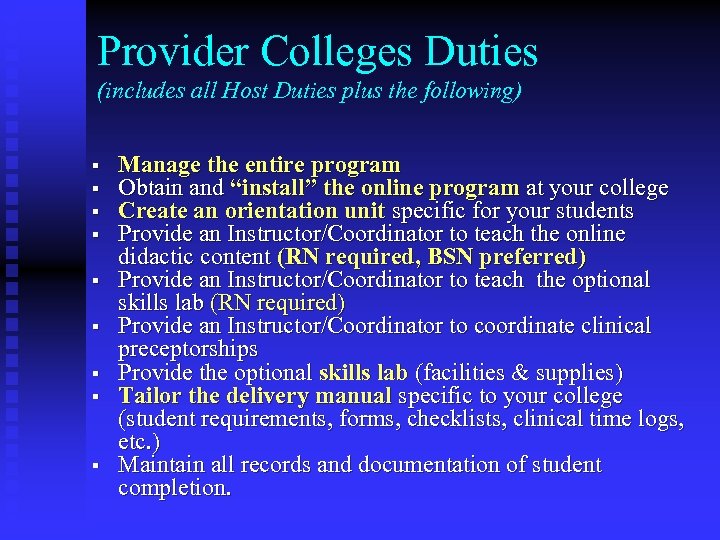 Provider Colleges Duties (includes all Host Duties plus the following) § § § § § Manage the entire program Obtain and “install” the online program at your college Create an orientation unit specific for your students Provide an Instructor/Coordinator to teach the online didactic content (RN required, BSN preferred) Provide an Instructor/Coordinator to teach the optional skills lab (RN required) Provide an Instructor/Coordinator to coordinate clinical preceptorships Provide the optional skills lab (facilities & supplies) Tailor the delivery manual specific to your college (student requirements, forms, checklists, clinical time logs, etc. ) Maintain all records and documentation of student completion.
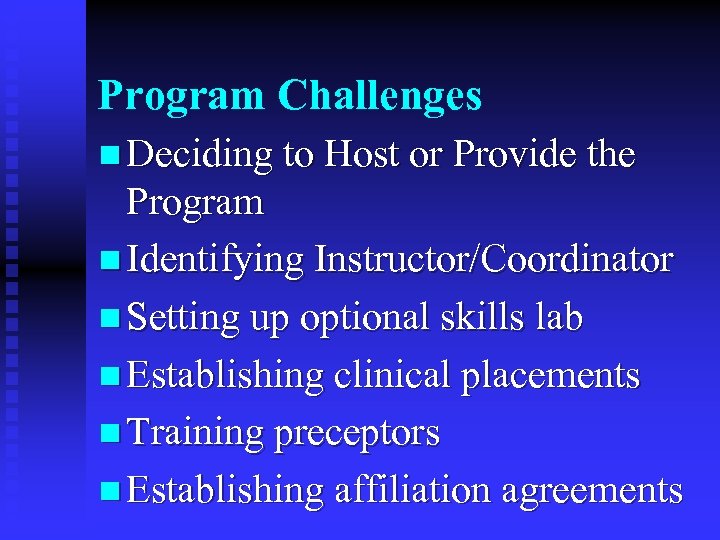 Program Challenges n Deciding to Host or Provide the Program n Identifying Instructor/Coordinator n Setting up optional skills lab n Establishing clinical placements n Training preceptors n Establishing affiliation agreements
 We would like to thank … n Texas Higher Education Coordinating Board / Perkins Funding n Texas State Leadership Consortium for Curriculum Development n Project Development & Advisory Group Members n Our 8 Pilot Students
 Project Contacts Kirk White, RN, MSN Executive Director ACC Workforce Development Center 512 -223 -7535, kwhite@austincc. edu